2026 春季新人教版九年级
Unit 2 单词
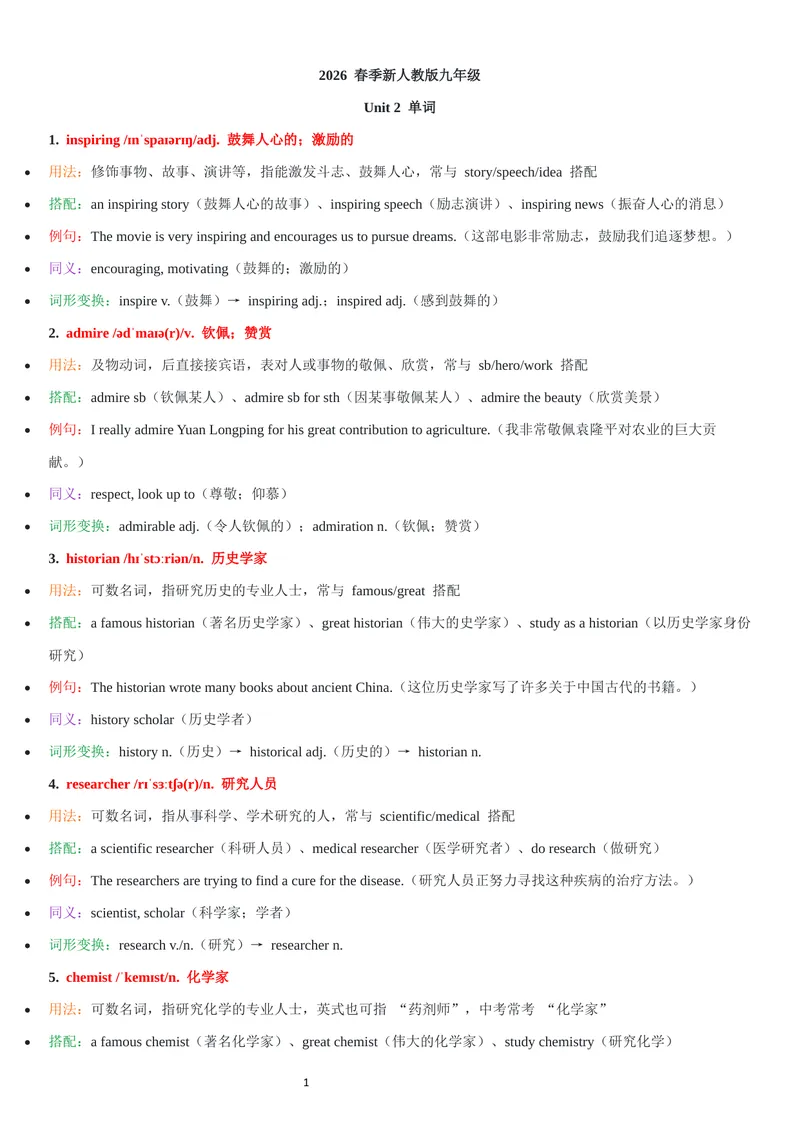
1. inspiring /ɪnˈspaɪərɪŋ/adj. 鼓舞人心的;激励的
用法:修饰事物、故事、演讲等,指能激发斗志、鼓舞人心,常与 story/speech/idea 搭配
搭配:an inspiring story(鼓舞人心的故事)、inspiring speech(励志演讲)、inspiring news(振奋人心的消息)
例句:The movie is very inspiring and encourages us to pursue dreams.(这部电影非常励志,鼓励我们追逐梦想。)
同义:encouraging, motivating(鼓舞的;激励的)
词形变换:inspire v.(鼓舞)→ inspiring adj.;inspired adj.(感到鼓舞的)
2. admire /ədˈmaɪə(r)/v. 钦佩;赞赏
用法:及物动词,后直接接宾语,表对人或事物的敬佩、欣赏,常与 sb/hero/work 搭配
搭配:admire sb(钦佩某人)、admire sb for sth(因某事敬佩某人)、admire the beauty(欣赏美景)
例句:I really admire Yuan Longping for his great contribution to agriculture.(我非常敬佩袁隆平对农业的巨大贡
献。)
同义:respect, look up to(尊敬;仰慕)
词形变换:admirable adj.(令人钦佩的);admiration n.(钦佩;赞赏)
3. historian /hɪˈstɔːriən/n. 历史学家
用法:可数名词,指研究历史的专业人士,常与 famous/great 搭配
搭配:a famous historian(著名历史学家)、great historian(伟大的史学家)、study as a historian(以历史学家身份
研究)
例句:The historian wrote many books about ancient China.(这位历史学家写了许多关于中国古代的书籍。)
同义:history scholar(历史学者)
词形变换:history n.(历史)→ historical adj.(历史的)→ historian n.
4. researcher /rɪˈsɜːtʃə(r)/n. 研究人员
用法:可数名词,指从事科学、学术研究的人,常与 scientific/medical 搭配
搭配:a scientific researcher(科研人员)、medical researcher(医学研究者)、do research(做研究)
例句:The researchers are trying to find a cure for the disease.(研究人员正努力寻找这种疾病的治疗方法。)
同义:scientist, scholar(科学家;学者)
词形变换:research v./n.(研究)→ researcher n.
5. chemist /ˈkemɪst/n. 化学家
用法:可数名词,指研究化学的专业人士,英式也可指 “药剂师”,中考常考 “化学家”
搭配:a famous chemist(著名化学家)、great chemist(伟大的化学家)、study chemistry(研究化学)
1 例句:Marie Curie was a great chemist and physicist.(玛丽 居里是一位伟大的化学家和物理学家。)
・
同义:chemical scientist(化学科学家)
词形变换:chemistry n.(化学)→ chemical adj.(化学的)→ chemist n.
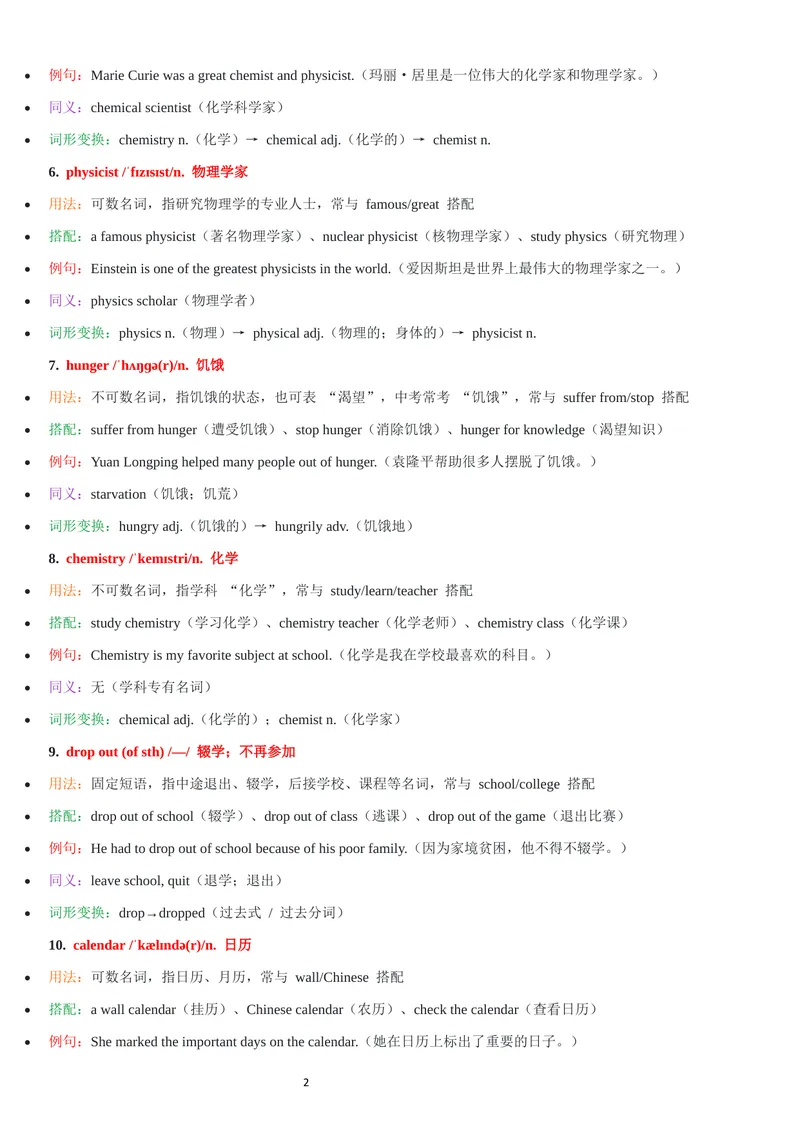
6. physicist /ˈfɪzɪsɪst/n. 物理学家
用法:可数名词,指研究物理学的专业人士,常与 famous/great 搭配
搭配:a famous physicist(著名物理学家)、nuclear physicist(核物理学家)、study physics(研究物理)
例句:Einstein is one of the greatest physicists in the world.(爱因斯坦是世界上最伟大的物理学家之一。)
同义:physics scholar(物理学者)
词形变换:physics n.(物理)→ physical adj.(物理的;身体的)→ physicist n.
7. hunger /ˈhʌŋɡə(r)/n. 饥饿
用法:不可数名词,指饥饿的状态,也可表 “渴望”,中考常考 “饥饿”,常与 suffer from/stop 搭配
搭配:suffer from hunger(遭受饥饿)、stop hunger(消除饥饿)、hunger for knowledge(渴望知识)
例句:Yuan Longping helped many people out of hunger.(袁隆平帮助很多人摆脱了饥饿。)
同义:starvation(饥饿;饥荒)
词形变换:hungry adj.(饥饿的)→ hungrily adv.(饥饿地)
8. chemistry /ˈkemɪstri/n. 化学
用法:不可数名词,指学科 “化学”,常与 study/learn/teacher 搭配
搭配:study chemistry(学习化学)、chemistry teacher(化学老师)、chemistry class(化学课)
例句:Chemistry is my favorite subject at school.(化学是我在学校最喜欢的科目。)
同义:无(学科专有名词)
词形变换:chemical adj.(化学的);chemist n.(化学家)
9. drop out (of sth) /—/ 辍学;不再参加
用法:固定短语,指中途退出、辍学,后接学校、课程等名词,常与 school/college 搭配
搭配:drop out of school(辍学)、drop out of class(逃课)、drop out of the game(退出比赛)
例句:He had to drop out of school because of his poor family.(因为家境贫困,他不得不辍学。)
同义:leave school, quit(退学;退出)
词形变换:drop→dropped(过去式 / 过去分词)
10. calendar /ˈkælɪndə(r)/n. 日历
用法:可数名词,指日历、月历,常与 wall/Chinese 搭配
搭配:a wall calendar(挂历)、Chinese calendar(农历)、check the calendar(查看日历)
例句:She marked the important days on the calendar.(她在日历上标出了重要的日子。)
2 同义:date book(日程本)
词形变换:复数 calendars
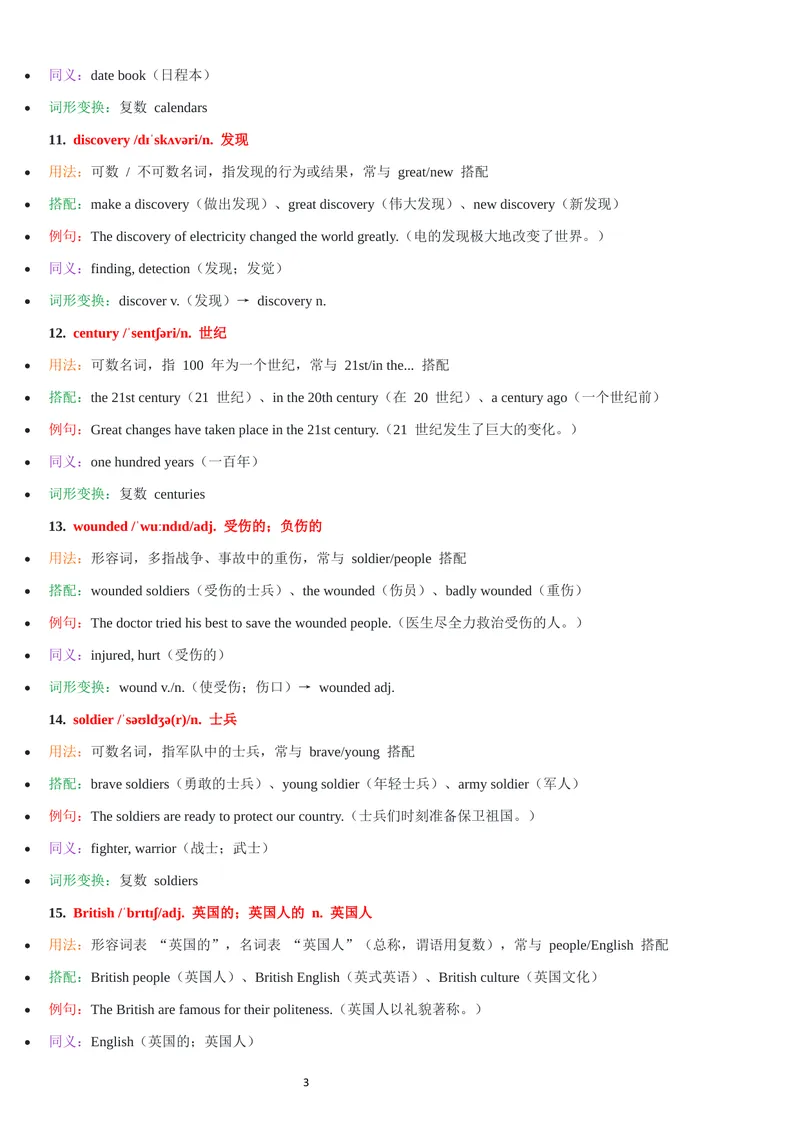
11. discovery /dɪˈskʌvəri/n. 发现
用法:可数 / 不可数名词,指发现的行为或结果,常与 great/new 搭配
搭配:make a discovery(做出发现)、great discovery(伟大发现)、new discovery(新发现)
例句:The discovery of electricity changed the world greatly.(电的发现极大地改变了世界。)
同义:finding, detection(发现;发觉)
词形变换:discover v.(发现)→ discovery n.
12. century /ˈsentʃəri/n. 世纪
用法:可数名词,指 100 年为一个世纪,常与 21st/in the... 搭配
搭配:the 21st century(21 世纪)、in the 20th century(在 20 世纪)、a century ago(一个世纪前)
例句:Great changes have taken place in the 21st century.(21 世纪发生了巨大的变化。)
同义:one hundred years(一百年)
词形变换:复数 centuries
13. wounded /ˈwuːndɪd/adj. 受伤的;负伤的
用法:形容词,多指战争、事故中的重伤,常与 soldier/people 搭配
搭配:wounded soldiers(受伤的士兵)、the wounded(伤员)、badly wounded(重伤)
例句:The doctor tried his best to save the wounded people.(医生尽全力救治受伤的人。)
同义:injured, hurt(受伤的)
词形变换:wound v./n.(使受伤;伤口)→ wounded adj.
14. soldier /ˈsəʊldʒə(r)/n. 士兵
用法:可数名词,指军队中的士兵,常与 brave/young 搭配
搭配:brave soldiers(勇敢的士兵)、young soldier(年轻士兵)、army soldier(军人)
例句:The soldiers are ready to protect our country.(士兵们时刻准备保卫祖国。)
同义:fighter, warrior(战士;武士)
词形变换:复数 soldiers
15. British /ˈbrɪtɪʃ/adj. 英国的;英国人的 n. 英国人
用法:形容词表 “英国的”,名词表 “英国人”(总称,谓语用复数),常与 people/English 搭配
搭配:British people(英国人)、British English(英式英语)、British culture(英国文化)
例句:The British are famous for their politeness.(英国人以礼貌著称。)
同义:English(英国的;英国人)
3 词形变换:Britain n.(英国)→ British adj./n.
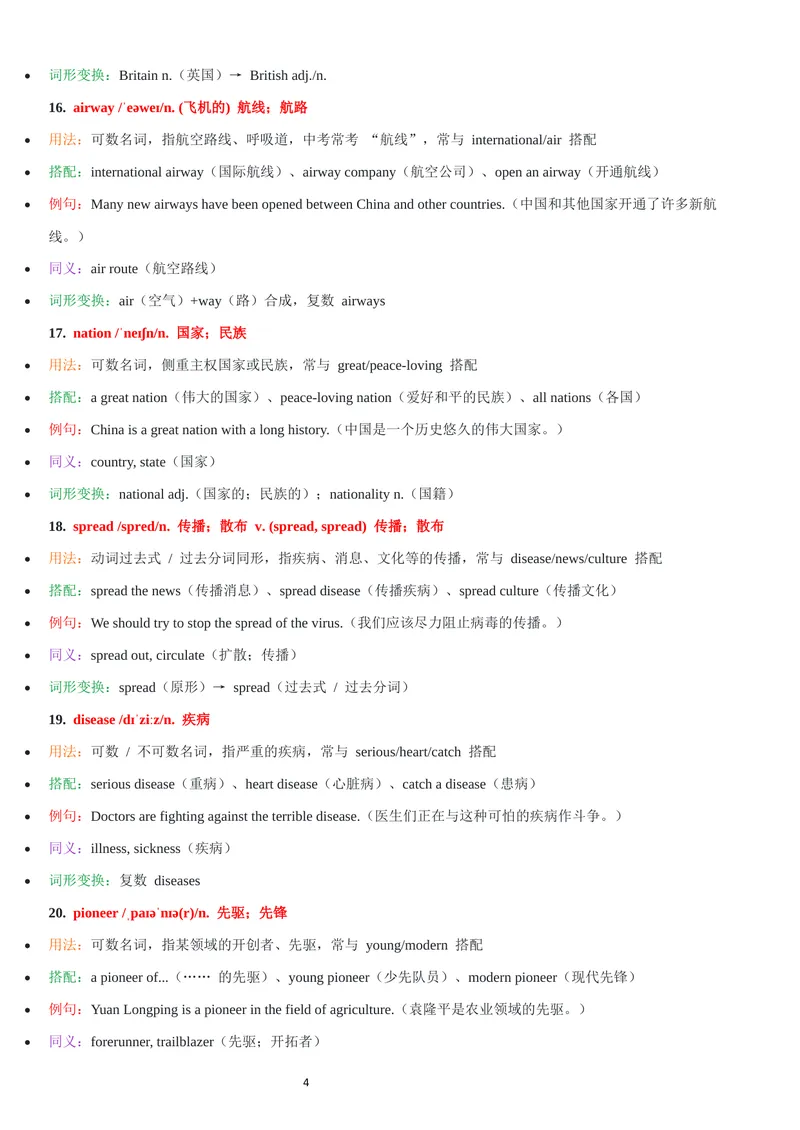
16. airway /ˈeəweɪ/n. (飞机的) 航线;航路
用法:可数名词,指航空路线、呼吸道,中考常考 “航线”,常与 international/air 搭配
搭配:international airway(国际航线)、airway company(航空公司)、open an airway(开通航线)
例句:Many new airways have been opened between China and other countries.(中国和其他国家开通了许多新航
线。)
同义:air route(航空路线)
词形变换:air(空气)+way(路)合成,复数 airways
17. nation /ˈneɪʃn/n. 国家;民族
用法:可数名词,侧重主权国家或民族,常与 great/peace-loving 搭配
搭配:a great nation(伟大的国家)、peace-loving nation(爱好和平的民族)、all nations(各国)
例句:China is a great nation with a long history.(中国是一个历史悠久的伟大国家。)
同义:country, state(国家)
词形变换:national adj.(国家的;民族的);nationality n.(国籍)
18. spread /spred/n. 传播;散布 v. (spread, spread) 传播;散布
用法:动词过去式 / 过去分词同形,指疾病、消息、文化等的传播,常与 disease/news/culture 搭配
搭配:spread the news(传播消息)、spread disease(传播疾病)、spread culture(传播文化)
例句:We should try to stop the spread of the virus.(我们应该尽力阻止病毒的传播。)
同义:spread out, circulate(扩散;传播)
词形变换:spread(原形)→ spread(过去式 / 过去分词)
19. disease /dɪˈziːz/n. 疾病
用法:可数 / 不可数名词,指严重的疾病,常与 serious/heart/catch 搭配
搭配:serious disease(重病)、heart disease(心脏病)、catch a disease(患病)
例句:Doctors are fighting against the terrible disease.(医生们正在与这种可怕的疾病作斗争。)
同义:illness, sickness(疾病)
词形变换:复数 diseases
20. pioneer /ˌpaɪəˈnɪə(r)/n. 先驱;先锋
用法:可数名词,指某领域的开创者、先驱,常与 young/modern 搭配
搭配:a pioneer of...(…… 的先驱)、young pioneer(少先队员)、modern pioneer(现代先锋)
例句:Yuan Longping is a pioneer in the field of agriculture.(袁隆平是农业领域的先驱。)
同义:forerunner, trailblazer(先驱;开拓者)
4 词形变换:复数 pioneers
21. admirable /ˈædmərəbl/adj. 令人钦佩的
用法:形容词,修饰人或行为,指值得敬佩、赞赏,常与 action/quality 搭配
搭配:admirable action(令人钦佩的行为)、admirable quality(优秀品质)、truly admirable(真正令人敬佩)
例句:His courage and kindness are really admirable.(他的勇气和善良真的令人钦佩。)
同义:praiseworthy, respectable(值得赞扬的;可敬的)
词形变换:admire v.(钦佩)→ admirable adj.;admiration n.(钦佩)
22. pyramid /ˈpɪrəmɪd/n. 金字塔
用法:可数名词,指埃及金字塔,也可指 “棱锥体”,中考常考专有含义
搭配:the Pyramids(金字塔)、Egyptian pyramid(埃及金字塔)、ancient pyramid(古代金字塔)
例句:The Pyramids in Egypt are one of the greatest wonders in the world.(埃及金字塔是世界上最伟大的奇迹之
一。)
同义:无(专有名词)
词形变换:复数 pyramids
23. balance /ˈbæləns/n. 平衡 v. 保持平衡
用法:名词表 “平衡”,动词表 “使平衡”,常与 keep/lose/work-life 搭配
搭配:keep balance(保持平衡)、lose balance(失去平衡)、work-life balance(工作生活平衡)
例句:It’s important for us to keep a balance between study and rest.(保持学习和休息的平衡对我们很重要。)
同义:stability(稳定);steady(使稳定)
词形变换:balanced adj.(平衡的)
24. courage /ˈkʌrɪdʒ/n. 勇气;勇敢
用法:不可数名词,指面对困难的勇气,常与 have/gather/brave 搭配
搭配:have courage(有勇气)、gather courage(鼓起勇气)、moral courage(道德勇气)
例句:She had the courage to speak in front of the whole class.(她有勇气在全班面前发言。)
同义:bravery, boldness(勇敢;无畏)
词形变换:courageous adj.(勇敢的);encourage v.(鼓励)
25. wisdom /ˈwɪzdəm/n. 智慧;学问
用法:不可数名词,指经验、知识带来的智慧,常与 ancient/great 搭配
搭配:ancient wisdom(古老智慧)、great wisdom(大智慧)、learn wisdom(学习智慧)
例句:We can learn much wisdom from old stories.(我们可以从古老的故事中学到很多智慧。)
同义:knowledge, insight(知识;洞察力)
5 词形变换:wise adj.(明智的)→ wisely adv.(明智地)
26. look up to sb /—/ 钦佩;仰慕
用法:固定短语,指尊敬、仰慕某人,主语为人,常与 hero/star/teacher 搭配
搭配:look up to heroes(仰慕英雄)、look up to teachers(尊敬老师)、look up to great people(仰慕伟人)
例句:All the students look up to their hard-working teacher.(所有学生都敬佩他们勤奋的老师。)
同义:admire, respect(钦佩;尊敬)
词形变换:无(短语本身无词形变化)
27. inspiration /ˌɪnspəˈreɪʃn/n. 鼓舞人心的人 (或事物)
用法:可数 / 不可数名词,指灵感、鼓舞人心的人 / 事,常与 get/give 搭配
搭配:get inspiration(获得灵感)、give sb inspiration(给某人鼓舞)、a great inspiration(巨大鼓舞)
例句:Her story is a great inspiration to all of us.(她的故事对我们所有人都是巨大的鼓舞。)
同义:encouragement, motivation(鼓舞;动力)
词形变换:inspire v.(鼓舞)→ inspiring adj.(鼓舞人心的)→ inspiration n.
28. brave /breɪv/adj. 勇敢的;无畏的 v. 勇敢面对;经受 (困难)
用法:形容词修饰人,指勇敢无畏;动词指勇敢面对困难,常与 man/danger 搭配
搭配:a brave boy(勇敢的男孩)、brave danger(勇敢面对危险)、brave difficulties(直面困难)
例句:He is brave enough to save the little girl from the fire.(他足够勇敢,从火中救出了小女孩。)
同义:courageous, fearless(勇敢的;无畏的)
词形变换:bravery n.(勇敢);bravely adv.(勇敢地)
29. necessary /ˈnesəsəri/adj. 必要的;必需的
用法:形容词,常用句型 It’s necessary for sb to do sth,常与 for/condition 搭配
搭配:it’s necessary to do(做某事有必要)、necessary condition(必要条件)、if necessary(如果有必要)
例句:It’s necessary for us to learn English well.(学好英语对我们来说是必要的。)
同义:essential, required(必要的;必需的)
词形变换:necessarily adv.(必要地);unnecessary adj.(不必要的)
30. seed /siːd/n. 种子
用法:可数 / 不可数名词,指植物种子,也可比喻 “根源”,常与 plant/grow 搭配
搭配:plant seeds(播种)、grow from seeds(从种子生长)、seed of hope(希望的种子)
例句:The seeds will grow into big trees in spring.(种子在春天会长成大树。)
同义:grain, kernel(谷粒;籽)
词形变换:复数 seeds
631. childhood /ˈtʃaɪldhʊd/n. 童年
用法:不可数名词,指儿童时期,常与 happy/hard/spend 搭配
搭配:happy childhood(快乐的童年)、hard childhood(艰苦的童年)、spend one’s childhood(度过童年)
例句:He spent his childhood in a small village.(他在一个小村庄度过了童年。)
同义:early years(早年)
词形变换:child n.(孩子)→ childhood n.
32. come true /—/ 实现;成为现实
用法:固定短语,主语为梦想、愿望等抽象名词,无被动语态,常与 dream/plan/wish 搭配
搭配:dream come true(梦想成真)、wish come true(愿望实现)、hope come true(希望实现)
例句:His dream of becoming a doctor finally came true.(他成为医生的梦想终于实现了。)
同义:realize, achieve(实现)
词形变换:come→came→come(过去式 / 过去分词)
33. dynasty /ˈdɪnəsti; ˈdaɪnəsti/n. 朝代;王朝
用法:可数名词,指古代王朝、朝代,常与 ancient/Chinese 搭配
搭配:Chinese dynasty(中国朝代)、ancient dynasty(古代王朝)、Tang Dynasty(唐朝)
例句:The Tang Dynasty was a very strong dynasty in Chinese history.(唐朝是中国历史上非常强盛的朝代。)
同义:kingdom, empire(王国;帝国)
词形变换:复数 dynasties
34. western /ˈwestən/adj. 西方的;西部的
用法:形容词,指地理上的西部或文化上的西方,常与 countries/culture 搭配
搭配:western countries(西方国家)、western culture(西方文化)、western food(西餐)
例句:Western festivals are becoming more and more popular in China.(西方节日在中国越来越受欢迎。)
同义:Occidental(西方的,正式)
词形变换:west n.(西方)→ western adj.
35. scientific /ˌsaɪənˈtɪfɪk/adj. 科学 (上) 的
用法:形容词,修饰研究、方法、实验等,指科学的、符合科学的
搭配:scientific research(科学研究)、scientific method(科学方法)、scientific experiment(科学实验)
例句:We should use scientific ways to solve problems.(我们应该用科学的方法解决问题。)
同义:technical, rational(技术的;理性的)
词形变换:science n.(科学)→ scientist n.(科学家)→ scientific adj.
36. biologist /baɪˈɒlədʒɪst/n. 生物学家
7 用法:可数名词,指研究生物学的专业人士,常与 famous/great 搭配
搭配:a famous biologist(著名生物学家)、study biology(研究生物)、wildlife biologist(野生生物学家)
例句:The biologist studies the living habits of animals.(这位生物学家研究动物的生活习性。)
同义:biology scholar(生物学者)
词形变换:biology n.(生物)→ biological adj.(生物的)→ biologist n.
37. whole /həʊl/adj. 所有的;完全的
用法:形容词,修饰名词,表 “整个的、全部的”,常与 the/life/day 搭配
搭配:the whole world(全世界)、whole life(一生)、whole day(一整天)
例句:She spent the whole day reading books at home.(她在家读了一整天书。)
同义:entire, total(整个的;全部的)
词形变换:无(本身为形容词)
38. bank /bæŋk/n. 银行
用法:可数名词,指银行,也可指 “河岸”,中考常考 “银行”,常与 money/account 搭配
搭配:go to the bank(去银行)、bank account(银行账户)、save money in the bank(把钱存银行)
例句:My mother works in a bank as a clerk.(我妈妈在一家银行做职员。)
同义:financial institution(金融机构)
词形变换:复数 banks
39. forever /fərˈevə(r)/adv. 永远
用法:副词,表时间永久,常与 live/remember/love 搭配
搭配:live forever(永生)、remember forever(永远铭记)、love forever(永远相爱)
例句:We will remember the great people forever.(我们将永远铭记这些伟人。)
同义:always, eternally(永远;永恒地)
词形变换:无(本身为副词)
40. radio /ˈreɪdiəʊ/n. 无线电;收音机
用法:可数 / 不可数名词,指收音机、无线电,常与 listen to/on 搭配
搭配:listen to the radio(听收音机)、on the radio(通过广播)、radio station(电台)
例句:My grandfather likes listening to the radio every morning.(我爷爷喜欢每天早上听收音机。)
同义:wireless(无线电)
词形变换:复数 radios
41. leave behind /—/ 留下;遗留
用法:固定短语,指留下某物、遗留某事,也可指 “把…… 抛在后面”,常与 thing/memory 搭配
8 搭配:leave behind things(留下东西)、leave behind memories(留下回忆)、leave behind problems(遗留问题)
例句:The great man left behind many valuable works.(这位伟人留下了许多珍贵的作品。)
同义:remain, leave over(留下;遗留)
词形变换:leave→left→left(过去式 / 过去分词)
42. collection /kəˈlekʃn/n. 收集物;收藏品
用法:可数名词,指收集的物品、收藏品,常与 book/stamp/art 搭配
搭配:a stamp collection(集邮)、book collection(藏书)、art collection(艺术收藏品)
例句:He has a large collection of old coins.(他收藏了大量的古钱币。)
同义:assortment, gathering(收集品;聚集物)
词形变换:collect v.(收集)→ collection n.
43. live on /—/ 继续存在;继续活着
用法:固定短语,指人 / 精神 / 传统继续存在、流传,也可指 “以…… 为食”,中考常考 “继续存在”
搭配:live on forever(永垂不朽)、live on in history(名垂青史)、live on rice(以米饭为主食)
例句:The spirit of the hero will live on forever.(这位英雄的精神将永垂不朽。)
同义:continue to exist, survive(继续存在;幸存)
词形变换:live→lived→lived(过去式 / 过去分词)
44. exploration /ˌekspləˈreɪʃn/n. 探索
用法:不可数名词,指对未知事物的探索、探究,常与 space/scientific 搭配
搭配:space exploration(太空探索)、scientific exploration(科学探索)、exploration of nature(探索自然)
例句:Space exploration helps us know more about the universe.(太空探索帮助我们更多地了解宇宙。)
同义:search, investigation(探索;调查)
词形变换:explore v.(探索)→ exploration n.
45. universe /ˈjuːnɪvɜːs/n. 宇宙
用法:可数名词(常用单数),指天地万物、宇宙,常与 the/whole 搭配
搭配:the whole universe(整个宇宙)、in the universe(在宇宙中)、explore the universe(探索宇宙)
例句:There are countless stars in the universe.(宇宙中有无数的星星。)
同义:cosmos(宇宙,正式)
词形变换:universal adj.(普遍的;宇宙的)
46. socialism /ˈsəʊʃəlɪzəm/n. 社会主义
用法:不可数名词,指社会制度 “社会主义”,专有名词
搭配:build socialism(建设社会主义)、socialist country(社会主义国家)
9 例句:China is developing socialism with Chinese characteristics.(中国正在发展中国特色社会主义。)
同义:无(专有名词)
词形变换:socialist adj./n.(社会主义的;社会主义者)
47. hole /həʊl/n. 洞;孔
用法:可数名词,指物体上的洞、孔,常与 small/big/dig 搭配
搭配:a small hole(小洞)、dig a hole(挖洞)、hole in the wall(墙上的洞)
例句:There is a hole in my trousers.(我的裤子上有个洞。)
同义:cavity, opening(洞;开口)
词形变换:复数 holes
48. daughter /ˈdɔːtə(r)/n. 女儿
用法:可数名词,指父母的女性子女,常与 only/young 搭配
搭配:only daughter(独生女)、young daughter(小女儿)、love one’s daughter(爱女儿)
例句:Marie Curie’s daughter also became a famous scientist.(玛丽 居里的女儿也成为了一名著名的科学家。)
・
同义:girl child(女孩)
词形变换:复数 daughters
49. herself /hɜːˈself; həˈself/pron. 她自己;她本人
用法:反身代词,指代女性主语,常与 by/help/enjoy 搭配
搭配:by herself(独自)、help herself(自便)、enjoy herself(玩得开心)
例句:She finished the work all by herself.(她独自完成了这项工作。)
同义:无(反身代词)
词形变换:she(主格)→ her(宾格 / 形容词性物主代词)→ herself(反身代词)
50. flight /flaɪt/n. 飞行;航班
用法:可数名词,指空中飞行、航班,常与 first/take/air 搭配
搭配:take a flight(乘航班)、first flight(首次飞行)、air flight(空中航班)
例句:The first flight into space was a great success.(首次太空飞行取得了巨大成功。)
同义:air travel, flying(航空旅行;飞行)
词形变换:fly v.(飞)→ flight n.
51. woodwork /ˈwʊdwɜːk/n. 木工手艺
用法:不可数名词,指木工活、木制品,常与 do/learn 搭配
搭配:do woodwork(做木工活)、learn woodwork(学习木工手艺)、woodwork tools(木工工具)
例句:He is good at woodwork and can make beautiful furniture.(他擅长木工,能做出漂亮的家具。)
10 同义:carpentry(木工手艺)
词形变换:wood n.(木头)+work n.(工作)合成
52. inventor /ɪnˈventə(r)/n. 发明家
用法:可数名词,指发明创造的人,常与 great/famous 搭配
搭配:a great inventor(伟大的发明家)、famous inventor(著名发明家)、invent things(发明东西)
例句:Edison was one of the greatest inventors in the world.(爱迪生是世界上最伟大的发明家之一。)
同义:creator, maker(创造者;制造者)
词形变换:invent v.(发明)→ invention n.(发明)→ inventor n.
53. above all /—/ 最重要的是;尤其是
用法:固定短语,用于句首 / 句中,表强调,突出最重要的一点
搭配:above all, ...(最重要的是……)、love, above all(尤其爱)
例句:Above all, we should keep healthy in our daily life.(最重要的是,我们在日常生活中要保持健康。)
同义:most importantly, especially(最重要的是;尤其)
词形变换:无(短语本身无词形变化)
54. thinker /ˈθɪŋkə(r)/n. 思想家
用法:可数名词,指有思想、善于思考的人,常与 great/famous 搭配
搭配:a great thinker(伟大的思想家)、famous thinker(著名思想家)、ancient thinker(古代思想家)
例句:Confucius is a great thinker in Chinese history.(孔子是中国历史上伟大的思想家。)
同义:philosopher(哲学家)
词形变换:think v.(思考)→ thinker n.
55. period /ˈpɪəriəd/n. 时期;一段时间
用法:可数名词,指一段时期、时代,常与 long/short/history 搭配
搭配:a long period(很长一段时间)、history period(历史时期)、period of time(时间段)
例句:He lived in France for a period of time.(他在法国住过一段时间。)
同义:time, era(时间;时代)
词形变换:复数 periods
56. kingdom /ˈkɪŋdəm/n. 王国
用法:可数名词,指君主统治的王国,也可指 “领域”,常与 animal/plant 搭配
搭配:animal kingdom(动物王国)、plant kingdom(植物王国)、ancient kingdom(古代王国)
例句:The old king ruled his kingdom wisely.(老国王明智地统治他的王国。)
同义:realm, domain(领域;王国)
11 词形变换:king n.(国王)+dom(后缀)合成
57. kindness /ˈkaɪndnəs/n. 善良;仁慈
用法:不可数名词,指善良的品质,常与 show/act of 搭配
搭配:show kindness(表现善良)、act of kindness(善举)、kindness to others(对他人的善意)
例句:Her kindness to the poor moved many people.(她对穷人的善良感动了很多人。)
同义:goodness, benevolence(善良;仁慈)
词形变换:kind adj.(善良的)→ kindly adv.(亲切地)
58. whether /ˈweðə(r)/conj. 是否
用法:连词,引导宾语从句 / 主语从句,常与 or not 搭配,可与 if 互换(句首 / 介词后只能用 whether)
搭配:whether...or not(是否)、whether to do(是否做)、whether...or(是…… 还是……)
例句:I don’t know whether he will come to the party.(我不知道他是否会来参加派对。)
同义:if(是否,口语 / 从句中)
词形变换:无(连词)
59. mankind /mænˈkaɪnd/n. 人类
用法:集合名词,表 “人类”(总称),谓语用单数,常与 all/for 搭配
搭配:all mankind(全人类)、for mankind(为了人类)、mankind’s progress(人类的进步)
例句:Yuan Longping’s work has benefited all mankind.(袁隆平的工作造福了全人类。)
同义:human beings, humanity(人类)
词形变换:man(人)+kind(种类)合成
60. wet /wet/adj. 湿的;潮湿的
用法:用于形容物体表面、天气或身体状态潮湿,常与 “clothes”“ground”“weather” 等词搭配
搭配:wet clothes(湿衣服)、wet ground(潮湿的地面)、get wet(淋湿 / 弄湿)
例句:Don't touch the wet wall, it's dangerous.(不要摸那面潮湿的墙,很危险。)
同义:damp, moist(潮湿的)
词形变换:wetter (比较级);wettest (最高级)
61. dead /ded/adj. 死的;无生命的
用法:指生物死亡或完全没有活力的状态,常与 “animal”“tree”“phone” 等词搭配
搭配:dead animal(死动物)、dead phone(没电的手机)、be dead(死亡)
例句:The tree has been dead for two years.(这棵树已经死了两年了。)
同义:deceased, lifeless(死的;无生命的)
词形变换:die v. (死) → death n. (死亡)
1262. wide /waɪd/adj. 宽的;广泛的
用法:形容物体宽度大或范围广,可修饰道路、眼睛、兴趣等,常与 “road”“eyes” 搭配
搭配:wide road(宽阔的马路)、open your eyes wide(睁大眼睛)、wide interest(广泛的兴趣)
例句:She has a wide circle of friends.(她有广泛的社交圈。)
同义:broad, spacious(宽的;广阔的)
词形变换:widely adv. (广泛地)
63. widely /ˈwaɪdli/adv. 广泛地;普遍地
用法:用于修饰动词,表示传播、分布或为人所知的范围很广,常与 “use”“spread”“know” 搭配
搭配:widely used(广泛使用)、widely known(众所周知)、spread widely(广泛传播)
例句:English is widely used in the world.(英语在世界上被广泛使用。)
同义:generally, extensively(广泛地;普遍地)
词形变换:wide adj. → widely adv.
64. high /haɪ/adj. 高的;高级的
用法:形容物体垂直高度高,也可指程度、水平高,常与 “mountain”“price”“grade” 搭配
搭配:high mountain(高山)、high price(高价)、high grade(高等级)
例句:The bird is flying high in the sky.(鸟在高空中飞翔。)
同义:tall, tall (指人 / 树);top (指等级)(高的)
词形变换:higher (比较级);highest (最高级)
65. weight /weɪt/n. 重量;体重
用法:不可数名词,指物体的重量或人的体重,常与 gain/lose/measure 搭配
搭配:gain weight(增重)、lose weight(减肥)、the weight of…(…… 的重量)
例句:She is trying to lose weight by doing exercise every day.(她正通过每天锻炼来减肥。)
同义:heaviness(重量)
词形变换:weigh v.(称重);weighty adj.(沉重的)
66. weigh /weɪ/v. 称…… 的重量;权衡
用法:及物动词,指测量重量,也可指在做决定前思考利弊,常与 scale/options 搭配
搭配:weigh the fruit(称水果)、weigh the advantages and disadvantages(权衡利弊)
例句:Please weigh the flour before making the cake.(做蛋糕前请称好面粉。)
同义:measure(测量);consider(权衡)
词形变换:weight n.(重量);weighed(过去式 / 过去分词)
67. fit /fɪt/adj. 健康的;合适的 v. 适合;合身
13 用法:形容词指身体健康或物品合适;动词指大小、形状或性质符合,常与 clothes/health 搭配
搭配:keep fit(保持健康)、fit in(适应;融入)、fit sb well(很适合某人)
例句:This pair of shoes fits me perfectly.(这双鞋我穿着非常合脚。)
同义:suitable(合适的);healthy(健康的)
词形变换:fitness n.(健康;适合);fitter(比较级)
68. fitness /ˈfɪtnəs/n. 健康;适合
用法:不可数名词,指身体状况良好或适合某项工作 / 任务的状态,常与 physical/improve 搭配
搭配:physical fitness(身体健康)、improve fitness(提升体质)、fitness center(健身中心)
例句:Regular sports can improve our physical fitness.(规律运动能提升我们的身体素质。)
同义:health(健康);suitability(适合)
词形变换:fit adj.(健康的;合适的)
69. terrible /ˈterəbl/adj. 可怕的;糟糕的
用法:形容词,形容事物极其糟糕、令人不快或恐惧,常与 weather/news/experience 搭配
搭配:terrible weather(糟糕的天气)、terrible news(可怕的消息)、a terrible accident(严重事故)
例句:I had a terrible headache yesterday and couldn’t go to school.(我昨天头疼得厉害,没法去上学。)
同义:awful, horrible(可怕的;糟糕的)
词形变换:terribly adv.(非常;可怕地)
70. terribly /ˈterəbli/adv. 非常;可怕地
用法:程度副词,修饰形容词或动词,表示程度深,口语中常表示 “非常”
搭配:terribly sorry(非常抱歉)、terribly cold(冷得要命)、terribly hurt(伤得很重)
例句:I am terribly sorry for keeping you waiting so long.(让你等了这么久,我非常抱歉。)
同义:very, extremely(非常;极度地)
词形变换:terrible adj.(可怕的;糟糕的)
71. comfortable /ˈkʌmftəbl/adj. 舒适的;舒服的
用法:形容词,形容身体或心理感觉安逸、无压力,常与 seat/shoe/feel 搭配
搭配:comfortable seat(舒适的座位)、comfortable bed(舒服的床)、feel comfortable(感到舒适)
例句:The sofa is so comfortable that I can fall asleep quickly.(这张沙发太舒服了,我很快就能睡着。)
同义:cozy, pleasant(舒适的)
词形变换:comfortably adv.(舒适地);uncomfortable adj.(不舒服的)
72. uncomfortable /ʌnˈkʌmftəbl/adj. 不舒服的
用法:形容词,指身体或心理上感到不自在、不适,是 comfortable 的反义词
14 搭配:uncomfortable chair(不舒服的椅子)、feel uncomfortable(感到不适)、uncomfortable situation(尴尬的处
境)
例句:The new shoes are a bit uncomfortable at first.(这双新鞋刚穿时有点不舒服。)
同义:uneasy, awkward(不舒服的;尴尬的)
词形变换:un-(否定前缀)+ comfortable;uncomfortably adv.(不舒服地)
73. possible /ˈpɒsəbl/adj. 可能的
用法:形容词,指某事可以发生、存在或做到,常用句型 It is possible (for sb) to do sth
搭配:as soon as possible(尽可能快)、possible solution(可能的解决办法)、if possible(如果可能的话)
例句:It is possible to finish the homework before 9 o’clock.(在 9 点前完成作业是可能的。)
同义:likely, feasible(可能的)
词形变换:possibly adv.(可能地);impossible adj.(不可能的)
74. impossible /ɪmˈpɒsəbl/adj. 不可能的
用法:形容词,指某事无法发生、实现或做到,是 possible 的反义词
搭配:impossible task(不可能的任务)、nothing is impossible(一切皆有可能)、impossible to do(做…… 是不
可能的)
例句:It is impossible to live without water for a week.(一周不喝水是不可能生存的。)
同义:unachievable, out of the question(不可能的)
词形变换:im-(否定前缀)+ possible;impossibly adv.(不可能地)
75. possibly /ˈpɒsəbli/adv. 可能地;也许
用法:副词,用于修饰动词或句子,表示某事有发生的可能性,常用于疑问句或否定句加强语气
搭配:possibly right(也许是对的)、can’t possibly(绝不可能)、possibly help(可能帮忙)
例句:Could you possibly lend me your pen for a moment?(你能把笔借我用一下吗?)
同义:maybe, perhaps(可能地;也许)
词形变换:possible adj.(可能的)
76. mankind /mænˈkaɪnd/n. 人类
用法:集合名词,表 “人类”(总称),谓语用单数,常与 all/for/progress 搭配
搭配:all mankind(全人类)、for the good of mankind(为了人类的利益)、mankind’s progress(人类的进步)
例句:Yuan Longping’s work has benefited all mankind.(袁隆平的工作造福了全人类。)
同义:human beings, humanity(人类)
词形变换:man(人)+ kind(种类)合成
15