Unit 6 Do you like bananas?
Section B (1a-1e)
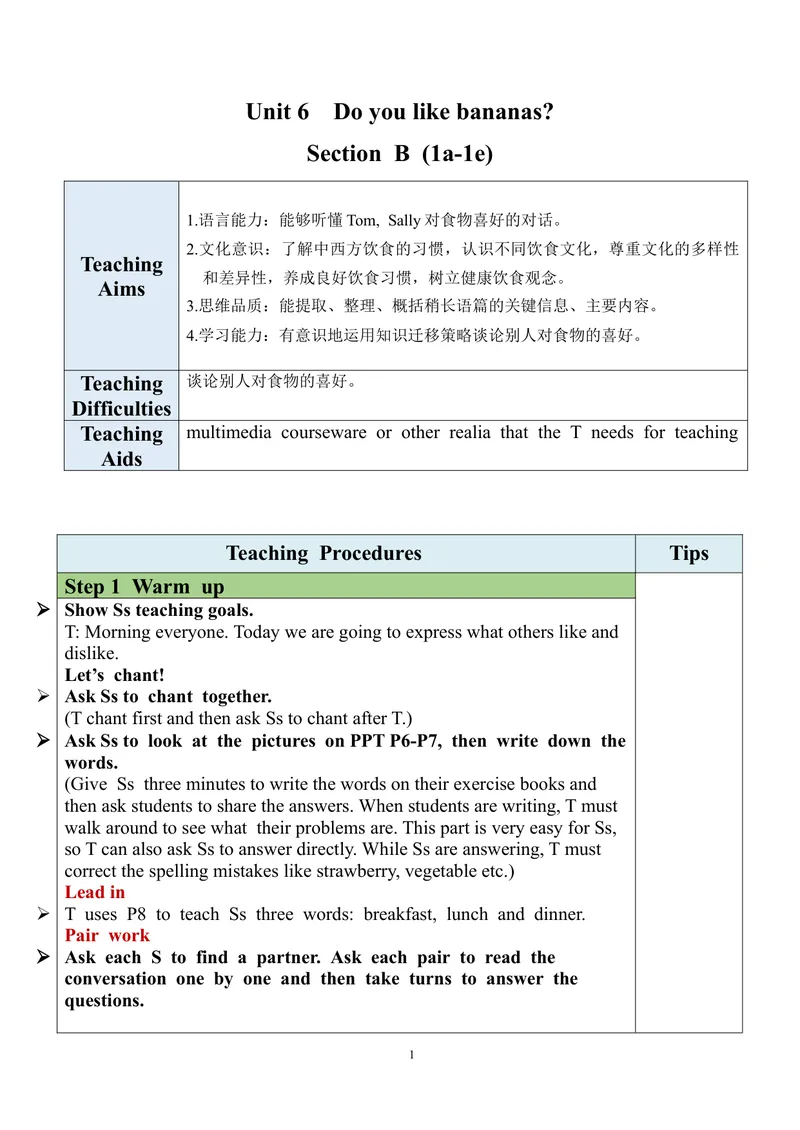
1.语言能力:能够听懂Tom, Sally对食物喜好的对话。
2.文化意识:了解中西方饮食的习惯,认识不同饮食文化,尊重文化的多样性
Teaching
和差异性,养成良好饮食习惯,树立健康饮食观念。
Aims
3.思维品质:能提取、整理、概括稍长语篇的关键信息、主要内容。
4.学习能力:有意识地运用知识迁移策略谈论别人对食物的喜好。
Teaching 谈论别人对食物的喜好。
Difficulties
Teaching multimedia courseware or other realia that the T needs for teaching
Aids
Teaching Procedures Tips
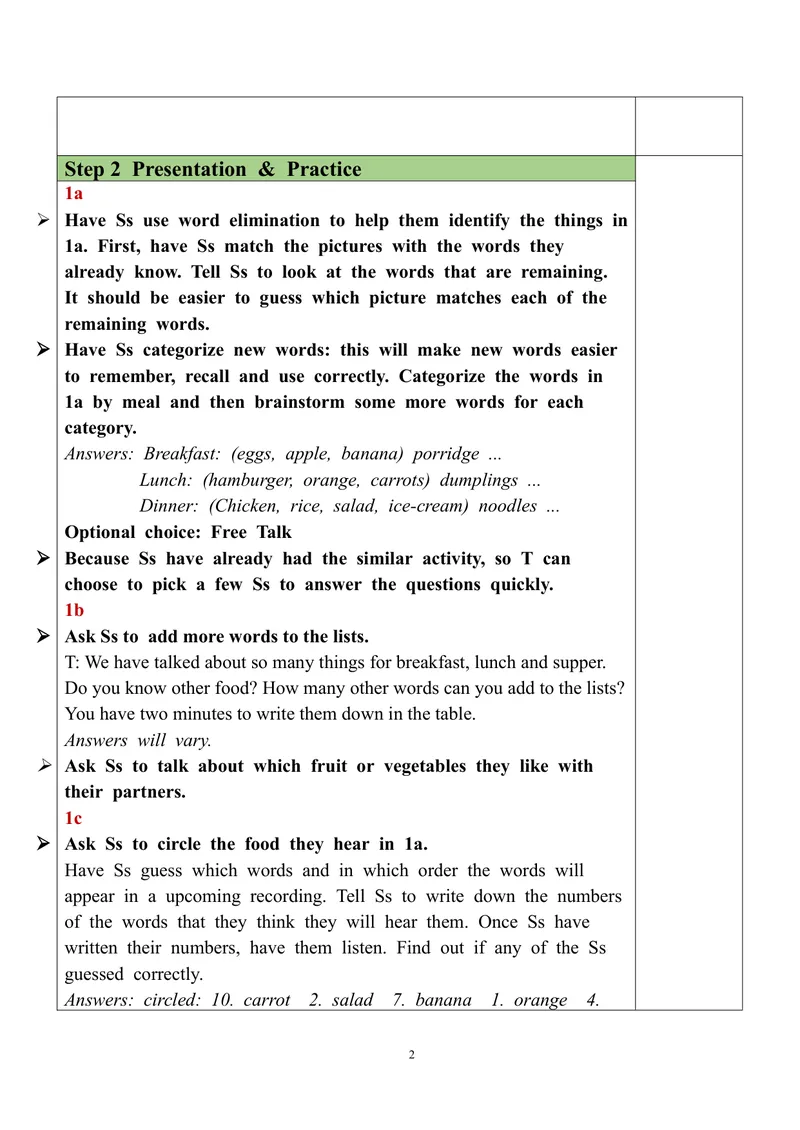
Step 1 Warm up
Show Ss teaching goals.
T: Morning everyone. Today we are going to express what others like and
dislike.
Let’s chant!
Ask Ss to chant together.
(T chant first and then ask Ss to chant after T.)
Ask Ss to look at the pictures on PPT P6-P7, then write down the
words.
(Give Ss three minutes to write the words on their exercise books and
then ask students to share the answers. When students are writing, T must
walk around to see what their problems are. This part is very easy for Ss,
so T can also ask Ss to answer directly. While Ss are answering, T must
correct the spelling mistakes like strawberry, vegetable etc.)
Lead in
T uses P8 to teach Ss three words: breakfast, lunch and dinner.
Pair work
Ask each S to find a partner. Ask each pair to read the
conversation one by one and then take turns to answer the
questions.
1Step 2 Presentation & Practice
1a
Have Ss use word elimination to help them identify the things in
1a. First, have Ss match the pictures with the words they
already know. Tell Ss to look at the words that are remaining.
It should be easier to guess which picture matches each of the
remaining words.
Have Ss categorize new words: this will make new words easier
to remember, recall and use correctly. Categorize the words in
1a by meal and then brainstorm some more words for each
category.
Answers: Breakfast: (eggs, apple, banana) porridge ...
Lunch: (hamburger, orange, carrots) dumplings ...
Dinner: (Chicken, rice, salad, ice-cream) noodles ...
Optional choice: Free Talk
Because Ss have already had the similar activity, so T can
choose to pick a few Ss to answer the questions quickly.
1b
Ask Ss to add more words to the lists.
T: We have talked about so many things for breakfast, lunch and supper.
Do you know other food? How many other words can you add to the lists?
You have two minutes to write them down in the table.
Answers will vary.
Ask Ss to talk about which fruit or vegetables they like with
their partners.
1c
Ask Ss to circle the food they hear in 1a.
Have Ss guess which words and in which order the words will
appear in a upcoming recording. Tell Ss to write down the numbers
of the words that they think they will hear them. Once Ss have
written their numbers, have them listen. Find out if any of the Ss
guessed correctly.
Answers: circled: 10. carrot 2. salad 7. banana 1. orange 4.
2apple 5. ice-cream
1d
Ask Ss to listen again. Fill in the chart.
It may help Ss if T plays the recording sentence by sentence. Stop
the recording after each sentence and ask questions about the
meaning of the sentence. If Ss cannot understand a sentence, T may
choose to write the sentence on the board and explain it in more
detail.
Answers: Tom likes: carrots, vegetables (including salad)
Tom doesn’t like: apples
Sally likes: salad, fruit (including bananas, oranges, apples), ice-
cream
Sally doesn’t like: vegetables (except for salad)
Ask Ss to listen for the third time and complete the conversation.
Answers: carrots, vegetables, How about, great, But, fruit, bananas,
really, Ice-cream
(After Ss listen to the conversation and finish the task, T asks them to
read the listening scripts by themselves.)
Post-listening
1e
Ask Ss to answer questions about what Sally and Tom like and don’t
like.
Ask Ss to do a survey in groups about what their group members like
and don’t like.
( T encourages Ss to use the following sentences to ask and answer
questions: What do you like for breakfast / lunch / dinner? For breakfast /
lunch / dinner, I like ________, but I don’t like __________. Then Ss
collect the ideas of all the group members and share together. When Ss are
sharing, the sentence patterns are as follows: In my group, for breakfast,
Sally likes … but she doesn’t like…)
Step 3 Exercises & Homework
Exercises
Ask Ss to do the exercises on PPT P22-P24.
T asks Ss to make a summary about language points they learned
today.
Homework
3 Preview the passage in Section B 2b.
Do the exercises in students’ book.
Through various activities, students have a full practice of the sentence
Teaching patterns: What do you like for breakfast / lunch / dinner? For breakfast /
Reflection lunch / dinner, I like ________, but I don’t like __________. The survey
makes the class interesting and vivid for students.
4