文档文本内容
Unit 2 This is my sister.
Section B(1a-1d)
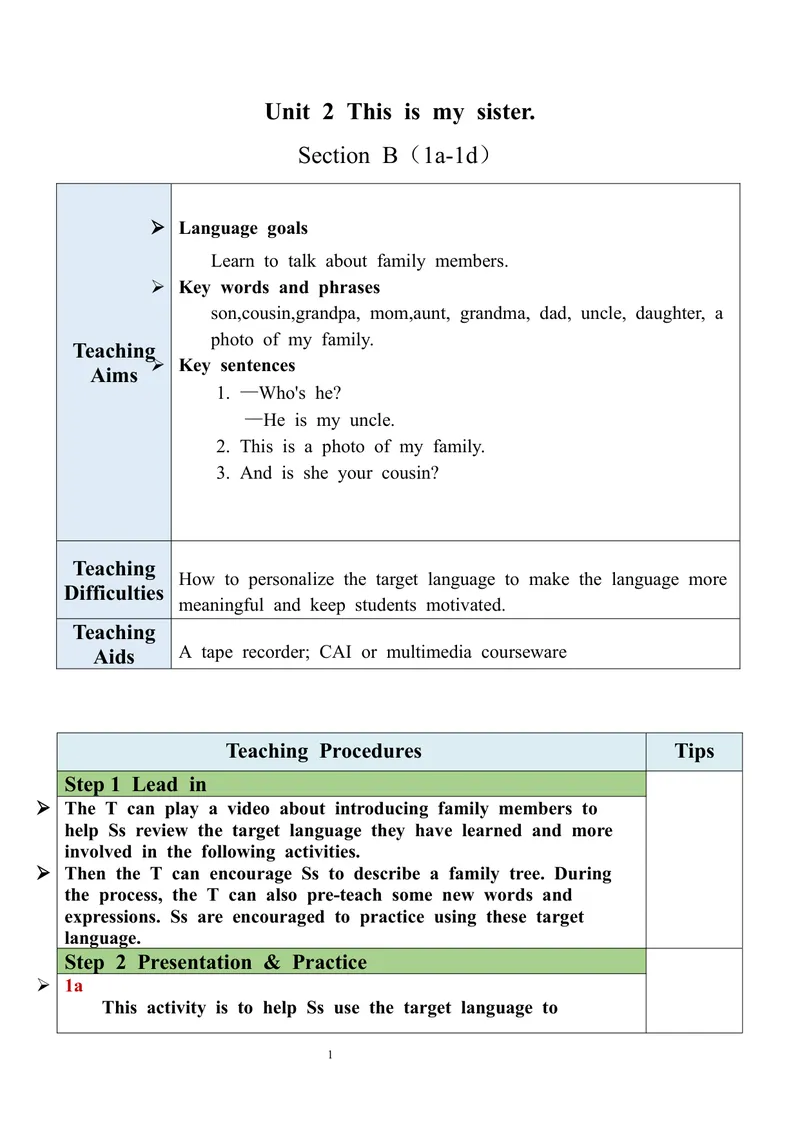
Language goals
Learn to talk about family members.
Key words and phrases
son,cousin,grandpa, mom,aunt, grandma, dad, uncle, daughter, a
photo of my family.
Teaching
Key sentences
Aims
1. —Who's he?
—He is my uncle.
2. This is a photo of my family.
3. And is she your cousin?
Teaching
How to personalize the target language to make the language more
Difficulties
meaningful and keep students motivated.
Teaching
Aids A tape recorder; CAI or multimedia courseware
Teaching Procedures Tips
Step 1 Lead in
The T can play a video about introducing family members to
help Ss review the target language they have learned and more
involved in the following activities.
Then the T can encourage Ss to describe a family tree. During
the process, the T can also pre-teach some new words and
expressions. Ss are encouraged to practice using these target
language.
Step 2 Presentation & Practice
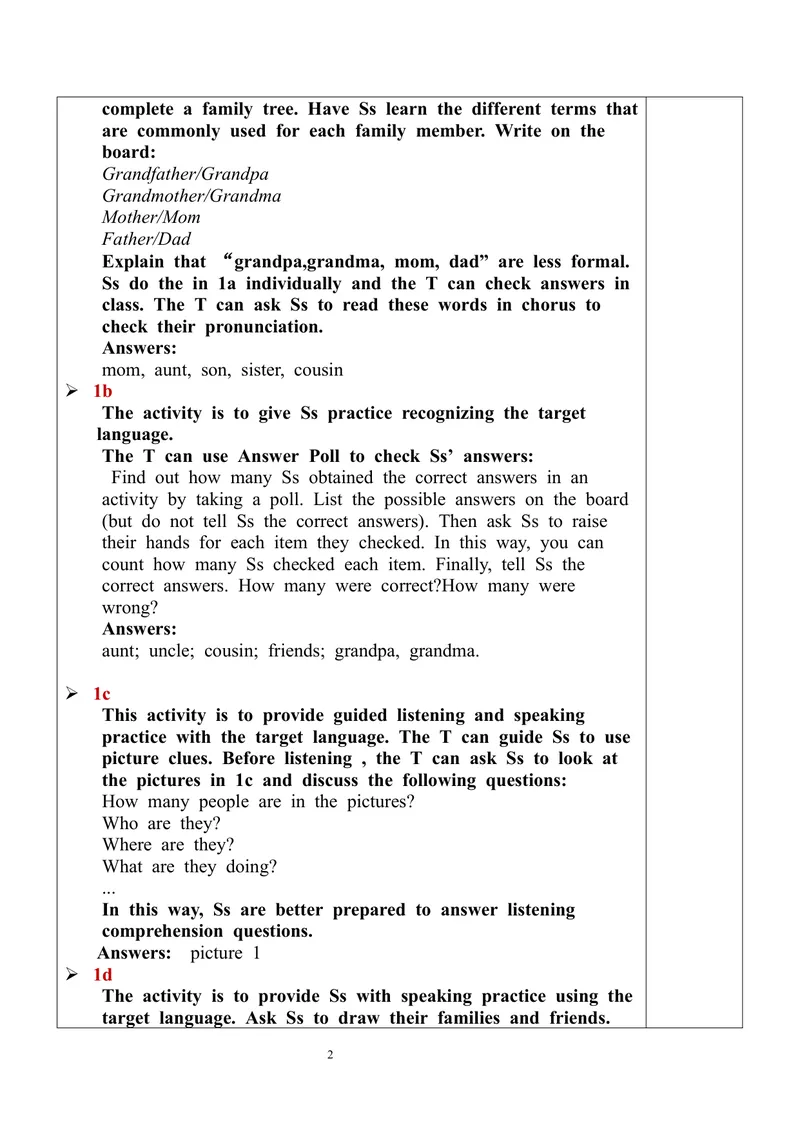
1a
This activity is to help Ss use the target language to
1complete a family tree. Have Ss learn the different terms that
are commonly used for each family member. Write on the
board:
Grandfather/Grandpa
Grandmother/Grandma
Mother/Mom
Father/Dad
Explain that “grandpa,grandma, mom, dad” are less formal.
Ss do the in 1a individually and the T can check answers in
class. The T can ask Ss to read these words in chorus to
check their pronunciation.
Answers:
mom, aunt, son, sister, cousin
1b
The activity is to give Ss practice recognizing the target
language.
The T can use Answer Poll to check Ss’ answers:
Find out how many Ss obtained the correct answers in an
activity by taking a poll. List the possible answers on the board
(but do not tell Ss the correct answers). Then ask Ss to raise
their hands for each item they checked. In this way, you can
count how many Ss checked each item. Finally, tell Ss the
correct answers. How many were correct?How many were
wrong?
Answers:
aunt; uncle; cousin; friends; grandpa, grandma.
1c
This activity is to provide guided listening and speaking
practice with the target language. The T can guide Ss to use
picture clues. Before listening , the T can ask Ss to look at
the pictures in 1c and discuss the following questions:
How many people are in the pictures?
Who are they?
Where are they?
What are they doing?
...
In this way, Ss are better prepared to answer listening
comprehension questions.
Answers: picture 1
1d
The activity is to provide Ss with speaking practice using the
target language. Ask Ss to draw their families and friends.
2Then Ss work in pairs to introduce the people in their
pictures. The T can observe and offer help to Ss in need. Ss
should pay attention to the accuracy of Ss’ speaking.
Step 3 Language points
aunt 指父母那一辈除母亲之外的所有女性长辈,相当于汉语
中的“姑母;姨母;伯母;婶母;舅母”。前面有不定冠词
修饰时,应用 an。注意:a+读音以辅音音素开头的词;
an+读音以元音音素开头的词。
uncle 指父母那一辈除父亲之外的所有男性长辈,相当于汉
语中的“舅父;叔父;伯父;姑父;姨父”。前面有不定冠
词修饰时,应用 an。
aunt 与 uncle 与人名连用的时候, 书写与汉语习惯相反, 要
将称呼写在人名前, 且首字母要大写。
cousin 是名词, 意为“堂兄(弟、姊、妹);表兄(弟、姊、
妹)”,表示与自己同辈的男性亲属或女性亲属,其复数形
式为 cousins。
Step 4 Summary & Homework
The
Summary The T can encourage Ss to summarize the key points homework
of this class to help Ss consolidate the knowledge. can vary
Homework: with the
Preview the passage in Section B 2b. specific
Do the exercises in students’ book. conditions
.
The design of activities before listening(Activities1a and 1b) is very
important. The purpose is to activate the memory in students' brain, recall
Teaching
the learned words, phrases and sentence patterns, and pave the way for
Reflection
listening activities. At the same time, students' response process is also to
learn and consolidate language knowledge in application.
3