文档文本内容
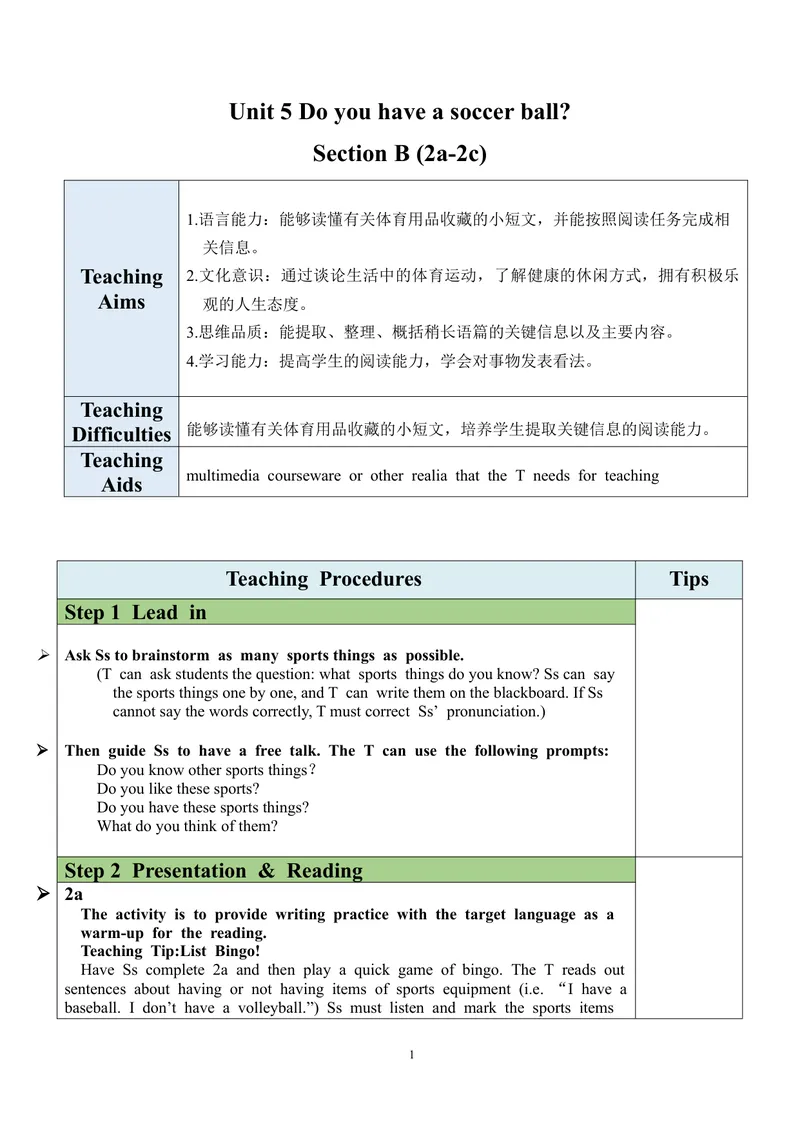
Unit 5 Do you have a soccer ball?
Section B (2a-2c)
1.语言能力:能够读懂有关体育用品收藏的小短文,并能按照阅读任务完成相
关信息。
Teaching 2.文化意识:通过谈论生活中的体育运动,了解健康的休闲方式,拥有积极乐
Aims
观的人生态度。
3.思维品质:能提取、整理、概括稍长语篇的关键信息以及主要内容。
4.学习能力:提高学生的阅读能力,学会对事物发表看法。
Teaching
Difficulties 能够读懂有关体育用品收藏的小短文,培养学生提取关键信息的阅读能力。
Teaching
multimedia courseware or other realia that the T needs for teaching
Aids
Teaching Procedures Tips
Step 1 Lead in
Ask Ss to brainstorm as many sports things as possible.
(T can ask students the question: what sports things do you know? Ss can say
the sports things one by one, and T can write them on the blackboard. If Ss
cannot say the words correctly, T must correct Ss’ pronunciation.)
Then guide Ss to have a free talk. The T can use the following prompts:
Do you know other sports things?
Do you like these sports?
Do you have these sports things?
What do you think of them?
Step 2 Presentation & Reading
2a
The activity is to provide writing practice with the target language as a
warm-up for the reading.
Teaching Tip:List Bingo!
Have Ss complete 2a and then play a quick game of bingo. The T reads out
sentences about having or not having items of sports equipment (i.e. “I have a
baseball. I don’t have a volleyball.”) Ss must listen and mark the sports items
1in the correct “Things I have” or “Things I don’t have” columns of their
lists. Once a S marks all six items on their list, they shout “Bingo”. Then the
S confirms that he/she has marked only the correct items by reading out the
six sentences (i.e. I have a baseball. I don’t have a volleyball) The S who first
shouts “Bingo” after correctly marking the sports equipment in his/her list is
the winner.
Predicting
The T can explain to Ss what predicting is . Then have Ss look at the
title and pictures in 2b, try to predict the main idea of the passage. Then
choose the right answer. Ss can check their own answers after they finish
the reading.
2b Skimming
The T can tell Ss what skimming is: Look through the passage without
reading every word. Focus on the beginning and the ending. Then ask Ss
to do the match task on P11 to figure out who has a soccer ball.
Answer: Gina Smith
Scanning
Ask Ss to read the passage carefully and do different tasks.
Task1(Para.1): ①Read the passage about Frank Brown. Choose T or F.
②Read the passage about Frank Brown. Fill in the chart.
Task2(Para.2):①Read the passage about Gina Smith. Fill in the blanks.
Task3(Para.3):①Read the passage about Wang Wei. Choose T or F.
②Read the passage about Wang Wei. Fill in the blanks
(T tells Ss what scanning is: to read carefully and find the details. Ss read para by
para and do the tasks. After Ss read the passage together, T should correct their
pronunciation, and lead them to read the words the sentences where they have
problems again to make sure they can read correctly. T asks Ss to answer the questions
after each paragraph. They can share the answers one by one or in a row or in a line.
It's better for T to correct their pronunciation of the words or grammar mistakes when
Ss answer questions.)
Retelling
Ask Ss to retell the passage.
(T can use a mind map and give some clues to help them retell. For example, Frank
has ... Gina likes… but she doesn’t …)
At last the T can explain the key language points to Ss and play the
recording of the passage. Ss can read after the recording and the T can
pay attention to their pronunciation and intonation.
2c
The activity is to provide Ss with reading comprehension practice using
the target language.Ask Ss to cover the passage and finish 2c from
memory. The T can check answers as a class.
Answers: 1.2.3.4.5.6.
After Ss have completed 2c, have them change the sentence to yes/no
questions. Elicit the questions from Ss and write the questions on the
2board. As a class, ask and answer the questions about Frank, Gina and
then Wang Wei. For example:
1.Does Frank play ping-pong with his classmates after class? No, he doesn’t.
2.Does Frank have soccer balls, basketballs, volleyballs and baseballs? No,
he doesn’t.
3.Does Frank’s brother have a soccer ball? Yes, he does.
4.Does Frank only enjoy watching sports on TV? No, he doesn’t.
5.Does Frank say soccer is easy? No, he doesn’t.
6.Do Frank and his brother go to the same school ?Yes, they do.
Step 3 Language Points
1. but是并列连词,意为“但是”,用来连接两个并列成分,表示转折关系。
2. do/does代替句中动词的用法:在并列句中,当前一分句的谓语动词为实义动
词,且后一分句中作谓语的实义动词与前一分句中的相同时,可省略与前一分
句中相同的成分,用助动词do或does代替。
3. same adj. 相同的 作形容词通常与定冠词the连用,位于单数名词前作定语。
常构成短语:the same... as... 意为“与……相同的……”
【拓展延伸】same的反义词为different(不同的),后接名词时用复数形式。常
构成短语:be different from... 意为“与……不同”。
4. love v. & n. 爱; 喜爱
1) love在句中作动词,意为“爱; 喜爱”,近义词为like,但love感情色彩比
like更强烈。其后接名词、代词、动词-ing或动词不定式作宾语。
2) love还可用作名词,意为“爱; 喜爱”。
5. with prep. 和……在一起;带有; 使用
1) 介词“和……在一起”
2) 介词“带有”
3) 介词“使用”
6. sport在此用作可数名词,当它作定语修饰名词时,常用其复数形式。
sports meeting 运动会 sports club 体育俱乐部
play sports和do sports都表示“做运动; 参加体育运动”。
Step 4 Exercises & Homework
Exercises
Step1: Ask Ss to do the exercises on PPT P36-P38.
Step2: Ask Ss to make a summary about what they learned today.
Homework
1. Read and recite the new words and phrases.
2. Do the exercises in students’ book.
I used various forms of reading strategies, such as skim, scan, retell, etc. to help students
quickly understand the text. There are too many tasks in scanning part. I can delete some
Teaching to create more time for the following parts. The exercises at the end of the class are not
Reflection necessary because it is a reading class and we don't have enough time to finish that part. I
paid much attention to the usage of the language points and let students make enough
sentences to master the language points, so Ss can master the language points and
3understand the passage clearly.
4