文档文本内容
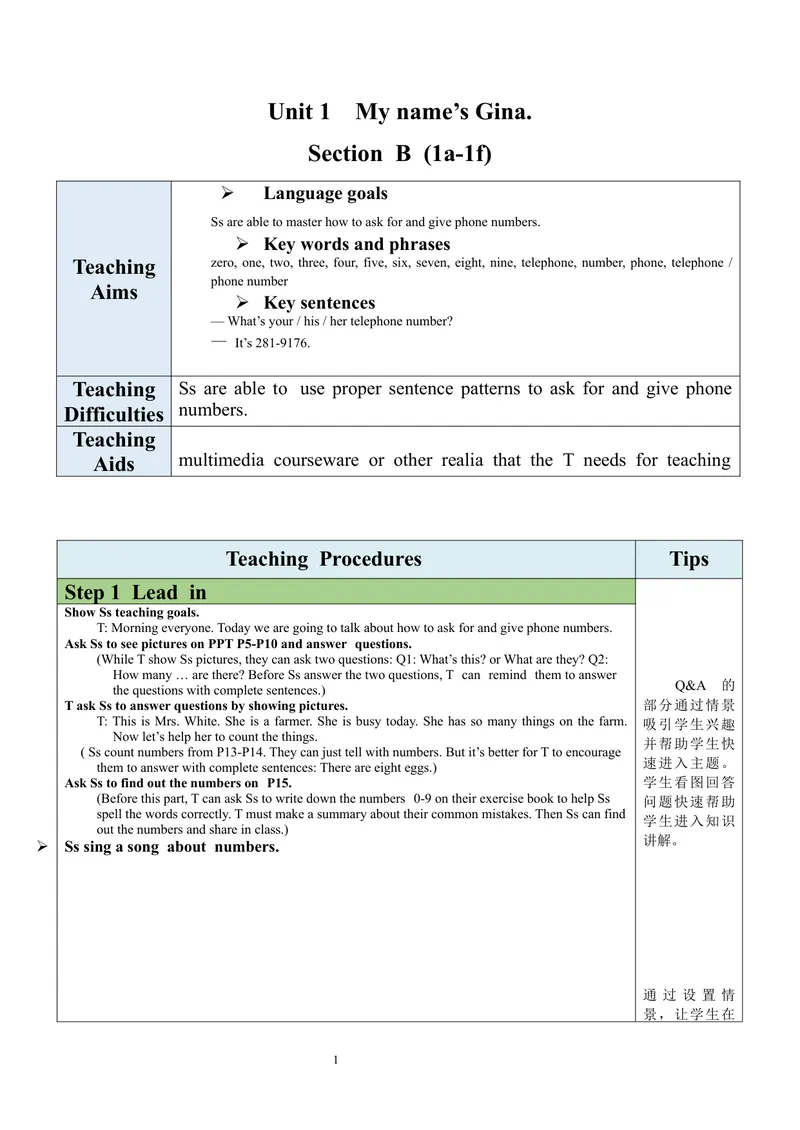
Unit 1 My name’s Gina.
Section B (1a-1f)
Language goals
Ss are able to master how to ask for and give phone numbers.
Key words and phrases
Teaching zero, one, two, three, four, five, six, seven, eight, nine, telephone, number, phone, telephone /
phone number
Aims
Key sentences
— What’s your / his / her telephone number?
— It’s 281-9176.
Teaching Ss are able to use proper sentence patterns to ask for and give phone
Difficulties numbers.
Teaching
Aids multimedia courseware or other realia that the T needs for teaching
Teaching Procedures Tips
Step 1 Lead in
Show Ss teaching goals.
T: Morning everyone. Today we are going to talk about how to ask for and give phone numbers.
Ask Ss to see pictures on PPT P5-P10 and answer questions.
(While T show Ss pictures, they can ask two questions: Q1: What’s this? or What are they? Q2:
How many … are there? Before Ss answer the two questions, T can remind them to answer
Q&A 的
the questions with complete sentences.)
T ask Ss to answer questions by showing pictures. 部分通过情景
T: This is Mrs. White. She is a farmer. She is busy today. She has so many things on the farm. 吸引学生兴趣
Now let’s help her to count the things.
并帮助学生快
( Ss count numbers from P13-P14. They can just tell with numbers. But it’s better for T to encourage
速进入主题。
them to answer with complete sentences: There are eight eggs.)
Ask Ss to find out the numbers on P15. 学生看图回答
(Before this part, T can ask Ss to write down the numbers 0-9 on their exercise book to help Ss 问题快速帮助
spell the words correctly. T must make a summary about their common mistakes. Then Ss can find
学生进入知识
out the numbers and share in class.)
讲解。
Ss sing a song about numbers.
通 过 设 置 情
景,让学生在
1真是的场景中
运用数字。学
生通过用完整
句 子 回 答 问
题,实现了从
单词到句子的
练习。
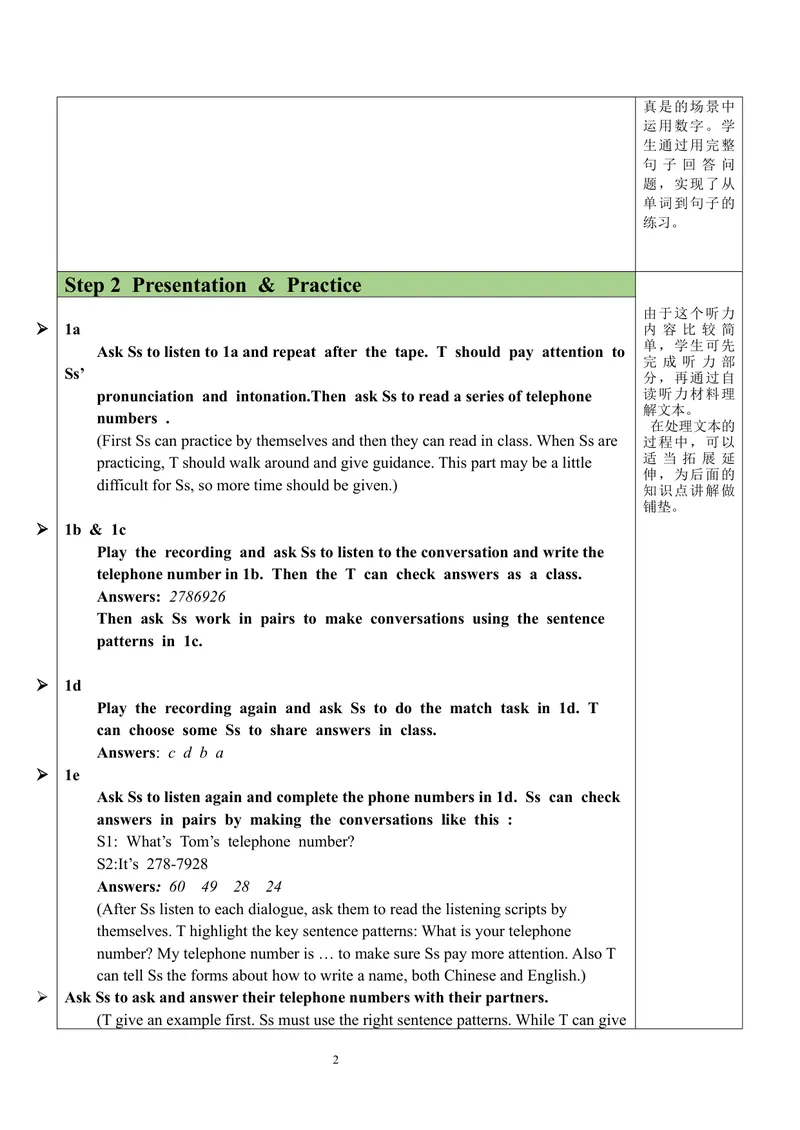
Step 2 Presentation & Practice
由于这个听力
1a 内 容 比 较 简
单,学生可先
Ask Ss to listen to 1a and repeat after the tape. T should pay attention to
完 成 听 力 部
Ss’
分,再通过自
pronunciation and intonation.Then ask Ss to read a series of telephone 读听力材料理
解文本。
numbers .
在处理文本的
(First Ss can practice by themselves and then they can read in class. When Ss are 过程中,可以
适 当 拓 展 延
practicing, T should walk around and give guidance. This part may be a little
伸,为后面的
difficult for Ss, so more time should be given.)
知识点讲解做
铺垫。
1b & 1c
Play the recording and ask Ss to listen to the conversation and write the
telephone number in 1b. Then the T can check answers as a class.
Answers: 2786926
Then ask Ss work in pairs to make conversations using the sentence
patterns in 1c.
1d
Play the recording again and ask Ss to do the match task in 1d. T
can choose some Ss to share answers in class.
Answers: c d b a
1e
Ask Ss to listen again and complete the phone numbers in 1d. Ss can check
answers in pairs by making the conversations like this :
S1: What’s Tom’s telephone number?
S2:It’s 278-7928
Answers: 60 49 28 24
(After Ss listen to each dialogue, ask them to read the listening scripts by
themselves. T highlight the key sentence patterns: What is your telephone
number? My telephone number is … to make sure Ss pay more attention. Also T
can tell Ss the forms about how to write a name, both Chinese and English.)
Ask Ss to ask and answer their telephone numbers with their partners.
(T give an example first. Ss must use the right sentence patterns. While T can give
2Ss more extension like: What is his / her / your mother’s telephone number? )
Step 3 Language Points
这个环节的小
1. 基数词
组讨论,激发
英语中的数词可以分为两大类:基数词和序数词。表示数目多少的词为基数 学生自主学习
词,如zero, one, five等;表示事物先后顺序的词为序数词,如first(第一), 的能力,帮助
他们快速适应
second(第二)等。其中,基数词可以表示数目、年龄、编号、号码等。
七年级的学习
2. What’s one’s telephone number? 生活。
该句型用来询问某人的电话号码, 意为“某人的电话号码是多少?”。答语用
“It’s + 电话号码. ”或“One’s telephone / phone number is + 电话号码.”,也可
直接回答电话号码。
3. 中文姓名的英语书写方式
此处Li Xin是一个中文姓名。 中文姓名的英语写法,一般用汉语拼音拼写。姓
和名分开写,姓在前,名字在后。姓和名字的第一个字母都要大写。
(Ss can find out the usage by finding out the details in the listening scripts.)
Step 4 Exercises & Homework 通过习题让学
生对知识点的
用法有更加清
Exercises
晰的认识。
Step1: Ask Ss to do the exercises on PPT P30-P32.
Step2: T ask Ss to make a summary about language points they learned today.
Homework
1. Preview the passage in Section B 2b.
2. Do the exercises in students’ book.
The design of activities before listening(Activities1a and 1b) is very
important. The purpose is to activate the memory in students' brain, recall
Teaching
the learned words, phrases and sentence patterns, and pave the way for
Reflection
listening activities. At the same time, students' response process is also to
learn and consolidate language knowledge in application.
3