文档文本内容
温老师教育
人教版六年级下册英语语法总结表
Unit1 How tall are you?
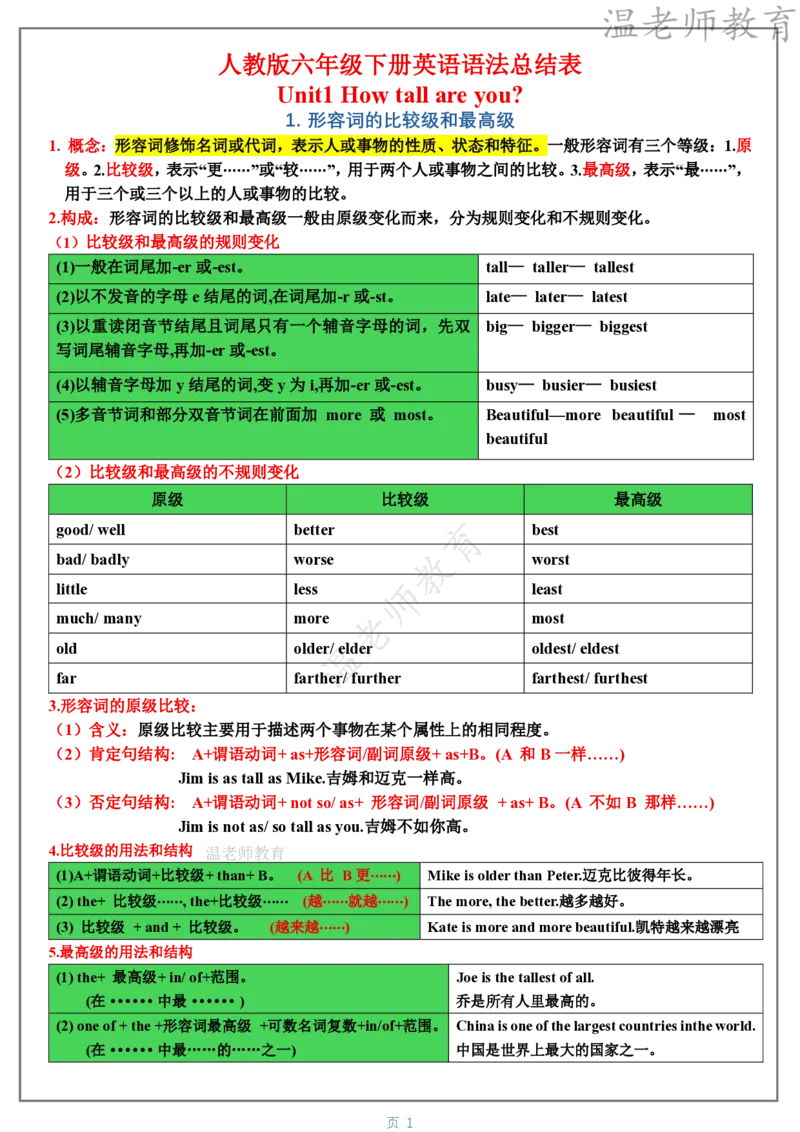
1. 形容词的比较级和最高级
1. 概念:形容词修饰名词或代词,表示人或事物的性质、状态和特征。一般形容词有三个等级:1.原
级。2.比较级,表示“更⋯⋯”或“较⋯⋯”,用于两个人或事物之间的比较。3.最高级,表示“最⋯⋯”,
用于三个或三个以上的人或事物的比较。
2.构成:形容词的比较级和最高级一般由原级变化而来,分为规则变化和不规则变化。
(1)比较级和最高级的规则变化
(1)一般在词尾加-er或-est。 tall— taller— tallest
(2)以不发音的字母 e结尾的词,在词尾加-r或-st。 late— later— latest
(3)以重读闭音节结尾且词尾只有一个辅音字母的词,先双 big— bigger— biggest
写词尾辅音字母,再加-er或-est。
(4)以辅音字母加 y结尾的词,变 y为 i,再加-er 或-est。 busy— busier— busiest
(5)多音节词和部分双音节词在前面加 more 或 most。 Beautiful—more beautiful — most
beautiful
(2)比较级和最高级的不规则变化
原级 比较级 最高级
育
good/ well better best
教
bad/ badly worse worst
师
little less least
老
much/ many more most
温
old older/ elder oldest/ eldest
far farther/ further farthest/ furthest
3.形容词的原级比较:
(1)含义:原级比较主要用于描述两个事物在某个属性上的相同程度。
(2)肯定句结构: A+谓语动词+ as+形容词/副词原级+ as+B。(A 和 B 一样……)
Jim is as tall as Mike.吉姆和迈克一样高。
(3)否定句结构: A+谓语动词+ not so/ as+ 形容词/副词原级 + as+ B。(A 不如 B 那样……)
Jim is not as/ so tall as you.吉姆不如你高。
4.比较级的用法和结构 温老师教育
(1)A+谓语动词+比较级+ than+ B。 (A 比 B更⋯⋯) Mike is older than Peter.迈克比彼得年长。
(2) the+ 比较级⋯⋯, the+比较级⋯⋯ (越⋯⋯就越⋯⋯) The more, the better.越多越好。
(3) 比较级 + and + 比较级。 (越来越⋯⋯) Kate is more and more beautiful.凯特越来越漂亮
5.最高级的用法和结构
(1) the+ 最高级+ in/ of+范围。 Joe is the tallest of all.
(在······中最······) 乔是所有人里最高的。
(2) one of + the +形容词最高级 +可数名词复数+in/of+范围。 China is one of the largest countries inthe world.
(在······中最……的……之一) 中国是世界上最大的国家之一。
页 1温老师教育
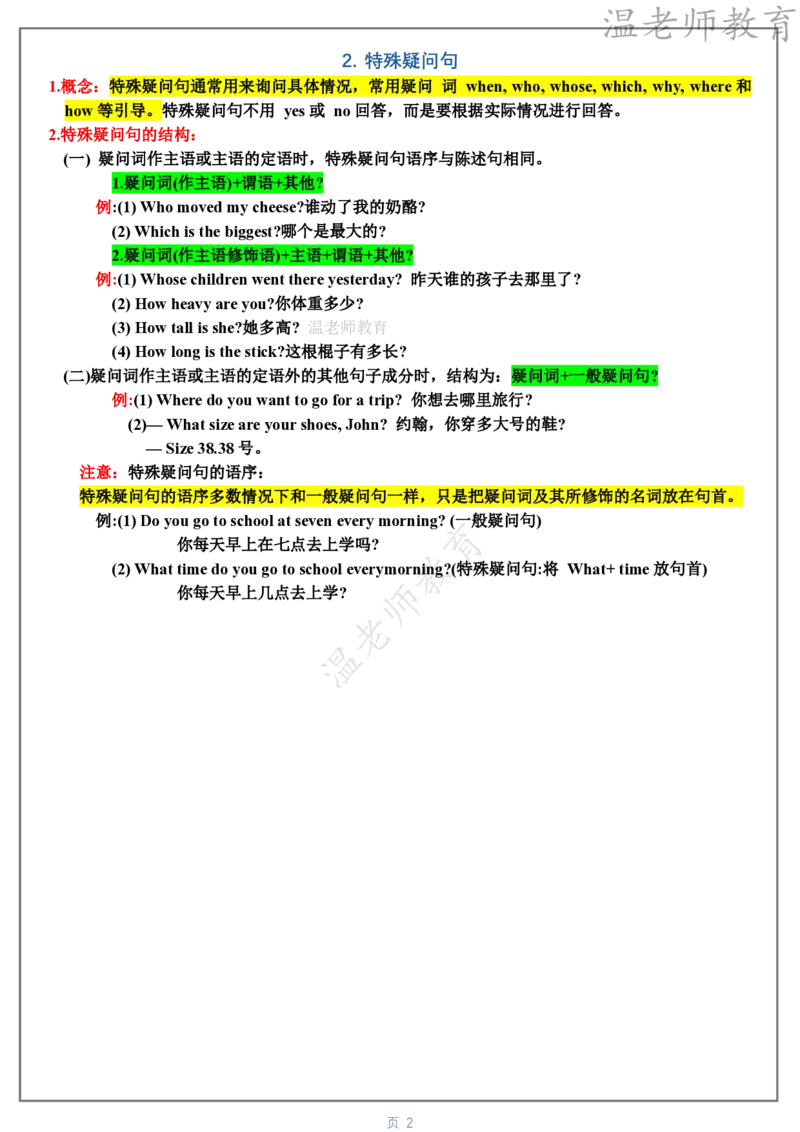
2. 特殊疑问句
1.概念:特殊疑问句通常用来询问具体情况,常用疑问 词 when, who, whose, which, why, where 和
how 等引导。特殊疑问句不用 yes 或 no 回答,而是要根据实际情况进行回答。
2.特殊疑问句的结构:
(一) 疑问词作主语或主语的定语时,特殊疑问句语序与陈述句相同。
1.疑问词(作主语)+谓语+其他?
例:(1) Who moved my cheese?谁动了我的奶酪?
(2) Which is the biggest?哪个是最大的?
2.疑问词(作主语修饰语)+主语+谓语+其他?
例:(1) Whose children went there yesterday? 昨天谁的孩子去那里了?
(2) How heavy are you?你体重多少?
(3) How tall is she?她多高? 温老师教育
(4) How long is the stick?这根棍子有多长?
(二)疑问词作主语或主语的定语外的其他句子成分时,结构为:疑问词+一般疑问句?
例:(1) Where do you want to go for a trip? 你想去哪里旅行?
(2)— What size are your shoes, John? 约翰,你穿多大号的鞋?
— Size 38.38 号。
注意:特殊疑问句的语序:
特殊疑问句的语序多数情况下和一般疑问句一样,只是把疑问词及其所修饰的名词放在句首。
例:(1) Do you go to school at seven every morning育? (一般疑问句)
你每天早上在七点去上学吗?
教
(2) What time do you go to school everymorning?(特殊疑问句:将 What+ time放句首)
师
你每天早上几点去上学?
老
温
页 2温老师教育
人教版六年级下册英语语法总结表
Unit2 Last weekend
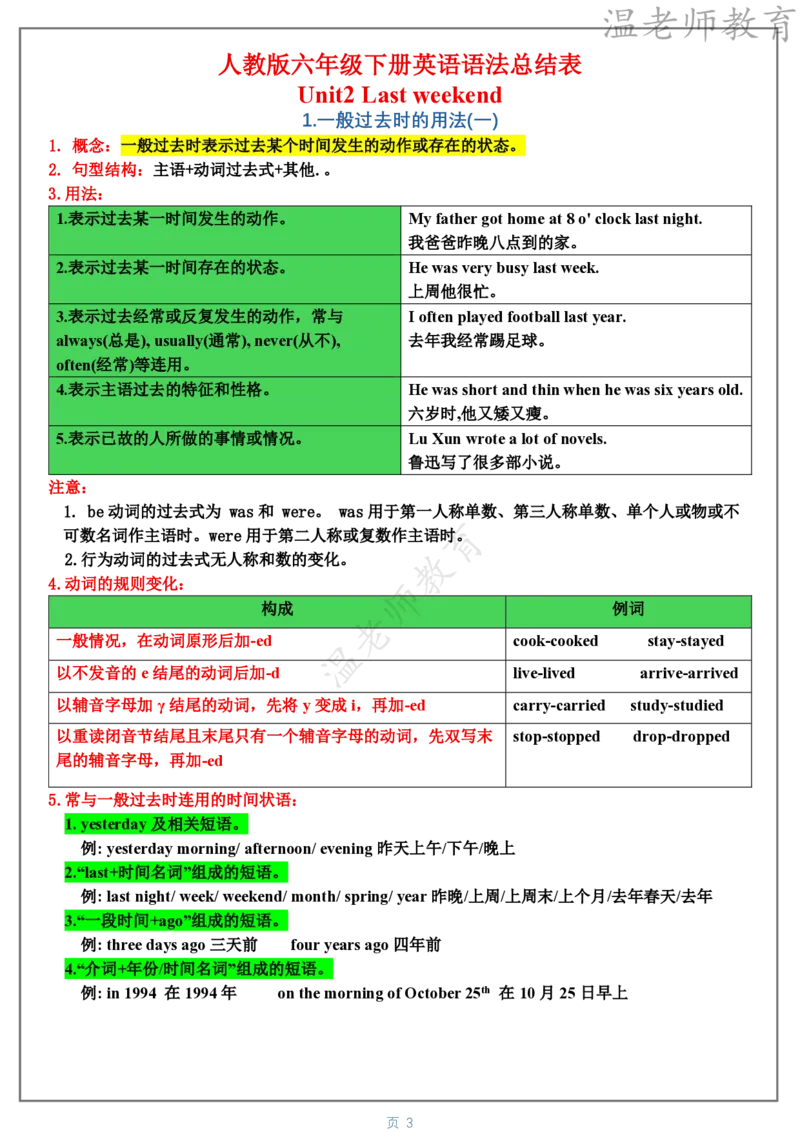
1.一般过去时的用法(一)
1. 概念:一般过去时表示过去某个时间发生的动作或存在的状态。
2. 句型结构:主语+动词过去式+其他.。
3.用法:
1.表示过去某一时间发生的动作。 My father got home at 8 o' clock last night.
我爸爸昨晚八点到的家。
2.表示过去某一时间存在的状态。 He was very busy last week.
上周他很忙。
3.表示过去经常或反复发生的动作,常与 I often played football last year.
always(总是), usually(通常), never(从不), 去年我经常踢足球。
often(经常)等连用。
4.表示主语过去的特征和性格。 He was short and thin when he was six years old.
六岁时,他又矮又瘦。
5.表示已故的人所做的事情或情况。 Lu Xun wrote a lot of novels.
鲁迅写了很多部小说。
注意:
1. be 动词的过去式为 was 和 were。 was 用于第一人称单数、第三人称单数、单个人或物或不
育
可数名词作主语时。were 用于第二人称或复数作主语时。
教
2.行为动词的过去式无人称和数的变化。
4.动词的规则变化: 师
构成 例词
老
一般情况,在动词原形后加-ed 温 cook-cooked stay-stayed
以不发音的 e结尾的动词后加-d live-lived arrive-arrived
以辅音字母加 γ 结尾的动词,先将 y变成 i,再加-ed carry-carried study-studied
以重读闭音节结尾且末尾只有一个辅音字母的动词,先双写末 stop-stopped drop-dropped
尾的辅音字母,再加-ed
5.常与一般过去时连用的时间状语:
1. yesterday 及相关短语。
例: yesterday morning/ afternoon/ evening 昨天上午/下午/晚上
2.“last+时间名词”组成的短语。
例: last night/ week/ weekend/ month/ spring/ year 昨晚/上周/上周末/上个月/去年春天/去年
3.“一段时间+ago”组成的短语。
例: three days ago 三天前 four years ago 四年前
4.“介词+年份/时间名词”组成的短语。
例: in 1994 在 1994年 on the morning of October 25th 在 10月 25日早上
页 3温老师教育
人教版六年级下册英语语法总结表
Unit3 Where did you go?
1.一般过去时的用法(二)
1.含有 be动词的一般过去时的四种句型结构:
句型 结构 例句
肯定句: 主语+ was/ were+其他. I was very happy yesterday.
我昨天很高兴。
否定句 主语+ was/ were+ not+其他. They weren't at home last night.
昨晚他们不在家。
一般疑问句 Was/ Were+主语+其他? Was Kate in the bedroom just now?
肯定回答: Yes,人称代词+ was/ were. 刚才凯特在卧室吗?
否定回答: No,人称代词+ wasn't/ weren't. No, she wasn't.不,她不在。
特殊疑问句 特殊疑问词+ was/were+主语+其他? How was your last weekend?
你上周末过得怎么样?
2.含有行为动词的一般过去时的四种句型结构:
句型 结构 例句
肯定句: 主语+动词过去式+其他. She cooked dinner for her parents last night.
她育昨天晚上给她的父母做了晚餐。
教
否定句 主语+ did+ not+动词原形+其他. I didn't have a Chinese class yesterday.
师我昨天没有语文课。
一般疑问句 Did+主语+动词原形+其他老? Did you go to school yesterday?
肯定回答: Yes,人称代词+ did. 你昨天去上学了吗?
温
否定回答: No,人称代词+ didn't. Yes, I did.是的,我去了。
特殊疑问句 特殊疑问词+did+主语+动词原形+ What did you do last weekend?
其他? 你上周末干什么了?
注意:
含有实义动词的一般过去时的否定句和疑问句都应用助动词 do的过去式“did”来帮助完成。若
句中含有情态动词,则疑问句中将情态动词提前,否定句中在情态动词后加 not。
4.动词过去式的不规则变化:
替换个别字母变过去式 come— came; get— got;fall—— fell;
ride— rode; run— ran; sit—— sat
过去式和原形一样(有的读音会发生变化) read— read/ red/;hurt— hurt;cut—— cut;
let— let;put— put; hit— hit
需要单独记忆 sleep—— slept; go— went;teach— taught;
eat— ate;buy— bought; see— saw
页 4温老师教育
人教版六年级下册英语语法总结表
Unit4 Then and now
1.there be 句型及 have的用法归纳
1. 概念: there be句型是英语中的一种常用句型,表示“某地存在某物或在某时发生某事”。be动
词要根据时态及主语的变化而变化。
2. there be 句型的句式结构:
肯定陈述句: There be+名词+地点/时间状语.
(1) There is a dog under the tree.树底下有一只狗。 (可数名词单数)
(2) There is some water in the water bottle.水壶里有一些水。 (不可数名词)
(3) There are many kids in the park.公园里有很多孩子。(可数名词的复数形式)
there be句型的就近原则:
如果 there be后面是几个并列名词作主语时,be动词的形式应与跟它最近的那个名词保持单
复数的一致。
例: There is a book and some pens on the desk.
例: There are some pens and a book on the desk.
否定陈述句:There be+ not/ no+名词+地点/时间状语.
育
(1) There wasn't any food in the kitchen.厨房里没有食物。
教
(2) There were no books on the desk.书桌上没有书。
师
注意:陈述句中如果出现 some,变否定句时, some要变成 any。
老
一般疑问句: Be动词+ there+名词+地点/时间状语?
温
(1) Is there a dictionary on the desk?书桌上有一本词典吗?
(2) Are there any elephants in the zoo?动物园里有大象吗?
特殊疑问句:特殊疑问词(+名词)+be动词+there+地点/时间状语?
How many students are there in the classroom?教室里有多少名学生?
4.there be句型与 have的异同:
there be have/ has
there be句型表示的是“存在”的“有”, have/ has 表示的是“所属”的“有”, have/
there be句型的主语放在 be动词之后。 has 前需要有主语。
例:
(1)I have some good friends.我有一些好朋友。
主语 温老师教育
(2) Lisa has an elder sister. 主语莉萨有一个姐姐。
主语
(3) There are many kids in the park.公园里有很多孩子。
主语
页 5