2025-2026 学年第
一学期天域全国名
校协作体联考英语
试题
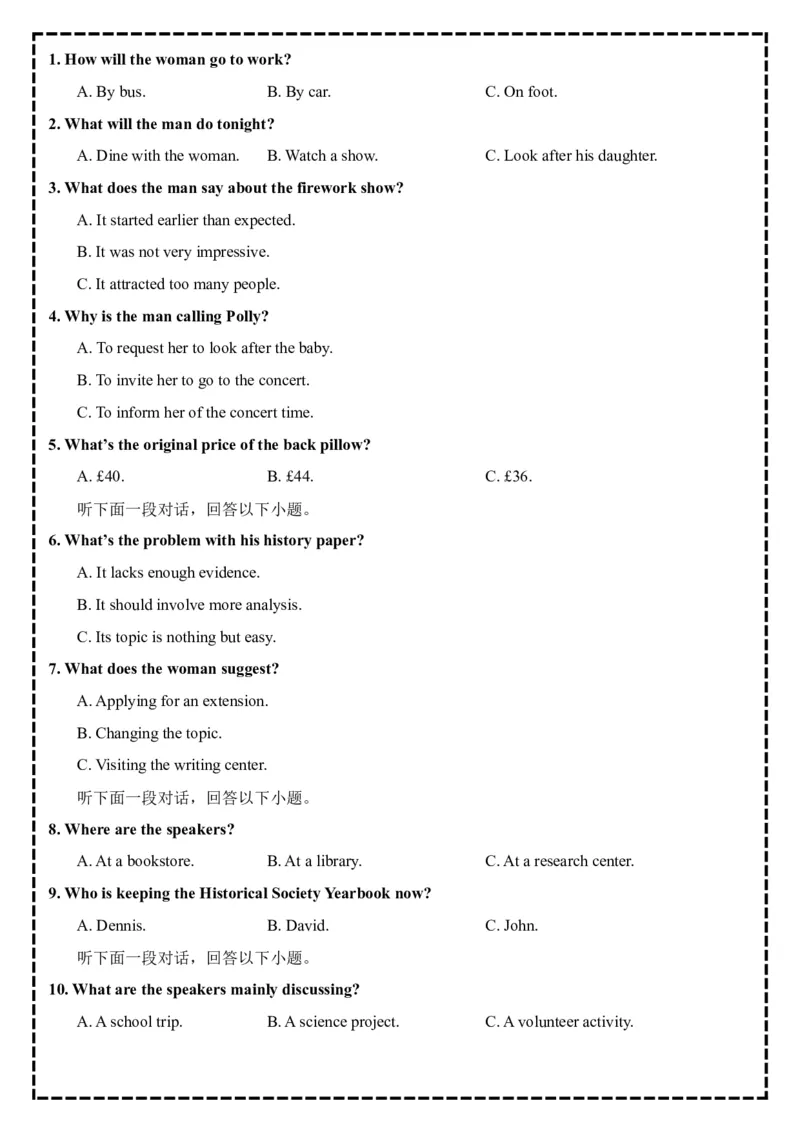
1. How will the woman go to work?
A. By bus.
B. By car.
C. On foot.
2. What will the man do tonight?
A. Dine with the woman.
B. Watch a show.
C. Look after his daughter.
3. What does the man say about the firework show?
A. It started earlier than expected.
B. It was not very impressive.
C. It attracted too many people.
4. Why is the man calling Polly?
A. To request her to look after the baby.
B. To invite her to go to the concert.
C. To inform her of the concert time.
5. What’s the original price of the back pillow?
A. £40.
B. £44.
C. £36.
听下面一段对话,回答以下小题。
6. What’s the problem with his history paper?
A. It lacks enough evidence.
B. It should involve more analysis.
C. Its topic is nothing but easy.
7. What does the woman suggest?
A. Applying for an extension.
B. Changing the topic.
C. Visiting the writing center.
听下面一段对话,回答以下小题。
8. Where are the speakers?
A. At a bookstore.
B. At a library.
C. At a research center.
9. Who is keeping the Historical Society Yearbook now?
A. Dennis.
B. David.
C. John.
听下面一段对话,回答以下小题。
10. What are the speakers mainly discussing?
A. A school trip.
B. A science project.
C. A volunteer activity.
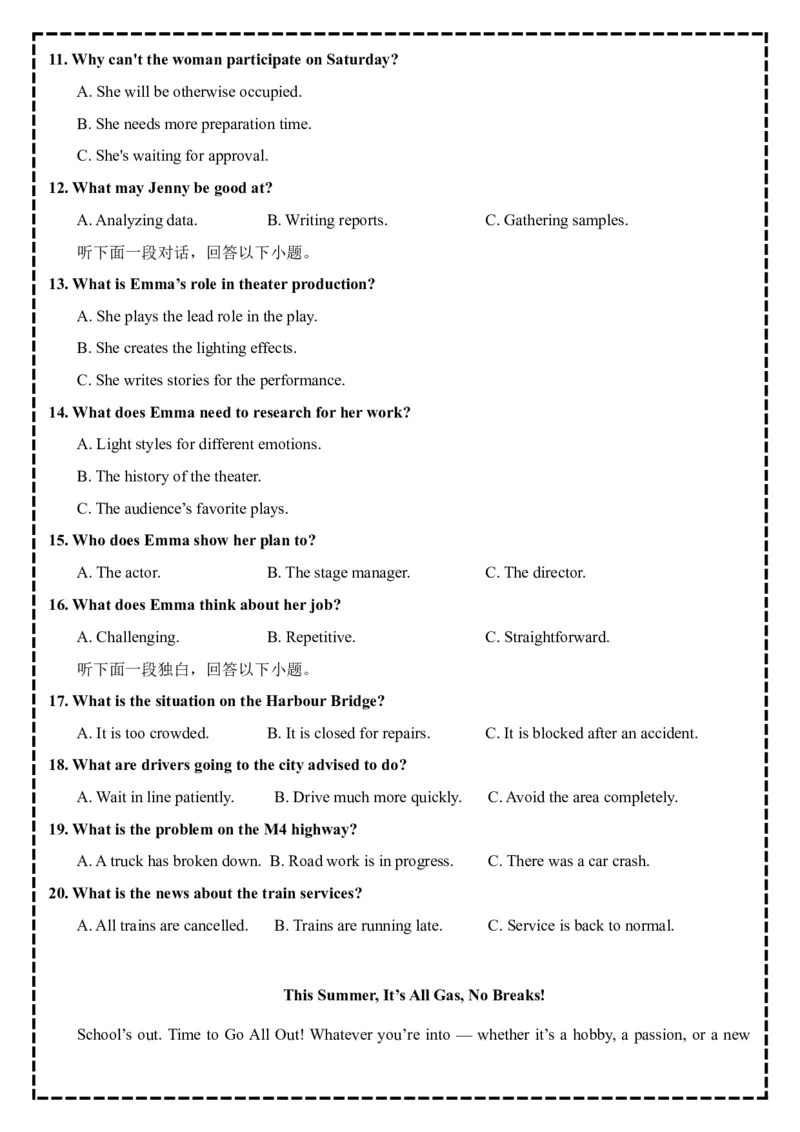
11. Why can't the woman participate on Saturday?
A. She will be otherwise occupied.
B. She needs more preparation time.
C. She's waiting for approval.
12. What may Jenny be good at?
A. Analyzing data.
B. Writing reports.
C. Gathering samples.
听下面一段对话,回答以下小题。
13. What is Emma’s role in theater production?
A. She plays the lead role in the play.
B. She creates the lighting effects.
C. She writes stories for the performance.
14. What does Emma need to research for her work?
A. Light styles for different emotions.
B. The history of the theater.
C. The audience’s favorite plays.
15. Who does Emma show her plan to?
A. The actor.
B. The stage manager.
C. The director.
16. What does Emma think about her job?
A. Challenging.
B. Repetitive.
C. Straightforward.
听下面一段独白,回答以下小题。
17. What is the situation on the Harbour Bridge?
A. It is too crowded.
B. It is closed for repairs.
C. It is blocked after an accident.
18. What are drivers going to the city advised to do?
A. Wait in line patiently.
B. Drive much more quickly.    C. Avoid the area completely.
19. What is the problem on the M4 highway?
A. A truck has broken down.  B. Road work is in progress.
    C. There was a car crash.
20. What is the news about the train services?
A. All trains are cancelled.
B. Trains are running late.
    C. Service is back to normal.
This Summer, It’s All Gas, No Breaks!
School’s out. Time to Go All Out! Whatever you’re into — whether it’s a hobby, a passion, or a new
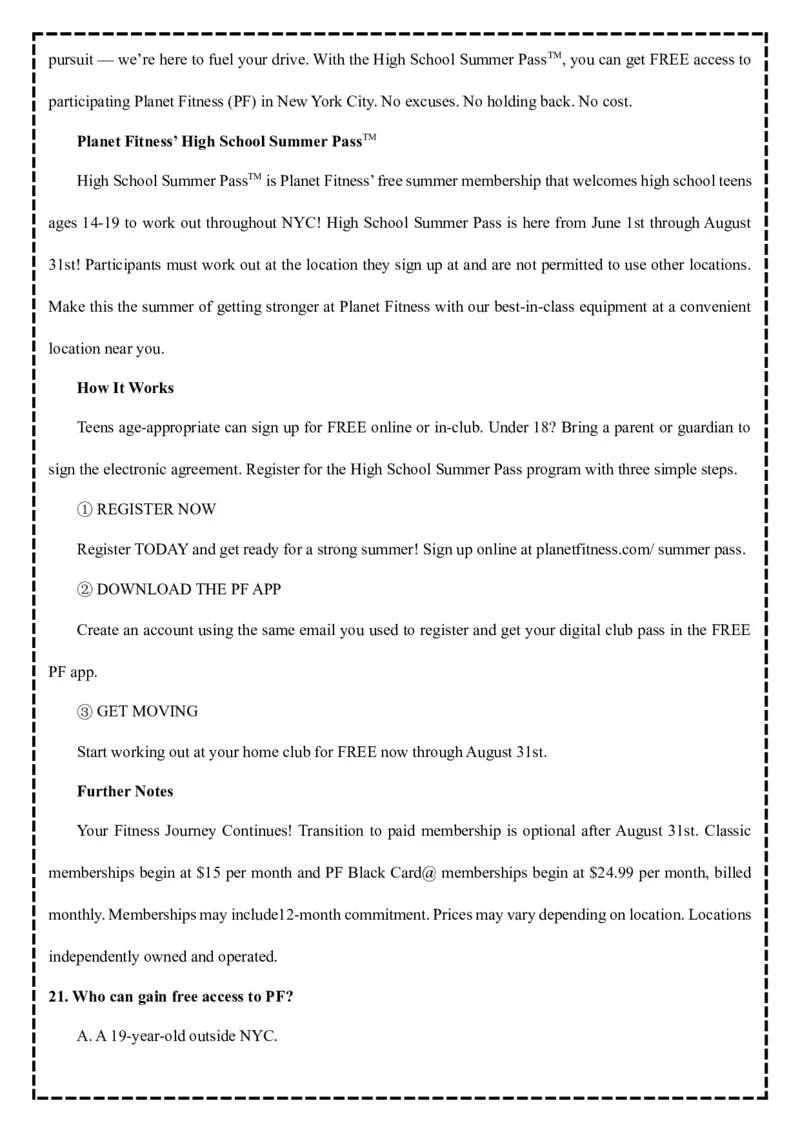
pursuit — we’re here to fuel your drive. With the High School Summer PassTM, you can get FREE access to
participating Planet Fitness (PF) in New York City. No excuses. No holding back. No cost.
Planet Fitness’ High School Summer PassTM
High School Summer PassTM is Planet Fitness’ free summer membership that welcomes high school teens
ages 14-19 to work out throughout NYC! High School Summer Pass is here from June 1st through August
31st! Participants must work out at the location they sign up at and are not permitted to use other locations.
Make this the summer of getting stronger at Planet Fitness with our best-in-class equipment at a convenient
location near you.
How It Works
Teens age-appropriate can sign up for FREE online or in-club. Under 18? Bring a parent or guardian to
sign the electronic agreement. Register for the High School Summer Pass program with three simple steps.
① REGISTER NOW
Register TODAY and get ready for a strong summer! Sign up online at planetfitness.com/ summer pass.
② DOWNLOAD THE PF APP
Create an account using the same email you used to register and get your digital club pass in the FREE
PF app.
③ GET MOVING
Start working out at your home club for FREE now through August 31st.
Further Notes
Your Fitness Journey Continues! Transition to paid membership is optional after August 31st. Classic
memberships begin at $15 per month and PF Black Card@ memberships begin at $24.99 per month, billed
monthly. Memberships may include12-month commitment. Prices may vary depending on location. Locations
independently owned and operated.
21. Who can gain free access to PF?
A. A 19-year-old outside NYC.
B. A 17-year-old registering alone in July.
C. A 13-year-old with a parent within NYC.
D. A 16-year-old with a guardian at the registered club.
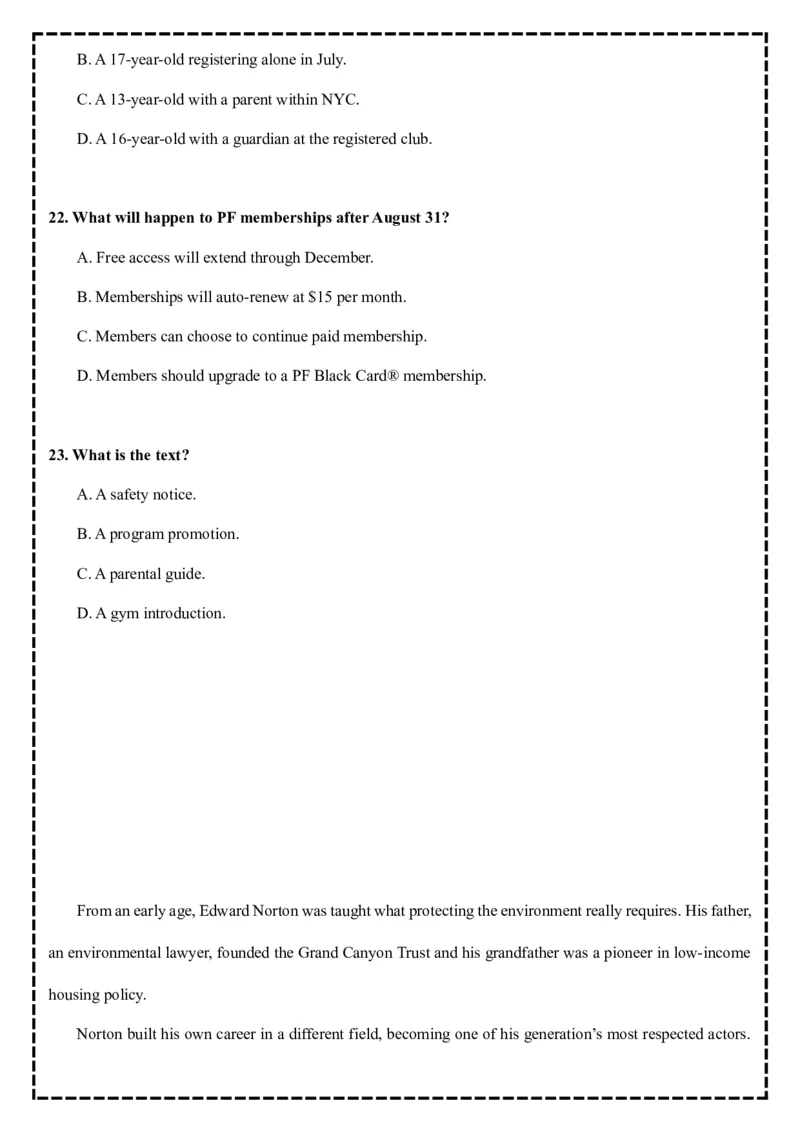
22. What will happen to PF memberships after August 31?
A. Free access will extend through December.
B. Memberships will auto-renew at $15 per month.
C. Members can choose to continue paid membership.
D. Members should upgrade to a PF Black Card® membership.
23. What is the text?
A. A safety notice.
B. A program promotion.
C. A parental guide.
D. A gym introduction.
From an early age, Edward Norton was taught what protecting the environment really requires. His father,
an environmental lawyer, founded the Grand Canyon Trust and his grandfather was a pioneer in low-income
housing policy.
Norton built his own career in a different field, becoming one of his generation’s most respected actors.
When Norton first became famous, he concluded that he wasn’t interested in ordinary celebrity ambassador
work. “I am not interested in being some weak sauce kind of spokesperson,” he says. “It’s not that I don’t
believe those things are important, but that held no nourishment for me.”
What does nourish Norton is his work with a Kenya-based organization called the Maasai Wilderness
Conservation Trust, which helps the Maasai people to make a living from their land through innovative means.
One project that Norton is particularly proud of channels profits from the sale of carbon offsets (碳补偿) to
local Maasai communities who use that money to support health, education, and conservation initiatives.
One challenge that concerns Norton would be familiar to his father and grandfather: raising funds. This
led Norton to a realization. “We can’t have the conservation movement depend only on donor-funded charity,”
he says, “It not only can’t scale; it’s fundamentally unstable.”
A new model is needed. Norton and his partners argue that tourist dollars being spent in fragile places
ought to remain in-country — or better yet, in-community. Norton and his team have started a company called
Conservation Equity that will invest in tourism in critical places and will reinvest its profits locally, instead of
paying distant shareholders.
Norton is optimistic about the model’s prospects, “I think what we are doing has no previous example to
follow. The needs of people are not going to take a lower priority to the spiritual value of nature. If protecting
and restoring nature can’t produce a stronger and more reliable economy, the effort will fail.”
24. How did Norton feel about being a typical celebrity spokesperson?
A. Enthusiastic.
B. Tolerant.
C. Dissatisfied.
D. Confused.
25. What is Norton’s main concern about the conservation movement?
A. Expansion of its public influence.
B. Lack of a stable source of funding.
C. Failure to meet the needs of local communities.
D. Repetition of the faults of previous generations.
26. What is special about Norton’s new model of conservation?
A. Downplaying the value of nature.
B. Raising funds from distant donors.
C. Focusing on local children’s education.
D. Benefiting local economic development.
27. Which of the following words best describe Norton?
A. Confident and honest.
B. Generous and talented.
C. Practical and pioneering.
D. Ambitious and conventional.
Is text-messaging driving us apart? These days, we talk to each other a lot with our thumbs — sending six
billion text messages a day, and likely a few billion more on services like Whats App.
But some worry that so much messaging leads to less communication. For instance, when hanging out
with friends, we’d be texting secretively at the same time, pretending to maintain eye contact but mentally
somewhere else.
New technologies often upset the way we relate to one another, of course. But such division caused by
texting have a strong echo in the arguments we had over telephone a hundred years ago. The small device
gave us a new way to contact one another and quickly promote new forms of socializing. Callers arranged
regular “visiting” calls, dialing remote family to catch up on news.
Soon, though, social critics thought it would be so easy to talk that we’d never leave each other alone.
Others worried that the telephone sped up life, demanding instant reactions. The use of the telephone gave
little room for reflection. It produced a craziness in the ordinary concerns of life which didn’t make for
domestic happiness. “We shall soon be nothing but transparent piles of jelly (果冻) to each other,” a London
writer moaned in 1897.
However, nowadays the telephone call seems like a throwback to a gentler era. When Jenna Birch, a
communication professor at the University of Iowa, started dating a man who insisted on calling her on the
phone, she found it warm and delightful. So she doesn’t think the shift to texting has degraded our interactions.
According to her study, teenagers who text the most are also those who spend the most time face to face with
friends. Communication, it seems, brings more communication, and — as she argues — just because talk
happens in text doesn’t mean it’s not meaningful.
Michéle Martin of Carleton University, thinks we’re living through a replay of the telephone, where the
things that made it valuable — instant communications — are the same that made it annoying. “People believe
they are liberated because they can bring the mobile phone everywhere,” Martin says. “But at the same time,
they are slaves to it.”
28. What’s the function of the first paragraph?
A. To introduce the topic.
B. To describe a scene.
C. To offer an argument.
D. To issue a warning.
29. According to paragraph 4, what does telephone use cause?
A. People experience very tight schedule.
B. People tend to lack individuality.
C. People become narrow and uninformed.
D. People lose the ability to reflect.
30. What can we learn from paragraph 5?
A. Telephone calls are particularly welcomed in dating.
B. Teenagers are addicted to communicating by texting.
C. The shift to texting is destructive to face-to-face time.
D. The meaning of communication goes beyond medium.
31. What’s the best title for the text?
A. Oh My God! We’ve Been Here Before!
B. Gone with the Wind, Dear Texting!
C. Life is Too Short for So Many Texting.
D. Oh, Telephone, a Tale of Two Sides.
Doctor Dolittle, the well-known, fictional naturalist who famously possesses the ability to converse with
animals and understand their languages has now inspired a high-paying science prize aimed at cracking the
challenge of interspecies communication. A grand prize of $500,000, awaits whichever research team can
make real progress: not just decoding the language of another species but using it to draw a reply from an
animal. Last week, an initial $100,000 went to a US team studying dolphin whistles — after decades of
recording bottlenose dolphins in Florida, they identified around 20 distinct messaging whistles.
The Coller Dolittle Challenge financed by Jeremy Coller, a vegan and animal lover, is unashamedly
modelled on the Turing test (图灵测试). That 20th-century test promotes efforts to design a machine capable
of imitating human conversation, and became a touchstone in the evolution of AI. It also became a focus for
concerns about machines tricking, even taking over, humans. The ability to commune with other species is
likely to raise similar, unsettling questions as research progresses. If we were able to decode animal chatter,
should this knowledge change how we treat them, whether as pets, labour or food? The prize presents a moral
challenge and it forces us to reconsider our relationships with other species.
Philosopher Jonathan Birch, also a judge of the Jeremy Coller Centre, stressed that the Challenge is
looking beyond the interspecies communication we have with pets, or that a farmer has with a sheepdog.
Those relationships involve signalling and behavioural responses, Birch explains, “but that’s not telling us
how animals communicate with each other... this prize is about understanding it so well that we can start to
join the conversation.”
While Coller hopes his charity will reshape our attitude to animals, the truth is that even groundbreaking
research has largely failed to move the dial on their welfare. Recent work on cephalopod’s (头足类动物)
intelligence has not stopped plans to farm the creatures. We might one day be able to understand what animals
are saying — but there is no guarantee we will listen.
32. Why is Turing test mentioned in the passage?
A. To stress its role and value in AI progress.
B. To show its difference from the Challenge.
C. To warn of concerns the Challenge may face.
D. To show its use in interspecies communication.
33. Which research would Birch approve of to win the prize?
A. People communicating with their pets.
B. People directing sheepdogs during work.
C. Researchers recording how cattle communicate.
D. Researchers interacting with birds using whistles.
34. What does the “move the dial” mean in the last paragraph?
A. Make a change.
B. Win the prize.
C Slow the process.
D. Continue the research.
35. What’s the author’s attitude toward the practical effect of the research?
A. Optimistic.
B. Doubtful.
C. Objective.
D. Dismissive.
Blind boxes, or mystery boxes, are sealed packages containing surprise items. Buyers don’t know exactly
what they’re purchasing until they open the box. ___36___ It transforms the way collectibles are marketed
and purchased. Today, brands like Pop Mart have perfected the formula, offering themed blind boxes that cater
to different tastes.
The blind box phenomenon isn’t limited to collectibles. ___37___ Businesses across sectors can
incorporate this trend to increase customer engagement, attract a wider audience, and enhance the shopping
experience. Here are a few ideas for how different types of businesses can incorporate blind box concepts.
Create mystery product boxes.
Introduce a line of mystery boxes for your products. For example, a beauty brand could create blind boxes
with a mix of skincare or makeup products. ___38___ Each box could include items of varying values, creating
an element of surprise for customers.
___39___
Create exclusive (独有的) blind box series that feature one-of-a-kind items or unique packaging, which
can increase demand and bring in regular customers. Offering these boxes on a seasonal or limited-time basis
also adds an element of urgency, motivating customers to act quickly.
Incorporate blind boxes in loyalty programs.
For businesses with loyalty programs, offering blind boxes as part of a rewards program can drive
engagement. ___40___ This would give them a unique stimulation to continue buying and interacting with
your brand.
Adopting the blind box model can help businesses tap into the excitement and mystery that drives this
trend, while also providing a fun and memorable experience for customers. By adding elements of exclusivity
and variety, brands can boost sales and customer loyalty, turning each purchase into an engaging experience.
A. Consider rarity an artistic focus.
B. Launch limited-edition blind boxes.
C. This trend started in Japan and quickly spread worldwide.
D. And a fashion shop might offer mystery gift packs.
E. Regular customers could exchange points for mystery boxes.
F. There are countless social media groups discussing the blind boxes.
G. It has also become a business model for industries ranging from fashion to beauty.
I had always loved hip-hop dancing, so when senior year began, I couldn’t wait for what I thought would
be another exciting hip-hop class. But my heart ___41___ when I learned we had a new teacher — Ms. Barton,
a strict ballet instructor. On that first day, I ___42___ in the crowd. While all the other girls wore perfect ballet
outfits, I showed up in my ___43___ hip-hop clothes. My face burned when Ms. Barton made me demonstrate
a grand plié (大屈膝), then told the class, “This is exactly how not to do it.” That night, I almost ___44___.
But something ___45___ inside me refused to give up and I kept trying. While Ms. Barton never smiled, I
started noticing little nodes of ___46___. Then came the shock — she asked me to join a ballet dance for our
year-end show!
During ___47___, I tripped, I stumbled, but I kept going. On opening night, as the spotlight ___48___ me
during the finale, all my nervousness ___49___. The audience’s cheers washed over me like warm sunshine.
Another ____50____ came on the last day of school. When Ms. Barton called my name for the “Ballerina”
award, I nearly ____51____ my books. That serious teacher was actually smiling at me. As I received the
award, a bit ____52____, I smiled back at Ms. Barton and said, “Thank you for challenging me.”
Holding the ____53____, I realized something important — my biggest ____54____ had become my
proudest moment. In that instant, it hit me: When you ____55____ in life, make it part of your dance.
41. A. beat
B. sank
C. pumped
D. hardened
42. A. came out
B. came by
C. stood by
D. stood out
43. A. worn
B. tidy
C. baggy
D. tight
44. A. complained
B. failed
C. hesitated
D. quit
45 A. stubborn
B. humble
C. passionate
D. sensitive
46. A. dismissal
B. approval
C. proposal
D. withdrawal
47. A. performances
B. trials
C. exercise
D. practice
48. A. covered
B. hit
C. passed
D. blinded
49. A. came up
B. rose up
C. melted away
D. died away
50. A. shock
B. task
C. comfort
D. lesson
51. A. opened
B. dropped
C. threw
D. collected
52. A. teary-eyed
B. cold-hearted
C. long-faced
D. weak-kneed
53. A. hand
B. breath
C. prize
D. book
54. A. achievement
B. acknowledgement
C. embarrassment
D. disappointment
55. A. trip
B. jump
C. run
D. turn
Woodcarving an ancient craft with ____56____ (globe) cultural significance, involves shaping wood into
delicate designs and figures. Dating back thousands of years in China, this art ____57____ (consider) a
valuable traditional art, reflecting rich craftsmanship and symbolism.
Craftsmen employ different techniques like relief carving and sculpture in the round, each ____58____
(require) distinct skills and tools. Faced with such demanding work, these craftsmen often remind
____59____ (they) to stay patient, as even a small mistake could ruin hours of work. At the same time, many
traditional tools like gouges (凿子) remain essential, which demonstrates the craft’s respect for time-honored
methods, ____60____ modern tools are gradually being adopted for efficiency.
For example, in Chaoshan, Guangdong, woodcarving decorates furniture and temples, ____61____ (deep)
serving both artistic and symbolic purposes. Ethnic groups like the Zhuang integrate traditional patterns that
often describe traditional stories or natural elements, conveying ____62____ (wish) for happiness and
harmony. Dongyang woodcarving, represented by the contemporary artist Lu Guangzheng, gains worldwide
____63____ (recognize).
Today, woodcarving, ____64____ aim is to encourage new generations of craftsmen, adapts to modern
trends when preserving tradition, standing ____65____ a living example of human creativity and cultural
continuity.
假定你是李华,你校英文校报新开了“Campus Upgrade Tips”栏目,向学生征集校园环境优
化创意。请给该栏目进行投稿,推荐一项具体方案,内容包括:
1.说明改造做法;
2.说明理由。
注意:
1.写作字数应为80 个左右;
2.请按如下格式在答题卡的相应位置作答。
A Campus Upgrade Tip


Mason’s Souper Idea
Mason Martin was unenthusiastic on the subject of soup. He could take it or leave it. His mother, on the
other hand, loved soup. She made two different kinds every day of the week. Some days, it was chicken soup
and tomato soup steaming in big pots. Other days, it was beef stew and mushroom soup. The only thing
Mason’s mom loved as much as soup was ducks. The Martin house overflowed with duck decorations. Duck
curtains hung from every window. Duck doormats, duck dishware, and duck throw pillows filled the house.
When Mason was eight years old, his mother combined her two favorite things and opened a small
restaurant called Soup and Quackers. When it was cold outside, Mason didn’t mind some chicken soup or
tomato soup, even if his mother served it with a duck-shaped spoon into a duck-shaped bowl. But when she
offered cold soup in the summer, he politely refused.
Other than Mason’s dad, who loved everything Mason’s mom made, it seemed that the entire town felt
the way Mason did. In winter, customers young and old filled Soup and Quackers. The soup warmed their
insides and prepared them for the freezing outdoors. But when the steamy days of summer crept in, business
dropped off sharply.
Mason knew that one more bad summer would mean the end of the business. One boiling summer Sunday,
Mason sat with his friends at the ice-cream shop. They were trying to escape the fry-an-egg-on-the-sidewalk
heat. Mason absently moved his spoon in circles, watching his orange ice cream melt in the bottom of his
bowl. How could he help save his mother’s restaurant? He kept stirring as he thought — until suddenly, he
opened his eyes wide. “Oh, man, I’ve got it! I’ve got it! Ice-cream soup!” Cold, sweet, and perfect for beating
the summer heat — just what Mom’s restaurant needs!
Mason rushed home, his mind racing with the possibilities of his new idea.
  On the day of the launch, the Martins were nervous but hopeful.