文档文本内容
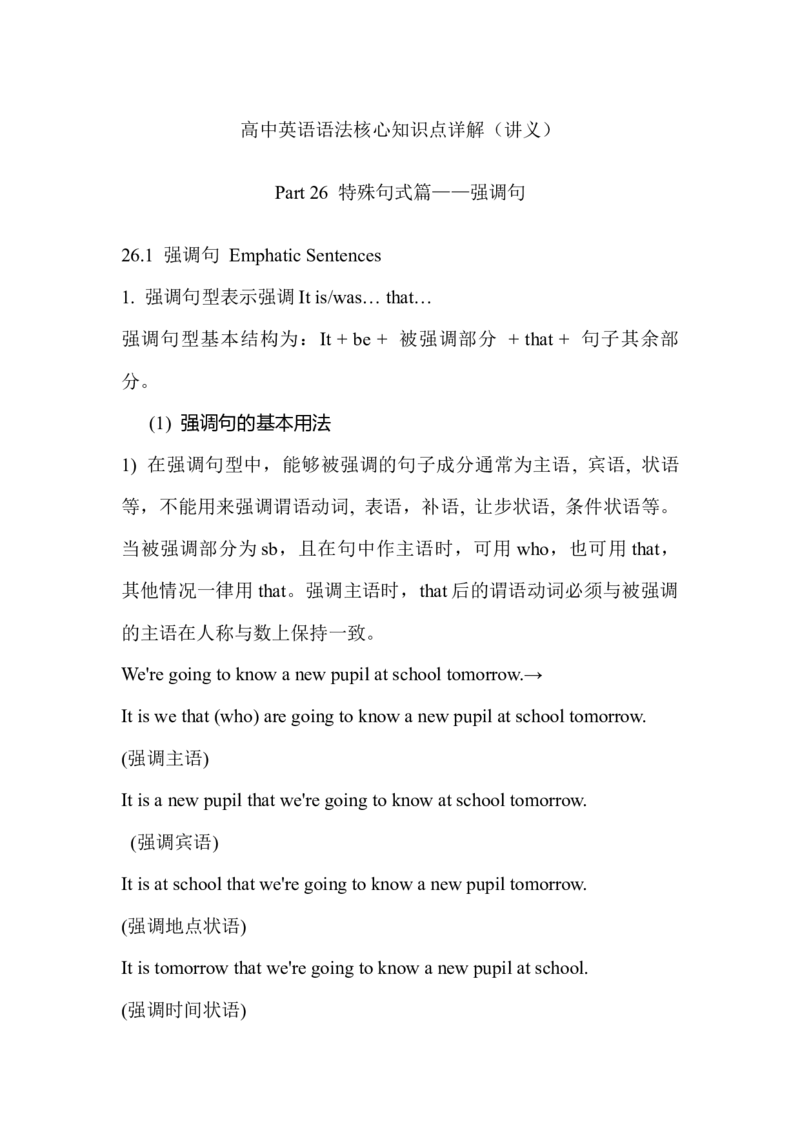
高中英语语法核心知识点详解(讲义)
Part 26 特殊句式篇——强调句
26.1 强调句 Emphatic Sentences
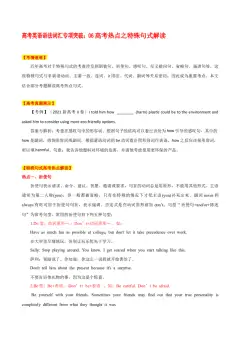
1. 强调句型表示强调It is/was… that…
强调句型基本结构为:It + be + 被强调部分 + that + 句子其余部
分。
(1) 强调句的基本用法
1) 在强调句型中,能够被强调的句子成分通常为主语, 宾语, 状语
等,不能用来强调谓语动词, 表语,补语, 让步状语, 条件状语等。
当被强调部分为 sb,且在句中作主语时,可用 who,也可用 that,
其他情况一律用 that。强调主语时,that后的谓语动词必须与被强调
的主语在人称与数上保持一致。
We're going to know a new pupil at school tomorrow.→
It is we that (who) are going to know a new pupil at school tomorrow.
(强调主语)
It is a new pupil that we're going to know at school tomorrow.
(强调宾语)
It is at school that we're going to know a new pupil tomorrow.
(强调地点状语)
It is tomorrow that we're going to know a new pupil at school.
(强调时间状语)注 如果要强调谓语动词,则用助动词do/does/did。
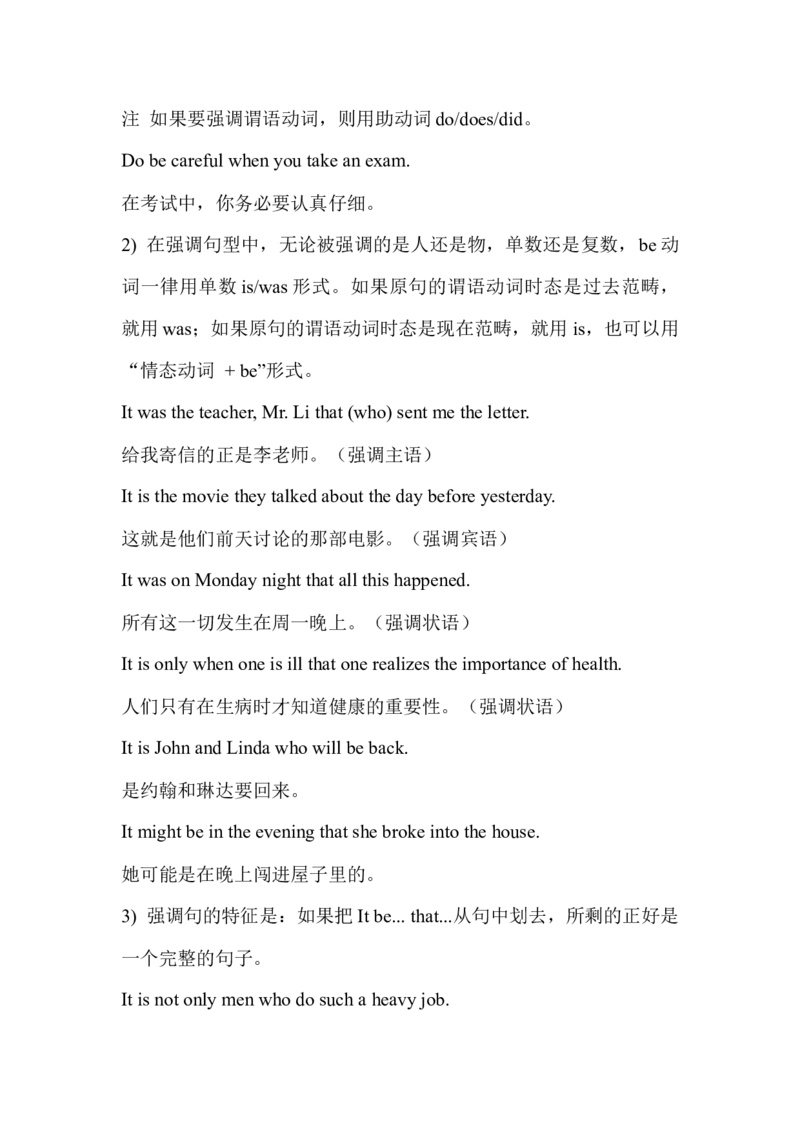
Do be careful when you take an exam.
在考试中,你务必要认真仔细。
2) 在强调句型中,无论被强调的是人还是物,单数还是复数,be动
词一律用单数 is/was 形式。如果原句的谓语动词时态是过去范畴,
就用was;如果原句的谓语动词时态是现在范畴,就用 is,也可以用
“情态动词 + be”形式。
It was the teacher, Mr. Li that (who) sent me the letter.
给我寄信的正是李老师。(强调主语)
It is the movie they talked about the day before yesterday.
这就是他们前天讨论的那部电影。(强调宾语)
It was on Monday night that all this happened.
所有这一切发生在周一晚上。(强调状语)
It is only when one is ill that one realizes the importance of health.
人们只有在生病时才知道健康的重要性。(强调状语)
It is John and Linda who will be back.
是约翰和琳达要回来。
It might be in the evening that she broke into the house.
她可能是在晚上闯进屋子里的。
3) 强调句的特征是:如果把 It be... that...从句中划去,所剩的正好是
一个完整的句子。
It is not only men who do such a heavy job.不是只有男人才会干这种力气活。
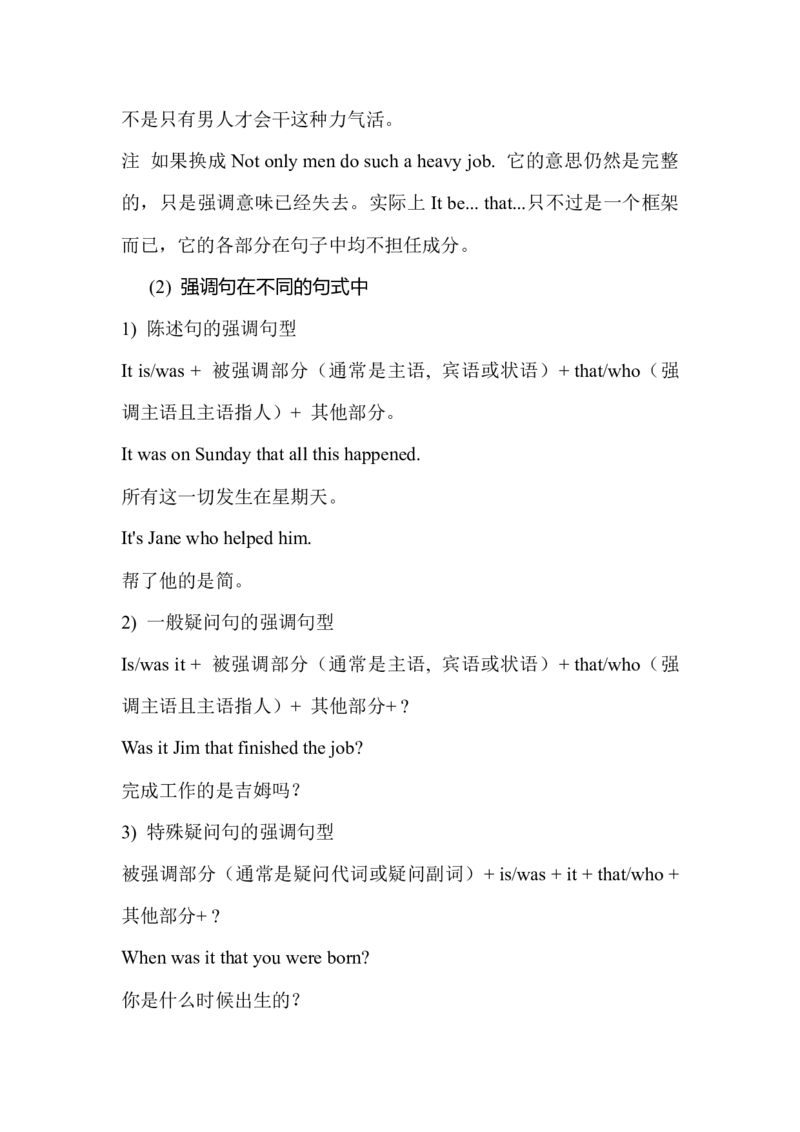
注 如果换成 Not only men do such a heavy job. 它的意思仍然是完整
的,只是强调意味已经失去。实际上 It be... that...只不过是一个框架
而已,它的各部分在句子中均不担任成分。
(2) 强调句在不同的句式中
1) 陈述句的强调句型
It is/was + 被强调部分(通常是主语, 宾语或状语)+ that/who(强
调主语且主语指人)+ 其他部分。
It was on Sunday that all this happened.
所有这一切发生在星期天。
It's Jane who helped him.
帮了他的是简。
2) 一般疑问句的强调句型
Is/was it + 被强调部分(通常是主语, 宾语或状语)+ that/who(强
调主语且主语指人)+ 其他部分+ ?
Was it Jim that finished the job?
完成工作的是吉姆吗?
3) 特殊疑问句的强调句型
被强调部分(通常是疑问代词或疑问副词)+ is/was + it + that/who +
其他部分+ ?
When was it that you were born?
你是什么时候出生的?4) not... until...句型的强调
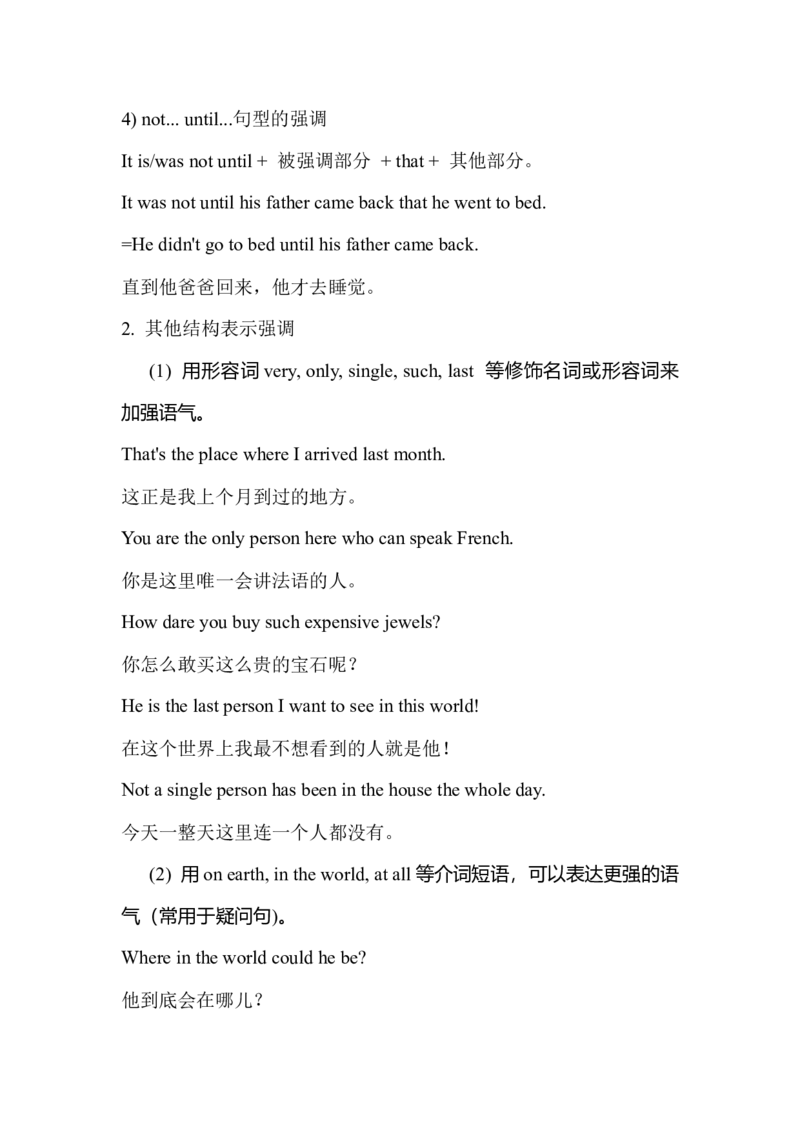
It is/was not until + 被强调部分 + that + 其他部分。
It was not until his father came back that he went to bed.
=He didn't go to bed until his father came back.
直到他爸爸回来,他才去睡觉。
2. 其他结构表示强调
(1) 用形容词 very, only, single, such, last 等修饰名词或形容词来
加强语气。
That's the place where I arrived last month.
这正是我上个月到过的地方。
You are the only person here who can speak French.
你是这里唯一会讲法语的人。
How dare you buy such expensive jewels?
你怎么敢买这么贵的宝石呢?
He is the last person I want to see in this world!
在这个世界上我最不想看到的人就是他!
Not a single person has been in the house the whole day.
今天一整天这里连一个人都没有。
(2) 用on earth, in the world, at all 等介词短语,可以表达更强的语
气(常用于疑问句)。
Where in the world could he be?
他到底会在哪儿?What on earth is it?
它究竟是什么?
What the devil are you talking about?
你究竟在说些什么?
What the hell are you doing there?
你到底在那干什么呢?
(3) 用助动词“do (does/did) + 动词原形”来表示强调。
He does know the place well.
他的确很熟悉这个地方。
Do write to me when you get there.
你到那儿后务必给我来信。
(4) 用if来表示强调
① if 从句 + I don't know who/what + does/is/has,主语部分也可以用
nobody does/is/has,或 everybody does/is/has 来代替(这里的 if 从句
往往是正话反说,反话正说)。
If they can't finish it, I don't know who can.
要是他们完成不了这件事,我不知道还有谁能做。(强调只有他们
能做)
If Bill is a fool, everybody is.
如果比尔是个傻瓜,那么人人都是傻瓜。(强调比尔不是傻瓜)
② if从句 + it be主句(把所要强调的内容放在 it be的后面,把其他
内容放在由if引导的从句中)。If there is one thing she loves, it is money.
如果说世界上还有她爱的东西,那便是金钱。
If anyone knew the truth, it was John.
如果说谁了解事实的真相,那便是约翰。
(5) 用破折号, 黑体字也可以表示强调,加强语气。
The new term begins in September.
我们在9月开学。(强调时间)
It's because of hard work—five years of hard work!
那是因为艰苦的工作——5年艰苦的工作!
(6) 用重复来表示强调。
Why! Why! The cage is empty!
啊!啊!箱子是空的。
They walked for miles and miles.
他们走了好多英里。
(7) 双重否定表示强调。
Shopping online is never without drawbacks.
网上购物并非全无弊端。
(8) 用感叹句来表示强烈的感情,突出说话人的情感。
How interesting a story it is!
这是一个多么有趣的故事啊!
Oh, what a lie!
啊,真是弥天大谎!(9) 用倒装句(也就是将要强调的句子或被强调的部分置于句
首)来加强语气。
On the table were some flowers.
桌上摆着一些花。
Only in this way, can we finish this job.
只有这样,我们才能完成这项工作。(强调方式)
Many a time have I climbed that hill.
我多次翻过那座山。