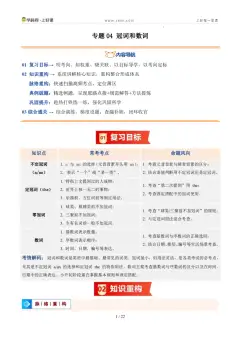
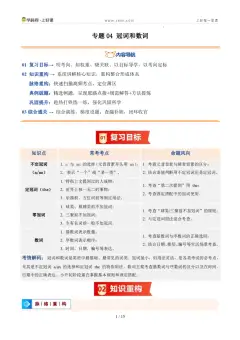
专题03 情态动词和it 的用法
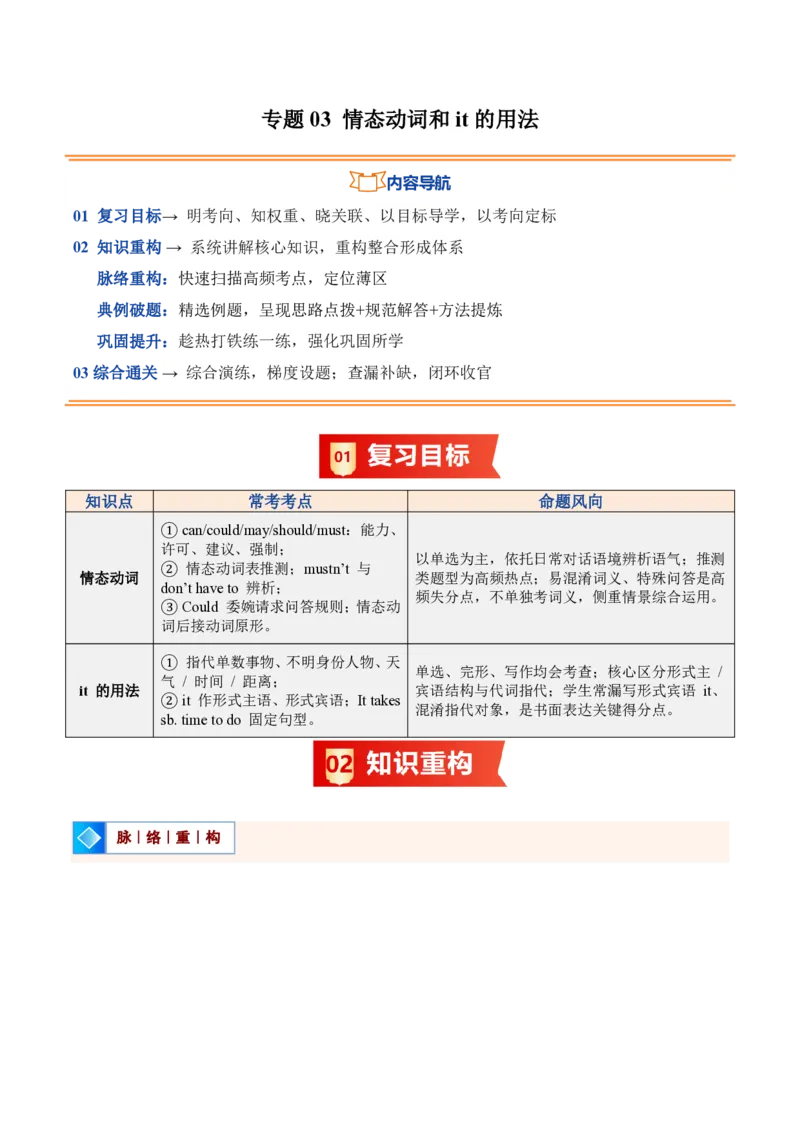
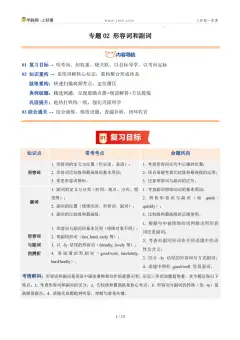
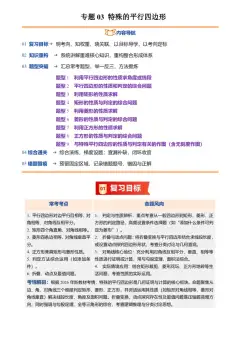
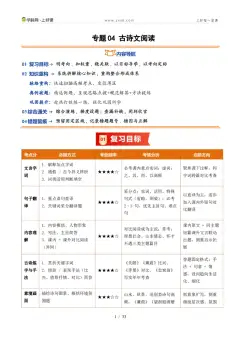
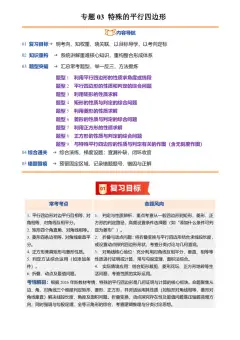
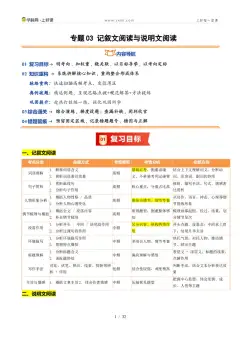
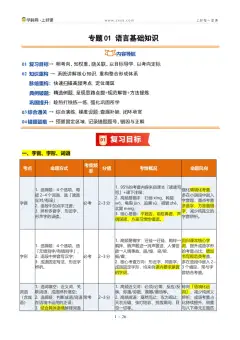
内容导航
01 复习目标→ 明考向、知权重、晓关联、以目标导学,以考向定标
02 知识重构 → 系统讲解核心知识,重构整合形成体系
   脉络重构:快速扫描高频考点,定位薄区
   典例破题:精选例题,呈现思路点拨+规范解答+方法提炼
   巩固提升:趁热打铁练一练,强化巩固所学
03 综合通关 → 综合演练,梯度设题;查漏补缺,闭环收官
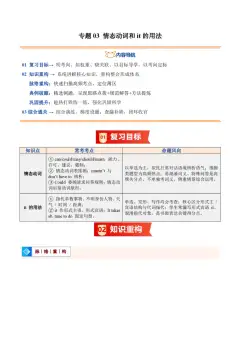
知识点
常考考点
命题风向
情态动词
① can/could/may/should/must:能力、
许可、建议、强制;
② 情态动词表推测;mustn’t 与
don’t have to 辨析;
③ Could 委婉请求问答规则;情态动
词后接动词原形。
以单选为主,依托日常对话语境辨析语气;推测
类题型为高频热点;易混淆词义、特殊问答是高
频失分点,不单独考词义,侧重情景综合运用。
it 的用法
① 指代单数事物、不明身份人物、天
气 / 时间 / 距离;
② it 作形式主语、形式宾语;It takes
sb. time to do 固定句型。
单选、完形、写作均会考查;核心区分形式主 /
宾语结构与代词指代;学生常漏写形式宾语 it、
混淆指代对象,是书面表达关键得分点。
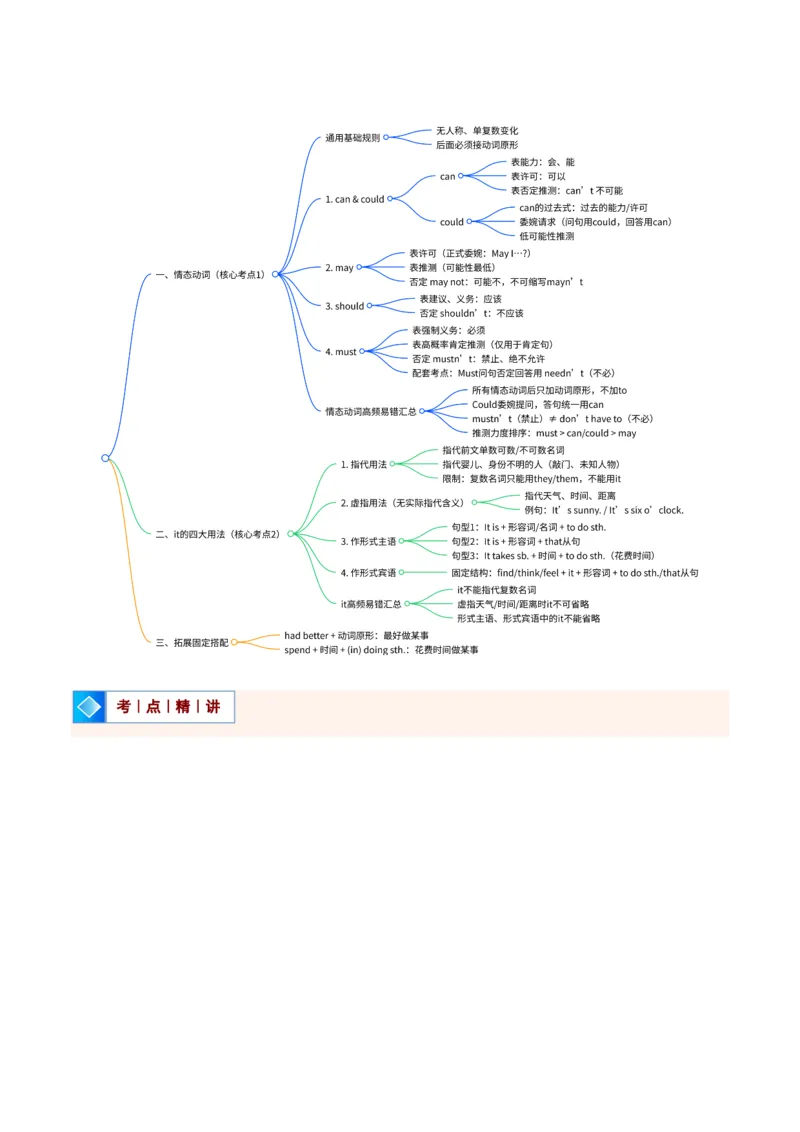
脉|络|重|构
考|点|精|讲
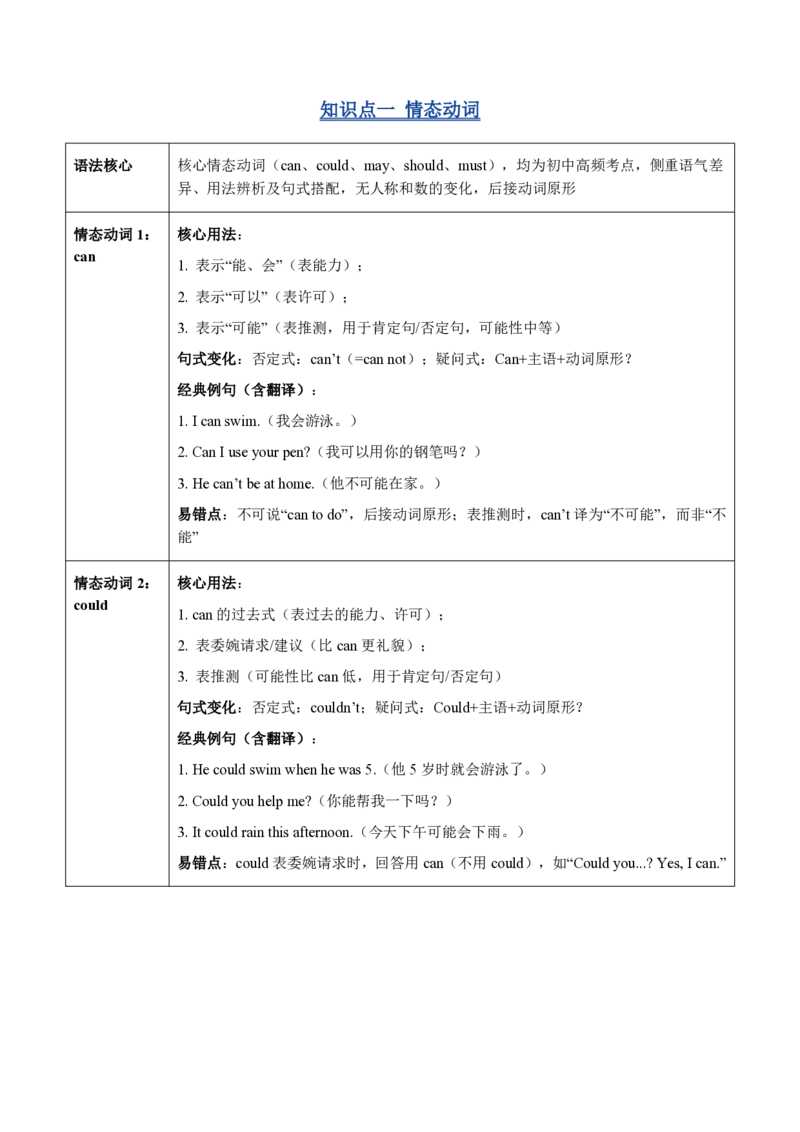
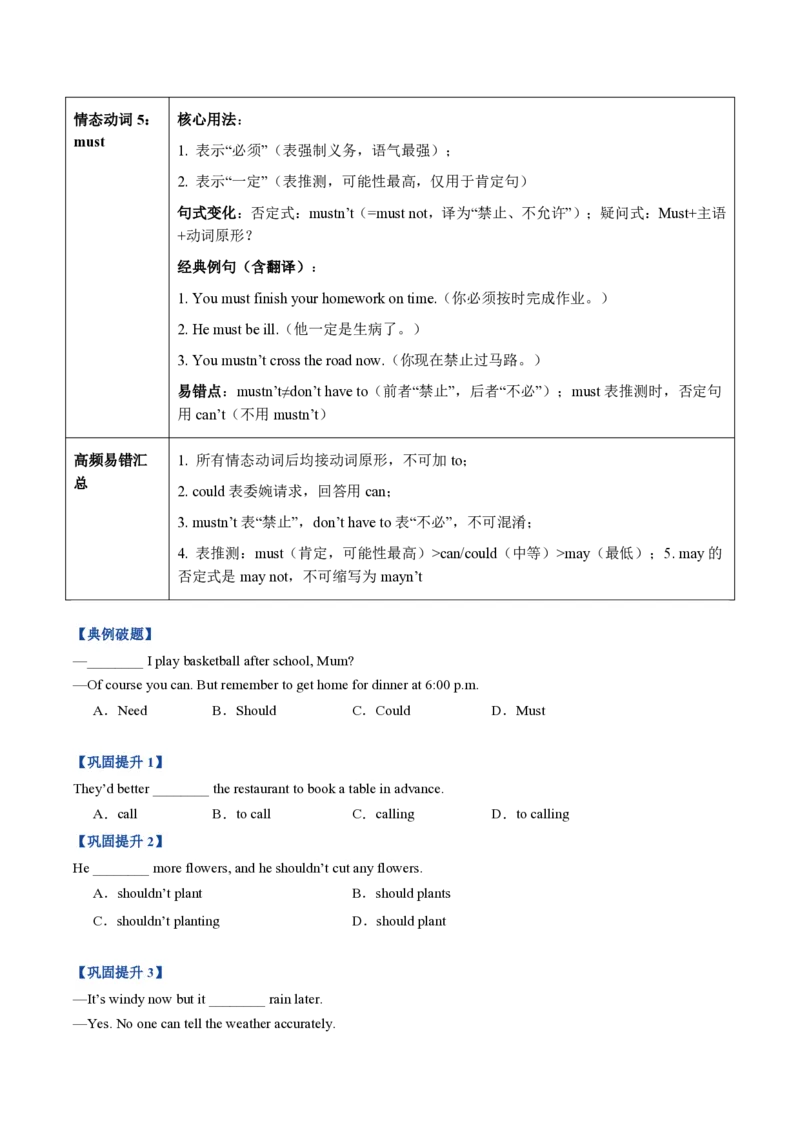
知识点一 情态动词
语法核心
核心情态动词(can、could、may、should、must),均为初中高频考点,侧重语气差
异、用法辨析及句式搭配,无人称和数的变化,后接动词原形
情态动词1:
can
核心用法:
1. 表示“能、会”(表能力);
2. 表示“可以”(表许可);
3. 表示“可能”(表推测,用于肯定句/否定句,可能性中等)
句式变化:否定式:can’t(=can not);疑问式:Can+主语+动词原形?
经典例句(含翻译):
1. I can swim.(我会游泳。)
2. Can I use your pen?(我可以用你的钢笔吗?)
3. He can’t be at home.(他不可能在家。)
易错点:不可说“can to do”,后接动词原形;表推测时,can’t 译为“不可能”,而非“不
能”
情态动词2:
could
核心用法:
1. can 的过去式(表过去的能力、许可);
2. 表委婉请求/建议(比can 更礼貌);
3. 表推测(可能性比can 低,用于肯定句/否定句)
句式变化:否定式:couldn’t;疑问式:Could+主语+动词原形?
经典例句(含翻译):
1. He could swim when he was 5.(他5 岁时就会游泳了。)
2. Could you help me?(你能帮我一下吗?)
3. It could rain this afternoon.(今天下午可能会下雨。)
易错点:could 表委婉请求时,回答用can(不用could),如“Could you...? Yes, I can.”
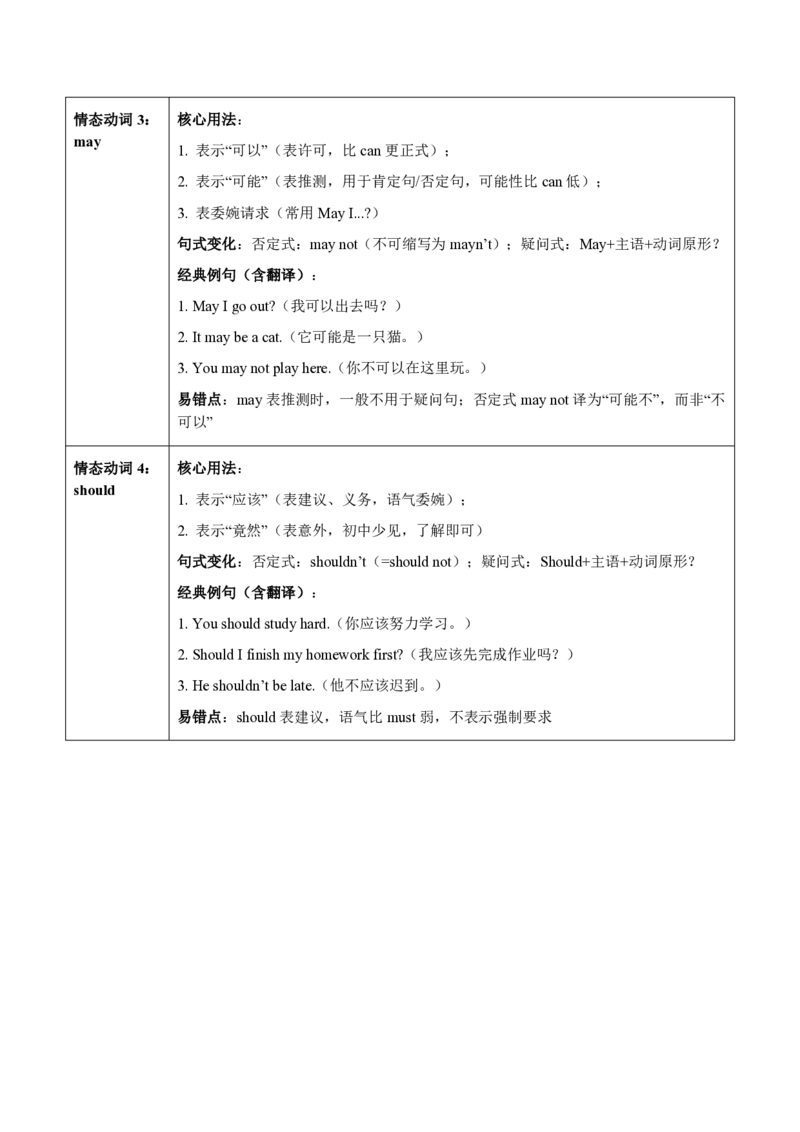
情态动词3:
may
核心用法:
1. 表示“可以”(表许可,比can 更正式);
2. 表示“可能”(表推测,用于肯定句/否定句,可能性比can 低);
3. 表委婉请求(常用May I...?)
句式变化:否定式:may not(不可缩写为mayn’t);疑问式:May+主语+动词原形?
经典例句(含翻译):
1. May I go out?(我可以出去吗?)
2. It may be a cat.(它可能是一只猫。)
3. You may not play here.(你不可以在这里玩。)
易错点:may 表推测时,一般不用于疑问句;否定式may not 译为“可能不”,而非“不
可以”
情态动词4:
should
核心用法:
1. 表示“应该”(表建议、义务,语气委婉);
2. 表示“竟然”(表意外,初中少见,了解即可)
句式变化:否定式:shouldn’t(=should not);疑问式:Should+主语+动词原形?
经典例句(含翻译):
1. You should study hard.(你应该努力学习。)
2. Should I finish my homework first?(我应该先完成作业吗?)
3. He shouldn’t be late.(他不应该迟到。)
易错点:should 表建议,语气比must 弱,不表示强制要求
情态动词5:
must
核心用法:
1. 表示“必须”(表强制义务,语气最强);
2. 表示“一定”(表推测,可能性最高,仅用于肯定句)
句式变化:否定式:mustn’t(=must not,译为“禁止、不允许”);疑问式:Must+主语
+动词原形?
经典例句(含翻译):
1. You must finish your homework on time.(你必须按时完成作业。)
2. He must be ill.(他一定是生病了。)
3. You mustn’t cross the road now.(你现在禁止过马路。)
易错点:mustn’t≠don’t have to(前者“禁止”,后者“不必”);must 表推测时,否定句
用can’t(不用mustn’t)
高频易错汇
总
1. 所有情态动词后均接动词原形,不可加to;
2. could 表委婉请求,回答用can;
3. mustn’t 表“禁止”,don’t have to 表“不必”,不可混淆;
4. 表推测:must(肯定,可能性最高)>can/could(中等)>may(最低);5. may 的
否定式是may not,不可缩写为mayn’t
【典例破题】
—________ I play basketball after school, Mum?
—Of course you can. But remember to get home for dinner at 6:00 p.m.
A.Need
B.Should
C.Could
D.Must
【巩固提升1】
They’d better ________ the restaurant to book a table in advance.
A.call
B.to call
C.calling
D.to calling
【巩固提升2】
He ________ more flowers, and he shouldn’t cut any flowers.
A.shouldn’t plant
B.should plants
C.shouldn’t planting
D.should plant
【巩固提升3】
—It’s windy now but it ________ rain later.
—Yes. No one can tell the weather accurately.
A.may
B.need
C.should
D.must
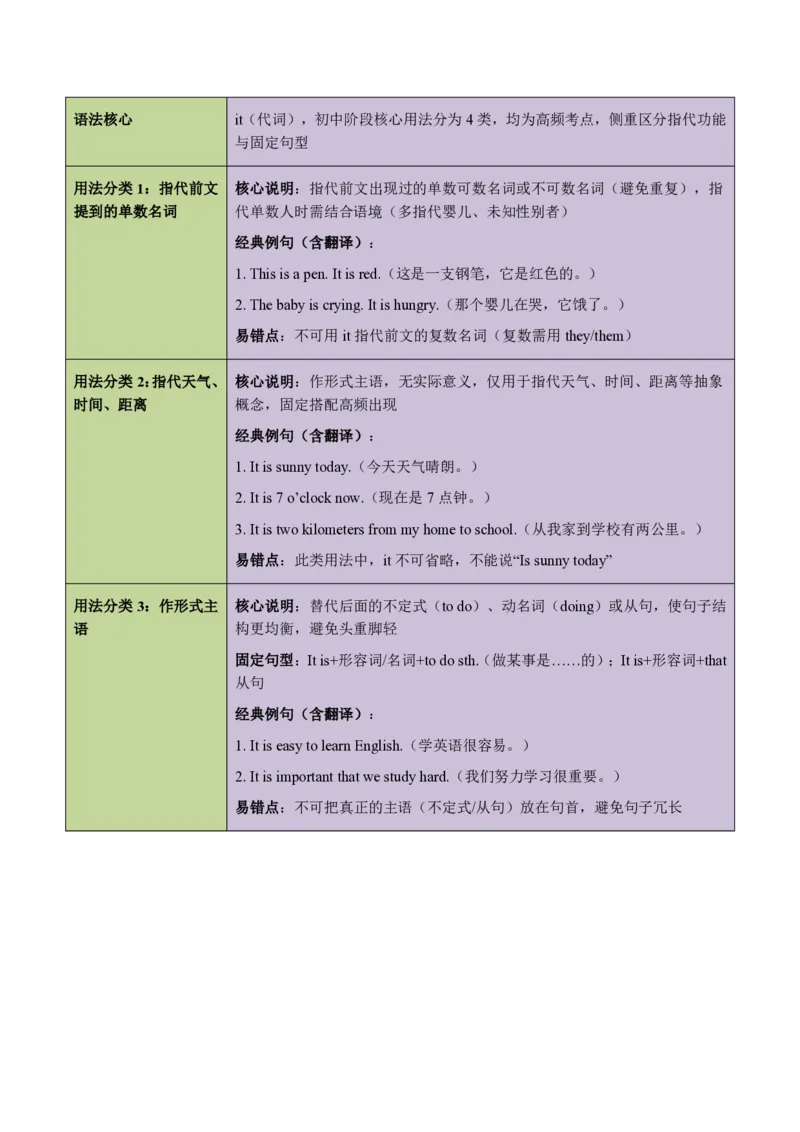
知识点二 it 的用法
语法核心
it(代词),初中阶段核心用法分为4 类,均为高频考点,侧重区分指代功能
与固定句型
用法分类1:指代前文
提到的单数名词
核心说明:指代前文出现过的单数可数名词或不可数名词(避免重复),指
代单数人时需结合语境(多指代婴儿、未知性别者)
经典例句(含翻译):
1. This is a pen. It is red.(这是一支钢笔,它是红色的。)
2. The baby is crying. It is hungry.(那个婴儿在哭,它饿了。)
易错点:不可用it 指代前文的复数名词(复数需用they/them)
用法分类2:指代天气、
时间、距离
核心说明:作形式主语,无实际意义,仅用于指代天气、时间、距离等抽象
概念,固定搭配高频出现
经典例句(含翻译):
1. It is sunny today.(今天天气晴朗。)
2. It is 7 o’clock now.(现在是7 点钟。)
3. It is two kilometers from my home to school.(从我家到学校有两公里。)
易错点:此类用法中,it 不可省略,不能说“Is sunny today”
用法分类3:作形式主
语
核心说明:替代后面的不定式(to do)、动名词(doing)或从句,使句子结
构更均衡,避免头重脚轻
固定句型:It is+形容词/名词+to do sth.(做某事是……的);It is+形容词+that
从句
经典例句(含翻译):
1. It is easy to learn English.(学英语很容易。)
2. It is important that we study hard.(我们努力学习很重要。)
易错点:不可把真正的主语(不定式/从句)放在句首,避免句子冗长
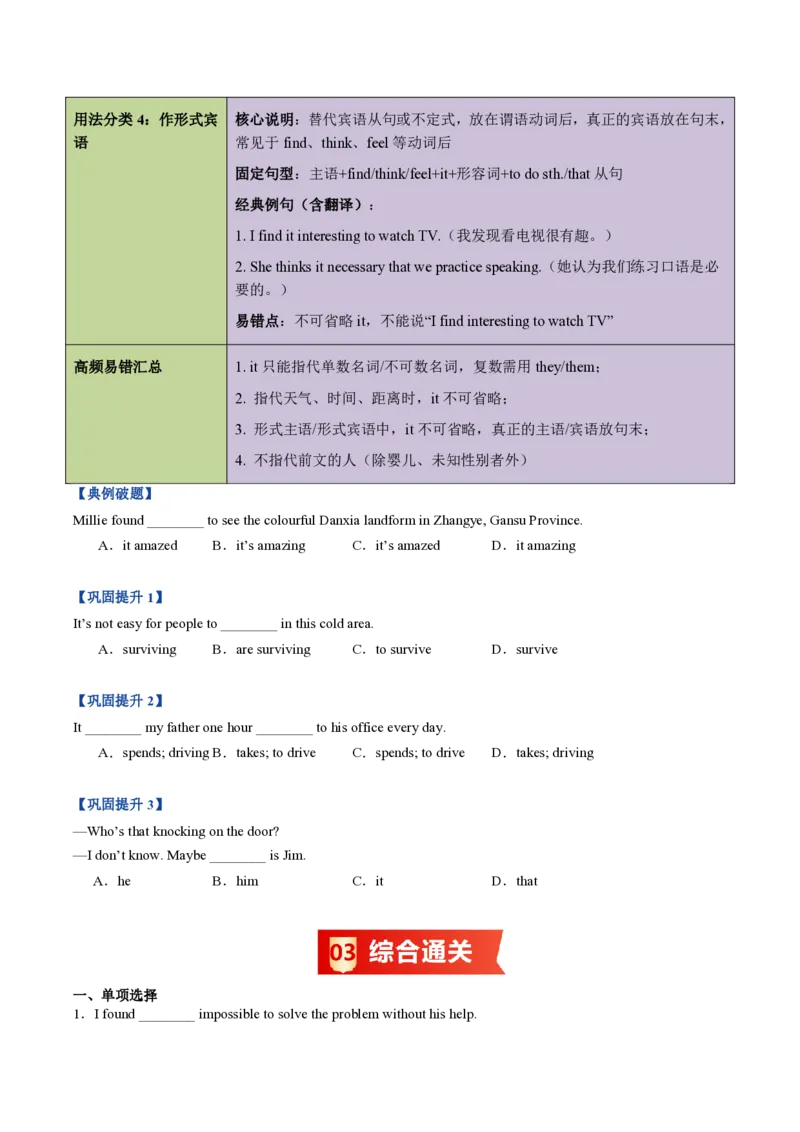
用法分类4:作形式宾
语
核心说明:替代宾语从句或不定式,放在谓语动词后,真正的宾语放在句末,
常见于find、think、feel 等动词后
固定句型:主语+find/think/feel+it+形容词+to do sth./that 从句
经典例句(含翻译):
1. I find it interesting to watch TV.(我发现看电视很有趣。)
2. She thinks it necessary that we practice speaking.(她认为我们练习口语是必
要的。)
易错点:不可省略it,不能说“I find interesting to watch TV”
高频易错汇总
1. it 只能指代单数名词/不可数名词,复数需用they/them;
2. 指代天气、时间、距离时,it 不可省略;
3. 形式主语/形式宾语中,it 不可省略,真正的主语/宾语放句末;
4. 不指代前文的人(除婴儿、未知性别者外)
【典例破题】
Millie found ________ to see the colourful Danxia landform in Zhangye, Gansu Province.
A.it amazed
B.it’s amazing
C.it’s amazed
D.it amazing
【巩固提升1】
It’s not easy for people to ________ in this cold area.
A.surviving
B.are surviving
C.to survive
D.survive
【巩固提升2】
It ________ my father one hour ________ to his office every day.
A.spends; driving B.takes; to drive
C.spends; to drive
D.takes; driving
【巩固提升3】
—Who’s that knocking on the door?
—I don’t know. Maybe ________ is Jim.
A.he
B.him
C.it
D.that
一、单项选择
1.I found ________ impossible to solve the problem without his help.
A.its
B.the
C.it
D.that
2.The twins look the same, even their father finds ________ difficult to tell them from each other.
A.that
B.this
C.it
D.those
3._______ is hard to walk in the street when the weather is wet.
A.They
B.This
C.It
D.That
4.________ is very honest of you ________ the money you found on the playground.
A.That; to return
B.This; returning
C.It; to return
D.It; returning
5.________ difficult for the little plants ________ to the new pots at first.
A.It’s; adapt
B.It’s; to adapt
C.That’s; adapt
D.That’s; to adapt
6.I think ________ is important to read the instructions before buying something.
A.this
B.that
C.it
D.which
7.—I’m planning to go to Sanya this winter holiday. How’s the weather there?
—Not so hot. Sometimes _________ is very cool.
A.this
B.that
C.one
D.it
8.—Look at the watch. ________ 7 o’clock now.
—Let’s go to school.
A.It
B.They
C.It’s
D.They’re
9.—_______ is the weather in Beijing?
—_______ warm and sunny.
A.What; It’s
B.How; It’s
C.How; It
D.What; It
10.—Dad, someone is knocking at the door.
—Go and see who ________ is. I am busy now.
A.him
B.she
C.it
D.this
11.—Who ________ your English teacher, Tom?
—________ Miss Green.
A.is; It’s
B.are; It’s
C.is; He is
D.are; Its
12.Linda, there is somebody knocking at the door. Go and see who ________ is.
A.he
B.she
C.it
D.this
13.—Someone is knocking on the door.
—________ must be Jim. He is here to give back my bike.
A.He
B.This
C.It
D.They
14.—Which “could” is used to show politeness?  —“________ ” is.
A.He could not shout at you.
B.They could do it well in the past.
C.I could give a seat to someone in need. D.Could you play with the dog for a short while?
15.—Who ________ it be knocking at the door?
—It ________ be Grandpa. He told me he was coming just now.
A.must; must
B.can; must
C.may; can’t
D.may; mustn’t
16.—Dick, ________ I use your dictionary?
—Yes, sure. ________ you give it to David after you use it?
A.will; Would
B.may; Might
C.can; Could
D.shall; Should
17.How ________ a large crowd of students are shouting next door! They ________ win the match.
A.exciting; must B.excitingly; may
C.excited; may
D.excitedly; must
18.I want to join the ________ club because I can ________ well.
A.swims; swim
B.swimming; swim
C.swim; swims
D.swimming; swims
19.—Can you play the guitar?
—________. But I can play the piano.
A.Yes, I can.
B.No, I can’t.
C.No, they can’t.
D.Yes, they can.
20.It ________ rain this afternoon. You’d better take an umbrella.
A.may
B.must
C.need
D.should
21.— Must we finish all exercises today?
— Yes, you ________.
A.must
B.need
C.can
D.may
22.The Cheshire Cat could ________ and disappear suddenly.
A.appear
B.appears
C.appearing
D.to appear
23.We should ________ with our classmates.
A.cooperate
B.cooperation
C.cooperating
D.to cooperate
24.It’s raining heavily outside, so we ________ stay at home.
A.have to
B.can
C.may
D.mustn’t
25.—________ I finish my homework now, Mum?
— No, you ________. You can do it after dinner.
A.Must; mustn’t B.May; needn’t
C.Must; needn’t
D.Can; can’t
26.— Mum, I want to eat a hamburger for lunch. ________ you please buy one for me?
— No way! You ________ eat more vegetables instead of junk food.
A.Could; should B.Should; must
C.Must; should
D.Could; mustn’t
27.It’s cold outside. You should ________ your coat.
A.wear
B.wears
C.wearing
D.wore
28.She can ________ English very well.
A.speak
B.speaks
C.speaking
D.to speak
29.Scientists made ________ possible to use robots to clean the rooms.
A.it is
B.that it
C.it
D.it’s
30.We all thought ________ necessary for you to spend as much time as you could ________ English.
A.that; improving B.it is; to improve
C.it; improve
D.it was; improving
二、阅读理解
About 500 years ago in China, there was a famous traveller named Xu Xiake. He spent 30 years travelling
across China.
As a child, Xu enjoyed reading books about China’s mountains and rivers. He decided to see them when he
grew up. At that time, many kids studied hard to become officials. But Xu’s father never made him take exams.
Instead, he encouraged his son to explore the world. Xu began his journey (旅行) at about 20. Before he left, his
mother made him a travelling hat to encourage him.
Xu travelled to 21 provinces (省) and over 100 cities in China. He climbed thousands of mountains and
visited over 350 caves (洞穴). He was the first person to find the peak of Huangshan Mountain. He was also the
first to find lots of karst (喀斯特) caves. He found the Yangtze River’s headwater (源头). All of these were very
important for the later study of geography. Xu travelled mainly on foot. He slept and ate in nature. Sometimes he
met dangers like falling into rivers or running into dangerous animals. But he wasn’t afraid and enjoyed his
journey.
Xu kept a travelling diary. It was published (出版) only after he died. The book Travel Diaries of Xu Xiake is
still liked by people today.
Being a traveller and an explorer can be very exciting. But you must be brave and have skills. Do you want
to be one like Xu Xiake?
1.Why did Xu decide to travel across China?
A.Because he was interested in nature.
B.Because he wanted to write a book.
C.Because travelling could help him become an official.
D.Because he had to find a new home.
2.What did Xu Xiake do during his travels?
A.He discovered the Yellow River’s headwater. B.He explored many places around China.
C.He became famous because of his diary. D.He taught people how to protect nature.
3.What does the underlined word “these” in Paragraph 3 refer to?
A.Travelers.
B.Places.
C.Xu’s findings.
D.The caves only.
4.What can we learn from Xu Xiake’s experience?
A.If a man travels far, he will know more. B.The future starts today, not tomorrow.
C.Every journey has its end.
D.Old habits die hard
5.What is the best title for this passage?
A.A World-Famous Diary
B.The Trip to the Big Mountains
C.A Cool Chinese Traveller
D.How to Write a Travel Diary
Saihanba is China’s largest forest. It lies in the south of Inner Mongolia Autonomous Region (内蒙古自治
区). Saihanba means “beautiful and high mountains”.
Around the 10th century, the rulers of the Liao Dynasty (916—1125) made it a royal (皇家的) hunting place
because it was home to beautiful forests, green grasslands, clear lakes and different kinds of wild animals. Emperor
Kangxi of the Qing Dynasty (1644—1911) liked Saihanba so much that he made hunting there a royal festival. The
royal festival finally stopped in 1860 because of no money and it had to be open to the public. After that, the
cutting down of trees and wild fires changed green Saihanba into gray deserts. By the 1950s, the beauty of
Saihanba had completely disappeared with only one tree left. The tree is now famous as “the Tree of Honor”.
On seeing the tree, Chinese scientists made up their minds and dreamt of restoring Saihanba. In February,
1962, the plans were made and more than 120 foresters joined 242 local people in Saihanba to begin rebuilding it.
Over the next 55 years, those first tree-planters fought against many difficulties to continue planting trees. After
their death, their children and relatives followed their footsteps and went on with their hard work of planting trees.
Today, the scientists’ dream has come true and beautiful grassland and flowers appear again around the tree
of honor. Chinese people successfully changed Saihanba in the past half-century.
1.What’s the right order of events (事件) given in Paragraph 2?
①Saihanba became a royal hunting place.
②Saihanba was a desert and disappeared.
③Saihanba wasn’t closed to the public any more.
④Saihanba turned into the place for royal hunting festivals.
A.①③②④
B.①③④②
C.①④③②
D.①④②③
2.What does the underlined word “restoring” in Paragraph 3 probably mean?
A.Looking around.
B.Bringing back.
C.Arriving at.
D.Travelling to.
3.According to Paragraph 4, how does the writer feel about Chinese people?
A.Proud.
B.Worried.
C.Cheerful.
D.Nervous.
4.Which of the following best shows the structure of the passage? (Paragraph 1—Paragraph 4)
A.
B.
C.
D.
5.What is the best title of this passage?
A.Saihanba: Past and Present
B.The Largest Forest in China
C.The Disappearing Saihanba
D.The Tree of Honor in Saihanba
The graphics (图表) show the weather report for City G today and the following six days.

1.What’s the date today in City G?
A.It’s 13th May. B.It’s 14th May.
C.It’s 15th May.
D.It’s 16th May.
2.What's the temperature at 10:00 am today in City G?
A.It’s 21℃.
B.It’s 23℃.
C.It’s 25℃.
D.It’s 24℃.
3.Henry is in City G today. What will most probably happen to him according to the graphics?
A.He will wash his car.
B.He will catch a cold.
C.He will ride fast on the road.
D.He will wear a coat.
4.What will the weather be like on Wednesday in City G?
A.It will be rainy. B.It will be sunny.
C.It will be cloudy.
D.It will be windy.
5.According to the weather report, the highest temperature of this week will be on ________.
A.Sunday
B.Saturday
C.Friday
D.Thursday
三、任务型阅读
The weather is different in different seasons. Each season has its own special weather and activities.
Spring is warm and rainy. The flowers bloom, and the trees turn green. People like to go hiking, have
picnics, and fly kites in spring. It’s a great time to enjoy nature.
Summer is hot and sunny. The temperature is high, and people often go swimming, go to the beach, or eat
ice cream. Some people also like to travel to cool places during summer vacation.
Autumn is cool and windy. The leaves turn red and yellow, and fall from the trees. People like to pick
apples, climb mountains, and have barbecues. It’s a harvest season.
Winter is cold and snowy. Some places have heavy snow, and people can build snowmen, go sledding, or
ski. People also like to stay at home and drink hot chocolate.
1.What’s the weather like in spring?

.
2.What do people like to do in summer?

.
3.Is autumn a harvest season?

.
4.What can people do in winter if there is heavy snow?

.
5.Do you like winter? Why or why not?

.
阅读短文,根据短文内容回答问题,每个题目的答案不超过5 个单词。
Kong Fuzi is known in the west as Confucius. Confucius was born into a noble (贵族的) family around 551
BC. But his family became poor later. When he was about 15, he began to love learning. In those days, only the
upper class and royal members (王室成员) had the chance to learn. It was hard for him to find a way to learn. To
solve this, he went to work for a nobleman.
Confucius studied hard and became a learned man. He probably was the most learned man of his day. People
heard of his knowledge and sent their sons to study under him. He was the first teacher in China. Confucius taught
anyone who was thirsty for (渴求) knowledge.
Confucius taught many ideas about study to his students over 2,500 years ago. People today still study them.
Today, people celebrate the birthday of Confucius to show respect for him, the great teacher.
1.When did Confucius begin to love learning?


2.How did Confucius find a way to learn?


3.Why did people send their sons to Confucius?


4.What do people today still study from Confucius?


5.What do you think of Confucius from the passage?


夸克群
群满加Q
秘塔
QQ群
AI
【温馨提示】本页为广告页,打印前可以把这页删掉
群
满
或
未
通
过
:
请
至
左
侧
资
料
库
文
档
获
取
最
新
二
维
码
防失联渠道二:https://link3.cc/xbjf
防失联渠道一