专题04 祈使句、there be 句型和特殊疑问句
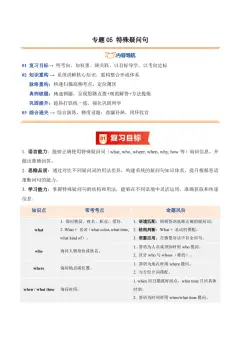
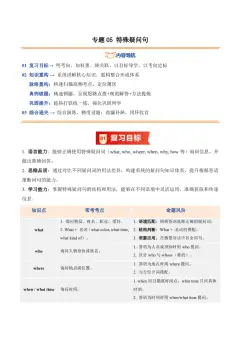
内容导航
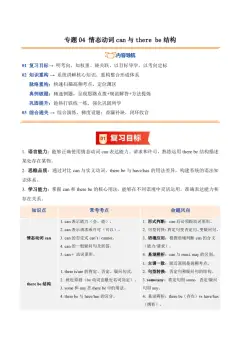
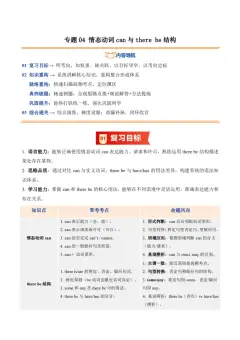
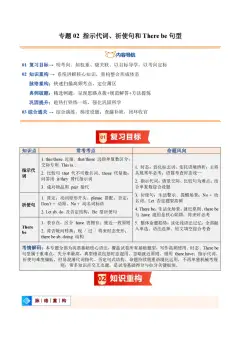
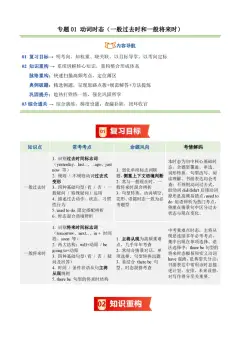
01 复习目标→明考向、知权重、晓关联、以目标导学,以考向定标
02 知识重构→系统讲解核心知识,重构整合形成体系
脉络重构:快速扫描高频考点,定位薄区
典例破题:精选例题,呈现思路点拨+规范解答+方法提炼
巩固提升:趁热打铁练一练,强化巩固所学
03 综合通关→综合演练,梯度设题;查漏补缺,闭环收官
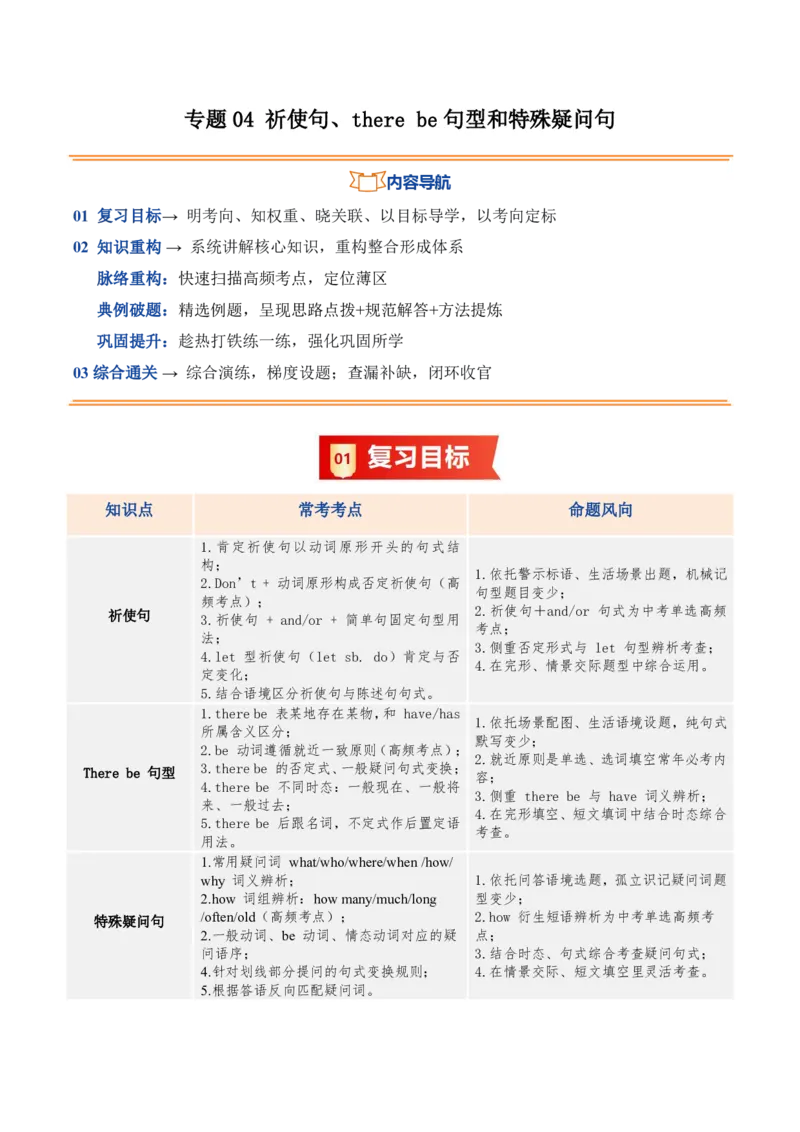
知识点
常考考点
命题风向
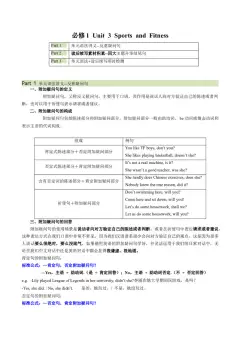
祈使句
1.肯定祈使句以动词原形开头的句式结
构;
2.Don’t + 动词原形构成否定祈使句(高
频考点);
3.祈使句+ and/or + 简单句固定句型用
法;
4.let 型祈使句(let sb. do)肯定与否
定变化;
5.结合语境区分祈使句与陈述句句式。
1.依托警示标语、生活场景出题,机械记
句型题目变少;
2.祈使句+and/or 句式为中考单选高频
考点;
3.侧重否定形式与let 句型辨析考查;
4.在完形、情景交际题型中综合运用。
There be 句型
1.there be 表某地存在某物,和have/has
所属含义区分;
2.be 动词遵循就近一致原则(高频考点);
3.there be 的否定式、一般疑问句式变换;
4.there be 不同时态:一般现在、一般将
来、一般过去;
5.there be 后跟名词,不定式作后置定语
用法。
1.依托场景配图、生活语境设题,纯句式
默写变少;
2.就近原则是单选、选词填空常年必考内
容;
3.侧重there be 与have 词义辨析;
4.在完形填空、短文填词中结合时态综合
考查。
特殊疑问句
1.常用疑问词what/who/where/when /how/
why 词义辨析;
2.how 词组辨析:how many/much/long
/often/old(高频考点);
2.一般动词、be 动词、情态动词对应的疑
问语序;
4.针对划线部分提问的句式变换规则;
5.根据答语反向匹配疑问词。
1.依托问答语境选题,孤立识记疑问词题
型变少;
2.how 衍生短语辨析为中考单选高频考
点;
3.结合时态、句式综合考查疑问句式;
4.在情景交际、短文填空里灵活考查。
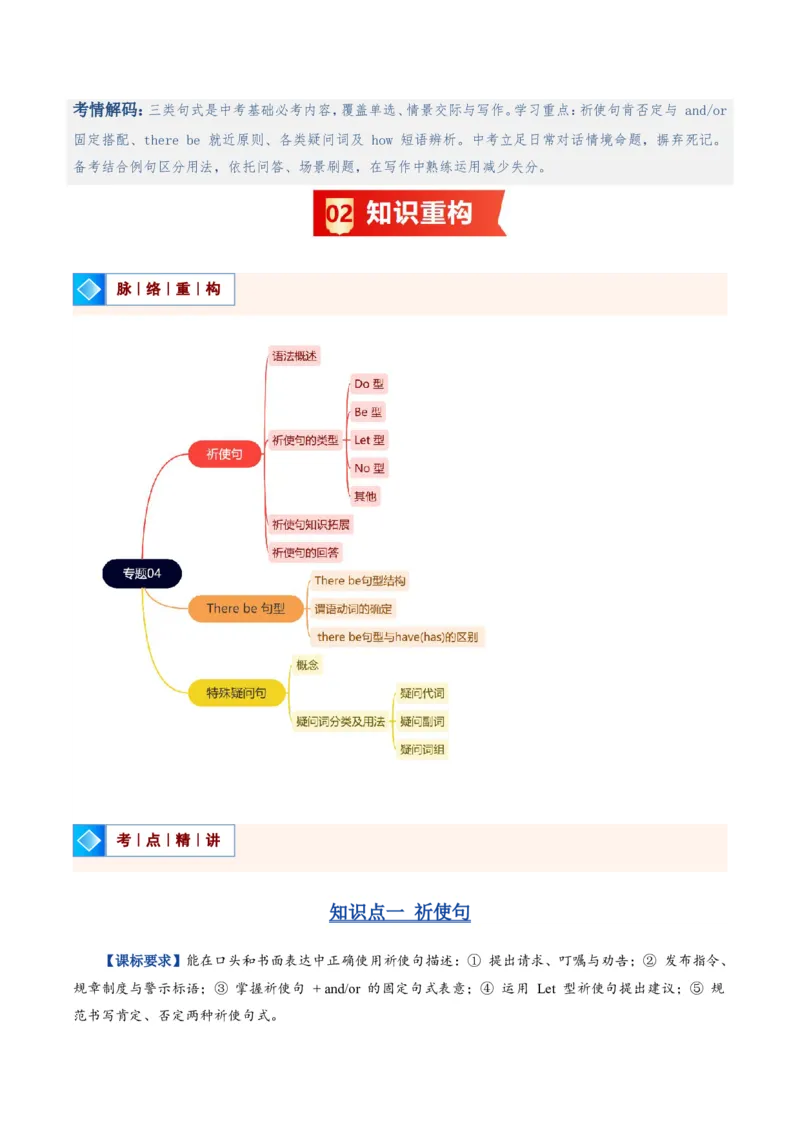
考情解码:三类句式是中考基础必考内容,覆盖单选、情景交际与写作。学习重点:祈使句肯否定与and/or
固定搭配、there be 就近原则、各类疑问词及how 短语辨析。中考立足日常对话情境命题,摒弃死记。
备考结合例句区分用法,依托问答、场景刷题,在写作中熟练运用减少失分。
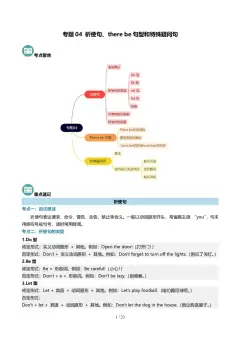
脉|络|重|构
考|点|精|讲
知识点一祈使句
【课标要求】能在口头和书面表达中正确使用祈使句描述:①提出请求、叮嘱与劝告;②发布指令、
规章制度与警示标语;③掌握祈使句+ and/or 的固定句式表意;④运用Let 型祈使句提出建议;⑤规
范书写肯定、否定两种祈使句式。
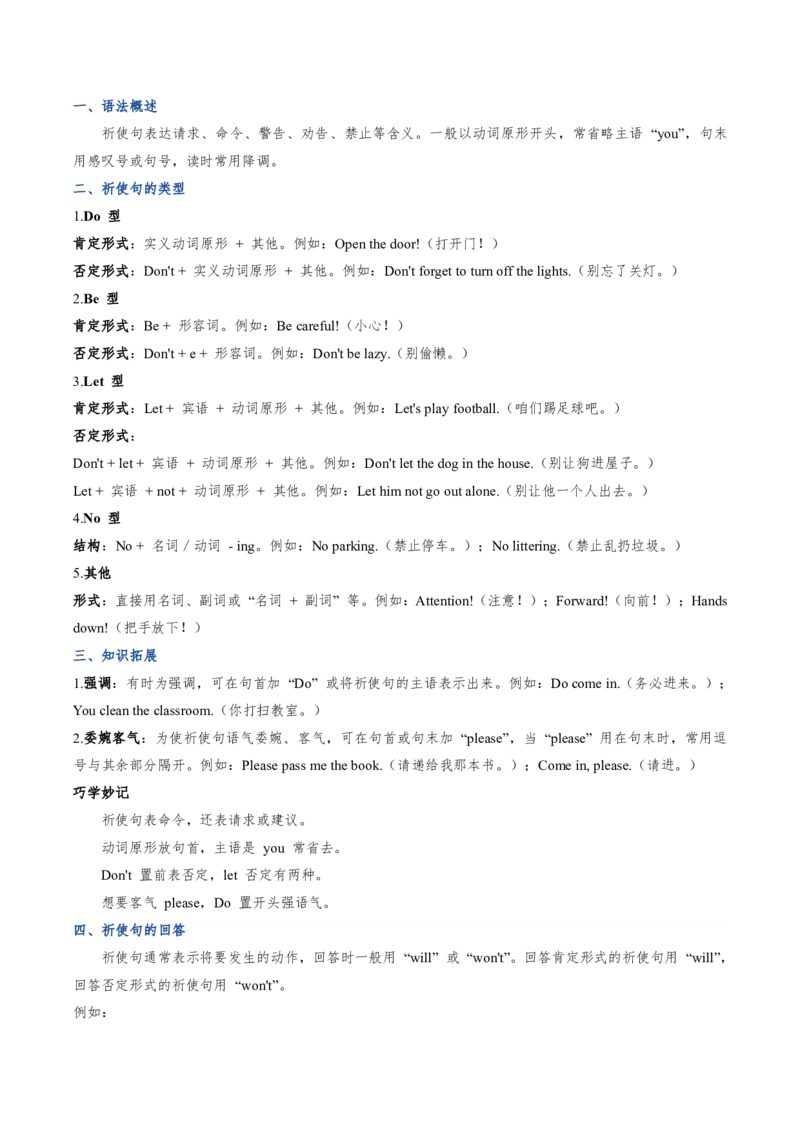
一、语法概述
祈使句表达请求、命令、警告、劝告、禁止等含义。一般以动词原形开头,常省略主语“you”,句末
用感叹号或句号,读时常用降调。
二、祈使句的类型
1.Do 型
肯定形式:实义动词原形+ 其他。例如:Open the door!(打开门!)
否定形式:Don't + 实义动词原形+ 其他。例如:Don't forget to turn off the lights.(别忘了关灯。)
2.Be 型
肯定形式:Be + 形容词。例如:Be careful!(小心!)
否定形式:Don't + e + 形容词。例如:Don't be lazy.(别偷懒。)
3.Let 型
肯定形式:Let + 宾语+ 动词原形+ 其他。例如:Let's play football.(咱们踢足球吧。)
否定形式:
Don't + let + 宾语+ 动词原形+ 其他。例如:Don't let the dog in the house.(别让狗进屋子。)
Let + 宾语+ not + 动词原形+ 其他。例如:Let him not go out alone.(别让他一个人出去。)
4.No 型
结构:No + 名词/动词- ing。例如:No parking.(禁止停车。);No littering.(禁止乱扔垃圾。)
5.其他
形式:直接用名词、副词或“名词+ 副词” 等。例如:Attention!(注意!);Forward!(向前!);Hands
down!(把手放下!)
三、知识拓展
1.强调:有时为强调,可在句首加“Do” 或将祈使句的主语表示出来。例如:Do come in.(务必进来。);
You clean the classroom.(你打扫教室。)
2.委婉客气:为使祈使句语气委婉、客气,可在句首或句末加“please”,当“please” 用在句末时,常用逗
号与其余部分隔开。例如:Please pass me the book.(请递给我那本书。);Come in, please.(请进。)
巧学妙记
祈使句表命令,还表请求或建议。
动词原形放句首,主语是you 常省去。
Don't 置前表否定,let 否定有两种。
想要客气please,Do 置开头强语气。
四、祈使句的回答
祈使句通常表示将要发生的动作,回答时一般用“will” 或“won't”。回答肯定形式的祈使句用“will”,
回答否定形式的祈使句用“won't”。
例如:
“Please call me tomorrow.(请明天给我打电话。)”
“OK, I will.(好的,我会的。)”
“Don't run in the hallway.(不要在走廊里跑。)”
“Sorry, I won't.(对不起,我不会了。)”
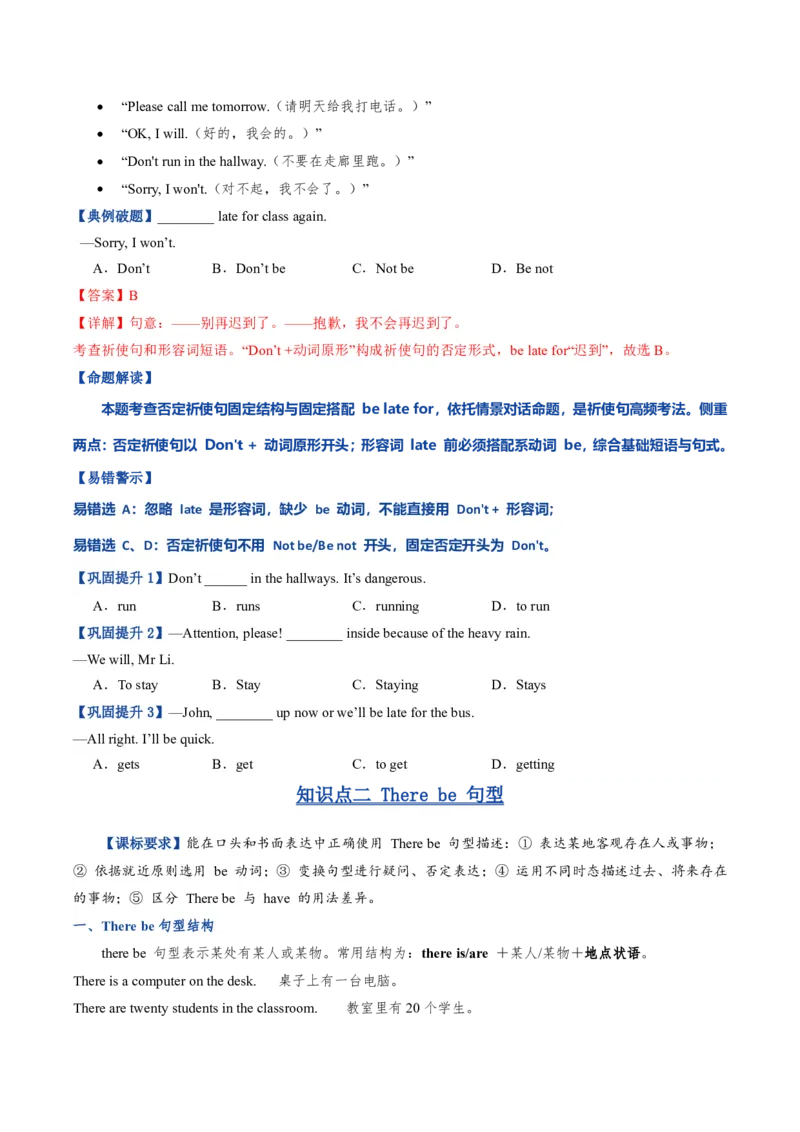
【典例破题】________ late for class again.
—Sorry, I won’t.
A.Don’t
B.Don’t be
C.Not be
D.Be not
【答案】B
【详解】句意:——别再迟到了。——抱歉,我不会再迟到了。
考查祈使句和形容词短语。“Don’t +动词原形”构成祈使句的否定形式,be late for“迟到”,故选B。
【命题解读】
本题考查否定祈使句固定结构与固定搭配be late for,依托情景对话命题,是祈使句高频考法。侧重
两点:否定祈使句以Don't + 动词原形开头;形容词late 前必须搭配系动词be,综合基础短语与句式。
【易错警示】
易错选A:忽略late 是形容词,缺少be 动词,不能直接用Don't + 形容词;
易错选C、D:否定祈使句不用Not be/Be not 开头,固定否定开头为Don't。
【巩固提升1】Don’t ______ in the hallways. It’s dangerous.
A.run
B.runs
C.running
D.to run
【巩固提升2】—Attention, please! ________ inside because of the heavy rain.
—We will, Mr Li.
A.To stay
B.Stay
C.Staying
D.Stays
【巩固提升3】—John, ________ up now or we’ll be late for the bus.
—All right. I’ll be quick.
A.gets
B.get
C.to get
D.getting
知识点二There be 句型
【课标要求】能在口头和书面表达中正确使用There be 句型描述:①表达某地客观存在人或事物;
②依据就近原则选用be 动词;③变换句型进行疑问、否定表达;④运用不同时态描述过去、将来存在
的事物;⑤区分There be 与have 的用法差异。
一、There be 句型结构
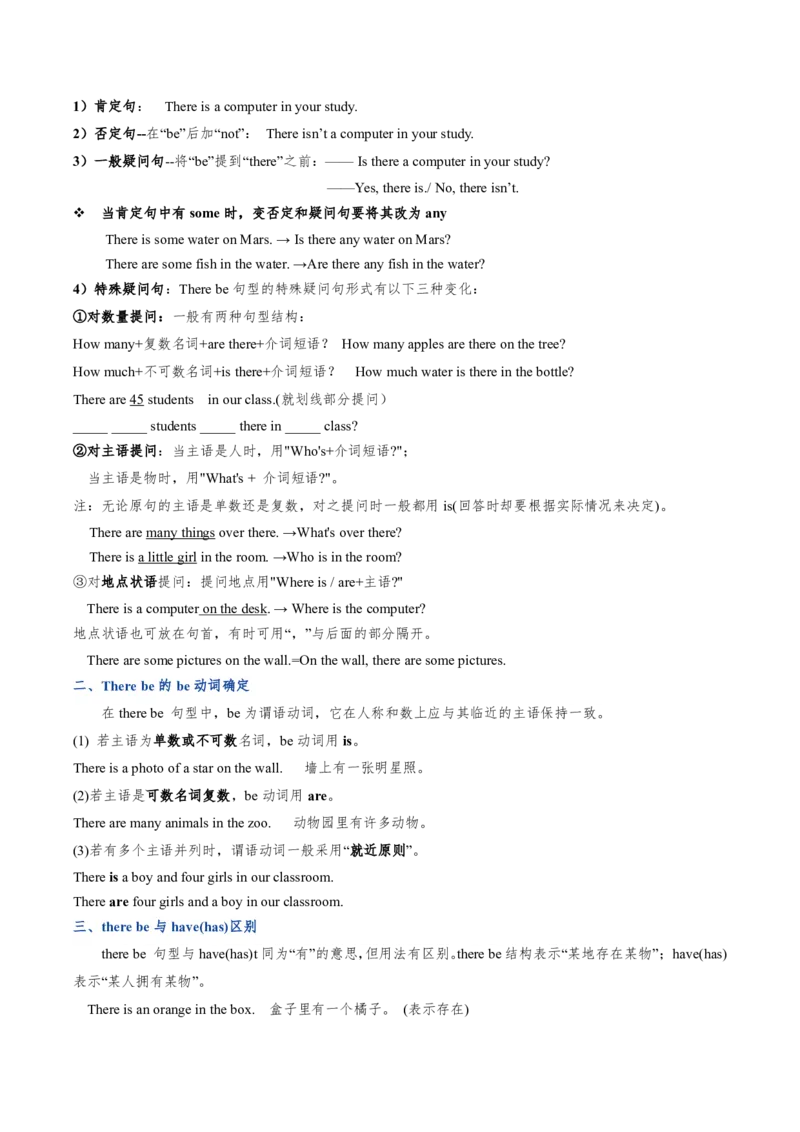
there be 句型表示某处有某人或某物。常用结构为:there is/are +某人/某物+地点状语。
There is a computer on the desk.
桌子上有一台电脑。
There are twenty students in the classroom.
教室里有20 个学生。
1)肯定句:
There is a computer in your study.
2)否定句--在“be”后加“not”:There isn’t a computer in your study.
3)一般疑问句--将“be”提到“there”之前:—— Is there a computer in your study?
——Yes, there is./ No, there isn’t.
当肯定句中有some 时,变否定和疑问句要将其改为any
There is some water on Mars. →Is there any water on Mars?
There are some fish in the water. →Are there any fish in the water?
4)特殊疑问句:There be 句型的特殊疑问句形式有以下三种变化:
①对数量提问:一般有两种句型结构:
How many+复数名词+are there+介词短语?How many apples are there on the tree?
How much+不可数名词+is there+介词短语?
How much water is there in the bottle?
There are 45 students
in our class.(就划线部分提问)
_____ _____ students _____ there in _____ class?
②对主语提问:当主语是人时,用"Who's+介词短语?";
当主语是物时,用"What's + 介词短语?"。
注:无论原句的主语是单数还是复数,对之提问时一般都用is(回答时却要根据实际情况来决定)。
There are many things over there. →What's over there?
There is a little girl in the room. →Who is in the room?
③对地点状语提问:提问地点用"Where is / are+主语?"
There is a computer on the desk. →Where is the computer?
地点状语也可放在句首,有时可用“,”与后面的部分隔开。
There are some pictures on the wall.=On the wall, there are some pictures.
二、There be 的be 动词确定
在there be 句型中,be 为谓语动词,它在人称和数上应与其临近的主语保持一致。
(1) 若主语为单数或不可数名词,be 动词用is。
There is a photo of a star on the wall.
墙上有一张明星照。
(2)若主语是可数名词复数,be 动词用are。
There are many animals in the zoo.
动物园里有许多动物。
(3)若有多个主语并列时,谓语动词一般采用“就近原则”。
There is a boy and four girls in our classroom.
There are four girls and a boy in our classroom.
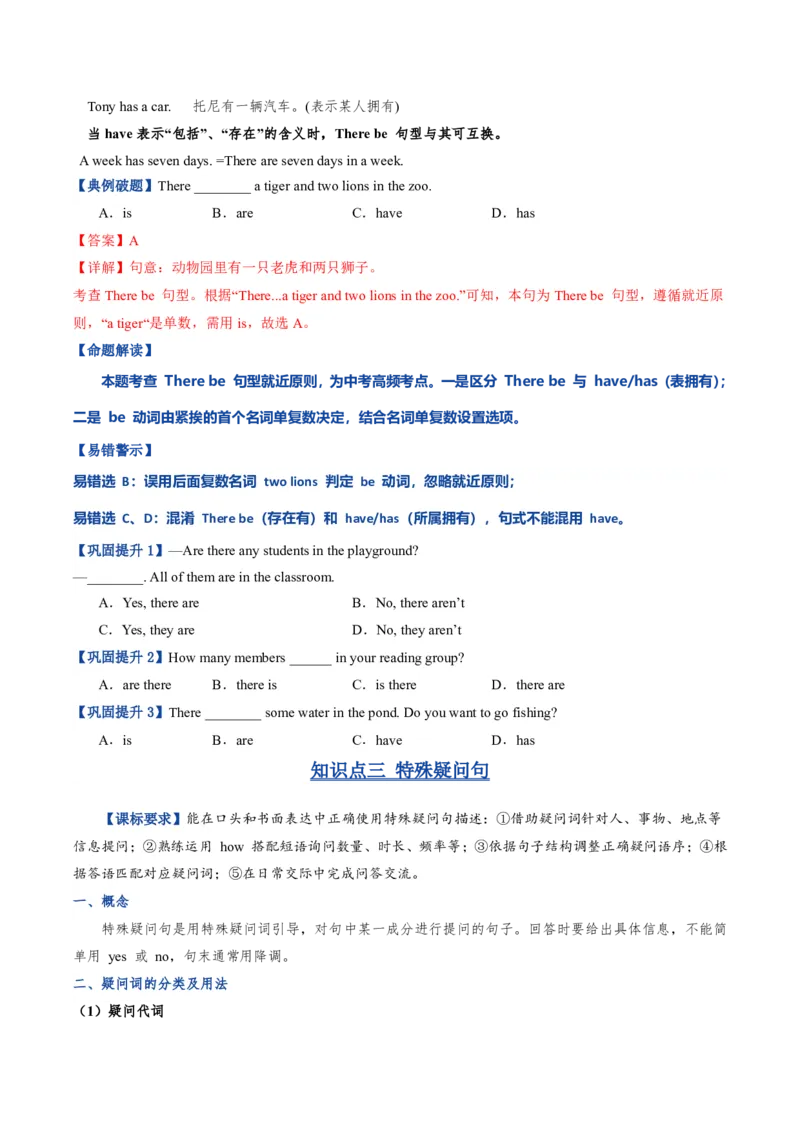
三、there be 与have(has)区别
there be 句型与have(has)t 同为“有”的意思,但用法有区别。there be 结构表示“某地存在某物”;have(has)
表示“某人拥有某物”。
There is an orange in the box.
盒子里有一个橘子。(表示存在)
Tony has a car.
托尼有一辆汽车。(表示某人拥有)
当have 表示“包括”、“存在”的含义时,There be 句型与其可互换。
A week has seven days. =There are seven days in a week.
【典例破题】There ________ a tiger and two lions in the zoo.
A.is
B.are
C.have
D.has
【答案】A
【详解】句意:动物园里有一只老虎和两只狮子。
考查There be 句型。根据“There...a tiger and two lions in the zoo.”可知,本句为There be 句型,遵循就近原
则,“a tiger“是单数,需用is,故选A。
【命题解读】
本题考查There be 句型就近原则,为中考高频考点。一是区分There be 与have/has(表拥有);
二是be 动词由紧挨的首个名词单复数决定,结合名词单复数设置选项。
【易错警示】
易错选B:误用后面复数名词two lions 判定be 动词,忽略就近原则;
易错选C、D:混淆There be(存在有)和have/has(所属拥有),句式不能混用have。
【巩固提升1】—Are there any students in the playground?
—________. All of them are in the classroom.
A.Yes, there are
B.No, there aren’t
C.Yes, they are
D.No, they aren’t
【巩固提升2】How many members ______ in your reading group?
A.are there
B.there is
C.is there
D.there are
【巩固提升3】There ________ some water in the pond. Do you want to go fishing?
A.is
B.are
C.have
D.has
知识点三特殊疑问句
【课标要求】能在口头和书面表达中正确使用特殊疑问句描述:①借助疑问词针对人、事物、地点等
信息提问;②熟练运用how 搭配短语询问数量、时长、频率等;③依据句子结构调整正确疑问语序;④根
据答语匹配对应疑问词;⑤在日常交际中完成问答交流。
一、概念
特殊疑问句是用特殊疑问词引导,对句中某一成分进行提问的句子。回答时要给出具体信息,不能简
单用yes 或no,句末通常用降调。
二、疑问词的分类及用法
(1)疑问代词
①who/whom:
用法:对人进行提问,who 在句中作主语或宾语,whom 只作宾语(在口语中常用who 代替whom)。
例句:Who is your teacher?(谁是你的老师?)这里who 作主语。
例句:Who/Whom did you meet yesterday?(你昨天遇到谁了?)这里who/whom 作宾语。
②whose:
用法:对名词所有格或物主代词进行提问,表示“谁的”。
例句:Whose book is this?(这是谁的书?)
③what:
用法:对事物进行提问。
例句:What is your favorite sport?(你最喜欢的运动是什么?)
④which:
用法:对特定范围内的人或事物进行提问,意为“哪一个”。
例句:Which color do you like better, red or blue?(红色和蓝色,你更喜欢哪一个颜色?)
(2)疑问副词
①when:
用法:对时间进行提问。
例句:When do you get up every day?(你每天什么时候起床?)
②where:
用法:对地点进行提问。
例句:Where is your school?(你的学校在哪里?)
③why:
用法:对原因进行提问。
例句:Why are you late?(你为什么迟到?)
④how:
用法:对行为方式、身体状况或程度等进行提问。
例句:How do you go to school?(你怎么去上学?)这里问方式。
例句:How are you feeling today?(你今天感觉怎么样?)这里问身体状况。
(3)疑问词组
①what class/grade:
用法:对所在班级或年级进行提问。
例句:What class are you in?(你在哪个班级?)
②what colour:
用法:对颜色进行提问。
例句:What colour is your bag?(你的书包是什么颜色?)
③what time:
用法:对时间点进行提问。
例句:What time is it now?(现在几点了?)
④how many:
用法:对可数名词的数量进行提问。
例句:How many students are there in your class?(你们班有多少学生?)
⑤how much:
用法:对不可数名词的量或事物的价钱进行提问。
例句:How much water do you need?(你需要多少水?)
例句:How much is this shirt?(这件衬衫多少钱?)
⑥how old:
用法:对年龄进行提问。
例句:How old are you?(你多大了?)
⑦how tall:
用法:对高度进行提问。
例句:How tall is the building?(这座建筑物有多高?)
⑧how often:
用法:对频率进行提问。
例句:How often do you play basketball?(你多久打一次篮球?)
how long:
用法:对长度或时间段进行提问。
例句:How long is the river?(这条河有多长?)
例句:How long have you lived here?(你在这里住了多久了?)
how far:
用法:对距离进行提问。
例句:How far is it from your home to school?(从你家到学校有多远?)
what day:
用法:对星期进行提问。
例句:What day is it today?(今天星期几?)
【典例破题】— ________ is the nearest hospital from here?
— About two kilometers.
A.How long
B.How far
C.How often
D.How soon
【答案】B
【详解】句意:——最近的医院离这儿有多远?——大约两公里。
考查疑问词组辨析。How long 多长;How far 多远;How often 多久一次;How soon 多久以后。根据答语“About
two kilometers”可知问距离。故选B。
【命题解读】
本题侧重how 衍生疑问词组辨析,依托问答语境命题,是特殊疑问句高频考点。依据答语距离数据,
考查how far 提问路程,区分how long/how often/how soon 不同提问范畴。
【易错警示】
易错选A:混淆how long(时长/ 物体长度)与how far(路程距离);
易错选C:how often 用于询问动作发生频率,和距离答语不匹配;
易错选D:how soon 提问“多久之后”,多用于将来时态。
【巩固提升1】—______ do you go to the library?
—Twice a week.
A.How long
B.How often
C.How far
D.How soon
【巩固提升2】—Could you please tell me ________ the library is from here?
—It’s about fifteen minutes’ ride.
A.how soon
B.how long
C.how far
D.how many
【巩固提升3】—________ do you like pandas?
—Because they are pretty fun.
A.What
B.When
C.Where
D.Why
一、单项选择
1.________. It’s time for class. Let’s ________ English!
A.Don’t talk; read B.Don’t talk; reading C.Doesn’t talk; read
D.Doesn’t talk; reading
2.________ late for class again! The teacher will be angry.
A.Not be
B.Don’t be
C.Be not
D.Doesn’t be
3.—Look at the sign, “________ swimming!”
—So it must be dangerous to swim here.
A.Don’t
B.Not
C.Not be
D.No
4.Please ________ quiet in the library. Your classmates are reading.
A.is
B.are
C.be
D.to be
5.“Lily, ________ your homework first, and you can watch TV for 30 minutes,” said her mum.
A.does
B.do
C.did
D.doing
6.Turn off or silence your phone in the museum, ________ you will annoy other visitors.
A.and
B.but
C.or
D.so
7.Take some food with you, ________ you ________ hungry on the way.
A.and, will feel
B.and, don’t feel
C.or, won’t feel
D.or, will feel
8.—________ a post office near here?
—Yes, ________ next to the supermarket.
A.Is there; there’s B.Are there; there’re
C.Is there; it’s
D.Are there; they’re
9.—Look! The photo is fun!
—Yes. ________ a dog and two cats in the photo.
A.There is
B.There are
C.There has
D.There have
10.—________ do you call your pen pal?
— Once a week.
A.How old
B.How many
C.How much
D.How often
11.—________ is the Huanghe River?
—It’s 5464 kilometers long, and it’s the mother river of the Chinese people.
A.How long
B.How much
C.How many
D.How often
12.—________ were you late for school today?
—Because I got up late this morning.
A.What
B.Why
C.Where
D.Who
13.— ________ bread do we need for breakfast?
—About eight pieces. It’s enough.
A.How much
B.How often
C.How long
D.How soon
14.—________ is it from your home to Jinshan Park?
—About thirty minutes’ ride.
A.How far
B.How often
C.How long
D.How soon
15.— ________ did you start to be a volunteer?
— Three years ago.
A.How long
B.How often
C.When
D.Where
二、短文填空
阅读短文,在文中空白处填入1 个适当的词,或是用括号内所给单词的正确形式填空。
What is the best season to visit the Amazon Rainforest (亚马逊雨林)? This is a common question we get
from people visiting the rainforest for the
1
(one) time. The answer is any time. There is a wet season
and a dry season in the rainforest. There is no time that is
2
(good) than the other. Both offer beautiful
sights and
3
(amaze) chances (机会) to see plant and animal life, hot weather and some
4
(rain) days.
The wet season is from November to April. During the time, the rainforest gets 60% of the total rainfall, so it
is cool and wet. Also, because of the rain, the water in the river rises and there is a flood in the forest. That means
you can take a boat and travel
5
the forest. Since you are closer to the top of the trees, you will see
6
(beauty) birds, monkeys and many other animals.
The dry season is between May
7
October. This is the warm season,
8
a temperature of
about 36°C.However, it still gets some heavy rains. A key difference is that the land comes out, so people can go
to the forest on foot. During these months, it is much easier to find snakes and
9
(fish) is much easier
too. You may not be able
10
(see) the birds in the trees, but you will see them flying in the sky.
Which season would you like to come to the rainforest?