专题02 指示代词、祈使句和There be 句型
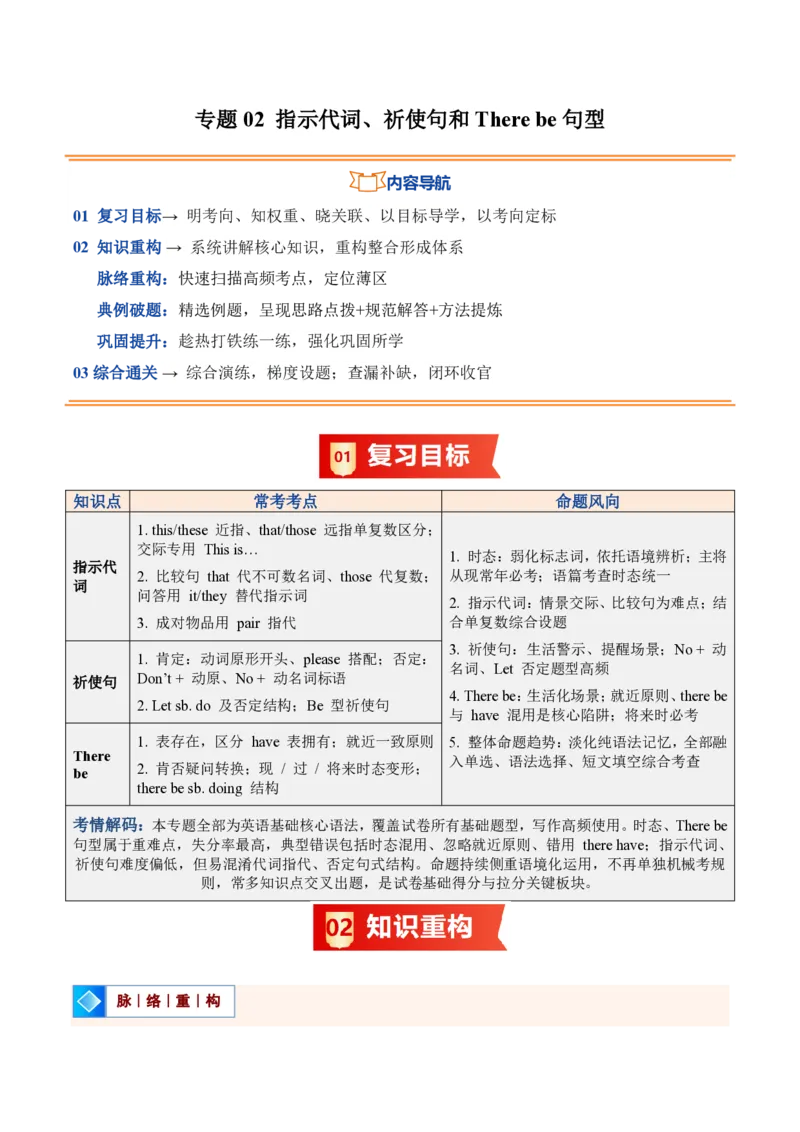
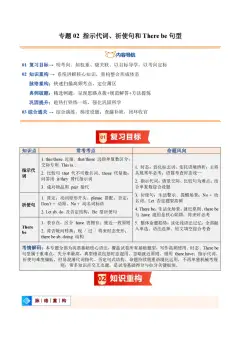
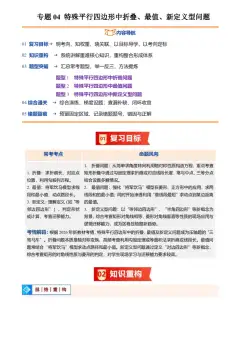
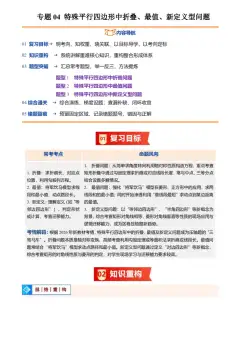
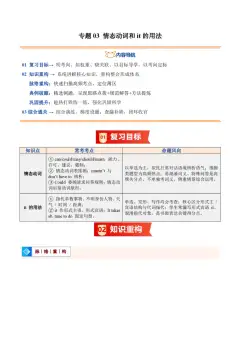
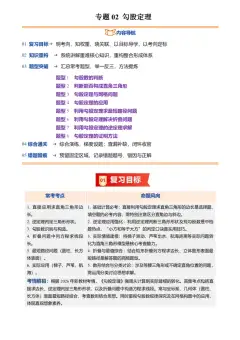
内容导航
01 复习目标→ 明考向、知权重、晓关联、以目标导学,以考向定标
02 知识重构 → 系统讲解核心知识,重构整合形成体系
   脉络重构:快速扫描高频考点,定位薄区
   典例破题:精选例题,呈现思路点拨+规范解答+方法提炼
   巩固提升:趁热打铁练一练,强化巩固所学
03 综合通关 → 综合演练,梯度设题;查漏补缺,闭环收官
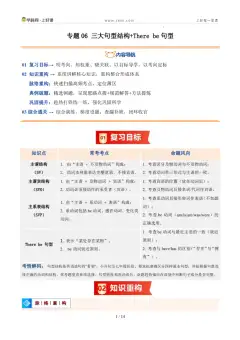
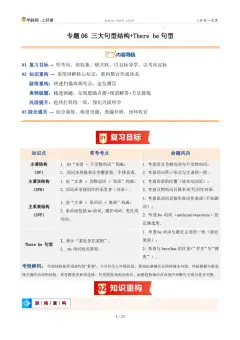
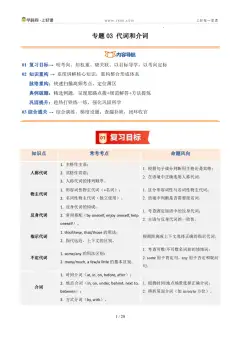
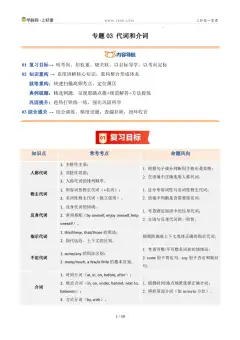
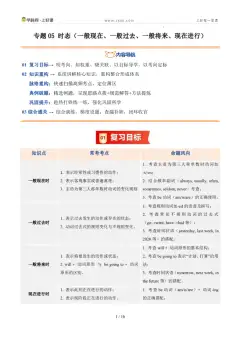
知识点
常考考点
命题风向
指示代
词
1. this/these 近指、that/those 远指单复数区分;
交际专用 This is…
2. 比较句 that 代不可数名词、those 代复数;
问答用 it/they 替代指示词
3. 成对物品用 pair 指代
祈使句
1. 肯定:动词原形开头、please 搭配;否定:
Don’t + 动原、No + 动名词标语
2. Let sb. do 及否定结构;Be 型祈使句
There
be
1. 表存在,区分 have 表拥有;就近一致原则
2. 肯否疑问转换;现 / 过 / 将来时态变形;
there be sb. doing 结构
1. 时态:弱化标志词,依托语境辨析;主将
从现常年必考;语篇考查时态统一
2. 指示代词:情景交际、比较句为难点;结
合单复数综合设题
3. 祈使句:生活警示、提醒场景;No + 动
名词、Let 否定题型高频
4. There be:生活化场景;就近原则、there be
与 have 混用是核心陷阱;将来时必考
5. 整体命题趋势:淡化纯语法记忆,全部融
入单选、语法选择、短文填空综合考查
考情解码:本专题全部为英语基础核心语法,覆盖试卷所有基础题型,写作高频使用。时态、There be
句型属于重难点,失分率最高,典型错误包括时态混用、忽略就近原则、错用 there have;指示代词、
祈使句难度偏低,但易混淆代词指代、否定句式结构。命题持续侧重语境化运用,不再单独机械考规
则,常多知识点交叉出题,是试卷基础得分与拉分关键板块。
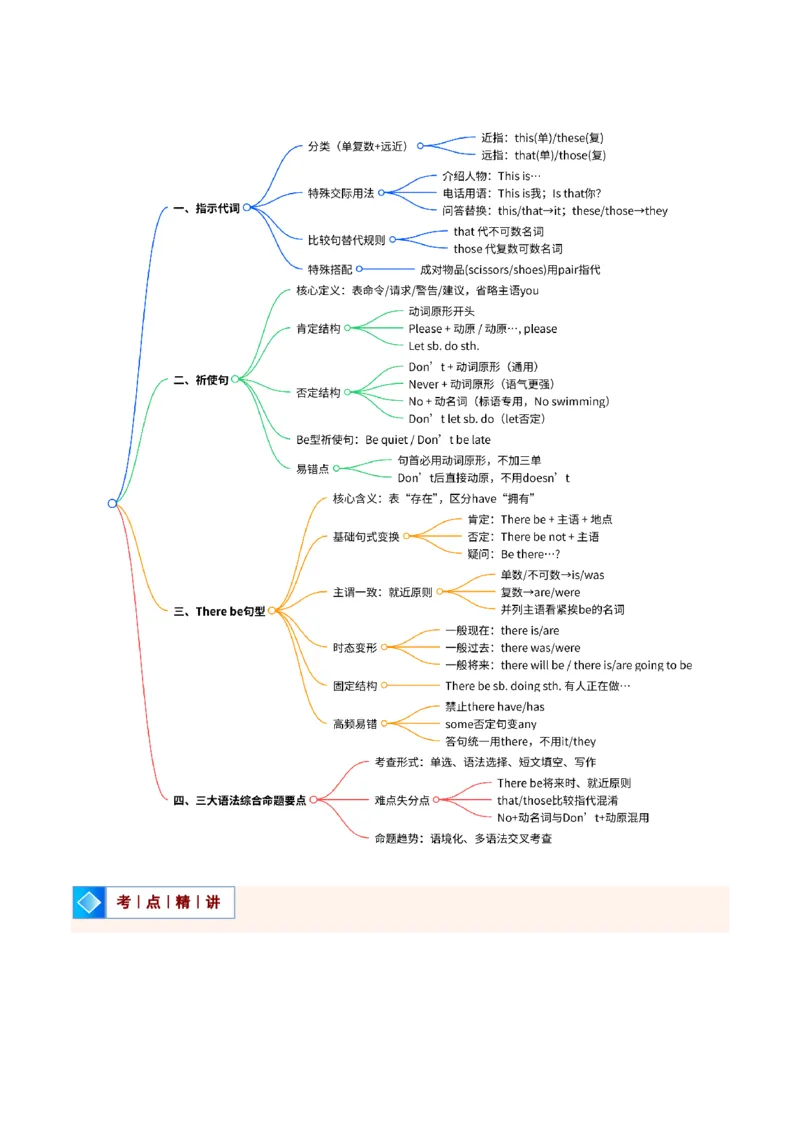
脉|络|重|构
考|点|精|讲
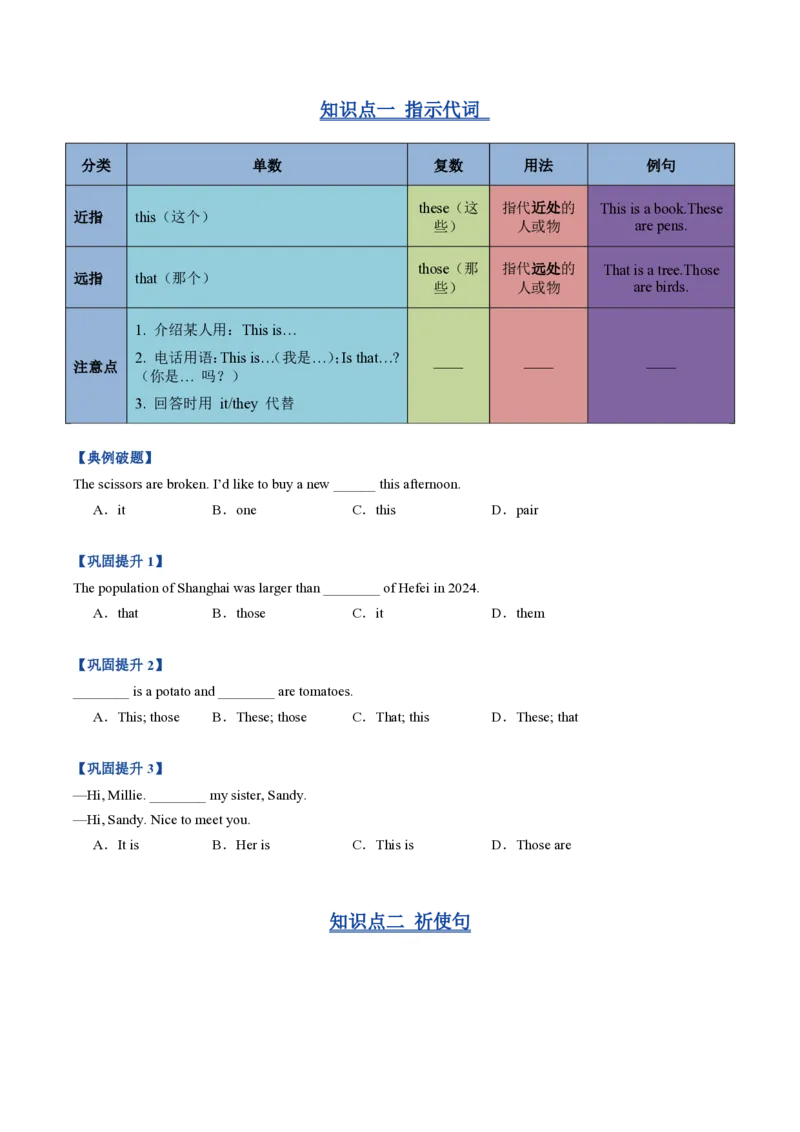
知识点一 指示代词
分类
单数
复数
用法
例句
近指
this(这个)
these(这
些)
指代近处的
人或物
This is a book.These
are pens.
远指
that(那个)
those(那
些)
指代远处的
人或物
That is a tree.Those
are birds.
注意点
1. 介绍某人用:This is…
2. 电话用语:This is…(我是…);Is that…?
(你是… 吗?)
3. 回答时用 it/they 代替
——
——
——
【典例破题】
The scissors are broken. I’d like to buy a new ______ this afternoon.
A.it
B.one
C.this
D.pair
【巩固提升1】
The population of Shanghai was larger than ________ of Hefei in 2024.
A.that
B.those
C.it
D.them
【巩固提升2】
________ is a potato and ________ are tomatoes.
A.This; those
B.These; those
C.That; this
D.These; that
【巩固提升3】
—Hi, Millie. ________ my sister, Sandy.
—Hi, Sandy. Nice to meet you.
A.It is
B.Her is
C.This is
D.Those are
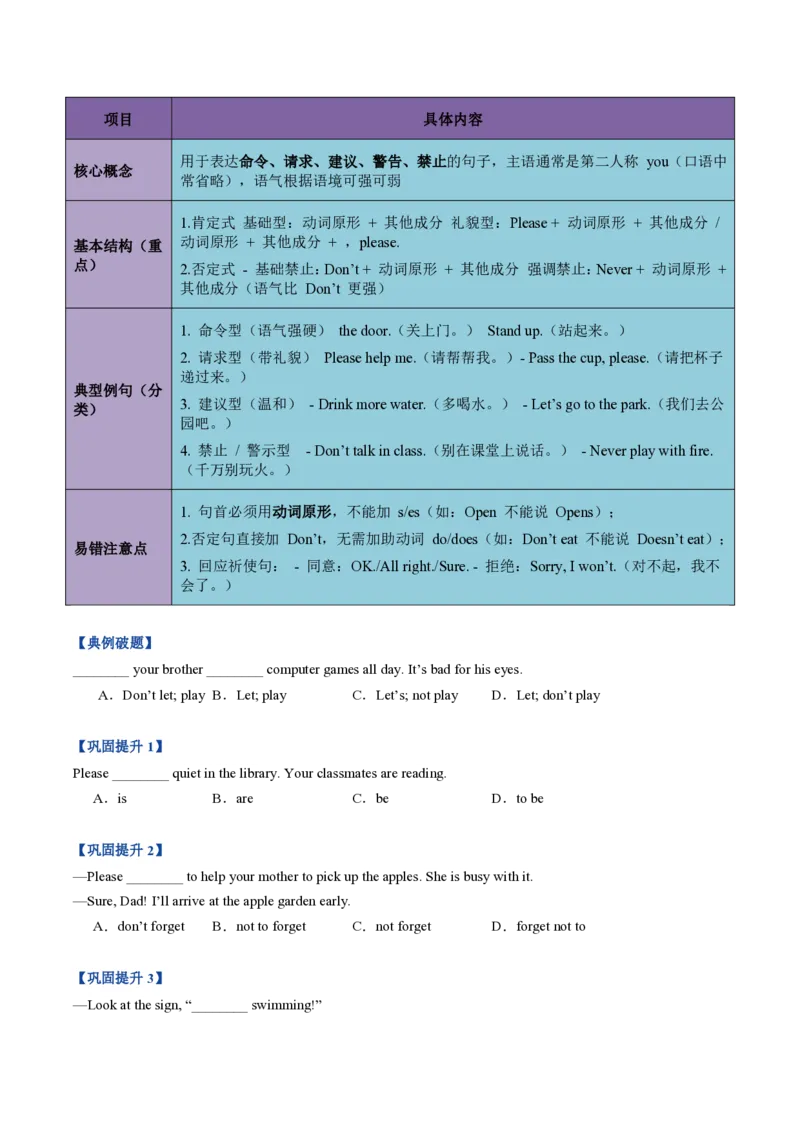
知识点二 祈使句
项目
具体内容
核心概念
用于表达命令、请求、建议、警告、禁止的句子,主语通常是第二人称 you(口语中
常省略),语气根据语境可强可弱
基本结构(重
点)
1.肯定式 基础型:动词原形 + 其他成分 礼貌型:Please + 动词原形 + 其他成分 /
动词原形 + 其他成分 + ,please.
2.否定式 - 基础禁止:Don’t + 动词原形 + 其他成分 强调禁止:Never + 动词原形 +
其他成分(语气比 Don’t 更强)
典型例句(分
类)
1. 命令型(语气强硬) the door.(关上门。) Stand up.(站起来。)
2. 请求型(带礼貌) Please help me.(请帮帮我。)- Pass the cup, please.(请把杯子
递过来。)
3. 建议型(温和) - Drink more water.(多喝水。) - Let’s go to the park.(我们去公
园吧。)
4. 禁止 / 警示型  - Don’t talk in class.(别在课堂上说话。) - Never play with fire.
(千万别玩火。)
易错注意点
1. 句首必须用动词原形,不能加 s/es(如:Open 不能说 Opens);
2.否定句直接加 Don’t,无需加助动词 do/does(如:Don’t eat 不能说 Doesn’t eat);
3. 回应祈使句: - 同意:OK./All right./Sure. - 拒绝:Sorry, I won’t.(对不起,我不
会了。)
【典例破题】
________ your brother ________ computer games all day. It’s bad for his eyes.
A.Don’t let; play B.Let; play
C.Let’s; not play
D.Let; don’t play
【巩固提升1】
Please ________ quiet in the library. Your classmates are reading.
A.is
B.are
C.be
D.to be
【巩固提升2】
—Please ________ to help your mother to pick up the apples. She is busy with it.
—Sure, Dad! I’ll arrive at the apple garden early.
A.don’t forget
B.not to forget
C.not forget
D.forget not to
【巩固提升3】
—Look at the sign, “________ swimming!”
—So it must be dangerous to swim here.
A.Don’t
B.Not
C.Not be
D.No
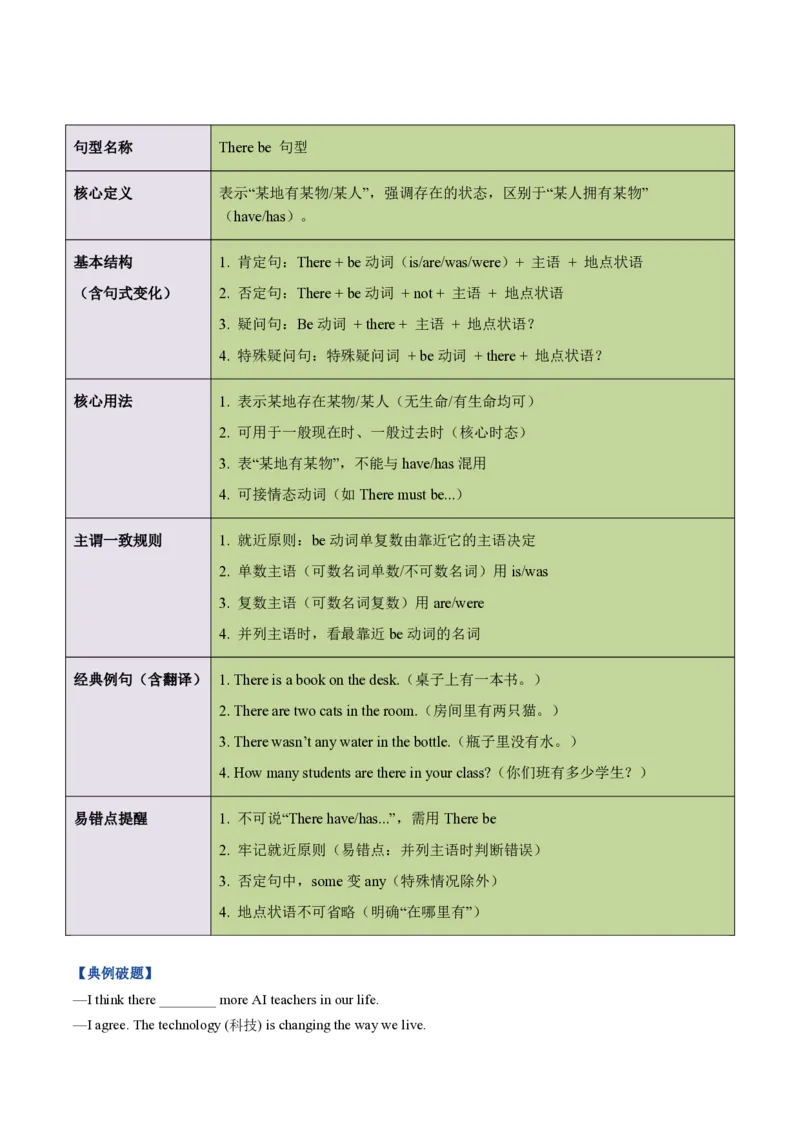
知识点三 There be 句型
句型名称
There be 句型
核心定义
表示“某地有某物/某人”,强调存在的状态,区别于“某人拥有某物”
(have/has)。
基本结构
(含句式变化)
1. 肯定句:There + be 动词(is/are/was/were)+ 主语 + 地点状语
2. 否定句:There + be 动词 + not + 主语 + 地点状语
3. 疑问句:Be 动词 + there + 主语 + 地点状语?
4. 特殊疑问句:特殊疑问词 + be 动词 + there + 地点状语?
核心用法
1. 表示某地存在某物/某人(无生命/有生命均可)
2. 可用于一般现在时、一般过去时(核心时态)
3. 表“某地有某物”,不能与have/has 混用
4. 可接情态动词(如There must be...)
主谓一致规则
1. 就近原则:be 动词单复数由靠近它的主语决定
2. 单数主语(可数名词单数/不可数名词)用is/was
3. 复数主语(可数名词复数)用are/were
4. 并列主语时,看最靠近be 动词的名词
经典例句(含翻译)1. There is a book on the desk.(桌子上有一本书。)
2. There are two cats in the room.(房间里有两只猫。)
3. There wasn’t any water in the bottle.(瓶子里没有水。)
4. How many students are there in your class?(你们班有多少学生?)
易错点提醒
1. 不可说“There have/has...”,需用There be
2. 牢记就近原则(易错点:并列主语时判断错误)
3. 否定句中,some 变any(特殊情况除外)
4. 地点状语不可省略(明确“在哪里有”)
【典例破题】
—I think there ________ more AI teachers in our life.
—I agree. The technology (科技) is changing the way we live.
A.were
B.are
C.will be
D.will have
【巩固提升1】
We hope there ________ war in the world. Everyone can live a happy life.
A.will not have
B.is not going to have C.is going to be
D.will not be
【巩固提升2】
When I entered the quiet lab, there ________ nobody ________ the expensive equipment.
A.was; using
B.were; using
C.was; to use
D.were; to use
【巩固提升3】
—There ________ an English speaking competition next week.
—I want to ________ it to improve my English!
A.will have; compete in
B.is going to have; compete
C.is going to be; compete in
D.will be; compete
一、单项选择
1.—Will there be libraries in the future?
—No, ________. People will use computers.
A.there isn’t
B.it isn’t
C.there won’t
D.it won’t
2.________ 20 girls in my class, and I ________ two good friends of them.
A.There have; are B.There have; have
C.There is; are
D.There are; have
3.There ________ an English party _________ the evening of Halloween.
A.is going to be; inB.is going to be; on
C.will be; in
D.will have; on
4.The app shows that Bus No.3 is about 5 km ________ of the bus stop. There is no ________ in worrying.
A.east; point
B.the east; point
C.east; need
D.the east; need
5.—Why are you so excited, Ricky?
—Because there ________ a big show on TV this evening.
A.is going to have B.will have
C.are going to be
D.is going to be
6.—________ something wrong with my computer. Can I use yours?
—No problem.
A.It is
B.It was
C.There is
D.There was
7.We hope there ________ war in the world. Everyone can live a happy life.
A.will not have
B.is not going to have C.is going to be
D.will not be
8.Which of the following sentences is correctly paused?
A.There are/ storms/ from time to time in summer and/ autumn.
B.There are storms/ from time to time in summer/ and autumn.
C.There are storms/ from time to time/ in summer and autumn.
D.There are storms/ from time to time in summer and autumn.
9.—Is there a supermarket near here?
—________. It’s next to the school.
A.Yes, there is
B.No, there isn’t
C.Yes, it is
D.No, it isn’t
10.There ________ some important meetings this coming weekend.
A.are going to have
B.will have
C.will be
D.is going to be
11.—The floor is wet. ________ slowly, please.
—OK, I’ll be careful.
A.To walk
B.Walk
C.Walks
D.Walking
12.________ more books about great people in our free time.
A.Reads
B.Read
C.Reading
D.To read
13.________ late for the speech about modern role models.
A.Not be
B.Don’t be
C.No being
D.Don’t
14.________ your brother ________ computer games all day. It’s bad for his eyes.
A.Don’t let; play B.Let; play
C.Let’s; not play
D.Let; don’t play
15.Please ________ quiet in the library. Your classmates are reading.
A.is
B.are
C.be
D.to be
16.—Look at the sign, “________ swimming!”
—So it must be dangerous to swim here.
A.Don’t
B.Not
C.Not be
D.No
17.Close your eyes and ________ before blowing out birthday candles.
A.make a wish
B.makes a wish
C.making a wish
D.to make a wish
18.Lily is tired now because she ________ late to finish her homework last night. Don’t ________, please.
A.put up; wake up her
B.stays up; wake her up
C.stayed up; wake her up
D.stayed up; woke her up
19.Don’t ________ a promise easily.
A.make
B.makes
C.made
D.is making
20.It’s windy. Please ________ the window.
A.close
B.closes
C.closing
D.closed
21.The girl is flying a kite on ________.
A.so a windy day
B.such a windy day
C.such windy day
D.so windy day
22.—What are ________ over there?
—________ are her computers.
A.these; These
B.they; These
C.those; They
D.those; Those
23.__________ are in the schoolbag.
A.This pencil
B.That pencil
C.These pencil
D.Those pencils
24.— What are those?
— ________ ducks.
A.Those are
B.These are
C.It’s
D.They’re
25.—Mum! ________my English teacher, Miss Li.
—Nice to meet you, Miss Li.
A.This’s
B.It is
C.This is
D.He is
26.—Hi, Millie. ________ my sister, Sandy.
—Hi, Sandy. Nice to meet you.
A.It is
B.Her is
C.This is
D.Those are
27.Which of the underlined pronouns (代词) is wrong?
A.—I need something to cut the beef. —Oh, you want a knife. I’ll buy that for you.
B.The number of the women teachers in our school is larger than that in their school.
C.—How smoothly your pen writes! —Well, you can find one in the shop near our school.
D.The house prices in Changzhou are much lower than those in one of the first-tier cities like Beijing.
28.—Are ________ your classmates?
—Yes, and ________ are all very friendly.
A.these; they
B.them; they
C.they; them
D.those; them
29.What ________ it is to go surfing in ________ weather
A.great fun; so fine
B.a great fun; such a fine
C.great fun; such fine
D.great fun; such a fine
30.— Are those your pictures?
— ________. They are Sally’s.
A.Yes, they are
B.Yes, those are
C.No, they aren’t
D.No, those aren’t
二、语法选择
阅读下面短文,掌握其大意,然后从每题所给的A、B、C、D 四个选项中,选出最佳选项。
Hi Mike,
How are you? I want to tell you about my experience with Chinese folk art last weekend.
On Saturdays, I     1     get up early. So I went to the folk art center early. There, I learned how to     2
paper cuttings. The teacher showed us some wonderful works first. Then we started to cut. I     3     made a
paper flower, but it was not perfect. In the afternoon, I went to a museum with my friend. We saw many old clay
figures and     4     about their history.
On Sunday, I     5     go out. I stayed at home and     6     a book about shadow puppetry. I also tried
to make a simple shadow puppet with cardboard. Sometimes I asked my dad to     7     me. In the evening, we
watched a shadow puppetry show online.
What about you? What do you     8     know about Chinese folk art? I’d love to know     9     you
think of it.
Looking forward to     10     from you soon!
Wu Jun
1.A.seldom
B.always
C.never
D.like
2.A.make
B.makes
C.made
D.making
3.A.finally
B.first
C.quickly
D.easily
4.A.learn
B.learned
C.learns
D.learning
5.A.often
B.usually
C.sometimes
D.seldom
6.A.read
B.reads
C.readed
D.Reading
7.A.help
B.helps
C.helped
D.helping
8.A.usually
B.already
C.never
D.sometimes
9.A.what
B.when
C.where
D.how
10.A.hear
B.hears
C.hearing
D.heard
Exams (考试) are important to students. But some schools give their students     1     exams. Study     2
up too much of their time and many students don’t have much time to sleep and exercise. It is not good     3
their health. To make students have     4     happy and healthy life, China makes some rules for schools. Now
students of Grades One and Two don’t have to take written exams. Students of Grades Three to Six only have one
exam a term.
Students like the     5    . They can     6     themselves. Many parents think the rules are good too.
Now     7     children have much time to play sports and join some clubs. There are many other rules for schools
in China. For example, teachers     8     give homework to children in the first grade. Tutoring institutions (辅导
机构) can’t teach school subjects. Schools have students’ favourite after-school classes     9     students can
finish their homework at school. China wants these rules     10     good to the young children. What do you
think of the rules?
1.A.too much
B.too many
C.much too
2.A.take
B.takes
C.taking
3.A.for
B.at
C.of
4.A.a
B.an
C.the
5.A.rule
B.rule’s
C.rules
6.A.relaxed
B.relax
C.relaxing
7.A.they
B.theirs
C.their
8.A.can
B.can’t
C.must
9.A.because
B.but
C.and
10.A.do
B.doing
C.to do
Read the following passage and choose the correct answer.
Alan lives in the city. Last summer, he     1     to visit his grandma. His grandma lives on a farm. After
he arrived that morning,     2     grandma showed him around her farm. There were a lot of cows and some of
them looked very lovely. Alan wanted     3     after them.
“Alan, do you remember the milk you drank just now? It came from these     4    ,” said his grandma.
“Let me tell you where milk comes from.” His grandma picked up a bottle, sat by a cow and started to milk the cow
5    . Alan watched closely (接近地) and shouted, “Wow, Grandma! The milk     6     out now!”
After that, Grandma cooked the milk in the kitchen. Five minutes later, Alan got     7     glass of fresh
milk. It tasted so good that Alan finished it quickly.
“Grandma,     8     I go back, I’ll tell all my friends where milk comes from,” said Alan. “Can you teach
me how to milk a cow now? I’m interested     9     it.”
Grandma was very     10    . “Sure. Let’s milk them together,” she said.
1.A.goes
B.went
C.is going
2.A.he
B.him
C.his
3.A.look
B.looking
C.to look
4.A.cow
B.cows
C.cow’s
5.A.slow
B.slowly
C.slowness
6.A.come
B.is coming
C.are coming
7.A.a
B.an
C.the
8.A.although
B.because
C.when
9.A.in
B.by
C.with
10.A.happy
B.happier
C.happiest
三、短文填空
阅读下面短文并填空,然后将答案写到答题卡的相应位置(如有提示词,则填入提示词的正确形式;如无
提示词,则填入1 个适当的单词。)
Bob’s brother Eric and his friends are playing dodgeball (躲避球). Bob wants     1     (join) them.
“Can I play? It looks     2     (interest).” Bob says.
“Do you know the rules of dodgeball?” they ask.
“No, but I can learn. Could you teach     3     (I)?”
Eric tells the rules to him, “We have two teams. One team stands outside the circle and throws (扔) the ball.
The other team     4     (stay) in the middle to dodge (躲避).     5     (usual), no one wants to get hit (被击
中).”
Bob thinks it is easy. “Let’s start!” He says.
Julie, one of     6     (Eric) friends, throws the ball first. “Oh, no!” Bob shouts—the ball hits him.
“You’re out!”
“Waaah...” Bob cries. “The ball goes too fast!”
“It’s OK. It’s your     7     (one) time to play dodgeball. Let’s do it one more time.” Eric says kindly.
They play again. This time, Eric throws the ball. Bob catches it, but he starts running away     8     it.
Eric laughs and says, “No, Bob!     9     (not run). If you catch the ball, it means you win and you can
bring one of your teammates back in.”
Now, Bob knows there are so many special     10     (rule) about this game. He has to keep them in mind
and practise more. Nothing can be achieved without rules.
阅读短文,在空白处填入适当内容或用括号内单词适当形式填空 (每空不多于3 个单词)。
Do you know World Egg Day? It is on the second Friday     1     October each year. It’s a special day for
eggs. And it tells people that eggs are important and     2     (health).
It’s common to have eggs around the world. In China, many people are good at     3     (make) different
foods with eggs.
Tea eggs have a long history in China. Lots of restaurants sell     4     (they). It’s easy for people     5
(order) them in restaurants. Many people in China would like to make tea eggs and eat them during Chinese New
Year,     6     the tea egg is a symbol of good luck.
    7     (tomato) and eggs pair (配对) well. People use them to make many     8     (dish). Chinese
people of all ages like eating tomato and egg noodles. Tomato and egg soup is also popular. It’s     9     (real)
nice to have some tomato and egg soup in cold winter.
If you want     10     (eat) eggs with meat, you can try egg foo young (芙蓉蛋). It’s OK to make it with
beef. It’s also a good choice to make it with chicken.
Eggs are such a great star in Chinese food. Do you eat it every day?
夸克群
群满加Q
秘塔
QQ群
AI
【温馨提示】本页为广告页,打印前可以把这页删掉
群
满
或
未
通
过
:
请
至
左
侧
资
料
库
文
档
获
取
最
新
二
维
码
防失联渠道二:https://link3.cc/xbjf
防失联渠道一