Unit 1 How can we become good learners?
第1 讲
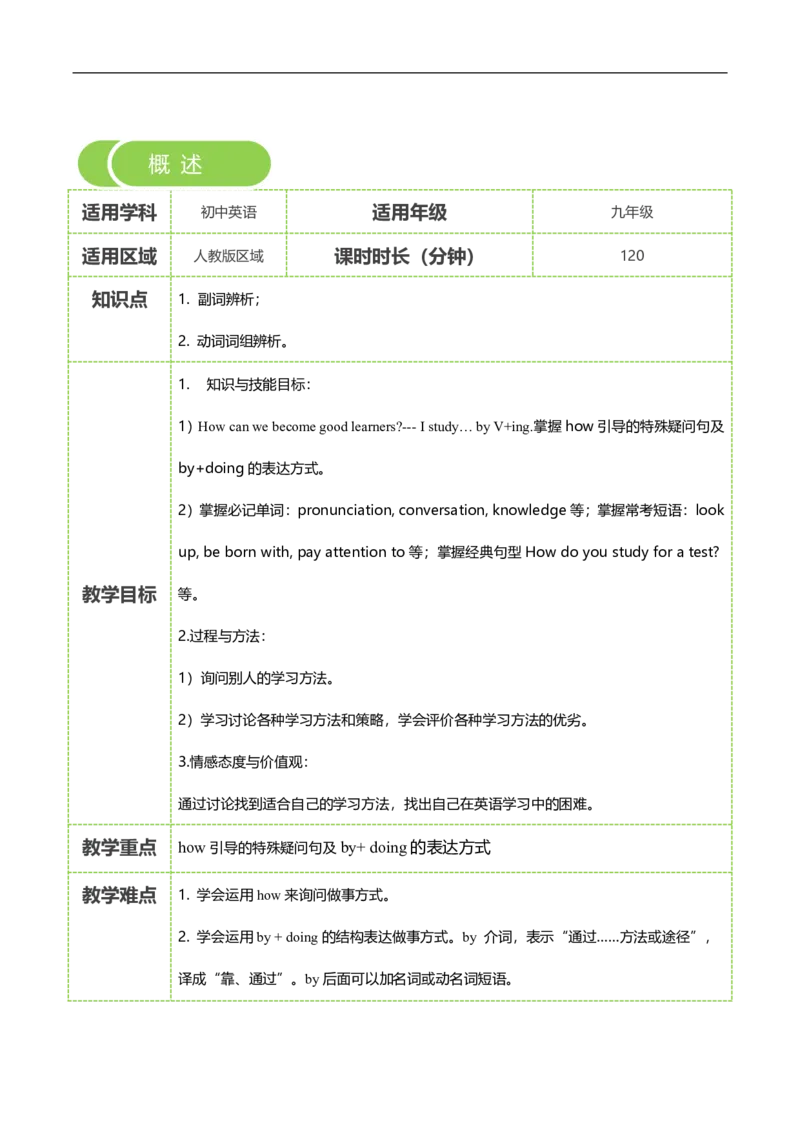
适用学科
初中英语
适用年级
九年级
适用区域
人教版区域
课时时长(分钟)
120
知识点
1. 副词辨析;
2. 动词词组辨析。
教学目标
1.
知识与技能目标:
1)How can we become good learners?--- I study… by V+ing.掌握how 引导的特殊疑问句及
by+doing 的表达方式。
2)掌握必记单词:pronunciation, conversation, knowledge 等;掌握常考短语:look
up, be born with, pay attention to 等;掌握经典句型How do you study for a test?
等。
2.过程与方法:
1)询问别人的学习方法。
2)学习讨论各种学习方法和策略,学会评价各种学习方法的优劣。
3.情感态度与价值观:
通过讨论找到适合自己的学习方法,找出自己在英语学习中的困难。
教学重点
how 引导的特殊疑问句及by+ doing 的表达方式
教学难点
1. 学会运用how 来询问做事方式。
2. 学会运用by + doing 的结构表达做事方式。by 介词,表示“通过……方法或途径”,
译成“靠、通过”。by 后面可以加名词或动名词短语。
概述
3. 动名词的构成:
动词后加动名词doing,相当于名词,在句子中可以做主语、宾语、表语,定语等。
教学过程
一、导入
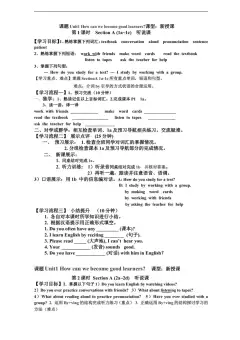
T: How do you study English? Do you study English by the following ways?
(Show some pictures and present the important phrases.)
T: How do you study English?
S: I study English by ______.
by working with friends.
by making word cards.
by asking the teacher for help.
by reading the textbook.
by working with a group.
by listening tapes.
二、知识讲解
知识点1
发音:pronunciation 是名词,pronounce 是动词,注意词形的细微变化。
如:What do you think of his pronunciation? 你觉得他的发音怎么样?
知识点2
Patient
(1)名词,“病人”,可数。
如:The patient is too weak to speak.
(2)形容词,“有耐心的”,反义词:impatient 不耐烦的。
常用搭配:be patient with…对……有耐心
如:My teacher is a very patient man.
The nurse is very patient with the patients.
知识点3
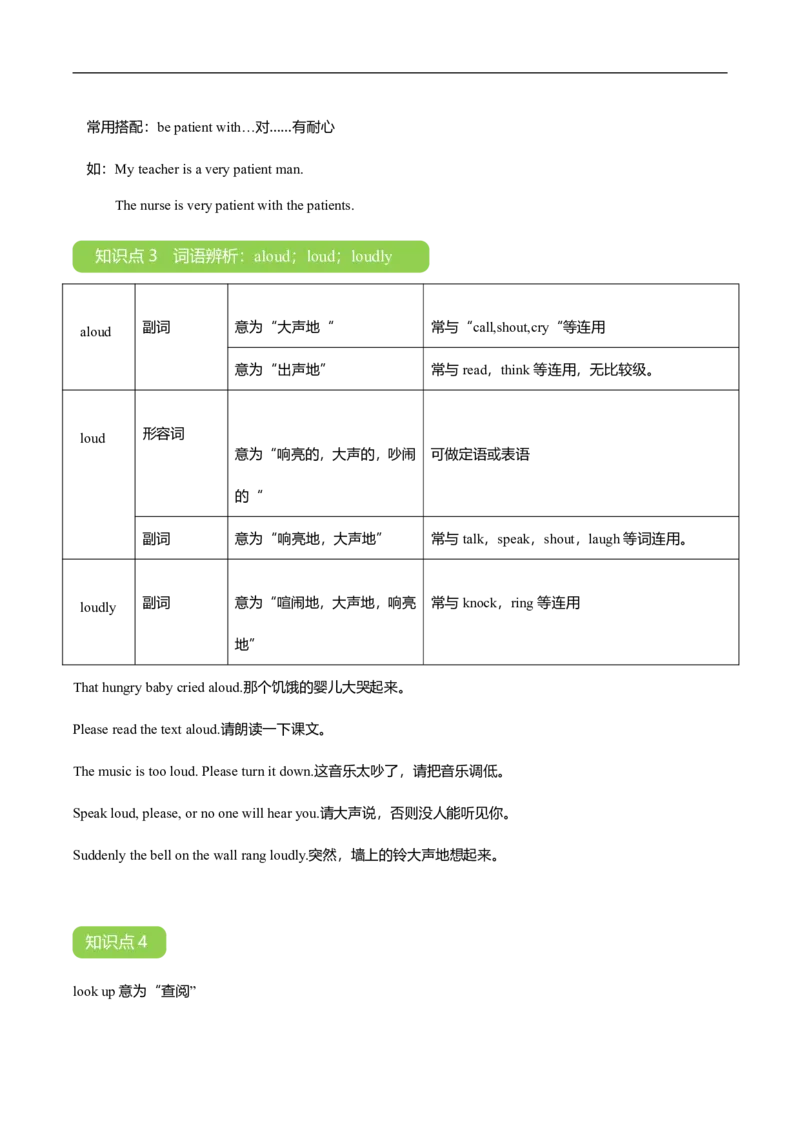
词语辨析:aloud;loud;loudly
aloud
副词
意为“大声地“
常与“call,shout,cry“等连用
意为“出声地”
常与read,think 等连用,无比较级。
loud
形容词
意为“响亮的,大声的,吵闹
的“
可做定语或表语
副词
意为“响亮地,大声地”
常与talk,speak,shout,laugh 等词连用。
loudly
副词
意为“喧闹地,大声地,响亮
地”
常与knock,ring 等连用
That hungry baby cried aloud.那个饥饿的婴儿大哭起来。
Please read the text aloud.请朗读一下课文。
The music is too loud. Please turn it down.这音乐太吵了,请把音乐调低。
Speak loud, please, or no one will hear you.请大声说,否则没人能听见你。
Suddenly the bell on the wall rang loudly.突然,墙上的铃大声地想起来。
知识点4
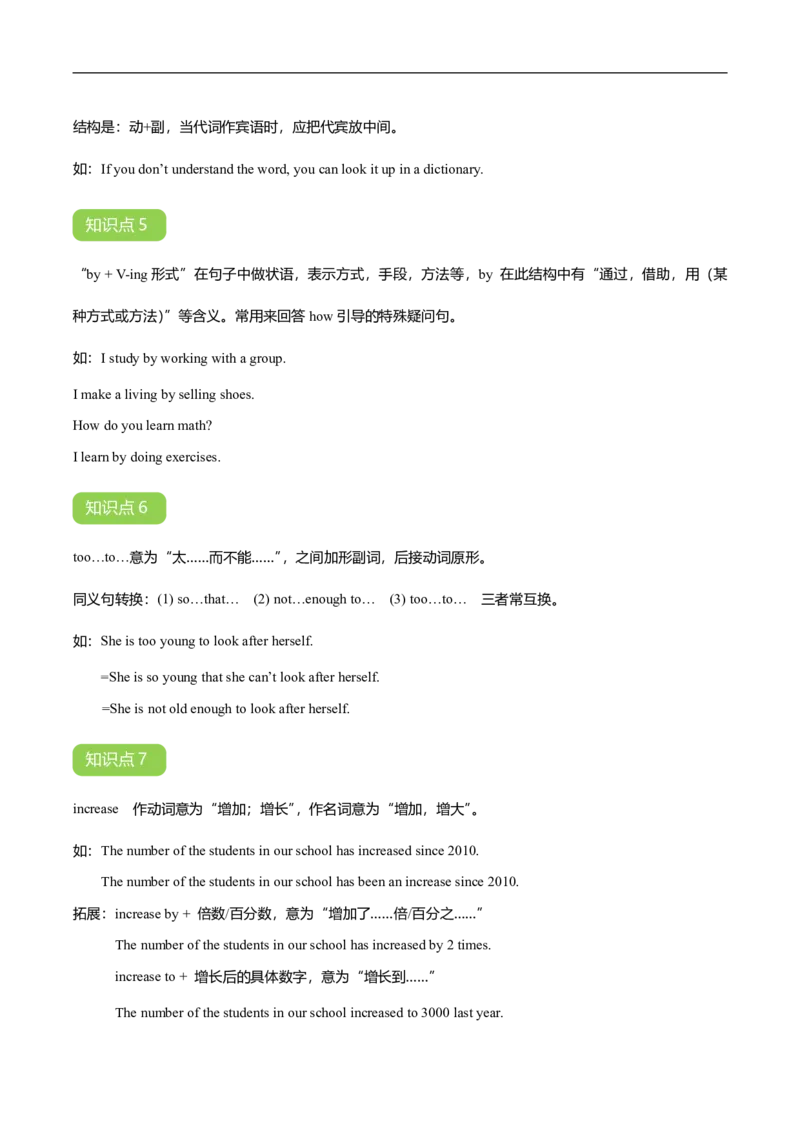
look up 意为“查阅”
结构是:动+副,当代词作宾语时,应把代宾放中间。
如:If you don’t understand the word, you can look it up in a dictionary.
知识点5
“by + V-ing 形式”在句子中做状语,表示方式,手段,方法等,by 在此结构中有“通过,借助,用(某
种方式或方法)”等含义。常用来回答how 引导的特殊疑问句。
如:I study by working with a group.
I make a living by selling shoes.
How do you learn math?
I learn by doing exercises.
知识点6
too…to…意为“太……而不能……”,之间加形副词,后接动词原形。
同义句转换:(1) so…that…
(2) not…enough to…
(3) too…to…
三者常互换。
如:She is too young to look after herself.
=She is so young that she can’t look after herself.
=She is not old enough to look after herself.
知识点7
increase
作动词意为“增加;增长”,作名词意为“增加,增大”。
如:The number of the students in our school has increased since 2010.
The number of the students in our school has been an increase since 2010.
拓展:increase by + 倍数/百分数,意为“增加了……倍/百分之……”
The number of the students in our school has increased by 2 times.
increase to + 增长后的具体数字,意为“增长到……”
The number of the students in our school increased to 3000 last year.
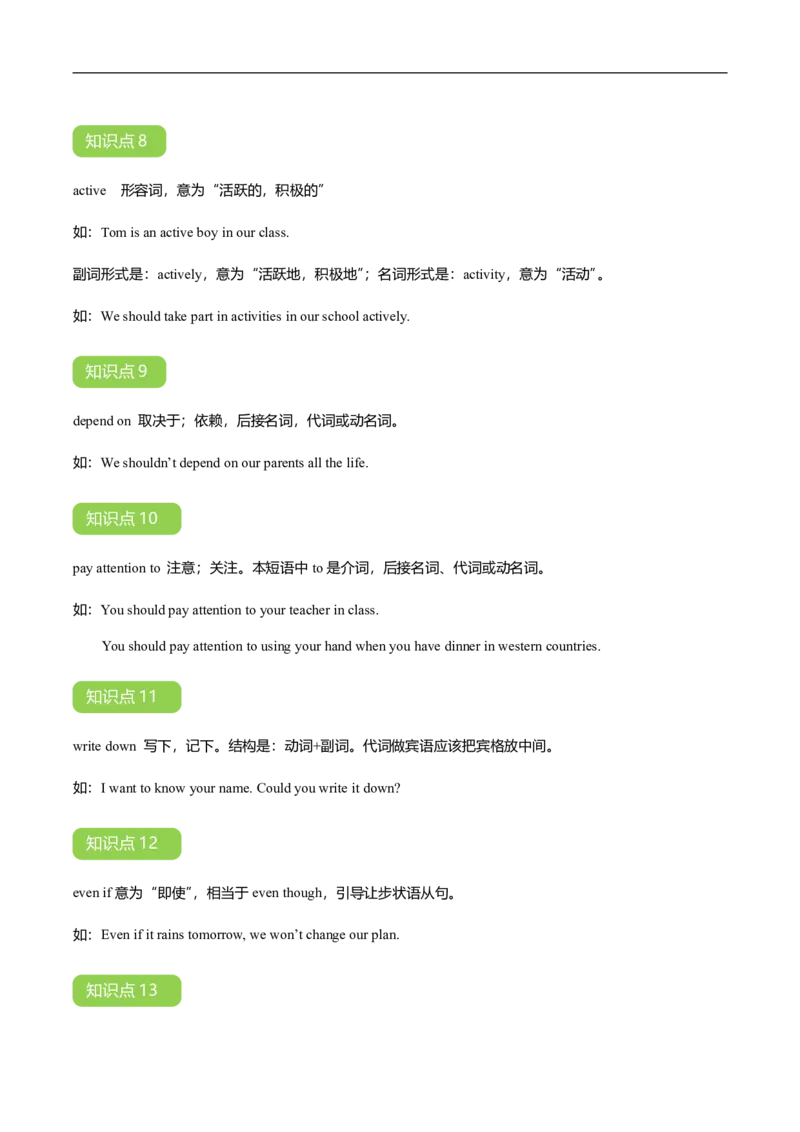
知识点8
active
形容词,意为“活跃的,积极的”
如:Tom is an active boy in our class.
副词形式是:actively,意为“活跃地,积极地”;名词形式是:activity,意为“活动”。
如:We should take part in activities in our school actively.
知识点9
depend on 取决于;依赖,后接名词,代词或动名词。
如:We shouldn’t depend on our parents all the life.
知识点10
pay attention to 注意;关注。本短语中to 是介词,后接名词、代词或动名词。
如:You should pay attention to your teacher in class.
You should pay attention to using your hand when you have dinner in western countries.
知识点11
write down 写下,记下。结构是:动词+副词。代词做宾语应该把宾格放中间。
如:I want to know your name. Could you write it down?
知识点12
even if 意为“即使”,相当于even though,引导让步状语从句。
如:Even if it rains tomorrow, we won’t change our plan.
知识点13
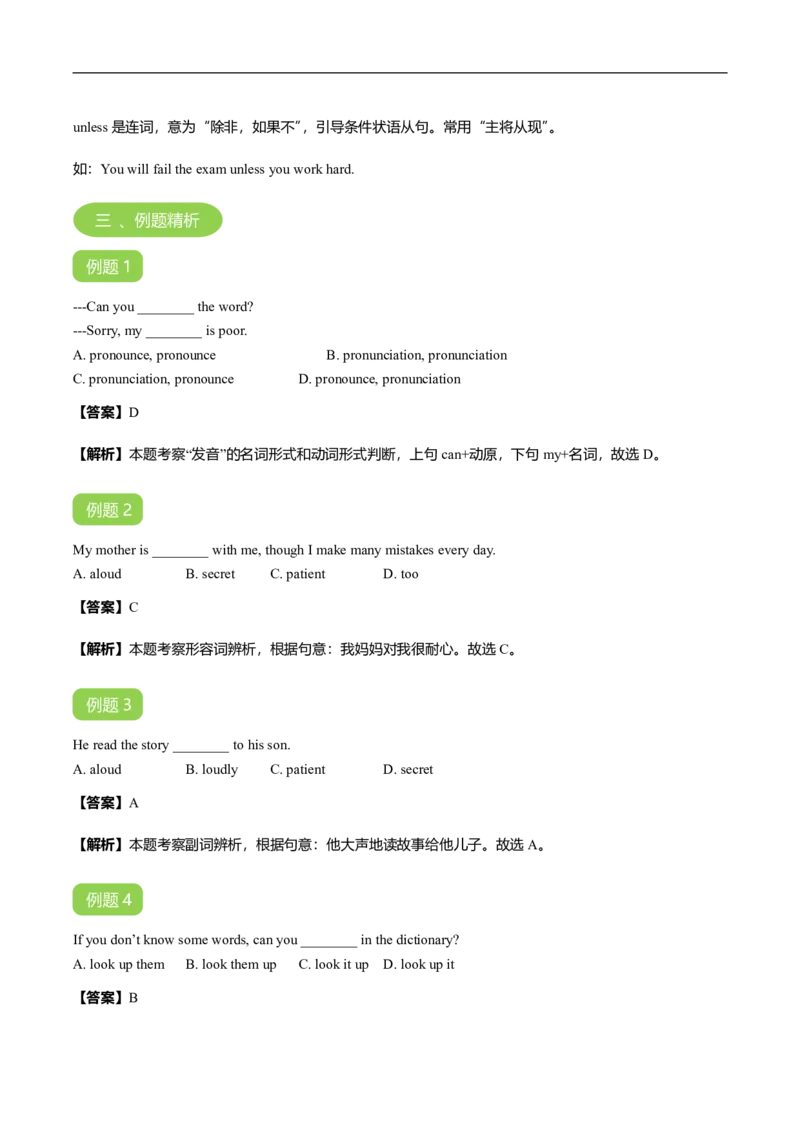
unless 是连词,意为“除非,如果不”,引导条件状语从句。常用“主将从现”。
如:You will fail the exam unless you work hard.
例题1
---Can you ________ the word?
---Sorry, my ________ is poor.
A. pronounce, pronounce
B. pronunciation, pronunciation
C. pronunciation, pronounce
D. pronounce, pronunciation
【答案】D
【解析】本题考察“发音”的名词形式和动词形式判断,上句can+动原,下句my+名词,故选D。
例题2
My mother is ________ with me, though I make many mistakes every day.
A. aloud
B. secret
C. patient
D. too
【答案】C
【解析】本题考察形容词辨析,根据句意:我妈妈对我很耐心。故选C。
例题3
He read the story ________ to his son.
A. aloud
B. loudly
C. patient
D. secret
【答案】A
【解析】本题考察副词辨析,根据句意:他大声地读故事给他儿子。故选A。
例题4
If you don’t know some words, can you ________ in the dictionary?
A. look up them
B. look them up
C. look it up
D. look up it
【答案】B
三、例题精析
【解析】本题首先考察动词短语look up 应该把代词宾格放中间;其次,words 是复数,故选B。
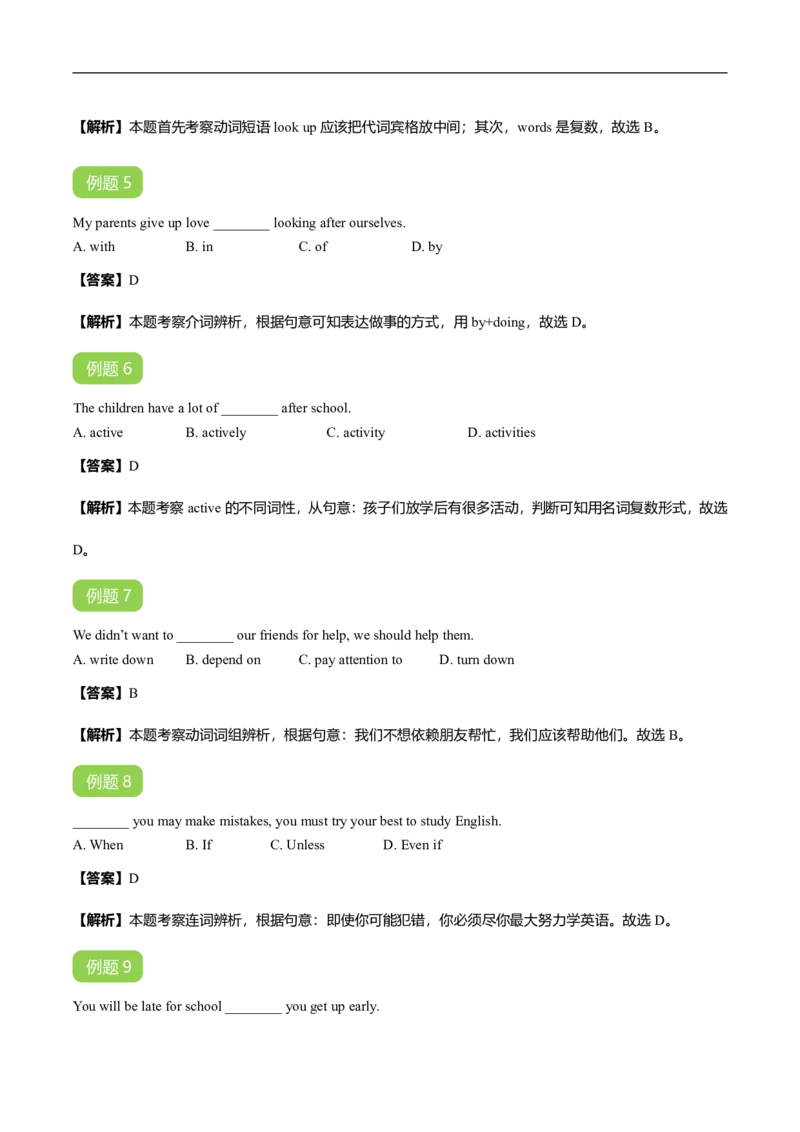
例题5
My parents give up love ________ looking after ourselves.
A. with
B. in
C. of
D. by
【答案】D
【解析】本题考察介词辨析,根据句意可知表达做事的方式,用by+doing,故选D。
例题6
The children have a lot of ________ after school.
A. active
B. actively
C. activity
D. activities
【答案】D
【解析】本题考察active 的不同词性,从句意:孩子们放学后有很多活动,判断可知用名词复数形式,故选
D。
例题7
We didn’t want to ________ our friends for help, we should help them.
A. write down
B. depend on
C. pay attention to
D. turn down
【答案】B
【解析】本题考察动词词组辨析,根据句意:我们不想依赖朋友帮忙,我们应该帮助他们。故选B。
例题8
________ you may make mistakes, you must try your best to study English.
A. When
B. If
C. Unless
D. Even if
【答案】D
【解析】本题考察连词辨析,根据句意:即使你可能犯错,你必须尽你最大努力学英语。故选D。
例题9
You will be late for school ________ you get up early.
A. because
B. unless
C. if
D. until
【答案】B
【解析】本题考察连词辨析;根据句意:你将上学迟到,除非你早起。故选B。
四、课堂运用
1. We study English by ________ some reading.
A.did
B.doing
C.do
D did
2. Hurry up, ________ finish your homework!
A.or
B.but
C.and
D.while
3. If you meet some new words, you'd better ________ in a dictionary.
A.look out them
B.look them out
C.look them up
D.look up them
4. It's much too noisy here. Can you speak ________?
A.fast
B.slowly
C.quietly
D.aloud
5.My mother is an excellent teacher. She is ________ to spend a lot of time explaining things to her students.
A.enough patient
B.patient enough
C.too patient
D.so patient
6.Practice makes perfect. It is ________ of becoming a successful learner.
A.one of the secret
B.one of the secrets
C.one of secret
D.one secrets
7.—Sorry, we can't hear you clearly. Will you please ________ your email address?
基础
—I'll write it down.
A.review
B.recite
C.report
D.repeat
8.The 3rd China's Got Talent (中国达人秀) gives the child a chance to show his special________.
A.ability
B.behavior
C.education
D.background
9.I like English very much. I never miss a ________ to practice English with foreigners.
A.subject
B. mistake
C.chance
D. space
10.My dad usually ________the subway to work, but today he goes to work________ bus.
A.by; by
B.takes; by
C.takes; on
D.drives; by
【答案】
1—5 BCCDB 6—10 BDACB
【解析】
1.
考查by + Ving 形式。
2.
考查连词。句意为:快一点,___完成你的作业。根据句意,所以选and。
3.
考查动副短语。动词+人称代词宾格+adv 或动词+n+副词或动词+adv+n。
4.
形容词辨析。根据句意:这太吵了,你讲话能_____吗?所以选大声地aloud。
5.
根据句意:我妈是一个优秀的老师,她_____花很长时间给学生们讲题。本题考查了too…to,so…that…
和adj+enough 的句式区别。
6.
本题考查的是one of + 名词复数。
7.
动词辨析。根据题意:对不起,我听不清你说什么?你能____一下你的地址吗?可知选repeat 重复。
8.
名词辨析。根据句意:第三季中国达人秀给了这个孩子一个机会去展示他的特殊的_____。根据句意可
知选A.能力。
9.
名词辨析。根据句意:我非常喜欢英语。我绝对不会错过一个_____去和外国人练习英语。根据句意可
知选C.机会。
10. 本题考查动词和介词搭配问题。乘地铁take the subway。乘公交by bus。注:by+表示交通工具的名词
(by 后不加冠词)。
巩固
1. Mr. Brown teaches ________ well ________ everybody likes his lessons.
A.very; that
B.so; that
C.so; to
D.even; that
2.Why not join an English club to practice ________?
A.speaking
B.to speak
C.speaker
D.speak
3.We must ________the teacher says in class.
A.pay attention to
B.pay attentions to
C.pay attentions to what
D.pay attention to what
4. Tom often thinks ________ talking.
A.instead
B.in place
C.instead of
D.instead to
5.The boy had nothing ________.
A.say
B.to say
C.says
D.saying
【答案】
1—5 BADCB
【解析】
1. 本题考查too…to, so…that…和adj + enough 的句式区别。
2. 本题考查practice+ doing。
3. 本题考查pay attention to + 从句。
4. 本题考查instead of + doing。
5. 本题考查have + 不定代词+ to do。
拔高
wait
call
buy
take
see
Mrs. Miller is a vase over, and she often goes to the flea market (1)
some old ones.
She went on vacation last month and asked her son to look after her vases. To her surprise, she
found no vase in her house when she came back. She (2)
her son at once.“ Where are my vases,
James?" Mrs. Miller asked. "I (3)
them to my house." James answered.
After hearing this. Mrs. Miller ran out of the house and took a taxi to her son's home. When
she arrived, her son (4)
for her in front of the door. "Don't worry, mom." James said, "They
are much more beautiful now."
"I can't (5)
them! "Mrs. Miller shouted. "Don't you see them?
They are on the wall."
James was right, because he built a wall made of vases.
【答案】
1.__to buy__
2.__called__
3.__took__
4.__was waiting__
5.__see__
五、课堂小结
重要单词、词组句型
(1) pronunciation n. : pronounce(v. 发音) + -ation (名词后缀)
(2) practice sth./ doing sth. 练习、实践某事;去做某事
(注意)practice 后面接的动词要用ing 形式。
(3) look up 查(字典)
(4) get mad 生气、发怒、
(5)I study by making flashcards. (我通过制作抽认卡来学习。)
by 是介词,“通过…;用…方法”之意,后接名词,代词的宾格以及动词的ing 形式
(6)It’s too hard to understand the voices.
正确理解及运用too…to 结构:too…to 表否定。too 是副词,后接形容词或副词,to 后接动词原型构成不
定式。
(7)What about listening to tapes?
what about =how about, 意为“(你认为)…怎么样?”about 是介词,后接名词,代词的宾格或动词的ing 形
式。
(8)end up sth.\ doing sth. 结束做某事,以做某事而告终(后面还可以接介词with)
例:We ended up talking. 我们结束了谈话。
The headmaster ended up speaking to the students.校长结束了对学生们的谈话。
He ended up the meeting with a word. 他用一句话结束了会议。
(9)get excited about sth. \ doing sth.
对…感到兴奋
例:The scientists got excited about the result of the experiment. 科学家们对实验的结果感到很兴奋。
Do you get excited about going to Beijing? 你对去北京感到兴奋吗?
(10)疑难句子
He finds watching movies frustrating because the people speak too quickly.
find + it \ sth. \ dong sth. + adj +(to do sth.) 发现做某事很…
例:I found it hard to understand them. 我发现理解他们很困难。
You can find studying English very useful in your life. 你会发现学英语对你的生活很有用。
六、课后作业
基础
1. I’m new at the party and I don’t have a friend _________.
A to talk with
B talking to
C to talk
D
speaking to
2. She was afraid _____ out at night, because she was afraid ______ the dark.
A of going, to
B to go , of
C going , of
D
to go, to
3. I can’t always make complete sentences, _________.
A too
B also
C either
D
neither
4. Jackson studied Chinese by ________ tapes.
A listening
B to listen
C listening to
D
to listening to
5. The party ________ with a beautiful song.
A ended up
B end up
C is ended up
D
ending up
6. The drink is _______ delicious _______ I enjoy it very much.
A too, to
B so , that
C such , that
D
to , too
【答案】
1—6 ABCCCB
【解析】
1.
to do 表目的,而talk 为不及物动词,所以选A。
2.
be afraid to do 害怕做某事;be afraid of …害怕。。。
3.
肯定句用too,否定句用either 表示也。
4.
考查by+Ving。
5.
根据句意考查被动语态。
6.
考查so adj/adv that 从句。
巩固
请仔细阅读教材,补充完整下列句子。
1. When you visit a museum you should ________ the instructions.
A.compare with
B.look forward to
C.pay attention to
D.try out
2.I ________ a mistake. Please don't be angry with me.
A.make
B.made
C.will make
D.had made
3.—Shall we go for a picnic tomorrow?
—Well, it all ________ the weather.
A.belongs to
B.happens to
C.depends on
D.concentrates on
4.—Mr. Li, I can't understand everything in class.
—Don't worry! I'll ________ the main points at the end.
A.record
B.review
C.require
D.remember
5. If you want to send your photos by email, connect the camera ________ your computer.
A.out
B.of
C.in
D.to
【答案】
1—5 CBCBD
【解析】
1.C
pay attention to 注意。句意:当你参观博物馆时要注意指示。故选C。
2.B
make a mistake 犯错误。由语境可知错误已经发生,故用过去时态。
3.C
题意:“明天我们去野餐吗?”“这全依赖于天气。”belong to 属于;happen to 发生;depend on 依赖
于;concentrate on 集中。根据题意可知选C。
4.B
题意:“并不是所有在课上讲的知识我都能理解。”“别担心!我会在最后复习那些要点。”record 记录;
review 复习;require 要求;remember 记得。根据题意可知选B。
5.D
connect to 把……连接起来。
拔高
为了提高大家的英语成绩,在新学期的第一节英语课上,老师让同学们相互交流自己学习英语的心得。请
你以“What Should We Do In English Study?”为题,写一篇英语短文,谈谈学生应该怎样做才能更有效地学
习英语。
内容包括:
1.上课认真听讲,做笔记。
2.参加各种英语活动。
3.自己应充满信心,不要害怕出错。
作文要求:
语句连贯,词数80 个左右。
________________________________________________________________________
________________________________________________________________________
________________________________________________________________________
________________________________________________________________________
参考范文:
What Should We Do In English Study?
How can we study English well? First, get ready for the lessons before class. Second, in English class we should
listen to the teacher and take notes carefully. Third, after class we should review our lessons. It's also a good way to
take part in English activities. In addition, it's very important for us to be confident and don't be afraid to make
mistakes. Making mistakes is also a way to improve our study. In this way, I think all of us can learn English well.
七、教学反思