Unit 4 I used to be afraid of the dark.
第4 讲
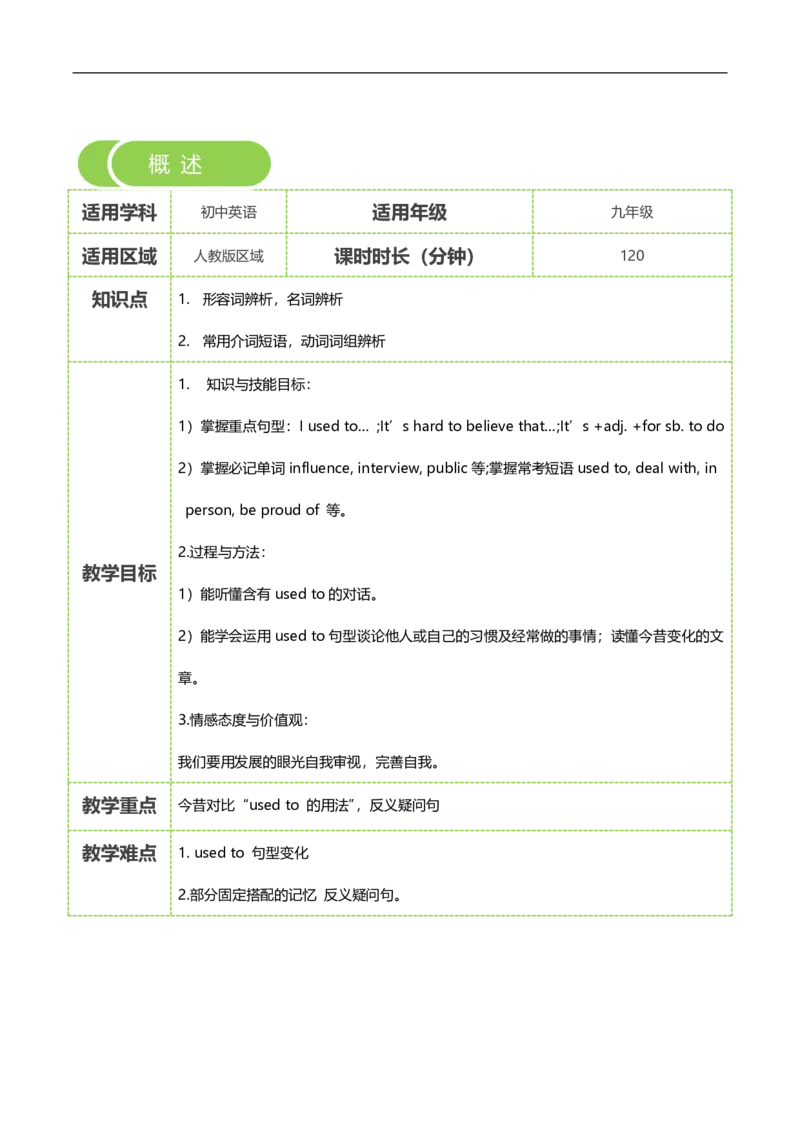
适用学科
初中英语
适用年级
九年级
适用区域
人教版区域
课时时长(分钟)
120
知识点
1.
形容词辨析,名词辨析
2.
常用介词短语,动词词组辨析
教学目标
1.
知识与技能目标:
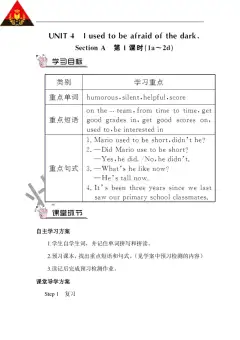
1)掌握重点句型:I used to… ;It’s hard to believe that…;It’s +adj. +for sb. to do
2)掌握必记单词influence, interview, public 等;掌握常考短语used to, deal with, in
person, be proud of 等。
2.过程与方法:
1)能听懂含有used to 的对话。
2)能学会运用used to 句型谈论他人或自己的习惯及经常做的事情;读懂今昔变化的文
章。
3.情感态度与价值观:
我们要用发展的眼光自我审视,完善自我。
教学重点
今昔对比“used to 的用法”,反义疑问句
教学难点
1. used to 句型变化
2.部分固定搭配的记忆反义疑问句。
概述
教学过程
一、导入
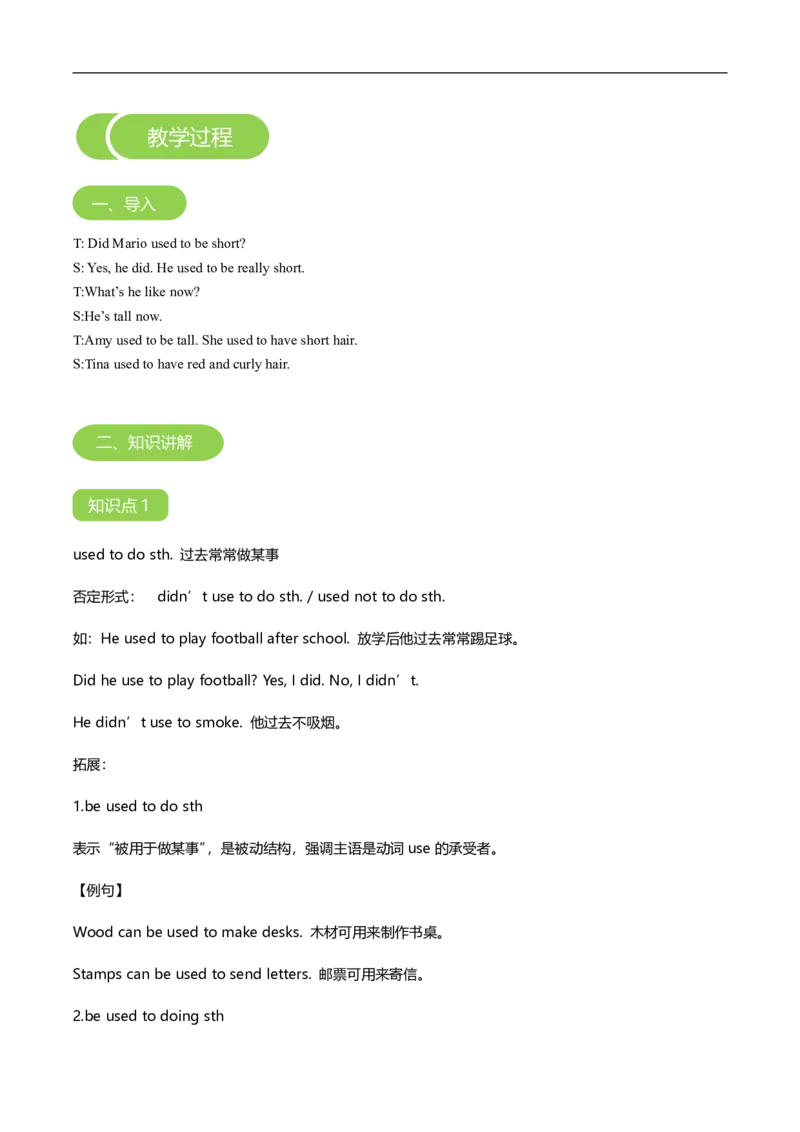
T: Did Mario used to be short?
S: Yes, he did. He used to be really short.
T:What’s he like now?
S:He’s tall now.
T:Amy used to be tall. She used to have short hair.
S:Tina used to have red and curly hair.
二、知识讲解
知识点1
used to do sth. 过去常常做某事
否定形式:
didn’t use to do sth. / used not to do sth.
如:He used to play football after school. 放学后他过去常常踢足球。
Did he use to play football? Yes, I did. No, I didn’t.
He didn’t use to smoke. 他过去不吸烟。
拓展:
1.be used to do sth
表示“被用于做某事”,是被动结构,强调主语是动词use 的承受者。
【例句】
Wood can be used to make desks. 木材可用来制作书桌。
Stamps can be used to send letters. 邮票可用来寄信。
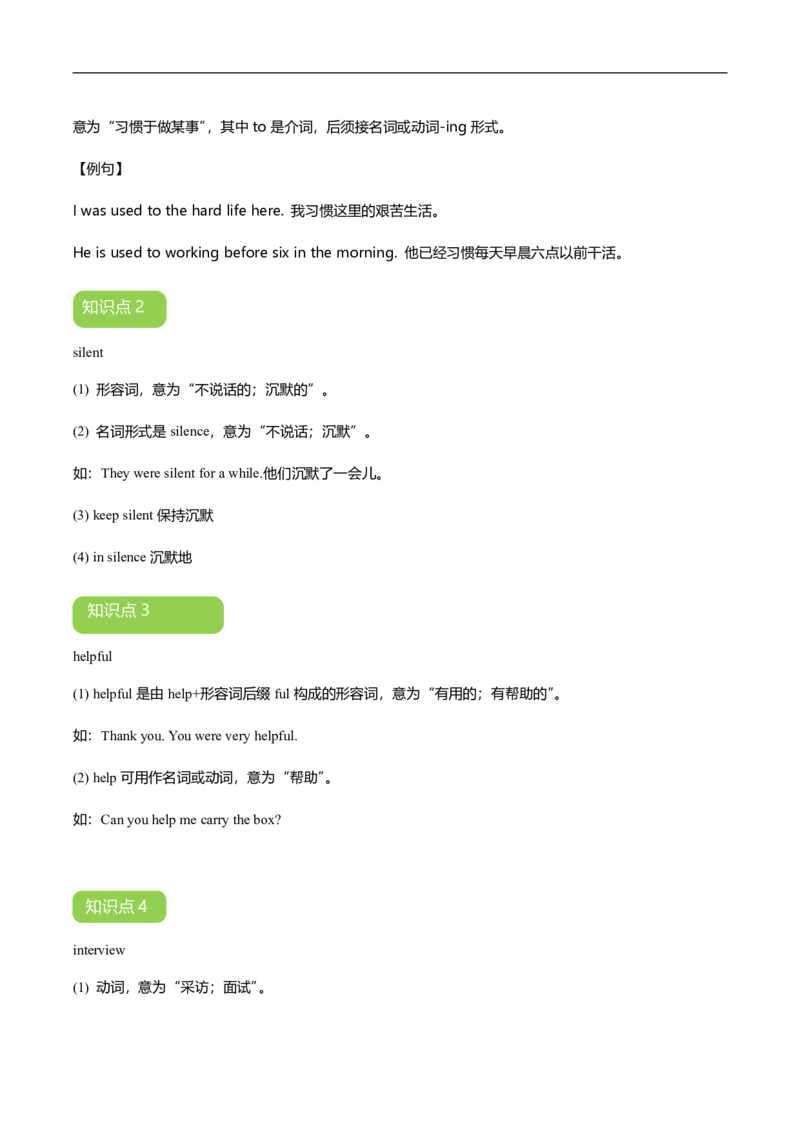
2.be used to doing sth
意为“习惯于做某事”,其中to 是介词,后须接名词或动词-ing 形式。
【例句】
I was used to the hard life here. 我习惯这里的艰苦生活。
He is used to working before six in the morning. 他已经习惯每天早晨六点以前干活。
知识点2
silent
(1) 形容词,意为“不说话的;沉默的”。
(2) 名词形式是silence,意为“不说话;沉默”。
如:They were silent for a while.他们沉默了一会儿。
(3) keep silent 保持沉默
(4) in silence 沉默地
知识点3
helpful
(1) helpful 是由help+形容词后缀ful 构成的形容词,意为“有用的;有帮助的”。
如:Thank you. You were very helpful.
(2) help 可用作名词或动词,意为“帮助”。
如:Can you help me carry the box?

知识点4
interview
(1) 动词,意为“采访;面试”。
(2) 名词,意为“采访;面试”。
如:Jackie Chan gave an interview last week.
(3) interviewer 是名词,意为“采访者;记者”
如:His uncle is an interviewer.
知识点5
dare
(1) dare 是实义动词,意为“敢于;胆敢”。
如:he dared to climb the tree.
(2) dare 还可用作情态动词,常用于否定句,疑问句或条件句中。
如:She dare not go out alone.
知识点6
require
(1) 动词,意为“需要;要求”。后接名词,不定式或that 从句。
如:They required us to help them.
(2) require 还可接动名词,表示被动的含义。
如:The car requires repairing next week.
知识点7
from time to time
意为“有时;不时”,相当于sometimes 或at times。
如:They visited us from time to time.
知识点8
give up
意为“放弃”,后接名词、代词或动名词。
give up doing sth.意为“放弃做某事”。
如:You’d better give up smoking. It’s bad for your health.
知识点9
in public
意为“公开地;在别人面前”,相当于in public places。
如:She dare not sing in public.
知识点10
辨析deal with 与do with
(1) 两者都是“处理;应付”的意思。
(2) deal with 与how 连用;do with 与what 连用。
如:How do you deal with this problem?=What do you do with this problem?
知识点11
It’s been three years since we last saw our primary school classmates.
本句是复合句,主句是现在完成时,句中it’s 是it has,从句是由since 引导的时间状语从句,用一般过去
时。
如:I have been a teacher since I came to the school.
知识点12
influence
(1) 可用作动词或名词,意为“影响”。
如:My advice has no influence on him.
(2) 由influence 构成的短语
have an influence on 对……有影响
under the influence of 在……的影响下
知识点13
seldom
(1) 副词,意为“不常;很少”。表示频率,一般放在实义动词的前面,be 动词、助动词、情态动词的后面。
如:I seldom go to the cinema because I don’t like it.
(2) 频率副词还有:often“经常”;sometimes“有时”;usually“通常”;always“总是”;never“从不”。
知识点14
fail
(1) 动词,意为“不及格;失败;未能做到”。
(2) “未能做某事”fail to do sth.
如:They failed to climb the mountain because of the heavy rain.
(3) fail 的反义词是succeed“成功”,短语succeed (in) doing sth.意为“成功做成某事”。
知识点15
be proud of
意为“以……为骄傲、自豪”,相当于take part in。
如:I am proud of our country.
He takes pride in his cooking.
知识点16
be interested in doing sth.
be interested in doing sth.意为“对做……感兴趣”。其中be interested in 相当于take an interest in。
如:He is interested in swimming.
知识点17
in person
意为“亲身;亲自”,相当于in one’s own person。
如:You should do the job in person.
知识点18
to one’s surprise
(1) 意为“使某人惊奇的是”。
(2) 常用于句首,后面加逗号与其他句子成分隔开。
如:To my surprise, he passed the English exam.
知识点19
take care of
(1) 意为“照顾;照料”。
(2) 相当于look after。
如:My grandma is ill. I have to look after her at home.
(3) take good care of 相当于look after well。
如:Can you take good care of yourself?= Can you look after yourself well?
知识点20
反意疑问句
①肯定陈述句+否定提问
如:Lily is a student, isn’t she?
Lily will go to China, won’t she?
②否定陈述句+肯定提问
如:
She doesn’t come from China, does she?
You haven’t finished homework, have you?
③提问部分用代词而不用名词Lily is a student, isn’t she?
④陈述句中含有否定意义的词,如:little, few, never, nothing, hardly 等。其反意疑问句用肯定式。如:
He knows little English, does he?
他一点也不懂英语,不是吗?
They hardly understood it, did they?他们几乎不明白,不是吗?
例题1
【题干】---How is your grandma?
---She’s fine. She used to ___ TV at home after supper. But now she is used to ____ out for a walk.
A. watch; go
B. watching; go
C. watching; going D. watch; going
例题2
【题干】When I walked past the park, I saw some old people ________ Chinese Taiji.
A. do
B. did
C. doing
D. are doing
例题3
三、例题精析
【题干】---Which hobby do you think ________ the least time?
---Collecting stamps.
A. takes up
B. puts up
C. gives up
D. makes up
例题4
【题干】You are supposed to ________ smoking, ________ you will get ill.
A. go on, so
B. give up, or
C. stop, so
D. pass by
例题5
【题干】---Do you like seeing a movie on your mobile phone?
---No. I ________ do that because it makes me uncomfortable.
A. seldom
B. often
C. usually
D. sometimes
例题6
【题干】---Mom, I was the first to reach the top of the mountain.
---Good job, Jack! I’m ________ of you.
A. careful
B. proud
C. tired
D. afraid
例题7
【题干】Thanks for your invitation, but I’m so sorry I can’t go. I need to ________ my baby at home.
A. take away
B. take off
C. take care of
D. take out of
例题8
【题干】Andrea Bocelli never ________, which makes him a successful singer.
A. takes away
B. gives away
C. gets up
D. gives up
四、课堂运用
基础
1. ---How is your grandma?
---She’s fine. She used to ______ TV at home after supper. But now she is used to ______ out for a walk.
A. watch; go
B. watching; go
C. watching; going D. watch; going
2.I have ___ to tell you. Maybe you will be _____ in it.
A. interesting something; interested
B. something interesting; interesting
C. something interesting; interested
D. something interested; interesting
3. She used to____ in the morning, but now she is used to ______ at night.
A. read; read
B. read; reading
C. reading; read
D. reading; reading
4. I used to go outside on weekends. (改为否定句) I____ ____ to go outside on weekends.
5.—What does the lady look like?—
.
A. She’s fine and well
B. She’s really a nice lady
C. She’s tall and thin
D. She likes wearing skirts
6.—Is he still raising money for charity?
—Yes. He never_____ hope of helping poor children.
A. gives up
B. gives out
C. takes off
D. takes out
7.—What’s your plan for the new school year?
—Oh, I am going to _____a new hobby by learning to play the guitar.
A. take part
B. take up
C. take back
D. take care
8. The boss found two boys stealing his bread but he didn’t know _____
A. how to do with
B. what to do with them
C. how to deal with it
D. what to deal with
9.Don’t give up! Come on. I know you can make____.
A. it
B. this
C. that
D. so
10.Look! The monkeys are jumping _____.
A. in time
B. for the first time
C. all the time
D. at times
巩固
1. Every year driving after drinking wine _____ a lot of traffic accidents.
A. happens
B. provides
C. causes
D. affords
2.你不要把时间浪费在看电视上。Don’t waste your time ____ ____ TV.
3.让那个孩子不要浪费时间了。Ask the child ____ ____ ____time.
4.—Jack, will your family move to Shanghai?
—Yes. That’s a very big ______my parents made.
A. decide
B. decision
C. education
D. difference
5. He no longer lives here. (同义句转换)
He ____ ____here ____ ____ .
拔高
1.We felt ________ when Liu Xiang won the first prize again in the race.
A. pride
B. proud
C. successful
D. worried
2.October 12th was one of
day in 2005, for Shenzhou VI was sent up successfully into the
space.
A. exciting
B. more exciting
C. much exciting
D. the most exciting
3. 刘翔是世界上最受欢迎的体育明星之一。________________________________________
4. Knives are used to _____ things.
A. cut
B. cuts
C. cutting
D. to cut
5. He wanted to know _____.
A. where did my pen pal come from
B. where does my pen pal come from
C. where my pen pal came from
D. where my pen pal comes from
五、课堂小结
1、used to do sth. 过去常常做某事
否定形式:
didn’t use to do sth. / used not to do sth.
如:He used to play football after school. 放学后他过去常常踢足球。
Did he use to play football? Yes, I did. No, I didn’t.
He didn’t use to smoke. 他过去不吸烟。
拓展:
1.be used to do sth
表示“被用于做某事”,是被动结构,强调主语是动词use 的承受者。
【例句】
Wood can be used to make desks. 木材可用来制作书桌。
Stamps can be used to send letters. 邮票可用来寄信。
2.be used to doing sth
意为“习惯于做某事”,其中to 是介词,后须接名词或动词-ing 形式。
【例句】
I was used to the hard life here. 我习惯这里的艰苦生活。
He is used to working before six in the morning. 他已经习惯每天早晨六点以前干活。
2、反意疑问句
①肯定陈述句+否定提问
如:Lily is a student, isn’t she?
Lily will go to China, won’t she?
②否定陈述句+肯定提问
如:
She doesn’t come from China, does she?
You haven’t finished homework, have you?
③提问部分用代词而不用名词Lily is a student, isn’t she?
④陈述句中含有否定意义的词,如:little, few, never, nothing, hardly 等。其反意疑问句用肯定式。如:
He knows little English, does he?
他一点也不懂英语,不是吗?
They hardly understood it, did they?他们几乎不明白,不是吗?
六、课后作业
基础
1. Mario is afraid of ___ alone.
A. be
B. being
C. is
D. /
2.. You used to be outgoing, ______?
A. do you
B. don’t you
C. didn’t you
D. did you
3.. I haven’t _____ him for a long time.
A. see
B. saw
C. seen
D. seeing
4. I used to have short hair, but now I have______hair.
A. curly
B. long
C. straight
D. brown
5.----- You used to be short, _____you ?
------Yes , I_______.
A. didn’t, did
B. usedn’t, used
C. didn’t, used
D. usedn’t, did
巩固
请仔细阅读教材,补充完整下列句子。
Life is not easy, so I’d like to say “When anything happens, believe in yourself.”
When I was a young boy, I was _1_shy to talk to anyone. My classmates often _2_me. I was sad but could do
nothing, Later,_3_happened,and it changed my life. It was an English speech contest. My mother asked me to
_4_it .What a terrible idea! It meant I had to speak before all the teachers and students of my school.
“Come on, boy. Believe in yourself. You are sure to _5_the contest.” Then mother and I talked about many
different topics. At last I chose the topic “Believe in yourself.” I tried my best to remember all the speech and
practiced it over 100 _6_.With my mother’s great love, I did _7_in the contest. I could hardly believe my ears
when the news came that I had won the first place, I heard the cheers _8_the teachers and the students. Those
classmates_9_once looked down on(看不起)me ,now all said “Congratulations!” to me. My mother hugged me
and cried excitedly.
Since then, everything has changed for me. When I do anything, I try to tell _10_to be sure and I will find myself.
This is not only for a person but also for a country.
(
)1. A. too
B. so
C. quite
D. very
(
)2.A.made faces at
B. looked after
C. caught up with
D. laughed at
(
)3.A.nothing
B. something
C. everything
D. anything
(
)4.A.take part in
B. join
C. get
D. make
(
)5.A.lose
B. win
C. pass
D. beat
(
)6.A.words
B. topics
C. times
D. sentences
(
)7.A.well
B. good
C. bad
D. interested
(
)8.A.for
B. at
C. from
D. to
(
)9.A.when
B. what
C. which
D. who
(
)10.A.someone
B. me
C. everything
D. myself
拔高
写一篇关于Make our world more beautiful !的文章,80 词左右。