1
2026 秋新八上仁爱英语课文解析
Unit 3 Sound Body, Sound Mind
healthy adj.健康的;健壮的
比较级:___________
最高级:___________
派生词:___________ adv.健康地
___________ n.健康;健康性
如:Keep ___________
by eating well and exercising regularly.
通过良好饮食和经常性锻炼保持健康。
She eats ___________
by choosing fresh vegetables and lean meat every day.
她每天选择新鲜蔬菜和瘦肉,吃得很健康。
1.用所给词的正确形式填空:
Regular exercise helps you stay ______ (health).
___________ ___________ ___________ ___________ ___________
2.汉译英:
他的饮食习惯很好,总是吃得很健康。
________ __________ __________ __________ __________ ________
3.选择题:
The doctor advised him to care about his ______ more.
A. healthy
B. healthily
C. health
知识点精讲
即学即用
2
Preparing for the Topic
Activity 3
Doctor: What’s wrong with you?
医生:你哪里不舒服?
Li Xiang: I feel very sick and have a stomachache.
李翔:我感觉很不舒服,而且肚子疼。
Doctor: When did you feel the ache?
医生:你什么时候开始疼的?
Li Xiang: About one hour ago. Just after lunch.
李翔:大约一小时前,刚吃完午饭之后。
Doctor: Let me examine you. (A few minutes later)
医生:让我给你检查一下。(几分钟后)
Doctor: OK. What did you have for lunch?
医生:好了。你午饭吃了什么?
Li Xiang: I had some hamburgers, chips, fried pork together with some
pepper and a cold drink.
李翔:我吃了一些汉堡、薯条、炸猪肉,还加了些辣椒,喝了一杯冰饮料。
Doctor: I see. You ate too much junk food, especially hot pepper and iced
Coke. It is not healthy at all.
医生:我知道了。你吃了太多垃圾食品,尤其是辣椒和冰可乐,这一点都不健康。
Li Xiang: Thanks, doctor. I will remember that.
3
李翔:谢谢您,医生。我会记住的。
Doctor: You need to take a rest and take some pills.
医生:你需要休息一下,再吃点药。
Li Xiang: OK. Thank you.
李翔:好的,谢谢您。
(1)What’s wrong with you?
等价于“What’s the matter?”还可以用“What’s the matter?”
“What’s up?” “Are you all right?” 等表达
例如:“You look so pale. What’s wrong with you?”
你脸色看起来这么苍白。你怎么了?
(2)Li Xiang: I feel very sick and have a stomachache.
①sick adj.生病的;恶心
比较级:___________
最高级:___________
a sick child 生病的孩子
Her mother's very sick.她母亲病得很厉害。
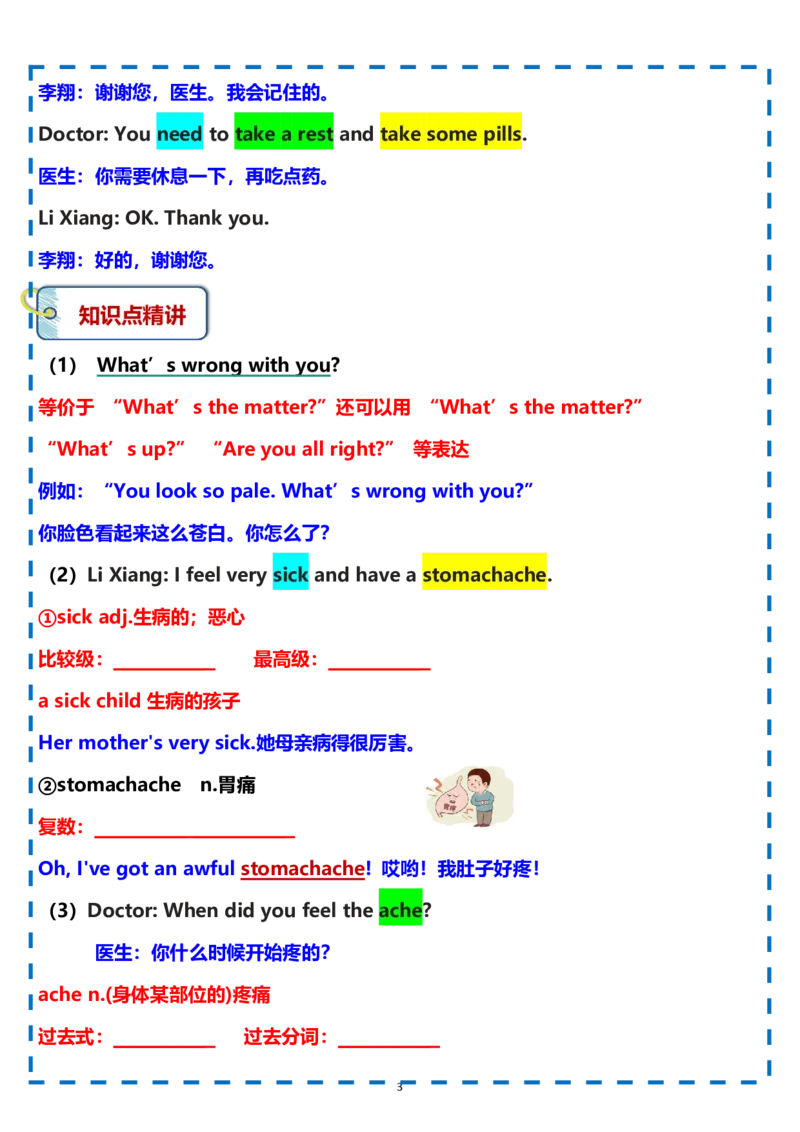
②stomachache
n.胃痛
复数:___________ ___________
Oh, I've got an awful stomachache! 哎哟!我肚子好疼!
(3)Doctor: When did you feel the ache?
医生:你什么时候开始疼的?
ache n.(身体某部位的)疼痛
过去式:___________
过去分词:___________
知识点精讲
4
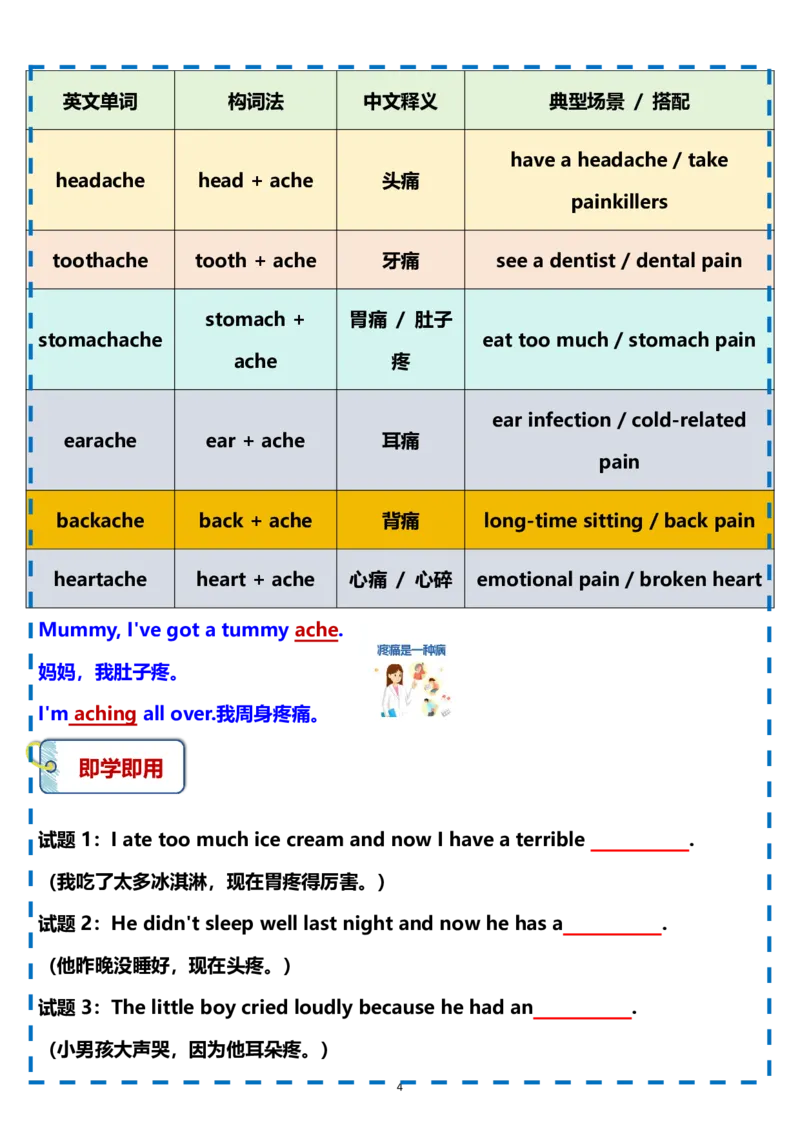
英文单词
构词法
中文释义
典型场景/ 搭配
headache
head + ache
头痛
have a headache / take
painkillers
toothache
tooth + ache
牙痛
see a dentist / dental pain
stomachache
stomach +
ache
胃痛/ 肚子
疼
eat too much / stomach pain
earache
ear + ache
耳痛
ear infection / cold-related
pain
backache
back + ache
背痛
long-time sitting / back pain
heartache
heart + ache
心痛/ 心碎
emotional pain / broken heart
Mummy, I've got a tummy ache.
妈妈,我肚子疼。
I'm aching all over.我周身疼痛。
试题1:I ate too much ice cream and now I have a terrible ___________ .
(我吃了太多冰淇淋,现在胃疼得厉害。)
试题2:He didn't sleep well last night and now he has a___________ .
(他昨晚没睡好,现在头疼。)
试题3:The little boy cried loudly because he had an___________ .
(小男孩大声哭,因为他耳朵疼。)
即学即用
5
试题4:My father often has a ___________
after working in front of the
computer for a long time.(我父亲长时间在电脑前工作后,经常背痛。)
试题5:She ate too many candies, so she had a___________
and had to see the
dentist.(她吃了太多糖果,所以牙疼,不得不去看牙医。)
试题6:The news of her pet dog's death gave her a deep ___________ .
(她宠物狗去世的消息让她非常心痛。)
(4)Doctor: Let me examine you. (A few minutes later)
医生:让我给你检查一下。(几分钟后)
examine v.检查,检验;审查
过去式:___________
过去分词:___________
①___________ ”“检查;审查;考察;考试”,可缩写为“exam”。
②“___________ ”“审查员;考官;主考人;检查人”。
③“___________ ”,意思是“应试人;参加考试者”
The goods were examined for damage on arrival.
货物到达时检查是否有破损。
Another doctor examined her and could still find nothing wrong.
另外一名医生对她进行了诊察,仍旧没有发现任何问题。
试题1:The final ______ is coming next week. All the students are busy
preparing for it.(下周就要期末考试了。所有学生都在忙着备考。)
试题2:The ______ asked the students some very difficult questions in the oral
test.(主考人在口语测试中问了学生们一些非常难的问题。)
试题3:All the ______ in the classroom were concentrating hard on the test
即学即用
6
paper.(教室里所有的应试者都在全神贯注地做试卷。)
(5)Li Xiang: I had some hamburgers, chips, fried pork together with some
pepper and a cold drink.
李翔:我吃了一些汉堡、薯条、炸猪肉,还加了些辣椒,喝了一杯冰饮料。
①hamburger n.汉堡包
复数:___________
She was eating a hamburger. 她在吃汉堡包。
Avoid unhealthy foods such as hamburger and chips.
不要吃不健康食品,如汉堡和薯条。
②chip n.炸薯条;v.打破,弄缺,被损坏;切下,削下
复数:___________
过去式:___________
过去分词:___________
potato chips 炸土豆片
I do not like the chip they serve here-they are too greasy.
我不喜欢这里做的炸薯条,太油腻了。
I've never been a great one for fish and chips.
我从来不是个好吃炸鱼薯条的人。
③.fried adj.油炸的;v.___________
Mushrooms are best when fried in olive oil.
蘑菇用橄榄油炒最好。
You should taste my Dad's fried chicken, it's delicious.
你应该尝尝我父亲炸的鸡,非常可口。
④.pork n.猪肉[不可数名词]
roast pork 烤猪肉
pork chops 猪排
7
Legs of pork were cured and smoked over the fire.
在火上熏制猪腿。
⑤together with 用法:“together with” 是一个常用的介词短语,意思是“和……
一起;连同…… 一起”,用于表示与某人或某物一同进行某项活动或处于某种状态。
例如:“I went to the meeting together with my colleagues.”
(我和我的同事们一起去参加了会议。)
“He brought his books together with his notebook.”
(他把他的书和笔记本一起带来了。)
⑥.pepper n.胡椒粉[不可数名词] ;辣椒[可数];vt.(在食物上)撒胡椒粉
复数:___________
Add salt and pepper to taste.适量放盐和胡椒粉。
试题1:I like ______ very much. They are delicious. But they are not healthy.
(
)
A. hamburger
B. hamburgers
C. a hamburger
试题2:My brother often eats ______ for lunch. (
)
A. chip
B. chips
C. a chip
试题3:The ______ pork smells so good. I can't wait to eat it. (
)
A. fry
B. fries
C. fried
试题4:There are some green ______ in the basket. (
)
A. pepper
B. peppers
C. a pepper
即学即用
8
试题5:My sister doesn't like ______ food. She thinks it is bad for her health.
(
)
A. fried
B. fries
C. fry
(6)Doctor: I see. You ate too much junk food, especially hot pepper and iced
Coke. It is not healthy at all.
医生:我知道了。你吃了太多垃圾食品,尤其是辣椒和冰可乐,这一点都不健康。
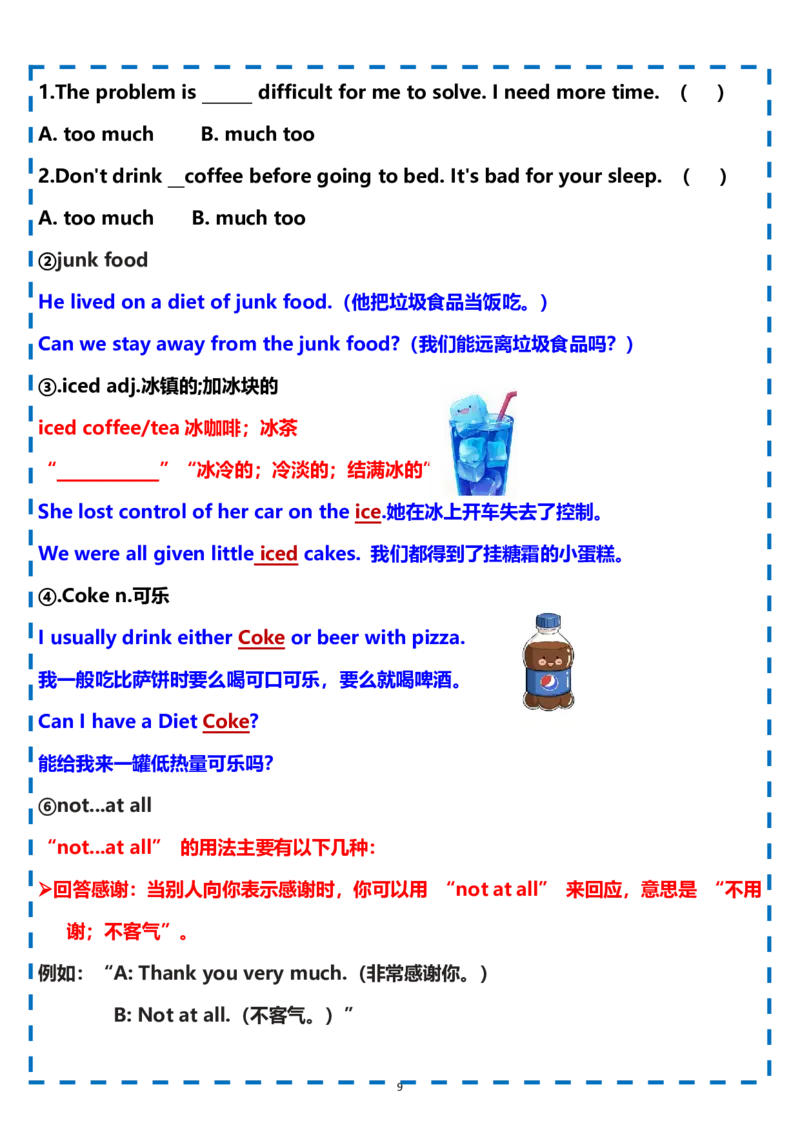
①too much 用法:
作名词词组:此时“too much” 可在句中作主语或宾语等。
例如:“Too much has been said on this topic.
关于这个话题已经说得太多了。(这里“Too much” 作主语)
再如:“You have given me too much.(你给我的太多了。)”
(此处“too much” 作宾语。)
作形容词词组:用于修饰不可数名词,放在名词前面,表示“数量过多”
例如:“There is too much water in the bottle.瓶子里的水太多了。
Don't eat too much junk - food.不要吃太多垃圾食品。
作副词词组:用来修饰动词,通常放在动词后面,表示动作的程度过度。
例如:He talks too much.他说得太多了。
She worries too much about her children.她过于担心她的孩子们了。
此外,还需要注意“too much” 与“much too” 的区别,“much too” 的中
心词是“too”,用来修饰形容词或副词,强调程度“太……”,例如:“It's much
too cold.(天气实在太冷了。)
即学即用
9
1.The problem is ______ difficult for me to solve. I need more time. (
)
A. too much
B. much too
2.Don't drink __coffee before going to bed. It's bad for your sleep. (
)
A. too much
B. much too
②junk food
He lived on a diet of junk food.(他把垃圾食品当饭吃。)
Can we stay away from the junk food?(我们能远离垃圾食品吗?)
③.iced adj.冰镇的;加冰块的
iced coffee/tea 冰咖啡;冰茶
“___________ ”“冰冷的;冷淡的;结满冰的”
She lost control of her car on the ice.她在冰上开车失去了控制。
We were all given little iced cakes. 我们都得到了挂糖霜的小蛋糕。
④.Coke n.可乐
I usually drink either Coke or beer with pizza.
我一般吃比萨饼时要么喝可口可乐,要么就喝啤酒。
Can I have a Diet Coke?
能给我来一罐低热量可乐吗?
⑥not...at all
“not...at all” 的用法主要有以下几种:
回答感谢:当别人向你表示感谢时,你可以用“not at all” 来回应,意思是“不用
谢;不客气”。
例如:“A: Thank you very much.(非常感谢你。)
B: Not at all.(不客气。)”
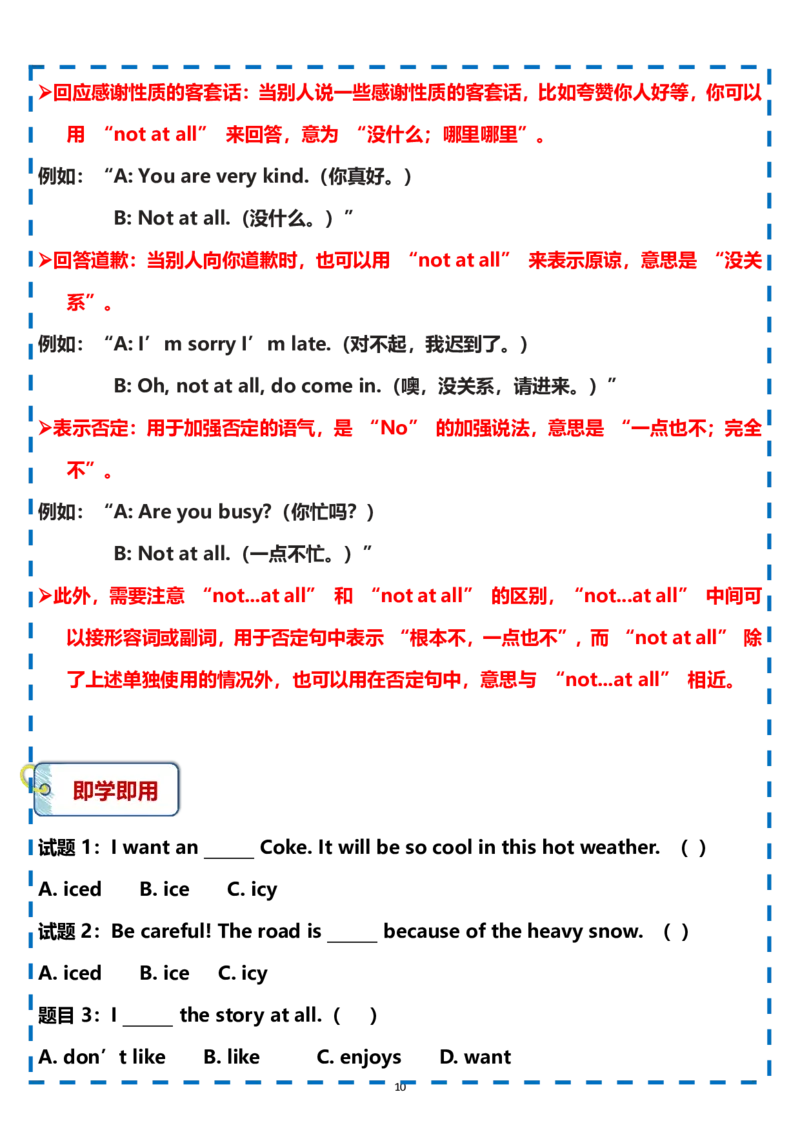
10
回应感谢性质的客套话:当别人说一些感谢性质的客套话,比如夸赞你人好等,你可以
用“not at all” 来回答,意为“没什么;哪里哪里”。
例如:“A: You are very kind.(你真好。)
B: Not at all.(没什么。)”
回答道歉:当别人向你道歉时,也可以用“not at all” 来表示原谅,意思是“没关
系”。
例如:“A: I’m sorry I’m late.(对不起,我迟到了。)
B: Oh, not at all, do come in.(噢,没关系,请进来。)”
表示否定:用于加强否定的语气,是“No” 的加强说法,意思是“一点也不;完全
不”。
例如:“A: Are you busy?(你忙吗?)
B: Not at all.(一点不忙。)”
此外,需要注意“not...at all” 和“not at all” 的区别,“not...at all” 中间可
以接形容词或副词,用于否定句中表示“根本不,一点也不”,而“not at all” 除
了上述单独使用的情况外,也可以用在否定句中,意思与“not...at all” 相近。
试题1:I want an ______ Coke. It will be so cool in this hot weather. ()
A. iced
B. ice
C. icy
试题2:Be careful! The road is ______ because of the heavy snow. ()
A. iced
B. ice
C. icy
题目3:I ______ the story at all.(
)
A. don’t like
B. like
C. enjoys
D. want
即学即用
11
(7)Li Xiang: Thanks, doctor. I will remember that.
李翔:谢谢您,医生。我会记住的。
“remember” 有“记得;牢记;纪念” 等意思,既可用作及物动词,也可用作不及
物动词。
例如:“I don't remember his name.”(我不记得他的名字了。)
接动词不定式(to - do):“___________ ___________ ” 表示“记得去做某事”,强
调动作还未发生。
例如:“Remember to bring your homework tomorrow. ”
明天记得带你的作业。
接动名词(doing):“___________ ___________ ” 表示“记得做过某事”,动作是
已经发生过的。
例如:“I remember seeing this movie before. ”
我记得以前看过这部电影。
接that 从句或疑问词引导的从句:用于记住具体的内容或信息。
例如:“I remember that he is a doctor.”(我记得他是一名医生。)
“Do you remember what she said? ”(你记得她说了什么吗?)
1.I remember__________ the gloves on the sofa, but they are not there now.
A. leave
B. to leave
C. leaving
D. left
2.I must remember _____ you for the tickets.
A. paying
B. to pay
C. pay
D. paid
(8)Doctor: You need to take a rest and take some pills.
医生:你需要休息一下,再吃点药。
即学即用
12
①need 此处need 是实义动词,结构need to do sth.需要做...
I need to finish my homework tonight.我今晚需要完成我的作业。
You need to call your parents and let them know.
你需要给你的父母打电话并让他们知道。
1.你需要每天早上打扫房间。
________ _________ _________ _________ _________ _________ _
2.你不需要这么早来。
________ _________ _________ _________ _________ _________ _
②take a rest “休息一下”
I'll take a rest in the afternoon.(我下午要休息一下。)
Let me take a rest, I'm all beat up.(让我休息吧,我实在是精疲力竭了。)
③take some pills “服用一些药片/ 药丸”
The doctor told me to take some pills for my headache.
医生让我吃些药缓解头痛。
You should take these pills three times a day after meals.
这些药片你应该每天吃三次,饭后服用。
take 常考短语:
_____________ ____ _:(积极地)参加
_______________ __ _:为(发信人)留个信
________ _________ _:给(收信人)留/ 传个信
______________ ___ _:深呼吸
______________ ___ _:控制
即学即用
13
_______________ __ _:吸引某人注意
Exploring the Topic
Pingping and Yining both love sports a lot. Pingping is outgoing and she
always plays football with her friends. Unlike her, Yining is shy. She likes
running alone. When doing sports, they both need to take care of their
safety.
平平和伊宁都非常热爱运动。平平性格外向,总是和朋友们一起踢足球。与她不同的是,
伊宁很害羞,喜欢独自跑步。做运动时,她们都需要注意安全。
Hello, I’m Wenwen. I love fruit and vegetables. I eat at home every day,
and I have meals with little salt and sugar. My favorite snack is chocolate. My
friend Xiaolu also likes fruit and vegetables. But she often eats hamburgers
and cookies. Her favorite snack is ice cream.
你好,我是文文。我喜欢水果和蔬菜,每天都在家吃饭,而且吃饭时很少放盐和糖。我
最喜欢的零食是巧克力。我的朋友小路也喜欢水果和蔬菜,但她经常吃汉堡和饼干,她
最喜欢的零食是冰淇淋。
(1)both 用法:
①表示“两……(都),两个……(都)”,用于修饰复数名词。
知识点精讲
14
如“Both his eyes were seriously burned.”(他的双眼都严重烧伤了。)
②构成“both...and...” 结构,表示“既…… 且……;…… 和…… 都”,用于连接
两个并列的成分。
如“The prospects both excited and worried me.”
这前景既使我激动又令我忧虑。
“both” 和“neither” 都可以用来谈论两者之间的关系,但它们的含义和
用法有所不同。
①“both” 表示“两者都”,是对两者的肯定。
例如:“Both of them are students.”(他们两个都是学生。)
②“neither” 表示“两者都不”,是对两者的否定。
例如:“Neither of them is a teacher.”(他们两个都不是老师。)
③“both” 可作代词、形容词和连词。
作代词时,可单独使用,也可与“of” 连用。
如“Both are here.”(两个都在这儿。)
“Both of the girls like music.”(这两个女孩都喜欢音乐。)
作形容词时,修饰复数名词。
如“Both brothers are tall.”(两兄弟都很高。)
作连词时,构成“both...and...” 结构,用来连接两个并列的成分
如“He is both smart and hard - working.”(他既聪明又勤奋。)
④“neither” 可作代词、形容词和连词。
15
作代词时,可单独使用或与“of” 连用,作主语时谓语动词用单数
如“Neither is correct.”(两个都不对。)
“Neither of the books is interesting.”(这两本书都没趣。)
作形容词时,修饰单数名词。
如“Neither answer is right.”(两个答案都不对。)
作连词时,与“nor” 连用,构成“neither...nor...” 结构,连接两个并列成分
如“Neither he nor I like sports.”(他和我都不喜欢运动。)
⑤“both” 作主语或连接两个主语时,谓语动词通常用复数形式。
例如:“Both of us are from China.”(我们俩都来自中国。)
“Both Tom and Jerry like ice - cream.”(汤姆和杰瑞都喜欢冰淇淋。)
⑥“neither” 作主语或“neither...nor...” 连接两个主语时,谓语动词一般用单数形
式。当“neither...nor...” 连接两个主语时,遵循就近原则,即谓语动词的形式与靠近
它的主语保持一致。
例如:“Neither of them knows the answer.”(他们两个都不知道答案。)“Neither
you nor he is wrong.”(既不是你错,也不是他错。)
1.—Which dress do you prefer?
—I like ______ of them. They are both beautiful.
A. neither
B. both
C. either
2.______ of my parents are doctors. They work in the same hospital.
A. Both
B. All
C. Either
3.—Do you like tea or coffee?
—______. I prefer juice.
即学即用
16
A. Both
B. Neither
C. All
4.—Are these two pens yours?
—Yes. ______ pens are mine.
A. Both
B. Either
C. Neither
(2)a lot 用法:用作副词短语:在句中作程度状语,表示“很;非常;常常”,可以
修饰动词、感叹词、介词短语、形容词或副词的比较级。
比如:“George smokes a lot.”(乔治烟抽得很多。)
【这里“a lot” 修饰动词“smokes”】
“Thanks a lot.”(多谢。)【“a lot” 修饰感叹词“thanks”】
“He is feeling a lot better.”(他感觉好多了。)
【“a lot” 修饰比较级“better”】
(3)Pingping is outgoing and she always plays football with her friends. 平
平性格外向,总是和朋友们一起踢足球。
outgoing adj.外向的;友好的;爱交际的
an outgoing personality 外向的性格
比较级:more outgoing
最高级:most outgoing
I was totally affected by this outgoing girl.
我被这个性格外向的女孩子深深感染了。
1.Tina is as _______ as her sister, Tara.
A. outgoing
B. more outgoing
C. the most outgoing
2.Sarah was shy two years ago, but now she is __________.
A. much too outgoing
B. too much outgoing
C. a little more outgoing
D. much outgoing
即学即用
17
3.Molly is ________ girl of the three.
A. outgoing
B. more outgoing
C. the most outgoing
(4)Unlike her, Yining is shy. She likes running alone.
①unlike 用法:用于引出与前文所提及的人、事物或情况不同的人或事物。
例如:“Unlike his brother, he is very quiet.”(和他哥哥不同,他很安静。)
②alone 用法:
当形容词作表语:表示“独自的,单独的”,强调客观上没有其他人陪伴,不带有感
情色彩。
例如:“I'm alone at home today.”(今天我一个人在家。)
也可用于“be alone in (doing) sth.” 结构中,意思是“在做某事方面是唯一的”。
如:“He is not alone in thinking that the plan is unfeasible.”
(不只是他一个人认为这个计划不可行。)
作副词表示“独自地,单独地”,用来修饰动词,说明动作是由某人独自完成的。
例如:“She lives alone.”(她独自生活。)
“He finished the work alone.”(他独自完成了这项工作。)
还可以表示“仅仅,只”,要放在所修饰的词语之后。
例如:“He alone can solve this problem.”(只有他能解决这个问题。)
注意:“lonely”和“alone”有什么区别?
alone:强调的是客观上的“独自” 状态,即没有其他人陪伴,不涉及主观的情感感
受,是一种中性的描述。
例如:“He lives alone.”(他独自生活。)
【只是说明他一个人生活的状态,没有其他感情色彩】
lonely:侧重于表达主观的情感体验,意思是“孤独的,寂寞的”,带有较强的负面
情感,通常指因为缺乏陪伴、感到孤立而产生的悲伤或失落的情绪。
18
比如:“The old man feels lonely.”(这位老人感到很孤独。)
【突出老人内心的孤独感】
lonely:还可以直接修饰名词,放在名词前面作定语,而且它不仅可以修饰人,还可以
修饰表示地点等的名词,用来形容某个地方“荒凉的,人迹罕至的”。
例如:“a lonely village”(一个荒凉的村庄)。
1.He lives in the house, but he does not feel ____.
A. alone; alone
B. lonely; lonely C. lonely; alone
D. alone; lonely
2.The ____ old woman often walks in the park ____.
A. alone; lonely
B. alone; alone C. lonely; alone
D. lonely; lonely
(5)When doing sports, they both need to take care of their safety.
①“When doing sports” 是一个省略结构,完整的表达应该是“When they are
doing sports”,属于时间状语从句的省略。当时间状语从句的主语和主句主语一致,
且从句中含有be 动词时,可以省略从句的主语和be 动词。
②“need” 在这里是实义动词,后面接动词不定式“to do” 的形式,“take care of”
是固定短语,“照顾,注意”。
③“safety” 是名词,意为“安全”
Always fasten your seatbelt for the sake of safety while driving.
(开车时为了安全,一定要系好安全带。)
形容词:________ _“安全的;无危险的”
例如:“It's safe to stay at home in such bad weather.”
(在这么糟糕的天气里,待在家里是安全的。)
副词:________ _:“安全地;平安地”,用于修饰动词等。
即学即用
19
例如:“The plane landed safely.”(飞机安全着陆了。)
1.The police officer helped the children cross the road ______.
A. safety
B. safe
C. safely
2.We should always think about ______ before doing any dangerous sports.
A. safety
B. safe
C. safely
3.The lifeguard ensured that all swimmers were ______ in the pool.
A. safety
B. safe
C. safely
(6)I eat at home every day, and I have meals with little salt and sugar.
①little 用法:
修饰不可数名词,意为“几乎没有”,含否定意义。
例句:I have little time to finish this task.(我几乎没时间完成这项任务。)
修饰可数名词单数,意为“小的”,不强调数量。
例句:The little girl is playing with her toys.(小女孩正在玩玩具。)
作副词表示程度意为“很少;几乎不”,修饰动词、形容词或副词。
例句:He little realizes the danger.(他几乎没意识到危险。)
“little”与“a little” 的区别
用法
little(否定)
a little(肯定)
修饰不可数名词
几乎没有(含否定)
有一点儿(含肯定)
例句
There is little water.
(没水了。)
There is a little water.(还有点水。)
即学即用
20
1.There is ____ milk in the fridge. Let's go and buy some.
A. a few
B. few
C. a little
D. little
2.My school changed ____.
A. little
B. a little of
C. a little
②sugar n.糖;食糖;[不可数名词]
This juice contains no added sugar .这种果汁没有加糖。
(7)My favorite snack is chocolate.
①snack
n.点心;小吃;快餐复数:________ _
vi.吃点心(或快餐、小吃)
I only have time for a snack at lunchtime.中午,我的时间只够吃点心。
②chocolate
n.巧克力;复数:________ _
adj.(含有)巧克力的;巧克力色的
a bar/piece of chocolate 一条/ 一块巧克力
a chocolate cake 巧克力蛋糕
You'll get fat if you eat so much chocolate.
你如果吃这么多巧克力就会发胖的。
Activity 1:
Exercise is good for us in many ways. For one thing, it can help build a strong
修饰形容词/
副词比较级
×
稍微(= slightly)
例句
×
She’s a little taller.(她稍微高一点。)
21
body. For example, jogging is good for our legs and heart. For another, it is a
good way to rest and relax our mind. That’s why we should do some exercise
after hours of work or study. So, don’t be lazy. Let’s exercise!
运动在很多方面对我们有好处。一方面,它可以帮助我们塑造强壮的身体。例如,慢跑
对我们的腿部和心脏有好处。另一方面,运动是让我们的大脑休息和放松的好方法。这
就是为什么我们应该在长时间工作或学习后做些运动。所以,不要懒惰。让我们动起来
吧!
22
(1)Exercise is good for us in many ways.运动在很多方面对我们有好处。
①exercise n.运动;行使;锻炼;练习;v.锻炼(身体某部位);训练;
Swimming is good exercise.游泳是有益的运动。
I don't get much exercise sitting in the office all day.
我整天坐在办公室很少运动。
【作为锻炼是不可数名词,训练活动,练习是可数名词】
②be good for“对…… 有益处,适合于……”其反义短语是“________ _”,表示“对……
有害处”。
“Eating more fruits is good for your health.”多吃水果对你的健康有益。“Doing
exercise regularly is good for keeping fit.”
定期做运动有助于保持健康。
短语核心辨析:
短语
核心含义
典型搭配示例
be good for
对…… 有益处
Exercise is good for health.
be good to
对…… 友好
My friend is good to everyone.
be good at
擅长(某技能/ 事)
She is good at painting.
be good with
善于与…相处/ 处理…
He is good with animals.
知识点精讲
即学即用
23
1.Exercise ______ our physical health. It can help us stay strong and energetic.
A. is good for
B. is good to
C. is good at
D. is good with
2.My grandmother ______ me. She always cooks delicious food and tells me
stories.
A. is good for
B. is good to
C. is good at
D. is good with
3.Lisa ______ playing the piano. She won first prize in the music competition
last month.
A. is good for
B. is good to
C. is good at
D. is good with
4.John ______ children. He can always make them laugh and feel happy.
A. is good for
B. is good to
C. is good at
D. is good with
③in many ways “在许多方面;用很多方法”
例如:
“In many ways, he is a very outstanding student.”
在许多方面,他都是一个非常出色的学生。
“Modern technology has changed our lives in many ways.”
现代科技在很多方面改变了我们的生活。
way 短语:
________ ______“挡道;妨碍”
___ _________ _“在路上”
___ _________ _“用这种方法;这样;因此”
___ _________ _“顺便说,顺便问一下”
___ _________ _“从某种程度上看,从某种意义上说”
___ _________ _“绝不”
___ _________ _:表示“让位于,让步”
(2)For one thing...For another“一方面……,另一方面……”,常用于列举两个
相关的理由或观点,来对某一情况进行阐述或解释。
24
例如:“For one thing, she is good at English. For another, she has rich work
experience.”(一方面,她擅长英语。另一方面,她有丰富的工作经验。)
(3)help v.帮助;协助;促进;援助
He always helps with the housework.他总是帮着做家务。
I need contacts that could help in finding a job.
我需要能帮我找到工作的社会关系。
Help 短语:
①___ _________ _:帮助某人做某事
②___ _________ _:在某事上帮助某人
③___ _________ _:自用;自取所需
④___ _________ _:禁不住做某事
⑤___ _________ _:帮助某人,帮助解决难题
⑥___ _________ _:在…… 的帮助下
(4)For example, jogging is good for our legs and heart.
例如,慢跑对我们的腿部和心脏有好处。
这是一个简单句。“For example” 是一个插入语,用于引出例子,在句子中作状
语,起到补充说明的作用,通常用逗号与句子其他部分隔开。“jogging” 是动名词,
在句中作主语,表示“慢跑” 这一动作或行为。
(5)For another, it is a good way to rest and relax our mind.
这是一个简单句。“For another” 是一个固定短语,在这里用作插入语,起到连接上
下文的作用,通常用于列举第二个方面的内容,后面一般用逗号与句子其他部分隔开。
“it” 是句子的主语,在这里指代前文提到的某件事情或某种活动等。“is a good way”
是系表结构,作句子的谓语部分,“to rest and relax our mind” 是动词不定式短语,
作后置定语,用来修饰“way”,说明是一种怎样的方式。
25
(6)That’s why we should do some exercise after hours of work or study. 这
就是为什么我们应该在长时间工作或学习后做些运动。
这是一个主从复合句。“That’s why...” 是一个常用的句型,其中“that” 是主语,
“is”是系动词,
“why we should do some exercise after hours of work or study”
是表语从句,用来解释原因。
(7)lazy adj.懒惰的;懒散的;懒洋洋的
比较级:___ _________ _
最高级:___ _________ _
派生词:___ _________ _ adv.
懒散地;怠惰地
___ _________ _ n.懒惰
He was not stupid, just lazy.他不笨,只是懒。
In their view, the benefit system just encourages laziness.
以他们的观点,这种福利体制只会助长怠惰。
1.She lay lazily in the armchair under the tree, the sun _______ down through
the broad leaves.
A. shone
B. shining
C. was shining
D. to shine
2.His _______(lazy)made him lose the chance.
Activity 3:
Tips for Doing Sports
When you plan to do exercise, here are some tips for you. Talk with your
doctor. He/She can give you some advice according to your condition. Warm
up. You need to start slowly with a warm-up, and then move on step by step.
Drink enough water. Your body needs a lot of water, especially on hot days.
即学即用
26
Listen to your body. Take a break or stop right away when you feel
uncomfortable.
运动小贴士
当你计划锻炼时,这里有一些建议给你:
咨询医生。医生会根据你的身体状况给出建议。
做好热身。锻炼前需先缓慢热身,再逐步进入运动状态。
补充足够水分。身体需要大量水分,尤其在炎热天气里。
关注身体信号。如果感到不适,立即休息或停止运动。
(1)When you plan to do exercise, here are some tips for you.
这是一个主从复合句。“When you plan to do exercise” 是时间状语从句。
“here are some tips for you” 是主句,采用了“here be” 句型,属于倒装结
构,正常语序应该是“some tips for you are here”,这里将“here” 提前,
起到了强调的作用,表达“这里有一些建议给你”。
(2)talk with 与…谈话
I often talk with my parents about my school life.
我经常和父母谈论我的学校生活。
She loves to talk with her classmates during the break.
她喜欢在课间和同学们交谈。
(3)He/She can give you some advice according to your condition.医生会根
据你的身体状况给出建议。
①according to:“according to” 是一个常用的介词短语,意思是“根据”“按照”
“据…… 所说”
知识点精讲
27
例如:“Everything went off according to plan.”一切都按照计划实现了。
“According to my watch, it is five o’clock.”照我的表,现在是5 点钟。
②condition n.健康状况;状态,状况
复数:___ _________ _
be in bad/good/excellent condition 处于糟糕的/ 良好的/ 极佳的状态
He is overweight and out of condition.他体重超重,健康状况不佳。
(4)You need to start slowly with a warm-up, and then move on step by step.
锻炼前需先缓慢热身,再逐步进入运动状态。
①move on “继续前进”“离开”“换工作”“放下”
It’s time for him to move on from his past mistakes and look forward.(他该
从过去的错误中走出来,展望未来了。)
She knew it was time to move on and start her own business.
(她知道是时候继续前进,自己创业了。)
②step by step“一步一步地,逐步地”
“We must map out program step by step.”
(我们必须逐步制定我们的规划。)
“He threw an arm round my shoulder and nursed me step by step forward.”
(他伸出一只手臂抱住我的肩膀,扶我一步一步往前走。)
(5)Your body needs a lot of water, especially on hot days.
身体需要大量水分,尤其在炎热天气里。
a lot of 表示“许多”,可用于修饰可数名词或不可数名词。修饰可数名词时,其后
接可数名词复数形式;修饰不可数名词时,名词保持原形。
例如:“There are a lot of students in the classroom.”教室里有很多学生。
“We need a lot of money.”我们需要很多钱。
28
(6)Take a break or stop right away when you feel uncomfortable.
如果感到不适,立即休息或停止运动。
①Take a break“休息一下”
例如:“You've been working hard all day. Take a break.”
(你已经辛苦工作了一整天,休息一下吧。)
②right away “立刻,马上”
例如:“She left right away.”(她立刻就离开了。)
“They will come right away.”(他们马上就会来。)
③...when you feel uncomfortable.
“when you feel uncomfortable” 是由“when” 引导的时间状语从句,用来表
明前面动作发生的时间条件。
1. We should make decisions ______ the actual situation.
A. talk with
B. according to
C. condition
D. move on
2.If you want to improve your English, you’d better ______ native speakers as
much as possible.
A. talk with
B. according to
C. condition
D. step by step
3.The car is old, but it is still in good ______.
A. talk with B. according to C. condition D. move on
4.After finishing this project, we need to ______ to the next one.
A. talk with
B. according to
C. condition
D. move on
5.Learning a new language is not easy. You should learn it ______.
A. talk with
B. according to
C. step by step
D. a lot of
即学即用
29
6.There are ______ books in the library. You can borrow some.
A. talk with
B. according to
C. step by step
D. a lot of
7.You’ve been working for hours. You should ______ and have a cup of coffee.
A. take a break
B. according to
C. move on
D. right away
8.The bus is coming. We have to leave ______.
A. talk with
B. condition
C. step by step
D. right away
20:30, March 2nd
Meimei:
I’m an 8th grader. In my opinion, staying positive has amazing benefits. I can
study and work better in a good mood. Here are a few tips to help you. First,
you should exercise more. You can try ball games, such as volleyball and
football. They will make you feel good. Second, you can communicate with
more people and you don’t need to face bad feelings alone. Last, make sure
to get enough sleep. After a good sleep, you will be full of energy. It will
make you feel excited to start a new day.
3 月2 日20:30
梅梅:
我是一名八年级学生。在我看来,保持积极的心态有惊人的好处。心情好的时候,我学
习和做事的效率会更高。以下是一些帮助你的小建议:首先,你应该多锻炼。可以尝试
球类运动,比如排球和足球,这些运动能让你感觉良好。其次,多与人交流,这样就不
必独自面对负面情绪。最后,确保充足的睡眠。睡个好觉后,你会充满能量,也会对新
30
的一天感到兴奋。
(1)“In my opinion” 是英语中表达个人观点的常用短语,意为“在我看来;依我
之见”。
例:In my opinion, the movie is worth watching.
在我看来,这部电影值得一看。
表达相似含义的短语还有:
Personally (speaking):Personally, I prefer coffee.
就我个人而言,我更喜欢咖啡。
As far as I’m concerned:As far as I’m concerned, the decision is wrong.
在我看来,这个决定是错误的。
From my point of view:From my point of view, the problem is simple.
从我的角度看,这个问题很简单。)
(2)In my opinion, staying positive has amazing benefits.
划线部分是动名词短语,在句子中作主语,意思是“保持积极(的态度)”“positive”:
形容词,有“积极的,乐观的” 等意思,在这里用来描述一种积极的心态或态度。
(3)in a good mood “心情好,心情愉快”
例如:You seem to be in a good mood.(你看起来心情不错。)
(4)a few “几个”“一些”只能用来修饰可数名词的复数形式,不能修饰不可数名词。
比如可以说“a few pencils”(几支铅笔),“a few cars”(几辆汽车),但不能
说“a few water”。
(5)communicate with“与…… 交流;与…… 联系;与…… 相通”
知识点精讲
31
例如:“It's necessary that young and old people should communicate more
with each other.”(年轻人和老年人有必要更多地相互交流。)
“I communicate with my friends by phone.”(我通过电话和朋友们交流。)
(6)make sure “确保”
make sure + 句子:这是最常见的用法之一,用于强调确保某件事发生或完成。
例如:“We make sure our clients get the best that money can buy.”(我们要
确保我们的客户能买到花钱所能买到的最好的东西。)
(7)be full of “充满,装满”相当于be filled with
“be full of” 后面通常接名词或动名词,用于说明主语所处的状态,强调“满满的”
这种状态
例如:“The room is full of books.”(这个房间堆满了书。)
常与“be filled with” 进行比较。“be full of” 是主动结构,更强调状态;而“be
filled with” 是被动结构,更强调动态的“装满” 过程。
例如:“The bottle is full of water.”(瓶子里装满了水,强调水满的状态)
“The bottle is filled with water by him.”(瓶子被他装满了水,强调装水的动作)。
不过,这两个短语在很多情况下可以相互改写。
1.______, we should start early and finish the task on time.
A. In my opinion
B. In a good mood
C. A few
D. Be full of
2.She is always ______ and ready to help others.
A. in my opinion
B. in a good mood
C. a few
D. make sure
3.There are ______ apples left in the basket. You can take some.
A. in my opinion B. in a good mood C. a few D. communicate with
即学即用
32
4.We should learn to ______ others effectively to solve problems.
A. in my opinion B. in a good mood C. a few D. communicate with
5.______ you lock the door before you leave the house.
A. In my opinion B. In a good mood C. Make sure D. Be full of
6.The room ______ people. It's very crowded.
A. in my opinion B. in a good mood C. makes sure D. is full of
19:35, March 4th
Yinuo:
Hi, Meimei. I am glad to come across your post. I think being positive can
bring us a lot of benefits. We can become more confident and have better
chances for success. How can we stay positive? To start with, I think playing
sports is one of the ways. I am never absent from the football matches in my
school. When I am playing football, I am always confident in myself. Besides,
we need to find the good points in ourselves. To live a happy life, we must fi
rst love ourselves. Finally, if we do have bad feelings, we can write them
down. Talking to ourselves is a useful way to get through difficult moments.
3 月4 日19:35
一诺:
嗨,梅梅。很高兴看到你的帖子。我认为保持积极的心态能给我们带来很多好处。我们
会变得更自信,也会有更多成功的机会。那么我们该如何保持积极呢?首先,我觉得运
动是方法之一。我从不错过学校的足球比赛。踢足球时,我总是对自己充满信心。此外,
我们需要发现自己的优点。要过上幸福的生活,首先必须热爱自己。最后,如果我们确
33
实有负面情绪,可以把它们写下来。与自己对话是度过困难时刻的有效方法。
(1)I am glad to come across your post.很高兴看到你的帖子。
①glad adj.高兴;愉快
___ _________ _.高兴....
___ _________ _...高兴..
___ _________ _:很乐意做某事
I'm glad to hear you're feeling better.听说你感觉好些了,我很高兴。
②come across 偶然发现;偶然遇见,碰上;使产生…印象
例如:“I came across an old friend in the street yesterday.”
昨天我在街上偶然遇到了一位老朋友。
例如:“He comes across as a very friendly person.”
他给人的印象是一个非常友好的人。
(2)I think being positive can bring us a lot of benefits.
“being positive” 是动名词短语,在宾语从句中作主语,其中“positive” 是形容
词,意为“积极的,乐观的”。
(3)We can become more confident and have better chances for success.
①confident adj.自信的;有把握的
比较级:___ _________ _
最高级:___ _________ _
派生词:___ _________ _adv.自信地;确信地
___ _________ _ n.自信
I'm confident that you will get the job.我肯定你能得到那份工作。
②success 成功;胜利;成功的人
What's the secret of your success?你成功的秘诀是什么?
知识点精讲
34
___ _________ _ (取得成功)
___ _________ _(在某事上/ 做某事取得成功)
___ _________ _(把某事做成)
动词:succeed “成功完成某事”,是不及物动词,无被动语态。常用结构为“___
_________ ____ _________ _”,表示“成功做某事”,
例如“He succeeded in getting the job.”(他成功得到了那份工作。)
形容词:successful “成功的”,用于修饰名词或作表语。
例如“___ _________ ____ _________ _”(一个成功的学生)
“be successful in/at sth”(在…… 中成功)
如“They were successful in launching a communication satellite.”(他们成
功地发射了一颗通讯卫星。)
副词:___ _________ _“成功地”,主要用来修饰动词。
例如“He completed the task successfully.”(他成功完成了任务。)
(4)To start with, I think playing sports is one of the ways.
①To start with “首先,作为开始”,在句子中可以起到引导、过渡等作用。
例如“To start with, I'd like to talk about the importance of education.”(首
先,我想谈谈教育的重要性。)
②划线部分是宾语从句:
“playing sports is one of the ways”是省略了引导词“that”
的宾语从句,作“think” 的宾语。
③“one of the ways” 是表语,其中“one of + 可数名词复数” 是一个常用结构,
表示“…… 中的一个”
(5)I am never absent from the football matches in my school.
absent adj.缺席;不在
35
___ _________ ____ _________ _缺勤
反义词:___ _________ _存在;当前的;出现;出席
名词形式:
___ _________ _:意为“缺席;缺乏;没有;不注意”
___ _________ _:指“缺席者;缺勤者”
副词形式:___ _________ _“心不在焉地;茫然地”
The number of students absent is two today.今天学生缺席的人数是两个。
(6)When I am playing football, I am always confident in myself.
“when I am playing football” 是一个时间状语从句,由连词“when” 引导。固
定搭配“___ _________ ____ _________ _” 表示“对…… 有信心”。
(7)Besides,表示“除…… 之外(还)”:强调在已有的事物或情况基础上,再添加
或包括其他的事物或情况,是一种累加关系。
例如:“Besides English, she also speaks French.”除了英语,她还说法语。
(8)To live a happy life, we must first love ourselves.
“To live a happy life” 是一个动词不定式短语,在句中作目的状语,用来表示主句
动作“love ourselves” 的目的。
(9)Finally, if we do have bad feelings, we can write them down.
“Finally” 是一个副词,在句中作状语,通常用于引出最后一项内容或表示最终的情
况,在这里起到了一个衔接和强调的作用,表明这是最后要表达的观点或建议,一般
用逗号与后面的内容隔开。
“if we do have bad feelings” 是一个由“if” 引导的条件状语从句。
短语动词“write down”,表示“写下,记下”
Write down some notes on the new things that you learned in the unit.
记下你在本单元学到的新东西。
36
(10)Talking to ourselves is a useful way to get through difficult moments.
“Talking to ourselves” 是动名词短语,在句中作主语。
“a useful way” 是名词短语,作句子的表语,用来描述主语的特征或属性,说明“和
自己说话” 是一种“有用的方法”。
1.I'm really ______ to hear that you've won the competition!
A. glad B. confidently C. success D. absent
2.While cleaning the attic, I ______ an old photo of my grandparents.
A. came across
B. succeeded in
C. wrote down
D. was absent from
3.She is ______ about her ability to solve the problem.
A. confidence
B. confident
C. successfully
D. absence
4.______, we need to gather all the necessary information.
A. To start with
B. Besides
C. Write down
D. Come across
5.The team's ______ in the championship made the whole school proud.
A. confident
B. succeed
C. success
D. absent
6.He ______ passing the driving test after three months of practice.
A. was glad
B. came across
C. succeeded in
D. wrote down
7.______ studying English, she also learns French and Spanish.
A. Absent from
B. Besides
C. To start with
D. Write down
8.Don't forget to ______ your ideas before the meeting.
A. come across
B. be absent from
C. write down
D. succeed in
9.His ______ from the conference was due to a sudden illness.
A. absent
B. absence
C. confident
D. success
即学即用
37
10.The project was ______ because of the team's hard work.
A. successfully
B. success
C. succeed
D. successful
11.Why were you ______ the math class yesterday?
A. absent from B. glad about C. confident in D. besides
12.She spoke clearly and ______ during the interview, leaving a good
impression.
A. came across
B. wrote down
C. was absent
D. succeeded in
Activity 2
How Healthy Are You?
I’m Xiao Lin. I have a sister, and her name is Xiao Ya. We both live healthy
lifestyles. We like to play sports and eat good foods. I enjoy running and
playing soccer. I also love fruit, such as apples and bananas. My sister, on the
other hand, prefers swimming and basketball. She likes to eat vegetables,
carrots, beans and cucumbers are all her favorites. We both have fun staying
active and eating well. Though we choose different sports and foods, we
both care about being healthy. Our lifestyles help us stay strong and feel
happy.
你有多健康?
我是小林。我有一个妹妹,她叫小雅。我们俩都过着健康的生活方式。我们喜欢运动,
也爱吃健康的食物。我喜欢跑步和踢足球,还爱吃水果,比如苹果和香蕉。另一方面,
我妹妹更喜欢游泳和打篮球。她喜欢吃蔬菜,胡萝卜、豆子和黄瓜都是她的最爱。我们
38
俩都从坚持运动和健康饮食中获得了乐趣。尽管我们选择的运动和食物不同,但都很注
重健康。这样的生活方式让我们身体强壮,心情愉悦。
(1)lifestyle n.生活方式;工作方式
复数:lifestyles
It was a big change in lifestyle when we moved to the country.
我们迁居到乡下,这在生活方式上是个巨大的变化
(2)play sports 做运动
He doesn't play sports.他不做运动。
I like sports very much. I play sports every day. I'm good at many sports.
我非常喜欢运动。我每天都做运动。我擅长很多种运动。
(3)enjoy v.享受;享有;欣赏;喜爱
Thanks for a great evening. I really enjoyed it .
感谢你这美好的晚会。我真的玩得很开心。
___ _________ ____ _________ _.“喜欢做某事,乐于做某事”
___ _________ ____ _________ _“过得愉快,玩得高兴”
(4)on the other hand“另一方面”
与“on the one hand” 连用:构成“on the one hand... on the other (hand)...”
句型,用来列举两项或两方面的内容,明示两个方面,即“on the one hand” 中的
第一方面和“on the other hand” 中的第二方面,作句内连接语,连接一个句子中
的两个分句或单词短语。
例如:“On the one hand, we should focus on our study. On the other hand,
we also need to take part in some social activities.”
一方面,我们应该专注于学习。另一方面,我们也需要参加一些社会活动。
知识点精讲
39
(5)prefer v.较喜欢;喜欢.多于
过去式:___ _________ _
过去分词:___ _________ _
①___ _________ _.“更喜欢做某事”
②___ _________ _.“宁愿某人做某事”
③___ _________ _:用于比较两者,意为“喜欢A 胜过B”
④___ _________ _“宁愿做A 事而不愿做B 事”
⑤___ _________ _“宁愿做A 事而不愿做B 事”
⑥___ _________ _(从句谓语动词通常用虚拟语气,即用过去式或“should + 动词原
形”)
I much prefer jazz to rock music.我喜欢爵士乐远胜过摇滚乐。
(6)bean n.豆;豆荚
复数:___ _________ _
I can't eat beans ─they give me wind.我不能吃豆子,吃了肚子就胀气。
(7)cucumber n.黄瓜
复数:___ _________ _
Slice the cucumber thinly.把黄瓜切成薄薄的片。
(8)have fun 玩得高兴,玩得开心
“___ _________ ____ _________ _.”,表示“愉快地做某事,做某事很开心”
“They often have fun playing games together.”
(他们经常一起愉快地玩游戏。)
(9)Though we choose different sports and foods, we both care about being
healthy.
“Though we choose different sports and foods” 是一个由though 引导的
让步状语从句。though 作为连词,意思是“虽然,尽管”,用来引导让步状语从
句,表示尽管存在从句中所描述的情况,但主句的情况仍然会发生。
care about 关心;在意
40
He doesn't bloody care about anybody else.他根本不关心别人。
1.Many people believe that a healthy lifestyle should include _______ regularly.
A. play sports
B. to play sports
C. playing sports
D. played sports
2.She always _______ reading books in her free time.
A. enjoy doing
B. enjoys doing
C. enjoy to do
D. enjoys to do
3.The children _______ at the amusement park yesterday.
A. enjoyed oneself
B. enjoyed themselves
C. enjoy oneself
D. enjoy themselves
4._______, some people prefer staying at home on weekends.
A. On the other hand
B. On other hand
C. In the other hand
D. In other hand
5.I _______ watching movies _______ going shopping.
A. prefer; than
B. prefer to; rather than
C. prefer; rather than
D. prefer doing; than
6.He _______ swim in the pool _______ run outside in summer.
A. prefers to; rather than
B. prefers; rather than
C. prefers doing; than
D. prefer to; than
7._______ are rich in vitamins and good for digestion.
A. Cucumber
B. Cucumbers
C.
beans
D.
bean
8._______ she is busy, she still finds time to exercise.
即学即用
41
A. Cucumbers
B. Prefer to
C. Though
D. On the other hand
9.They _______ hiking in the mountains rather than staying in the city.
A. enjoy
B. prefer
C. prefer to
D. enjoy oneself
10.The children had a lot of fun _______ in the park yesterday.
A. fly kites
B. to fly kites
C. flying kites
D. flew kites
42
Activity 4
Parkrun is a fun and exciting way for people to run or walk in parks every
week. It started in 2004 when a group of friends wanted to have a running
event in London, England. They wanted to make running fun and friendly for
everyone. The first event had only a few runners, but many people liked it.
Soon, Parkrun grew and spread to many other countries. Now, thousands of
people join every Saturday to run or walk the 5-kilometer course. Parkrun
welcomes everyone, no matter how fast or slow they are. It is free, and
people can bring family and friends to enjoy the fresh air together. Parkrun is
about getting active, having fun, and making new friends.
Parkrun 是一种有趣又令人兴奋的方式,能让人们每周在公园里跑步或散步。它始于
2004 年,当时一群朋友想在英国伦敦举办一场跑步活动。他们希望让跑步对每个人来说
都既有趣又友好。第一次活动只有少数几名跑步者参加,但很多人都喜欢它。很快,
Parkrun 就发展起来并传播到了许多其他国家。现在,每周六都有成千上万的人参加,
去跑或走5 公里的路程。Parkrun 欢迎每一个人,无论他们跑得是快还是慢。它是免
费的,人们可以带上家人和朋友一起去享受新鲜空气。Parkrun 的意义在于让人们动起
来、享受乐趣并结交新朋友。
(1)Parkrun is a fun and exciting way for people to run or walk in parks every
week.
知识点精讲
43
“to run or walk” 是动词不定式短语,作后置定语,修饰“way”,具体说明是一
种什么样的方式,即“跑步或散步的方式”。
(2)It started in 2004 when a group of friends wanted to have a running
event in London, England.
“ when a group of friends wanted to have a running event in London,
England” 是一个由“when” 引导的时间状语从句,用来进一步说明主句动作发
生的具体时间背景。
(3)want v.要;希望;想要
___ _________ ____ _________ _.“想要做某事”
例如:“He wanted to find a place to hide.”(他想找一个地方躲藏。)
(4)Soon, Parkrun grew and spread to many other countries.
spread v/n.蔓延;扩散
过去式___ _________ _
过去分词:___ _________ _
The bird spread its wings.鸟展开翅膀。
(5 )Now, thousands of people join every Saturday to run or walk the
5-kilometer course.
thousands of 成千上万
是一个概数,用来描述数量很多但不确切的情况。其后接可数名词的复数形式。例如:
“Thousands of people are watching the football game.”(成千上万的人在观看
足球比赛。)
当“thousand” 前面有具体的数词时,它要用单数形式,后面直接跟可数名词复数,
表示确切的数量。【确数用原形,概数+s+of】
比如:“three thousand students”(三千名学生)
(6)Parkrun welcomes everyone, no matter how fast or slow they are.
44
“no matter how fast or slow they are” 是一个让步状语从句,用来补充说明主句
的情况,即无论人们的速度如何,“公园跑” 都欢迎他们。“no matter” 是引导词,
意思是“无论,不管”,用来引导让步状语从句。“how fast or slow” 是由“how”
引导的感叹句结构,在这里作从句中的表语,用来描述“they(他们)” 的速度情况,
“fast” 和“slow” 是形容词,分别表示“快的” 和“慢的”。“they are” 是
从句的主谓部分,“they” 指代前面提到的“everyone”。
(7)It is free, and people can bring family and friends to enjoy the fresh air
together.
bring vt.带来;提供;导致;引起
过去式:___ _________ _
过去分词:___ _________ _
Don't forget to bring your books with you.别忘了把书带来。
She brought her boyfriend to the party.她带着男朋友去参加聚会。
1.The children always ____ to visit the science museum during holidays.
A. want
B. wants
C. wanted
D. wanting
2. News of the victory ____ quickly across the country after the match.
A. spreaded
B. spreads
C. spread
D. is spreading
3. ____ people gathered in the square to watch the New Year’s countdown.
A. Thousand of
B. Thousands of
C. Three thousand of
D. Three thousands
4.
The storm ____ strong winds and heavy rain to the coastal area yesterday.
即学即用
45
A. Brings
B. brought
C. bring
D. bringing