1
2026 秋新仁爱版英语八上课
文解析
Unit 2 The World of Art
Preparing for the Topic
Activity 3
Xuanxuan: Hi, Lingling. What are you going to do this weekend?
轩轩:嗨,玲玲。你这周末打算做什么?
Lingling: Hi, Xuanxuan. I plan to go to the City Park with my aunt.
玲玲:嗨,轩轩。我计划和姑姑一起去城市公园。
Xuanxuan: How exciting! Are you going to watch the gardening
show?
轩轩:太令人兴奋了!你要去看园艺展吗?
Lingling:That's correct. How do you know about it?
玲玲:没错。你怎么知道的?
Xuanxuan: My mom told me. She loves gardening.
轩轩:我妈妈告诉我的。她喜欢园艺。
Lingling: Wonderful! I enjoy gardening, too. I often help the workers
in the park near our community. Here are some photos on my phone.
玲玲:太棒了!我也喜欢园艺。我经常在我们社区附近的公园帮工人们干活。这
2
是我手机里的一些照片。
(Lingling and Xuanxuan are looking at the photos on Lingling 's
phone.)(玲玲和轩轩正在看玲玲手机里的照片。)
Xuanxuan: Wow, how beautiful the park is!
轩轩:哇,这个公园太美了!
Lingling: Join us, and we can enjoy more green works there.
玲玲:加入我们吧,我们可以在那儿欣赏更多园艺作品。
Xuanxuan: I’d love to, but I have to practice for the baseball match
next week
轩轩:我很想去,但我得为下周的棒球比赛训练。
Lingling: What a pity!
玲玲:太遗憾了!
(1)Xuanxuan: Hi, Lingling. What are you going to do this weekend?
轩轩:嗨,玲玲。你这周末打算做什么?
划线部分是一般将来时,通过“be going to + 动词原形” 表达计划、打算
或即将发生的动作。
用法场景:用于询问对方周末的计划,类似表达还有:
What will you do this weekend?(will + 动词原形,也是一般将来时)
Do you have any plans for this weekend?(更口语化的询问方式)
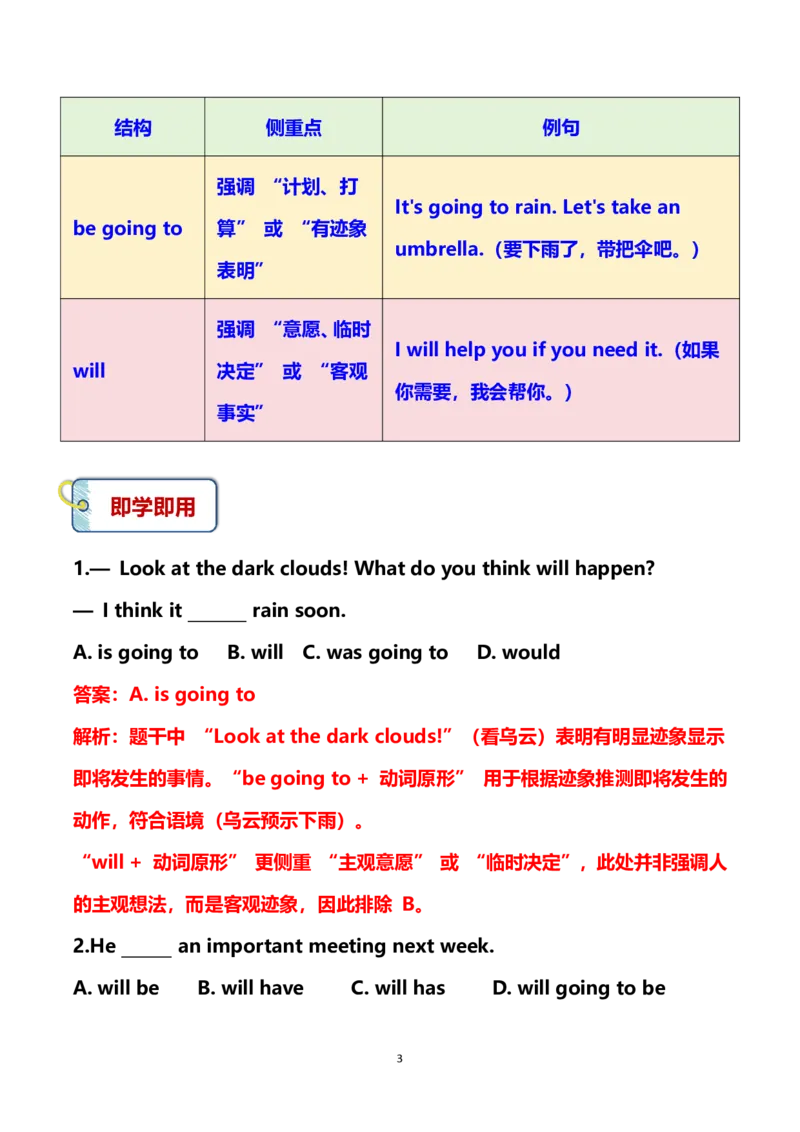
拓展:“be going to” 与“will” 的区别
知识点精讲
3
结构
侧重点
例句
be going to
强调“计划、打
算” 或“有迹象
表明”
It's going to rain. Let's take an
umbrella.(要下雨了,带把伞吧。)
will
强调“意愿、临时
决定” 或“客观
事实”
I will help you if you need it.(如果
你需要,我会帮你。)
1.— Look at the dark clouds! What do you think will happen?
— I think it _______ rain soon.
A. is going to
B. will
C. was going to
D. would
答案:A. is going to
解析:题干中“Look at the dark clouds!”(看乌云)表明有明显迹象显示
即将发生的事情。“be going to + 动词原形” 用于根据迹象推测即将发生的
动作,符合语境(乌云预示下雨)。
“will + 动词原形” 更侧重“主观意愿” 或“临时决定”,此处并非强调人
的主观想法,而是客观迹象,因此排除B。
2.He ______ an important meeting next week.
A. will be
B. will have
C. will has
D. will going to be
即学即用
4
答案:B。
解析:根据句中的时间状语“next week”,可知句子要用一般将来时。一般
将来时的构成之一是“will + 动词原形”,所以首先排除选项C,因为“has”
不是动词原形;选项D 的结构错误,“will” 和“be going to” 不能同时
使用;选项A “will be” 表示“将是”,不符合语境,这里表达的是“将
有一个重要会议”,应该用“will have”,所以正确答案是B。
(2)Lingling: Hi, Xuanxuan. I plan to go to the City Park with my aunt.
玲玲:嗨,轩轩。我计划和姑姑一起去城市公园。
plan 的用法:
①名词用法:表示“计划,打算,方案”:可指从初步的想法到详细的书面方
案等。
例如:“Their master plan won't work.”(他们的总体规划不会奏效。)
②及物动词:意为“计划,设计,打算”,后面可以接名词、代词、动词不定
式、动名词或“wh - 从句” 作宾语。
例如:I like to plan my meals before a trip.我喜欢在旅行前规划好饮食。
③“plan to do” 是一个常用的短语“计划做某事”
例如:I plan to learn a new language next year.
我计划明年学习一门新语言。
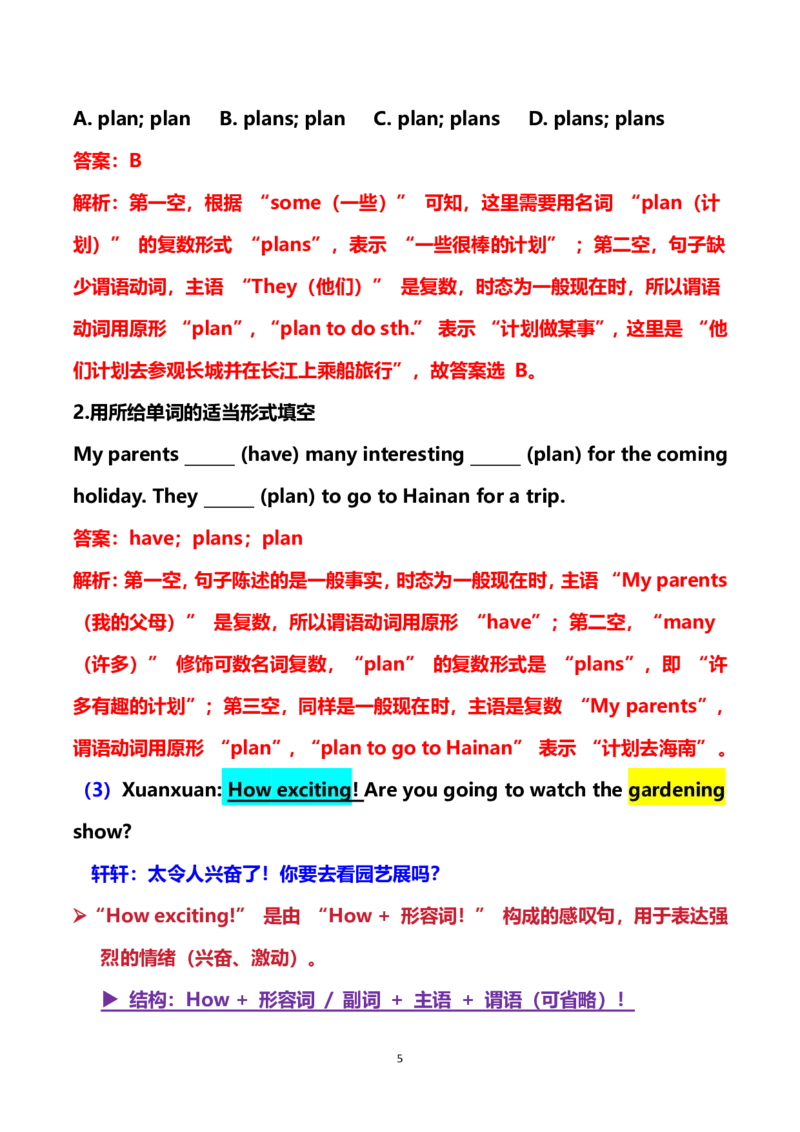
1.They have some great ______ for the summer vacation. They ______ to
visit the Great Wall and take a boat trip on the Yangtze River.
即学即用
5
A. plan; plan
B. plans; plan
C. plan; plans
D. plans; plans
答案:B
解析:第一空,根据“some(一些)” 可知,这里需要用名词“plan(计
划)” 的复数形式“plans”,表示“一些很棒的计划” ;第二空,句子缺
少谓语动词,主语“They(他们)” 是复数,时态为一般现在时,所以谓语
动词用原形“plan”,“plan to do sth.” 表示“计划做某事”,这里是“他
们计划去参观长城并在长江上乘船旅行”,故答案选B。
2.用所给单词的适当形式填空
My parents ______ (have) many interesting ______ (plan) for the coming
holiday. They ______ (plan) to go to Hainan for a trip.
答案:have;plans;plan
解析:第一空,句子陈述的是一般事实,时态为一般现在时,主语“My parents
(我的父母)” 是复数,所以谓语动词用原形“have”;第二空,“many
(许多)” 修饰可数名词复数,“plan” 的复数形式是“plans”,即“许
多有趣的计划”;第三空,同样是一般现在时,主语是复数“My parents”,
谓语动词用原形“plan”,“plan to go to Hainan” 表示“计划去海南” 。
(3)Xuanxuan: How exciting! Are you going to watch the gardening
show?
轩轩:太令人兴奋了!你要去看园艺展吗?
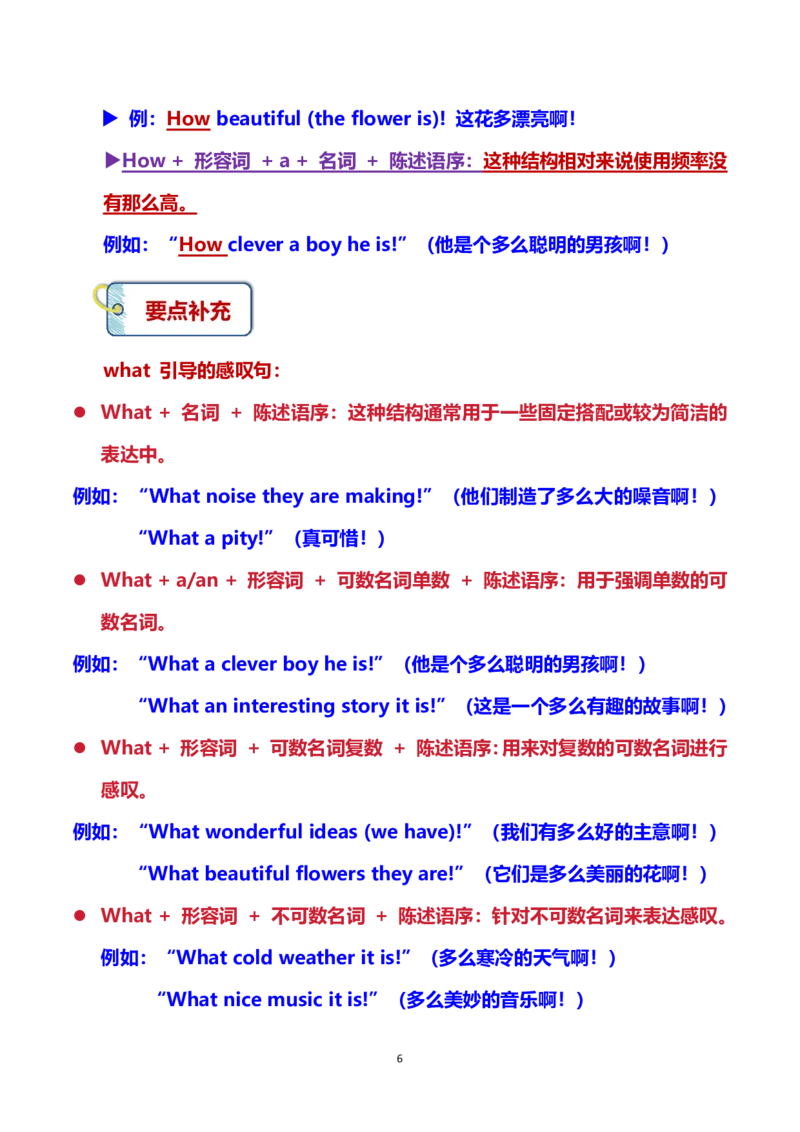
“How exciting!” 是由“How + 形容词!” 构成的感叹句,用于表达强
烈的情绪(兴奋、激动)。
▶结构:How + 形容词/ 副词+ 主语+ 谓语(可省略)!
6
▶例:How beautiful (the flower is)! 这花多漂亮啊!
▶How + 形容词+ a + 名词+ 陈述语序:这种结构相对来说使用频率没
有那么高。
例如:“How clever a boy he is!”(他是个多么聪明的男孩啊!)
what 引导的感叹句:
What + 名词+ 陈述语序:这种结构通常用于一些固定搭配或较为简洁的
表达中。
例如:“What noise they are making!”(他们制造了多么大的噪音啊!)
“What a pity!”(真可惜!)
What + a/an + 形容词+ 可数名词单数+ 陈述语序:用于强调单数的可
数名词。
例如:“What a clever boy he is!”(他是个多么聪明的男孩啊!)
“What an interesting story it is!”(这是一个多么有趣的故事啊!)
What + 形容词+ 可数名词复数+ 陈述语序:用来对复数的可数名词进行
感叹。
例如:“What wonderful ideas (we have)!”(我们有多么好的主意啊!)
“What beautiful flowers they are!”(它们是多么美丽的花啊!)
What + 形容词+ 不可数名词+ 陈述语序:针对不可数名词来表达感叹。
例如:“What cold weather it is!”(多么寒冷的天气啊!)
“What nice music it is!”(多么美妙的音乐啊!)
要点补充
7
1. —Did you take part in Dayang Bay Yancheng Marathon on April
21? —Yes. ________ hard work!
A. What a
B. What
C. How a
D. How
答案:B
解析:感叹句中,what 修饰名词,how 修饰形容词或副词。此处“hard
work” 的中心词是“work”,为不可数名词,其结构应该是“What +
形容词+ 不可数名词+ 主语+ 谓语”,这里省略了主语和谓语,所以用
what 引导,不需要加不定冠词a/an,答案选B。
2.The young man saved an old lady out of the Yangtze River.
__________ great courage he showed!
A. What a
B. What
C. How a
D. How
答案:B
解析:本句的中心词是“courage”,意思是“勇气”,为不可数名词。
根据感叹句结构“What + 形容词+ 不可数名词+ 主语+ 谓语”,这
里同样省略了主语和谓语,所以用what 来引导感叹句,答案是B 选项。
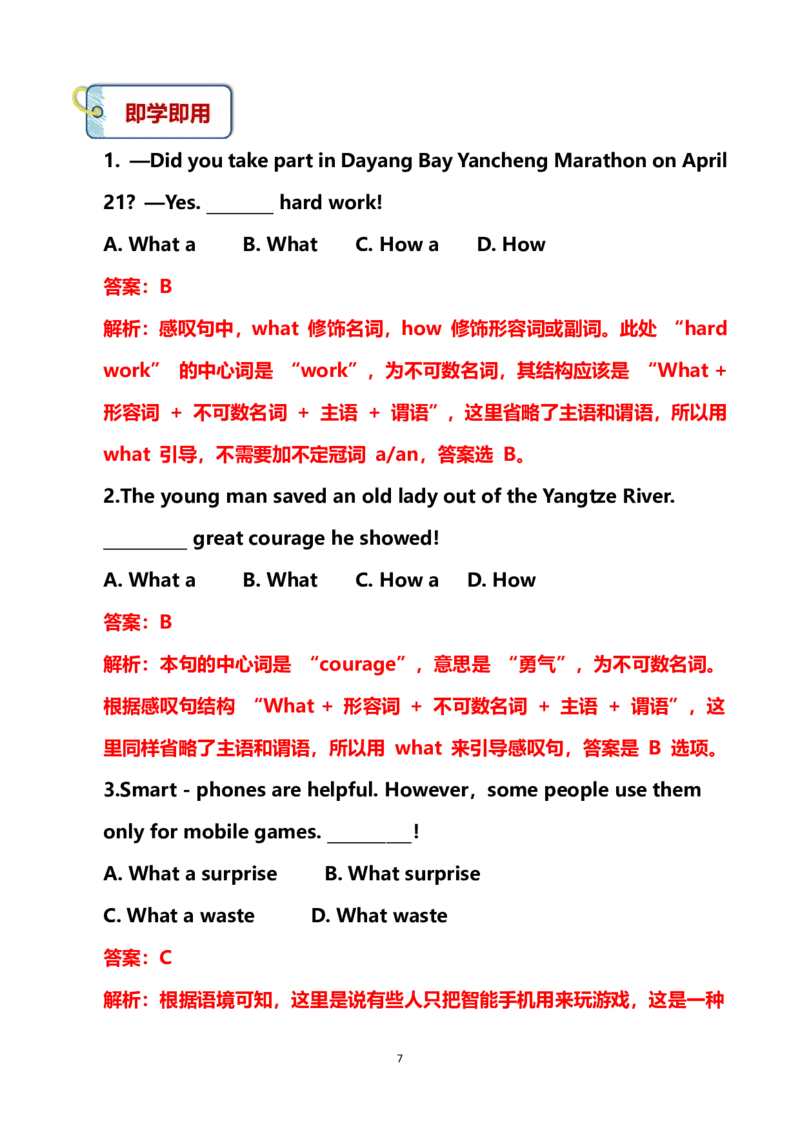
3.Smart - phones are helpful. However,some people use them
only for mobile games. __________!
A. What a surprise
B. What surprise
C. What a waste
D. What waste
答案:C
解析:根据语境可知,这里是说有些人只把智能手机用来玩游戏,这是一种
即学即用
8
浪费,“浪费” 的英文是“waste”,是可数名词。感叹句结构为“What
+ a/an + 形容词+ 可数名词单数+ 主语+ 谓语”,此处省略了主语和
谓语,“waste” 是以辅音音素开头的单词,所以用what a 来引导,答
案是C。
4.—I can’t believe Jack talked to his grandfather like that just now.
______ boy he is! —I agree. He is not supposed to do that.
A. How polite
B. How impolite
C. What a polite
D. What an impolite
答案:D
解析:从语境可知,Jack 那样和他爷爷说话是不礼貌的,所以排除A、C 选
项。感叹句的中心词是“boy”,是可数名词单数,应该用what 来引导,
其结构为“What + a/an + 形容词+ 可数名词单数+ 主语+ 谓语”,
“impolite” 是以元音音素开头的单词,所以用an,答案是D。
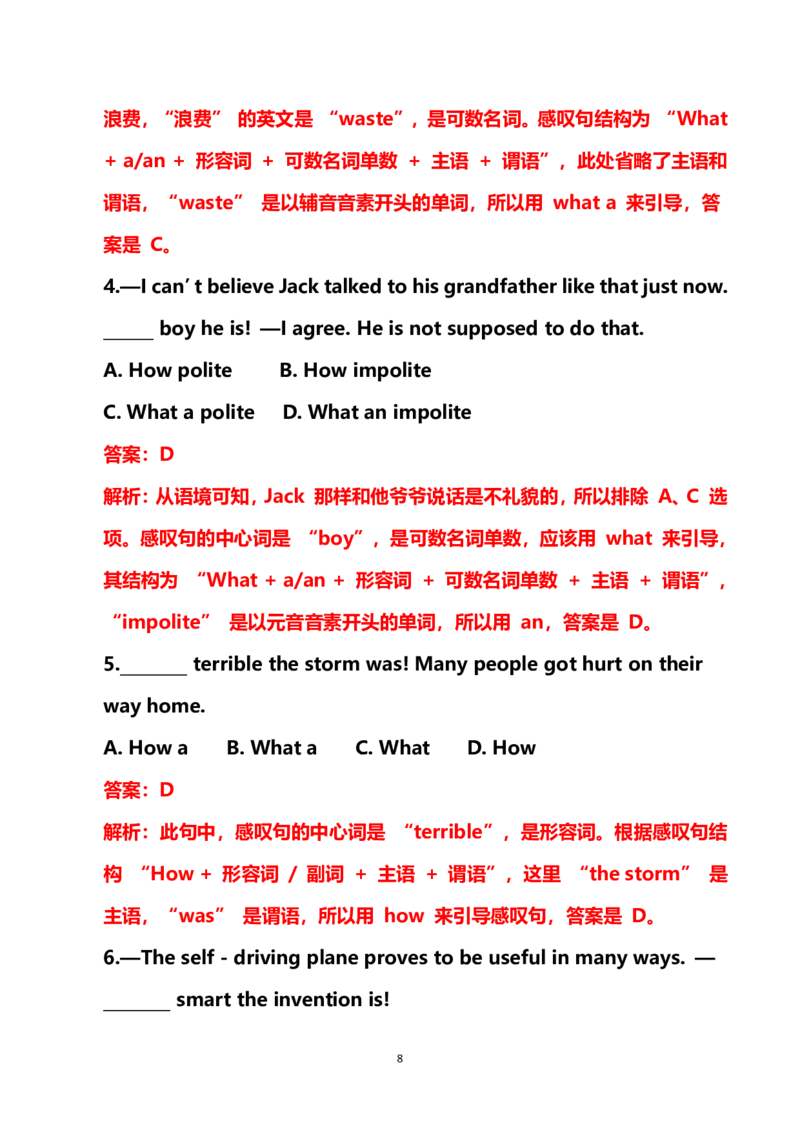
5.________ terrible the storm was! Many people got hurt on their
way home.
A. How a
B. What a
C. What
D. How
答案:D
解析:此句中,感叹句的中心词是“terrible”,是形容词。根据感叹句结
构“How + 形容词/ 副词+ 主语+ 谓语”,这里“the storm” 是
主语,“was” 是谓语,所以用how 来引导感叹句,答案是D。
6.—The self - driving plane proves to be useful in many ways. —
________ smart the invention is!
9
A. What
B. How
C. What a
D. How a
答案:B
解析:该感叹句的中心词是“smart”,为形容词。按照“How + 形容
词/ 副词+ 主语+ 谓语” 的结构,“the invention” 是主语,“is”
是谓语,所以要用how 来引导,答案选B。
gardening v.做园艺工作;种植花木
Are you going to continue gardening after dinner?
吃饭后你还要继续做园艺工作吗?
“garden” 既可以作名词,表示“花园;菜园;果园” 等,也可以作动词,
意思是“从事园艺活动;种植花木”
gardener n.园丁;花匠;园艺爱好者
复数:gardeners
The gardener was clearing a space so he could plant the young
seedlings.
园艺工正在清理出一个地方来种植幼苗。
用所给词的适当形式填空
1.My grandfather loves ______ (garden) and he often plants
different kinds of flowers in our small yard.
答案:gardening
解析:love doing sth. 表示“喜欢做某事”,强调习惯性、经常性的爱好。
这里表达爷爷喜欢园艺活动,“garden” 的动名词形式“gardening” 符
即学即用
10
合语境,表示从事园艺相关的种植、养护等活动。
2.The ______ (garden) in the park are busy pruning the trees and
shrubs these days.
答案:gardeners
解析:根据句子谓语“are” 可知,主语应为复数形式。“garden” 意为
“花园”,“gardener” 表示“园丁”,这里指公园里忙碌工作的园丁们,
要用复数“gardeners”。
3.We are planning to build a small ______ (garden) at the back of
our house to grow some fresh vegetables.
答案:garden
解析:“a” 表示“一个”,后面接可数名词单数。“garden” 作名词时,
有“花园;菜园” 之意,此处表示要在房子后面建一个小菜园,用名词单
数形式“garden”。
(4)Lingling:That's correct. How do you know about it?
玲玲:没错。你怎么知道的?
correct
adj.准确无误的;正确的
v.纠正;修正;改正
过去式:corrected
过去分词:corrected
派生词:correctly adv.正确地
correctness n.正确性
Please check that these details are correct.
请检查这些细节是否准确无误。
(5)Lingling: Wonderful! I enjoy gardening, too. I often help the
11
workers in the park near our community. Here are some photos on
my phone.
玲玲:太棒了!我也喜欢园艺。我经常在我们社区附近的公园帮工人们干活。这
是我手机里的一些照片。
①enjoy v.享受;享有;欣赏;喜爱
enjoy + 动名词(doing)“喜欢做某事”
“I enjoy reading novels in my spare time.”(我喜欢在业余时间读小说。)
enjoy + 反身代词(oneself)“enjoy oneself”“过得快活,玩得开心”,
相当于“have a good time”。
例如:“Did you enjoy yourself at the concert?”
(你在音乐会上玩得开心吗?)
②help v.帮助;协助;促进
help sb. (to) do sth.:帮助某人做某事
help sb. with sth.:在某方面帮助某人
help oneself (to sth.):随便吃/ 用某物,通常用于招待客人时
with the help of sb. / with one's help:在某人的帮助下
with the help of sb. / with one's help:在某人的帮助下
help each other:互相帮助
can't help doing sth.:禁不住做某事,情不自禁做某事
ask for help:寻求帮助,求助
③community n.社区;社会;团体
复数:communities
As well as being a community worker, he's a fully - qualified nurse.
12
他不仅是社区工作者,而且还是个完全合格的护士。
Half of the community lies in a flood zone.
这个社区一半位于洪涝区。
(6)(Lingling and Xuanxuan are looking at the photos on Lingling 's
phone.)(玲玲和轩轩正在看玲玲手机里的照片。)
look at
Look at that boat dancing on the waves.(看那艘随波漂荡的船。)
I look at tennis differently from some coaches.
我看待网球的方法与别的教练不同。
(7)Xuanxuan: I’d love to, but I have to practice for the baseball
match next week
轩轩:我很想去,但我得为下周的棒球比赛训练。
would like to do sth.想要做...
— Would you like to go shopping with me?
— Yes, I’d like to./ I’d like to, but I have to do my homework.
(你愿意与我一起去购物吗?—— 愿意。/ 我想去,但是我还有家庭作业要做。)
The content of the course depends on what the students would like to
study.
(课程的内容取决于学生愿意学什么。)
(8)Lingling: What a pity! 玲玲:太遗憾了!
这是一个由“what” 引导的感叹句。“what” 用于引导感叹句时,通常用
来修饰名词,结构为“What + a/an + 形容词+ 可数名词单数(+ 主语+
13
谓语)!”,在“What a pity!” 这个句子中,省略了后面的“it is”,完
整的句子可以是“What a pity (it is)!”。
1.She enjoys ______ tennis every weekend.
A. play
B. plays
C. playing
D. to play
答案:C
解析:enjoy 后接动名词(doing)作宾语,构成“enjoy doing sth.” 结构,
表示“喜欢做某事”。其他选项不符合语法规则。
2. Could you help me ______ my math homework?
A. with
B. to
C. for
D. in
答案:A
解析:help sb. with sth. 为固定搭配,意为“帮助某人做某事”,介词with
后接具体事务。
3. Help ______ to some cake, kids!
A. yourself
B. yourselves
C. himself
D. herself
答案:B
解析:help oneself to sth. 表示“随便吃/ 用某物”,因句中宾语是“kids”
(复数),反身代词用yourselves。
4. _____ the help of my friend, I found my lost wallet.
A. Under
B. With
C. In
D. On
答案:B
即学即用
14
解析:with the help of sb. 是固定短语,意为“在某人的帮助下”,其他介
词无法构成此搭配。
5. When she heard the joke, she couldn't help ______.
A. laugh
B. laughing
C. to laugh
D. laughed
答案:B
解析:can't help doing sth. 表示“忍不住做某事”,需接动名词形式,故选
B。
6. Don't be afraid to ______ when you're in trouble.
A. ask for help
B. ask help
C. ask to help
D. ask with help
答案:A
解析:ask for help 是固定短语,意为“求助”,介词for 不可省略,其他
搭配均错误。
7.Our ______ organized a clean-up day last month.
A. community
B. family
C. school
D. office
答案:A
解析:community 意为“社区”,根据语境“组织清洁日”,最符合的选项
是A。其他选项“家庭”“学校”“办公室” 与“社区活动” 逻辑不符。
8. Please ______ the picture and describe what you see.
A. look at
B. look for
C. look after
D. look up
答案:A
解析:look at 表示“看……”,后接具体对象;look for(寻找)、look after
(照顾)、look up(查阅)均不符合句意。
15
9.They would like ______ to the concert next week.
A. go
B. goes
C. to go
D. going
答案:C
解析:would like to do sth. 表示“想要做某事”,后接不定式(to do),
故选C。
10. The ______ answer is option B. Please check your work.
A. correct
B. correctly
C. correction
D. correcting
答案:A
解析:correct 在此处作形容词,意为“正确的”,修饰名词answer;
correctly(副词)、correction(名词)、correcting(现在分词)均不符合
语法结构。
Exploring the Topic
Activity 1
According to the types of musical instruments, there are four families:
string instruments,beat instruments, keyboard instruments and wind
instruments. The violin and erhu belong to the string instruments and
the drum belongs to the beat instruments. The piano is an example of
the keyboard instruments, and the trumpet is a wind instrument.
根据乐器的类型,有四个家族:弦乐器、打击乐器、键盘乐器和管乐器。小提琴
16
和二胡属于弦乐器,鼓属于打击乐器。钢琴是键盘乐器的一个例子,而小号是管
乐器。
(1)According to the types of musical instruments, there are four
families: string instruments,beat instruments, keyboard instruments
and wind instruments.
根据乐器的类型,有四个家族:弦乐器、打击乐器、键盘乐器和管乐器。
①according to prep.根据;按照
According to the law, you must stop at a red light.
依照法律,遇到红灯必须停车。
He is an honest businessman, according to what everyone says.
根据大家所说,他是位诚实的商人。
②type n.类型,种类;典型;字体;v.打字
复数:types
v.打字;分型;定型
different racial types 不同的人种
a rare blood type 罕见的血型
She mixes with people of all types.她和各种类型的人打交道。
③musical musical adj.音乐的
musical talent/ability/skill 音乐天赋/ 才能/ 技巧
反义词:unmusical 刺耳的
名词:musician 音乐家
She's very musical.她极具音乐天赋。
④.instrument n.乐器:仪器;工具
知识点精讲
17
复数:instruments
the flight instruments 飞行仪表
Is he learning an instrument?他在学习演奏乐器吗?
⑤.keyboard
n.琴键;键盘v.用键盘输入
复数:keyboards
I was expected to familiarise myself with the keyboard.
对我的要求是熟悉键盘。
(2)The violin and erhu belong to the string instruments and
the drums belong to the beat instruments.
小提琴和二胡属于弦乐器,鼓属于打击乐器。
belong to“属于;归…… 所有”
Lions belong to the cat family.(狮属于猫科。)
It could belong to anyone.(它可以属于任何人。)
1.Sarah likes computers, and she can very quickly. (
)
A. using; type
B. use; type
C. using; types
答案:A
解析:句意是“莎拉喜欢使用电脑,并且她能够快速地打字”。句子考查“like
doing sth.”,表示“喜欢做某事”,所以第一个空用“using”;“can” 是
情态动词,其后接动词原形,所以第二个空用“type”,故答案选A。
2. She is very talented in music and can play many m_______
即学即用
18
instruments.
答案:musical。
解析:根据“in music” 以及“instruments” 可知,这里是说她能演奏很
多乐器,结合首字母“m”,可知应填“musical”,“musical instruments”
表示“乐器”。
3.When using a computer to write an article, you mainly input words
through the _____.
A. monitor
B. keyboard
C. mouse
D. printer
答案:B
解析:monitor(显示器)的主要功能是展示计算机输出的图像、文字等信息,
用于视觉呈现,并非用于输入文字,所以A 选项错误。keyboard(键盘)是
计算机重要的输入设备之一,人们主要通过按下键盘上的按键来输入字母、数字、
符号等,从而完成文字内容的输入,在撰写文章时起到关键作用,B 选项正确。
mouse(鼠标)主要用于控制屏幕上的光标位置,进行点击、选择、拖动等操
作,虽能辅助操作计算机,但不是输入文字的主要工具,C 选项错误。printer
(打印机)的功能是将计算机中的文档、图片等内容输出到纸张上,属于输出设
备,不能用于输入文字,D 选项错误。
4._____ the school rules, students are not allowed to use mobile
phones during class.
A. Instead of
B. According to
C. Thanks to
D. Because of
答案:B
解析:“Instead of” 意为“代替;而不是”,其后接名词、代词或动名词形
19
式,常表示一种替代关系,如“Instead of going to the park, we went to
the zoo.(我们没去公园,而是去了动物园)”,在此处不符合语境,A 选项错
误。“According to” 意思是“根据;按照”,通常用来引出依据的内容,
“According to the school rules(根据学校规定)”,符合“学生不被允许
在课堂上使用手机” 这一规定是基于学校规则的语境,B 选项正确。“Thanks
to” 表示“多亏;由于”,一般用于表达正面的原因,引出的原因往往是带来
好结果的因素,比如“Thanks to his help, I passed the exam.(多亏了他
的帮助,我通过了考试)”,此处并非表达多亏学校规则,C 选项错误。“Because
of” 意为“因为”,强调原因,后接名词、代词或动名词短语,例如“Because
of the rain, we didn't go out.(因为下雨,我们没出去)”,但这里重点不
是强调原因,而是依据,D 选项错误。
Activity 2
What is music? Music is a language. It can help us speak our minds
and allow us to communicate heart to heart. Music is a tool of
showing feelings. It can relax us and make us feel happy, afraid or sad.
Music is a medium. It can take us to a world of art and bring together
people all over the world.
音乐是什么?音乐是一种语言。它能帮助我们说出我们的想法,让我们心与心相
连地沟通。音乐是情感的工具。它能让我们放松,使我们感受到快乐、恐惧或悲
伤。音乐是一个媒介。它能带我们去到艺术世界,把全世界的人们聚在一起。
知识点精讲
20
(1)It can help us speak our minds and allow us to communicate
heart to heart.它能帮助我们说出我们的想法,让我们心与心相连地沟通。
①allow v.允许;使可能
allow sb. to do sth.允许某人做某事
be allowed to do sth.被允许做某事
His parents won't allow him to stay out late.
他的父母不会允许他在外待得很晚。
②communicate v.沟通、交流
communicate with sb.:与某人交流
例句:Teenagers should learn to communicate with their parents.
青少年应学会与父母沟通。
核心词汇变形
词性
形式
释义
动词
communicate
交流;沟通;传达
名词
communication
交流;沟通;信息传递
形容词
communicative
爱交流的;健谈的
形容词
communicable
可传达的;可传染的
21
词性
形式
释义
名词
communicator
交流者;沟通者
副词
communicatively
交流地;沟通地
例句:We need to communicate with each other more often.
我们需要更频繁地互相交流。
Effective communication is key to building trust.
有效的沟通是建立信任的关键。
She’s very communicative and always shares her ideas.
她很健谈,总是分享自己的想法。
③heart to heart.“坦诚的(地)、推心置腹的(地)”
We had a heart-to-heart talk about her future plans.
我们就她的未来规划进行了一次推心置腹的谈话。
hand in hand(手拉手;紧密相连)
eye to eye(意见一致;看法相同)
shoulder to shoulder(肩并肩;齐心协力)
face to face(面对面;直接地)
arm in arm(臂挽臂;亲密地)
(2)It can relax us and make us feel happy, afraid or sad.
它能让我们放松,使我们感受到快乐、恐惧或悲伤。
①relax
v.(使)放松;放松精神(或思想)
名词:relaxation
Just relax and enjoy the movie.休息休息,看看电影吧。
22
②afraid
adj.害怕;担心
be afraid of (doing) sth.害怕(做)某事;担忧某事发生
be afraid to do sth.因害怕而不敢做某事
be afraid that + 从句...担心/ 恐怕…
Don't be afraid.别怕。
1.She needs to ______ her teacher about the missing homework.(
)
A. speak at
B. speak to
C. speak for
D. speak over
答案:B
解析:“speak to sb.” 表示“与某人交谈”,是固定搭配。句意为“她需
要和老师谈谈作业丢失的事”,B 正确。A 选项“speak at” 意为“影射;
对…… 说话”,不符合语境;C 选项“speak for” 表示“代表…… 说话”;
D 选项“speak over” 意为“大声说以盖过……”,均不符合题意。
2.The school doesn’t allow ______ in the classroom.()
A. to eat
B. eat
C. eating
D. eats
答案:C
解析:“allow doing sth.” 表示“允许做某事”,动名词作宾语,C 正确。
若用“allow sb. to do sth.”,需接宾语,如“The school doesn’t allow
students to eat in the classroom.”,但本题无宾语,故A 错误。B、D 语
法错误。
3.Effective ______ is important for building good relationships.()
即学即用
23
A. communicate
B. communication
C. communicative
D. communicator
答案:B
解析:空格处需填名词作主语,“communication”(交流)符合题意,B 正
确。A 为动词“交流”;C 为形容词“爱交际的”;D 为名词“交流者”,
均不符合句子结构。
4.They had a ______ talk about their future plans.()
A. heart to heart B. heart in heart C. heart by heart D. heart with heart
答案:A
解析:“heart to heart” 为固定短语,意为“坦诚的”,修饰“talk”,
表示“推心置腹的谈话”,A 正确。其他选项均为错误搭配,无实际含义。
5.After a long day, she felt ______ when listening to music.()
A. relaxing
B. relaxed
C. relax
D. relaxes
答案:B
解析:“relaxed”(感到放松的)修饰人,“relaxing”(令人放松的)修饰
物。句中主语“she” 指人,用B 正确。C 为动词原形,D 为第三人称单数
形式,均不符合语法;A 用于描述“music” 时正确,如“relaxing music”,
但此处修饰人,故错误。
5.He is afraid ______ alone at night.()
A. of going out
B. to going out
C. go out
D. goes out
答案:A
解析:“be afraid of doing sth.” 表示“害怕做某事”,A 正确。
24
“be afraid to do sth.” 也可表示“不敢做某事”,但B 选项“to going
out” 语法错误(to 后接动词原形);C、D 不符合短语搭配。
Good actors know how to use their eyes to express their minds. To
train his eyes, Mei Lanfang often watched the pigeons flying far away
into the sky.
好演员知道如何用眼神来表达他们的想法。为了训练自己的眼神,梅兰芳经常观
察鸽子飞向远方的天空。
When Mei was young, he had great difficulty in remembering the
lines of Beijing Opera. He worked hard and was very strict with
himself. He got up very early every day and practiced the lines again
and again.
在梅兰芳年轻时,他在记忆京剧台词方面困难很大。但他很努力,并且对自己要
求非常严格。他每天都很早起床,一遍又一遍地练习台词。
Qi Baishi first learned painting all by himself. And then in his twenties,
he began to travel around China to visit famous painters and study
their paintings. Finally, in his mid-fifties, his paintings became
popular, and he became famous all over China.
起初,齐白石完全是自学绘画。然后在他二十多岁的时候,他开始周游中国,拜
访著名画家并研究他们的画作。最终,在他五十多岁时,他的画作开始受到欢迎,
25
他也闻名于全中国。
(1)Good actors know how to use their eyes to express their minds.
好演员知道如何用眼神来表达他们的想法。
划线部分是由“疑问词+ 不定式结构”(how to...)充当宾语
...to express their minds 此处为目的状语,说明“use their eyes” 的
目的。
(2)To train his eyes, Mei Lanfang often watched the pigeons flying
far away into the sky.
为了训练自己的眼神,梅兰芳经常观察鸽子飞向远方的天空。
划线部分“To train his eyes”是不定式短语,在句中作目的状语。
“flying far away into the sky”3:是现在分词短语作宾语补足语,用来
补充说明宾语“the pigeons” 的动作状态,强调看到鸽子正在飞向天空
的这个动作过程。“
【“watch sb./sth. doing sth.” 是一个固定结构,意思是“看到某人/ 某
物正在做某事”,如果是“watch sb./sth. do sth.”,则强调看到动作的
全过程。】
pigeon
n.鸽子
复数:pigeons
例如:In the past, carrier pigeons were used to deliver messages.
(在过去,信鸽被用来传递信息。)
far away “远,遥远”
知识点精讲
26
The town my friend lives in is far (away).(我朋友住的城镇很远。)
(3)When Mei was young, he had great difficulty in remembering the
lines of Beijing Opera. 在梅兰芳年轻时,他在记忆京剧台词方面困难很大。
固定搭配“have difficulty in doing sth.”,表示“在做某事方面有困
难”
(4)He worked hard and was very strict with himself. He got up very
early every day and practiced the lines again and again.
但他很努力,并且对自己要求非常严格。他每天都很早起床,一遍又一遍地练习
台词。
be strict with:表示“对…… 严格”,后接人。
例句:My parents are always strict with me in my study.
(我的父母在我的学习方面总是对我很严格。)
get up:表示“起床” 。
例句:I usually get up at six o'clock in the morning.
(我通常早上六点起床。)
practice v.练习;实行;实习
practice doing sth/sth.
I practice playing the guitar for two hours every day to improve my
skills.(我每天练习弹吉他两小时,以提高我的技巧。)
“again and again”,是副词短语,意为“一次又一次地;反复地”
例句:She read the poem again and again to understand its meaning.
(她反复读这首诗以理解它的含义。)
27
(5)Qi Baishi first learned painting all by himself.
起初,齐白石完全是自学绘画。
first
一开始
短语:at first 起初;一开始
例句:At first, I didn't like this song, but it grew on me.
(起初,我不喜欢这首歌,但后来我慢慢喜欢上了。)
painting 作名词时,绘画、绘画艺术;也可视为动名词,表示绘画的行为。
例句:His hobby is painting.(他的爱好是绘画。)
“by oneself” 结构,表示“依靠;通过” 。
例句:She fixed the broken chair by herself.(她自己修好了那把坏椅子。)
(6)And then in his twenties, he began to travel around China to visit
famous painters and study their paintings.
然后在他二十多岁的时候,他开始周游中国,拜访著名画家并研究他们的画作。
“in one's + 整十复数” 是固定表达,用来描述某人在某个年龄段。
例句:In her thirties, she became a successful businesswoman.
(在她三十多岁时,她成为了一名成功的女商人。)
划线部分“to + 动词原形” 结构作目的状语。
1.Pigeons have a special ability to find their way home even from
______.
A. far away
B. far off
C. far out
D. far and wide
答案:A
即学即用
28
解析:“far away” 表示“遥远地”,符合语境,指鸽子即使从很远的地方也
能找到回家的路;“far off” 也有“遥远” 之意,但常用于描述时间或距离
上较远的点;“far out” 意为“远离陆地、非常奇特”;“far and wide” 表
示“到处”,均不符合题意。
2.Some students ______ remembering so many English words in a
short time.
A. have difficulty on
B. have difficulty in
C. have difficulty at
D. have difficulty with
答案:B
解析:“have difficulty in doing sth.” 是固定短语,意为“做某事有困难”,
这里指学生在短时间内记住大量英语单词有困难,所以选B。
3.My parents ______ me, especially in my study.
A. are strict with
B. are strict in
C. are strict at
D. are strict for
答案:A
解析:“be strict with sb.” 表示“对某人严格”,“be strict in sth.” 表
示“对某事严格”,此句是说父母对“我” 严格,用“are strict with”,
选A。
4.It's hard for him to ______ early on weekends.
A. get up
B. get on
C. get off
D . get out
答案:A
解析:“get up” 意为“起床”,符合“周末早起对他来说很难” 的语境;
“get on” 表示“上车、进展”;“get off” 表示“下车、离开”;“get
29
out” 表示“出去、泄露”,均不符合。
5. You should ______ speaking English every day if you want to
improve it.
A. practice to
B. practice
C. practice with
D. practice for
答案:B
解析:“practice doing sth.” 表示“练习做某事”,这里是练习说英语,直
接用“practice”,选B。
6.The little boy made the same mistake ______. His teacher felt very
angry.
A. again and again
B. over and over
C. time after time
D. all of the above
答案:D
解析:“again and again”“over and over”“time after time” 都表示
“反复地、一次又一次地”,均符合小男孩反复犯同样错误的语境,所以选D。
7.______, I didn't like this movie, but later I found it very interesting.
A. At first
B. First of all
C. Above all
D. After all
答案:A
解析:“At first” 意为“起初”,符合“起初不喜欢,后来觉得有趣” 的
逻辑;“First of all” 表示“首先”;“Above all” 表示“最重要的是”;
“After all” 表示“毕竟”,均不符合。
8.The girl finished the difficult task ______. Her parents were proud of
her.
30
A. by her
B. by herself
C. on her
D. on herself
答案:B
解析:“by oneself” 表示“独自地、依靠自己”,这里指女孩独自完成任务,
用“by herself”,选B。
9.______, he was just a poor worker, but now he has his own
company.
A. At his twenties
B. In his twenty
C. In his twenties
D. On his twenties
答案:C
解析:“in one's + 整十复数” 表示“在某人几十岁时”,“in his twenties”
表示“在他二十多岁时”,是固定用法,选C。
10.She spends two hours every day ______ the piano.
A. practice play
B. practicing play
C. practice playing
D. practicing playing
答案:D
解析:“spend time (in) doing sth.” 表示“花费时间做某事”,“practice
doing sth.” 表示“练习做某事”,所以此处用“practicing playing”,
选D。
31
Hi, everyone! This is an amazing Chinese painting, Along the River
During the Qingming Festival. With the painting, we can travel back
to the Northem Song Dynasty.
大家好!这是一幅令人惊叹的中国画作《清明上河图》。通过这幅画,我们可以
回到北宋时期。
The painting is 528.7 centimeters long and 24.8 centimeters wide. It
shows the colorful daily life of different people at work and play. Now,
let's travel back to Tomb-sweeping Day in the city of Kaifeng. Look
over here! There is a great bridge over the river. A line of workers are
pulling a boat under the bridge and shouting out their work song all
the way along the riverside. On the river, we can see ships full of
tourists. They are chatting and drinking. On the riverbanks, shops are
selling all kinds of goods, such as toys and clothes. On the right side,
a huge gate tower marks the door to the city. Many businessmen and
tourists are going in or out through the gate.
这幅画长528.7 厘米,宽24.8 厘米。它展现了不同人群丰富多彩的日常工作
和娱乐生活。现在,让我们回到开封城的清明节。看这里!河上有一座大桥。一
排工人正在桥下拉船,沿着河岸一路喊着号子。在河面上,我们可以看到满载游
客的船只。他们一边聊天,一边喝酒。在河岸边,商店里售卖着各种各样的商品,
比如玩具和衣服。在右侧,一座巨大的城楼标志着城门的位置。许多商人和游客
32
正从城门进出。
What a great piece of art it is! Now follow me to explore some other
works of art of the Northern Song Dynasty.
这是一件多么伟大的艺术作品啊!现在跟着我去探索一下北宋时期的其他一些艺
术作品吧。
(1)Hi, everyone! This is an amazing Chinese painting, Along the
River During the Qingming Festival. With the painting, we can travel
back to the Northem Song Dynasty.
大家好!这是一幅令人惊叹的中国画作《清明上河图》。通过这幅画,我们可以
回到北宋时期。
①amazing
:形容词,意为“令人惊叹的;了不起的”,用于修饰事物,说
明事物给人的感受。
例句:We saw an amazing performance last night.
(我们昨晚看了一场令人惊叹的表演。)
②with the painting” 意为“借助这幅画”,在句中作方式状语。
例句:With this map, we can find the way easily.(借助这张地图,我们能
轻松找到路。)
③“travel back” 表示“回到” 。
例句:He went back to his hometown last month.
(他上个月回到了他的家乡。)
知识点精讲
33
(2)The painting is 528.7 centimeters long and 24.8 centimeters wide.
英语中,表达长宽高有多种方式,常见的有:
“基数词+ 单位+ long/wide/high/deep”
“基数词+ 单位+ in length/width/height/depth” 等结构
例句:The river is 100 meters wide.(这条河宽100 米。)
The tree is 5 meters high.(这棵树高5 米。)
例句:The bridge is 200 meters in length.(这座桥长200 米。);
The hole is 2 feet in depth.(这个洞深2 英尺。)
(3)look over 用法:
①检查;查看:常用于检查事物的状况、质量,查看资料、文件等。
例句:The doctor is looking over the patient carefully.
医生正在仔细检查病人。
②从…… 上面看过去:描述从某个较高物体的上方看过去的动作。
例句:She looked over the fence and saw a beautiful garden.
她从篱笆上方看过去,看到了一个美丽的花园。
(4)A line of workers are pulling a boat under the bridge and
shouting out their work song all the way along the riverside.
①a line of 表示“一排;一列”,用于描述事物成直线排列的状态。
例句:There is a line of cars waiting at the traffic light.
有一排汽车在等红绿灯。
②shout out
意为“大声喊出;呼喊” ,强调声音响亮且公开。
例句:He shouted out his name.(他大声喊出自己的名字。)
34
③all the way
表示“一路上;自始至终” ,在句中作状语,强调动作在整
个过程中持续进行。
例句:We walked all the way to the park.(我们一路步行到公园。)
④riverside
名词,意为“河边;河畔”
例句:They had a picnic by the riverside.(他们在河边野餐。)
(5)They are chatting and drinking. On the riverbanks, shops are
selling all kinds of goods, such as toys and clothes.
①chatting
动词“chat” 的现在分词形式,意为“聊天;闲谈”,常用于
描述人们轻松地交谈。
搭配chat...with 与...聊天
例句:The friends are chatting happily in the coffee shop.
朋友们在咖啡馆里开心地聊天。
②riverbanks
名词“riverbank” 的复数形式,意为“河岸;河畔” ,指
河流旁边的陆地边缘。
例句:There are many beautiful flowers on the riverbanks.
河岸上有许多美丽的花朵。
(6)On the right side, a huge gate tower marks the door to the city.
Many businessmen and tourists are going in or out through the gate.
①marks
动词“mark” 的第三人称单数形式,作动词时意为“标志;标明;
做记号”;在句中表示城门楼作为城市入口的标志。
例句:A red X marks the spot.(一个红色的X 标明了那个地点。)
mark... as...(句中虽未完整呈现,但可引申理解)“把…… 标志为……;
把…… 标明为……”,在句中“a huge gate tower marks the door to
35
the city” 可理解为城门楼标志着城市的入口。
②businessmen
名词“businessman” 的复数形式,意为“商人”,指
从事商业活动的人。
例句:Many businessmen attend the trade fair.
(许多商人参加贸易展览会。)
(7)What a great piece of art it is! Now follow me to explore some
other works of art of the Northern Song Dynasty.
这是一件多么伟大的艺术作品啊!现在跟着我去探索一下北宋时期的其他一些艺
术作品吧。
①What a...!
引导感叹句的常用结构,用于强调名词短语,结构为“What +
a/an + 形容词+ 可数名词单数+ 主语+ 谓语!”,若名词为不可数名词或
复数名词,则去掉“a/an” 。
例句:What an interesting book it is!(这是一本多么有趣的书啊!)
What beautiful flowers they are!(多么漂亮的花啊!)
②a piece of
表示“一块;一片;一件” 等,用于修饰不可数名词,使其可
以被计量。
例句:I'd like a piece of cake.(我想要一块蛋糕。)
③explore
动词,意为“探索;探究”,表示对未知领域、事物进行深入研究
或发现。
例句:They want to explore the mysterious forest.
他们想探索这片神秘的森林。
④works of art
意为“艺术作品”,是固定短语,“works” 表示作品,“of
36
art” 作后置定语,修饰“works”。
例句:The exhibition showcases many famous works of art.
这次展览展出了许多著名的艺术作品。
1.The view from the mountaintop is ______. I’ve never seen such
beautiful scenery.
A. amazing
B. amazed
C. amazed at
D. amazing at
答案:A
解析:“amazing” 意为“令人惊叹的”,用于修饰事物;“amazed” 意
为“感到惊讶的”,用于修饰人;“be amazed at” 表示“对…… 感到惊
讶” 。此处修饰“the view”(景色),要用“amazing”,选A。
2.This time - travel movie allows us to ______ to the ancient times and
experience life there.
A. travel back
B. travel on
C. travel around
D. travel through
答案:A
解析:“travel back” 表示“回到(过去)”;“travel on” 意为“继续
旅行”;“travel around” 表示“四处游历”;“travel through” 表示
“穿越” 。根据“to the ancient times” 可知是回到古代,选A。
3.The swimming pool is 25 meters ______ and 15 meters ______.
A. long; wide
B. length; width
C. in long; in wide
D. in length; in width
即学即用
37
答案:A
解析:“基数词+ 单位+ long/wide/high/deep” 直接描述物体的长宽高,
“25 meters long” 表示“25 米长”,“15 meters wide” 表示“15
米宽”;“基数词+ 单位+ in length/width/height/depth” 也可表达,
但B 选项词性错误。所以选A。
4. The river is 30 meters ______. It’s dangerous to swim in it.
A. deep
B. depth
C. in deep
D. in depth
答案:D
解析:“基数词+ 单位+ in depth” 表示“在深度上……”,这里表示河
在深度上是30 米;A 选项直接用“deep” 前面不能加“in”,B 选项词
性错误,所以选D。
5. The doctor ______ the patient carefully and told him what was
wrong.
A. looked over
B. looked up
C. looked for
D. looked after
答案:A
解析:“look over” 意为“检查”;“look up” 表示“查阅;向上看”;
“look for” 表示“寻找”;“look after” 表示“照顾” 。医生对病人
的动作应该是检查,选A。
6.______ trees stands along the road, making the street look
beautiful.
A. A line of
B. A piece of
C. A pair of
D. A set of
答案:A
38
解析:“a line of” 表示“一排”;“a piece of” 表示“一块;一件”;
“a pair of” 表示“一双;一对”;“a set of” 表示“一套” 。树是成
排沿着路生长,选A。
7.When he saw the famous singer, he couldn’t help ______ her
name.
A. shouting out
B. shouting at
C. shouting to
D. shout for
答案:A
解析:“shout out” 表示“大声喊出”;“shout at” 表示“冲…… 大
喊(含生气意味)”;“shout to” 表示“朝…… 喊(为引起注意)”;D 选
项“shout for” 形式错误。看到喜欢的歌手应该是大声喊出名字,选A。
8.They walked ______ to the village without taking a rest.
A. all the way
B. in the way
C. by the way
D. on the way
答案:A
解析:“all the way” 表示“一路上;自始至终”;“in the way” 表示
“妨碍;挡道”;“by the way” 表示“顺便说一下”;“on the way” 表
示“在途中” 。这里表示一路走到村庄没休息,选A。
9.We had a picnic on the ______ and enjoyed the beautiful view of the
river.
A. riverside
B. riverbanks
C. river
D. rivers
答案:A
解析:“riverside” 和“riverbanks” 都有“河边” 之意,但
“riverside” 更常用;“river” 表示“河流”,“rivers” 是其复数形式。
39
这里表示在河边野餐,选A。
10.The two friends sat on the bench and spent hours ______.
A. chatting
B. chatted
C. to chat
D. chat
答案:A
解析:“spend + 时间+ (in) doing sth.” 表示“花费时间做某事”,
“chat” 的动名词形式是“chatting” ,选A。
11.The ancient tower ______ the entrance to the old town.
A. marks
B. marked as
C. marks as
D. is marking
答案:A
解析:“mark” 表示“标志;标明”,此处表示古塔标志着古镇入口,是一
般现在时描述客观事实;“mark... as...” 表示“把…… 标记为……”,不符
合语境,选A。
12. Many ______ gathered at the business conference to discuss
cooperation opportunities.
A. businessman B. businessmans C. businessmen D. businessmens
答案:C
解析:“businessman” 的复数形式是“businessmen” ,选C。
13.She gave me ______ advice on how to solve the problem.
A. a line of
B. a piece of
C. a pair of
D. a set of
答案:B
解析:“a piece of” 用于修饰不可数名词,“advice”(建议)是不可数名
词,“a piece of advice” 表示“一条建议” ,选B。
40
14.The museum displays hundreds of ______ from different
dynasties.
A. work of art
B. works of art C. work of arts D. works of arts
答案:B
解析:“work” 表示“作品” 时,复数是“works”,“works of art” 表
示“艺术作品” ,选B。
15.The old bridge ______ an important part of the city’s history.
A. marks as
B. is marked as
C. marks
D. marking
答案:B
解析:“be marked as” 表示“被标记为;被视为”,这里表示古桥被视为
城市历史重要部分;A 选项“marks as” 用法错误,C 选项“marks” 语
义不符,D 选项“marking” 不能单独作谓语,选B。
Developing the Topic
Activity 2
Falling in Love with Beijing Opera《爱上京剧》
My name is Lingling. When I was six, my grandfather
introduced Beijing Opera to me, and I fell in love with it
immediately.
我叫玲玲。六岁时,爷爷把京剧介绍给我,我立刻就爱上了它。
41
I like Beijing Opera for many reasons. First, the actors
wear colorful masks. Each color stands for a different type
of character. For example, a red mask means a good guy,
and a white mask means a bad person. Second, I think the
great acting of the different roles is really amazing. There
are four main roles in Beijing Opera-Sheng, Dan, Jing and
Chou. Each plays its part in its own way. Third, I like the
singing style and the music. The singing style of Beijing
Opera is very popular among its fans, and the traditional
Chinese instruments like erhu and sanxian make the music
so pleasant to the ear.
我喜欢京剧的原因有很多。首先,演员们戴着色彩鲜艳的脸谱。每种颜色代表不
同的角色类型:比如,红脸象征好人,白脸代表坏人。其次,我认为不同角色的
精湛表演真的令人惊叹。京剧有四个主要行当—— 生、旦、净、丑,每个行当
都以独特的方式演绎着自己的角色。第三,我喜欢它的唱腔和音乐。京剧的演唱
风格深受戏迷喜爱,而二胡、三弦等中国传统乐器更让音乐悦耳动听。
I hope more people around the world can enjoy this great art.
希望世界各地更多人能欣赏到这门伟大的艺术。
(1)Falling in Love with Beijing Opera《爱上京剧》
falling in love with 爱上...
知识点精讲
42
例句:He fell in love with her at first sight.(他对她一见钟情。)
She fell in love with painting after attending an art exhibition.
她在参加一次艺术展览后爱上了绘画。
(2)When I was six, my grandfather introduced Beijing Opera to me,
and I fell in love with it immediately.
六岁时,爷爷把京剧介绍给我,我立刻就爱上了它。
When 引导时间状语从句,意为“当…… 时候”
例句:When she arrived home, it was already dark.
(当她到家时,天已经黑了。)
introduced
动词“introduce” 的过去式,“介绍;引进” ,在句中
表示把京剧引荐给“我”。
introduce... to...
表示“把…… 介绍给……”,
可以是介绍人,也可以是介绍事物。
例句:She introduced the new product to the customers.
她把新产品介绍给了客户。
He introduced his new friend to us.(他把他的新朋友介绍给了我们。)
immediately 副词“立即;马上”,用于修饰动词,强调动作迅速发生。
例句:He left the room immediately when he heard the news.
他一听到这个消息就立即离开了房间。
(3)First, the actors wear colorful masks. Each color stands for a
different type of character.
首先,演员们戴着色彩鲜艳的脸谱。每种颜色代表不同的角色类型。
masks
名词“mask” 的复数形式,“面具;面罩” 。
43
例句:They wore scary ____________ on Halloween.
(他们在万圣节戴着吓人的面具。)
stand for
表示“代表;象征;意味着”,后接名词、代词等,说明某个
事物所代表的意义或象征的内容。
例句:The dove stands for peace.(鸽子象征和平。)
character
名词,此处意为“角色”,也可表示“人物;性格;特点” 。
例句:The main character in the story is very brave.
故事里的主角非常勇敢。
(4)Each plays its part in its own way. 每个行当都以独特的方式演绎着自
己的角色。
“...play...part/role in” 表示“在…… 中发挥…… 作用”
Education plays a crucial part in shaping a person's future.
教育在塑造一个人的未来中发挥着至关重要的作用。
(5)Opera is very popular among its fans, and the traditional
Chinese instruments like erhu and sanxian make the music
so pleasant to the ear.
京剧的演唱风格深受戏迷喜爱,而二胡、三弦等中国传统乐器更让音乐悦耳动听。
“pleasant” 是形容词,“令人愉快的;舒适的;友好的;和蔼可亲的”
The garden is filled with a pleasant smell of flowers.(花园里弥漫着宜人
的花香。)
副词:pleasantly,意为“愉快地;友好地;亲切地”,用于修饰动词、形
容词或其他副词。
44
She smiled pleasantly at me when I entered the room.
我进屋时,她友好地朝我微笑。
名词:pleasure,作不可数名词时意为“愉快;快乐;满足”;作可数名词
时意为“乐事;快事” 。
It's a pleasure to work with such a great team.
与这么棒的团队合作是一件乐事。