1
2026 秋仁爱版八上
Unit 1 My Dream Job
Preparing for the Topic
Activity 3
Wang Junfeng: Hi, Lingling. How are you doing today?
王军锋:嗨,玲玲。你今天过得怎么样?
Lingling: Not bad. I just got back from the pet hospital.
玲玲:还不错。我刚从宠物医院回来。
Wang Wei: What happened to your dog, Lingling?
王薇:玲玲,你的狗狗怎么了?
Lingling: It got sick yesterday. But, thanks to the vets, it’s doing
better now.
玲玲:它昨天生病了。不过多亏了兽医们,它现在好多了。
Wang Wei: The vets are kind and helpful. I will be a vet like them
because I love pets.
王薇:兽医们既善良又乐于助人。我也要像他们一样当一名兽医,因为我喜欢宠
物。
Wang Junfeng: That's great! I’m sure you will be an excellent vet.
What are you going to be, Lingling?
2
王军锋:那太棒了。我相信你会成为一名优秀的兽医。玲玲,你长大后打算做什
么呢?
Lingling: I am going to be a dancer. I think I’m lively and I love
dancing very much.
玲玲:我打算当一名舞蹈家。我觉得自己性格活泼,而且非常热爱跳舞。
Wang Wei: How about you, Junfeng?
王薇:你呢,军锋?
Wang Junfeng: I am going to be a news reporter. You know, I’m
active and love following the news.
王军锋:我打算当一名新闻记者。你知道的,我很活跃,也喜欢关注新闻。
Wang Wei: That sounds wonderful. Maybe some day you will write a
news report about Lingling.
王薇:听起来真不错! 也许有一天你会写一篇关于玲玲的新闻报道呢。
(1)Wang Junfeng: Hi, Lingling. How are you doing today?
王军锋:嗨,玲玲。你今天过得怎么样?
更多类似“How are you doing today?” 的问候语:
What's up? 这是较为随意、常用的问候,意为“怎么了”“有什么事”,
常用于朋友、熟人之间打招呼,可开启对话,了解对方当下情况。例如在校园
里,同学见面笑着问:“Hey, what's up?” (嘿,咋样?)
(2)Lingling: Not bad. I just got back from the pet hospital.
知识点精讲
3
玲玲:还不错。我刚从宠物医院回来
get back from“从…… 回来”后面一般接表示地点的名词或名词短语。
“Just get back from Shenzhen.” “刚从深圳回来”。
“get back from abroad” “海外归来”。
(3)Wang Wei: What happened to your dog, Lingling?
王薇:玲玲,你的狗狗怎么了?
happen v.(尤指偶然)发生,出现
①表示“发生”常用“sth.+happen (s)/happened + 地点/ 时间” 的
结构,来表示“某地/ 某时发生了某事”。
例如:“The story happened in a small village.”
(这个故事发生在一个小村庄里。)
②表示“某人出了某事”:用“sth.+happen (s)/happened to+sb.” 的
结构,意思是“某人出了某事”,通常指不好的事情发生在某人身上。
例如:“A strange thing happened to him yesterday.”
(昨天他遇到了一件奇怪的事情。)
③表示“碰巧”:有两种常用结构。一是“sb.+happen (s)/happened to
do sth.”,表示“某人碰巧做某事”。
例如:“I happened to pass by the store.”(我碰巧路过那家商店。)
二是“It happen (s)/happened that...”,意思是“碰巧/ 恰巧发生某
事”。
例如:“It happened that I was not at home when she called.”
(她打电话时,碰巧我不在家。)
4
happen 和take place 的区别是什么?
①“happen” 强调事情的发生是偶然的、不可预测的,通常用于描述日常事件、
意外情况或个人经历等,比较口语化。
例如:“An accident happened on the road this morning.”
(今天早上路上发生了一起事故。)
②“take place” 则表示事情是按计划或安排发生的,一般用于描述会议、婚
礼、活动、故事背景等有组织、有预谋的事件,语气相对中性或正式。
例如:“The wedding will take place next Sunday.”
(婚礼将在下周日举行。)
(4)Lingling: It got sick yesterday. But, thanks to the vets, it's doing
better now.
玲玲:它昨天生病了。不过多亏了兽医们,它现在好多了。
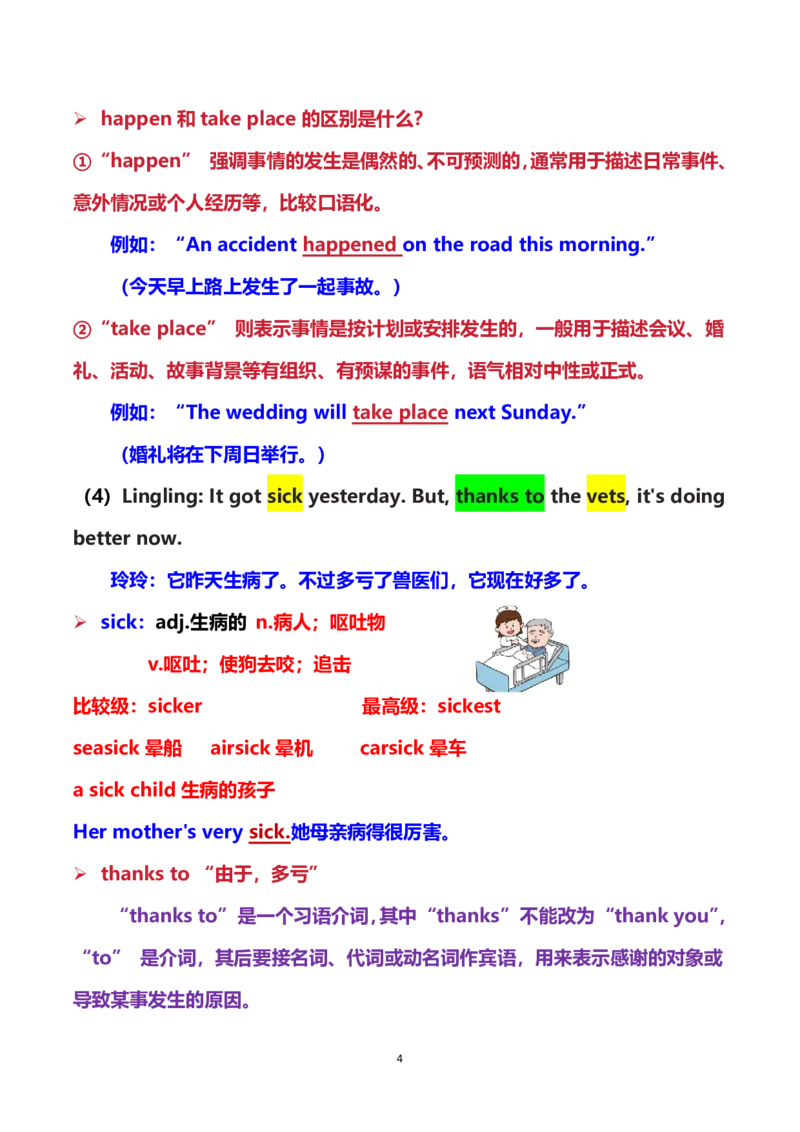
sick:adj.生病的n.病人;呕吐物
v.呕吐;使狗去咬;追击
比较级:sicker
最高级:sickest
seasick 晕船
airsick 晕机
carsick 晕车
a sick child 生病的孩子
Her mother's very sick.她母亲病得很厉害。
thanks to “由于,多亏”
“thanks to”是一个习语介词,其中“thanks”不能改为“thank you”,
“to” 是介词,其后要接名词、代词或动名词作宾语,用来表示感谢的对象或
导致某事发生的原因。
5
“Thanks to your help, I was able to finish the work on time.”
(多亏了你的帮助,我才能按时完成这项工作。)
vet n.兽医
复数:vets;vt.审查(某人过去的生活和职业);仔细检查,审
查
过去式:vetted
过去分词:vetted
What made you decide on a career as a vet?
是什么驱使你选择兽医这门职业的?
(5)The vets are kind and helpful. I will be a vet like them because I
love pets.
王薇:兽医们既善良又乐于助人。我也要像他们一样当一名兽医,因为我喜欢宠
物。
kind adj.友好的;友善的;宽容的;n.种类
复数:kinds
比较级:kinder
最高级:kindest
three kinds of cakes/cake 三种蛋糕
a kind heart/face 仁慈的心;友好的面容
She isn't that kind of girl.她不是那种类型的女孩。
It was really kind of you to help me.你帮我的忙,我太感激了。
(6)Lingling: I am going to be a dancer. I think I’m lively and I love
dancing very much.
玲玲:我打算当一名舞蹈家。我觉得自己性格活泼,而且非常热爱跳舞。
lively adj.活泼的;令人兴奋的;生气勃勃的
比较级:livelier
最高级:liveliest
派生词:liveliness n.活泼;生动
6
He showed a lively interest in politics.他对政治表现出浓厚的兴趣。
The meeting was then at its liveliness.会议那时正开得很活跃。
(7)Wang Junfeng: I am going to be a news reporter. You know, I’m
active and love following the news.
王军锋:我打算当一名新闻记者。你知道的,我很活跃,也喜欢关注新闻。
news n.新闻;消息[不可数名词]
That's great news.这真是好消息。
reporter n.记者
复数:reporters
She forced her way through the crowd of reporters.
她在记者群中挤出一条通路。
1.She ______ Beijing last night and brought me some special snacks.
A. get back from
B. got back from
C. will get back from
D. gets back from
答案:B
解析:根据“last night” 可知,句子时态为一般过去时,“get back from”
表示“从…… 回来”,其过去式为“got back from”,所以选B。
2.What ______ to you? You look so upset.
A. happen
B. happens
C. happened
D. is happening
答案:C
即学即用
7
解析:从“You look so upset” 可知事情已经发生,对现在造成影响,用一
般过去时,“happen to sb.” 表示“某人发生了什么事”,“happen” 的
过去式是“happened”,因此选C。
3.I ______ meet an old friend on my way to school this morning.
A. happened
B. happened to
C. take place
D. took place
答案:B
解析:“happen to do sth.” 表示“碰巧做某事”,根据“this morning”
可知是过去发生的事,用一般过去时,“happen” 的过去式是“happened”,
所以选B;“take place” 表示按计划发生,不符合语境。
4.The school sports meeting will ______ next Friday.
A. happen
B. happens
C. take place
D. took place
答案:C
解析:“will” 后接动词原形,排除B 和D;运动会是按计划举行的,应用
“take place”,“happen” 强调偶然发生,所以选C。
5._____ your help, I passed the difficult math exam.
A. Thanks for
B. Thanks to
C. Because
D. Because of
答案:B
解析:“thanks to” 表示“多亏”,后接名词,符合“多亏你的帮助,我通
过考试” 的语境;“thanks for” 表示“为…… 感谢”;“because” 后
接句子;“because of” 虽然后接名词,但没有“多亏” 这种感激的情感色
彩,所以选B。
6.My sister is ______ than me. She always helps others.
8
A. kind
B. kinds
C. kinder
D. kindest
答案:C
解析:由“than” 可知要用比较级,“kind” 的比较级是“kinder”,A 是
原级,B 是名词复数形式,D 是最高级,所以选C。
7.Among all the students in our class, Tom is the ______.
A. lively
B. livelier
C. liveliest
D. more lively
答案:C
解析:“Among all the students” 表示在三者以上的范围内比较,要用最高
级,“lively” 的最高级是“liveliest”,A 是原级,B 是比较级,D 形式错
误,所以选C。
8.There are many ______ of animals in the zoo.
A. kind
B. kinds
C. kinder
D. kindest
答案:B
解析:“many kinds of” 表示“许多种类的”,是固定搭配,A 是单数形
式,C 是比较级,D 是最高级,均不符合,所以选B。
9.A strange thing ______ in our neighborhood yesterday evening.
A. happened
B. took place
C. happens
D. takes place
答案:A
解析:根据“yesterday evening” 可知用一般过去时,排除C 和D;“a
strange thing” 是偶然发生的,应用“happened”,“take place” 强
调有计划发生,所以选A。
9
Exploring the Topic
Activity 1
Jobs with Animals
A lot of people work with animals. Some people
help sick animals. For example, vets often help
sick animals on the farm, in the zoo or in the
animal park. Some people train animals to do jobs
for people. For example, guide dog teachers train
guide dogs to help blind people.
与动物相关的工作
很多人从事与动物相关的工作。有些人帮助生病的动物。例如,兽医经常在农场、
动物园或野生动物园里救助生病的动物。有些人训练动物为人类做事,比如导盲
犬训练师会训练导盲犬来帮助盲人。
(1)a lot of “许多,大量”既可以修饰可数名词复数,也能修饰不可数名词
There are a lot of books in the library.(图书馆里有很多书。)
We need a lot of water to grow these plants.
(我们需要大量的水来种植这些植物。)
注意:
知识点精讲
10
“a lot of” 和“lots of” 都有“许多,大量” 的意思,都可以用来修饰
可数名词复数或不可数名词,但“lots of” 在实际使用中,可能会更自然地与
可数名词复数连用。比如“lots of students”(很多学生),“lots of books”
(很多书)等。当然,这并不是说它不能修饰不可数名词,只是相对来说,这种
情况会少一些。
(2)on the farm“在农场”
live on the farm(住在农场)
如They live on the farm all their lives.(他们一辈子都住在农场。)
work on the farm(在农场工作)
He has worked on the farm for decades.(他已经在农场工作了几十年。)
(3)Some people train animals to do jobs for people.
有些人训练动物为人类做事
划线部分动词不定式短语作宾语补足语。
(4)For example, guide dog teachers train guide dogs to help blind
people.
比如导盲犬训练师会训练导盲犬来帮助盲人。
guide dogs 导盲犬;领路狗
Some people use guide dogs.有些人用导盲犬。
blind
adj.瞎的;失明的
vt.使失明;使目眩;使变瞎
过去式:blinded
过去分词:blinded 派生词:blindness n.盲目;精神性盲
Doctors think he will go blind .医生们认为他会失明。
即学即用
11
1.There are _______ vegetables growing on the farm.
A. a lot
B. a lot of
C. lot of
D. lots
答案:B
解析:“a lot of” 和“lots of” 都表示“许多”,可以修饰可数名词复数
或不可数名词,这里“vegetables” 是可数名词复数,所以用“a lot of”
合适。A 选项“a lot” 表示“很,非常” 或作名词短语,不能直接修饰名
词;C 选项“lot of” 表达错误;D 选项“lots” 单独使用不能修饰名词。
2._______ the blind people, guide dogs are their important helpers.
A. On
B. In
C. For
D. At
答案:C
解析:“for” 在这里表示“对于”,“For the blind people” 意思是“对
于盲人来说”,整句话表达对于盲人而言,导盲犬是他们重要的帮手。
“on”“in”“at” 没有这种表示对象的含义,不符合语境。
3.Guide dogs help the blind _______ on the street.
A. walks
B. walked
C. walking
D. walk
答案:D
解析:“help sb. do sth.” 是固定搭配,意思是“帮助某人做某事”,所以
这里用动词原形“walk” ,表示导盲犬帮助盲人在街上行走。A 选项
“walks” 是第三人称单数形式;B 选项“walked” 是过去式;C 选项
“walking” 是现在分词形式,均不符合该固定搭配。
12
4.On the farm, there are _______ animals, and some of them can help
people do jobs, just like guide dogs help the blind.
A. a lot of
B. much
C. a little
D. few
答案:A
解析:“animals” 是可数名词复数,“a lot of” 可修饰可数名词复数,符
合题意,表示农场有许多动物。B 选项“much” 和C 选项“a little” 都
只能修饰不可数名词;D 选项“few” 表示“几乎没有”,与语境中农场有
很多动物不符。
Activity 2
Jobs at Night
We sleep at night, but some people do their jobs at night. For
example, many doctors and nurses work at night because patients
need help at night. Some railway workers also work at night because
a few trains run during night time.
夜间工作
我们在晚上睡觉,但有些人却在晚上工作。例如,许多医生和护士在晚上工作,
因为病人在夜间需要帮助。一些铁路工人也在晚上工作,因为有一些火车在夜间
运行。
(1)at night,“在晚上”
I usually read books at night.(我通常在晚上看书。)
知识点精讲
13
at noon:指“在中午”,强调正午十二点这个时间点。
We usually have lunch at noon.(我们通常在中午吃午饭。)
at midnight:意为“在午夜”,表示深夜十二点整。
例如:The clock strikes at midnight.(钟在午夜敲响。)
at dawn:意思是“在黎明;在拂晓”,描述天刚亮的时候。
比如:The soldiers set out at dawn.(士兵们在黎明时分出发。)
at dusk:表示“在黄昏;在傍晚” ,指日落前后,天色渐暗的时候。
例:The birds fly back home at dusk.(鸟儿在黄昏时分飞回家。)
(2)For example, many doctors and nurses work at night because
patients need help at night.
例如,许多医生和护士在晚上工作,因为病人在夜间需要帮助。
“because” 是从属连词,引导原因状语从句。
例如“Tom was late for school because he missed the bus.”(汤姆上
学迟到了,因为他错过了公交车。),其中“because” 引导的从句也是说明
原因。
(3)railway n.铁路;铁道
复数:railways
Her father worked on the railways. 她父亲在铁路部门工作。
1.The street lights in this neighborhood are turned on at 7 p.m. and
stay on until dawn. So, you can see the well-lit streets mainly _______.
A. in the morning
B. in the afternoon
即学即用
14
C. at noon
D. at night
答案:D
解析:句子提到街灯下午7 点开启直到黎明,在这段时间内街道明亮。A 选项
“in the morning” 指早上,不符合街灯亮起的时段;B 选项“in the
afternoon” 是下午,通常街灯还未开启;C 选项“at noon” 是中午,街
灯处于关闭状态;只有D 选项“at night”(在晚上)符合街灯亮着,街道被
照亮的时间区间,所以选D。
2._______ many railway workers have to work at night _______ there are
always tasks to complete on the railways.
A. Because; so
B. Because; /
C. So; because
D. /; because
答案:B
解析:在英语中,“because” 和“so” 不能同时使用,排除A 选项。“there
are always tasks to complete on the railways” 是原因,“many railway
workers have to work at night” 是结果,所以用“Because” 引导原因
状语从句,后面直接跟主句,不需要其他连词,选B。C 选项语序和逻辑都不
对;D 选项没有引导词,句子逻辑不完整。
3.Compared with trucks, _______ can transport a much larger quantity
of goods in a single trip and are more suitable for transporting heavy
- duty materials over long distances without being easily affected by
road congestion.
A. railways
B. airplanes
C. ships
D. motorcycles
答案:A
15
解析:B 选项“airplanes”(飞机)虽然运输速度快,但单次载货量有限,且
运输成本高,不适合运输重型材料,不符合题意;C 选项“ships”(轮船)虽
运载量大,但灵活性差,受水域限制,不能随意到达任何地点,且运输时间长,
不满足长距离运输中对时效性有一定要求的场景,也不符合描述;D 选项
“motorcycles”(摩托车)主要用于客运,载货量极小,与题目中运输大量货
物的要求相差甚远;而A 选项“railways”(铁路)可以通过列车编组,在
单次行程中运输大量货物,尤其适合长途运输重型材料,并且铁路运输有固定轨
道,不受道路拥堵影响,与题目描述一致,所以答案选A。
Activity 1
My Dream Job
I want to be a modern farmer in the future. Modern farmers plant
more green food and care more about people’s health. They try to
protect the environment and make the world a better place.
我的梦想职业
未来我想成为一名现代化农民。现代化农民种植更多绿色食品,更关注人们的健
康。他们努力保护环境,让世界变得更美好。
(1)I want to be a modern farmer in the future.
未来我想成为一名现代化农民。
modern adj.现代的;现代化的;近代的;当代的
知识点精讲
16
比较级:more modern
最高级:most modern
Stress is a major problem of modern life.压力是现代生活中的主要问题。
in the future“在未来”
“in the future” 表明动作或状态在未来的某个时间发生。此时,句子常使用
“will + 动词原形” 或“be going to + 动词原形” 的结构。
We will travel to the moon in the future.(在未来我们将前往月球旅行。)
She is going to be a famous doctor in the future.
她将来要成为一名著名的医生。
(2)They try to protect the environment and make the world a better
place.
他们努力保护环境,让世界变得更美好。
①try v.尝试;试图;努力;设法;n.尝试;试图;努力
过去式:tried
过去分词:tried
I don't know if I can come but I'll try.我不知道是否能来,但我尽可能来。
try to do sth:意为“努力做某事;试图做某事”,强调付出努力去达成某
个目标,即使可能面临困难或不确定能否成功。
I try to get up early every morning.(我努力每天早上早起。)
try doing sth:表示“尝试做某事”,通常是尝试一种新的方法、方式,
看是否能达到某种效果或得到某种结果。
Try adding some sugar to the coffee. Maybe it will taste better.(试着
在咖啡里加点糖。也许会更好喝。)
17
try on:意思是“试穿(衣物、鞋子等)” ,也可引申为“试戴(帽子、
首饰等)”。
Can I try on this dress?(我可以试穿这件连衣裙吗?)
try one's best:即“尽某人最大的努力”,强调全力以赴去做某事。
We should try our best to protect the environment.(我们应该尽最大努
力保护环境。)
②protect v.防护
过去式:protected
过去分词:protected
protect...from/against:意为“保护…… 免受……”,“from” 和
“against” 有时可互换,但“against” 更强调抵御外来的攻击、侵袭
等,“from” 侧重使事物免受伤害、影响。
We should wear sunglasses to protect our eyes from the strong
sunlight.(我们应该戴太阳镜来保护眼睛免受强烈阳光的伤害。)
protect oneself:意思是“保护自己”,常用于描述个人采取措施保障自
身安全或利益。
When facing danger, you should know how to protect yourself.
(面对危险时,你应该知道如何保护自己。)
1.In modern society, people ______ new technologies to improve their
living standards.
A. try using
B. try to use
C. try on
D. try their best
答案:B
即学即用
18
解析:“try to do sth” 表示“努力做某事;试图做某事”,句意为在现代社
会,人们试图使用新技术来提高生活水平,符合语境。“try using” 强调尝试
某种方式或方法,与句意不符;“try on” 表示“试穿”;“try one's best”
需接“to do sth”,此处缺少“to”,所以选B。
2.______ in the future, scientists will invent more amazing things.
A. Protecting
B. Tried
C. In modern times
D. Maybe
答案:D
解析:“Maybe” 表示“也许”,用于推测未来可能发生的事情,符合“在
未来,科学家将发明更多令人惊叹的东西” 这一语境。“Protecting” 是现在
分词,不能直接用于句首表推测;“Tried” 是过去分词,逻辑不通;“In
modern times” 意为“在现代”,与“in the future” 矛盾,所以选D。
3.She ______ the new dress in the store but decided not to buy it.
A. tried to wear
B. tried wearing
C. tried on
D. tried her best
答案:C
解析:“try on” 表示“试穿”,根据“the new dress in the store” 可
知是在商店试穿新裙子,符合题意。“try to wear”(努力去穿)、“try wearing”
(尝试穿的动作或方式)均不符合语境;“try her best” 用法错误,缺少“to
do sth”,所以选C。
4.We should ______ to protect the environment ______ pollution.
A. try our best; from
B. try using; against
C. try on; for
D. try to do; at
答案:A
19
解析:“try one's best to do sth” 表示“尽某人最大努力做某事”,
“protect...from/against” 表示“保护…… 免受……”,句意为我们应该
尽最大努力保护环境免受污染,A 选项正确。“try using”(尝试使用)、“try
on”(试穿)搭配不当;“protect...at” 无此用法,所以选A。
5.When facing danger, we must learn how to ______.
A. protect against
B. protect from
C. protect us
D. protect ourselves
答案:D
解析:“protect oneself” 表示“保护自己”,句意为当面临危险时,我们
必须学会如何保护自己,D 选项正确。“protect against” 和“protect
from” 后需接宾语,此处无合适宾语;“protect us” 表达错误,应该用反
身代词,所以选D。
6.They ______ climbing the mountain although it was very difficult.
A. tried
B. tried to
C. tried on
D. tried their best
答案:A
解析:“try doing sth” 表示“尝试做某事”,句意为尽管爬山非常困难,
他们还是尝试去爬,A 选项符合语境。“tried to” 后缺少动词原形;“tried
on”(试穿)不符合语境;“tried their best” 后缺少“to do sth”,所
以选A。
7.______ cars will be more energy - efficient in the future.
A. Modern
B. Tried
C. Protect
D. Maybe
答案:A
20
解析:“Modern” 表示“现代的”,“Modern cars” 意为“现代汽车”,
符合“未来现代汽车将更节能” 的语境。“Tried”(尝试过的)、“Protect”
(保护)、“Maybe”(也许)均不符合语境,所以选A。
8.He ______ to finish the project on time, and finally he succeeded.
A. tried using
B. tried
C. tried on
D. tried his best
答案:D
解析:“try one's best to do sth” 表示“尽某人最大努力做某事”,句意
为他尽最大努力按时完成项目,最后成功了,D 选项正确。“try using”(尝
试使用)、“tried”(尝试,用法不准确)、“tried on”(试穿)均不符合
语境,所以选D。
21
Activity 2
Friday
Sunny
We had a job experience day in the fire station today. We heard the
alarm and got a fire call. A house was on fire and a child was on the
sofa in the bedroom. We then put on the fireman uniforms, rushed to
the house, saved the child and put out the fire. From this experience,
we learned how to put out fire and save people from fire. Fighting
fires is really dangerous. All firemen are brave.
星期五晴
今天我们在消防站度过了职业体验日。我们听到了警报声,接到了一个火灾报警
电话—— 一栋房子着火了,有个孩子困在卧室的沙发上。随后我们穿上消防员
制服,冲向那栋房子,救出了孩子并扑灭了大火。从这次体验中,我们学会了如
何灭火以及在火灾中救人。(灭火工作)真的很危险,所有消防员都很勇敢。
(1)We had a job experience day in the fire station today.
今天我们在消防站度过了职业体验日。
experience n.经验(不可数);经历(可数)vt.体验;经历;体会;感受;
遭受;经受
Do you have any previous experience of this type of work?
你以前干过这种工作吗?(名词:经验)
I had a bad experience with fireworks once.
知识点精讲
22
我放烟火有过一次不愉快的遭遇。(名词:经历)
Everyone experiences these problems at some time in their lives.
每个人在人生的某个阶段都会经历这些问题。(动词:经历)
(2)We heard the alarm and got a fire call. 我们听到了警报声。
alarm n.警报;警报器;恐慌;vt.使担心;使惊恐;使害怕
A car alarm went off in the middle of the night.
半夜里一辆汽车的警报器突然响了起来。
(3)A house was on fire and a child was on the sofa in the bedroom.
一栋房子着火了,有个孩子困在卧室的沙发上。
on fire “着火;燃烧;情绪激昂;充满热情;状态极佳” 等含义
The kitchen was on fire when the firefighters arrived.
消防员到达时,厨房正在着火。
The team was on fire in the second half and scored three goals in a
row.
这支队伍在下半场状态极佳,连续进了三个球。
The singer's performance set the stage on fire last night.
昨晚这位歌手的表演点燃了舞台。
(4)We then put on the fireman uniforms, rushed to the house,
saved the child and put out the fire.
随后我们穿上消防员制服,冲向那栋房子,救出了孩子并扑灭了大火。
①put on “穿上、戴上(衣物、饰品等)”“上演、举办”“增加(体重、速
度等)”“假装、伪装” 等,
23
Put on your coat. It's cold outside.(穿上你的外套。外面很冷。)
The theater will put on a new play next month.
这家剧院下个月将上演一部新剧。
②rush n.迅速移动v.冲;冲向(持球人)adj.猛冲的
Don't rush off, I haven't finished.
别急着走哇,我还没说完呢。
rush to do sth:匆忙做某事;赶紧做某事
例句:When she heard the baby crying, she rushed to check on him.
(当她听到婴儿啼哭,就赶紧跑去查看。)
in a rush:急忙,匆忙
例句:I was in a rush this morning and forgot to bring my keys.
(我今天早上很匆忙,忘了带钥匙。)
③put out 常见含义有“扑灭(火、灯等)”“伸出”“出版;发布”“生产”
“使不方便;打扰” 等,
The firefighters worked hard to put out the forest fire.
消防员们奋力扑灭森林大火。
put away:把…… 收起来放好;储存
put down:放下;写下;镇压
put off:推迟;拖延
put on:穿上;戴上;上演;增加(体重)
put out:扑灭(火、灯等);伸出;出版;生产
put up:举起;张贴;搭建;提供住宿
24
(5)From this experience, we learned how to put out fire and save
people from fire. Fighting fires is really dangerous. All firemen are
brave.
从这次体验中,我们学会了如何灭火以及在火灾中救人。(灭火工作)真的很危
险,所有消防员都很勇敢。
划线部分是“疑问词+ 不定式” 结构作宾语,
“Fighting fires is really dangerous.”:此句是动名词短语“Fighting
fires” 作主语,动名词具有名词的性质,可在句中充当主语,表明“灭火”
这个行为本身的属性。
brave adj.勇敢的;无畏的;崭新的;需要勇气的
vt.勇敢面对;冒(风险);经受(困难)
比较级:braver
最高级:bravest
派生词:bravely adv. 勇敢地
bravery n.勇敢
The brave firefighter rushed into the burning building to save the
trapped children.(这位勇敢的消防员冲进着火的大楼去救被困的孩子们。)
The rescue team worked bravely through the night to search for
survivors.(救援队整夜勇敢地工作,搜寻幸存者。)
1.When the fire ______ rang, people ______ the building immediately.
A. experience; rushed to leave
B. alarm; rushed to leave
C. bravery; rushed leaving
D. on fire; rushed leaving
即学即用
25
答案:B
解析:“fire alarm” 是固定短语,意为“火警警报”,所以第一个空应填
“alarm”;“rush to do sth” 表示“匆忙做某事”,此处指匆忙离开大楼,
“rushed to leave” 正确。A 选项“experience” 表示“经历”,不符
合语境;C 选项“bravery” 是名词“勇敢”,不能作主语,且“rushed
leaving” 用法错误;D 选项“on fire” 表示“着火”,不能作主语,
“rushed leaving” 用法也错误。所以选B。
2.She was ______ this morning and forgot to ______ her clothes.
A. in a rush; put away
B. in a rush; put on
C. on fire; put down
D. bravely; put up
答案:A
解析:“in a rush” 意思是“匆忙”,符合“忘记做某事” 的匆忙情境,
所以第一个空填“in a rush”;“put away” 表示“把…… 收起来放好”,
“put away her clothes” 即把衣服收起来,符合逻辑,第二个空填“put
away”。B 选项“put on” 表示“穿上;上演;增加”,不符合语境;C 选
项“on fire” 表示“着火”,“put down” 表示“放下;写下;镇压”,
均不符合;D 选项“bravely” 是副词“勇敢地”,不能作表语,“put up”
表示“举起;张贴;搭建”,也不符合。所以选A。
3.The ______ firefighters ______ to the burning building and tried their
best to ______ the fire.
A. brave; rushed; put out
B. bravery; rushed; put away
C. bravely; rush; put off
D. brave; rush; put on
26
答案:A
解析:第一个空需要形容词修饰“firefighters”,“brave” 是形容词“勇
敢的”,所以第一个空填“brave”;根据语境可知动作发生在过去,“rush”
的过去式是“rushed”,第二个空填“rushed”;“put out” 表示“扑
灭(火等)”,这里指扑灭大火,第三个空填“put out”。B 选项“bravery”
是名词,不能修饰名词,“put away” 表示“把…… 收起来放好”,不符合;
C 选项“bravely” 是副词,不能修饰名词,“rush” 时态错误,“put off”
表示“推迟”,不符合;D 选项“rush” 时态错误,“put on” 表示“穿
上;上演;增加”,不符合。所以选A。
4.Due to the bad weather, they decided to ______ the picnic.
A. put down
B. put off
C. put on
D. put away
答案:B
解析:“put off” 表示“推迟”,因为天气不好,所以推迟野餐,符合语境,
选B。A 选项“put down” 表示“放下;写下;镇压”,不符合;C 选项
“put on” 表示“穿上;上演;增加”,不符合;D 选项“put away” 表
示“把…… 收起来放好”,不符合。
5.He ______ his hand to catch the falling book.
A. put up
B. put down
C. put off
D. put on
答案:A
解析:“put up” 有“举起” 的意思,“put up his hand” 即举起手去接
掉落的书,符合语境,选A。B 选项“put down” 表示“放下;写下;镇
27
压”,不符合;C 选项“put off” 表示“推迟”,不符合;D 选项“put on”
表示“穿上;上演;增加”,不符合。
6.The little girl showed great ______ when she faced the danger.
A. brave
B. bravely
C. bravery
D. on fire
答案:C
解析:“bravery” 是名词“勇敢”,在句中作宾语,“showed great
bravery” 表示表现出极大的勇敢,符合语境,选C。A 选项“brave” 是
形容词,不能作宾语;B 选项“bravely” 是副词,不能作宾语;D 选项“on
fire” 表示“着火”,不符合语境。
7.She ______ a new dress and looked beautiful.
A. put away
B. put down
C. put off
D. put on
答案:D
解析:“put on” 表示“穿上”,“put on a new dress” 即穿上新裙子,
符合语境,选D。A 选项“put away” 表示“把…… 收起来放好”,不符
合;B 选项“put down” 表示“放下;写下;镇压”,不符合;C 选项“put
off” 表示“推迟”,不符合。
8.The firemen worked ______ to ______ the fire and save the people.
A. brave; put out
B. bravely; put out
C. bravery; put off
D. bravely; put on
答案:B
解析:第一个空需要副词修饰动词“worked”,“bravely” 是副词“勇敢
地”,所以第一个空填“bravely”;“put out” 表示“扑灭(火等)”,
28
这里指扑灭大火,第二个空填“put out”。A 选项“brave” 是形容词,
不能修饰动词;C 选项“bravery” 是名词,不能修饰动词,“put off” 表
示“推迟”,不符合;D 选项“put on” 表示“穿上;上演;增加”,不
符合。所以选B。
9.Don't ______ until tomorrow what you can do today.
A. put away
B. put down
C. put off
D. put up
答案:C
解析:“put off” 表示“推迟”,“Don't put off until tomorrow what
you can do today.” 是一句谚语,意思是今日事今日毕,符合语境,选C。
A 选项“put away” 表示“把…… 收起来放好”,不符合;B 选项“put
down” 表示“放下;写下;镇压”,不符合;D 选项“put up” 表示“举
起;张贴;搭建”,不符合。
10.The house was ______ and the whole family had to leave
immediately.
A. in a rush
B. on fire
C. brave
D. bravely
答案:B
解析:“on fire” 表示“着火”,房子着火了所以全家必须立刻离开,符合
语境,选B。A 选项“in a rush” 表示“匆忙”,不符合;C 选项“brave”
是形容词“勇敢的”,不符合;D 选项“bravely” 是副词“勇敢地”,不
符合。
11.When he heard the news, he ______ to tell his friends.
A. rushed
B. in a rush
C. brave
D. bravery
29
答案:A
解析:“rush to do sth” 表示“匆忙做某事”,这里“rushed to tell his
friends” 即匆忙去告诉朋友,“rushed” 是“rush” 的过去式,符合语境,
选A。B 选项“in a rush” 是介词短语,不能作谓语;C 选项“brave” 是
形容词,不能作谓语;D 选项“bravery” 是名词,不能作谓语。
12.______ soldiers always protect people in danger.
A. Brave
B. Bravely
C. Bravery
D. On fire
答案:A
解析:“brave” 是形容词“勇敢的”,用来修饰名词“soldiers”,“Brave
soldiers” 即勇敢的士兵,符合语境,选A。B 选项“bravely” 是副词,
不能修饰名词;C 选项“bravery” 是名词,不能修饰名词;D 选项“on fire”
表示“着火”,不符合语境。
13.He ______ his pen and started to write.
A. put away
B. put down
C. put off
D. put up
答案:B
解析:“put down” 表示“放下”,“put down his pen” 即放下笔开始
写,符合语境,选B。A 选项“put away” 表示“把…… 收起来放好”,
不符合;C 选项“put off” 表示“推迟”,不符合;D 选项“put up” 表
示“举起;张贴;搭建”,不符合。
14.She walked ______ into the dark room to find her cat.
A. brave
B. bravely
C. bravery
D. on fire
答案:B
30
解析:“bravely” 是副词“勇敢地”,用来修饰动词“walked”,
“walked bravely” 即勇敢地走,符合语境,选B。A 选项“brave” 是
形容词,不能修饰动词;C 选项“bravery” 是名词,不能修饰动词;D 选项
“on fire” 表示“着火”,不符合语境。
Activity 2
Deng Qingming is a taikonaut with a great dream. In 1998, he joined
China's space team as a young pioneer. From the very first day, he
made a promise to himself — to fly into space one day.
To prepare for that day, he started a long and hard journey of training
with his teammates. They trained, for example, to live in a small space,
eat special space food, work under strong lights and go without
showers. They knew that they must always be ready, both in mind
and body, for flying and working in space.
For nearly 25 years, Deng had no chance to fly into space. But he did
not give up. He kept training and always believed in his dream. Finally,
his hard work paid off. On November 29, 2022, Deng flew into space
on the Shenzhou-15 spaceship.
31
Deng succeeded by holding on to his dream and working hard for it.
He sets an excellent example to us all. His story teaches us that our
dreams will one day come true as long as we keep going.
邓清明是一位有着伟大梦想的宇航员。1998 年,他作为青年先锋加入了中国航
天队伍。从第一天起,他就对自己许下了一个承诺——有一天要飞向太空。
为了那一天的到来,他和队友们开始了漫长而艰苦的训练之旅。例如,他们训练
在狭小的空间里生活,吃特殊的航天食品,在强光下工作,而且不洗澡。他们知
道,为了在太空飞行和工作,他们必须在精神和身体上时刻做好准备。
近25 年来,邓清明一直没有机会飞向太空。但他没有放弃。他坚持训练,始终
相信自己的梦想。最终,他的努力得到了回报。2022 年11 月29 日,邓清明乘
坐神舟十五号飞船飞向太空。
邓清明通过坚持梦想并为之努力工作而取得了成功。他为我们大家树立了一个优
秀的榜样。他的故事告诉我们,只要我们坚持不懈,我们的梦想总有一天会实现。
(1)In 1998, he joined China's space team as a young pioneer.
知识点精讲
32
1998 年,他作为青年先锋加入了中国航天队伍。
①join v.加入,指加入某个团队、组织,成为成员
区分: take part in 参加,指参加具体活动、会议、事件
如: join the Party/League/ army
入党/ 入团/ 参军
join the chess/ football club
参加象棋/足球俱乐部
take part in volunteer activities
参加志愿者活动
②pioneer
课文中用作名词,表示“先驱者”,“先锋”
如: He is a pioneer in the field of artificial intelligence.他是人工智能领域
的先驱者。
(2)From the very first day, he made a promise to himself — to fly
into space one day.从第一天起,他就对自己许下了一个承诺——有一天要飞
向太空。
①“From the very first day” 是介词短语作时间状语,起到修饰谓语动词
“made” 的作用,表明“他向自己许下承诺” 这个动作是从“第一天” 就
开始的。
②make a promise
作出承诺,许下诺言
类似表达: keep a promise 遵守诺言
break a promise 违背诺言
♦补充: promise ①n. 承诺; 诺言
②v.许诺; 保证; 答应
promise to do sth. 承诺做某事;答应做某事
如:If you promise to buy a gift for your sister, you should keep your
promise. 如果你答应给你妹妹买一辆自行车,你应该遵守诺言。
33
③one day
既可以指过去的某一天,也可以指将来某一天
时态: 一般过去时或一般将来时
♦区分: some day 仅仅指将来不确定的某一天
时态: 只用于一般将来时
如: I will win the competition one day.
总有一天我会赢得比赛。
One day, I went shopping with my friends. 有一天,我和朋友去购物
了
Your dream will come true some day in the future. 你的梦想会在将来
的某一天实现。
(3)To prepare for that day, he started a long and hard journey of
training with his teammates.
为了那一天的到来,他和队友们开始了漫长而艰苦的训练之旅。
①to prepare for that day, 这是动词不定式短语作目的状语,句子主干是后
半句。表明“开始漫长又艰苦训练”的目的是“为那天做准备”。
如: To win the competition, she practiced piano for six hours every
day without rest.(为了赢得比赛,她每天不间断地练习钢琴六个小时。)
To explore the ancient ruins, the team hired a local guide and set off
early in the morning.(为了探索那座古老的遗迹,团队雇了一位当地向导,
一大早就出发了。)
②a long and hard journey 漫长而艰苦的训练
34
hard
①adj. 坚硬的;困难的
②adv. 努力地;艰难地
如: It’s hard for me to work out the math problem. (adj. 困难的
=difficult)
We should study hard to make our dream come true. (adv. 努力地)
(4)They trained, for example, to live in a small space, eat special
space food, work under strong lights and go without showers.
例如,他们训练在狭小的空间里生活,吃特殊的航天食品,在强光下工作,而且
不洗澡。
①space n.空间;外层空间;空白;空隙[不可数名词]
We must make good use of the available space.
我们必须充分利用现有空间。
That desk takes up too much space .那张桌子占的地方太大。
②go without shower
不洗澡
without ” 作为介词,意为“没有;缺乏”,后面通常接名词、代词或动名词
(-ing 形式)。在本句里,“go without showers” 是一个常用的表达结
构,“go” 在这里是系动词,“without showers” 整体作表语,描述一种
状态。“without” 后面接名词“showers”,表示“没有淋浴;不洗澡”。
(5)They knew that they must always be ready, both in mind and
body, for flying and working in space.
他们知道,为了在太空飞行和工作,他们必须在精神和身体上时刻做好准备。
35
①句子的主谓是they knew, 后面是一个that 引导的宾语从句,且that 可以
省略。
②both in mind and body, 这是一个插入语,起到补充说明的作用,强调不
仅在心理上(in mind),而且在身体上(in body)都要做好准备。
③for flying.....space, 这是一个目的状语。“for” 是介词,表示目的,
“flying and working in space” 是“for” 的宾语,说明他们做好准备是
为了在太空中飞行和工作。
(6)For nearly 25 years, Deng had no chance to fly into space. But he
did not give up. 近25 年来,邓清明一直没有机会飞向太空。但他没有放弃。
①have no chance to do sth. 没有机会做某事
如: He has no chance to travel abroad this year because of his busy
work schedule.(由于工作繁忙,他今年没有机会出国旅行。)
②chance
n.机会;机遇
复数:chances
take a chance“冒险;投机”
take one's chance “碰运气,听凭命运”
give sb. a chance“给某人一个机会”
by chance “偶然;碰巧”
by any chance:常用于问句中,意思是“万一;碰巧”
on the chance of“希望,期待”
例句:Don't miss this chance to study abroad.
(不要错过这次出国留学的机会。)
36
She won the game by chance.(她靠运气赢得了比赛。)
③give up 投降,认输,放弃;把…让给;辞去(工作);让出;戒除
例句:Don't give up easily when you meet difficulties in study.
(学习中遇到困难时,不要轻易放弃。)
例句:After losing the first two rounds, he finally gave up.
(输掉前两轮后,他最终认输了。)
.
(7)He kept training and always believed in his dream. Finally, his
hard work paid off.他坚持训练,始终相信自己的梦想。最终,他的努力得到
了回报。
①keep 用法:
keep + 宾语+ 形容词
表示“使…… 保持某种状态”
例句:We should keep the room clean.(我们应该保持房间干净。)
keep + 宾语+ 现在分词
表示“使…… 一直做某事”,强调动作持续进行
例句:The noise kept me waiting all night.(噪音让我等了一整晚。)
keep doing sth
表示“继续做某事;一直做某事”
例句:He kept running until he reached the finish line.
(他一直跑,直到到达终点线。)
keep on doing sth
表示“反复做某事;继续做某事”,强调动作的反复性
和决心
37
例句:She kept on trying although she failed many times.
(尽管失败了很多次,她还是继续尝试。)
②
pay off 取得成功;奏效;还清(债务)
如: It would take him the rest of his life to pay off that loan.他要用余生
才能还清那笔贷款。
Sandra was determined to become a doctor and her persistence paid
off.
Sandra 决心成为一名医生,而她的坚持最终得到了回报。
⭐be determined to do sth. 决心做某事
⭐persistence n.坚持
(8)Deng succeeded by holding on to his dream and working hard for
it.
邓清明通过坚持梦想并为之努力工作而取得了成功。
①succeed
v.
成功
succeed in doing sth. 成功做某事
如: I succeeded in baking a perfect cake on my first try!
我第一次尝试就成功烤出了完美的蛋糕!
⭐词性变化:
success
n.成功
successful
adj.成功的
successfully
adv. 成功地
38
②by 是介词,后接动名词形式,后面的两个动名词短语holding on to his
dream 和working hard for it 是两个并列成分。
③“hold on to” 是一个固定短语,意为“坚持;抓住……不放”,“his
dream” 是该短语的宾语。
④“work hard” 是常见的表达,意思是“努力工作/学习”,“for it” 中的
“it” 指代前面的“his dream”,说明努力的方向是围绕着这个梦想。
(9)He sets an excellent example to us all. His story teaches us that
our dreams will one day come true as long as we keep going.
他为我们大家树立了一个优秀的榜样。他的故事告诉我们,只要我们坚持不懈,
我们的梦想总有一天会实现。
①set an excellent example 树立优秀榜样
②his story teaches us that...这是一个that 引导的宾语从句,teach 是一个
接双宾语的动词,us 是间接宾语,that 后面的整个句子是直接宾语。
如:Her experience shows us that kindness and patience can create
miracles in difficult situations.(她的经历告诉我们,善良和耐心能在困境中
创造奇迹。)
③as long as 只要,as long as we keep going 是一个条件状语从句。
The children were happy as long as they had toys to play with.(孩子
们只要有玩具玩就很开心。)
We’ll succeed as long as we stick together.(只要我们团结一致,就会成
39
功。)
1.Yang Liwei, China's first ____, made history by entering space in
2003.
A. taikonaut
B. spacecraft
C. hero
D. backup
答案:A
解析:“taikonaut” 专指中国宇航员,杨利伟是中国首位进入太空的宇航员,
所以选A;“spacecraft” 是航天器,“hero” 是英雄,“backup” 是备
份、替补,均不符合语境。
2.The Shenzhou series of spacecrafts have ____ carried Chinese
astronauts into space many times.
A. successB. succeedC. successfulD. successfully
答案:D
解析:空格处需要一个副词来修饰动词“carried”。选项A “success” 是
名词,意思是“成功”。选项B “succeed” 是动词,意为“成功、做成”,
而原句已有谓语动词“carried”,一个简单句中不能同时出现两个独立的谓语
动词,所以B 选项错误。选项C “successful” 是形容词,意为“成功的”,
形容词通常用来修饰名词或代词,不能修饰动词。选项D “successfully” 是
即学即用
40
副词,副词的主要功能之一就是修饰动词,这里“successfully” 修饰
“carried”,表示神舟系列飞船多次成功地将中国宇航员送入太空,所以选D。
3.The space taikonauts worked hard day and night to ensure the ____
of the mission.
A. successB. succeedC. successfulD. successfully
答案:A
解析:“the...of” 结构表明此处需要一个名词,用来作“ensure” 的宾语。
选项A “success” 是名词,意为“成功”,“the success of the mission”
表示“任务的成功”,符合该结构对名词的要求。选项B “succeed” 是动词,
意思是“成功、做成”。选项C “successful” 是形容词,意为“成功的”。
选项D “successfully” 是副词,意为“成功地”,副词主要用来修饰动词、
形容词或其他副词。所以选A。
4.After years of hard training, their efforts finally ____ when they
successfully completed the spacewalk.
A. paid off
B. took off
C. put off
D. set off
答案:A
解析:“paid off” 意为取得成功、有回报,多年训练后成功完成太空行走,
努力得到回报,符合语境;“took off” 起飞、脱下;“put off” 推迟;“set
off” 出发、引发,均不符合,所以选A。
5.Don't be afraid to ____. You might succeed.
A. take a chance
B. by chance
C. give up
D. keep silent
答案:A
41
解析:“take a chance” 意为冒险一试,句子鼓励尝试可能会成功,符合语
境;“by chance” 偶然;“give up” 放弃;“keep silent” 保持沉默,
均不符合,所以选A。
6.I met an old friend on the street ____ yesterday.
A. take a chance
B. by chance
C. give up
D. keep silent
答案:B
解析:“by chance” 表示偶然,昨天在街上偶然遇到老朋友,所以选B;A 选
项“take a chance” 冒险一试;C 选项“give up” 放弃;D 选项
“keep silent” 保持沉默,均不符合。
7.Never ____ your dreams, no matter how difficult things are.
A. take a chance
B. by chance
C. give up
D. keep silent
答案:C
解析:“give up” 意为放弃,句子表达无论多难都不要放弃梦想,所以选C;
A 选项“take a chance” 冒险一试;B 选项“by chance” 偶然;D 选
项“keep silent” 保持沉默,均不符合。
8.We should ____ the room clean and tidy to create a good living
environment.
A. keep
B. make
C. let
D. have
答案:A
解析:“keep + 宾语+ 形容词” 表示使… 保持某种状态,这里是使房间保
持干净整洁,B 选项“make” 使让,常用“make sb/sth do”;C 选项
42
“let” 让,常用“let sb do”;D 选项“have” 使让,常用“have sb
do”,所以选A。
9.—My cousin wants to ____ the music club this term. He can play the
guitar very well.
—That’s great!I hope he can enjoy it.
A. take part inB. joinC. go toD. leave
答案:B
解析:句中“the music club(音乐俱乐部)”是一个组织/团体,表示“成为
其中一员”需用“join”,B 正确。"take part in"用于具体活动(如比赛、会
议等),不接组织;"go to(去)"仅表示到达,未体现“成为成员”的含义;
"leave(离开)"与“wants to(想要)”矛盾。所以选B。
10.Yuan Longping is one of the greatest ____ in agriculture (农业). He
helped feed millions of people with his hybrid rice.
A. doctorB. engineerC. pioneerD. teacher
答案:C
解析:题干说明袁隆平(农业领域)通过杂交水稻帮助养活了数百万人,他是
该领域的“先驱者/开拓者”,强调在某一领域做出开创性贡献的人。"pioneer
(先驱;开拓者)"最符合语境。"doctor(医生)"、"engineer(工程师)"、
"teacher(教师)"均未突出其“开创农业新领域”的核心身份。所以选C。
11.The math homework last night was so ____ that I could ____ finish it
before 11 p.m. After that, I had no energy to play games.
A. simple; hardlyB. interesting; easilyC. hard; hardlyD. short; quickly
43
答案:C
解析:第一空:根据后文“直到晚上11 点才完成”“没精力玩游戏”可知,数
学作业是“难的/艰难的”,"hard(艰难的;难的)","simple(简单的)",
"interesting(有趣的)","short(短的)"。
第二空:“ I could __ finish
it before 11 p.m.” 表示几乎没能在11 点前完成,强调“几乎不”,"hardly
(几乎不)"正确", "easily(容易地)","quickly(快速地)"。所以选C。
12.Lily passed the important singing competition ____ practicing for
only one week. Everyone was surprised at her amazing voice.
A. withB. inC. onD. without
答案:D
解析:根据“大家都对她惊人的嗓音感到惊讶”以及“只练习了一周就通过了
重要的歌唱比赛”可知,此处强调她“没有经过长时间练习”却取得了好成绩。
“without(没有)”符合逻辑。"with(有)"表示“有练习”,与后文的惊讶
语气矛盾;"in(在……里面;用一段时间)"和"on(在……上面)"均不表示“没
有练习”的含义。所以选D。
13.I’m sure we will have a good time at the party ____ everyone
follows the rules and has fun together. It doesn’t matter if we play
simple games.
A. becauseB. butC. thoughD. as long as
答案:D
解析:句子表达“我们一定会玩得开心”的关键条件是“大家遵守规则并一起
享受乐趣”,强调“只要满足这个条件,结果就会成立”。“as long as(只要)”。
44
"because(因为)"表原因,"but(但是)"表转折,"though(虽然)"表让
步,均与语境不符。所以选D。
Developing the Topic
Activity 2
My Dream Job
My dream job is a plane engineer. When I was twelve, my father
bought me a toy plane. I liked it very much and became interested in
planes. Now my dream is to design great planes for our country. To
make it happen, I will study hard at school. At the same time, I’m
going to join the model plane club in my school. I will make some
friends there and we can learn scientific knowledge about planes
together. I know it is not easy to become a plane engineer and I will
meet a lot of difficulties. However, I will try my best to make my
dream come true.
我的梦想职业
我的梦想职业是成为一名飞机工程师。我12 岁的时候,爸爸给我买了一个玩具
飞机。我非常喜欢它,从此对飞机产生了兴趣。现在,我的梦想是为我们的国家
设计出优秀的飞机。
为了实现这个梦想,我会在学校努力学习。同时,我打算加入学校的航模俱乐部。
45
我会在那里交到一些朋友,我们可以一起学习关于飞机的科学知识。
我知道,成为一名飞机工程师并不容易,我会遇到很多困难。但我会尽我最大的
努力,让我的梦想成真。
(1)My dream job is a plane engineer. 我的梦想职业是成为一名飞机工程
师。
engineer 复数:engineers
They're sending an engineer to fix the phone.
他们要派一名技师来安装电话。
My brother designs to be an engineer.(我弟弟立志要当工程师。)
(2)When I was twelve, my father bought me a toy plane.
十二岁时,父亲给我买了一架玩具飞机
划线部分When 引导时间状语从句
When I got home, my mother was cooking.当我到家时,我妈妈正在做饭。
(3)become/be interested in “对…… 感兴趣”
He became interested in health and physical fitness.
他开始对健康和体能感兴趣。
Be interested in others and they are sure to be interested in you.
对别人感兴趣,别人肯定也会对你感兴趣。
(4)Now my dream is to design great planes for our country.
现在,我的梦想是为我们的国家设计出优秀的飞机。
知识点精讲
46
划线部分是不定式作表语,不定式作表语可清晰表达目标或计划的具体内容
(5)To make it happen, I will study hard at school.
为了实现这个梦想,我会在学校努力学习。
划线部分是不定式表目的,做目的状语。
(6)At the same time 有“同时”“然而,不过” 等含义
We can't do two things at the same time.(我们不能同时做两件事。)
He is very lazy. At the same time, he is very lucky.
(他很懒,然而他却很幸运。)
(7)I will make some friends there and we can learn scientific
knowledge about planes together.
我会在那里交到一些朋友,我们可以一起学习关于飞机的科学知识。
scientific 科学的;与科学有关的
“A great deal of scientific research is being performed in this area.”
(这个领域正在进行大量的科学研究。)
(8)I know it is not easy to become a plane engineer and I will meet a
lot of difficulties.
我知道,成为一名飞机工程师并不容易,我会遇到很多困难。
划线部分是宾语从句,it 作为形式主语,不定式短语作真正的主语。
It is important to study.
difficulty n.困难;难度;困境;难题;艰难
复数:difficulties
We've run into difficulties/difficulty with the new project.
我们在这项新工程中遇到了难题。
47
He got into difficulties while swimming and had to be rescued.
他游泳时遇险,只好靠人营救。
have difficulty in doing sth:表示“做某事有困难”,其中的介词“in”
有时可以省略。
例如:“We had difficulty in finding a parking place.”
(我们费了很大劲才找到一个停车位。)
with difficulty:表示“困难地,吃力地”。
例如:“He spoke slowly and with great difficulty.”
(他话说得很慢,而且很吃力。)
“The injured man mounted his horse with difficulty.”
(受伤的男子艰难地上了马。)
without difficulty:意思是“容易地,毫不费力地”。
例如:“We found the house without difficulty.”
(我们轻而易举就找到了这栋房子。)
(9)However, I will try my best to make my dream come true.
但我会尽我最大的努力,让我的梦想成真。
try my best “尽我最大的努力”“竭尽全力”结构:try one's
best “尽
某人最大的努力”
I will try my best to finish this project on time.
(我会尽力按时完成这个项目。)
come true “实现,成真;应验”
Winning the medal was like a dream come true.
48
(获得这枚奖牌好比梦想成真。)
If I win, it will be a dream come true.
(如果我赢了,那就是梦想成真。)
1.My brother wants to be an _______ and design new machines.
A. engine B. engineer C. engineering D. engineered
答案:B
解析:根据句意“设计新机器”,需填入表示“工程师” 的名词,engineer
符合;engine(发动机)、engineering(工程学)、engineered(设计的,
动词过去式)均不符合语境。
2.I was reading a book _______ the phone rang.
A. when B. while C. as D. since
答案:A
解析:when 引导时间状语从句,可接短暂性动词(rang),强调“当…… 时
突然发生某事”;while/as 常接延续性动词,since 表“自从”,故选A。
3.She _______ painting after watching an art documentary.
A. is interested in
B. becomes interested in
C. became interested in
D. was interested in
答案:C
即学即用
49
解析:句中“after watching” 提示“产生兴趣” 是过去的动作,强调从
无到有的过程,用一般过去时的became interested in;A/D 表状态,B 时
态不符。
4.He likes playing basketball, and _______, he is good at swimming.
A. at the same time B. on time C. in time D. from time to time
答案:A
解析:at the same time 表示“同时,此外”,符合“既喜欢篮球又擅长游
泳” 的并列关系;on time(准时)、in time(及时)、from time to time
(偶尔)均不符合。
5.The _______ research on AI has made great progress in recent
years.
A. science
B. scientist
C. scientific
D. scientifically
答案:C
解析:需用形容词修饰名词research,scientific(科学的)符合;science(名
词,科学)、scientist(名词,科学家)、scientifically(副词)均不可直接
修饰research。
6.Do you have any _______ in solving this math problem?
A. Difficult
B. difficulty
C. difficulties
D. difficultly
答案:B
解析:have difficulty in doing sth 为固定搭配,difficulty 此处为不可数名
词,表“困难”;A 是形容词,C 为可数名词复数(此处无需复数),D 为副
词,均错误。
50
7.They _______ climbing the steep mountain because of the bad
weather.
A. had difficulty in
B. had difficulty with
C. with difficulty
D. without difficulty
答案:A
解析:have difficulty in doing sth(做某事有困难)后接动名词climbing,
符合结构;B 后接名词,C/D 是介词短语,不能作谓语,故选A。
8.The old man walked up the stairs _______ because of his bad legs.
A. had difficulty
B. with difficulty
C. without difficulty
D. in difficulty
答案:B
解析:with difficulty(困难地)是介词短语作状语,修饰walked;A 是动
词短语,不能直接作状语;C(轻易地)与句意相反;D(处境困难)不符。
9.I will _______ to finish the task before the deadline.
A. try me best
B. try my best
C. do me best
D. do my best
答案:B
解析:try one's best 是固定短语,意为“尽某人最大努力”,my 与主语I 一
致;do one's best 虽正确,但选项中无正确形式,故选B。
10.If you keep working hard, your dream will _______ one day.
A. come out
B. come true
C. come up
D. come on
答案:B
51
解析:come true(实现)专指梦想、愿望等变为现实;come out(出版)、
come up(出现)、come on(加油)均不符合“梦想” 的语境。
52
Activity 4
I first worked as a waitress. Every day, I greeted guests with a warm
smile and led them to the tables. I also carried meals and drinks from
the kitchen to their tables. The work was boring, and I had to work for
long hours. Soon after, I found a new job at a bookstore. With shelves
of books all around me, I really enjoyed my work. Before the
bookstore opened or after it closed, I often took books from the
shelves to read. I always shared my reading experiences with my
customers and had interesting conversations with them. Last year, I
became the new manager. Moving from the noisy restaurant to the
quiet bookstore,
and from a waitress to a manager,
is not just a
simple job change, but a big change in my life.
我最初是一名服务员。每天,我都用热情的微笑迎接客人,并带他们到餐桌旁。
我还要把餐食和饮料从厨房送到客人的桌子上。这份工作很枯燥,而且我不得不
长时间工作。不久之后,我在一家书店找到了新工作。周围摆满了书架,我真的
很享受我的工作。在书店开门前或关门后,我经常从书架上取书来阅读。我总是
和顾客分享我的阅读经历,并与他们进行有趣的交谈。去年,我成为了新经理。
从嘈杂的餐厅搬到安静的书店,从服务员变成经理,这不仅仅是一次简单的工作
变动,更是我人生中的一次重大转变。
53
(1)I first worked as a waitress. Every day, I greeted guests with a
warm smile and led them to the tables.
我最初的工作是服务员。每天,我都用温暖的微笑迎接客人,把他们领到餐桌旁
worked as 是固定搭配:work as + 职业名称,表示“以…… 身份工作”例
如:She worked as a teacher before becoming a writer.
(她在成为作家前当过老师。)
waitress:由waiter(服务员)+ 阴性后缀- ess 构成,指“女服务员”
waiter(男服务员),waitstaff(统称服务人员)
The waitress recommended the signature dish.
(女服务员推荐了招牌菜。)
greet:及物动词,意为“迎接;问候”,强调主动且友好的行为。
对比:与welcome 的区别在于,greet 侧重“打招呼的动作”,welcome
更强调“正式的欢迎”。
例句:She greeted me with a handshake.(她握手迎接我。)
例句:The mayor welcomed the guests at the ceremony.
(市长在仪式上欢迎来宾。)
..... with a warm smile and led them to the tables. 是with 引导方式状
语。
lead (led):动词,意为“带领;引导”,过去式为led。
搭配:lead sb. to + 地点,表示“带某人到某处”
知识点精讲
54
例句:The guide led us through the forest.(导游带我们穿过森林。)
(2)With shelves of books all around me, I really enjoyed my work.
周围都是摆满书籍的书架,我真的很享受这份工作。
“With shelves of books all around me”是伴随状语,由"with + 名
词+ 介词短语" 构成,描述主句动作发生的背景或伴随状态。
常见搭配:with + 名词+ 形容词/ 副词/ 分词/ 介词短语。
She walked into the room with her hair wet.(with + 名词+ 形容词)
He left the office with the lights on.(with + 名词+ 副词)
(3)I always shared my reading experiences with my customers and
had interesting conversations with them.
我总是和顾客分享我的阅读体验,与他们进行有趣的交谈。
share:及物动词,意为“分享;分担”,强调主动与他人交换资源、经历
或情感。
用法:share sth. with sb.(与某人分享某物)
share in sth.(分担某事)
I shared my umbrella with her during the rain.我在雨中与她共用雨伞。
customer:名词,指“顾客;客户”,复数形式为customers。
对比:customer(普通消费者,如商店顾客)
client(专业服务的客户,如律师、医生的客户)
The store offers discounts to loyal customers.(这家店给忠实顾客打折。)
conversation:名词,指“对话;交谈”,侧重非正式、轻松的交流。
对比:conversation(日常闲聊)
discussion(正式讨论)
55
dialogue(双方互动的对话,如戏剧中的对白)
We had a lively conversation about travel.(我们热烈讨论了旅行话题。)
have conversations with:固定搭配,意为“与某人进行对话”,强调互
动性。
例句:
I enjoy having deep conversations with my colleagues.
(我喜欢与同事进行深入交流。)
(4)I became the new manager. Moving from the noisy restaurant to
the quiet bookstore, from a waitress to a manager, it is not just a
simple job change, but a big change in my life.
从喧闹的餐厅到安静的书店,从服务员到经理,这不仅仅是一次简单的工作变动,
更是我人生中的一次重大转变。
manager(经理)
The manager is responsible for overseeing daily operations.
(经理负责监督日常运营。)
两个"from...to..." 短语形成空间对比(noisy restaurant →quiet
bookstore)和职业对比(waitress →manager),通过并列结构强化
变化的幅度。
not just...but... 结构:连接两个并列成分,强调后者的重要性或程度更深。
用法:可替换为not only...but also...,但前者更强调对比性。
例句:The project is not just challenging but also rewarding.
(这个项目不仅具有挑战性,还很有回报。)
56
1.She has been _______ a _______ in this restaurant for three years.
A. working as; waiter
B. working as; waitress
C. working for; waitress
D. working for; waiter
答案:B
解析:“work as” 表示“担任…… 职务”,后接职业名称;“waitress” 指
女性服务员,“waiter” 指男性服务员,句中主语为“She”,故选B。“work
for” 表示“为…… 工作”,后接单位,不符合语境。
2.The _______ welcomed us at the door and showed us to our table.
A. waitress B. waiter C. manager D. customer
答案:A/B(根据性别语境,此处两者均符合语法,优先选A 体现女性服务场
景)
解析:句中“welcomed us” 描述服务人员的动作,waitress 和
waiter 均为餐饮服务人员;manager(经理)虽可能迎接客人,但“showed
us to our table” 更符合基层服务员的职责;customer(顾客)不可能执行
此动作。
3.The receptionist _______ the guests with a friendly smile when they
entered the hotel.
A. greeted
B. greeted to
C. greet
D. greets
答案:A
解析:“greet” 是及物动词,直接接宾语,意为“问候,迎接”,无需加介
词to;句中“entered” 提示用过去时,故选A。
即学即用
57
4.The guide _______ the tourists _______ the ancient temple.
A. led; for
B. led; to
C. leads; in
D. leads; at
答案:B
解析:“lead sb. to + 地点” 是固定搭配,意为“带领某人去某地”;句中
无特殊时间提示,用过去时或现在时均可,但选项中“led; to” 符合搭配,故
选B。
5.My sister likes to _______ her toys _______ her friends.
A. share; for
B. share; with
C. shares; to
D. shares; with
答案:B
解析:“share sth. with sb.” 是固定短语,意为“与某人分享某物”;句中
“likes to” 后接动词原形,故选B。
6.The restaurant is popular because the staff always have good _______
with the _______.
A. conversations; customers
B. conversation; customer
C. talks; waiters
D. talk; waitresses
答案:A
解析:“have conversations with” 表示“与…… 交谈”,conversation
常用复数;“customers” 指顾客,符合“ staff(员工)与顾客交流” 的语
境,故选A。
7.The _______ is responsible for managing the restaurant and training
new _______.
A. manager; waiters
B. waitress; managers
58
C. customer; waitresses
D. waiter; customers
答案:A
解析:“manager”(经理)的职责是管理餐厅和培训员工,“waiters”(服
务员)是被培训的对象,逻辑通顺;其他选项中职业与职责不匹配。
8.When we arrived at the café, a young man _______ us _______ a quiet
corner.
A. greet; to
B. greeted; for
C. led; to
D. led; for
答案:C
解析:“lead sb. to + 地点” 表示“带领某人到某地”,符合“带到安静角
落” 的语境;“greet” 后不接地点,故选C。
9.The new _______ used to _______ a lot of stories _______ her former
colleagues.
A. manager; share; with
B. waitress; share; for
C. customer; share; to
D. waiter; share; in
答案:A
解析:“share stories with sb.” 表示“与某人分享故事”,是正确搭配;
“manager”(经理)符合“与前同事分享” 的身份,其他选项中“share”
的介词搭配错误,故选A。