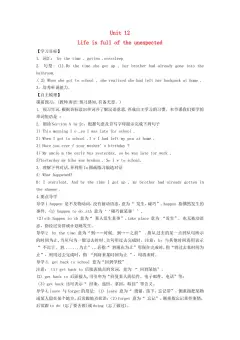
Unit 12 Life is full of the unexpected.
第14 讲
适用学科
初中英语
适用年级
九年级
适用区域
人教版区域
课时时长(分钟)
120
知识点
过去完成时,名词辨析,动词辨析,动词词组辨析,介词辨析,形容词辨析
教学目标
1. 知识与技能目标:
1)过去完成时
2)Embarrassed & embarrassing
3)Take place&happen
4)Alive & living
5)Above, on & over
2. 过程与方法:
1)能听懂谈论过去发生的突发事件的对话,并学会运用过去完成时谈论日常生活中的意
外事件;
2)能读懂有关描述突发事件的短文,能简单描述日常生活中的一次经历。
3. 情感态度与价值观:
学会合理安排时间,养成良好的学习习惯,增强做事的计划性;通过分享难忘的经历,增
进对彼此的了解,学会沟通;了解西方国家愚人节发生的事情,学会理智地分析事件,不
愚弄他人。
教学重点
过去完成时
教学难点
谈论生活中出乎意料的事情
概述
教学过程
一导入
T: What makes you angry? Can you talk with your desk mates about those things that make you feel very angry.
T: What makes you angry?
二知识讲解
知识点1
过去完成时
概念:过去完成时表示在过去某个时间或某个动作之前发生的动作或存在的状态行为,它表示动作发生的
时间是“过去的过去”,它是一种相对于一般过去时的时态,没有一般过去时就没有过去完成时。
时间状语:before, by +过去的时间点;by the end of+过去的时间(last year, term, month…), etc.
基本结构:had + done.
否定形式:had + not + done.
一般疑问句:had 放于句首。
如:The bus had gone when I got there.
The bus had not gone when I got there.
Had the bus gone when you got there?
知识点2
miss
(1) 可用作动词或名词,意为“错过;怀念;小姐;失误”。
如:I miss living in the country.
(2) miss doing sth. 错过做某事。
知识点3
unexpected
(1) 形容词,意为“出乎意料的;始料不及的”。
如:The unexpected thing makes me happy.
(2) unexpected 的反义词是expected,意为“预期要发生的,期待中的”。
如:Double the expected number of people came to the meeting.
知识点4 stare
动词或名词,意为“凝视”。
如:It’s impolite to stare at people.
知识点5 alive
(1) 形容词,“活着的;有生气的”,是表语形容词,不能放在它所说明的名词之前。
如:He says he is alive only because he is foreign.
(2) living 既可用作表语形容词,又可用作定语形容词,故可以放在它所修饰的名词之前。
如:English is a living language.
His father is still living.
知识点6 辨析above, on 与over
(1) above 意为“在……之上”,表示位置高,其反义词是below。
(2) over 意为“在……之上”,表示垂直向上,其反义词是under。
(3) on 意为“在……之上”表示与物体表面相接触。
如:His office is above ours.
The lamp is over the table.
There is a book on the desk.
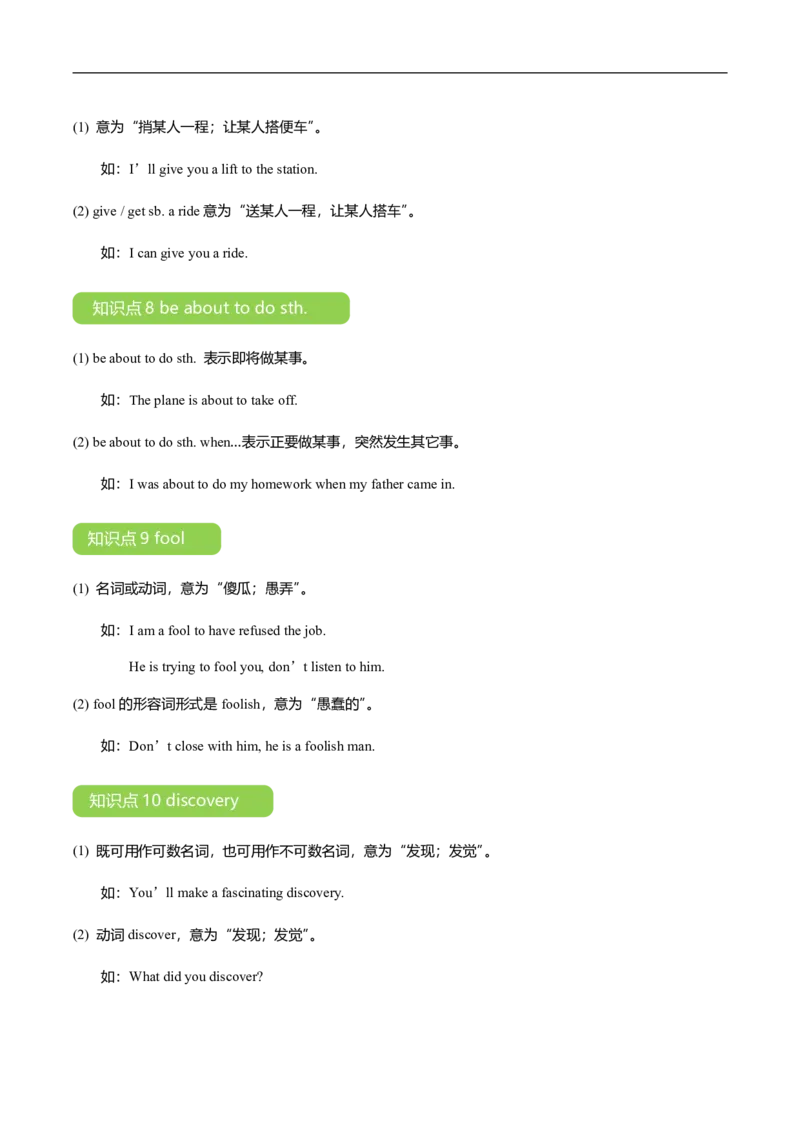
知识点7 give sb a gift
(1) 意为“捎某人一程;让某人搭便车”。
如:I’ll give you a lift to the station.
(2) give / get sb. a ride 意为“送某人一程,让某人搭车”。
如:I can give you a ride.
知识点8 be about to do sth.
(1) be about to do sth. 表示即将做某事。
如:The plane is about to take off.
(2) be about to do sth. when…表示正要做某事,突然发生其它事。
如:I was about to do my homework when my father came in.
知识点9 fool
(1) 名词或动词,意为“傻瓜;愚弄”。
如:I am a fool to have refused the job.
He is trying to fool you, don’t listen to him.
(2) fool 的形容词形式是foolish,意为“愚蠢的”。
如:Don’t close with him, he is a foolish man.
知识点10 discovery
(1) 既可用作可数名词,也可用作不可数名词,意为“发现;发觉”。
如:You’ll make a fascinating discovery.
(2) 动词discover,意为“发现;发觉”。
如:What did you discover?
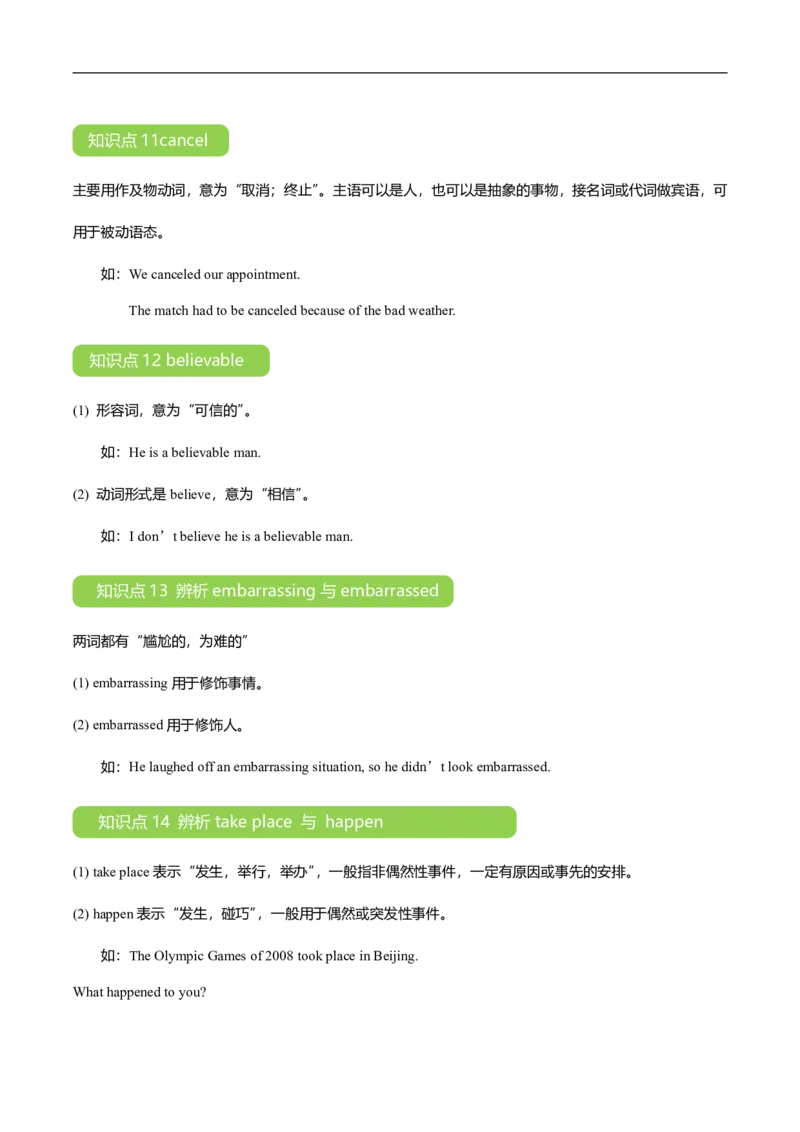
知识点11cancel
主要用作及物动词,意为“取消;终止”。主语可以是人,也可以是抽象的事物,接名词或代词做宾语,可
用于被动语态。
如:We canceled our appointment.
The match had to be canceled because of the bad weather.
知识点12 believable
(1) 形容词,意为“可信的”。
如:He is a believable man.
(2) 动词形式是believe,意为“相信”。
如:I don’t believe he is a believable man.
知识点13 辨析embarrassing 与embarrassed
两词都有“尴尬的,为难的”
(1) embarrassing 用于修饰事情。
(2) embarrassed 用于修饰人。
如:He laughed off an embarrassing situation, so he didn’t look embarrassed.
知识点14 辨析take place 与happen
(1) take place 表示“发生,举行,举办”,一般指非偶然性事件,一定有原因或事先的安排。
(2) happen 表示“发生,碰巧”,一般用于偶然或突发性事件。
如:The Olympic Games of 2008 took place in Beijing.
What happened to you?
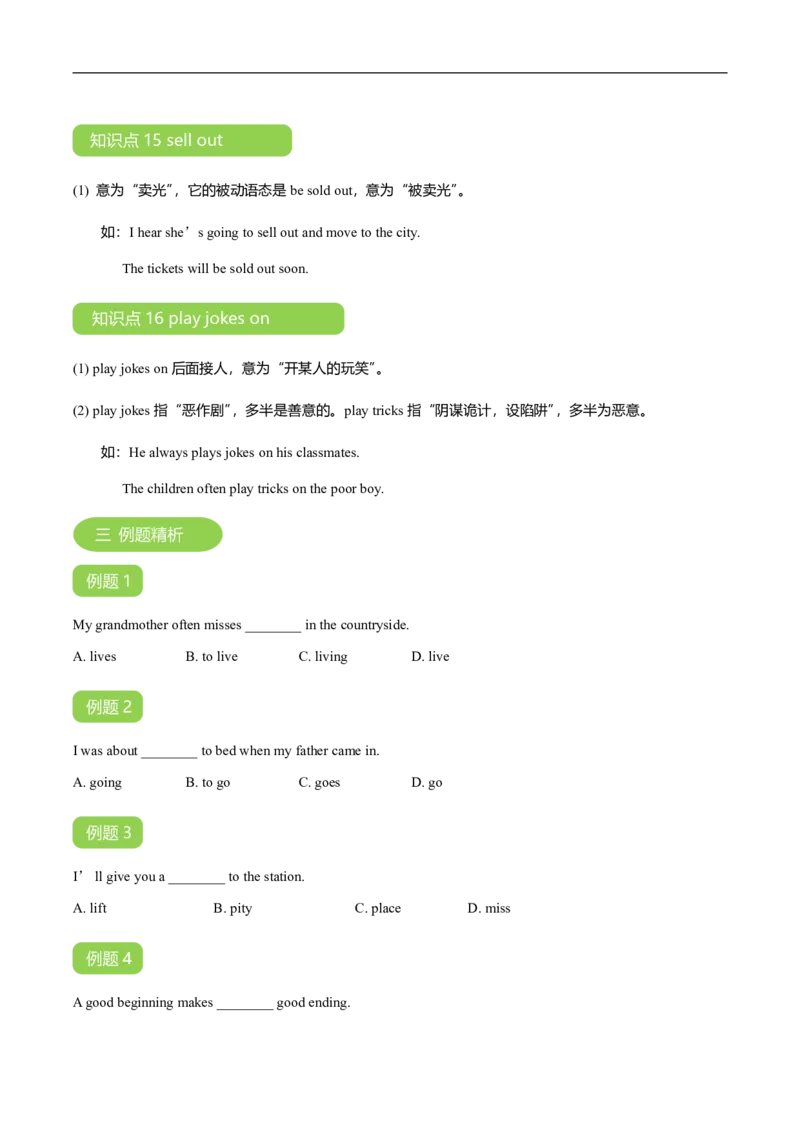
知识点15 sell out
(1) 意为“卖光”,它的被动语态是be sold out,意为“被卖光”。
如:I hear she’s going to sell out and move to the city.
The tickets will be sold out soon.
知识点16 play jokes on
(1) play jokes on 后面接人,意为“开某人的玩笑”。
(2) play jokes 指“恶作剧”,多半是善意的。play tricks 指“阴谋诡计,设陷阱”,多半为恶意。
如:He always plays jokes on his classmates.
The children often play tricks on the poor boy.
例题1
My grandmother often misses ________ in the countryside.
A. lives
B. to live
C. living
D. live
例题2
I was about ________ to bed when my father came in.
A. going
B. to go
C. goes
D. go
例题3
I’ ll give you a ________ to the station.
A. lift
B. pity
C. place
D. miss
例题4
A good beginning makes ________ good ending.
三例题精析
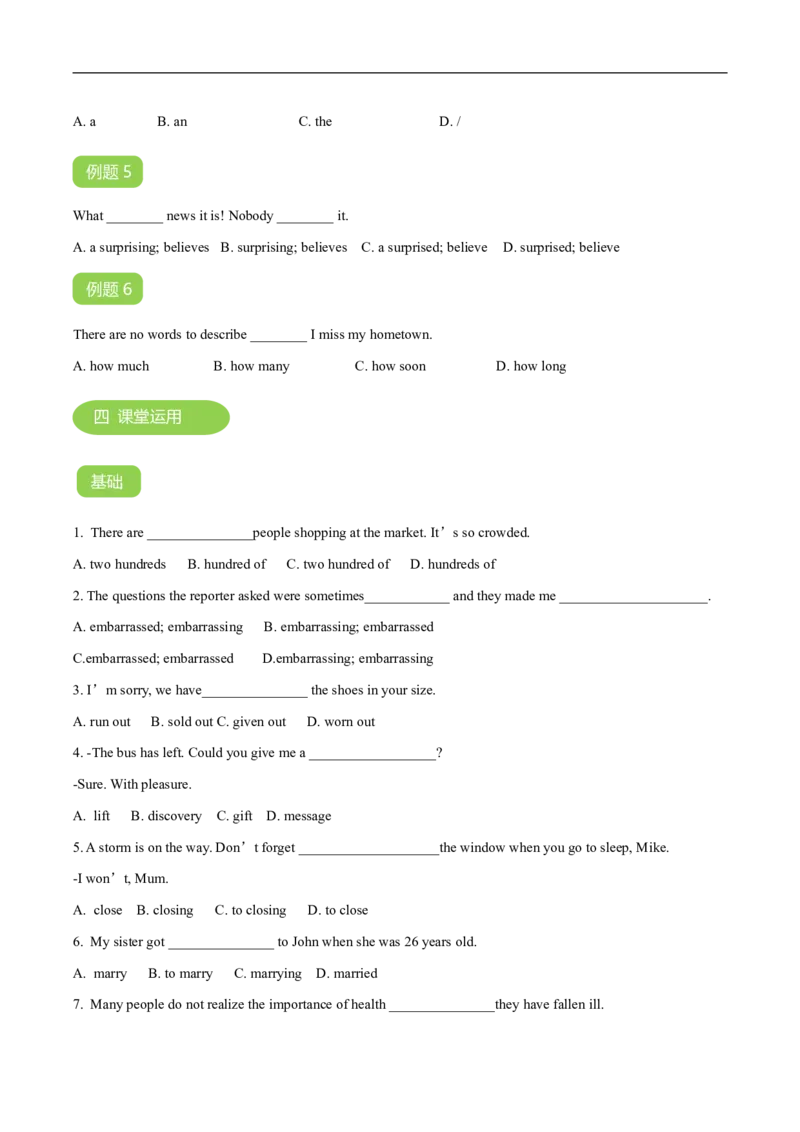
A. a
B. an
C. the
D. /
例题5
What ________ news it is! Nobody ________ it.
A. a surprising; believes B. surprising; believes
C. a surprised; believe
D. surprised; believe
例题6
There are no words to describe ________ I miss my hometown.
A. how much
B. how many
C. how soon
D. how long
四课堂运用
1. There are _______________people shopping at the market. It’s so crowded.
A. two hundreds
B. hundred of
C. two hundred of
D. hundreds of
2. The questions the reporter asked were sometimes____________ and they made me _____________________.
A. embarrassed; embarrassing
B. embarrassing; embarrassed
C.embarrassed; embarrassed
D.embarrassing; embarrassing
3. I’m sorry, we have_______________ the shoes in your size.
A. run out
B. sold out C. given out
D. worn out
4. -The bus has left. Could you give me a __________________?
-Sure. With pleasure.
A. lift
B. discovery
C. gift
D. message
5. A storm is on the way. Don’t forget ____________________the window when you go to sleep, Mike.
-I won’t, Mum.
A. close
B. closing
C. to closing
D. to close
6. My sister got _______________ to John when she was 26 years old.
A. marry
B. to marry
C. marrying
D. married
7. Many people do not realize the importance of health _______________they have fallen ill.
基础
A. till
B. while C. when D. after
8. -May I ______________your English-Chinese dictionary?
-Sorry, I______________ it at home.
A. lend; left
B. borrow; left
C. lend; forgot
D. borrow; forgot
9. Lucy called me to come to the party, but she herself didn’t _______________.
A. show around
B. show up
C. come out
D. put up
10. -Did you watch the basketball match?
-Oh, my alarm clock didn’t_____________. When I woke up,the match had been over.
A. go on
B. go away
C. go up
D. go off
巩固
完成句子同标密补加市的超诚南排复
1. 她捎了我们一程去机场,她真好。
It was very kind of her to ___________us __________ _____________to the airport.
2. 截止到上个月,他们已经制造了一万辆车。
They had made ten thousand cars ___________
______________
__________________last month.
3. 当电话铃响的时候,我正准备去睡觉。
I_____________ _______________ go to bed when the phone rang.
4. 你没有与其他人排在一排。
You are not____________ ____________ _____________ the others.
5. 如果你能从错误中学习的话,坏事能变成好事。
Bad
things
can
___________
______________good
things
if
you
can
____________
_____________mistakes.
拔高
所给单词的适当形式填空
discover, can, cancel, fool, believe
1. He______________ me into giving him much money.
2. In the future, humans ___________ more secrets of nature.
3. He is an honest man and his words are _______________.
4. I didn’t know the competition of model planes_________the other day.
5. On those snowy days,all the drivers drove as carefully as they_______________.
五课堂小结
重要单词、词组句型
1. 过去完成时常见的时间状语从句有by, before, by the end of last year
2. miss doing sth. 错过做某事
3. unexpected 的反义词是expected,意为“预期要发生的,期待中的”。
4. Living 形容词,“活着的;有生气的”,是表语形容词,不能放在它所说明的名词之前。
living 既可用作表语形容词,又可用作定语形容词,故可以放在它所修饰的名词之前。
5. above 意为“在……之上”,表示位置高,其反义词是below。
over 意为“在……之上”,表示垂直向上,其反义词是under。
on 意为“在……之上”表示与物体表面相接触。
6. give sb. a lift 意为“捎某人一程;让某人搭便车”。
7. be about to do sth. when…表示正要做某事,突然发生其它事。
8. 两词都有“尴尬的,为难的”embarrassing 用于修饰事情。embarrassed 用于修饰人。
9. take place 表示“发生,举行,举办”,一般指非偶然性事件,一定有原因或事先的安排。
happen 表示“发生,碰巧”,一般用于偶然或突发性事件。
10. play jokes on 后面接人,意为“开某人的玩笑”。
play jokes 指“恶作剧”,多半是善意的。
play tricks 指“阴谋诡计,设陷阱”,多半为恶意。
六课后作业
单项选择
1. Yingqi Bird Nest Library, the smallest library in the world, was opened to the public in Nanjing’s Huashu
Village _______________the World Reading Day.
A. on
B. in C. at
D. as
2. When they gave these books to the boy, he said that he
____________never_____________ so many books
and thanked them again and again.
A. have; seen
B. had; seen
C. will; seen
D. was; seen
3. Mary said she was going to meet me but she didn’t_________before I left.
A. put off
B. turn of
C. stay up
D. show up
4. - Who ___________the station on time?
- I did! In fact, I _____________there 5 minutes earlier.
A. reached; arrived
B. reached; arrived at
C. arrived; reached
D. got; arrived
5. We saw the old woman ________________across the street slowly. We went up to her and helped her cross it.
A. walking
B. walked
C. to walk
D. walks
6. - What happened to John?
He looks unhappy.
-He wanted to play a _______________ on his desk mate,
but he fooled himself at last.
A. game
B. joke
C. part
D. fool
7. We can be thankful every day, not just __________Thanksgiving Day.
A. in
B. on
C. to
D. by
8. - How long have Mr. and Mrs. Green_______________ ?
- For more than thirty years.
A. married
B. had married
C. marry
D. been married.
9. - Why did you miss the English class?
- Because my alarm clock didn’t_____________.
A. go off
B. put off
C. take of
D. fall off
10. - Do you have Jay’s CDs?
Sorry, they are_________________ . But we’ll get some more next week because they______________.
A. sold well; are on sale
B. sold out; sell well
C. selling well; sell well
D. for sale; sell well
基础
词汇运用
It is very exciting to make a new________________(发现)
The_______________________(出乎意料的)rain dropped down over and over again in the city of Urumgi from
June 7th to June 17th.
The person had ______________________(消失)by the time he realized that it was a hoax.
Do you think the story is_________________(可相信的)?
The_________________(军官)ordered his soldiers to stay where they were.
巩固
完成句子
1. 生活充满了意外。我感到很幸运我还活着。
Life ____________
___________
____________the unexpected. I feel lucky to be _________________.
2. 当我正和办公室其他人员排队等候时,我听到了一声巨响。
As I was___________
___________
_________________
___________ other office workers, I heard a
loud sound.
3. 我的闹钟没有响!我一直在睡觉,当我醒来时已经8 点了!
My alarm clock didn’t____________ ___________________! I kept___________, and when I _________up it
was already 8:00 a.m. !
4. 幸运的是,卡尔的爸爸在街上看见了我并开车捎了我一程。
Luckily, Karl’s dad saw me on the street and ___________ _______________ _____________ _____________.
5. 当人们意识到这个故事是一个骗局时,全国所有的意大利面条都已经卖光了。
By the time people realized that the story was a hoax, all of the spaghetti across the country__________
___________ _____________ ___________________.
拔高
任务型阅读请仔细阅读
1-5 题中关于个人旅游的描述,从A-G 中选出与之相对应的旅游建议,其中两项为多余选项。
1. Mary plans to spend her holiday in Egypt. She is interested in clothes made of silk.
1. Alice can’t wait to fly to Italy. She wants to buy a leather(皮革)handbag there before she comes back home.
2. Susan’s dream is to visit Vienna, the capital city of Austria. Her dream will come true son because she won a
trip to the city of Music just now.
3. Kate is looking forward to her vacation to Paris. She needs to buy some presents for her friends in Paris, but she
doesn’t have much money.
4. Frank has been in Thailand for two weeks. He will fly back home next week. He is shopping online for presents.
But he has no idea what to buy.
A. In German-speaking countries, few stores or restaurants accept payment by credit card. It’s wise to take more
cash(现金)with you.
B. It’s famous for pyramids and clothing made of silk and leather. To find good things, you’d better go to Cairo.
In February and August, they are often on sale.
C. There are many things you can buy, such as handmade clothing,silk ties and silver jewelry(珠宝).
D. Florence is well-known for its handmade leather goods. You could take time to stop by the Florence Leather
School where you can find lots of good leather goods.
E. In Hong Kong, you should look at the same product in different shops. Then you will have a better idea of what
is the right price for the product.
F. You don’t need to buy expensive presents. With 5-10euros, you can buy a wonderful scarf. You could also buy
Mini Eiffel Towels. Each of them only costs about 2 euros.
G. When you’re on vacation in America, do not miss Yellowstone National Park, the first national park in the
world. It’s famous for the natural sights, especially the hot fountains.