文档文本内容
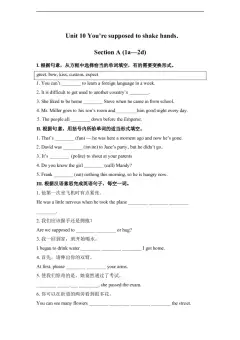
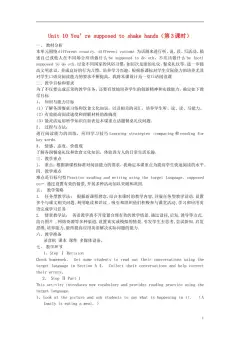
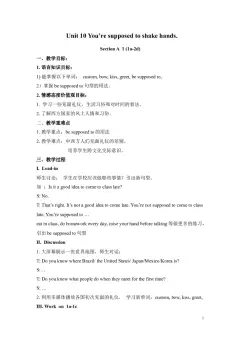
Unit 10 You're supposed to shake hands.
第11 讲
适用学科
初中英语
适用年级
九年级
适用区域
人教版新目标
课时时长(分钟)
120
知识点
1. 动词辨析;
2. 动词词组辨析;
3. 引导状语从句的从属连词
教学目标
1. 知识与技能:
动词辨析,动词词组辨析,引导状语从句的从属连词。
2. 过程与方法:
对变化规则所需要的条件进行判断,能够做到游刃有余,运用灵活自如。
3. 情感态度价值观:
激发对英语学习的热情,增强信心。
教学重点
1. 谈论风俗和你应该做什么
教学难点
2. 引导状语从句的从属连词
教学过程
一、导入
T: What do people do when they meet for the first time?
(Show some pictures and present the important phrases.)
T: What do people do when they meet for the first time?
S: You're supposed ______.
to shake hands
to bow
概述
to kiss on their cheeks
二、知识讲解
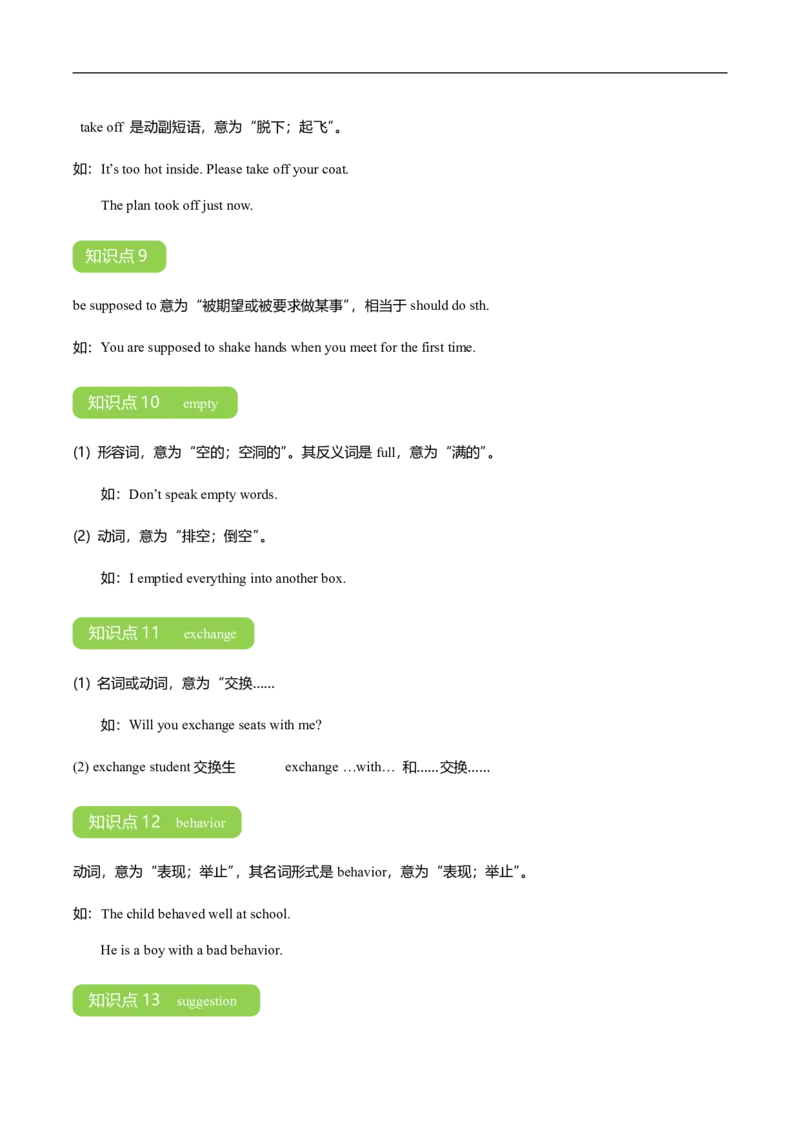
知识点1
kiss
(1) 动词或名词,意为“亲吻;接吻”。
如:He kissed his wife and children goodbye.
She gave her mother a kiss.
(2) 由kiss 构成的短语:hearty kiss 亲切的吻
sweet kiss 甜蜜的吻
exchange kisses 互相亲吻
知识点2
value
(1) 动词,意为“重视;珍视”。
如:Do you value her as your teacher?
(2) 名词,意为“价值”。
如:What is the value of this picture?
(3) 形容词形式是valuable,意为“有价值的;值钱的”
(4) 短语be of great value 相当于be very valuable,意为“很有价值的”。
如:The book is of great value. = The book is very valuable.
知识点3
mad
(1) 形容词,意为“很生气的;疯的”。相当于very angry。
(2) 短语be/get mad at sb. 意为“对某人很生气”。
如:Are you mad at your father?
知识点4
knock
(1) 动词,意为“敲;击”。
(2) 名词,意为“敲击声;敲击”。
如:He knocked his head against the door.
There was a knock at the window.
(3) knock at/on the door 敲门
knock down 击倒
knock into 撞在某人身上
知识点5
worth
形容词,意为“值得;有……价值(的)”。后接doing。
如:The book is worth reading.
知识点6
as soon as
(1) 意为“一……就……”,引导时间状语从句。当主句是一般过去时,从句也用一般过去时;当主句是一般
将来时,从句用一般现在时。
如:As soon as I got the news, I came to tell you.
As soon as I finish my homework, I will go and play with you.
知识点7
hold out
(1) 是动词短语,意为“伸出”。
如:She held out both her hands to show her welcome.
(2) 还有“坚持”的意思。
如:How long do you think we can hold out?
知识点8
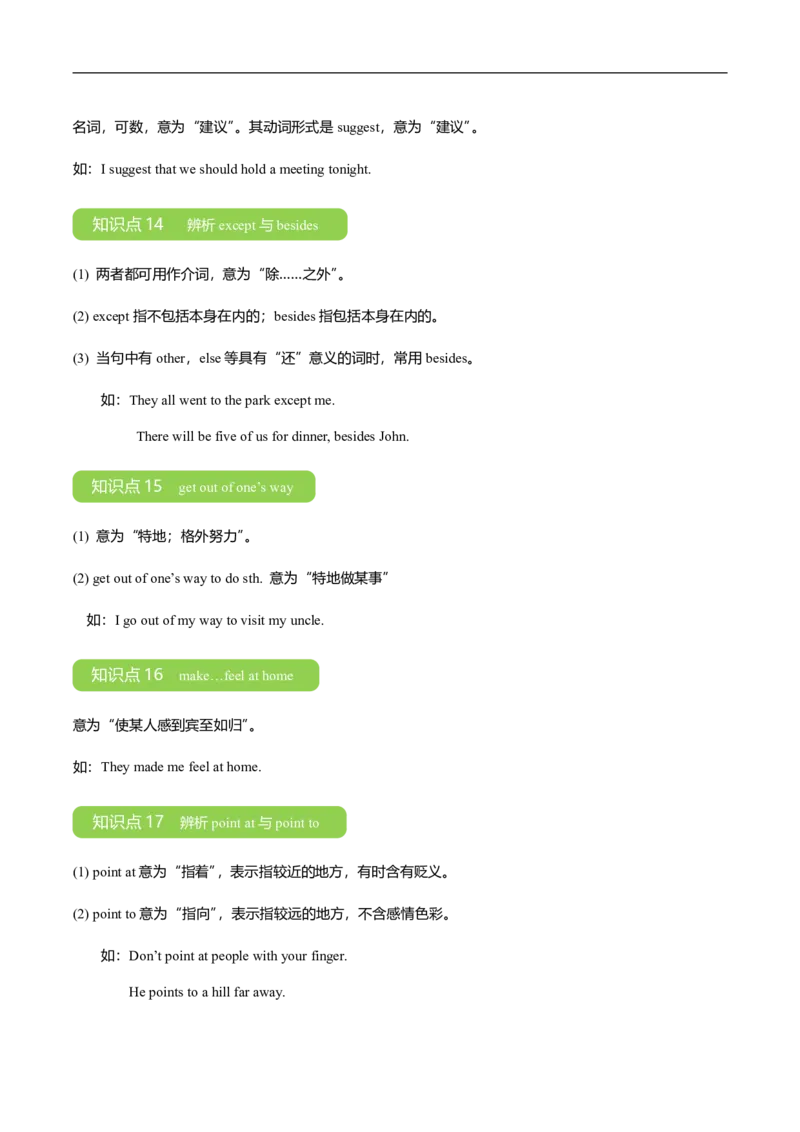
take off
take off 是动副短语,意为“脱下;起飞”。
如:It’s too hot inside. Please take off your coat.
The plan took off just now.
知识点9
be supposed to 意为“被期望或被要求做某事”,相当于should do sth.
如:You are supposed to shake hands when you meet for the first time.
知识点10
empty
(1) 形容词,意为“空的;空洞的”。其反义词是full,意为“满的”。
如:Don’t speak empty words.
(2) 动词,意为“排空;倒空”。
如:I emptied everything into another box.
知识点11
exchange
(1) 名词或动词,意为“交换……
如:Will you exchange seats with me?
(2) exchange student 交换生
exchange …with… 和……交换……
知识点12
behavior
动词,意为“表现;举止”,其名词形式是behavior,意为“表现;举止”。
如:The child behaved well at school.
He is a boy with a bad behavior.
知识点13
suggestion
名词,可数,意为“建议”。其动词形式是suggest,意为“建议”。
如:I suggest that we should hold a meeting tonight.
知识点14
辨析except 与besides
(1) 两者都可用作介词,意为“除……之外”。
(2) except 指不包括本身在内的;besides 指包括本身在内的。
(3) 当句中有other,else 等具有“还”意义的词时,常用besides。
如:They all went to the park except me.
There will be five of us for dinner, besides John.
知识点15
get out of one’s way
(1) 意为“特地;格外努力”。
(2) get out of one’s way to do sth. 意为“特地做某事”
如:I go out of my way to visit my uncle.
知识点16
make…feel at home
意为“使某人感到宾至如归”。
如:They made me feel at home.
知识点17
辨析point at 与point to
(1) point at 意为“指着”,表示指较近的地方,有时含有贬义。
(2) point to 意为“指向”,表示指较远的地方,不含感情色彩。
如:Don’t point at people with your finger.
He points to a hill far away.
知识点18
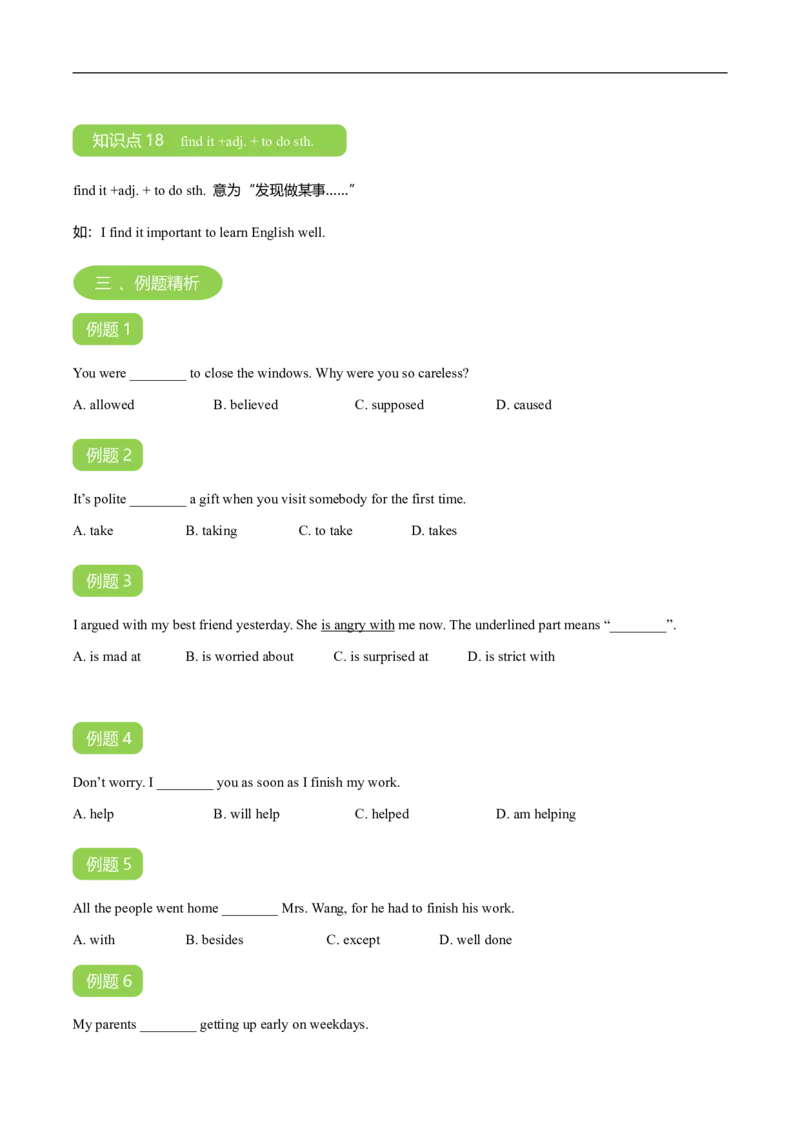
find it +adj. + to do sth.
find it +adj. + to do sth. 意为“发现做某事……”
如:I find it important to learn English well.
例题1
You were ________ to close the windows. Why were you so careless?
A. allowed
B. believed
C. supposed
D. caused
例题2
It’s polite ________ a gift when you visit somebody for the first time.
A. take
B. taking
C. to take
D. takes
例题3
I argued with my best friend yesterday. She is angry with me now. The underlined part means “________”.
A. is mad at
B. is worried about
C. is surprised at
D. is strict with
例题4
Don’t worry. I ________ you as soon as I finish my work.
A. help
B. will help
C. helped
D. am helping
例题5
All the people went home ________ Mrs. Wang, for he had to finish his work.
A. with
B. besides
C. except
D. well done
例题6
My parents ________ getting up early on weekdays.
三、例题精析
A. used to
B. be used to
C. was used to
D. are used to
例题7
David suddenly felt nervous. ________, it was his first time to go on stage.
A. At least
B. After all
C. At once
D. At all
例题8
My pen pal Andrew found it difficult ________ Chinese well.
A. learning
B. learn
C. to learn
D. learned
四、课堂运用
1.—China is getting better and better at making high technology products.
—That's right. People around the world can hardly avoid ________ products made in China.
A.not buying
B.not to buy
C.to buy
D.buying
2. We don't usually have to make plans ________our friends.
A.to meet
B.meeting
C.to meeting
D.Met
3. ________,the old woman is a thief.
A.To my surprise
B.In that
C.To start with
D.In all
4. I think she needs to have a rest. She is ________ tired.
A.a kind of
B.a bit of
C.little
D.a little
5. Jane was shy. She would not invite her classmates________ speaking English.
A.practice
B.practices
C.practicing
D.to practice
6. —I'm sorry,sir. I can't finish the work on time.
—Never mind. ________,the work is quite difficult.
A.At least
B.For instance
C.After all
D.First of all
7.It's windy outside. ____________ your jacket, Bob. Don't catch a cold.
A.Try on
B.Put on
C.Take off
基础
8.The teacher says that Mo Yan's new book is well worth________.
A.to read
B.read
C.reading
D.watching
9.The car which was driven by a drunken man________ the big tree last night.
A.knocked at
B.knocked on
C.knocked into
D.knocked out
10.I am really sorry to keep you ________ for me for such a long time.
A.waits
B.waiting
C.waited
D.to wait
巩固
1. You're supposed to __________your shoes before you enter the room.
A.take off
B. put off
C. get off
D. turn off
2.It is ________for him to finish the task in two hours, because he has something else to do.
A.easy
B.interesting
C.difficult
D.relaxing
3.Children are________ to visit more often and take better care of their parents according to the new law.
A.found
B.interested
C.made
D.supposed
4.
Tomorrow is Sunday. He will ____________ his grandparents' home.
A.see off
B.look at
C.come by
D.drop by
5. —Did you win the game yesterday?
—Not really.________ we all tried our best,we lost it.
A.If
B.Though
C.Unless
D.And
拔高
1.In our country, it's important to ________________ (守时).
2.
I ________________(顺便拜访) his home when I went
shopping yesterday.
3.My friend will ____________________(大动肝火) at me if I tell a lie.
4.We should value the time we ________________(与……一起度过) each other.
5.I don't mind if you are ______________________(晚一点儿) for the meeting sometimes.
五、课堂小结
重要单词、词组句型
(1) be supposed to do 应该
(2) be relaxed about sth. 对某事随意、不严格
(3) pretty adv. 相当,很
She is pretty friendly. 她相当友好。
adj. 美丽的
She is a pretty girl.她是一个美丽的女孩。
(4) plan to do. 打算做某事
(5) drop by 访问,看望,拜访,串门
(6) on time 按时; in time 及时
(7) after all 毕竟终究
(8) invite sb. to do sth. 邀请某人做某事
(9) around the world == all over the world 全世界
(10) pick up 捡起挑选
(11) go out of one's way to do 特意,专门做某事
He went out of his way to make me happy. 他特意使我高兴。
(12) make mistakes 犯错误
make a mistake 犯错误
(13) be different from 与……不同
(14) get/be used to sth. 习惯于……
get/be used to doing 习惯于……
be used to do
被用于做……
be used for doing 被用于做…
used to do 过去常常做…
(15) I find it difficult to remember everything. 我发现要记住每一样事是困难的。
find/think + it +形容词to do sth.
I think it hard to study English.
(16) cut up 切开切碎
(17) can't stop doing 忍不住做某
(18) make faces 做鬼脸
(19) face to face 面对面
(20) learn…by oneself 自学
六、课后作业
基础
1.I know you don't like him, but please make ________ effort to be polite.
A.a
B.an
C.the
D./
2.—Can you tell me how to ________ at table?
—Sure, you shouldn't put your elbows on the table.
A.take
B.put
C.behave
D.smell
3.Everyone is here ________ Jim. He is ill in hospital.
A.except
B.beside
C.besides
D.against
4. It's warm inside. Why not ________ your coat?
A.take away
B.take up
C.take down
D.take off
5.I found ________ difficult to make friends with him because he is very shy.
1.
A.that
B.it
C.one
D.this
巩固
1. 习惯另一个国家的习俗并不容易。
It's not easy to ________ ________ ________ another country's customs.
2.父母格外努力地为我创造一个好的学习环境。
My parents __________ __________ __________ ________ ________ to create a good learning environment for
me.
3.妈妈告诉她不要把筷子插进米饭里。
Her mother told her not to ________ the chopsticks ________ the rice.
4.他说话的方式和我们不同。
His way of speaking ________ ________ ________ ours.
5.正如你所能想象到的,我们非常需要援助。
________ ________ ________ ________,we are very much in need of help.
拔高
请根据提示写一篇短文,介绍一下在美国人家里做客时的注意事项。
提示:1) 买一件小礼物,比如一束花或一本漂亮的相册;
2) 准时到达主人家;
3) 用餐时,表现出喜欢主人的厨艺;
4) 不要在主人家呆得太久;
5) 告别时,记得向主人道谢。
要求:1) 书写规范,逻辑清晰,行文连贯;
2) 可适当发挥;
3) 词数:80 个词左右。
________________________________________________________________________
________________________________________________________________________
________________________________________________________________________
________________________________________________________________________
________________________________________________________________________
________________________________________________________________________
________________________________________________________________________