Unit 5 What are the shirts made of?
第5 讲
适用学科
初中英语
适用年级
九年级
适用区域
人教版区域
课时时长(分钟)
120
知识点
一般现在时的被动语态
教学目标
1.
知识与技能目标:
1)掌握一般现在时被动语态
2)掌握必记单词:avoid, produce 等;掌握常考短语:be made of, be known for 等;
掌握经典句型What’s the model plane made of?等。
2.过程与方法:
1)能听懂谈论物品材质,产地的对话。
2)能运用所学知识介绍产品特点,材质等。
3.情感态度与价值观:
了解中国制造在全球的影响,更热爱祖国并努力学习。
教学重点
一般现在时的被动语态
教学难点
一般现在时被动语态的句式变化。
概述
教学过程
一、导入
T: What’s the model plane made of?
S: It’s made of used wood and glass.
T:Are your shirt made of cotton?
S:Yes,they are.And they were made in the US.
二、知识讲解
知识点1
被动语态定义:被动语态是动词的一种特殊形式,用来说明主语与谓语动词之间的关系。
如果主语是动作的执行者(即某人做某事),便叫主动语态;
如果主语是动作的承受者(即某事被做),便叫被动语态。
主动与被动的区别不是词序的区别,而是主语与谓语意义上的区别。
在英语中只有及物动词和一些相当于及物动词的词组才有被动语态的形式。
被动语态的用法:
①不知道谁是动作的执行者(即不知道谁做)时用被动语态,省略by 短语。
如:A man was killed in the accident.一个人死于事故。
This window was broken yesterday.这扇窗子是昨天被打破的。
②不说或者众所周知是谁做时,用被动语态,省略by 短语。
如:Rice is also grown in this place.这个地方也种水稻。
A railroad will be built here in three years.三年之后这里将要修建一条铁路。
③强调动作的承受者,句尾加by 短语。
如:It was written by Lu Xun.它(书)是鲁迅写的。
A pet dog is never killed by its owner.宠物狗是不会被主人宰杀的。
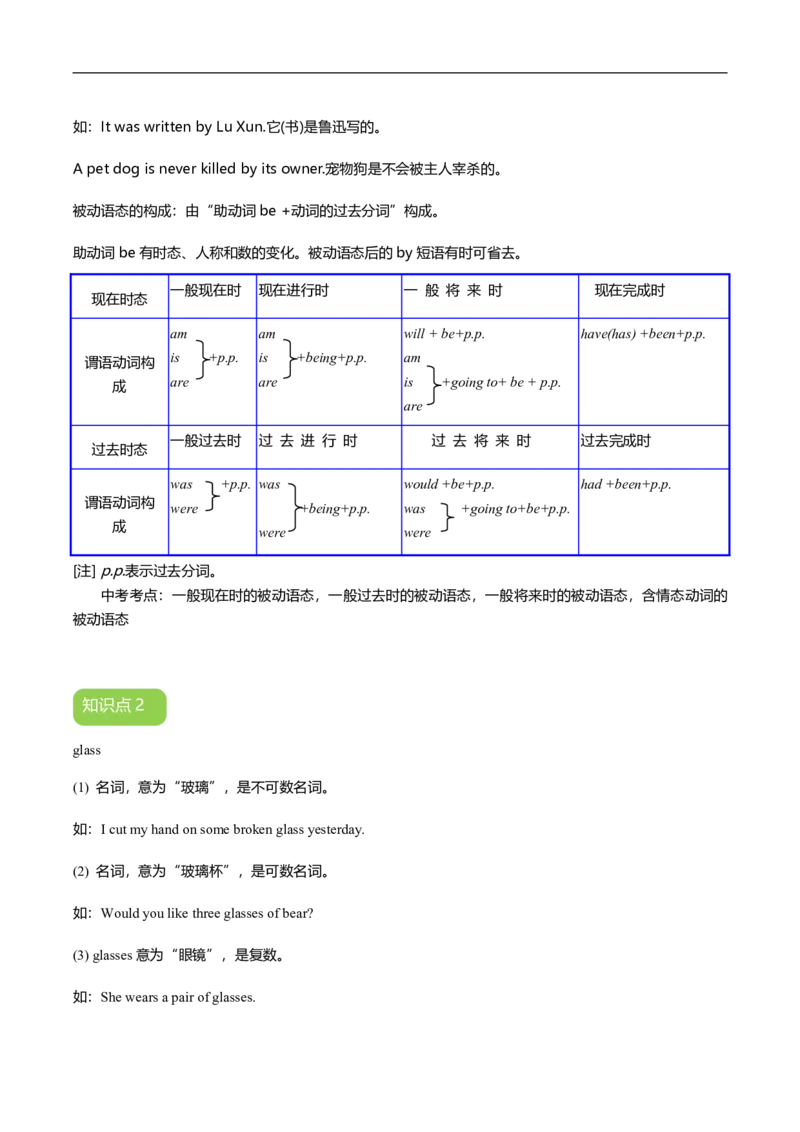
被动语态的构成:由“助动词be +动词的过去分词”构成。
助动词be 有时态、人称和数的变化。被动语态后的by 短语有时可省去。
[注] p.p.表示过去分词。
中考考点:一般现在时的被动语态,一般过去时的被动语态,一般将来时的被动语态,含情态动词的
被动语态
知识点2
glass
(1) 名词,意为“玻璃”,是不可数名词。
如:I cut my hand on some broken glass yesterday.
(2) 名词,意为“玻璃杯”,是可数名词。
如:Would you like three glasses of bear?
(3) glasses 意为“眼镜”,是复数。
如:She wears a pair of glasses.
现在时态
一般现在时
现在进行时
一般将来时
现在完成时
谓语动词构
成
am
is
+p.p.
are
am
is
+being+p.p.
are
will + be+p.p.
am
is
+going to+ be + p.p.
are
have(has) +been+p.p.
过去时态
一般过去时
过去进行时
过去将来时
过去完成时
谓语动词构
成
was
+p.p.
were
was
+being+p.p.
were
would +be+p.p.
was
+going to+be+p.p.
were
had +been+p.p.
知识点3
leaf
(1) 名词,意为“叶子”,可数。复数是leaves。
如:Trees begin to have leaves in spring.
(2) 以f/fe 结尾的名词变复数时,把f/fe 变成v,加es。
口决:妻子持刀去宰狼,小偷吓得发了慌,躲在架下保己命,半片树叶遮目光。
wife
knife
wolf
thief
shelf
self
life
half
leaf
知识点4
widely
(1) 副词,意为“广泛地;普遍地”。
如:Iphone 6 now is widely used by young people all over the world.
(2) 形容词是wide,意为“宽广的;宽阔的”。
如:The river is too wide to swim across.
知识点5
avoid
(1) 动词,意为“避免;回避”。
(2) 接名名词、代词或动名词。
如:I walk another way to avoid meeting him.
知识点6
辨析every day 与everyday
(1) every day 是副词短语,在句中做状语,常放在句子的后面。
如:I go to school on foot every day.
(2) everyday 是形容词,意为“每天的;日常的”,修饰名词,放在名词前。
如:She often wears everyday clothes at home.

知识点7
be known for
(1) 意为“以……著名”,相当于be famous for。
如:China is known for the Great Wall.
(2) be known as 意为“作为……而著名”,相当于be famous as。
如:Mo Yan is known as a writer.
知识点8
What are the shirts made of?
(1) 一般现在时被动语态的结构是:am/is/are + 过去分词。
如:Chinese is spoken by the largest number of people.
(2) be made of 意为“由……制成”,指能看出原材料。
如:The table is made of bamboo.
(3) be made from 意为“由……制成”,指看不出原材料。
如:Paper is made from wood.
知识点9
form
(1) 名词,意为“形成;类型”。
如:These are two different forms of the same thing.
(2) 名词,意为“表格”。
如:Please fill in this form, giving your name, address and business.
知识点10
scissors
(1) 名词,意为“剪刀”,常用复数形式。
如:I need a pair of scissors for the job.
(2) 常用复数形式的单词还有:glasses 眼镜
trousers 裤子
gloves 手套
知识点11
lively
(1) 形容词,意为“生气勃勃的;色彩鲜艳的”。
如:He is always making his classes lively and interesting.
(2) lively 可作定语、表语叵宾语补足语,修饰人或物;
living 意为“活着的;现存的”;可作表语或定语,修饰人或物;
alive 意为“活的;活着的”,可作表语或后置定语,修饰人或物,但不能修饰植物。
知识点12
different kinds of
(1) 意为“不同种类的”,其中kinds 可以换成sorts, forms, types 等。
如:There are many different kinds of things in the supermarket.
(2) 由kind 构成的短语:
a kind of 一种
all kinds of 各种各样的
many kinds of 很多种类的
知识点13
according to
(1) according to 是复合介词,后接名语或代词。
如:Everything went off according to plan.
(2) according as 意为“根据;随……而定”,后接从句。
如:You will be praised or blamed according as your work is good or bad.
知识点14
in trouble
意为“在困境中”,其反义词组是out of trouble“摆脱困境”。
如:We must go to help her. She is in trouble.
知识点15
be covered with
意为“被……覆盖”,表示状态。
如:The table is covered with a nice cloth.
知识点16
turn into
turn into 是动词短语,意为“变成”。
如:I don’t want to turn into that kind of person.
由turn 构成的短语:turn on 打开
turn off 关上
turn up 调大
turn down 调小
例题1
【题干】---You bought a new car! An American car?
---No. A Chinese car. It ________ in Taizhou.
A. makes
B. made
C. was made
D. will be made
【答案】C
【解析】本题考查一般过去时被动语态。一般过去时被动语态构成:was/were+过去分词,故答案为C。
例题2
【题干】This pair of shoes ________ hand, and it ________ very comfortable.
A. is made with, is felt
B. are made from, is felt
C. are made of, feels
D. is made by, feels
【答案】C
【解析】本题考查被动语态的用法。由pair 构成的短语以pair 为单复数的判断标准;feel 无被动语态,故答
案为C。
例题3
【题干】Sanya is famous ________ its beautiful beaches.
A. of
B. for
C. as
D. from
【答案】B
【解析】本题考查介词的用法。“以……为骄傲”用be famous for,故答案为B。
例题4
【题干】In autumn there are a lot of ________ on the ground.
三、例题精析
A. leaf
B. leafs
C. leaves
D. leafes
【答案】C
【解析】本题考察名词的用法。leaf 的复数是leaves,故答案为C。
例题5
【题干】This listening CD-ROMs ________ well.
A. sells
B. sell
C. is sold
D. are sold
【答案】D
【解析】本题考查一般现在时被动语态。一般现在时被动语态构成:am/is/are+过去分词,故答案为D。
例题6
【题干】Anna is going on a tour of Xi’an, and she wants to ________ Chinese history.
A. dream of
B. learn about
C. look through
D. pass on
【答案】B
【解析】本题考查动词词组辨析。由句意体会可知答案为B。
例题7
【题干】It will ________ them several years to learn English well.
A. cost
B. take
C. spend
D. pay
【答案】B
【解析】本题考查动词辨析。句意:学好英语将花费数年时间。It takes sb. st. to do sth.故答案为B。
四、课堂运用
1. This pair of shoes ________ hand, and it ________ very comfortable.
基础
A. is made with, is felt
B. are made from, is felt
C. are made of, feels
D. is made by, feels
2. Sanya is famous ________ its beautiful beaches.
A. of
B. for
C. as
D. from
3. In autumn there are a lot of ________ on the ground.
A. leaf
B. leafs
C. leaves
D. leafes
4. — Is the ring made of _______silver?
— Yes. It is made of______best silver in our factory.
A. a; the
B. /; the
C. a; /
D. /; a
5. — I don’t believe the toy is made ______ hand. The patterns (图案) are really fine.
— I don’t believe it, either. But no machine is used during the whole process.
A. for
B. with
C. by
D. in
6. — Are the visitors all from _______?
— No, there are only 5______ in the group.
A. Germany; Germany
B. Germany; Germans
C. German; Germans
D. German; Germany
7. — The wall of our building is made of_____.
— That’s good. So the room will be bright.
A. glass
B. steel
C. wood
D. paper
8. — Our English teacher always keeps his lessons _____.
— That’s why he is so popular among his students.
A. lively
B. happily
C. freely
D. friendly
【答案】
1—8
CBCBC
BAA
【解析】
1.
本题考查被动语态的用法。由pair 构成的短语以pair 为单复数的判断标准;feel 无被动语态,故答案为
C。
2.
本题考查介词的用法。“以……为骄傲”用be famous for,故答案为B。
3.
本题考察名词的用法。leaf 的复数是leaves,故答案为C。
4.
考查be made of 不加冠词;最高级前加冠词the。
5.
结合句意考查介词。
6.
本题考查名词词义及单复数。
7.
考查be made of 能否看出原材料
8.
结合句意“课堂生动活泼”
巩固
1. I’ll finish the job, _____ how long it takes.
A. until
B. unless
C. no matter
D. even though
2. — Are Jiangsu and Zhejiang famous for silk?
— I think so._______I know, more than half of the silk in China is produced in Jiangsu and Zhejiang.
A. As long as
B. As far as
C. As many as D. As little as
3. — Kate’s allowed to chat on WeChat with her friends at home, _____ she?
— Yes. Her parents think she is old enough.
A. doesn’t
B. isn’t
C. does
D. is
4. — Mom, is it OK for me to watch TV for a while?
— Sorry. Why not watch TV after your homework ______?
A. completes
B. completed
C. has completed
D. is completed
5. — An iPad is really a great thing.
— I agree. However, ______
. Using iPads too much has a bad influence on us.
A. every dog has its day
B. the grass is always greener on the other side
【答案】
1—5 CBBDD
拔高
短文填空
用方框中所给单词的适当形式填空,使短文完整正确(每个单词限用一次)。
give
while
past
way
ask
happy
hello
trouble
something
lose
Last Saturday, I went out to see a film after supper. On my (1)
to the cinema, I met an Englishman. He
looked puzzled (茫然的). So I walked up to him and said (2)
to him. His first name was Kevin. I (3)____
what I could do for him. He told me he had (4)
his way. So I (5)
up the opportunity to see the
film and took Kevin to his hotel. (6)
going there, I told him about the great changes that had taken place
in my hometown in the (7)
few years and Kevin told me (8)
interesting about his country,
Italy.
Though I couldn’t see the film, I felt very (9)
, for I had not only helped John get out of (10)
,
but also practiced my spoken English. I also realized that if I had not worked hard at English, I would not have
been able to help Kevin.
【答案】
1. way
2. Hello
3. asked
4. lost
5. Gave
6. While
7. past
8. Something
9. happy
10. trouble
五、课堂小结
被动语态定义:被动语态是动词的一种特殊形式,用来说明主语与谓语动词之间的关系。
如果主语是动作的执行者(即某人做某事),便叫主动语态;
如果主语是动作的承受者(即某事被做),便叫被动语态。
主动与被动的区别不是词序的区别,而是主语与谓语意义上的区别。
在英语中只有及物动词和一些相当于及物动词的词组才有被动语态的形式。
被动语态的用法:
①不知道谁是动作的执行者(即不知道谁做)时用被动语态,省略by 短语。
如:A man was killed in the accident.一个人死于事故。
This window was broken yesterday.这扇窗子是昨天被打破的。
②不说或者众所周知是谁做时,用被动语态,省略by 短语。
如:Rice is also grown in this place.这个地方也种水稻。
A railroad will be built here in three years.三年之后这里将要修建一条铁路。
③强调动作的承受者,句尾加by 短语。
如:It was written by Lu Xun.它(书)是鲁迅写的。
A pet dog is never killed by its owner.宠物狗是不会被主人宰杀的。
被动语态的构成:由“助动词be +动词的过去分词”构成。
助动词be 有时态、人称和数的变化。被动语态后的by 短语有时可省去。
[注] p.p.表示过去分词。
中考考点:一般现在时的被动语态,一般过去时的被动语态,一般将来时的被动语态,含情态动词的
被动语态
六、课后作业
基础
完成句子
现在时态
一般现在时
现在进行时
一般将来时
现在完成时
谓语动词构
成
am
is
+p.p.
are
am
is
+being+p.p.
are
will + be+p.p.
am
is
+going to+ be + p.p.
are
have(has) +been+p.p.
过去时态
一般过去时
过去进行时
过去将来时
过去完成时
谓语动词构
成
was
+p.p.
were
was
+being+p.p.
were
would +be+p.p.
was
+going to+be+p.p.
were
had +been+p.p.
1. 桌子上的盘子都是银制的。
All the plates on the table
silver.
2. 尽管爸爸感到很累, 他还是帮我学习数学。
my father was very tired, he still helped me with my math.
3. 著名的五羊雕像是广州的象征。
ThefamousFive-GoatStatueisa
Guangzhou.
4. 接下来你应该将布丁在高温下烤10分钟。
Next you should bake the pudding
for ten minutes.
5. 无论天气多坏, 孩子们都要去公园踢足球。
how bad the weather is, the children will play football in the park together.
【答案】
1. are made of
2. Even though
3. symbol of
4. at a (very) high heat
5. No matter
巩固
An ant is walking by the river. He looks at the river and says to himself, “
1
nice and cool this water looks!
I must drink some of it.” But when he is drinking, he
2
into the river.
“Oh. Help! Help!” the ant cries.
A dove (鸽子) is sitting
3
the tree. She hears him and offers him a leaf, “
4
up that leaf,” she says,
“and you will get to the bank (河岸).”
The ant climbs up onto the leaf, and the wind blows (吹) the leaf to the bank.
“Thank you, Dove. You’re so
5
. You have saved my life, and I wish I could do
6
for you.
Goodbye!” the ant says and runs home.
“Goodbye!” says the dove. “Be
7
not to fall into the river again.”
After a few days, the dove is building her nest (巢).
And a man is raising his gun (枪) to shoot
8
.
The ant sees this, and runs
9
to bite (咬) the man’s leg. “Ouch! Ouch!” The man
10
a terrible
pain and drops his gun. The dove flies away quickly. So the man picks up his gun and leaves.
The dove comes to the ant and says, “Thank you, my little friend. You have saved my life.” The little ant is so
glad, because he can help the dove.
(
)1. A. Where
B. What
C. When
D. How
(
)2. A. falls
B. drives
C. looks
D. runs
(
)3. A. on
B. in
C. with
D. down
(
)4. A. Get
B. Come
C. Climb
D. Put
(
)5. A. quick
B. kind
C. patient
D. worried
(
) 6. A. anything
B. nothing
C. everything
D. something
(
)7. A. careful
B. happy
C. easy
D. dangerous
(
)8. A. it
B. her
C. him
D. them
(
)9. A. slowly
B. off
C. fast
D. upstairs
(
)10. A. feels
B. takes
C. causes
D. gives
【答案】
1-5 DABCB
6-10 DABCA
拔高
为假如你叫李华,最近你的美国朋友Jim想通过邮件了解你家乡最著名的传统艺术是什么。请你根据提
示和问题回复邮件。
Name of the artwork: kite
History: over 2,000 years
Material: paper
Features (特征): different sizes, shapes, fly high
●
What is the most famous
traditional
art
in
your
hometown?
●What’s it made of/from?
●How long is its history?
●…
To: Jim
From: Li Hua
Subject: Artwork in my hometown
Hi, Jim!
I’m glad to hear from you.
Yours,
Li Hua
参考范文:
Hi, Jim!
I’m glad to hear from you.
In your last e-mail, you said you were interested in the local artwork in my hometown. Now I will tell you
something about it. My hometown is famous for making and flying kites. In my hometown, the history of making
kites goes back to over 2,000 years ago. Kites are mainly made of paper, which can be made into different sizes and
shapes. People like to fly them in spring. It’s not hard to fly kites, and flying kites is great fun. Some can fly as high
as hundreds of meters.
Yours,
Li Hua
七、教学反思