第 08 讲 Unit 1 Happy Holiday Section A(解析版)
【暑假自学课】2025 年新八年级上册人教版(2024)英语
一、单元核心框架
主题:谈论假期活动与经历(Talk about holiday activities and experiences)
核心素养:
语言能力:描述假期经历、运用复合不定代词、掌握一般过去时
文化意识:感受自然景观与不同地区文化(如黄山、草莓节)
学习能力:通过听力提取关键信息,用目标句型进行对话交流
二、Section A 教材内容全解析
Part 1 教材活动详解(1a-1d)
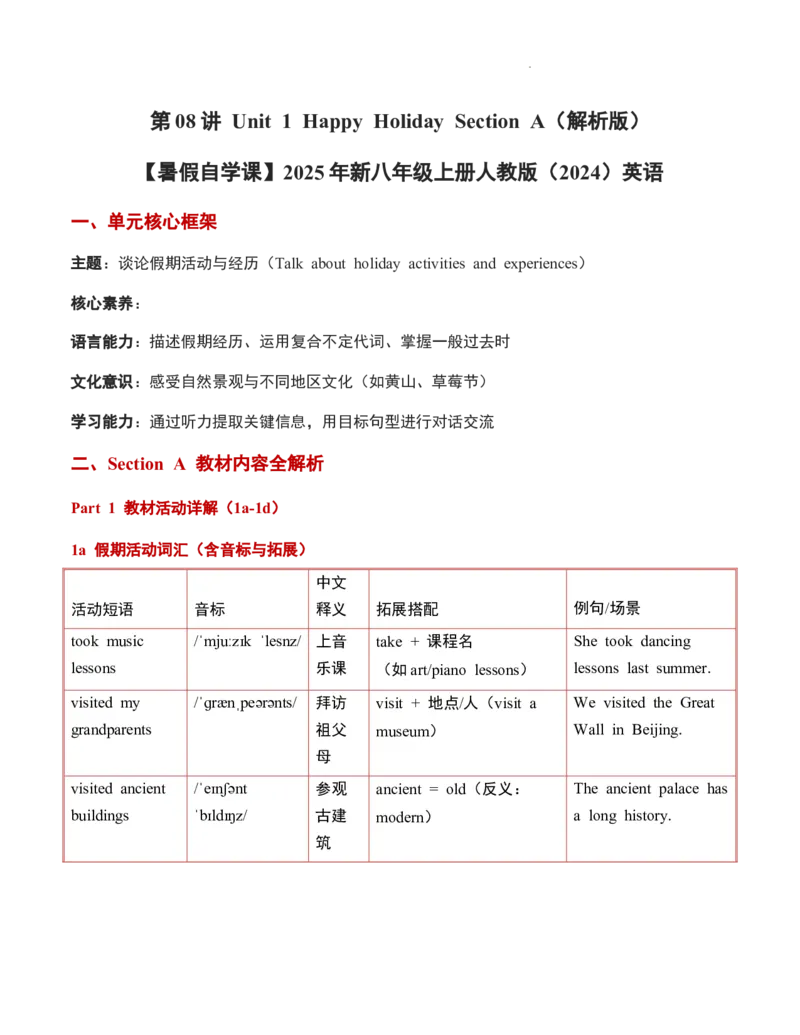
1a 假期活动词汇(含音标与拓展)
中文
活动短语 音标 释义 拓展搭配 例句/场景
took music /ˈmjuːzɪk ˈlesnz/ 上音 take + 课程名 She took dancing
lessons 乐课 (如art/piano lessons) lessons last summer.
visited my /ˈɡrænˌpeərənts/ 拜访 visit + 地点/人(visit a We visited the Great
grandparents 祖父 museum) Wall in Beijing.
母
visited ancient /ˈeɪnʃənt 参观 ancient = old(反义: The ancient palace has
buildings ˈbɪldɪŋz/ 古建 modern) a long history.
筑
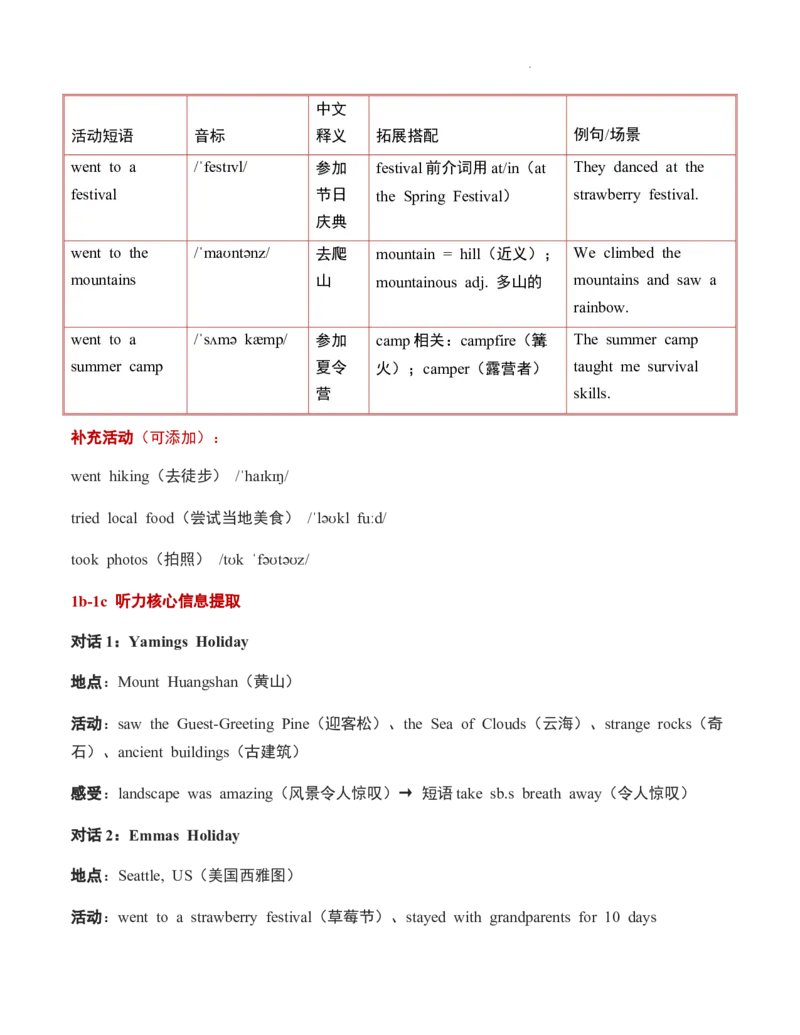
学科网(北京)股份有限公司中文
活动短语 音标 释义 拓展搭配 例句/场景
went to a /ˈfestɪvl/ 参加 festival前介词用at/in(at They danced at the
festival 节日 the Spring Festival) strawberry festival.
庆典
went to the /ˈmaʊntənz/ 去爬 mountain = hill(近义); We climbed the
mountains 山 mountainous adj. 多山的 mountains and saw a
rainbow.
went to a /ˈsʌmə kæmp/ 参加 camp相关:campfire(篝 The summer camp
summer camp 夏令 火);camper(露营者) taught me survival
营 skills.
补充活动(可添加):
went hiking(去徒步) /ˈhaɪkɪŋ/
tried local food(尝试当地美食) /ˈləʊkl fuːd/
took photos(拍照) /tʊk ˈfəʊtəʊz/
1b-1c 听力核心信息提取
对话1:Yamings Holiday
地点:Mount Huangshan(黄山)
活动:saw the Guest-Greeting Pine(迎客松)、the Sea of Clouds(云海)、strange rocks(奇
石)、ancient buildings(古建筑)
感受:landscape was amazing(风景令人惊叹)→ 短语take sb.s breath away(令人惊叹)
对话2:Emmas Holiday
地点:Seattle, US(美国西雅图)
活动:went to a strawberry festival(草莓节)、stayed with grandparents for 10 days
学科网(北京)股份有限公司细节:ate strawberry cookies and chocolates(草莓曲奇和巧克力)
听力技巧:
预读策略:听前圈出1a中的活动词汇,如visited, went to,预判听力中可能出现的动词过去
式。
数字捕捉:注意天数(10 days)、地点(Mount Huangshan首字母大写)等细节。
Part 2 核心单词深度解析
1. ancient /ˈeɪnʃənt/ adj. 古代的;古老的
用法:修饰可数/不可数名词,强调历史悠久
搭配:
in ancient times(在古代)
ancient history(古代历史)
ancient civilization(古代文明)
例句:
The museum has a collection of ancient art works.(博物馆收藏了古代艺术品。)
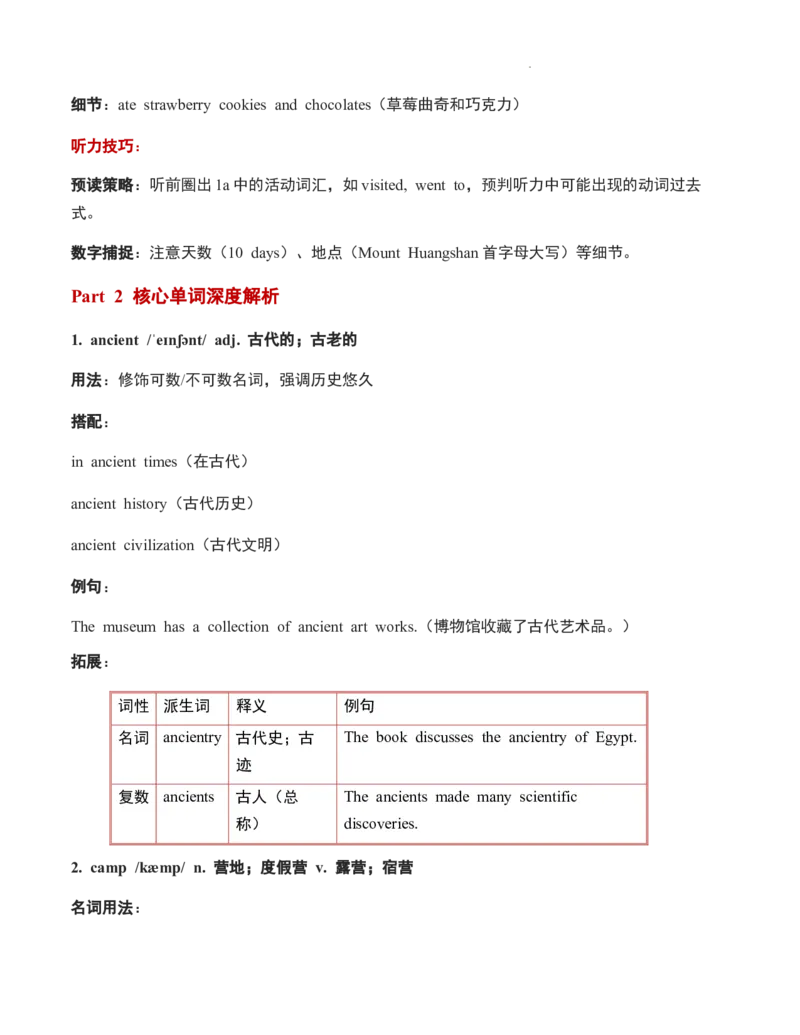
拓展:
词性 派生词 释义 例句
名词 ancientry 古代史;古 The book discusses the ancientry of Egypt.
迹
复数 ancients 古人(总 The ancients made many scientific
称) discoveries.
2. camp /kæmp/ n. 营地;度假营 v. 露营;宿营
名词用法:
学科网(北京)股份有限公司可数名词:summer camp(夏令营)、base camp(大本营)、camp site(露营地)
短语:at the camp(在营地)、make camp(扎营)、go to camp(去营地)
动词用法:
不及物动词:camp in the forest(在森林露营)、camp by the lake(在湖边宿营)
短语:go camping(去露营)、camp out(露宿)、camp up(装腔作势)
例句:
We set up tents at the camp and had a campfire party.(我们在营地搭帐篷,举办了篝火
晚会。)
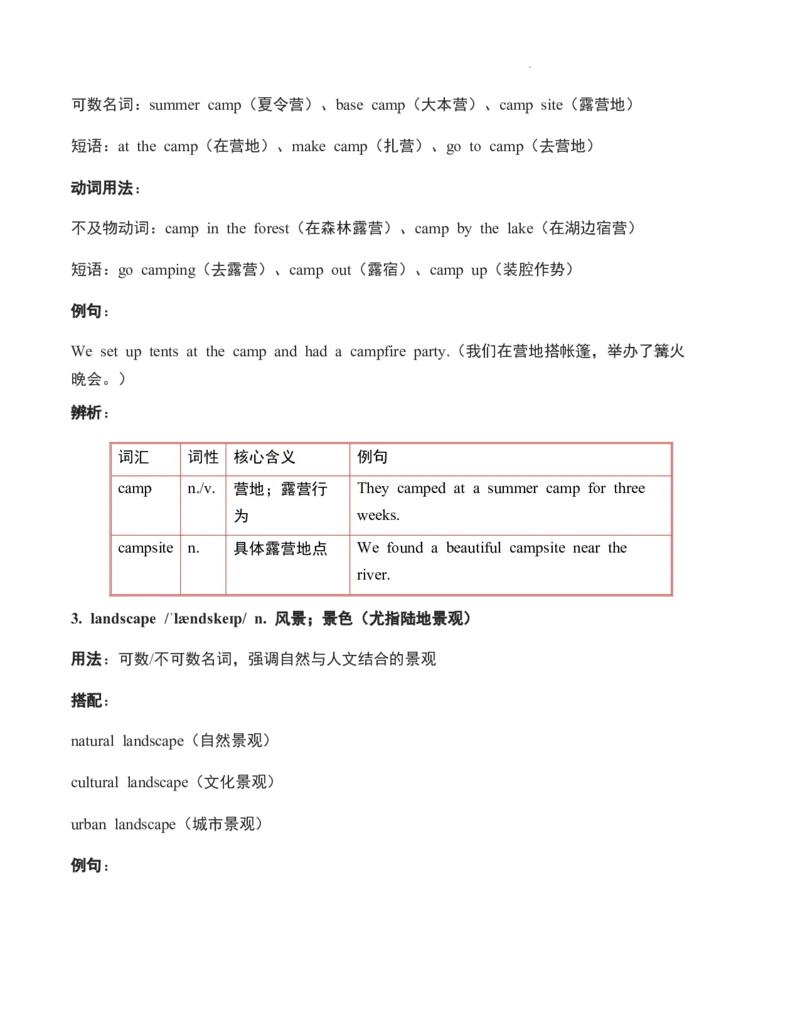
辨析:
词汇 词性 核心含义 例句
camp n./v. 营地;露营行 They camped at a summer camp for three
为 weeks.
campsite n. 具体露营地点 We found a beautiful campsite near the
river.
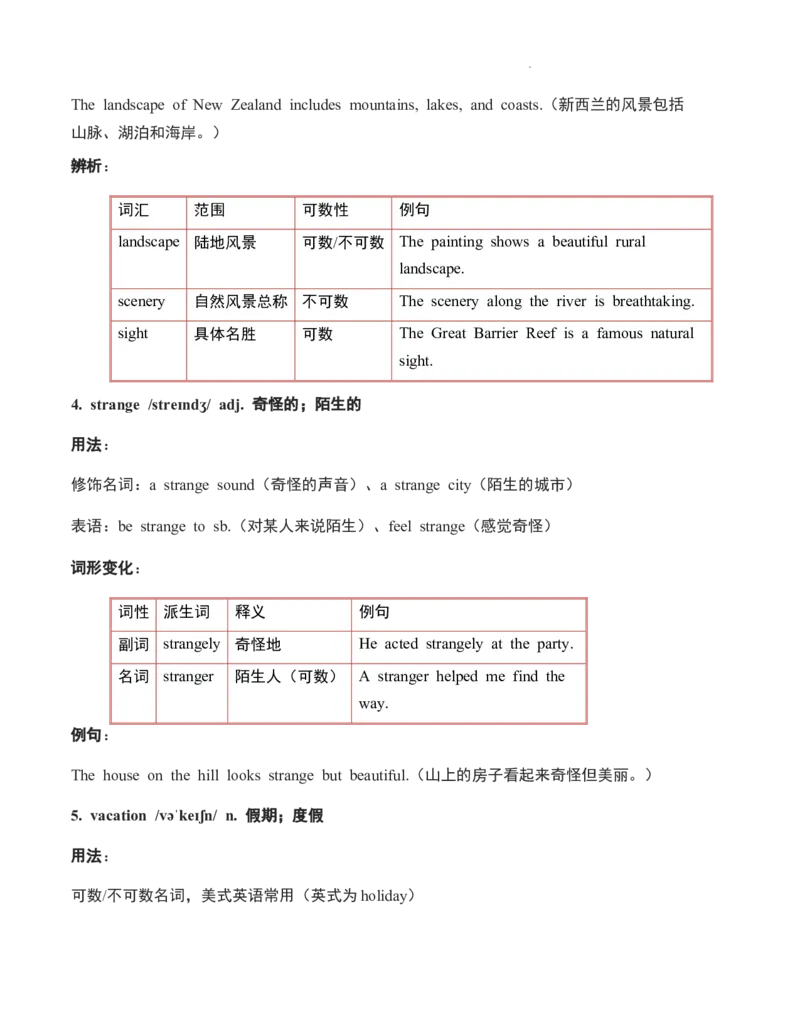
3. landscape /ˈlændskeɪp/ n. 风景;景色(尤指陆地景观)
用法:可数/不可数名词,强调自然与人文结合的景观
搭配:
natural landscape(自然景观)
cultural landscape(文化景观)
urban landscape(城市景观)
例句:
学科网(北京)股份有限公司The landscape of New Zealand includes mountains, lakes, and coasts.(新西兰的风景包括
山脉、湖泊和海岸。)
辨析:
词汇 范围 可数性 例句
landscape 陆地风景 可数/不可数 The painting shows a beautiful rural
landscape.
scenery 自然风景总称 不可数 The scenery along the river is breathtaking.
sight 具体名胜 可数 The Great Barrier Reef is a famous natural
sight.
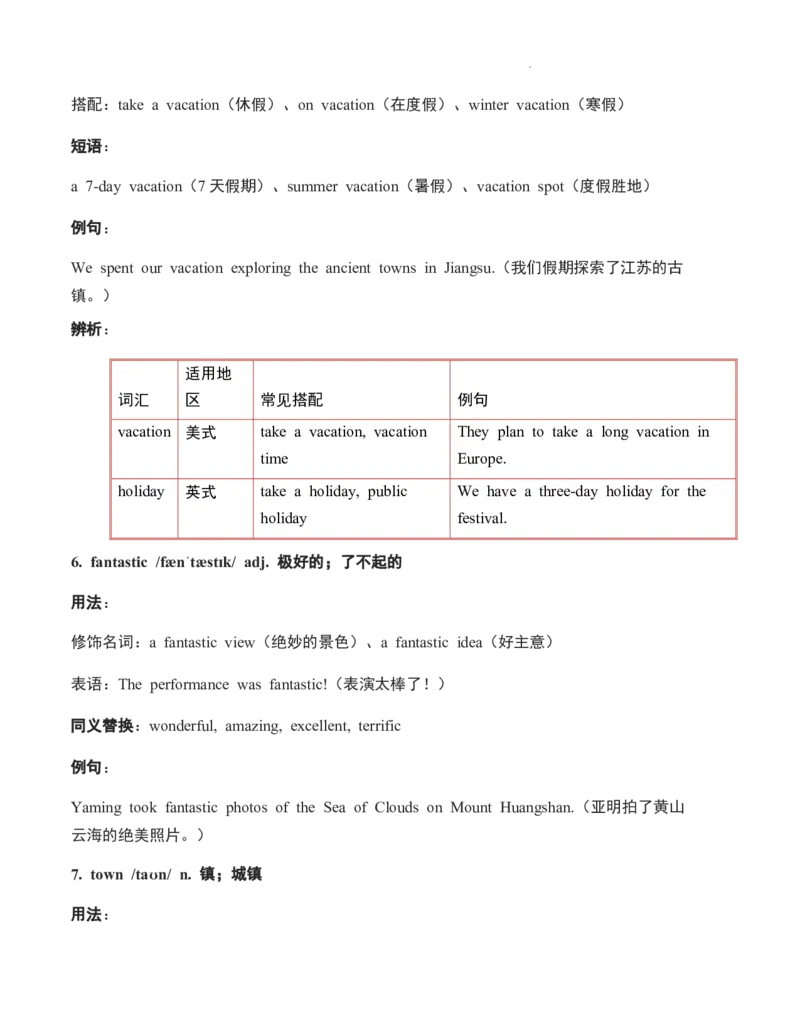
4. strange /streɪndʒ/ adj. 奇怪的;陌生的
用法:
修饰名词:a strange sound(奇怪的声音)、a strange city(陌生的城市)
表语:be strange to sb.(对某人来说陌生)、feel strange(感觉奇怪)
词形变化:
词性 派生词 释义 例句
副词 strangely 奇怪地 He acted strangely at the party.
名词 stranger 陌生人(可数) A stranger helped me find the
way.
例句:
The house on the hill looks strange but beautiful.(山上的房子看起来奇怪但美丽。)
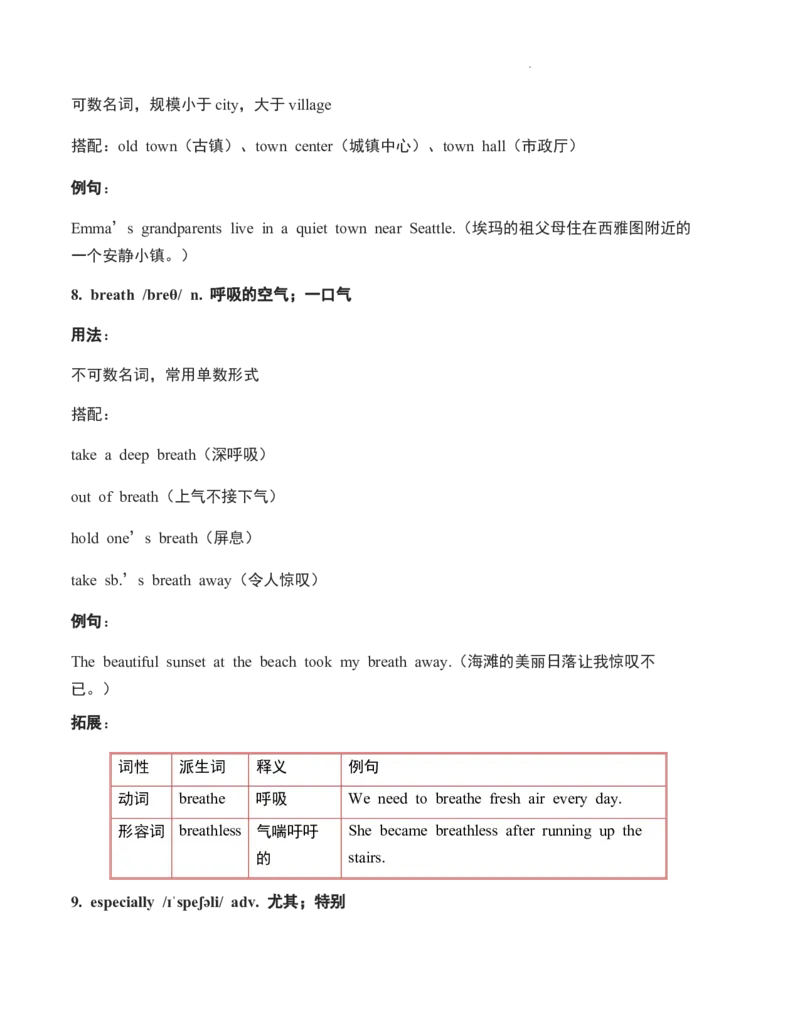
5. vacation /vəˈkeɪʃn/ n. 假期;度假
用法:
可数/不可数名词,美式英语常用(英式为holiday)
学科网(北京)股份有限公司搭配:take a vacation(休假)、on vacation(在度假)、winter vacation(寒假)
短语:
a 7-day vacation(7天假期)、summer vacation(暑假)、vacation spot(度假胜地)
例句:
We spent our vacation exploring the ancient towns in Jiangsu.(我们假期探索了江苏的古
镇。)
辨析:
适用地
词汇 区 常见搭配 例句
vacation 美式 take a vacation, vacation They plan to take a long vacation in
time Europe.
holiday 英式 take a holiday, public We have a three-day holiday for the
holiday festival.
6. fantastic /fænˈtæstɪk/ adj. 极好的;了不起的
用法:
修饰名词:a fantastic view(绝妙的景色)、a fantastic idea(好主意)
表语:The performance was fantastic!(表演太棒了!)
同义替换:wonderful, amazing, excellent, terrific
例句:
Yaming took fantastic photos of the Sea of Clouds on Mount Huangshan.(亚明拍了黄山
云海的绝美照片。)
7. town /taʊn/ n. 镇;城镇
用法:
学科网(北京)股份有限公司可数名词,规模小于city,大于village
搭配:old town(古镇)、town center(城镇中心)、town hall(市政厅)
例句:
Emma’s grandparents live in a quiet town near Seattle.(埃玛的祖父母住在西雅图附近的
一个安静小镇。)
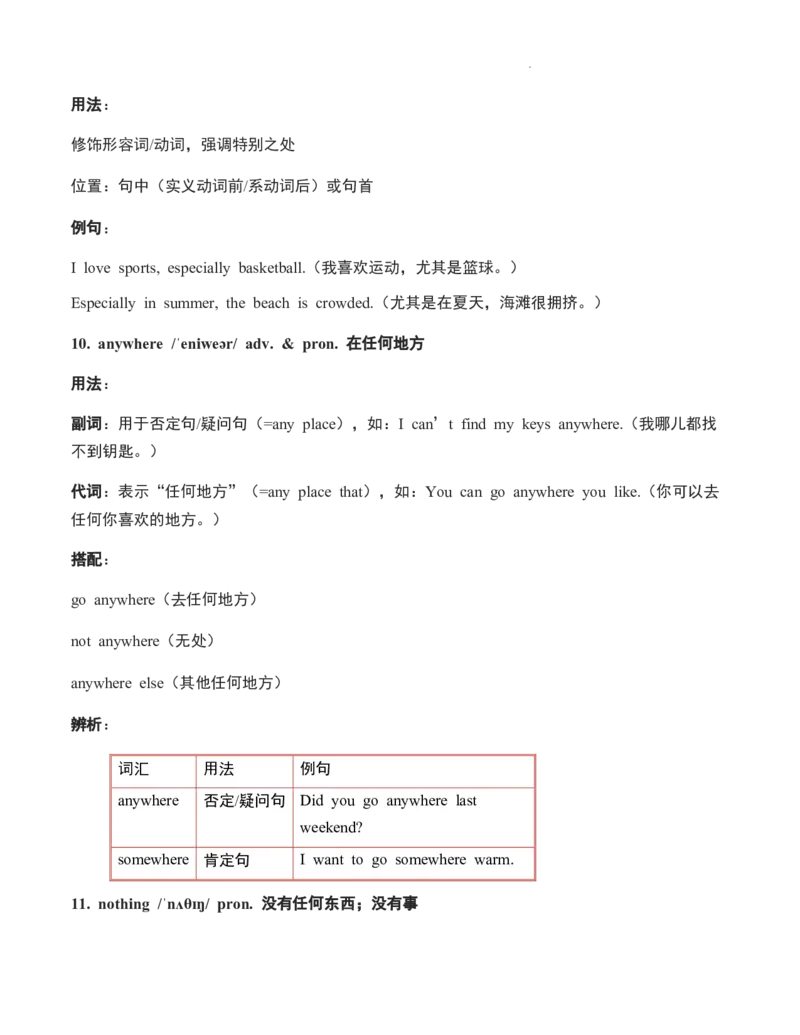
8. breath /breθ/ n. 呼吸的空气;一口气
用法:
不可数名词,常用单数形式
搭配:
take a deep breath(深呼吸)
out of breath(上气不接下气)
hold one’s breath(屏息)
take sb.’s breath away(令人惊叹)
例句:
The beautiful sunset at the beach took my breath away.(海滩的美丽日落让我惊叹不
已。)
拓展:
词性 派生词 释义 例句
动词 breathe 呼吸 We need to breathe fresh air every day.
形容词 breathless 气喘吁吁 She became breathless after running up the
的 stairs.
9. especially /ɪˈspeʃəli/ adv. 尤其;特别
学科网(北京)股份有限公司用法:
修饰形容词/动词,强调特别之处
位置:句中(实义动词前/系动词后)或句首
例句:
I love sports, especially basketball.(我喜欢运动,尤其是篮球。)
Especially in summer, the beach is crowded.(尤其是在夏天,海滩很拥挤。)
10. anywhere /ˈeniweər/ adv. & pron. 在任何地方
用法:
副词:用于否定句/疑问句(=any place),如:I can’t find my keys anywhere.(我哪儿都找
不到钥匙。)
代词:表示“任何地方”(=any place that),如:You can go anywhere you like.(你可以去
任何你喜欢的地方。)
搭配:
go anywhere(去任何地方)
not anywhere(无处)
anywhere else(其他任何地方)
辨析:
词汇 用法 例句
anywhere 否定/疑问句 Did you go anywhere last
weekend?
somewhere 肯定句 I want to go somewhere warm.
11. nothing /ˈnʌθɪŋ/ pron. 没有任何东西;没有事
学科网(北京)股份有限公司用法:
表完全否定,作主语时谓语动词用单数
搭配:nothing but(只有)、nothing special(没什么特别的)
例句:
There was nothing in the box—just an empty bottle.(盒子里什么都没有——只有一个空瓶
子。)
I did nothing today except watch TV.(我今天除了看电视什么都没做。)
12. silk /sɪlk/ n. 丝绸;(蚕)丝
用法:
不可数名词,可作定语
搭配:silk scarf(丝绸围巾)、silk road(丝绸之路)
例句:
She bought a beautiful silk dress in Hangzhou.(她在杭州买了一件漂亮的丝绸连衣裙。)
The Silk Road connected ancient China with the West.(丝绸之路连接古代中国和西方。)
13. scarf /skɑːrf/ n. 围巾;披巾
用法:
可数名词,复数形式:scarfs/scarves
搭配:wear a scarf(戴围巾)、silk scarf(丝绸围巾)
例句:
She wore a red scarf to keep warm in winter.(她冬天戴红围巾保暖。)
I bought two scarves for my mother as a gift.(我给妈妈买了两条围巾作为礼物。)
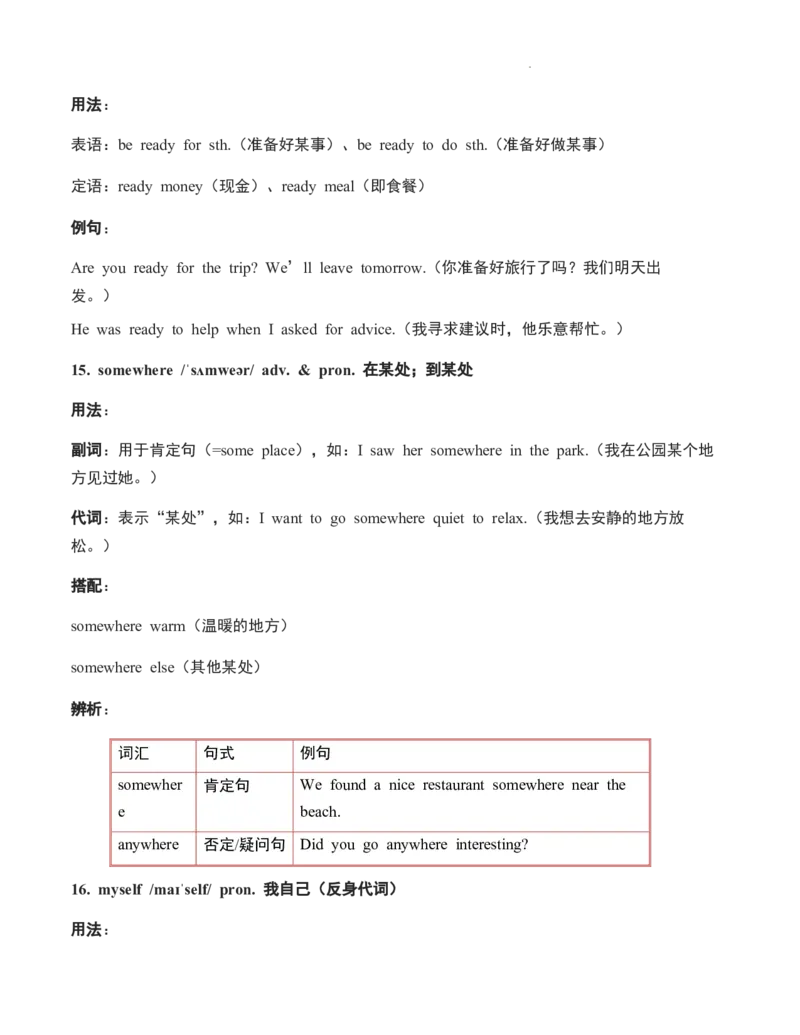
14. ready /ˈredi/ adj. 准备好的;现成的
学科网(北京)股份有限公司用法:
表语:be ready for sth.(准备好某事)、be ready to do sth.(准备好做某事)
定语:ready money(现金)、ready meal(即食餐)
例句:
Are you ready for the trip? We’ll leave tomorrow.(你准备好旅行了吗?我们明天出
发。)
He was ready to help when I asked for advice.(我寻求建议时,他乐意帮忙。)
15. somewhere /ˈsʌmweər/ adv. & pron. 在某处;到某处
用法:
副词:用于肯定句(=some place),如:I saw her somewhere in the park.(我在公园某个地
方见过她。)
代词:表示“某处”,如:I want to go somewhere quiet to relax.(我想去安静的地方放
松。)
搭配:
somewhere warm(温暖的地方)
somewhere else(其他某处)
辨析:
词汇 句式 例句
somewher 肯定句 We found a nice restaurant somewhere near the
e beach.
anywhere 否定/疑问句 Did you go anywhere interesting?
16. myself /maɪˈself/ pron. 我自己(反身代词)
用法:
学科网(北京)股份有限公司作宾语/同位语,表示“自己”
搭配:by myself(独自)、teach myself(自学)
例句:
I can solve the problem by myself.(我可以自己解决这个问题。)
She bought a gift for myself and my sister.(她给我和妹妹买了礼物。)
17. comfortable /ˈkʌmfərtəbl/ adj. 使人舒服的;舒适的
用法:
表语/定语:a comfortable bed(舒适的床)、feel comfortable(感到舒适)
反义词:uncomfortable(不舒服的)
例句:
The hotel room was clean and comfortable.(酒店房间干净又舒适。)
I feel comfortable wearing casual clothes.(我穿休闲装感觉舒适。)
18. bored /bɔːd/ adj. 厌倦的;烦闷的
用法:
表语:be bored with sth.(对某事厌倦)、get bored(变得无聊)
辨析:bored(人感到无聊) vs. boring(事物令人无聊)
例句:
He was bored with the long meeting and fell asleep.(他对冗长的会议感到厌倦,睡着
了。)
The movie was so boring that we left early.(电影太无聊,我们提前离开了。)
学科网(北京)股份有限公司Part 3 核心短语全解析
1. take sb.’s breath away
释义:令人惊叹;使某人屏息(因美丽或惊讶)
用法:
主语通常为物(景色、表演等)
被动结构:be taken away by sth.
例句:
The first sight of the Grand Canyon took my breath away.(第一次见到大峡谷让我惊叹不
已。)
2. nothing but
释义:只有;仅仅(=only,后接名词、代词或动词原形)
用法:
后接动词原形时,若前有do的某种形式,省略to(即“前有do,后省to”)
例句:
I had nothing but a sandwich for lunch.(我午餐只吃了一个三明治。)
3. ready to do sth.
释义:准备好做某事;愿意做某事(强调状态或意愿)
用法:
be ready to do sth.(处于准备好的状态)
例句:
They are ready to explore the ancient ruins.(他们准备好探索古代遗迹了。)
学科网(北京)股份有限公司4. fight against sb./sth.
释义:与……作战;与……斗争(如敌人、疾病、困难)
用法:
及物动词短语,后接斗争对象
例句:
Doctors are fighting against the disease to save lives.(医生们为拯救生命与疾病作斗
争。)
5. thousands of
释义:数以千计的;成千上万的(表示不确定的大数)
用法:
修饰可数名词复数,前不能加具体数字
例句:
Thousands of birds migrate here every winter.(每年冬天成千上万的鸟迁徙到这里。)
6. get together
释义:聚会;相聚(尤指亲友聚集)
用法:
不及物短语,后接with sb.或for sth.
例句:
Our family gets together for dinner every weekend.(我们家每周周末聚餐。)
7. turn around
释义:转身;翻转(身体或物体)
用法:
学科网(北京)股份有限公司及物/不及物:turn around sb./sth.或turn around
例句:
She turned around and smiled at me.(她转身对我微笑。)
8. look for
释义:寻找(强调动作过程)
用法:
及物短语,后接寻找的对象
例句:
I’m looking for my lost watch everywhere.(我到处找丢失的手表。)
Part 4 核心句式全解析
1. Did you do anything interesting on your holiday?
句式结构:
一般疑问句:Did + 主语 + do + 复合不定代词 + 形容词(后置)?
语法考点:复合不定代词(anything用于疑问句/否定句,形容词后置)
例句:
Did you meet anyone famous during the festival?(你在节日上遇到名人了吗?)
2. No, nothing special. But I met someone interesting.
句式结构:
否定回答 + 转折句,使用复合不定代词(nothing/someone)+ 形容词后置
例句:
—Did you buy anything expensive?(你买贵的东西了吗?)
学科网(北京)股份有限公司—No, nothing expensive. But I bought something meaningful.(没有,没买贵的。但买了有
意义的东西。)
3. Everything tasted good, especially the steamed chicken soup.
句式结构:
主系表结构:Everything(主语) + tasted(感官系动词) + good(表语)
强调部分:especially引导的状语(可前置或句中)
例句:
All the dishes smelled delicious, especially the fish.(所有菜都很香,尤其是鱼。)
4. It reminds us that war is terrible and peace does not come easily.
句式结构:
It(形式主语) + remind(谓语) + us(宾语) + that引导的宾语从句
例句:
The history museum reminds us that we should cherish peace.(历史博物馆提醒我们应珍
惜和平。)
三、核心语法:一般过去时 & 复合不定代词
1、一般过去时(重点规则+不规则动词表)
用法 结构 时间状语 例句
过去发生的动 肯定句:主语+动词过 yesterday, last week, She visited the museum
作/状态 去式 in 2023 yesterday.
过去习惯性动作 主语+used to do sth. often, always(过去时 He used to go camping
间) every summer.
否定句 主语+didn’t+动词原 They didn’t see anything
形 strange.
学科网(北京)股份有限公司用法 结构 时间状语 例句
一般疑问句 Did+主语+动词原形? Did you meet anyone
interesting?
不规则动词表(Section A高频词)
原形 过去式 例句
go went We went to the
mountains.
see saw I saw a rainbow in the
sky.
take took She took many photos.
meet met I met a famous singer.
2、复合不定代词(全分类+用法对比)
分类 指人代词 指物代词 用法说明 例句 注意事项
肯定 someone/somebody something 用于肯定句 I met someone some-类可用于希望
句 或请求 interesting. 肯定回答的疑问句
疑 anyone/anybody anything 用于否定句 Did you see any-类在肯定句中
问/否 或疑问句 anything? 表“任何”
定句
完全 no one/nobody nothing 表示“没有 Nothing no one不与of连
否定 任何人/物” happened. 用,nobody可互换
全体 everyone/everybody everythin 表示“所有 Everyone likes 谓语动词用单数
g 人/物” the idea.
四、发音与语音知识
元音音标对比表(Section A重点)
学科网(北京)股份有限公司音 补充单
标 口型/舌位 例词(教材) 词 发音错误提醒
/i:/ 嘴角拉平,舌前部高抬(长 he, she, see, tree, 不要发成汉语“一”,需拉
音) beach meet 长音
/ɪ/ 嘴唇放松,舌前部微抬(短 trip, swim, city, sit, miss 不要与/i:/混淆,发音更短促
音) busy
/e/ 嘴微张,舌尖抵下齿 fresh, forget, bed let, pen 比/æ/张口小,音更轻
/æ/ 嘴张大,舌尖抵下齿(发音 camp, relax, bad cat, hat 舌尖必须抵下齿,发音饱满
饱满)
Unit 1 Happy Holiday Section A 过关检测
I.词汇填空(根据首字母提示写单词,每空1分,共10分)
1.We visited an a______ temple in Xi’an, which has a history of over 1,000 years.
2.Let’s go c______ in the forest this weekend. I’ll bring the tent and sleeping bags.
3.The l______ of Guilin is famous for its karst mountains and clear rivers.
4.Did you meet a______ interesting at the summer camp? I heard there were many foreigners.
5.I’m going to take a v______ to Sanya with my family during the winter break.
学科网(北京)股份有限公司6.The s______ scarf my mother bought in Suzhou is very soft and beautiful.
7.I felt c______ in the new hotel room, so I slept well every night.
8.Don’t forget to bring your p______ when you go abroad. It’s necessary for international
travel.
9.The v______ of the Eiffel Tower was amazing from the top of the hill.
10.She looked s______ because she saw a snake in the grass.
II.语法选择(每题1分,共10分)
1.—Did you do ______ special during the holiday?
—Yes,I visited a village and learned to make traditional cookies.
A.something B.anything C.nothing D.everything
2.Yaming ______ to Mount Huangshan with his family last summer. They had a great time.
A.go B.goes C.went D.will go
3.The landscape in the park was so beautiful that it ______ my breath away.
A.take B.takes C.took D.taking
4.I didn’t go ______ interesting last weekend. I just stayed at home and read books.
A.somewhere B.anywhere C.nowhere D.everywhere
5.Emma ______ strawberry cookies at the festival and thought they were delicious.
A.eat B.eats C.ate D.eating
6.—Is there ______ in the box?
—No,it’s empty.
A.something B.anything C.nothing D.everything
7.They ______ thousands of photos during their trip to Beijing.
学科网(北京)股份有限公司A.take B.took C.takes D.taking
8.I met ______ interesting at the party—a famous writer from England.
A.someone B.anyone C.no one D.everyone
9.The museum ______ us that war is terrible and peace is precious.
A.remind B.reminds C.reminded D.reminding
10.She was ______ tired that she fell asleep on the bus.
A.so B.such C.very D.too
III.完形填空(每空1分,共10分)
阅读下面短文,根据语境、音标或首字母提示填空,使短文通顺。
Yaming’s summer vacation was 1.f______. He went to Mount Huangshan with his family.
The 2.l______ there was amazing—green mountains, white clouds, and 3.s______ rocks that
looked like animals. They stayed in a small 4.t______ near the mountain. The hotel was
5.c______, and the food was delicious, 6.e______ the local noodles.
Emma had a different vacation. She went back to the US and joined a 7.s______ festival in
Seattle. She ate lots of strawberry 8.c______ and danced with her grandparents. The best part
was staying with family—they 9.g______ together every day and told stories.
Both Yaming and Emma learned that holidays are not just about places, but also the
10.j______ of sharing experiences.
IV.阅读理解(每题2分,共10分)
阅读Yaming的假期日记,回答问题。
July 15th
Today was the first day of my summer vacation. I went to Mount Huangshan with my
parents. The weather was sunny and warm. We took a bus to the mountain and saw the
famous Guest-Greeting Pine. The Sea of Clouds was amazing—it looked like a white ocean!
学科网(北京)股份有限公司We also visited some ancient buildings on the mountain. Dad took many photos, and Mom told
me stories about the history of the area. I felt tired but excited at night.
July 16th
We woke up early and watched the sunrise. The sky turned red and orange, and the
mountains looked like they were on fire. After breakfast, we hiked to a village near the
mountain. The villagers were friendly and taught us to make traditional tea. I bought a silk
scarf as a souvenir. In the afternoon, we took the train back home. What a wonderful vacation!
1.Where did Yaming go on vacation?
______________________________________
2.What did Yaming see on the first day?
______________________________________
amazing”。
3.How did Yaming feel on the first night?
______________________________________
4.What did the villagers teach Yaming?
______________________________________
5.What souvenir did Yaming buy?
______________________________________
V.句型转换(每空1分,共10分)
1.He visited his grandparents last week.(改为一般疑问句)
______he______his grandparents last week?
2.She did nothing special at the party.(改为同义句)
She______do______special at the party.
学科网(北京)股份有限公司3.The landscape took my breath away.(改为同义句)
The landscape was______amazing______it made me feel surprised.
4.I met someone interesting at the camp.(对划线部分提问)
____________you meet at the camp?
5.They went to the mountains by bus .(对划线部分提问)
____________they go to the mountains?
VI.写作(15分)
根据提示,写一篇80词左右的短文,描述你去年暑假的一次经历,使用至少3个核心短语(如
take sb.’s breath away, get together, look for)和2个复合不定代词(如something,
anyone)。
提示:
地点:乡下奶奶家
活动:爬山、摘水果、和表弟表妹相聚
感受:自然美丽,体验新鲜
学科网(北京)股份有限公司