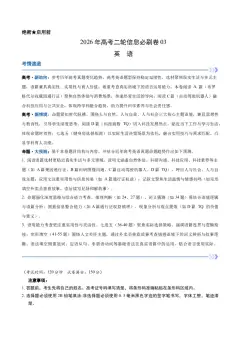
专题 03 国家安全
主|题|简|介
2025年高中英语课程标准新增“国家安全”主题,是立足时代发展、深化课程育人功能的关键举措。
这一主题的引入,远超传统军事与领土安全的范畴,而是拓展至网络、生态、科技、文化、公共卫生等
非传统安全领域,体现了对国家总体安全观的全面贯彻。在英语学科中融入该主题,要求学生不仅掌握
相关词汇与表达,更要具备全球视野,能够运用英语批判性地解读国际信息,辨识潜在风险,并在跨文
化交流中清晰、理性地阐述中国立场,讲好中国故事。这不仅是知识层面的拓展,更是价值观的引领,
旨在将语言学习与国家意识、社会责任感的培养深度融合,践行“立德树人”的根本任务。因此,这一
调整使英语学科超越了单纯的语言工具属性,成为培养具备家国情怀、国际视野和未来胜任力的新时代
公民的重要载体,极具前瞻性与现实意义。
原|创|专|练
Passage 1
China's security authorities have issued a warning to the public about the hidden dangers found in some
overseas-produced online games. These popular forms of entertainment, while seemingly harmless, can
sometimes contain negative content that poses risks to both social values and national security. The authorities are
calling on citizens, especially the youth, to strengthen their awareness and remain alert when engaging with such
digital platforms.
One major concern is the presence of unfair and harmful stereotypes. Some games deliberately design
characters with Chinese cultural elements to appear evil and dishonest, portraying them as violent lawbreakers.
This misrepresentation not only hurts the feelings of the Chinese people but also spreads prejudice. Furthermore, a
more serious issue is the deliberate distortion of China's territory in certain games. For example, some games
incorrectly show border regions and even depict Taiwan as a separate country from the Chinese mainland. Such
acts are described as crossing a serious boundary, as they challenge the country's core interests and territorial
integrity, which must be protected at all costs.Beyond cultural misrepresentation, a more direct threat to national security has been uncovered. Foreign
intelligence agencies are reportedly using games as a new tool for their activities. They employ clever tactics to
bypass official checks and reach potential targets. In one case, a game offered players in-game items as a reward
for watching advertisements. However, these ads were actually disguised messages aimed at recruiting spies.
These "job opportunities" or "collaboration offers" tempted players with high pay, promising them a chance to
make money from their knowledge, which is a classic method of targeted hunting.
To protect themselves and the nation, players are advised to take specific precautions. It is crucial to
download games only from official app stores or other legitimate sources to avoid unsafe software. More
importantly, everyone must learn to identify these hidden traps. When encountering suspicious offers that seem
too good to be true, one should recognize their true intent. The public is urged to stay vigilant online and report
any potential threats to national security through official channels like the 12339 hotline or the official reporting
website, thereby contributing to the safety of all.
1. What is the main purpose of the article?
A. To introduce new popular overseas games.
B. To warn about hidden dangers in some games.
C. To teach players how to win in games.
D. To compare Chinese and foreign games.
2. What can be inferred about the games mentioned?
A. They are designed to be unattractive.
B. They may threaten national security.
C. They are all produced by the same company.
D. Their main purpose is to educate players.
3. How do spy agencies contact players according to the text?
A. By sending direct emails to them.
B. Through in-game messages about jobs.
C. By creating fake social media accounts.
D. During official game reviews.
4. What does the author advise players to do?
A. Stop playing all overseas games.
B. Download games from any website.
C. Be careful and report suspicious activities.D. Focus only on winning the game.
Passage 2
Facing continuous restrictions from the United States, which aims to limit its progress in technology, China is
shaping a new path for its development. These actions, seen as part of a broader strategy to curb China's rise,
include blocking access to essential technologies and global markets. In response, China understands that it must
rely on its own efforts for technological advancement. However, this development must be built on a solid
foundation of security, leading to a strategy that balances growth with risk prevention.
This approach is deeply rooted in China's historical experiences. After suffering greatly from foreign
invasions in its modern history, the country learned that without national sovereignty, there could be no
development or security for its people. Therefore, security is not an end in itself but a means to ensure the safety
and well-being of the population. For instance, protecting farmland is about guaranteeing food security, and
strengthening energy and data security is about maintaining basic living standards and safeguarding critical
infrastructure.
China’s philosophy is not one of zero-sum competition. Guided by cultural values of "win-win cooperation"
and "harmony," China advocates for a community with a shared future for humanity. In a world facing rising
geopolitical risks and protectionism, this vision offers an alternative to conflict. China’s new security framework
is thus a timely response to the global need for steady development, aiming to create a more peaceful and stable
international environment where all nations can prosper.
As a major contributor to economic globalization, China has consistently been a key engine of global growth,
contributing about 30 percent for years. It played a crucial role in stabilizing the world economy during past
financial crises. Now, through its new opening-up strategy, China is actively working to break down the barriers
of anti-globalization. By advancing free trade agreements and making cross-border capital flows more orderly, it
provides a sound framework for global economic cooperation.
In conclusion, by balancing development with security, China offers both inspiration and practical pathways
for addressing current global challenges. Its commitment to peaceful growth and mutual benefit represents a
stabilizing force in an uncertain world, promising a more shared and prosperous future for all.
1. What is the main purpose of the passage?
A. To criticize US trade policies on China.
B. To detail China's painful modern history.C. To explain China's role in global stability.
D. To introduce China's advanced technology.
2. What can be inferred from China's focus on security?
A. It values security more than economic growth.
B. It is a new concept in Chinese foreign policy.
C. It is shaped by lessons from its past hardships.
D. It aims to build a "digital iron curtain" itself.
3. How does China balance development with security according to the passage?
A. By relying solely on its domestic market.
B. By slowing down its economic growth rate.
C. By competing fiercely with other nations.
D. By protecting basic needs and key areas.
4. Why does the author mention China's contribution during past financial crises?
A. To compare different types of economic crises.
B. To show China's role as a global stabilizer.
C. To argue that globalization is fundamentally risky.
D. To highlight the importance of the US economy.
Passage 3
Major American industry groups are urging the government to avoid new trade limits on medical products. A
recent national security review of imports, which includes personal protective equipment (PPE), medical supplies,
and devices, has caused these concerns. It is feared that new tariffs or limits, which could come as early as 2026,
would raise costs and disrupt the supply of essential goods.
Organizations from hospitals and manufacturers warn that these measures could have severe results. They
argue that higher costs would harm a healthcare system that is already under pressure. They are also worried that
supply chain problems would threaten patient safety, as hospitals might be unable to perform life-saving
operations or protect people from the spread of diseases. Furthermore, increased costs could reduce the money
available for developing new medical technologies.
The U.S. healthcare system relies heavily on international suppliers. A large portion of medical supplies is
bought from other countries, with many coming from China. For instance, China is the main source for most of
the protective masks and gloves used in American hospitals. These specific products have low profits, whichmakes them difficult to produce in a sustainable way within the United States.
Facing these challenges, some groups are proposing solutions. The American Hospital Association suggests a
"balanced approach." This plan includes creating a tariff-exemption process for critical products that might be in
short supply. This recognizes that medical equipment is vital for protecting public health and ensuring hospitals
can continue to operate without major interruptions.
This investigation is part of a broader effort by the government to strengthen critical supply chains. Trade
investigations, traditionally used for industries like steel and cars, are now being applied to areas seen as essential
to national economic security, such as medical supplies and computer chips. This shift reflects a more aggressive
government approach to ensuring a stable supply of key goods.
1. What is the main purpose of the passage?
A. To criticize China's dominance in the medical trade.
B. To explain the opposition to proposed medical tariffs and the reasons behind it.
C. To announce a new trade policy for the American medical industry.
D. To compare different types of medical products in the United States.
2. What does the passage imply about producing medical supplies like masks domestically in the U.S.?
A. American companies lack the technology to produce these products.
B. It is not economically attractive for companies to do so.
C. The U.S. government has banned the domestic production of these items.
D. American consumers prefer imported medical supplies.
3. What solution does the American Hospital Association suggest to deal with the potential harm of tariffs?
A. To stop all trade in medical products completely.
B. To increase domestic production to replace imports.
C. To set up a system for waiving tariffs on essential items.
D. To place higher taxes on foreign suppliers.
4. What is the author's likely attitude toward the proposed tariffs on medical products?
A. Strongly supportive.
B. Neutral and objective.
C. Worried and critical.
D. Dismissive and uninterested.
Passage 4
Hong Kong is advancing an ambitious plan to develop its Northern Metropolis into a world-class data hub,aiming to create a "one-stop" center for global information. A recent success story involved a Hong Kong
entrepreneur who easily secured a loan from a mainland bank. This was made possible through a new cross-
boundary data system, marking a significant step in digital integration with the Greater Bay Area. The project
symbolizes a new era of cooperation, focusing on the seamless flow of data to drive future growth.
To realize this vision, the government is introducing special legislation. These new laws are designed to
manage and facilitate the safe movement of data and capital across the border. The plan allows data to flow freely
within designated innovation parks, but with strict measures to protect sensitive information and ensure national
security. The goal is to build a management system that not only guarantees safe data transfers but also encourages
an open data market, combining information from both mainland China and overseas. This positions Hong Kong
as a key international data player.
Progress is already visible. The Shenzhen Data Exchange Centre, which began operations in 2022, has
handled billions of yuan in transactions, showing the huge potential for data trade. However, Hong Kong's leaders
acknowledge there is still work to do to catch up with Shenzhen's rapid development. The Legislative Council is
actively considering new policies to support this forward-looking initiative, always with a focus on maintaining
security.
Despite the government's proactive approach, the project faces hurdles, particularly from the private sector.
Some private developers are hesitant to join, worried about market risks. They point to the current oversupply of
housing in the area, making the prospect of developing thousands of new homes seem more like a financial
burden than an opportunity. This reluctance highlights a gap between the government's grand plan and the
practical concerns of businesses.
To overcome these challenges, experts and lawmakers are calling for closer cooperation between the
government and private companies. They emphasize that building infrastructure alone is not enough. Ultimately,
the success of the Northern Metropolis will depend on attracting competitive and innovative enterprises to
establish themselves there. It is the companies and their activities, not just the buildings, that will bring the project
to life and ensure its long-term success.
1. What does the passage mainly want to convey?
A. To praise a successful Hong Kong entrepreneur.
B. To introduce a new data system in Shenzhen.
C. To discuss the goals and challenges of a major project.
D. To compare the development policies of Hong Kong and Shenzhen.2. What is the primary aim of the government's new data system?
A. To remove all restrictions on data usage.
B. To ensure data moves safely and efficiently.
C. To help individuals get loans more quickly.
D. To attract foreign companies to build houses.
3. The private developers' hesitation suggests what about the project?
A. It lacks sufficient financial support from the government.
B. It is facing practical difficulties in the market.
C. It has failed to consider national security issues.
D. It is not supported by new legislation.
4. What does the last paragraph imply is crucial for the project's success?
A. The speed of constructing new buildings.
B. The involvement of major enterprises.
C. The amount of public investment.
D. The passing of more new laws.
Passage 5
Five years ago, few could imagine farmers showing their farming online, doctors performing difficult
operations far away, or tourists visiting distant places through special glasses. Yet, these are now part of daily life
in China, thanks to its rapid progress in digital technology.
During the last five years, China's communications industry has made a great leap, moving from "catching
up" to "leading" the world. It has built the world's largest and most advanced digital systems, combining digital
technology with the real economy. The country now leads in both networks and computing power. By 2025, it had
built millions of 5G base stations, providing 5G to over a billion people. This digital "super factory" supports
everything from smooth video streaming to self-driving cars.
This technology is changing industries. In manufacturing, thousands of "5G + industrial internet" projects are
improving efficiency and safety. In healthcare, 5G enables doctors to perform operations on patients in faraway
cities, bringing high-quality medical care to more people. A similar change happened in education. With 5G and
virtual reality classrooms, students in remote areas can attend live lessons from top teachers in big cities. These
examples show that technology truly reshapes daily life, making it better and fairer.
China is also working hard to bring digital services to every corner. Over the past five years, more than130,000 villages have been connected to fiber networks. The prices for internet service have dropped greatly. New
services, like AI-powered anti-fraud call alerts, are making daily life safer. The rise of the "low-altitude economy"
is another example. In some cities, 5G-enabled drones transport medical samples daily, while in others, they patrol
forests to prevent fires. These technologies are now part of the country's basic systems.
Looking ahead, China aims to build a universal intelligent network connecting everything. The next phase
will integrate communications networks from the ground to the sky. 6G is expected to be in use by 2030, enabling
new experiences like immersive education. AI will be deeply embedded in devices, making them smarter and able
to anticipate users' needs. This future is not a distant dream but a reality China is actively building, where
technology serves to improve people's lives and bridge divides.
1. What is the main topic of the passage?
A. The history of China's economic development.
B. The challenges of building 6G networks.
C. China's digital progress and its vision for the future.
D. The technical details of 5G technology.
2. What can be inferred from the examples in paragraph 3?
A. Technology has made doctors and teachers' jobs easier.
B. Digital technology helps reduce the gap between different regions.
C. People in cities no longer need local hospitals or schools.
D. Online services are more popular than traditional ones.
3. How is 5G technology used in rural areas according to the passage?
A. Mainly for entertainment and farming.
B. For public safety and commercial services.
C. To replace traditional transportation systems.
D. To connect every home to satellite internet.
4. What will be a key feature of future technology as described?
A. It will be too complex for ordinary people to use.
B. It will focus mainly on environmental protection.
C. Daily life will become more convenient and automated.
D. Human workers will be completely replaced by machines.
Passage 6
请阅读下面短文,在空白处填入1个适当的单词或使用括号中单词的正确形式。President Xi Jinping has called for greater emphasis on balancing law-based governance with reform,
development and stability, and on protecting social fairness and justice. In a recent instruction, Xi stressed the
importance of the unity between Party leadership, the people running the country, and law-based governance. This
instruction was delivered at a central conference on overall law-based governance held in Beijing, 1.______
marked the fifth anniversary of the introduction of Xi Jinping Thought on the Rule of Law.
Since the Party's 18th National Congress in 2012, China 2.______ (make) remarkable progress in exercising
law-based governance. Xi said that the system of socialist rule of law with Chinese characteristics has been
greatly improved, and the path for it is growing ever broader. The main goal now is 3.______ (improve) this
system further. The president also highlighted the need for across-the-board efforts to ensure good laws, strict law
enforcement, fair justice, and society-wide observance of the law. This will provide legal safeguards 4.______
high-quality development and protect people's rights.
Speaking at the conference, Zhao Leji, chairman of the National People's Congress Standing Committee,
stressed that the Party's leadership must be carried out throughout the entire process of law-based governance.
Law-based governance, he said, helps to strengthen and show China's institutional advantages. It also offers legal
protection 5.______ the country's development and the people's well-being. Furthermore, it promotes fairness and
justice, and safeguards national security and social stability.
China has always valued law-based governance. In 2018, Xi became the first Chinese leader 6.______ (take)
an oath of office, pledging allegiance to the Constitution. A constitutional amendment that year requires all State
employees to do the same. By the end of October last year, China had 310 laws in force, more than 600
administrative regulations, and over 14,000 local regulations, showing the 7.______ (grow) strength of its legal
system.
To help people understand this thought better, the 2025 edition of the study outline on Xi Jinping Thought on
the Rule of Law has been published. The compilation, 8.______ (have) 14 chapters, explains the importance and
core ideas of the thought. It fully reflects its latest developments and is an 9.______ (increase) important guide for
the nation. This work will surely lead to 10.______ (great) progress in building a modern socialist country.