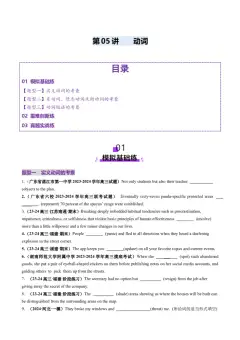
衔接点12
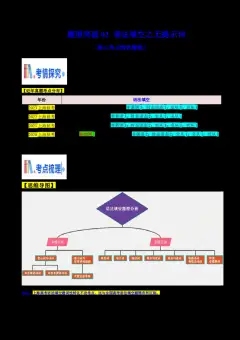
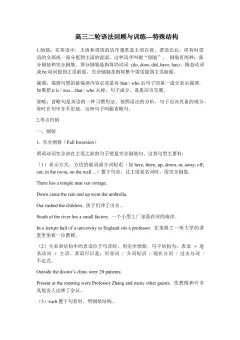
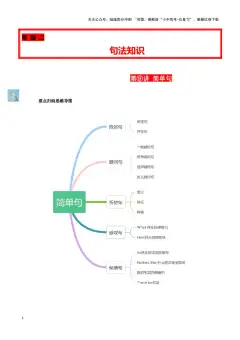
情态动词、系动词、助动词
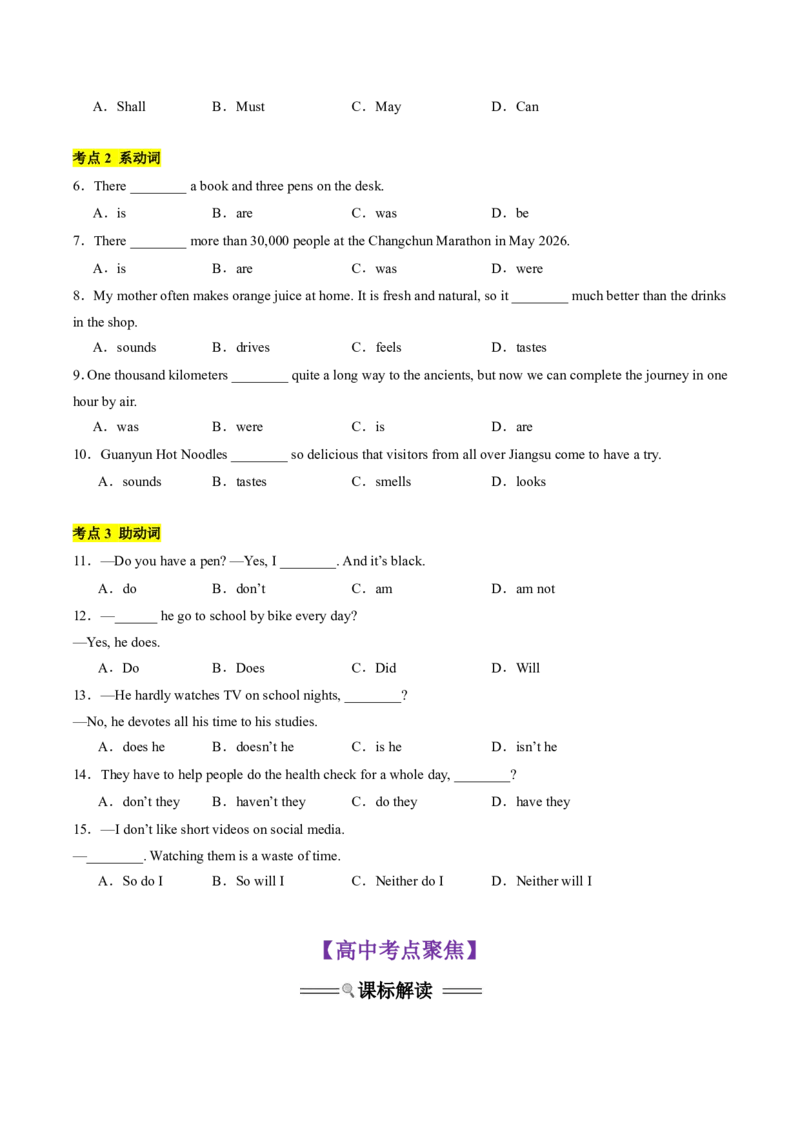
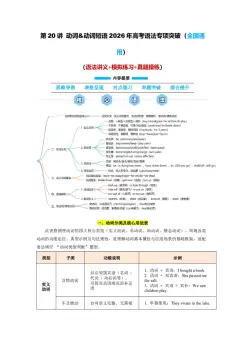
初中视角
高中展望
熟记can/may/must/should/will 等常用词,掌握基本含
义、句式及否定/ 疑问用法,能简单辨析must 与
have to。分清be 动词、感官动词、变化类系动
词,掌握主系表基本句型,熟记常用搭配。掌
握do/does/did/be/have/will 的基础用法,用于构
成时态、语态、疑问和否定句。
拓展could/might/ought to/dare/need 等,重点掌
握推测、虚拟语气、委婉语气,区分情态动词+
have done 结构。辨析易混系动词(如
become/get/turn),掌握系动词无被动、
无进行时的用法,结合语境灵活运用。区
分实义动词与助动词,掌握倒装、强调、
省略句式中助动词的特殊用法。
衔接引导
初中阶段考查形式:侧重语法知识的识记和简单运用,多以单句填空、选择题等基础形式考查语法知识。
高中阶段考查形式:注重语法知识的灵活运用和理解,更多地在语篇语法填空中综合运用语法知识。
【初中考点聚焦】
考点1 情态动词
1.—Mum, could I ride an electric bicycle to school?
—No, you _________. Students under the age of 16 aren’t allowed to ride electric bicycles.
A.couldn’t
B.needn’t
C.mustn’t
D.can’t
2.—Ms. Li, must we finish the science project today?
—No, you ________. Just make sure it’s done before Friday.
A.mustn’t
B.can’t
C.needn’t
D.shouldn’t
3.— These purple clay works look so amazing!
— True. But we ________ touch any of them. They break easily.
A.need not
B.may not
C.mustn’t
D.couldn’t
4.He ________ know the secret. I haven’t told anyone about it.
A.might
B.needn’t
C.can’t
D.mustn’t
5.—________ we clean the classroom together after the afternoon class?
—Good idea! Teamwork can make the work much easier and faster.
A.Shall
B.Must
C.May
D.Can
考点2 系动词
6.There ________ a book and three pens on the desk.
A.is
B.are
C.was
D.be
7.There ________ more than 30,000 people at the Changchun Marathon in May 2026.
A.is
B.are
C.was
D.were
8.My mother often makes orange juice at home. It is fresh and natural, so it ________ much better than the drinks
in the shop.
A.sounds
B.drives
C.feels
D.tastes
9.One thousand kilometers ________ quite a long way to the ancients, but now we can complete the journey in one
hour by air.
A.was
B.were
C.is
D.are
10.Guanyun Hot Noodles ________ so delicious that visitors from all over Jiangsu come to have a try.
A.sounds
B.tastes
C.smells
D.looks
考点3 助动词
11.—Do you have a pen? —Yes, I ________. And it’s black.
A.do
B.don’t
C.am
D.am not
12.—______ he go to school by bike every day?
—Yes, he does.
A.Do
B.Does
C.Did
D.Will
13.—He hardly watches TV on school nights, ________?
—No, he devotes all his time to his studies.
A.does he
B.doesn’t he
C.is he
D.isn’t he
14.They have to help people do the health check for a whole day, ________?
A.don’t they
B.haven’t they
C.do they
D.have they
15.—I don’t like short videos on social media.
—________. Watching them is a waste of time.
A.So do I
B.So will I
C.Neither do I
D.Neither will I
【高中考点聚焦】
课标解读
1. 情态动词:课标要求在语境中掌握can/could、may/might、must/have to、should/ought to、need 等;重
点理解并运用能力、许可、义务、推测四类核心情态意义;熟练掌握情态动词+ have done(对过去推测/
虚拟/ 责备),并能在交际与写作中准确表达语气、态度与情感。
2. 系动词:掌握be、感官系动词(look/sound/feel 等)、变化类(become/get/turn)、持续类(keep/stay);
核心是熟练运用主系表结构,明确系动词无被动、无进行时;能辨析易混系动词,在语境中准确描述主语
身份、性质、状态与变化。
3. 助动词:掌握be、do、have、will/shall 的语法功能,用于构成时态、语态、否定、疑问;区分助动词与
实义动词;掌握其在倒装、强调、省略句式中的用法,能在语篇中识别并运用助动词构建正确句式、理解
长难句。
考点清单
Part one
情态动词
1.情态动词的基本用法
(1)can/could:表示能力、请求、可能性。相关的特殊句型有:can not...too.../enough 再怎么……也不过分;
can’t help but do 不得不做……
The smallest good habits can make a big difference.
最小的好习惯会产生很大的作用。
You can’t be too careful while driving.
你开车时越小心越好。
(2)may/might:表示较小的可能性。相关句型或搭配:may/might as well do 表示“还是……好,最好……”。
If you forgot to turn it off when you went away, you might burn down the house.
当你离开时如果忘记关掉它,你可能把整个房子都烧毁的。
Since it is raining hard, you may as well stay here.
既然雨下得这么大,你倒不如待在这儿。
(3)must 表示非常肯定的推测;表示与说话人意愿相反或不耐烦等感情色彩,意为“偏要,非要……不可”;
表示“必须”。mustn’t 意为“禁止”,表示“不必”应用needn’t。
Men and women must be treated equally in education and employment.
在教育和就业方面,男性和女性必须被平等对待。
He thought that Joe must be dead, but he didn’t want to leave immediately.
他以为乔一定死了,但是他不想立刻就离开。
Must you make so loud noise?
你非得弄出这么大声吗?
(4)shall 的用法:①用于第二、三人称的陈述句中,表命令、警告、许诺或威胁等,语气强于should。②用
于第一、三人称的疑问句中,表示征询意见,肯定回答应用must,否定回答应用needn’t 或don’t have to。
I promised he shall get a present for his birthday.
我许诺给他一件生日礼物。
Shall I tell Brett to come over straight after school tomorrow?
要我告诉布雷特明天放学以后直接过来吗?
(5)should/ought to
①表示责任、义务、劝告、建议等,意为“应该”。
(陕西卷)Why shouldn’t we buy the lady a flower?It will make her feel better.
为什么我们不给那位女士买一朵花呢?这会让她感觉好一些。
②should 表示出乎意料的口气,意为“竟然;居然”。
It is quite surprising that he should speak to you like that.
他竟然那样对你说话,真是令人惊讶。
③should 和ought to 表示推测,指预期的可能性,意为“应该,估计”。
He ought to/should be here on time—he started early enough.
他应该按时到这里了——他很早就出发了。
2.“情态动词+have done”的用法
(1)must have done“一定做过了某事”,表示对过去事情有把握的推测。
(2)could/can have done“本能做某事(而实际上未做)”,can’t/couldn’t have done“(过去)不可能做过某事”。
(3)may/might have done“(过去)有可能做过某事”。
(4)should/ought to have done“本该做某事而没做”。
(5)needn’t have done“本不必做某事(而实际上做了)”。
The boy might have known the truth, but I am not quite sure.
那个男孩(当时)也许知道了真相,但我不是很确定。
George can’t have gone too far.His coffee is still warm.
乔治一定没走远,他的咖啡仍旧热呢。
“情态动词+have+过去分词”结构是难点和重点,记住以下最常考查的结构:
(1)must have done “过去一定做了某事”
(2)can’t/couldn’t have done “过去不可能做了某事”
(3)may/might have done “过去可能做了某事”
(4)needn’t have done “过去本来没有必要做而做了某事”
(5)could have done “过去本来能够做某事而没有做”
(6)should/ought to have done “过去本来应该做某事而没有做”
(7)shouldn’t/oughtn’t to have done “过去本来不应该做某事而做了”
Part two
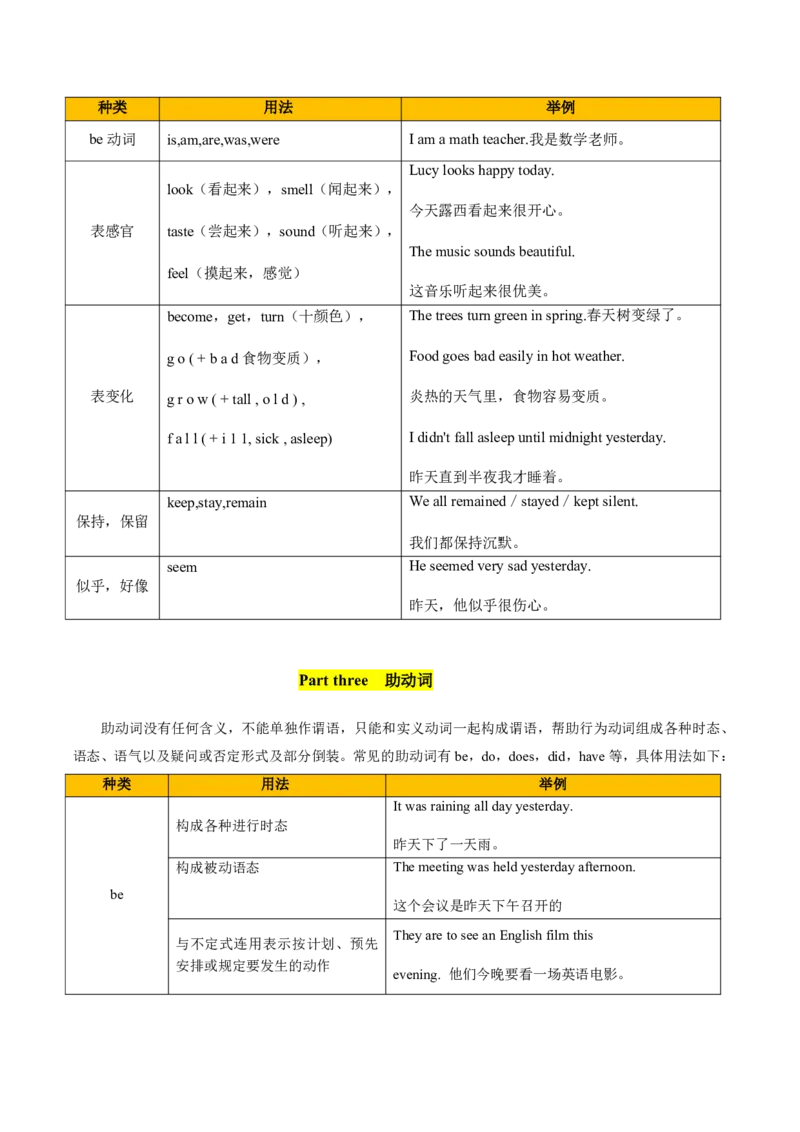
系动词
系动词又称连系动词,其后常接形容词或名词等作表语。
注意:系动词只能有主动语态,不能有被动语态,多数不能用于进行时态。系动词有一定意义,它们要与
其后作表语的形容词、名词或介词(短语)一起构成合成谓语。常见的系动词如下:
种类
用法
举例
be 动词
is,am,are,was,were
I am a math teacher.我是数学老师。
表感官
look(看起来),smell(闻起来),
taste(尝起来),sound(听起来),
feel(摸起来,感觉)
Lucy looks happy today.
今天露西看起来很开心。
The music sounds beautiful.
这音乐听起来很优美。
表变化
become,get,turn(十颜色),
g o ( + b a d 食物变质),
g r o w ( + tall , o l d ) ,
f a l l ( + i 1 1, sick , asleep)
The trees turn green in spring.春天树变绿了。
Food goes bad easily in hot weather.
炎热的天气里,食物容易变质。
I didn't fall asleep until midnight yesterday.
昨天直到半夜我才睡着。
保持,保留
keep,stay,remain
We all remained/stayed/kept silent.
我们都保持沉默。
似乎,好像
seem
He seemed very sad yesterday.
昨天,他似乎很伤心。
Part three
助动词
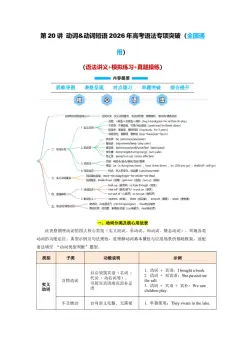
助动词没有任何含义,不能单独作谓语,只能和实义动词一起构成谓语,帮助行为动词组成各种时态、
语态、语气以及疑问或否定形式及部分倒装。常见的助动词有be,do,does,did,have 等,具体用法如下:
种类
用法
举例
be
构成各种进行时态
It was raining all day yesterday.
昨天下了一天雨。
构成被动语态
The meeting was held yesterday afternoon.
这个会议是昨天下午召开的
与不定式连用表示按计划、预先
安排或规定要发生的动作
They are to see an English film this
evening. 他们今晚要看一场英语电影。
do
do 的过去式是did;第三人称单数
是does;do,did,does 用于构成
疑问式或否定式
Does he think so?他这么认为吗?
在动词前加上do,does,did 表示
强调,意为“的确,确实”
They do study hard.他们确实学习努力。
have
have 的过去式是had;第三人称单
数是has;have,has,had 均可与
动词的过去分词一起构成完成时
态
He has lived here for three years.
他已经住在这里三年了。
1.助动词do/does/did 主要帮助构成疑问句、否定句及部分倒装。助动词do/does/did 后只能跟动词原形,助
动词不能用作实义动词。
2.助动词be/being/been 主要帮助构成进行时、完成进行时和各种被动语态。需注意be 虽然没有实际意义,
但却是结构中不可缺少的。
3.助动词have/has/had 主要是帮助构成完成时态和完成进行时态。需注意其构成形式have/has/had done 和
have/has/had been doing。
[助记]
助动词,用法怪;只当佐料不当菜。
句型变换显身手;常与时态谈恋爱。
have 完成be 进行,will 将来三大块。
加上各自过去式,总共构成六时态。
否定疑问靠它们,过去did,do 现在。
一般现在和过去,没有助动也无碍。
第三人单用does,否定疑问照常变。
一、语法填空
1.Why
you always interrupt me when I am doing my homework? (用适当的词填空)
2.The medicine
be on the way to be tested, but I’m not sure. (用适当的词填空)
3.I love the weekend, because I
get up early to go to school. (用适当的词填空)
4.Mr. Smith is on time for everything. How
it be that he was late for the important meeting? (用适当的
词填空)
5.Cars
be parked in front of the entrance to the supermarket. (用适当的词填空)
6.He is a badtempered man, but he
be quite kind and patient sometimes. (用适当的词填空)
7.Look at the dark clouds. It
rain this afternoon. You’d better take an umbrella.(填入恰当的情态动
词).
8.We
have helped him; in that case, he would have been able to finish the work. (选择恰当的情态动
词填空can/should) (所给词的适当形式填空)
9.When you cross the street, you
be careful of the passing cars. (用适当的词填空)
10.Jack set out at seven in the morning; he
be here now. (用适当的词填空)
11.You
have told him the truth; it made him so sad. (用适当的情态动词填空)
12.She
have earned a lot of money, for she bought a second new car yesterday. (用适当的词填空)
13.She didn’t come to school yesterday.
she have been ill? (用适当的词填空)
14.I haven’t seen her for weeks. She
have gone on holiday. (用适当的词填空)
15.The ground is wet. It
have rained last night. (用适当的词填空)
16.The water
(feel) cool when I jumped into the pool for morning exercise. (所给词的适当形式填
空)
17.China’s deadliest earthquake in recent years
(be)a 7.9 magnitude quake in 2008 that killed nearly 90,
000 people in Sichuan. (所给词的适当形式填空)
18.This sort of roast meat is a local super food and it
(taste)delicious. (所给词的适当形式填空)
19.It had whitepainted tunnels and bright red carriages, and
(prove)extremely popular with the public.
(所给词的适当形式填空)
20.This material
(feel)soft and may be used to make underwear. (所给词的适当形式填空)
21.Do I have to take this medicine? It
(taste) so terrible. (所给词的适当形式填空)
22.Neither my parents nor my younger sister
(be) at home today. (所给词的适当形式填空)
23.Not only
he speak correctly, but he also speaks easily. (用适当的词填空)
24.How long
you suppose it is since he arrived and began to work here? (用适当的词填空)
25.Not until then
I realise words could be powerful in positive and negative ways. (用适当的词填空)
26.The number of students of our school
(be) increasing rapidly these years. (所给词的适当形式填空)
27.No sooner
he arrived at the station than his friend left by train.(用适当的词填空)
28.As a result of destroying the forests, a large quantity of desert
(have)covered the land. (所给词
的适当形式填空)
29.You
not have bought the book. I have a copy for you. (用适当的情态动词填空)
30.Using supercomputer, many labs are now conducting experiments that couldn’t
(be) possible in the
past.(所给词的适当形式填空)
二、完成句子
31.Don’t scold him for his mistake again. Anybody ________ (都可能犯错误). (根据汉语提示完成句子)
32.If you ________________ (非要走的话), at least wait until the storm is over. (根据汉语提示完成句子)
33.She ________________ (一定累了) after such a long walk. (根据汉语提示完成句子)
34.你不需要现在完成,你有三天的时间。
You ________________now; you have three days’ time.
35.You________ (不必担心) the car any more, since I just had it repaired. (根据汉语提示完成句子)
36.Helen ________ nervous.
看起来很紧张。
37.除此之外, 一些学生在网上受骗。(“get+过去分词”构成的被动结构)
Besides, some students ________ online.
38.____________________(树上的叶子变绿了)when spring comes, which makes a beautiful scene.
39.I _______ like being laughed at.
我不喜欢被人嘲笑。
40.Tom _______go to school today because he is ill.
汤姆今天没去上学,因为他生病了。
41.昨天Tom 确实按时完成了作业。
Yesterday Tom ________________.
42.If you have any other questions, _______.
如果你还有其他问题,一定要告诉我。
43.When _____________ (do) the bus start?
公共汽车什么时候开?(按时刻表)
44.那么你如何着手完成那项计划呢?
So how do you ________________ accomplishing that plan?
45.谁都没有受伤,我深感欣慰。
I ________________ that nobody was hurt.
三、语篇填空(情态动词、系动词、助动词专练)
(A) Life is full of small challenges, and we ____1____be brave enough to face them. I ____2____
a middle
school student now, and I often wonder what I ____3____ do when I meet difficulties.
My teacher always tells us that we ____4____ never give up easily. When you feel tired, you ____5____ take
a short rest first. It ____6____ normal to feel upset sometimes, but you ____7____ not stay in bad moods for too
long.
____8____ you know how to cheer yourself up? If you have problems, you ____9____ ask your parents or
teachers for help. They ____10____ always ready to listen to you.
(B) Everyone ____1____ different from others. We ____2____ respect everyone around us. You ____3____
not laugh at people who are in trouble.
____4____ your friend have any special hobbies? He ____5____ play the guitar very well, and he ____6____
also good at singing. We ____7____ learn from each other and make progress together.
We ____8____ keep our promises if we make them. It ____9____ not hard to get along well with others. What
____10____ you do to get on with your classmates?
一、语法填空
阅读下面材料,在空白处填入适当的内容(1 个单词)或括号内单词的正确形式。
Different countries have wildly different forms of greeting.
In the USA, when you pass by someone you know, a nod is acceptable, and you usually shake hands with
someone you first meet. But in Latin countries, a firm handshake
1
(consider) rude. In my home country,
Mauritius, when people meet, they usually kiss each other
2
the cheeks. This is also common in France,
3
the act is called faire la bise. However, this is not
4
universal rule.
During my first week in the USA, I kissed every single girl I met. My friends had to tell me that that was
inappropriate,
5
(leave) me in great embarrassment. What is common here, however, is for friends
6
(hug) each other – something I was not used to. Hugs always make me
7
(frighten) because I don’t really
like that. This may seem strange since even kissing
8
(stranger) is normal in my country. Now that I think
about it, I hate cheekkissing as well.
Wouldn’t it be
9
(enjoy) to have a greeting code that is
10
(wide) acceptable? I’m not
saying we should start doing that, but we can surely do something to avoid misunderstanding.
二、阅读理解
Four Interesting Festivals in 2026
The following events happening in 2026 will make you want to pack your bags and join the fun.
Holi Festival
Holi turns cities into a sea of rainbow colors. People throw handfuls of colored powder at friends, family,
and total strangers, while music, dancing, and laughter fill the streets. The festival celebrates the arrival of spring
and the success. It happens on March 3, 2026. Wear white clothes if you don’t mind getting dirty, and prepare to be
covered headtotoe in every color imaginable.
Wife-Carrying World Championship
Competitors race through a difficult course while carrying their wife. The course includes water hazards (障
碍), and sand traps that test strength, speed, and teamwork. Winners receive their wife’s weight in beer. It happens
on July 3 and 4, 2026. Despite the traditional name, any couple can compete, and the event attracts teams from
around the world eager to prove their carrying skills and sense of humor.
Monkey Buffet Festival
Tables piled high with fruit, vegetables, and snacks are laid out for Lopburi’s famous monkeys in a yearly
feast that is both generous and makes for great photos. Hundreds of monkeys rush to the spread, creating a wild
feeding competition that delights photographers and tourists. Typically held in late November, the 2026 event
doesn’t have fixed dates yet.
Night of the Radishes (萝卜)
Artists in Oaxaca spend hours carving oversized radishes into welldesigned historical figures, and
imaginary creatures, knowing their creations will dry out within a day. The time pressure makes the festival feel
magical and shortlived, which is a special experience. It happens on December 23, 2026. It’s held yearly on the
same date. Arrive early for the best views, because the detailed carvings are amazing but only last for a short time.
11.Which event requires both physical effort and teamwork?
A.Holi Festival.
B.Night of the Radishes.
C.Monkey Buffet Festival.
D.WifeCarrying World Championship.
12.What can be inferred about the Monkey Buffet Festival?
A.It follows a fixed schedule.
B.Monkeys eat politely together.
C.Its 2026 date remains uncertain.
D.Tourists feed monkeys personally.
13.What makes the Night of the Radishes special?
A.Artists use special tools.
B.The art disappears quickly.
C.It happens before Christmas.
D.Carvings are sold for money.