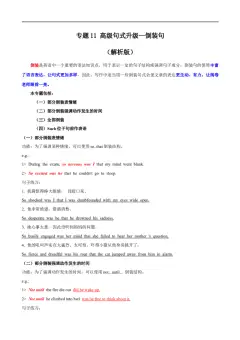
高中英语语法核心知识点详解(讲义)
Part 25 特殊句式篇——倒装
25.1 倒装 Inversion
主语和谓语是句子的核心,有两种语序:一是主语在谓语之前称
为自然语序,也叫正常语序,如陈述句;二是主语在谓语之后,或
使用与正常词序相反的词序,这种语序则称为倒装语序。
使用倒装语序,通常是为了表达的需要或语法结构的需要,有时
也为了强调。
倒装语序中有两种:部分倒装和完全倒装。
1. 部分倒装
部分倒装是指将谓语的一部分如助动词或情态动词放至主语之
前。如果句子的谓语没有助动词或情态动词,则需添加助动词do,
does 或did,并将其置于主语之前。
(1) 句首为否定或半否定的词语,如no, not, never, seldom, little,
hardly, at no time, in no way, not until...等。
Never have I watched such a moving film.
我从未看过如此感人的一部电影。
Hardly had I gone out of the school when I met my father.
我刚走出学校,就遇见了我爸爸。
(2) not until 引出主从复合句,主句倒装,从句不倒装。但是,如
果否定词不在句首,不倒装。
Not until then did he realize the importance of the problem.
直到那时他才意识到这个问题的重要性。
Not until it stopped raining did we set out.
直到雨停,我们才起程。
We didn't set out until it stopped raining.
直到雨停了,我们才出发。
2. 完全倒装
完全倒装又称“全部倒装”,是指将句子中的谓语动词全部置于
主语之前。此结构通常只用于一般现在时和一般过去时。常见的结
构有:
(1) here, there, now, then, thus 等副词置于句首, 谓语动词常用be,
come, go, lie, run 等表示来去或状态的动词。
Then came the bus.
公交车来了。
Here is your pen.
你的笔。
(2) 表示运动方向的副词或地点状语置于句首,谓语是表示运动
的动词。
Out rushed a missile from under the bomber.
轰炸机下面窜出一枚导弹。
Ahead stands a tree.
前面有棵树。
注 上述全部倒装的句型结构的主语必须是名词,如果主语是人
称代词则不能完全倒装。
Here she arrives.
她到了。
3. 倒装句功能
英语句子需要倒装的原因:一是由于语法结构的需要而进行的倒
装,二是由于修辞的需要而进行的倒装。前一种情况,倒装是必须
的,否则就会出现语法错误;后一种情况,倒装是选择性的,倒装
与否只会产生表达效果上的差异。
倒装句的修辞功能主要有以下几种:
(1) 表示强调。
倒装句最突出, 最常见的修辞效果就是强调,其表现形式如下:
1) so/such... that 结构中的so 或such 位于句首可以构成部分倒装
句,表示强调so/such 和that 之间的部分。
So unreasonable was his words that everybody can't understand.
他的话如此荒唐,没人能够理解。
To such depth did he dig the hole that the water was found.
他挖了那么深的一个洞,因此找到了水。
2) not, little, hardly, scarcely, no more, no longer, in no way, never,
seldom, not only, no sooner 等具有否定意义的词或词组位于句首,句
子用部分倒装。
No sooner had she seen him than she smiled.
她一见到他就笑。
Seldom do I have lunch in that restaurant.
我很少在那餐馆里吃饭。
3) only + 状语,或状语从句置于句首,句子用部分倒装。
Only in this way can the experiment succeed.
唯有这样做,实验才能成功。
Only after he left did he realize he had left his key home.
他离开之后才发现钥匙忘在家里了。
(2) 平衡结构。
在语言使用中为了避免产生头重脚轻, 结构不平衡的句子,我们
常采用倒装语序。英语修辞的一个重要原则是尾重原则,在主语较
长时就应采用倒装语序以取得理想的表达效果。
1) 以作状语的介词短语开头:当主语较长或主语所带修饰语较
长时,为了使句子结构保持平衡,常将状语置于句首,句子用完全
倒装语序。
On the ground are some dirty clothes, which are to be washed this
afternoon by our part-time maid.
地上放着一些脏衣服,今天下午我们的钟点工要来洗。
2) 以副词here, there 开头的句子,也采用完全倒装来保持句子平
衡。
Here is the money your father left to you.
这是你父亲留给你的钱。
3) 以表语开头的句子:有时为了把较长的主语放在后面,须将
表语和谓语都提到主语前。
Such would be our school few years later.
几年后我们的学校就是这个样子。
(3) 渲染气氛。
在新闻或文学创作中,有时为了内容的需要,或是为了强调,作
者常常运用倒装来制造悬念,渲染气氛。如:雪莱《西风颂》(Ode
to the West Wind),在这一节诗里,诗人就富有创意地运用了倒装。
Make me thy lyre, even as the forest is,
What if my leaves are falling like its own!
The tumult of thy mighty harmonies,
Will take from both a deep, autumnal tone,
Sweet though in sadness. Be thou, Spirit fierce
My spirit! Be thou me, impetuous one!
把我当做你的琴,当做那树林,
纵使我的叶片凋落又何妨?
你怒吼咆哮的雄浑交响中,
将有树林和我深沉的歌唱,
我将唱出秋声,婉转而忧愁。
精灵呀,让我变成你,猛烈,刚强!
(4) 承上启下。
有时倒装可把前一句说到的人或物,或与前一句有联系的人或物
在下一句紧接着先说出来,从而使前后两句在意思上的关系更加清
楚,衔接更加紧密,起到承上启下的作用。
I felt she was so happy, laughing all the time, then I understand—
around her finger was a gold ring. She got married.
我感觉她很开心,一直在笑。不久我明白了——她手指上有一枚
金戒指,她结婚了。
As young as we are, we should be optimistic.
我们这么年轻,我们应该乐观。
(5) 使描写更生动。
有时为了使叙述或描绘更加生动形象,增加语言效果,可将表示
方向的副词(如:down, up,out, in, off, on, away 等)或拟声词
(bang, crack 等)置于句首,句子采用全部倒装的语序(主语为人
称代词的句子除外)。
Down jumped the man from the plane when it was going to explode.
当飞机快爆炸的时候,他跳了下去。
Away flew the bird.
那鸟飞走了。
Bang came another shot!
砰!又是一声枪响!
Crack! Went the whip.
啪!鞭子一挥。
4. 不同句式的倒装
(1) 陈述句倒装
陈述句在一般情况下用自然语序,但在某些情况下,陈述句也可
以使用倒装语序。1) 主谓倒装。
Long, long ago there was a princess in a castle.
很久很久以前,一座城堡里面住着一位公主。
Once upon a time there was a story about a butterfly and a snail.
从前,有一个关于一只蝴蝶和一只蜗牛的故事。
"Come here." said the man.
那个男的说:“过来。”
At night, there came a terrible earthquake...
晚上,可怕的地震发生了……
2) 表语倒装。
Such was my father, a man of great love for the family.
这就是我的爸爸,一个很爱家的男人。(全倒装句)
Inside the room are many books of his father.
房间里有很多他爸爸的藏书。
A very beautiful woman she is.
她是一个很漂亮的女人。(主语是人称代词时,主谓不倒装)3)
宾语倒装。
Many beautiful places she had gone together with him.
她和他一起去了很多美丽的地方。
A million dollars they offered for the house.
他们出价100 万元买那套房子。
Not a single mistake did he make in his homework.
他的作业里没有一点错。
Only a little she spoke that night.
那个晚上,她很少说话。
注 宾语在前时,多数属于强调部分,句子一般不加助动词,偶
尔也有助动词出现。
4) 复合句中的倒装。
So unreasonable was his condition that she startled.
他的条件太离谱,令她瞠目结舌。
...and he would not have passed the exam had it not been for you.
……要不是你,他不可能通过考试。
Were I you, I would tell her the truth.
如果我是你,我就告诉她真相。
Not only did he read the book, but also remembered what he had read.
他不仅读了这本书,还记住了所读的内容。
Hardly (Scarcely) had he fallen asleep when a knock at the door
wakened him.
他刚睡着,一阵敲门声就把他惊醒了。
The more you give, the more you receive.
你付出得越多,收获就越多。
5) 其他倒装。
陈述句中为了保持句子平衡或为了强调表语, 宾语, 状语等成
分,或使上下文紧密衔接时,使用倒装句。
On the wall is a blackboard on which were written some words,
"Time waits for no man."
墙上有一块黑板,上面写着:“时光不待人。”(定语从句中,
主语的同位语太长)
They came to the castle, in front of which was an old tree.
他们来到了这座城堡前,城堡前有棵古老的树。(使上下文紧密
衔接)
Gone forever are the days when the Chinese people were in abyss of
misery.
中国人民生活在水深火热中的日子已经一去不复返了。
(主语加上定语后太长而表语短,所以表语放在前面,使句子结
构保持平衡。)
(2) 疑问句倒装
从某种意义上来说,各种疑问句都是倒装语序。
Will they come to visit us this weekend?
这个周末他们来看我们吗?
Are you talking about the strike happened yesterday?
你们是在谈论昨天那场罢工吗?
Can you speak French except English?
除了英语,你能说法语吗?
Where did you buy the book, in the bookstore nearby or in Xinhua
bookstore?
你在哪儿买的这本书,是在附近的书店还是在新华书店?
She is not a teacher, is she?
她不是老师,对吗?
1) 一般疑问句中,常把助动词或情态动词放在句首,即位于主
语前,而构成部分倒装。
Do you read English materials every day?
你每天都读英语资料吗?(部分倒装)
May I come in?
我可以进来吗?
Are you going to be a lawyer?
你将要成为一名律师吗?
2) 特殊疑问句中,如果疑问词作主语或疑问词修饰主语时,句
子不用倒装,即用陈述语序。
What is this?
这是什么?(全倒装)
What do you want?
你想要什么?(部分倒装)
When did you get up yesterday?
你昨天是什么时候起床的?
Who did it yesterday?
昨天是谁做的这件事?
Which comrade can do this work?
哪位同志能做这份工作?
(3) 祈使句倒装
Long live the king!
国王万岁!
May you succeed!
祝你成功!
Long may he live!
愿他长命百岁!
Don't you open the door!
你不要去开门!
祈使句一般无主语,有时也有主语出现。祈使句的主语要重读,
代词也要重读(陈述句的主语一般不重读)。祈使句通常用句号,
如果要表示一种强烈的感情,也可以用感叹号。
(4) 感叹句倒装
某些感叹句也用倒装语序。
Isn't it a beautiful flower!
多么美丽的一朵花啊!
What a beautiful flower it is!
多么美丽的花朵啊!
(在这种句式中,主语在谓语之前,属于自然语序。对于主语和
谓语而言,语序没有倒装。)
Have you ever seen such a smart kid like him!
你见过哪个孩子像他这么聪明!
1) how 引导的感叹句。
How promising she is!
她多有前途啊!(表语在前面)
How hard they are working!
他们工作多么努力啊!(状语在前面)
2) what 引导的感叹句。
What a happy family we have had!
我们的家庭多么幸福啊!(宾语在主语前面)
What a fine day it is!
天气多好啊!(表语在主语前面)
What an empty promise he has given me!
他给了我一个多么无望的承诺啊!(直接宾语在主语之前)
3) 副词引导的感叹句。
Here is your letter!
这是你的信!
In comes the teacher!
老师进来了!
注
①what 或how 引导的句子,主谓也有不倒装的。what 所强调的
重点是名词,这一名词一般是表语或宾语,有时所强调的名词可能
是主语。
What enormous crowd of bees came!
多么庞大的蜂群来了!
②how 修饰形容词, 副词或动词。有时how many 的搭配也可修饰
名词。
For how many years haven't we seen each other!
我们已经有好多年不见了!
③what 也可单独使用。
What she suffered in the past!
过去,她受了多少罪啊!
5. 不同结构的倒装
(1) 句首副词引起倒装
1) here, there, now, then 在句首引起的倒装。
在以here, there, now, then 等简短副词引起的句子中(前3 个须用
一般现在时),如果动词是be,come, go 等时,这类句子大多使用倒
装结构,具有引起注意的含义。
Here comes an old lady.
一个老妇人走了过来。
Look, there comes the bus.
瞧,公共汽车过来了。
2) so, neither, nor 在句首引起的倒装。
为了避免句子部分内容不必要的重复,常用“so + be 动词(助动
词, 情态动词)+ 主语”或“neither/nor + be 动词(助动词, 情态动
词)+ 主语”的倒装句式。即:
肯定:So + be/have/助动词/情态动词 + 主语,表示“与前面所
述的肯定情况相同”。
—He likes travelling. 他喜欢旅行。
—So do I. 我也是。
否定:Neither (nor) + be/have/助动词/情态动词 + 主语,表示
“与前面所述的否定情况相同”。
—They can't cheat. 他们不会作假。
—Neither can I. 我也不会。
His brother is an excellent student; so is mine.
他弟弟是一个优秀的学生,我弟弟也是。
His brother is not an excellent student; nor is mine.
他弟弟不是一个优秀的学生,我弟弟也不是。
He used to travel abroad; so did I.
他过去常常去国外旅游,我也是。
He didn't use to travel abroad; neither did I.
他不常常去国外旅游,我也是。
One of my friends can speak German; so can his wife.
我的一个朋友会说德语,他的妻子也会。
One of my friends cannot speak German; neither can his wife.
我的一个朋友不会说德语,他的妻子也不会。
3) out, in, away, up, bang 在句首引起的倒装。
out, in, away, up, bang 等表示方位或拟声词放在句首时,句子一
般要全部倒装。
这类句子比自然语序的句子更为生动, 形象。但如果这类句子的
主语是代词,则不用倒装句。
Bang opened the door.
砰地一声门打开了。
Away flew the swallow.
那燕子飞走了。
Away he went to the church.
他离开去教堂了。
4) so 和often 在句首引起的倒装。
so 和often 等表示程度, 频率的副词放在句首时,句子一般要倒
装。
So frightened was she that she did not to move an inch.
她害怕得很,动也不敢动。
So cold was it that we all didn't want to go to school.
天太冷了,我们都不想去上学。
5) only 在句首引起的倒装。
当副词only 位于句首并修饰状语或宾语时,引起句子的倒装,
其形式通常为部分倒装,如果谓语动词为be 的一般现在时或一般过
去时,则为完全倒装。
Only in this way can you make progress.
只有用这种方法,你才可以取得进步。
注 only 修饰主语时,则不用倒装。
Only Smiths knows this.
只有史密斯知道此事。
(2) 关联词引起倒装
1) neither... nor 引起的倒装。
neither... nor 位于句首引起的倒装句为部分倒装形式,如果谓语
动词为be 的一般现在时或一般过去时,则为完全倒装形式。
Neither do I know it, nor do I care about it.
我不知道,也不关心。
2) not only... but also 引起的倒装。
not only... but also 位于句首所引起的倒装句为部分倒装形式,如
果谓语动词为be 的一般现在时形式或一般过去时形式,则为完全倒
装形式。
Not only will help be given to people to find jobs, but also medical
treatment will be provided for people who need it.
不仅要给那些找工作的人提供帮助,而且也要给那些需要帮助的
人提供医疗保健服务。
3) such... that 引起的倒装。
such... that 位于句首所引起的倒装句为部分倒装形式,如果谓语
动词为be 的一般现在时或一般过去时,则为完全倒装形式。
Such was the force of the hurricane that all the houses were broken.
飓风的威力如此之大,以致于所有的房屋都被毁坏了。
4) so... that 引起的倒装。
so... that 位于句首所引起的倒装句为部分倒装形式,如果谓语动
词为be 的一般现在时或一般过去时,则为完全倒装形式。
So excited was he that he couldn't speak.
他如此激动,以致于说不出话来。
5) the more... the more...结构中的倒装。
在the more... the more...结构中,采用部分倒装;如果主句的主语
较长,可将谓语动词置于主语之前,形成完全倒装。
The more you listen to English(宾语提前), the easier it becomes(表
语提前).
对于英语这门语言,你听得越多,就变得越简单。
6) hardly... when/no sooner... than 引起的倒装。
hardly/scarcely/barely... when 或no sooner... than 位于句首所引起的
倒装句为部分倒装形式,如果谓语动词为be 的一般现在时或一般过
去时,则为完全倒装形式。
Hardly had he arrived when/No sooner had he arrived than the train
left.
他刚到火车就开走了。
(3) 否定词引起倒装
1) nowhere, no longer, no more 等引起的倒装。
nowhere 无处, no longer 不再, no more 也不等否定词,位于句首
时所引起的倒装句通常为部分倒装形式;如果谓语动词为be 的一般
现在时或一般过去时,则为完全倒装形式。
No longer was he in this company.
他不在这个公司了。
2) not until, not a, not in the least 等引起的倒装。
not until 直到……才, not a 一个……也没有, not in the least 一点
儿也不, not for a minute/moment 一点儿也不等位于句首时,通常引
起倒装(not a 之后的名词作主语时除外),其形式通常为部分倒装
形式;如果谓语动词为be 的一般现在时或一般过去时,则为完全倒
装形式。
Not until I began to work did I realize how much time I had wasted.
一直到开始工作我才意识到我已经浪费了多少时间。
3) never, seldom, hardly, little, few 等引起的倒装。
否定词never, seldom, rarely, hardly, barely, scarcely, little, few 等,
位于句首时所引起的倒装通常为部分倒装形式;如果谓语动词为be
的一般现在时或一般过去时,则为完全倒装形式。
Never shall I forget the days when I spent with you.
我绝不会忘记跟你一起度过的那些日子。
4) under no circumstances, by no means, in no way 等引起的倒装。
in/under no circumstances 无论如何不, by no means 决不, in no
case 无论如何不, in no way 决不, on no account 绝不, on no condition
决不等短语,位于句首时所引起的倒装句通常为部分倒装形式;如
果谓语动词为be 的一般现在时或一般过去时,则为完全倒装形式。
In no case should we break the rule.
我们绝不能破坏规则。
(4) 特殊结构引起倒装
1) There be 句型倒装。
在“there be”(或there + appear to be, come, exist, happen to be,
lie, live, occur, remain,seem, seem to be, stand, used to be)结构中,倒
装形式为完全倒装。
There were many stars in the sky this evening.
今晚天空中有很多星星。
2) 省略if 的非真实条件状语从句中的倒装。
① 省略了if 的虚拟条件句, 某些表示祝愿的句子, 以及某些让步
状语从句等,也要用倒装句式。
Had they not given us such a constructive suggestion, we could not
have done it so successfully.
如果没有他们提供的这么一个有建设性的建议,我们不可能把那
件事办的如此成功。(省略了if 的虚拟条件句)
Try as I might, I couldn't deal with the problem.
无论我使多大的劲,我也无解决那个难题。
They said they would follow the principle come what might.
他们说无论发生什么情况,他们都会按规则办事。
Should he come, say "Nobody in" to him.
万一他来了,对他说:“公司没人。”
② 虚拟结构中的条件从句省去if 时,were, had, should 须移至主
语之前。
Had you worked harder at college, you would have got a better job.
如果你在大学期间读书用功些,就会找到一份更好的工作了。
3) 状语位于句首时所引起的倒装。
① 当位于句首的状语是一些表示地点的介词短语或表示运动方
向的副词(如away, back, down, in,off, out, up)时,常常引起倒装,
其形式为全部倒装。
Away went the children.
孩子们跑开了。
② 介词短语作地点状语,放在句首,后面跟的是不及物动词be,
come, sit, live, stand, lie, exist 等时常常引起倒装,其形式为全部倒
装。
Next to the table is a chair.
桌子旁有把椅子。
4) 表语位于句首时所引起的倒装。
当作表语的形容词, 副词, 介词短语等位于句首时,常常引起倒
装,其形式为完全倒装。
Beautiful is his new girlfriend.
他的新女朋友很漂亮。
5) 某些表示祝愿的句子的倒装。
May you be happy.
愿你快乐!
May your future become prosperous.
祝你前程似锦!
6) 状语从句中的倒装。
① 比较状语从句的倒装。
由than 引导的比较状语从句一般为正常语序。但是,如果主语较
长,可将谓语动词置于主语之前,形成完全倒装。
Western area generally receives less sunshine than eastern area does.
西部地区的日照通常比东部地区少。
② 让步状语从句中的倒装。
在as 引导的让步状语从句中,位于句首的可以是形容词, 名词,
副词,还可以是谓语动词的一部分,从而形成从句的部分倒装。
Hard as I studied, I could not catch up with them.
虽然我努力学习,但赶不上他们。
Object as you may, I'll give it up.
即便你会反对,我也要放弃。
③ 方式状语从句中的倒装。
as 引导的方式状语从句一般为正常语序,但是,如果主语比谓语
长,可将谓语动词置于主语之前,形成完全倒装。
He believed, as did all his family, that their life would be better and
better.
他和他全家人一样,都认为他们的生活会越来越好。