专题03 高考时文阅读长难句分析策略
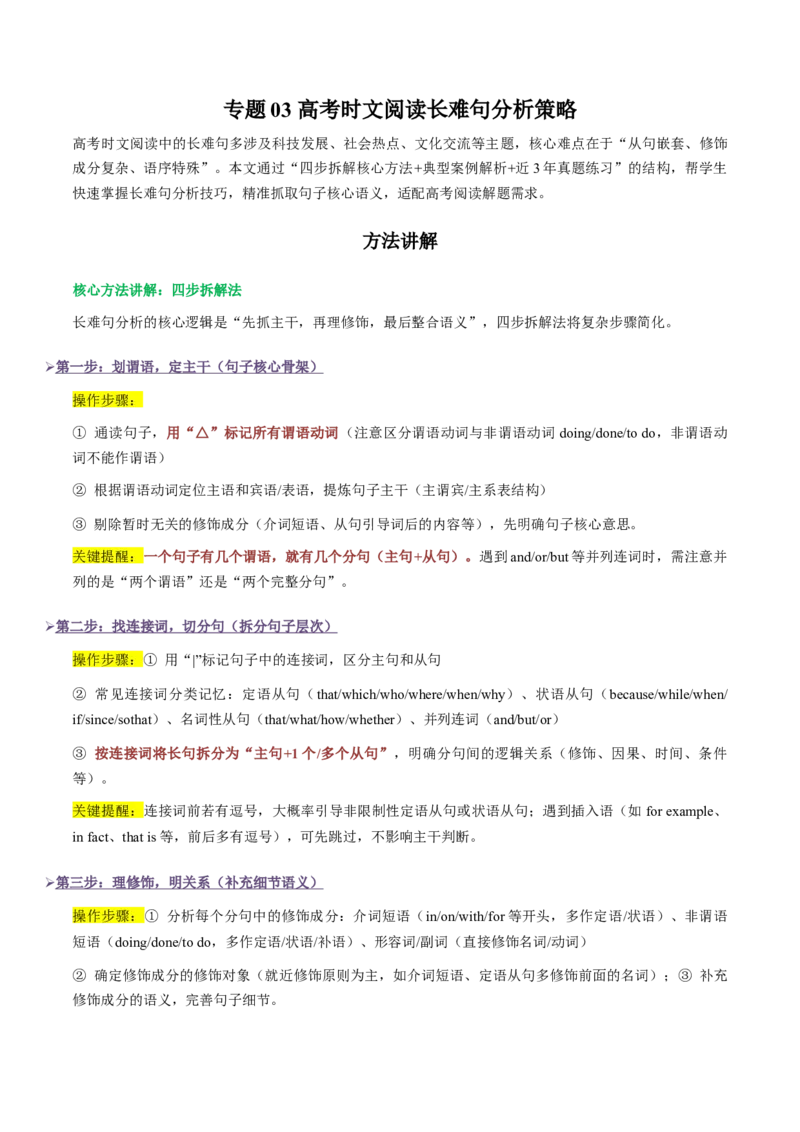
高考时文阅读中的长难句多涉及科技发展、社会热点、文化交流等主题,核心难点在于“从句嵌套、修饰
成分复杂、语序特殊”。本文通过“四步拆解核心方法+典型案例解析+近3 年真题练习”的结构,帮学生
快速掌握长难句分析技巧,精准抓取句子核心语义,适配高考阅读解题需求。
方法讲解
核心方法讲解:四步拆解法
长难句分析的核心逻辑是“先抓主干,再理修饰,最后整合语义”,四步拆解法将复杂步骤简化。
第一步:划谓语,定主干(句子核心骨架)
操作步骤:
① 通读句子,用“△”标记所有谓语动词(注意区分谓语动词与非谓语动词doing/done/to do,非谓语动
词不能作谓语)
② 根据谓语动词定位主语和宾语/表语,提炼句子主干(主谓宾/主系表结构)
③ 剔除暂时无关的修饰成分(介词短语、从句引导词后的内容等),先明确句子核心意思。
关键提醒:一个句子有几个谓语,就有几个分句(主句+从句)。遇到and/or/but 等并列连词时,需注意并
列的是“两个谓语”还是“两个完整分句”。
第二步:找连接词,切分句(拆分句子层次)
操作步骤:① 用“|”标记句子中的连接词,区分主句和从句
② 常见连接词分类记忆:定语从句(that/which/who/where/when/why)、状语从句(because/while/when/
if/since/sothat)、名词性从句(that/what/how/whether)、并列连词(and/but/or)
③ 按连接词将长句拆分为“主句+1 个/多个从句”,明确分句间的逻辑关系(修饰、因果、时间、条件
等)。
关键提醒:连接词前若有逗号,大概率引导非限制性定语从句或状语从句;遇到插入语(如for example、
in fact、that is 等,前后多有逗号),可先跳过,不影响主干判断。
第三步:理修饰,明关系(补充细节语义)
操作步骤:① 分析每个分句中的修饰成分:介词短语(in/on/with/for 等开头,多作定语/状语)、非谓语
短语(doing/done/to do,多作定语/状语/补语)、形容词/副词(直接修饰名词/动词)
② 确定修饰成分的修饰对象(就近修饰原则为主,如介词短语、定语从句多修饰前面的名词);③ 补充
修饰成分的语义,完善句子细节。
关键提醒:多重修饰成分叠加时,按“从近到远”的顺序分析,先理紧邻名词/动词的修饰内容,再逐步扩
展。
第四步:整语义,顺逻辑(合成完整句意)
操作步骤:① 先翻译主句语义,再翻译从句/修饰成分的语义
② 按中文表达习惯调整语序(如定语从句多翻译在名词前,状语从句可提前)
③ 整合所有分句和修饰成分的语义,确保逻辑连贯(因果、转折、时间等关系清晰)。
关键提醒:高考阅读只需“精准抓取核心语义”,无需逐词翻译,修饰成分若不影响解题,可适当简化理
解。
典型例题
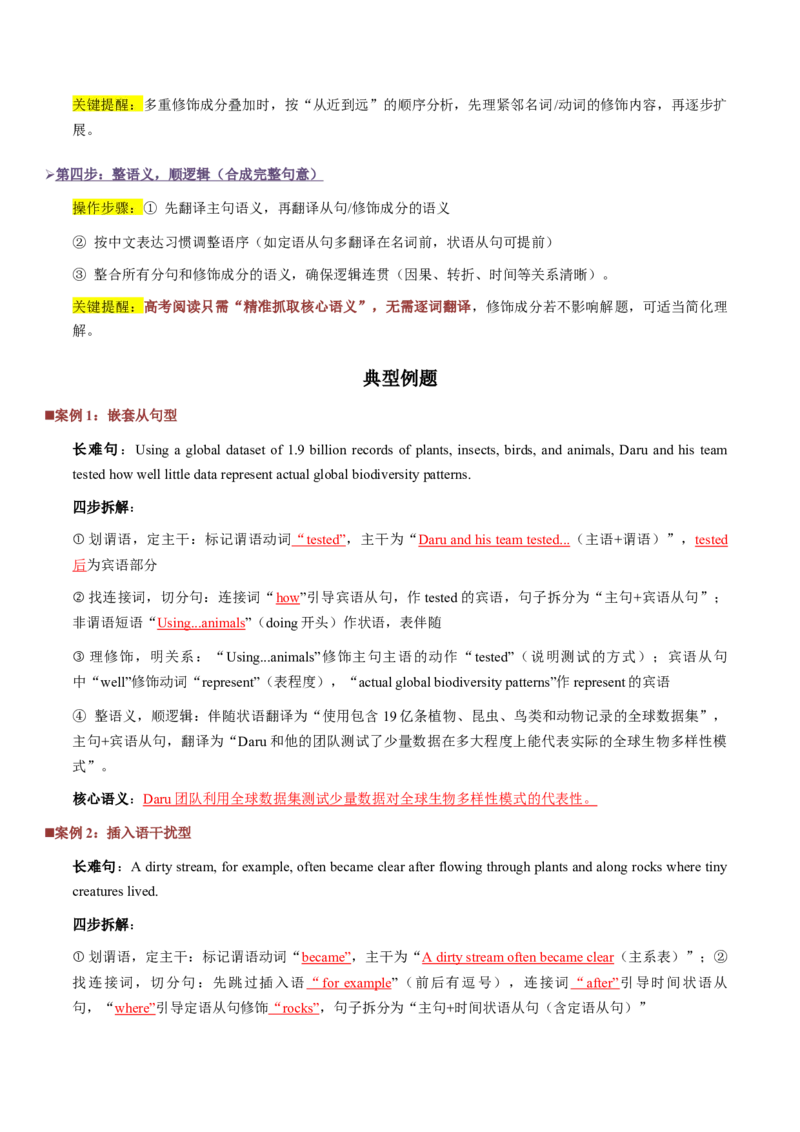
案例1:嵌套从句型
长难句:Using a global dataset of 1.9 billion records of plants, insects, birds, and animals, Daru and his team
tested how well little data represent actual global biodiversity patterns.
四步拆解:
①划谓语,定主干:标记谓语动词“
tested”
,主干为“Daru and his team tested...(主语+谓语)”,tested
后为宾语部分
②找连接词,切分句:连接词“how”引导宾语从句,作tested 的宾语,句子拆分为“主句+宾语从句”;
非谓语短语“Using...animals”(doing 开头)作状语,表伴随
③理修饰,明关系:“Using...animals”修饰主句主语的动作“tested”(说明测试的方式);宾语从句
中“well”修饰动词“represent”(表程度),“actual global biodiversity patterns”作represent 的宾语
④ 整语义,顺逻辑:伴随状语翻译为“使用包含19 亿条植物、昆虫、鸟类和动物记录的全球数据集”,
主句+宾语从句,翻译为“Daru 和他的团队测试了少量数据在多大程度上能代表实际的全球生物多样性模
式”。
核心语义:Daru
团队利用全球数据集测试少量数据对全球生物多样性模式的代表性。
案例2:插入语干扰型
长难句:A dirty stream, for example, often became clear after flowing through plants and along rocks where tiny
creatures lived.
四步拆解:
①划谓语,定主干:标记谓语动词“became”,主干为“A dirty stream often became clear(主系表)”;②
找连接词,切分句:先跳过插入语“
for example
”(前后有逗号),连接词“
after”
引导时间状语从
句,“where”引导定语从句修饰“
rocks”
,句子拆分为“主句+时间状语从句(含定语从句)”
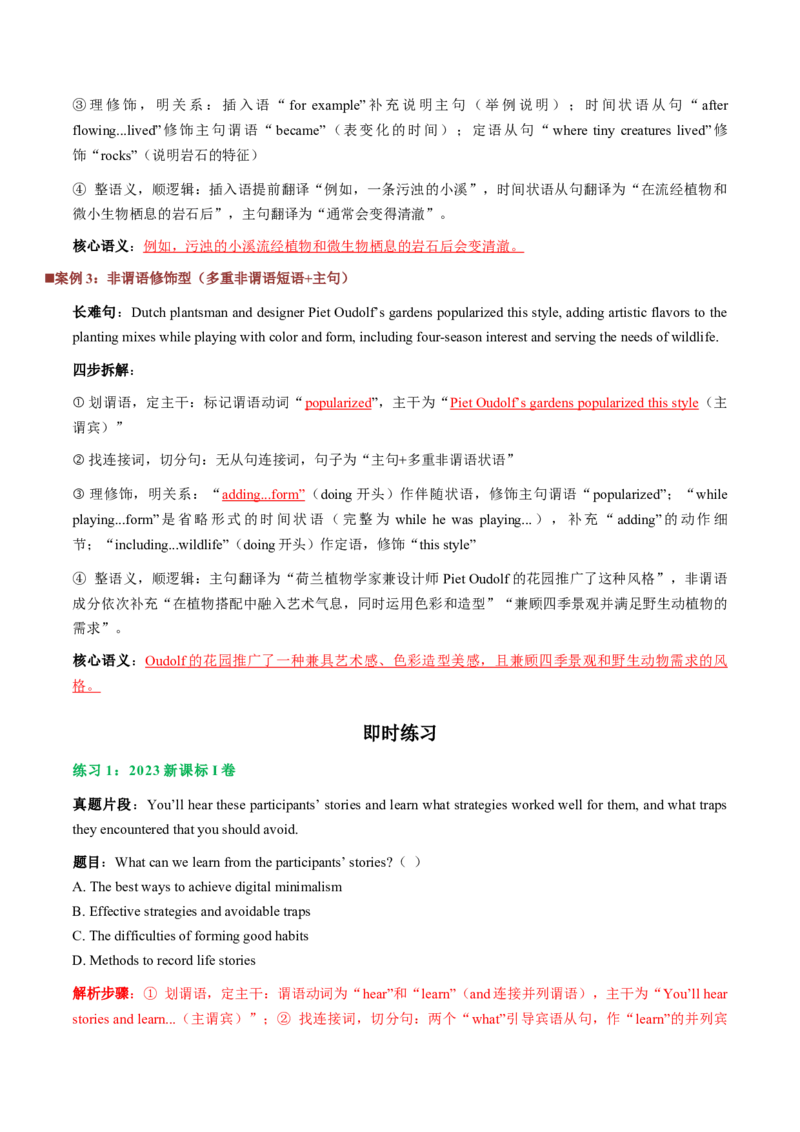
③理修饰,明关系:插入语“ for example” 补充说明主句(举例说明);时间状语从句“ after
flowing...lived”修饰主句谓语“ became”(表变化的时间);定语从句“ where tiny creatures lived” 修
饰“rocks”(说明岩石的特征)
④ 整语义,顺逻辑:插入语提前翻译“例如,一条污浊的小溪”,时间状语从句翻译为“在流经植物和
微小生物栖息的岩石后”,主句翻译为“通常会变得清澈”。
核心语义:例如,污浊的小溪流经植物和微生物栖息的岩石后会变清澈。
案例3:非谓语修饰型(多重非谓语短语+主句)
长难句:Dutch plantsman and designer Piet Oudolf’s gardens popularized this style, adding artistic flavors to the
planting mixes while playing with color and form, including four-season interest and serving the needs of wildlife.
四步拆解:
①划谓语,定主干:标记谓语动词“popularized”,主干为“Piet Oudolf’s gardens popularized this style(主
谓宾)”
②找连接词,切分句:无从句连接词,句子为“主句+多重非谓语状语”
③理修饰,明关系:“adding...form”(doing 开头)作伴随状语,修饰主句谓语“popularized”;“while
playing...form” 是省略形式的时间状语(完整为while he was playing... ),补充“ adding” 的动作细
节;“including...wildlife”(doing 开头)作定语,修饰“this style”
④ 整语义,顺逻辑:主句翻译为“荷兰植物学家兼设计师Piet Oudolf 的花园推广了这种风格”,非谓语
成分依次补充“在植物搭配中融入艺术气息,同时运用色彩和造型”“兼顾四季景观并满足野生动植物的
需求”。
核心语义:Oudolf
的花园推广了一种兼具艺术感、色彩造型美感,且兼顾四季景观和野生动物需求的风
格。
即时练习
练习1:2023 新课标I 卷
真题片段:You’ll hear these participants’ stories and learn what strategies worked well for them, and what traps
they encountered that you should avoid.
题目:What can we learn from the participants’ stories?( )
A. The best ways to achieve digital minimalism
B. Effective strategies and avoidable traps
C. The difficulties of forming good habits
D. Methods to record life stories
解析步骤:① 划谓语,定主干:谓语动词为“hear”和“learn”(and 连接并列谓语),主干为“You’ll hear
stories and learn...(主谓宾)”;② 找连接词,切分句:两个“what”引导宾语从句,作“learn”的并列宾
语;“that”引导定语从句,修饰“traps”;句子拆分为“主句+并列宾语从句(第二个含定语从句)”;③
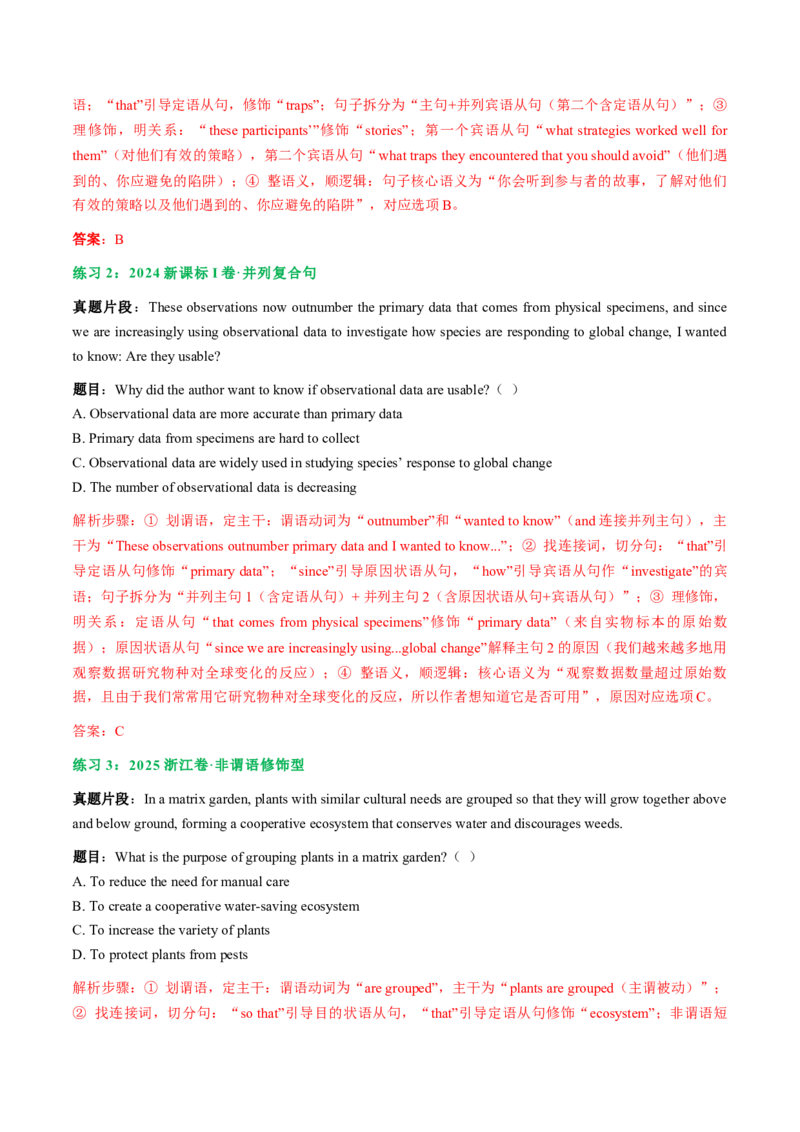
理修饰,明关系:“these participants’”修饰“stories”;第一个宾语从句“what strategies worked well for
them”(对他们有效的策略),第二个宾语从句“what traps they encountered that you should avoid”(他们遇
到的、你应避免的陷阱);④ 整语义,顺逻辑:句子核心语义为“你会听到参与者的故事,了解对他们
有效的策略以及他们遇到的、你应避免的陷阱”,对应选项B。
答案:B
练习2:2024 新课标I 卷·并列复合句
真题片段:These observations now outnumber the primary data that comes from physical specimens, and since
we are increasingly using observational data to investigate how species are responding to global change, I wanted
to know: Are they usable?
题目:Why did the author want to know if observational data are usable?( )
A. Observational data are more accurate than primary data
B. Primary data from specimens are hard to collect
C. Observational data are widely used in studying species’ response to global change
D. The number of observational data is decreasing
解析步骤:① 划谓语,定主干:谓语动词为“outnumber”和“wanted to know”(and 连接并列主句),主
干为“These observations outnumber primary data and I wanted to know...”;② 找连接词,切分句:“that”引
导定语从句修饰“primary data”;“since”引导原因状语从句,“how”引导宾语从句作“investigate”的宾
语;句子拆分为“并列主句1(含定语从句)+ 并列主句2(含原因状语从句+宾语从句)”;③ 理修饰,
明关系:定语从句“that comes from physical specimens”修饰“primary data”(来自实物标本的原始数
据);原因状语从句“since we are increasingly using...global change”解释主句2 的原因(我们越来越多地用
观察数据研究物种对全球变化的反应);④ 整语义,顺逻辑:核心语义为“观察数据数量超过原始数
据,且由于我们常常用它研究物种对全球变化的反应,所以作者想知道它是否可用”,原因对应选项C。
答案:C
练习3:2025 浙江卷·非谓语修饰型
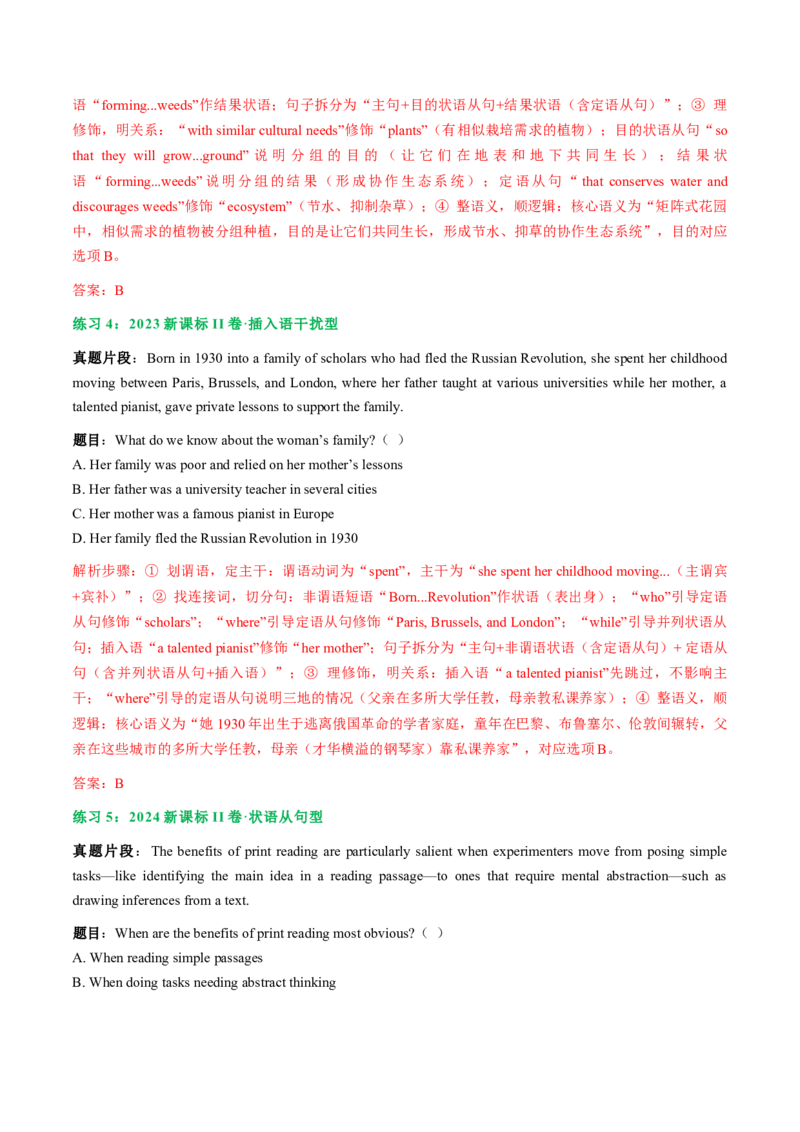
真题片段:In a matrix garden, plants with similar cultural needs are grouped so that they will grow together above
and below ground, forming a cooperative ecosystem that conserves water and discourages weeds.
题目:What is the purpose of grouping plants in a matrix garden?( )
A. To reduce the need for manual care
B. To create a cooperative water-saving ecosystem
C. To increase the variety of plants
D. To protect plants from pests
解析步骤:① 划谓语,定主干:谓语动词为“are grouped”,主干为“plants are grouped(主谓被动)”;
② 找连接词,切分句:“so that”引导目的状语从句,“that”引导定语从句修饰“ecosystem”;非谓语短
语“forming...weeds”作结果状语;句子拆分为“主句+目的状语从句+结果状语(含定语从句)”;③ 理
修饰,明关系:“with similar cultural needs”修饰“plants”(有相似栽培需求的植物);目的状语从句“so
that they will grow...ground” 说明分组的目的(让它们在地表和地下共同生长);结果状
语“ forming...weeds” 说明分组的结果(形成协作生态系统);定语从句“ that conserves water and
discourages weeds”修饰“ecosystem”(节水、抑制杂草);④ 整语义,顺逻辑:核心语义为“矩阵式花园
中,相似需求的植物被分组种植,目的是让它们共同生长,形成节水、抑草的协作生态系统”,目的对应
选项B。
答案:B
练习4:2023 新课标II 卷·插入语干扰型
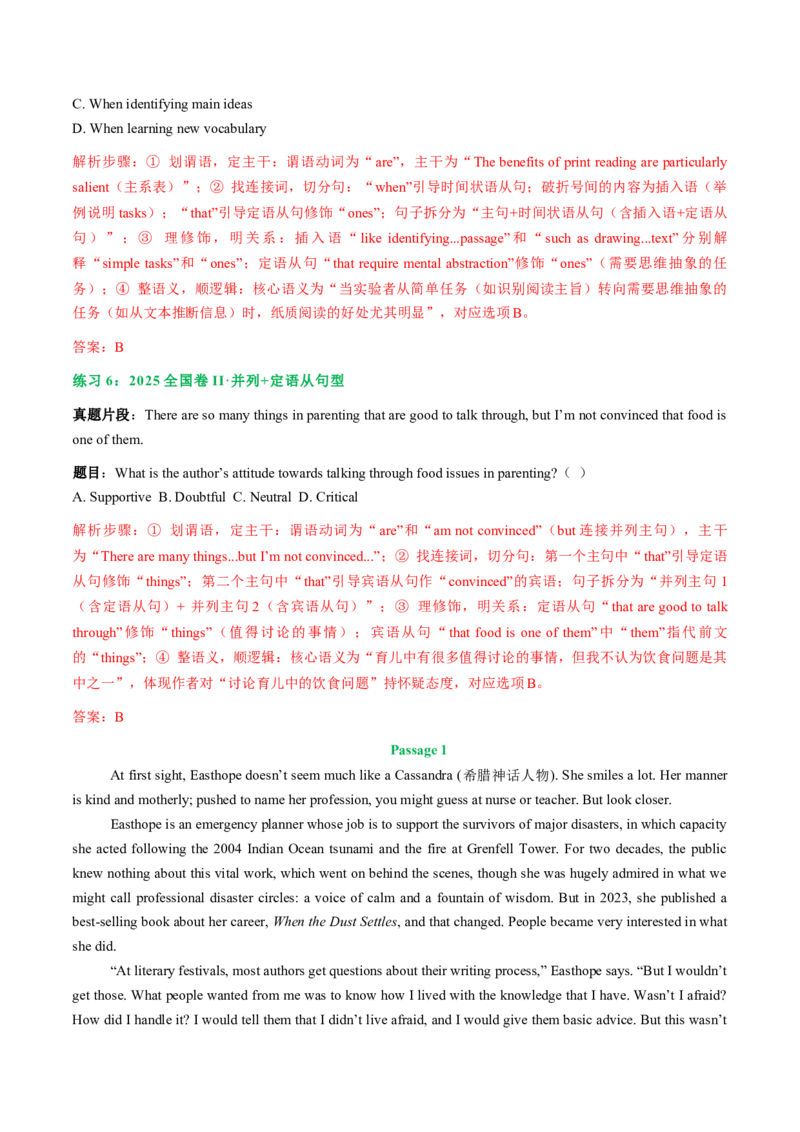
真题片段:Born in 1930 into a family of scholars who had fled the Russian Revolution, she spent her childhood
moving between Paris, Brussels, and London, where her father taught at various universities while her mother, a
talented pianist, gave private lessons to support the family.
题目:What do we know about the woman’s family?( )
A. Her family was poor and relied on her mother’s lessons
B. Her father was a university teacher in several cities
C. Her mother was a famous pianist in Europe
D. Her family fled the Russian Revolution in 1930
解析步骤:① 划谓语,定主干:谓语动词为“spent”,主干为“she spent her childhood moving...(主谓宾
+宾补)”;② 找连接词,切分句:非谓语短语“Born...Revolution”作状语(表出身);“who”引导定语
从句修饰“scholars”;“where”引导定语从句修饰“Paris, Brussels, and London”;“while”引导并列状语从
句;插入语“a talented pianist”修饰“her mother”;句子拆分为“主句+非谓语状语(含定语从句)+ 定语从
句(含并列状语从句+插入语)”;③ 理修饰,明关系:插入语“a talented pianist”先跳过,不影响主
干;“where”引导的定语从句说明三地的情况(父亲在多所大学任教,母亲教私课养家);④ 整语义,顺
逻辑:核心语义为“她1930 年出生于逃离俄国革命的学者家庭,童年在巴黎、布鲁塞尔、伦敦间辗转,父
亲在这些城市的多所大学任教,母亲(才华横溢的钢琴家)靠私课养家”,对应选项B。
答案:B
练习5:2024 新课标II 卷·状语从句型
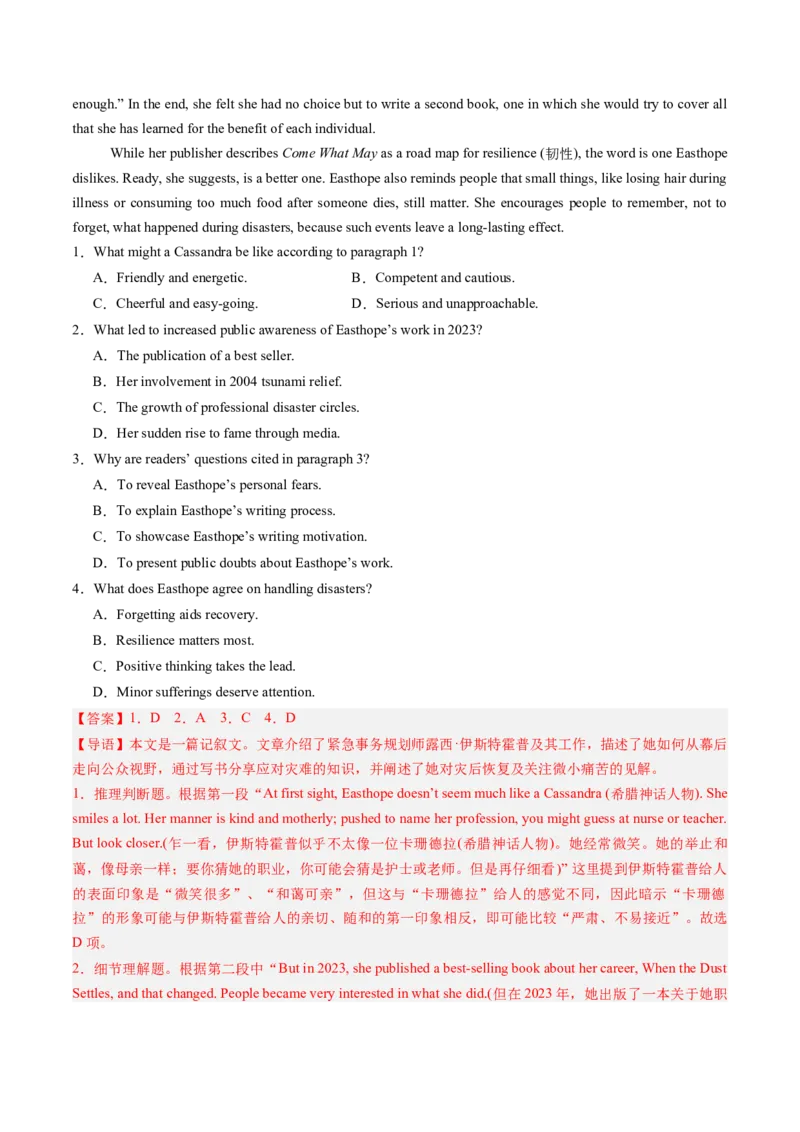
真题片段:The benefits of print reading are particularly salient when experimenters move from posing simple
tasks—like identifying the main idea in a reading passage—to ones that require mental abstraction—such as
drawing inferences from a text.
题目:When are the benefits of print reading most obvious?( )
A. When reading simple passages
B. When doing tasks needing abstract thinking
C. When identifying main ideas
D. When learning new vocabulary
解析步骤:① 划谓语,定主干:谓语动词为“are”,主干为“The benefits of print reading are particularly
salient(主系表)”;② 找连接词,切分句:“when”引导时间状语从句;破折号间的内容为插入语(举
例说明tasks);“that”引导定语从句修饰“ones”;句子拆分为“主句+时间状语从句(含插入语+定语从
句)” ;③ 理修饰,明关系:插入语“ like identifying...passage” 和“ such as drawing...text” 分别解
释“simple tasks”和“ones”;定语从句“that require mental abstraction”修饰“ones”(需要思维抽象的任
务);④ 整语义,顺逻辑:核心语义为“当实验者从简单任务(如识别阅读主旨)转向需要思维抽象的
任务(如从文本推断信息)时,纸质阅读的好处尤其明显”,对应选项B。
答案:B
练习6:2025 全国卷II·并列+定语从句型
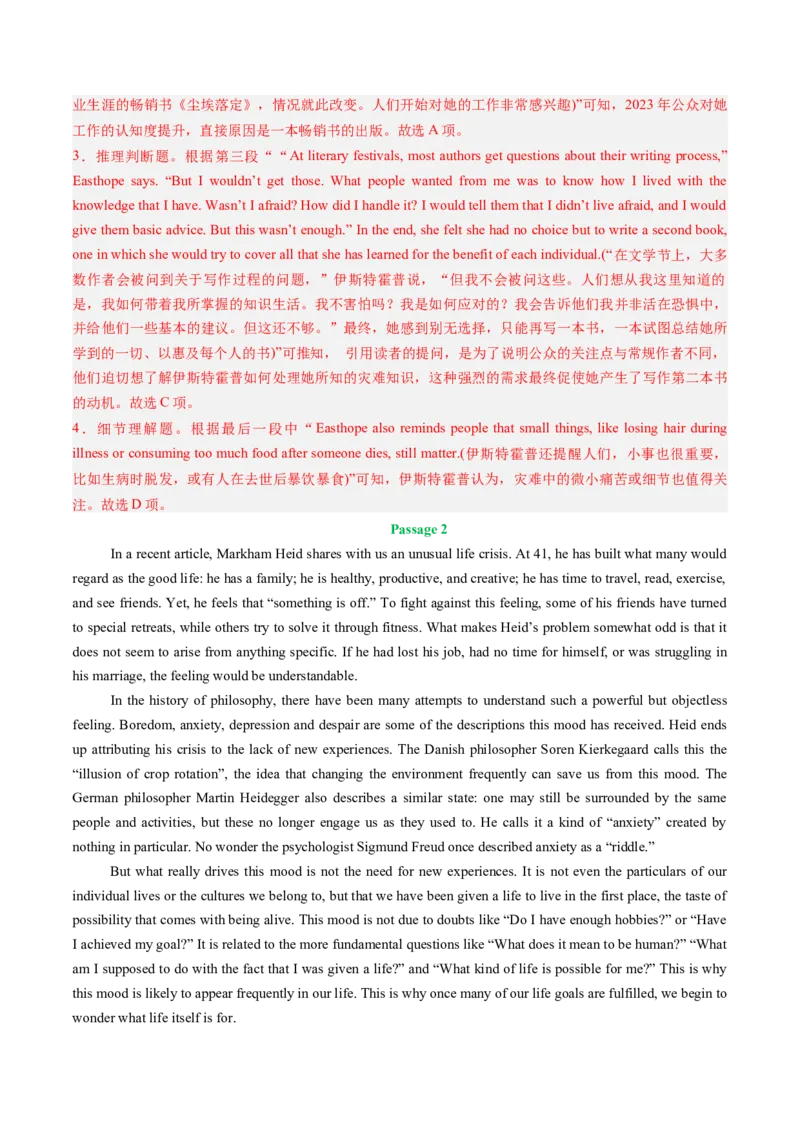
真题片段:There are so many things in parenting that are good to talk through, but I’m not convinced that food is
one of them.
题目:What is the author’s attitude towards talking through food issues in parenting?( )
A. Supportive B. Doubtful C. Neutral D. Critical
解析步骤:① 划谓语,定主干:谓语动词为“are”和“am not convinced”(but 连接并列主句),主干
为“There are many things...but I’m not convinced...”;② 找连接词,切分句:第一个主句中“that”引导定语
从句修饰“things”;第二个主句中“that”引导宾语从句作“convinced”的宾语;句子拆分为“并列主句1
(含定语从句)+ 并列主句2(含宾语从句)”;③ 理修饰,明关系:定语从句“that are good to talk
through”修饰“things”(值得讨论的事情);宾语从句“ that food is one of them”中“them”指代前文
的“things”;④ 整语义,顺逻辑:核心语义为“育儿中有很多值得讨论的事情,但我不认为饮食问题是其
中之一”,体现作者对“讨论育儿中的饮食问题”持怀疑态度,对应选项B。
答案:B
Passage 1
At first sight, Easthope doesn’t seem much like a Cassandra (希腊神话人物). She smiles a lot. Her manner
is kind and motherly; pushed to name her profession, you might guess at nurse or teacher. But look closer.
Easthope is an emergency planner whose job is to support the survivors of major disasters, in which capacity
she acted following the 2004 Indian Ocean tsunami and the fire at Grenfell Tower. For two decades, the public
knew nothing about this vital work, which went on behind the scenes, though she was hugely admired in what we
might call professional disaster circles: a voice of calm and a fountain of wisdom. But in 2023, she published a
best-selling book about her career, When the Dust Settles, and that changed. People became very interested in what
she did.
“At literary festivals, most authors get questions about their writing process,” Easthope says. “But I wouldn’t
get those. What people wanted from me was to know how I lived with the knowledge that I have. Wasn’t I afraid?
How did I handle it? I would tell them that I didn’t live afraid, and I would give them basic advice. But this wasn’t
enough.” In the end, she felt she had no choice but to write a second book, one in which she would try to cover all
that she has learned for the benefit of each individual.
While her publisher describes Come What May as a road map for resilience (韧性), the word is one Easthope
dislikes. Ready, she suggests, is a better one. Easthope also reminds people that small things, like losing hair during
illness or consuming too much food after someone dies, still matter. She encourages people to remember, not to
forget, what happened during disasters, because such events leave a long-lasting effect.
1.What might a Cassandra be like according to paragraph 1?
A.Friendly and energetic.
B.Competent and cautious.
C.Cheerful and easy-going.
D.Serious and unapproachable.
2.What led to increased public awareness of Easthope’s work in 2023?
A.The publication of a best seller.
B.Her involvement in 2004 tsunami relief.
C.The growth of professional disaster circles.
D.Her sudden rise to fame through media.
3.Why are readers’ questions cited in paragraph 3?
A.To reveal Easthope’s personal fears.
B.To explain Easthope’s writing process.
C.To showcase Easthope’s writing motivation.
D.To present public doubts about Easthope’s work.
4.What does Easthope agree on handling disasters?
A.Forgetting aids recovery.
B.Resilience matters most.
C.Positive thinking takes the lead.
D.Minor sufferings deserve attention.
【答案】1.D 2.A 3.C 4.D
【导语】本文是一篇记叙文。文章介绍了紧急事务规划师露西·伊斯特霍普及其工作,描述了她如何从幕后
走向公众视野,通过写书分享应对灾难的知识,并阐述了她对灾后恢复及关注微小痛苦的见解。
1.推理判断题。根据第一段“At first sight, Easthope doesn’t seem much like a Cassandra (希腊神话人物). She
smiles a lot. Her manner is kind and motherly; pushed to name her profession, you might guess at nurse or teacher.
But look closer.(乍一看,伊斯特霍普似乎不太像一位卡珊德拉(希腊神话人物)。她经常微笑。她的举止和
蔼,像母亲一样;要你猜她的职业,你可能会猜是护士或老师。但是再仔细看)” 这里提到伊斯特霍普给人
的表面印象是“微笑很多”、“和蔼可亲”,但这与“卡珊德拉”给人的感觉不同,因此暗示“卡珊德
拉”的形象可能与伊斯特霍普给人的亲切、随和的第一印象相反,即可能比较“严肃、不易接近”。故选
D 项。
2.细节理解题。根据第二段中“But in 2023, she published a best-selling book about her career, When the Dust
Settles, and that changed. People became very interested in what she did.(但在2023 年,她出版了一本关于她职
业生涯的畅销书《尘埃落定》,情况就此改变。人们开始对她的工作非常感兴趣)”可知,2023 年公众对她
工作的认知度提升,直接原因是一本畅销书的出版。故选A 项。
3.推理判断题。根据第三段““At literary festivals, most authors get questions about their writing process,”
Easthope says. “But I wouldn’t get those. What people wanted from me was to know how I lived with the
knowledge that I have. Wasn’t I afraid? How did I handle it? I would tell them that I didn’t live afraid, and I would
give them basic advice. But this wasn’t enough.” In the end, she felt she had no choice but to write a second book,
one in which she would try to cover all that she has learned for the benefit of each individual.(“在文学节上,大多
数作者会被问到关于写作过程的问题,”伊斯特霍普说,“但我不会被问这些。人们想从我这里知道的
是,我如何带着我所掌握的知识生活。我不害怕吗?我是如何应对的?我会告诉他们我并非活在恐惧中,
并给他们一些基本的建议。但这还不够。”最终,她感到别无选择,只能再写一本书,一本试图总结她所
学到的一切、以惠及每个人的书)”可推知, 引用读者的提问,是为了说明公众的关注点与常规作者不同,
他们迫切想了解伊斯特霍普如何处理她所知的灾难知识,这种强烈的需求最终促使她产生了写作第二本书
的动机。故选C 项。
4.细节理解题。根据最后一段中“ Easthope also reminds people that small things, like losing hair during
illness or consuming too much food after someone dies, still matter.(伊斯特霍普还提醒人们,小事也很重要,
比如生病时脱发,或有人在去世后暴饮暴食)”可知,伊斯特霍普认为,灾难中的微小痛苦或细节也值得关
注。故选D 项。
Passage 2
In a recent article, Markham Heid shares with us an unusual life crisis. At 41, he has built what many would
regard as the good life: he has a family; he is healthy, productive, and creative; he has time to travel, read, exercise,
and see friends. Yet, he feels that “something is off.” To fight against this feeling, some of his friends have turned
to special retreats, while others try to solve it through fitness. What makes Heid’s problem somewhat odd is that it
does not seem to arise from anything specific. If he had lost his job, had no time for himself, or was struggling in
his marriage, the feeling would be understandable.
In the history of philosophy, there have been many attempts to understand such a powerful but objectless
feeling. Boredom, anxiety, depression and despair are some of the descriptions this mood has received. Heid ends
up attributing his crisis to the lack of new experiences. The Danish philosopher Soren Kierkegaard calls this the
“illusion of crop rotation”, the idea that changing the environment frequently can save us from this mood. The
German philosopher Martin Heidegger also describes a similar state: one may still be surrounded by the same
people and activities, but these no longer engage us as they used to. He calls it a kind of “anxiety” created by
nothing in particular. No wonder the psychologist Sigmund Freud once described anxiety as a “riddle.”
But what really drives this mood is not the need for new experiences. It is not even the particulars of our
individual lives or the cultures we belong to, but that we have been given a life to live in the first place, the taste of
possibility that comes with being alive. This mood is not due to doubts like “Do I have enough hobbies?” or “Have
I achieved my goal?” It is related to the more fundamental questions like “What does it mean to be human?” “What
am I supposed to do with the fact that I was given a life?” and “What kind of life is possible for me?” This is why
this mood is likely to appear frequently in our life. This is why once many of our life goals are fulfilled, we begin to
wonder what life itself is for.
These questions never have a final answer and they can always leave us with a great sense of anguish about
who we are and how we should go on. Nevertheless, recognizing that these doubts are there, and that they matter,
can at least allow us to know what may be missing, even when everything is good.
5.What is the main purpose of the first paragraph?
A.To show Markham Heid’s perfect life is envied by many people
B.To introduce a confusing life crisis that lacks a specific cause
C.To suggest special retreats and fitness are the best ways to solve the crisis
D.To prove that a family and some leisure activities can never bring happiness
6.The author shares Markham Heid’s crisis mainly to________.
A.present an argument
B.introduce a topic
C.make an assumption
D.evaluate an event
7.According to the author, how can the crisis in the passage be dealt with?
A.By studying philosophy.
B.By developing new hobbies.
C.By going travelling frequently.
D.By embracing the objectless feeling.
8.What does the word “anguish” underlined in the last paragraph most probably mean?
A.Pain.
B.Wonder.
C.Direction.
D.Achievement.
9.Which would be the best title for the passage?
A.What leads to a Life Crisis
B.Letting Go of Dark Moods
C.Boredom Makes Us Human
D.Anxiety Gives Us Life Goals
【答案】5.B 6.B 7.D 8.A 9.C
【导语】本文是一篇议论文。文章主要探讨了无明确诱因的生活危机及其本质与应对。
5.推理判断题。根据第一段“In a recent article, Markham Heid shares with us an unusual life crisis. At 41, he
has built what many would regard as the good life: he has a family; he is healthy, productive, and creative; he has
time to travel, read, exercise, and see friends. Yet, he feels that “something is off.” To fight against this feeling,
some of his friends have turned to special retreats, while others try to solve it through fitness. What makes Heid’s
problem somewhat odd is that it does not seem to arise from anything specific. If he had lost his job, had no time
for himself, or was struggling in his marriage, the feeling would be understandable.(在最近发表的一篇文章中,
马克姆·海德向我们讲述了一种不同寻常的人生困境。41 岁的他,已然过上了许多人眼中的理想生活:拥
有美满的家庭,身体健康,工作高效且富有创造力,还有时间旅行、阅读、健身以及和朋友相聚。然而,
他却总觉得 “哪里不对劲”。为了摆脱这种心绪,他的一些朋友选择参加特色静修营,另一些人则试图
通过健身来消解。海德的困扰有些特别之处——这种感觉并非源于任何具体的人和事。若是他失业在家、
无暇自顾,或是婚姻陷入危机,那么产生这种情绪倒也情有可原。)”可知,第一段的主要目的是介绍一种
缺乏特定原因的令人困惑的生活危机。故选B。
6.推理判断题。通读全文,尤其是根据第一段“In a recent article, Markham Heid shares with us an unusual
life crisis. At 41, he has built what many would regard as the good life: he has a family; he is healthy, productive,
and creative; he has time to travel, read, exercise, and see friends. Yet, he feels that “something is off.” To fight
against this feeling, some of his friends have turned to special retreats, while others try to solve it through fitness.
What makes Heid’s problem somewhat odd is that it does not seem to arise from anything specific. If he had lost
his job, had no time for himself, or was struggling in his marriage, the feeling would be understandable.( 在最近发
表的一篇文章中,马克姆
海德向我们讲述了一种不同寻常的人生困境。
・
41 岁的他,已然过上了许多人眼
中的理想生活:拥有美满的家庭,身体健康,工作高效且富有创造力,还有时间旅行、阅读、健身以及和
朋友相聚。然而,他却总觉得 “哪里不对劲”。为了摆脱这种心绪,他的一些朋友选择参加特色静修
营,另一些人则试图通过健身来消解。海德的困扰有些特别之处 —— 这种感觉并非源于任何具体的人和
事。若是他失业在家、无暇自顾,或是婚姻陷入危机,那么产生这种情绪倒也情有可原。)”、第二段
中“In the history of philosophy, there have been many attempts to understand such a powerful but objectless
feeling. Boredom, anxiety, depression and despair are some of the descriptions this mood has received. Heid ends
up attributing his crisis to the lack of new experiences. The Danish philosopher Soren Kierkegaard calls this the
“illusion of crop rotation”, the idea that changing the environment frequently can save us from this mood.(在哲学
史上,学者们曾多次尝试剖析这种强烈却又无具体缘由的心境。人们将其描述为无聊、焦虑、消沉与绝望
等种种状态。海德最终将自己的人生困境归咎于缺乏新鲜体验。丹麦哲学家索伦·克尔凯郭尔将这种现象称
为“轮作的错觉”,其核心观点是:频繁更换生活环境,就能让我们摆脱这种心绪的困扰。)”可知,作者
以马克姆·海德的经历开篇,进而展开哲学与心理学层面的分析,并探讨其深层根源与应对态度,显然是为
了引出本文的主题。故选B。
7.细节理解题。根据最后一段中“Nevertheless, recognizing that these doubts are there, and that they matter,
can at least allow us to know what may be missing, even when everything is good.(尽管如此,认识到这些怀疑的
存在,并且它们很重要,至少可以让我们知道即使一切都好,也可能缺少什么。)”可知,作者认为,可以
通过接受这种无客体的感觉来处理文章中的危机。故选D。
8.词句猜测题。根据最后一段中“These questions never have a final answer and they can always leave us with
a great sense of anguish about who we are and how we should go on.(这些问题永远没有最终的答案,它们总是
会让我们对自己是谁以及应该如何继续下去感到极大的anguish。)”可知,这些关于人生的问题没有最终答
案,会让人感到痛苦,所以anguish 意为“痛苦”。故选A。
9.主旨大意题。通读全文,尤其是根据第二段中“In the history of philosophy, there have been many
attempts to understand such a powerful but objectless feeling. Boredom, anxiety, depression and despair are some
of the descriptions this mood has received. Heid ends up attributing his crisis to the lack of new experiences. The
Danish philosopher Soren Kierkegaard calls this the “illusion of crop rotation”, the idea that changing the
environment frequently can save us from this mood.(在哲学史上,学者们曾多次尝试剖析这种强烈却又无具体
缘由的心境。人们将其描述为无聊、焦虑、消沉与绝望等种种状态。海德最终将自己的人生困境归咎于缺
乏新鲜体验。丹麦哲学家索伦·克尔凯郭尔将这种现象称为“轮作的错觉”,其核心观点是:频繁更换生活
环境,就能让我们摆脱这种心绪的困扰。)”、最后一段中“Nevertheless, recognizing that these doubts are
there, and that they matter, can at least allow us to know what may be missing, even when everything is good.(尽管
如此,认识到这些怀疑的存在,并且它们很重要,至少可以让我们知道即使一切都好,也可能缺少什
么。)”可知,通过哲学与心理学视角,作者指出这种“无对象的焦虑”源于对生命意义的追问,而非外部
环境。认识这种情绪本身,有助于理解生活的缺失与价值。所以,C 选项“Boredom Makes Us Human(无聊
使我们成为人类)”最符合文章标题。故选C。
Passage 3
For 170 years, a hidden law has guided the growth and decline of U.S. cities, a new study reveals. After
analyzing huge amounts of historical data, researchers found that American cities follow a remarkably regular
pattern. As cities grow and their economies change, for example, from manufacturing to services, they manage to
keep a steady level of “economic connection”. This connection measures how closely a city’s different economic
activities are related and support each other.
This pattern holds true even in regions that developed rapidly. The West Coast, for instance, transformed
quickly from its early days during the Gold Rush. In just fifty years, its cities became nearly as economically
diverse as those on the East Coast. Despite this fast diversification, their level of economic connection remained
stable and similar to that of older eastern cities. This shows that even during periods of major change, cities follow
this underlying rule.
The study suggests that urban economic transformation is limited. Cities can develop new industries and
abandon old ones, but they must do so in a way that doesn’t harm their overall economic structure. For example,
cities like Pittsburgh, which shifted from heavy industry to high-tech fields, had to find a new path that maintained
stability. This means change is not random but follows a path that keeps the city’s economy coherent.
Furthermore, the research discovered a clear link between a city’s size and its economic connection. As cities
get larger, their level of connection steadily decreases at a predictable rate. This relationship has remained constant
for 170 years, despite massive technological and population growth. It implies that a city’s size sets a natural limit
on how diverse its economy can be while still remaining connected.
These findings offer important lessons for city leaders. While pursuing new technologies and industries is
good, cities must avoid overextending their resources. Larger cities can support a wider range of activities, but
every city’s ambitions for diversification are ultimately constrained by its size. Therefore, understanding this
“hidden law” can help policymakers create more realistic and effective development plans.
10.What can be inferred about urban economic change?
A.It often happens without a clear plan.
B.It is mainly driven by technological progress.
C.It is faster in smaller cities than in larger ones.
D.It requires a balance between new and old activities.
11.How does city size influence its economy?
A.City size has little effect on industrial diversity.
B.Larger cities are always more economically successful.
C.Smaller cities have a higher level of economic connection.
D.Only large cities can benefit from new technologies.
12.What is the key message for city policymakers?
A.They should focus only on traditional industries.
B.They must copy the development models of larger cities.
C.They need to match development goals with the city’s scale.
D.They should invest more in local infrastructure than workforce.
13.What is the main purpose of the passage?
A.To compare the economies of East and West Coast cities.
B.To introduce a hidden pattern in urban development.
C.To argue that larger cities are better for innovation.
D.To describe the history of U.S. economic growth.
【答案】10.D 11.C 12.C 13.B
【导语】本文是一篇说明文。文章通过一项新研究揭示了一项隐藏了170 年的规律,该规律指引着美国城
市的兴衰,阐述了城市经济变化的特点、城市规模对经济的影响,以及这些发现对城市政策制定者的重要
启示。
10.推理判断题。根据第三段中的“Cities can develop new industries and abandon old ones, but they must do
so in a way that doesn't harm their overall economic structure. For example, cities like Pittsburgh, which shifted
from heavy industry to high-tech fields, had to find a new path that maintained stability.(城市可以发展新产业,
放弃旧产业,但必须以不损害整体经济结构的方式进行。例如,像匹兹堡这样从重工业转向高科技领域的
城市,必须找到一条维持稳定的新路径。)”可知,城市经济变化需要在新旧活动之间取得平衡。故选D
项。
11.细节理解题。根据第四段中的“ As cities get larger, their level of connection steadily decreases at a
predictable rate.(随着城市规模的扩大,它们的连接水平以可预测的速度稳步下降。)”可知,城市规模越
大,经济连接水平越低,也就意味着较小城市的经济连接水平更高。故选C 项。
12.细节理解题。根据最后一段中的“Larger cities can support a wider range of activities, but every city’s
ambitions for diversification are ultimately constrained by its size. Therefore, understanding this ‘hidden law’ can
help policymakers create more realistic and effective development plans.(大城市可以支持更广泛的活动,但每
个城市多元化的雄心最终都受到其规模的限制。因此,了解这一‘隐藏规律’可以帮助政策制定者制定更
现实、更有效的发展计划。)”可知,城市政策制定者需要将发展目标与城市规模相匹配。故选C 项。
13.推理判断题。根据第一段中的“For 170 years, a hidden law has guided the growth and decline of U.S.
cities, a new study reveals.(一项新研究显示,170 年来,一项隐藏的规律一直指引着美国城市的兴衰。)”以
及全文内容可知,文章核心目的是介绍城市发展中隐藏的一种模式,包括城市经济变化遵循的规律、城市
规模对经济的影响等。故选B 项。
Passage 4
There exists a certain human experience that goes beyond cultures and generations— the sudden shake that
runs down your spine (脊柱) when a violin reaches its highest note, or when singers’ harmony resolves perfectly.
These musical chills, electrifying feelings triggered by emotionally powerful music, sometimes accompanied by
visible goosebumps, represent one of the most fascinating blends between art and neurology. Recent advances in
brain imaging have transformed our understanding of this phenomenon, revealing it to be a complex neurological
event involving multiple brain regions.
The process begins with pattern recognition in the auditory cortex (听觉皮层) , which constantly predicts
where a musical phrase will lead. When a composer breaks these expectations on purpose—through an unexpected
key change, or a delay in resolution— it creates what neuroscientists call “prediction error.” This surprise element
triggers the nucleus accumbens (伏隔核) , the brain’s pleasure center associated with reward processing. Within
milliseconds, the area releases dopamine, the same neurotransmitter involved in the pleasures of eating chocolate or
falling in love. Studies show this neural activity pattern is nearly identical to that seen during other peak emotional
experiences.
Individual differences in musical chills provide important clues. Only about half the population reports
frequent musical chills, and brain scans reveal why. These individuals possess stronger white matter connections
between the auditory cortex and two key regions: one processing bodily awareness and the other involved in
emotional evaluation. This enhanced neural connection creates the ability to experience more delicate emotional
responses to music.
The evolutionary origins of this response may come before humanity itself. Charles Darwin first noted that
music shares characteristics with animal distress calls and mating songs. The physiological markers of musical
chills— including goosebumps and changes in heart rate— mirror ancient fear and excitement responses. Some
theorists suggest music developed as an early language that promoted social unity, with chill responses reinforcing
group bonding through shared emotional peaks.
Modern medicine has begun using this knowledge. Neurologists now use musical chill tests to assess lack of
emotional response in depression patients, as reduced chill response connects with an inability to feel pleasure.
Music therapists working with Alzheimer’s patients have documented cases where chill-arousing songs temporarily
restore access to lost memories, likely through activation of the region relatively spared in early dementia ( 痴呆
症) .
The next time you feel that familiar shake during a favorite song, recognize it for what it truly is. In those
chilling notes lies evidence of our incredible neural complexity, our ancient evolutionary past, and our enduring
capacity for amazing experience.
14.What triggers the “prediction error” in Paragraph 2?
A.The release of dopamine from the same neurotransmitter area.
B.A composer’s intentional breaking of listeners’ musical expectations.
C.The similarity between musical chills and other emotional experiences.
D.The auditory cortex’s failure to recognize the familiar musical patterns.
15.What can we know about the evolutionary fact of musical chills?
A.They were developed to distinguish between fear and excitement responses.
B.They played a role in promoting social connection among early human groups.
C.Their origin lay in the same biological mechanism as animal mating behaviors.
D.Their physical indicators like goosebumps fade away in the process of evolution.
16.From the case of Alzheimer’s patients, we can infer that _________.
A.chill-arousing music is the more effective treatment for Alzheimer’s disease
B.all dementia patients can fully recover lost memories through musical chills
C.emotional distress in depression is caused by weakened musical chill responses
D.modern medicine has begun to apply the effect of musical chills to curing diseases
17.What does the author imply in the last paragraph?
A.Only music with specific notes can trigger the neural activity of chills.
B.The experience of musical chills reflects multiple aspects of human nature.
C.Musical chills are the most direct way to study the human brain’s complexity.
D.The ability to feel musical chills is unique to humans compared with other species.
【答案】14.B 15.B 16.D 17.B
【导语】这是一篇说明文。主要介绍了音乐寒颤是艺术与神经学的交汇现象,由作曲家打破听众音乐预期
触发,其个体差异、演化起源已被揭示,且该研究成果已应用于现代医学领域。
14.细节理解题。根据第二段中“When a composer breaks these expectations on purpose—through an
unexpected key change, or a delay in resolution— it creates what neuroscientists call “prediction error.”(当作曲家
故意打破这些预期时——比如采用出人意料的转调或延迟和声解决时——就会产生神经科学家所说的“预
测错误”。)”可知,作曲家故意打破听众的音乐期望触发了“预测错误”。故选B 项。
15.细节理解题。根据第四段中“Some theorists suggest music developed as an early language that promoted
social unity, with chill responses reinforcing group bonding through shared emotional peaks.( 一些理论家认为,
音乐是一种促进社会团结的早期语言,通过共同的情感高峰,寒颤反应加强了群体联系。)”可知,关于音
乐寒颤的进化事实,我们能知道它们在促进早期人类群体之间的社会联系方面发挥了作用。故选B 项。
16.推理判断题。根据第五段“Modern medicine has begun using this knowledge. Neurologists now use
musical chill tests to assess lack of emotional response in depression patients, as reduced chill response connects
with an inability to feel pleasure. Music therapists working with Alzheimer’s patients have documented cases
where chill-arousing songs temporarily restore access to lost memories, likely through activation of the region
relatively spared in early dementia (痴呆症) .( 现代医学已经开始运用这一知识。神经学家现在使用音乐寒颤
测试来评估抑郁症患者缺乏情绪反应,因为寒颤反应的减少与无法感受到快乐有关。与阿尔茨海默病患者
一起工作的音乐治疗师已经记录了一些案例,这些案例表明,能令人起鸡皮疙瘩的歌曲可以暂时恢复对失
去的记忆的访问,可能是通过激活早期痴呆症相对不受影响的区域。)”可知,从老年痴呆症患者的案例
中,我们可以推断现代医学已经开始利用音乐寒颤的效果来治疗疾病。故选D 项。
17.推理判断题。根据最后一段“The next time you feel that familiar shake during a favorite song, recognize it
for what it truly is. In those chilling notes lies evidence of our incredible neural complexity, our ancient
evolutionary past, and our enduring capacity for amazing experience.( 下次当你在听最喜欢的歌曲时感到那种熟
悉的颤抖时,认清它的真正含义。那些令人起鸡皮疙瘩的音符证明了我们令人难以置信的神经复杂性,我
们古老的进化历史,以及我们对惊人体验的持久能力。)”可推知,作者在最后一段暗示了音乐寒颤的经历
反映了人性的多个方面。故选B 项。