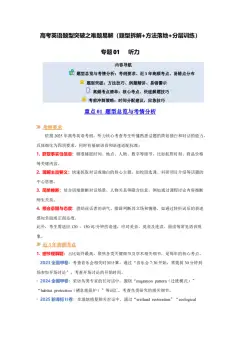
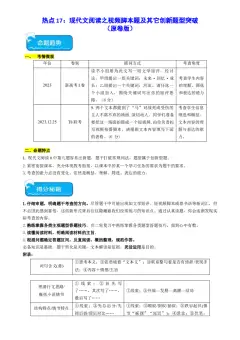
专题 01 时文快速浏览与主旨把握方法
在高考英语试卷中,时文阅读作为 “语言运用” 与 “信息获取” 结合的核心题型,主旨大意(含标题
归纳、段落大意、全文主旨)的考察绝非简单的 “内容概括”,而是对考生 “文本逻辑把控力”“信息
筛选能力”“思维深度” 的综合检验,其重要性可从考试定位、能力考查、实际应用三个维度展开。对
于考生而言,掌握主旨大意的解题方法(如 “三步浏览法”“分体裁定位技巧”),不仅能提升高考阅
读得分,更能培养终身受益的 “高效阅读” 与 “理性思维” 能力 —— 这正是高考英语时文阅读考查
主旨大意的核心价值所在。
方法讲解
核心方法:三步浏览法
步骤一:找主题段( 10-20 秒 )
知识1:有标题
技巧
①圈出 “名词短语 + 动词”(如 “Global Warming Harms Coral Reefs”→话题 + 关系);
②读首段前 1-2 句,补 “时间 / 数字 / 作者态度”。
注意:标题带问号(如 “Is AI Good?”)→仅为话题,非观点。
示例
标题:“China’s Space Station Returns 7th Batch of Scientific Samples”
首段:“On October 27, 2024, the Shenzhou-18 spacecraft carrying the 7th batch of scientific samples from China’s
Space Station landed safely in the Gobi Desert. Among the samples, zebrafish embryos and plant seeds have become
the focus of researchers.”
① 圈 出 “ 名 词 短 语 + 动 词 ” :
② 读 首 段 前 2 句 , 补 细 节 :
③ 主 题 :
知识2:无标题
技巧
①精读首段前 2-3 句,圈出 3 类词:
名词(定对象 / 话题);
形容词(定情感倾向);
逻辑词(定背景 / 转折);
②首段难→看首段末句(常总结主题)。易错注意:勿漏首段转折词(However/But)→避免片面预判。
示例1
“Nowadays, microplastic pollution has become a serious environmental problem affecting oceans and soil. Many
studies have proved its harmful effects on marine life—some fish even mistake microplastics for food. However,
Chinese researchers have recently developed a new biodegradable material that can absorb microplastics
effectively.”
1.精读首段前 3 句,圈出 3 类词:
名 词 :
形 容 词 :
逻 辑 词 :
2. 无 需 应 急 :
3. 主 题 :
示例2
“With the rapid development of holistic veterinary medicine—a branch of medical science that focuses on the overall
health of animals rather than single symptoms—more pet owners are turning to alternative treatments for their sick
pets. From acupuncture for dogs with joint pain to chiropractic adjustments for horses with mobility issues, these
treatments have gained popularity, but many veterinarians still question their scientific basis. A 2024 survey by the
American Holistic Veterinary Medical Association found that 68% of pet owners reported improvement in their pets'
conditions after such treatments, yet only 32% of traditional veterinarians recognize their effectiveness. Thus,
bridging the gap between holistic and traditional veterinary medicine is key to better pet care.”
①精读首段前 3 句遇难点:启用应急技巧,看首段末句:
.
②反推核心:
名 词 :
.
逻 辑 词 :
.
避 坑 验 证 :
.
步骤二 :找主题词( 1.5 分钟)
知识1:高频重复词
①每段首句 + 首/尾段中重复≥3 次的名词/名词短语;注意排除虚词、某段数据和笼统词。②同义替换词
知识2:逻辑词
①转折类信号词(However/But/Yet)
作用:提问题 / 反驳
技巧:圈出 “信号词后核心名词”
示例
“Urban reading rooms have become popular for their 24-hour service and free access.”However, many remote
communities still lack such facilities, making it hard for elderly residents to enjoy the service.
识别信号词: .
圈 出 信 号 词 后 核 心 名 词 :
.
快 速 判 断 :
.
②并列类信号词(Besides/First/Second)
作用:分点补充
技巧:标 “1/2” 区分维度(如优势 1/2)
示例
“Reducing plastic waste requires joint efforts from individuals and society.”First, individuals can use reusable bags
and bottles to cut down daily plastic consumption.Second, governments should ban single-use plastics in public
places and promote recycling programs.
识别信号词 : ;
标 “1/2” 区分维度:
个人维度: ;
政府维度: ;
快速判断: 。
③因果类信号词(Therefore/As a result)
作用:给结论 / 对策
技巧:圈出 “信号词后动词”
示例
“Global warming has caused Arctic ice to melt rapidly, destroying polar bears' habitats.”Therefore, countries around
the world must work together to reduce carbon emissions and protect the Arctic ecosystem.
识别信号词 ;
圈出信号词后动词 ;快速判断: ”。
④举例类信号词(For example/Such as)
作用:支撑观点
技巧:略读,仅记 “为哪句举例”
示例
“Many traditional crafts have been revived with the help of social media.”For example, craftsmen in Yunnan share
videos of making tie-dye clothes on TikTok, attracting millions of views and boosting sales of tie-dye products.
识别信号词 ;
略读例子细节
观点句 。
步骤三 :用标志词验证( 40 秒)
①选项匹配核心标志词:正确选项必包含全文高频主题词(或同义替换词),无主题词的选项直接排
除。
②警惕绝对化标志词:选项中出现 must/never/all/only 等绝对词,大概率不是主旨(主旨多为客观概
括,非极端表述)。
③锁定总结性标志词:文章尾段出现 in short/thus/therefore/to sum up 等总结词,其后内容的核心词
需与选项匹配。
④排除细节类标志词:选项含 for example/such as/specifically 等细节标志词,仅为论据,非主旨,
直接排除。
典型例题
Cancer - fighting genes in elephants could help to tackle one of the biggest killers of people, according to research.
Despite their large bodies and long lifespans (寿命), elephants are much less likely to die from cancer than humans,
with death rates of less than 5 per cent.
The paradox has puzzled scientists because more cells leads to greater replications, which increases the possibility
of the body failing to detect damaged DNA or a faulty cell that can result in tumours (肿瘤). Elephants live for almost
as long as humans, and can weigh up to five tons.
However, a group of British and European scientists say they have taken a big step towards solving Peto’s paradox,
named after the British epidemiologist Sir Richard Peto. Elephants, they say, carry a much larger, more diverse group
of tumour - fighting proteins.
The findings, published last week in the journal Molecular Biology and Evolution, raise hopes that the cancer -
fighting genes in elephants could be the key to tackling cancer, which kills about 167,000 Britons each year. Cells
keep dividing throughout an organism’s life, each carrying the risk of producing a tumour. One of the body’s weaponsis a gene called p53, known as the “guardian of the genome”, which hunts cells with faulty DNA.It encourages the
cell to repair itself or self - destruct, keeping the cell from binding with others and producing tumours.
Humans have two versions of p53 but elephants have 40, said the researchers, including those from Oxford and
Edinburgh universities. Biochemical analysis and computer simulations also showed that an elephant’s p53 genes are
structurally slightly different, providing a much larger anti - cancer toolkit. The researchers suspect that while faulty
cells might be able to skirt two p53 versions, they cannot bind to other cells as easily in the face of dozens.
The findings will open the way for research on how p53 genes are activated and on medical treatment for
humans.
Which is the most suitable title for the text?
A. Scientists Find Anti - cancer Genes in Elephants
B. P53 Genes Play Essential Role in Fighting Cancer
C. Elephant Genes Could Be Key to Preventing Cancer
D. Groundbreaking Medical Treatment for Cancer on the Way
步骤一:找主题段(10-20 秒)
精读首段前 2-3 句,圈出 3 类词:
① 名 词 ( 定 对 象 / 话 题 ) :
.
② 形 容 词 ( 定 情 感 倾 向 ) :
.
步骤二:找主题词(1.5 分钟)
知识 1 :高频重复词
①每段首句 + 首/尾段中重复≥3 次的名词/名词短语;注意排除虚词、某段数据和笼统词。
②同义替换词
.
知识 2 :逻辑词
① :前文提出 “大象体型大、寿
命长却癌症率低” 的悖论,后文通过其明确文本重点是 “大象基因与抗癌的关联”。
② 结 论 句 ( 尾 段 ) :
.进一步强化 “大象基因对人类抗癌的意义”。
步骤三:用标志词验证(40 秒)
选项 主题词匹配度 验证 结论
A选项 主题词匹配度 验证 结论
B
C
D
即时练习
2023年全国乙卷
If you want to tell the history of the whole world, a history that does not privilege one part of humanity, you
cannot do it through texts alone, because only some of the world has ever had texts, while most of the world, for most
of the time, has not. Writing is one of humanity's later achievements, and until fairly recently even many literate (有
文字的) societies recorded their concerns not only in writing but in things.
1. What is the first paragraph mainly about?
A. How past events should be presented.
B. What humanity is concerned about.
C. Whether facts speak louder than words.
D. Why written language is reliable.
2024年浙江卷
The Stanford marshmallow test was originally conducted by psychologist Walter Mischel in the late
1960s.Children aged four to six at a nursery school were placed in a room.A single sugary treat, selected by the
child, was placed on a table.Each child was told if they waited for 15 minutes before eating the treat, they would
be given a second treat.Then they were left alone in the room.Follow-up studies with the children later in life showed
a connection between an ability to wait long enough to obtain a second treat and various forms of success.
As adults we face a version of the marshmallow test every day.We’re not tempted (诱惑) by sugary
treats, but by our computers, phones, and tablets — all the devices that connect us to the global delivery
system for various types of information that do to us what marshmallows do to preschoolers.
We are tempted by sugary treats because our ancestors lived in a calorie-poor world, and our brains developed
a response mechanism to these treats that reflected their value — a feeling of reward and satisfaction.But as we’ve
reshaped the world around us, dramatically reducing the cost and effort involved in obtaining calories, we stillhave the same brains we had thousands of years ago, and this mismatch is at the heart of why so many of us
struggle to resist tempting foods that we know we shouldn’t eat.
A similar process is at work in our response to information.Our formative environment as a species was
information-poor, so our brains developed a mechanism that prized new information.But global connectivity has
greatly changed our information environment.We are now ceaselessly bombarded ( 轰 炸 ) with new
information.Therefore, just as we need to be more thoughtful about our caloric consumption, we also need to be
more thoughtful about our information consumption, resisting the temptation of the mental “junk food” in order to
manage our time most effectively.
2.Which of the following is the best title for the text?
A.Eat Less, Read More
B.The Bitter Truth about Early Humans
C.The Later, the Better
D.The Marshmallow Test for Grown-ups
2024年新课标Ⅱ卷
We all know fresh is best when it comes to food.However, most produce at the store went through weeks of
travel and covered hundreds of miles before reaching the table.While farmer’s markets are a solid choice to reduce
the journey, Babylon Micro-Farm (BMF) shortens it even more.
BMF is an indoor garden system.It can be set up for a family.Additionally, it could serve a larger audience
such as a hospital, restaurant or school.The innovative design requires little effort to achieve a reliable weekly supply
of fresh greens.
Specifically, it’s a farm that relies on new technology.By connecting through the Cloud, BMF is remotely
monitored.Also, there is a convenient app that provides growing data in real time.Because the system is automated,
it significantly reduces the amount of water needed to grow plants.Rather than watering rows of soil, the system
provides just the right amount to each plant.After harvest, users simply replace the plants with a new pre-seeded
pod (容器) to get the next growth cycle started.
Moreover, having a system in the same building where it’s eaten means zero emissions (排放) from
transporting plants from soil to salad.In addition, there’s no need for pesticides and other chemicals that pollute
traditional farms and the surrounding environment.
BMF employees live out sustainability in their everyday lives.About half of them walk or bike to work.Inside
the office, they encourage recycling and waste reduction by limiting garbage cans and avoiding single-use
plastic.“We are passionate about reducing waste, carbon and chemicals in our environment” said a BMF
employee.
3.What does the text mainly talk about?
A.BMF’s major strengths.
B.BMF’s general management.
C.BMF’s global influence.
D.BMF’s technical standards.
2024年新课标Ⅰ卷“I am not crazy” says Dr.William Farber, shortly after performing acupuncture(针灸)on a rabbit.“I am ahead
of my time.” If he seems a little defensive, it might be because even some of his coworkers occasionally laugh at his
unusual methods.But Farber is certain he’ll have the last laugh.He’s one of a small but growing number of American
veterinarian(兽医)now practicing “holistic” medicine — combining traditional Western treatments with
acupuncture, chiropractic(按摩疗法)and herbal medicine.
Farber, a graduate of Colorado State University,started out as a more conventional veterinarian.He became
interested in alternative treatments 20 years ago when he suffered from terrible back pain.He tried muscle-relaxing
drugs but found little relief.Then he tried acupuncture,an ancient Chinese practice, and was amazed that he
improved after two or three treatments.What worked on a veterinarian seemed likely to work on his patients.So,
after studying the techniques for a couple of years, he began offering them to pets.
Leigh Tindale’s dog Charlie had a serious heart condition.After Charlie had a heart attack,Tindale says, she was
prepared to put him to sleep, but Farber’s treatments eased her dog’s suffering so much that she was able to keep him
alive for an additional five months.And Priscilla Dewing reports that her horse, Nappy,“moves more easily and rides
more comfortably” after a chiropractic adjustment.
4.What does paragraph 3 mainly talk about?
A.Steps of a chiropractic treatment.
B.The complexity of veterinarians’ work.
C.Examples of rare animal diseases.
D.The effectiveness of holistic medicine.
模拟训练
2025-2026年高三安徽模拟卷
In a new study, conducted by Ohio State University, researchers set out to explain why children often gather
more information than they need to complete a task, exploring new ways to solve it even when they know the best
solution and have done many times before.
“Children can’t seem to stop themselves from gathering more information than they need to complete a task,
even when they know exactly what they need,” said Vladimir Sloutsky, co-author of the study and professor of
psychology at The Ohio State University.
Sloutsky thought this might be because children’s brains aren’t mature enough to understand the task or pay
proper attention, or because they lack the control to focus. But, to his surprise, he found that the most likely reason
for this “over-exploring” is that working memory is not fully developed in children. Therefore, while adults can easily
remember the best way to complete a task, children are forced to question their often-correct memories and re-explore
tasks they’ve done before.
Simply, children don’t hold information they need to complete a task in their memory for very long, the study
suggests.
Speaking about one of the tasks children were asked to complete in the study, where they were asked to identify
an animal by uncovering parts of a hidden picture of it, Sloutsky explained that even though it became obvious after
a few tries that the tail was the easiest and quickest part to uncover in order to identify the animal, the kids “just keptuncovering more body parts before they made their choice.”
“The children learned that one body part will tell them what the creature is, but they may be concerned that
they don’t remember correctly. Their working memory is still under development,” Sloutsky said. “They want to
resolve this uncertainty by continuing to sample, by looking at other body parts to see if they line up with what they
think.”
The children in the study were aged between four and six, with more research set to uncover exactly when
children’s working memory improves and gives them the confidence to “act more like adults do” when it comes to
completing tasks.
1.What did Sloutsky initially think caused children’s “over-exploring”?
A.Lack of interest in tasks. B.Immature brain and poor focus.
C.Strong desire for new experiences. D.Overdeveloped working memory.
2.What did children show in the animal identification task?
A.They struggled to recognize any features.
B.They ignored the most obvious visual clues.
C.They immediately guessed upon seeing the tail.
D.They kept checking additional body parts.
3.What can be predicted about children’s behavior as their working memory develops?
A.They will become more confident in their choices.
B.They will prefer more complex problem-solving.
C.They will require more time to complete tasks.
D.They will pick up more unnecessary skills.
4.What is the main idea of the text?
A.Children explore less efficiently than adults.
B.Children need more practice to remember tasks.
C.Children’s curiosity leads to better learning outcomes.
D.Children’s memory development affects their task-solving.
2025-202年高三重庆渝中
I was lost in the city. My nerves were stressed. My muscles were tense. My heart was pounding. My hands
held the steering wheel (方向盘) of my car as I circled the same city block for the tenth time. As a girl, I grew up in
the country. I had never driven in the city before, but I needed to pick up my elder daughter. With my three sons in
the car, I was trying my best to find the exit back to the interstate highway. This happened long before GPS, and my
handwritten directions seemed to be wrong. It didn't help that the just inches to spare as I inched my way back to
the turnoff again. Finally, in desperation, I whispered, “Please. I want to go home. Help us find our way safely
there!”
At that moment, I saw it, the tiny one-lane exit that led to the interstate highway again. At the last second, I
pulled into the right lane. The traffic out of the city at that time of the day was even worse than that in the city. It was
heavy traffic at 45 miles per hour. Finally, though, the vehicles started to thin out and moved freely, and I could relaxat the wheel. I took in the beauty of the mountains covered by green forests. I smiled at the sun shining down on
them. At last, we turned off the four-lane highway onto the winding two-lane road that would take us the last 16 miles
home. I turned on the radio and laughed with joy when I heard the song, “Take Me Home, Country Roads”, playing
loudly.
In our life, we will all take many paths and travel around many places. But in the end, all roads will lead us
home again. So travel with a light and loving heart!
5.Why was the author lost in the city?
A.She couldn’t use the GPS properly.
B.She didn’t know the city’s entrance.
C.She forgot the directions provided online.
D.She had no driving experience in the city.
6.When did the author start to feel at ease while driving?
A.When she turned onto the two-lane road.
B.As soon as she heard the song on the radio.
C.After she saw the exit to the interstate highway.
D.When the traffic on the interstate highway lessened.
7.What does the author mainly express in the last paragraph?
A.Her insights into life. B.Her opinions on home.
C.Her desire for travelling. D.Her love for urban paths.
8.What is the best title for the text?
A.Traffic Tales B.Lost and Found
C.Roads Lead Home D.Country and City Adventures