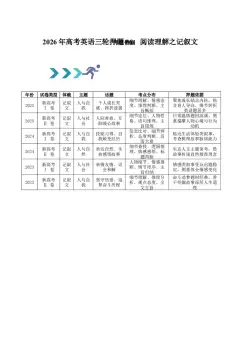
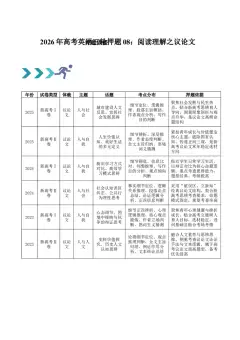
时文阅读与高考模拟冲刺试卷05(话题综合)
题号
难度
知识点
阅读理解A 篇
容易
应用文,杭州青年文化创新交流周启幕,搭建全球青年交流平台。
阅读理解B 篇
适中
记叙文,00 后非遗传承人,让老竹编焕发新活力。
阅读理解C 篇
适中
说明文,新技术突破,为濒危珊瑚礁带来重生希望。
阅读理解D 篇
较难
议论文,深度阅读,守护青少年认知与共情能力。
七选五
适中
四步养成终身学习的核心能力。
完形填空
适中
贵州山村支教,一场双向治愈的成长。
语法填空
适中
大熊猫国家公园,交出亮眼保护成绩单。
应用文写作
适中
邀请信,中国传统节日。
第一部分 阅读理解(共两节,满分50 分)
第一节(共15 小题;每小题2.5 分,满分37.5 分)
阅读下列短文,从每题所给的A、B、C、D 四个选项中,选出最佳选项。
A
Notice of 2025 China International Youth Innovation & Culture Exchange Week
Organized by the China Youth Development Foundation and supported by the Ministry of Culture and
Tourism, the 2025 China International Youth Innovation & Culture Exchange Week is scheduled to be held in
Hangzhou from November 15 to 21, 2025. This event aims to build a global platform for young people aged 16-25
to exchange cultural insights, showcase innovative projects, and build cross-border friendships.
▌Event Arrangements
Opening Ceremony & Keynote Forum (Nov 15)
The opening ceremony will feature speeches by renowned cultural scholars and young innovators from 12
countries. The forum will focus on the theme "Youth Power in Cultural Inheritance and Global Communication",
with live streaming available on our official website.
Cultural Experience Workshops (Nov 16-18)
We offer 15 themed workshops, including Chinese calligraphy, silk weaving, traditional paper-cutting, and
global folk music exchange. Each workshop is limited to 30 participants, and free pre-registration is required via
our official WeChat mini-program.
Global Youth Innovation Competition (Nov 19-20)
The competition welcomes innovative projects related to cultural inheritance, low-carbon development, and
public welfare. The top 3 projects will be awarded a total prize pool of 200,000 yuan, along with incubation support
from Chinese tech enterprises.
Closing Ceremony & Cultural Gala (Nov 21)
The closing ceremony will end with a gala featuring traditional and modern performances from participating
countries. All registered participants are welcome to attend for free.
▌Registration Notes
All participants must complete online registration before November 1, 2025. For overseas participants, we
provide free accommodation during the event. For more details, please visit https://www.cycweek2025.com.
1. What is the main purpose of the 2025 Exchange Week?
A. To promote Hangzhou's tourism resources to global youth.
B. To offer a platform for youth cultural exchange and innovation.
C. To award young innovators for their environmental protection efforts.
D. To provide free cultural courses for overseas students in China.
2. Which activity requires pre-registration through the WeChat mini-program?
A. The opening ceremony keynote forum.
B. The cultural experience workshops.
C. The global youth innovation competition.
D. The closing ceremony cultural gala.
3. What benefit can overseas participants get from the event?
A. Free accommodation during the event.
B. A guaranteed award in the innovation competition.
C. Free round-trip air tickets to Hangzhou.
D. Long-term incubation support from tech companies.
B
At 22, Li Jiaqi has already been named a "young inheritor of intangible cultural heritage" in her hometown of
Anji, Zhejiang Province, a place famous for its centuries-old bamboo weaving craft. Unlike many of her peers who
chose to pursue office jobs in big cities after college, Li returned to her village to take up the bamboo strips that her
grandmother had held for over 60 years.
Li's connection with bamboo weaving started in childhood. She grew up watching her grandmother turn thin
bamboo strips into delicate baskets, tea sets, and even decorative paintings. "When I was a kid, I thought it was just
old-fashioned handicraft for daily use," Li recalled. It was not until she held a solo exhibition of her bamboo
weaving works at her university in 2023 that she realized the charm of this craft could reach far beyond the
mountain village.
Her exhibition, which combined traditional bamboo weaving techniques with modern design elements,
attracted wide attention. One of her most popular works, a bamboo woven lamp featuring the pattern of the West
Lake, was collected by the Zhejiang Provincial Museum. However, the road to inheritance was not smooth. At first,
many villagers doubted her choice, saying that a college graduate was "wasting her talent" on a "dying" craft.
Instead of giving up, Li launched online live streams to teach bamboo weaving skills, and designed small,
affordable creative products such as keychains and phone cases. Now, her accounts have over 200,000 followers,
and her workshop has trained more than 50 young people from across the country. "Bamboo weaving is not just a
craft from the past. It can keep up with the times as long as we give it new life," Li said. "I hope more young people
will see the beauty of traditional Chinese culture through these thin bamboo strips."
4. Why did Li Jiaqi return to her hometown after college?
A. To find a well-paid office job in her village.
B. To inherit and promote the bamboo weaving craft.
C. To hold an exhibition of her works at a local museum.
D. To learn bamboo weaving from her grandmother.
5. What changed Li Jiaqi's opinion about bamboo weaving?
A. Her grandmother's encouragement.
B. The popularity of her works in the village.
C. Her solo exhibition at the university.
D. The collection of her work by the provincial museum.
6. What can we infer about Li Jiaqi from paragraph 3?
A. She was not supported by all the villagers at first.
B. Her works were widely recognized by museums nationwide.
C. She met no difficulties in promoting the traditional craft.
D. Her design was considered out of date by young people.
7. How did Li Jiaqi make bamboo weaving popular among young people?
A. By holding offline exhibitions across the country.
B. By teaching skills online and creating modern creative products.
C. By cooperating with famous designers around the world.
D. By setting up training courses in universities.
C
Coral reefs, often called the "rainforests of the sea", are home to more than 25% of marine species, yet they are
facing an unprecedented crisis due to climate change, ocean acidification, and human activities. According to a
2025 report from the Global Coral Reef Monitoring Network, half of the world's coral reefs have disappeared since
1950, and another 30% are at risk of extinction by 2030. However, a new study published in *Nature
Communications* in July 2025 has brought new hope for coral reef restoration.
The study, led by a team of scientists from the University of Queensland and the Australian Institute of Marine
Science, has developed a new "coral seeding" technique that significantly increases the survival rate of young
corals in the wild. Traditional coral restoration methods usually involve transplanting fully grown coral fragments
onto damaged reefs, which is labor-intensive, costly, and has a survival rate of only around 30% in most cases.
The new technique, by contrast, collects coral eggs and sperm during the annual coral spawning event, raises
them into baby corals in a controlled laboratory environment, and then plants them onto damaged reefs using
specially designed biodegradable carriers. These carriers, made from plant-based materials, can protect young
corals from predators and ocean currents, while gradually breaking down in the water without causing pollution.
After a 12-month field trial on the Great Barrier Reef, the research team found that the survival rate of corals
planted with the new technique reached 78%, more than twice the rate of traditional methods. What's more, the
corals grown with this method showed higher tolerance to rising ocean temperatures, a key factor in coral bleaching
events.
"Our technique solves two of the biggest problems in coral restoration: low survival rate and high cost," said
Dr. Emma Harrison, the lead author of the study. "We can produce hundreds of thousands of baby corals at a much
lower cost than before, and scale up the restoration work across entire reef systems." The research team is now
working with local communities and environmental organizations to apply this technique to other damaged coral
reefs around the world, with projects planned in Southeast Asia and the Caribbean in 2026.
8. What is the main problem facing coral reefs according to paragraph 1?
A. They are losing their ability to support marine species.
B. A large number of them are disappearing or at risk.
C. Ocean acidification has made them completely uninhabitable.
D. Human activities have replaced them with artificial reefs.
9. What is the disadvantage of traditional coral restoration methods?
A. They can only be used on the Great Barrier Reef.
B. They have a very low survival rate and high cost.
C. They cause serious pollution to the ocean environment.
D. They require a large number of fully grown corals.
10. What does the underlined word "spawning" in paragraph 3 probably mean?
A. Reproducing
B. Feeding
C. Migrating
D. Hibernating
11. What can we learn about the new coral seeding technique from the text?
A. It uses plastic carriers to protect young corals.
B. It has been applied worldwide with great success.
C. It improves coral survival rate and heat tolerance.
D. It is more labor-intensive than traditional methods.
D
In an era dominated by short videos, 15-second social media posts, and endless digital notifications, deep
reading – the slow, immersive practice of engaging with a long-form text – is often dismissed as an outdated habit.
However, a growing body of research in cognitive science and education is warning that the decline of deep reading
is taking a hidden toll on young people's intellectual and emotional development.
According to a 2025 study by the American Psychological Association, the average attention span of teenagers
has dropped from 12 seconds in 2010 to just 8 seconds in 2025, shorter than that of a goldfish. Researchers link this
decline directly to the rise of "skimming culture", where people scan digital content for keywords instead of reading
carefully. While skimming is a useful skill for processing large amounts of information quickly, it cannot replace
the cognitive benefits of deep reading.
Deep reading, unlike skimming, requires sustained focus and critical thinking. When we read a long, complex
text, our brains are forced to make connections between ideas, follow logical arguments, and imagine scenarios
described in the text. This process strengthens the brain's prefrontal cortex, the area responsible for decision-
making, problem-solving, and emotional regulation. A 2024 study from Stanford University found that students
who engaged in regular deep reading scored 23% higher on critical thinking tests than those who only read short
digital content.
Beyond cognitive benefits, deep reading also plays a vital role in developing empathy. When we read literary
fiction, we step into the shoes of characters from different backgrounds, experience their emotions, and see the
world through their eyes. This practice helps young people understand and relate to others, a skill that is
increasingly important in an increasingly divided world.
Critics of deep reading often argue that it is inefficient in the digital age, where information is abundant and
time is limited. But this argument misses the point: deep reading is not just about absorbing information, but about
building the cognitive and emotional capacity to understand, analyze, and care about the world around us. As
Maryanne Wolf, a leading cognitive neuroscientist, once said: "We read not only to know what others have
experienced, but to become the kind of people who can think deeply, feel deeply, and act wisely."
12. What is the main argument of the text?
A. Skimming culture is more efficient than deep reading in the digital age.
B. The decline of deep reading harms young people's development.
C. Short videos and social media have improved people's attention span.
D. Deep reading is an outdated habit for young people today.
13. What can we learn from the studies mentioned in the text?
A. Teenagers' attention span has increased with the development of digital media.
B. Skimming can significantly improve people's critical thinking ability.
C. Regular deep reading helps improve students' critical thinking performance.
D. Deep reading has no effect on people's emotional regulation ability.
14. Why does deep reading help develop empathy according to the text?
A. It teaches readers how to express their emotions better.
B. It allows readers to experience the lives and feelings of characters.
C. It provides readers with more information about different cultures.
D. It helps readers improve their communication skills with others.
15. What is the author's attitude towards the future of deep reading?
A. Doubtful
B. Optimistic
C. Supportive
D. Indifferent
第二节(共5 小题;每小题2.5 分,满分12.5 分)
根据短文内容,从短文后的选项中选出能填入空白处的最佳选项。选项中有两项为多余选项。
Lifelong learning is no longer just a nice-to-have skill, but a necessity in today's fast-changing world. With
technology developing rapidly and industries transforming constantly, the ability to keep learning new things
throughout your life is the key to staying competitive and fulfilled. 16       .
Set clear, achievable learning goals.
Many people give up on lifelong learning because they set goals that are too vague or too ambitious. Instead of
saying "I want to learn a new language", break it down into specific, small steps: "I will learn 10 new words every
day" or "I will finish one lesson per week". 17


   This way, you can track your progress and stay motivated.
18


One of the biggest barriers to lifelong learning is the belief that you don't have enough time. The truth is, you
don't need to spend hours every day learning. Even 15-20 minutes of consistent learning every day adds up to huge
progress over time. You can listen to a podcast while commuting, read a book chapter during your lunch break, or
watch an educational video before bed.
Embrace a growth mindset.
People with a fixed mindset believe that their abilities are unchangeable, so they avoid challenges and give up
easily when they fail. 19


   They see mistakes as opportunities to learn, and challenges as chances to grow.
When you embrace a growth mindset, you won't be afraid to try new things, even if you're not good at them at first.
Build a learning community.
Learning with others can make the process more enjoyable and more effective. Join an online course, a local
study group, or a community of people with the same learning interests. 20


   You can share your progress,
ask for help when you get stuck, and celebrate each other's achievements.
A. Make learning a daily habit, not a chore.
B. Here are some practical ways to develop lifelong learning habits.
C. People with a growth mindset, however, believe that they can improve their abilities through effort.
D. You can also find a learning partner to hold you accountable for your goals.
E. Each small goal should be measurable and have a clear deadline.
F. Learning a new skill can bring you a lot of happiness and a sense of achievement.
G. It's important to choose the right learning method that suits you best.
 第二部分 语言运用(共两节,满分30 分)
第一节(共15 小题;每小题1 分,满分15 分)
阅读下面短文,从短文后各题所给的A、B、C、D 四个选项中,选出可以填入空白处的最佳选项。
Last summer, I, a 17-year-old high school student, joined a volunteer teaching program in a remote village in
Guizhou Province. Before the trip, I had 21 about what I could offer to the children there, as I had no teaching
experience. However, what I 22 in the village changed my life completely.
The first day I stepped into the classroom, I was 23 by the bright eyes of the 20 children in front of me. Most
of them were left-behind children, living with their grandparents while their parents worked in big cities. At first,
they were very 24 and hardly spoke in class. I tried my best to create a relaxing 25, telling them stories about my
life in the city and playing games with them.
Slowly, the children began to 26 up to me. They shared their little secrets with me, asked me endless
questions about the outside world, and even brought me wild fruits they picked from the mountains. What 27 me
most was their strong desire for knowledge. Despite the poor learning conditions, they got up at 6 a.m. every day to
study, and never 28 a class.
During my one-month stay, I taught them English, painting, and told them about the importance of 29 their
dreams. But I soon realized that I was the one who learned more. The children taught me to be 30 for the small
things in life, to be brave in the face of difficulties, and to never lose hope.
When it was time for me to leave, the children gathered around me, crying and giving me hand-drawn
pictures. I 31 them that I would come back to visit them. That summer, I didn't just 32 knowledge to the children;
I built a lifelong connection with them, and found the 33 of volunteer work.
Now, I have set up a study group with my classmates to 34 books and stationery for the village children. I
know that this 35 journey will continue, and I will always do my best to help these lovely children.
21. A. doubts
B. dreams
C. plans
D. hopes
22. A. expected
B. experienced
C. designed
D. showed
23. A. frightened
B. shocked
C. touched
D. embarrassed
24. A. excited
B. curious
C. outgoing
D. shy
25. A. atmosphere
B. system
C. rule
D. holiday
26. A. look
B. open
C. wake
D. turn
27. A. annoyed
B. puzzled
C. impressed
D. confused
28. A. attended
B. missed
C. took
D. prepared
29. A. breaking
B. creating
C. hiding
D. following
30. A. grateful
B. responsible
C. suitable
D. ready
31. A. warned
B. reminded
C. promised
D. advised
32. A. take in
B. pass on
C. pick up
D. give up
33. A. difficulty
B. price
C. meaning
D. rule
34. A. collect
B. buy
C. borrow
D. steal
35. A. dangerous
B. tiring
C. boring
D. beautiful
第二节(共10 小题;每小题1.5 分,满分15 分)
阅读下面短文,在空白处填入1 个适当的单词或括号内单词的正确形式。
The Giant Panda National Park, which 36
  .

  (establish) in 2021, has achieved remarkable results in
giant panda protection over the past four years, according to a 2025 report released by the National Forestry and
Grassland Administration.
The park, covering an area of 22,000 square kilometers across Sichuan, Shaanxi and Gansu provinces, is home
37
  .

   more than 70% of China's wild giant pandas. Thanks to the continuous protection efforts, the
number of wild giant pandas in the park 38
  .

  (rise) to 1,864 by the end of 2025, an increase of 187
compared with 2021.
39.

  (lucky), the protection measures have not only benefited giant pandas, but also many other
rare species. The report shows that the number of other wild animals in the park, such as golden monkeys and
takins, has also increased 40

 .

   ( significant) in recent years.
The park has also made great progress in 41
  .

   (promote) scientific research on giant pandas.
Researchers have used advanced technologies, including AI monitoring and genetic analysis, 42
  .

   (learn) more
about the living habits of wild giant pandas.
"Giant pandas are 43

 .

  symbol of China's biodiversity protection efforts," said an official from the
administration. "We will continue to improve the protection system, and work with 44
  .

  (globe)
organizations to protect these lovely animals and their habitats. We hope that through our efforts, more and more
people will realize the 45 (important) of wildlife protection."
 第三部分 写作(满分15 分)
假定你是李华,你的英国笔友Peter 对中国传统节日文化非常感兴趣。请你给他写一封邮件,邀请他参加
你校将于4 月4 日举办的“中国传统节日文化展”,内容包括:
1. 展览的时间、地点;
2. 展览的主要内容;
3. 邀请他参加并陪同参观。
注意:
1. 词数80 左右;
2. 可以适当增加细节,以使行文连贯。
Dear Peter,


Yours,
Li Hua