主题05 对社会有突出贡献的人物

01 话题词汇佳句
02 时文热点阅读(全文翻译,词汇积累,长难句分析)
03 高考真题链接
04 话题阅读精练
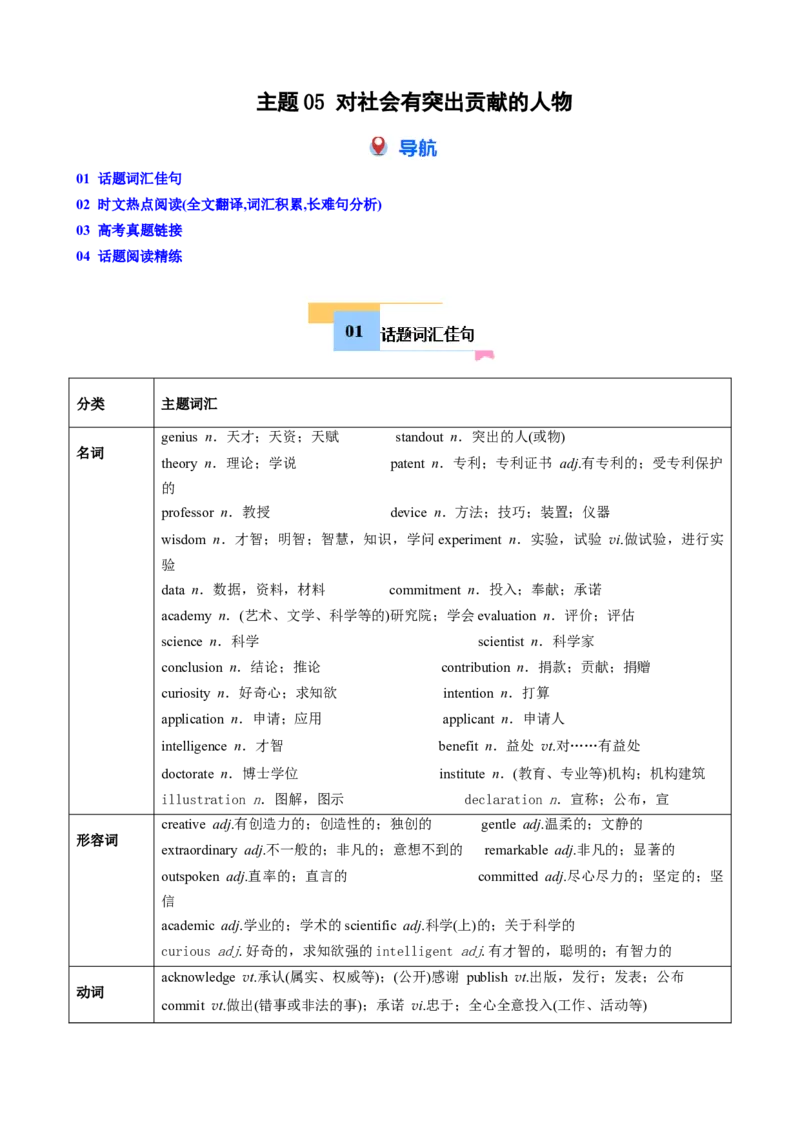
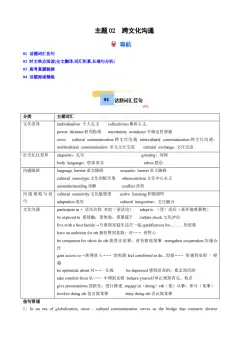
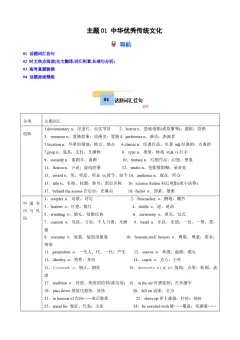
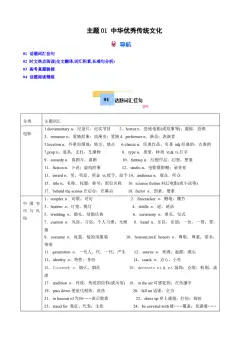
分类
主题词汇
名词
genius n.天才;天资;天赋        standout n.突出的人(或物)
theory n.理论;学说             patent n.专利;专利证书 adj.有专利的;受专利保护
的
professor n.教授                 device n.方法;技巧;装置;仪器
wisdom n.才智;明智;智慧,知识,学问experiment n.实验,试验 vi.做试验,进行实
验
data n.数据,资料,材料         commitment n.投入;奉献;承诺
academy n.(艺术、文学、科学等的)研究院;学会evaluation n.评价;评估
science n.科学                               scientist n.科学家
conclusion n.结论;推论                 contribution n.捐款;贡献;捐赠
curiosity n.好奇心;求知欲               intention n.打算
application n.申请;应用                 applicant n.申请人
intelligence n.才智                      benefit n.益处 vt.对……有益处
doctorate n.博士学位                    institute n.(教育、专业等)机构;机构建筑
illustration n.图解,图示                 declaration n.宣称;公布,宣
形容词
creative adj.有创造力的;创造性的;独创的       gentle adj.温柔的;文静的
extraordinary adj.不一般的;非凡的;意想不到的   remarkable adj.非凡的;显著的
outspoken adj.直率的;直言的                  committed adj.尽心尽力的;坚定的;坚
信
academic adj.学业的;学术的scientific adj.科学(上)的;关于科学的
curious adj.好奇的,求知欲强的intelligent adj.有才智的,聪明的;有智力的
动词
acknowledge vt.承认(属实、权威等);(公开)感谢 publish vt.出版,发行;发表;公布
commit vt.做出(错事或非法的事);承诺 vi.忠于;全心全意投入(工作、活动等)
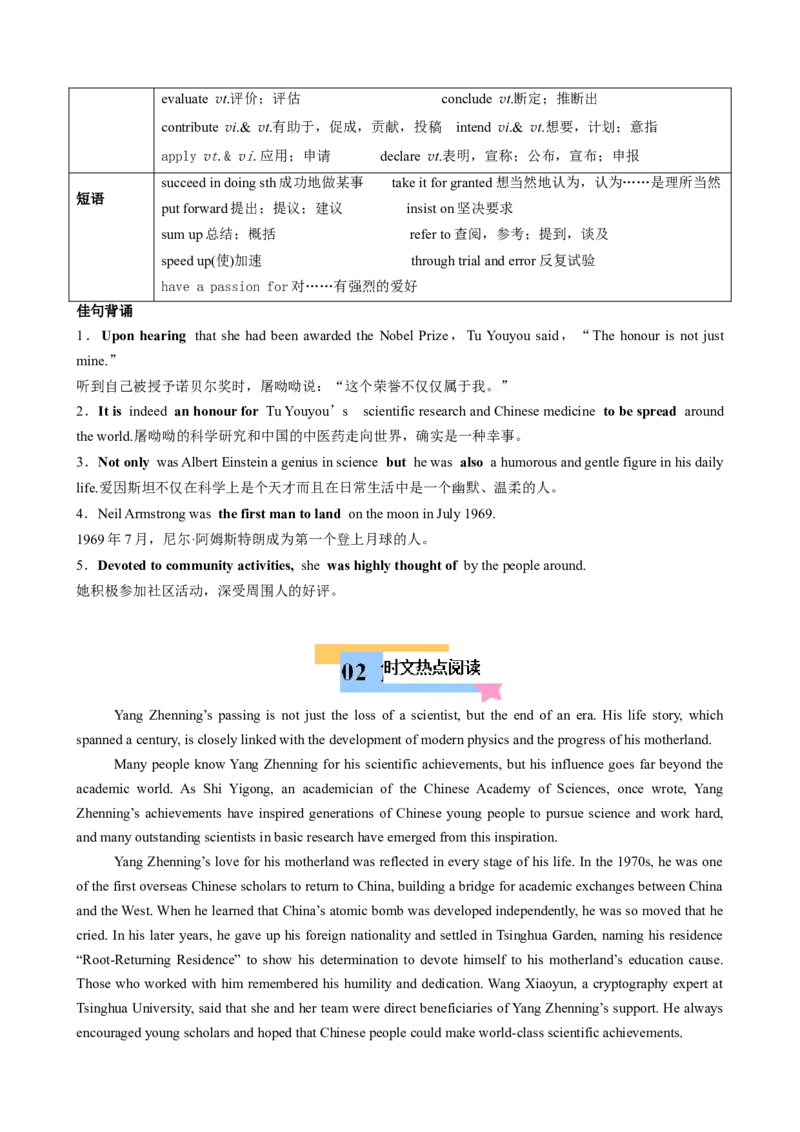
evaluate vt.评价;评估                    conclude vt.断定;推断出
contribute vi.& vt.有助于,促成,贡献,投稿  intend vi.& vt.想要,计划;意指
apply vt.& vi.应用;申请       declare vt.表明,宣称;公布,宣布;申报
短语
succeed in doing sth 成功地做某事    take it for granted 想当然地认为,认为……是理所当然
put forward 提出;提议;建议         insist on 坚决要求
sum up 总结;概括                   refer to 查阅,参考;提到,谈及
speed up(使)加速                     through trial and error 反复试验
have a passion for 对……有强烈的爱好
佳句背诵
1.Upon hearing that she had been awarded the Nobel Prize ,Tu Youyou said,“The honour is not just
mine.”
听到自己被授予诺贝尔奖时,屠呦呦说:“这个荣誉不仅仅属于我。”
2.It is indeed an honour for Tu Youyou’s  scientific research and Chinese medicine to be spread around
the world.屠呦呦的科学研究和中国的中医药走向世界,确实是一种幸事。
3.Not only was Albert Einstein a genius in science but he was also a humorous and gentle figure in his daily
life.爱因斯坦不仅在科学上是个天才而且在日常生活中是一个幽默、温柔的人。
4.Neil Armstrong was the first man to land on the moon in July 1969.
1969 年7 月,尼尔·阿姆斯特朗成为第一个登上月球的人。
5.Devoted to community activities, she was highly thought of by the people around.
她积极参加社区活动,深受周围人的好评。
Yang Zhenning’s passing is not just the loss of a scientist, but the end of an era. His life story, which
spanned a century, is closely linked with the development of modern physics and the progress of his motherland.
Many people know Yang Zhenning for his scientific achievements, but his influence goes far beyond the
academic world. As Shi Yigong, an academician of the Chinese Academy of Sciences, once wrote, Yang
Zhenning’s achievements have inspired generations of Chinese young people to pursue science and work hard,
and many outstanding scientists in basic research have emerged from this inspiration.
Yang Zhenning’s love for his motherland was reflected in every stage of his life. In the 1970s, he was one
of the first overseas Chinese scholars to return to China, building a bridge for academic exchanges between China
and the West. When he learned that China’s atomic bomb was developed independently, he was so moved that he
cried. In his later years, he gave up his foreign nationality and settled in Tsinghua Garden, naming his residence
“Root-Returning Residence” to show his determination to devote himself to his motherland’s education cause.
Those who worked with him remembered his humility and dedication. Wang Xiaoyun, a cryptography expert at
Tsinghua University, said that she and her team were direct beneficiaries of Yang Zhenning’s support. He always
encouraged young scholars and hoped that Chinese people could make world-class scientific achievements.
After his passing, people from all walks of life came to mourn him. From elderly people in work clothes to
young students in school uniforms, they all came to pay their respects, showing that his spirit has taken root in the
hearts of the people.
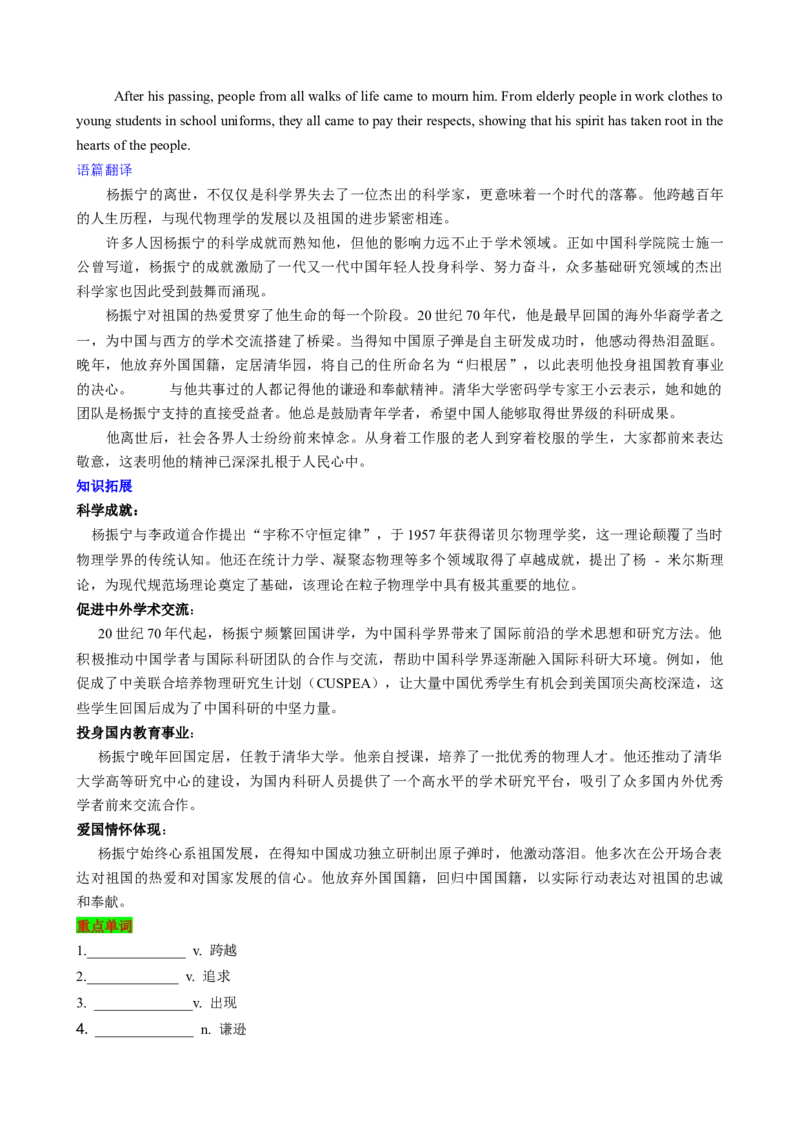
语篇翻译
    杨振宁的离世,不仅仅是科学界失去了一位杰出的科学家,更意味着一个时代的落幕。他跨越百年
的人生历程,与现代物理学的发展以及祖国的进步紧密相连。
    许多人因杨振宁的科学成就而熟知他,但他的影响力远不止于学术领域。正如中国科学院院士施一
公曾写道,杨振宁的成就激励了一代又一代中国年轻人投身科学、努力奋斗,众多基础研究领域的杰出
科学家也因此受到鼓舞而涌现。
    杨振宁对祖国的热爱贯穿了他生命的每一个阶段。20 世纪70 年代,他是最早回国的海外华裔学者之
一,为中国与西方的学术交流搭建了桥梁。当得知中国原子弹是自主研发成功时,他感动得热泪盈眶。
晚年,他放弃外国国籍,定居清华园,将自己的住所命名为“归根居”,以此表明他投身祖国教育事业
的决心。     与他共事过的人都记得他的谦逊和奉献精神。清华大学密码学专家王小云表示,她和她的
团队是杨振宁支持的直接受益者。他总是鼓励青年学者,希望中国人能够取得世界级的科研成果。
    他离世后,社会各界人士纷纷前来悼念。从身着工作服的老人到穿着校服的学生,大家都前来表达
敬意,这表明他的精神已深深扎根于人民心中。
知识拓展
科学成就:
  杨振宁与李政道合作提出“宇称不守恒定律”,于1957 年获得诺贝尔物理学奖,这一理论颠覆了当时
物理学界的传统认知。他还在统计力学、凝聚态物理等多个领域取得了卓越成就,提出了杨 - 米尔斯理
论,为现代规范场理论奠定了基础,该理论在粒子物理学中具有极其重要的地位。
促进中外学术交流:
   20 世纪70 年代起,杨振宁频繁回国讲学,为中国科学界带来了国际前沿的学术思想和研究方法。他
积极推动中国学者与国际科研团队的合作与交流,帮助中国科学界逐渐融入国际科研大环境。例如,他
促成了中美联合培养物理研究生计划(CUSPEA),让大量中国优秀学生有机会到美国顶尖高校深造,这
些学生回国后成为了中国科研的中坚力量。
投身国内教育事业:
   杨振宁晚年回国定居,任教于清华大学。他亲自授课,培养了一批优秀的物理人才。他还推动了清华
大学高等研究中心的建设,为国内科研人员提供了一个高水平的学术研究平台,吸引了众多国内外优秀
学者前来交流合作。
爱国情怀体现:
   杨振宁始终心系祖国发展,在得知中国成功独立研制出原子弹时,他激动落泪。他多次在公开场合表
达对祖国的热爱和对国家发展的信心。他放弃外国国籍,回归中国国籍,以实际行动表达对祖国的忠诚
和奉献。
重点单词
1.______________ v. 跨越
2._____________ v. 追求
3. ______________v. 出现
4. ______________ n. 谦逊
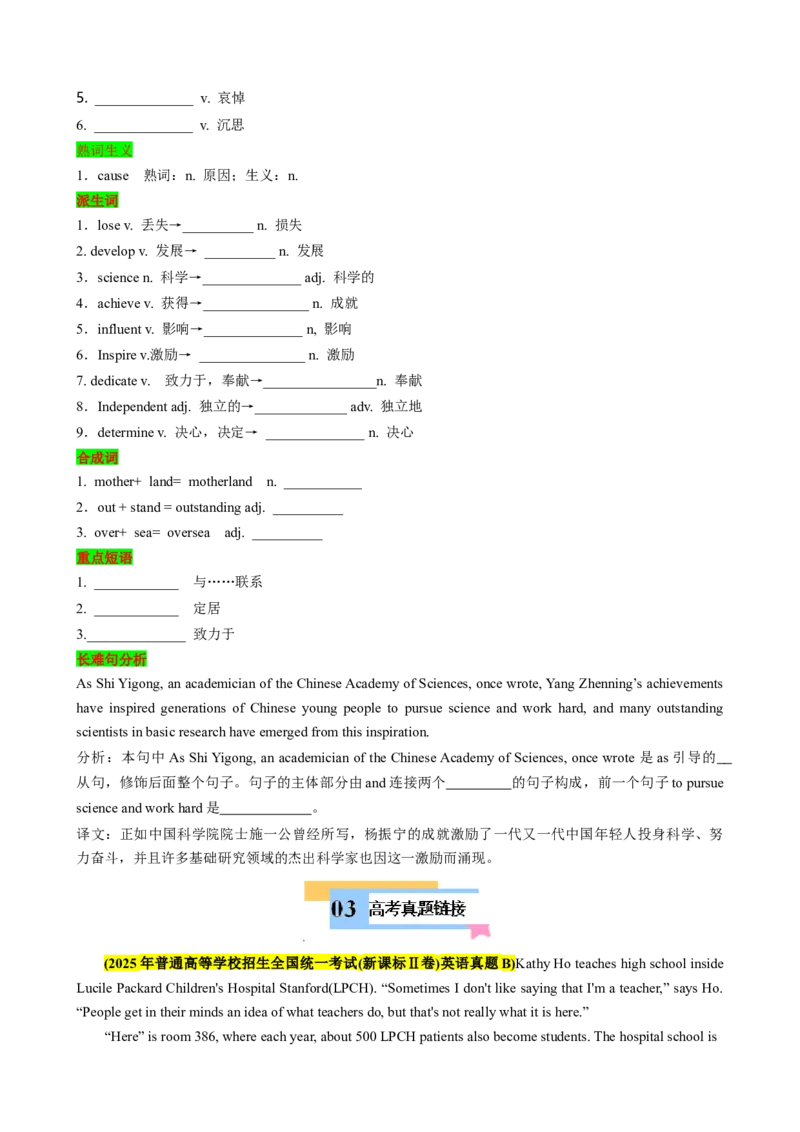
5. ______________ v. 哀悼
6. ______________ v. 沉思
熟词生义
1.cause  熟词:n. 原因;生义:n.
派生词
1.lose v. 丢失→__________ n. 损失
2. develop v. 发展→ __________ n. 发展
3.science n. 科学→______________ adj. 科学的
4.achieve v. 获得→_______________ n. 成就
5.influent v. 影响→______________ n, 影响
6.Inspire v.激励→ _______________ n. 激励
7. dedicate v.  致力于,奉献→________________n. 奉献
8.Independent adj. 独立的→_____________ adv. 独立地
9.determine v. 决心,决定→ ______________ n. 决心
合成词
1. mother+ land= motherland  n. ___________
2.out + stand = outstanding adj. __________
3. over+ sea= oversea  adj. __________
重点短语
1. ____________  与……联系
2. ____________  定居
3.______________ 致力于
长难句分析
As Shi Yigong, an academician of the Chinese Academy of Sciences, once wrote, Yang Zhenning’s achievements
have inspired generations of Chinese young people to pursue science and work hard, and many outstanding
scientists in basic research have emerged from this inspiration.
分析:本句中As Shi Yigong, an academician of the Chinese Academy of Sciences, once wrote 是as 引导的
从句,修饰后面整个句子。句子的主体部分由and 连接两个         的句子构成,前一个句子to pursue
science and work hard 是             。
译文:正如中国科学院院士施一公曾经所写,杨振宁的成就激励了一代又一代中国年轻人投身科学、努
力奋斗,并且许多基础研究领域的杰出科学家也因这一激励而涌现。
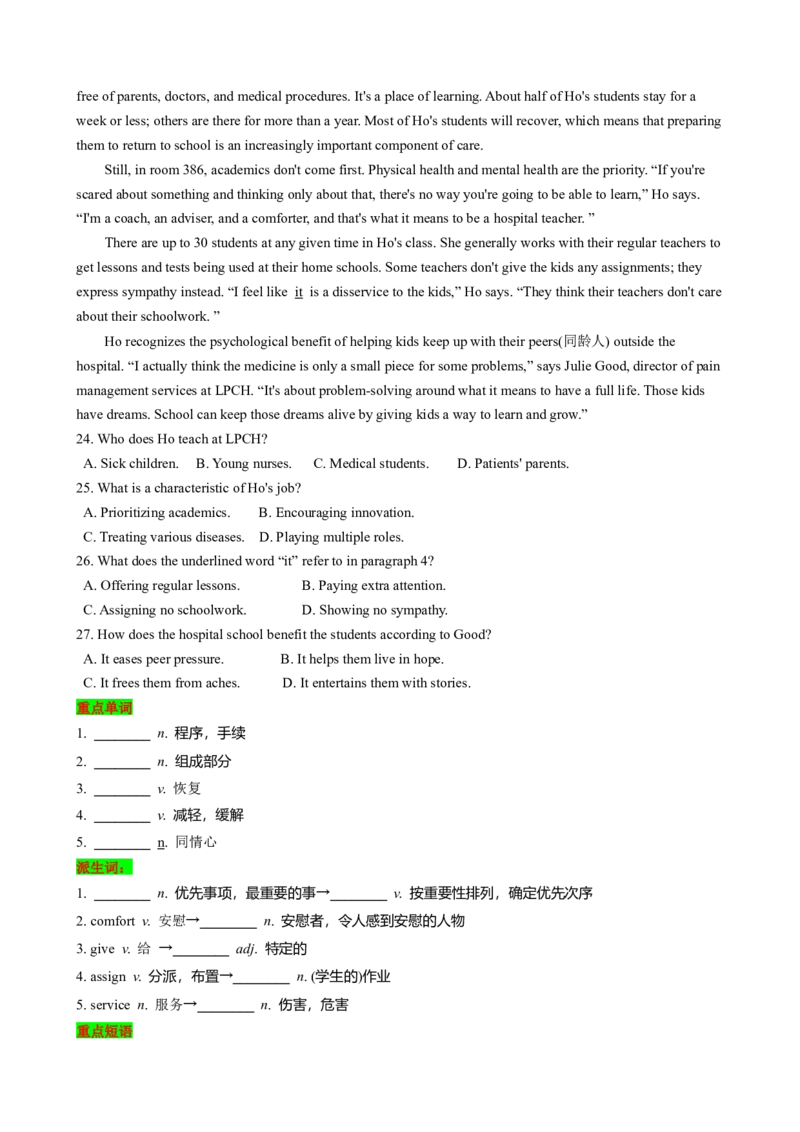
(2025 年普通高等学校招生全国统一考试(新课标Ⅱ卷)英语真题B)Kathy Ho teaches high school inside
Lucile Packard Children's Hospital Stanford(LPCH). “Sometimes I don't like saying that I'm a teacher,” says Ho.
“People get in their minds an idea of what teachers do, but that's not really what it is here.”
“Here” is room 386, where each year, about 500 LPCH patients also become students. The hospital school is
free of parents, doctors, and medical procedures. It's a place of learning. About half of Ho's students stay for a
week or less; others are there for more than a year. Most of Ho's students will recover, which means that preparing
them to return to school is an increasingly important component of care.
Still, in room 386, academics don't come first. Physical health and mental health are the priority. “If you're
scared about something and thinking only about that, there's no way you're going to be able to learn,” Ho says.
“I'm a coach, an adviser, and a comforter, and that's what it means to be a hospital teacher. ”
There are up to 30 students at any given time in Ho's class. She generally works with their regular teachers to
get lessons and tests being used at their home schools. Some teachers don't give the kids any assignments; they
express sympathy instead. “I feel like it is a disservice to the kids,” Ho says. “They think their teachers don't care
about their schoolwork. ”
Ho recognizes the psychological benefit of helping kids keep up with their peers(同龄人) outside the
hospital. “I actually think the medicine is only a small piece for some problems,” says Julie Good, director of pain
management services at LPCH. “It's about problem-solving around what it means to have a full life. Those kids
have dreams. School can keep those dreams alive by giving kids a way to learn and grow.”
24. Who does Ho teach at LPCH?
A. Sick children.  B. Young nurses.   C. Medical students.
  D. Patients' parents.
25. What is a characteristic of Ho's job?
A. Prioritizing academics.    B. Encouraging innovation.
C. Treating various diseases.  D. Playing multiple roles.
26. What does the underlined word “it” refer to in paragraph 4?
A. Offering regular lessons.
B. Paying extra attention.
C. Assigning no schoolwork.
D. Showing no sympathy.
27. How does the hospital school benefit the students according to Good?
A. It eases peer pressure.        B. It helps them live in hope.
C. It frees them from aches.      D. It entertains them with stories.
重点单词
1. ________ n. 程序,手续
2. ________ n. 组成部分
3. ________ v. 恢复
4. ________ v. 减轻,缓解
5. ________ n. 同情心
派生词:
1. ________ n. 优先事项,最重要的事→________ v. 按重要性排列,确定优先次序
2. comfort v. 安慰→________ n. 安慰者,令人感到安慰的人物
3. give v. 给 →________ adj. 特定的
4. assign v. 分派,布置→________ n. (学生的)作业
5. service n. 服务→________ n. 伤害,危害
重点短语
1. ________________无……的
2. ________________想要
3. ________________跟上,赶上
4. ________________过充实的生活
5. ________________使……摆脱
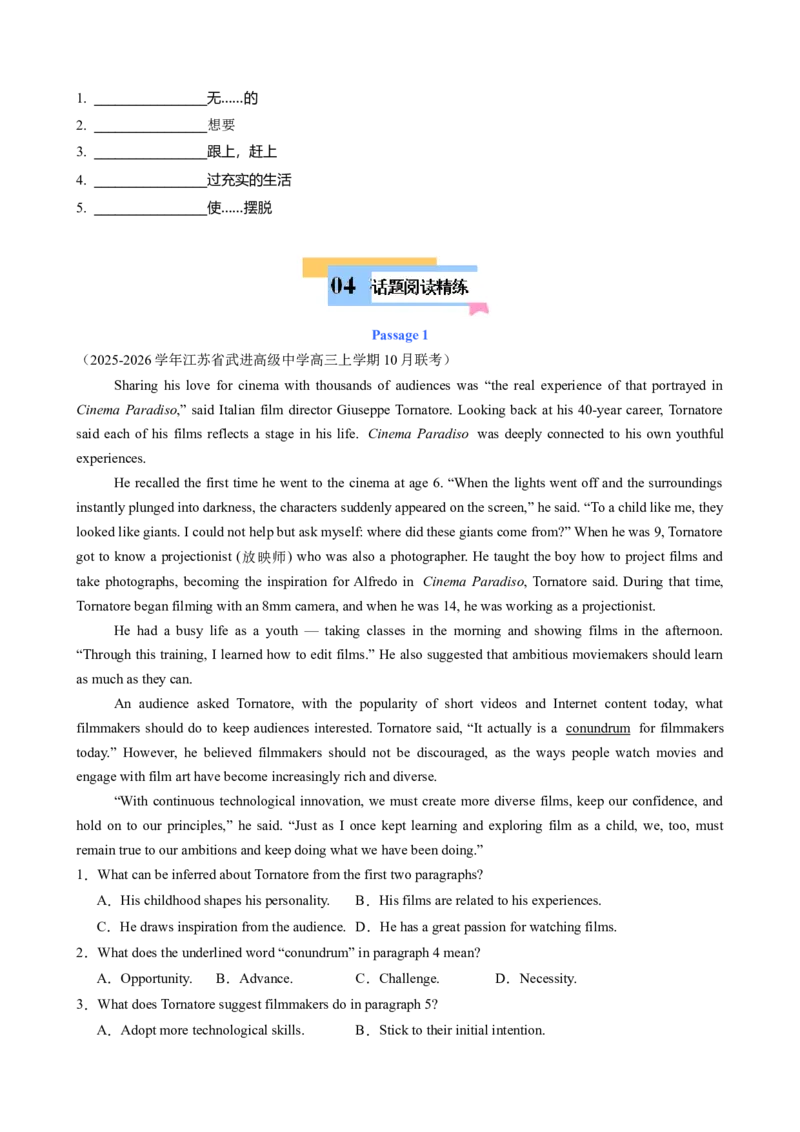
Passage 1
(2025-2026 学年江苏省武进高级中学高三上学期10 月联考)
Sharing his love for cinema with thousands of audiences was “the real experience of that portrayed in
Cinema Paradiso,” said Italian film director Giuseppe Tornatore. Looking back at his 40-year career, Tornatore
said each of his films reflects a stage in his life. Cinema Paradiso was deeply connected to his own youthful
experiences.
He recalled the first time he went to the cinema at age 6. “When the lights went off and the surroundings
instantly plunged into darkness, the characters suddenly appeared on the screen,” he said. “To a child like me, they
looked like giants. I could not help but ask myself: where did these giants come from?” When he was 9, Tornatore
got to know a projectionist (放映师) who was also a photographer. He taught the boy how to project films and
take photographs, becoming the inspiration for Alfredo in Cinema Paradiso, Tornatore said. During that time,
Tornatore began filming with an 8mm camera, and when he was 14, he was working as a projectionist.
He had a busy life as a youth — taking classes in the morning and showing films in the afternoon.
“Through this training, I learned how to edit films.” He also suggested that ambitious moviemakers should learn
as much as they can.
An audience asked Tornatore, with the popularity of short videos and Internet content today, what
filmmakers should do to keep audiences interested. Tornatore said, “It actually is a conundrum for filmmakers
today.” However, he believed filmmakers should not be discouraged, as the ways people watch movies and
engage with film art have become increasingly rich and diverse.
“With continuous technological innovation, we must create more diverse films, keep our confidence, and
hold on to our principles,” he said. “Just as I once kept learning and exploring film as a child, we, too, must
remain true to our ambitions and keep doing what we have been doing.”
1.What can be inferred about Tornatore from the first two paragraphs?
A.His childhood shapes his personality.
B.His films are related to his experiences.
C.He draws inspiration from the audience. D.He has a great passion for watching films.
2.What does the underlined word “conundrum” in paragraph 4 mean?
A.Opportunity.
B.Advance.
C.Challenge.
D.Necessity.
3.What does Tornatore suggest filmmakers do in paragraph 5?
A.Adopt more technological skills.
B.Stick to their initial intention.
C.Be faithful to their audience.
D.Set principles for their films.
4.Which of the following can best describe Tornatore from the passage?
A.Dedicated.
B.Far-sighted.
C.Cooperative.
D.Good-natured.
Passage 2
(2026 届贵州省遵义市高三上学期第一次适应性考试(一模)英语试卷)
For thousands of years, powerful dynasties ruled over China. Each dynasty was a distinct line of rulers
from the same group, order, or family. These dynasties produced powerful emperors and leaders.

 1
Throughout these dynasties, many armies were raised. Thousands of battles were fought throughout Eastern Asia.
During these conflicts, some of the greatest military commanders in ancient Chinese history rose to prominence.
These included commanders like Sun Wu and Wu Qi. These elite leaders, generals, and emperors had great
strategic skills.

 2

  Their military campaigns changed the course of Chinese history. These campaigns
influenced social and political outcomes in China for centuries.


 3

  It is widely recognized as one of the most important books written on the subject of
warfare.★Though there are few accurate details of Sun Tzu’s early life, scholars have determined that he was born
in the Chinese State of Qi and served King Ho-lu of Wu as a military specialist during the late Zhou Dynasty.
Through his knowledge and experience, Sun Tzu developed unique military theories that focused on
psychological warfare — an innovative concept during a period when most militaries were generally focused on
suppressing their enemies through overwhelming physical force.

 4
The lessons contained within The Art of War can be distilled down to one primary theme: the use of
unconventional means and deception to exert psychological dominance, producing invaluable leverage over
enemies in military situations. In his teachings, Sun Tzu encouraged tactics like eroding enemies’ alliances. He
also suggested using surprise attacks to gain a tactical advantage. Avoiding battle was another tactic he
recommended.

 5       By studying Sun Tzu’s philosophy of mental warfare and strategy versus total reliance on
physical force, military historians can enhance their understanding of how The Art of War influenced military
tactics employed by countries across the globe to this day.
A.They achieved incredible victories.
B.Sun Tzu is the author of The Art of War.
C.They have a strong sense of taking power.
D.Thus, his approach reshaped warfare principles.
E.They sought to control the entire massive region.
F.He even advised retreating to produce a favorable outcome.
G.Sun Tzu became one of the greatest generals in the world.
Passage 3
(2025-2026 学年云南省砚山县第一中学高三上学期9 月月考)
Terry, the star of the wrestling world, was born in 1953 in Georgia. His

 1

  seems to be designed
for wrestling.
Terry always had a(n)

 2

  in wrestling, and he further

 3

  the passion during high school.
He gained his     4     at the Hillsborough Community College. In order to

 5

  that passion, Terry
joined the local gym

 6

 , which was owned by brothers Jack and Jerry Brisco.


 7

  by his performance, the brothers motivated him to perform even further. Terry started wrestling
in small circuits in the Southeast where he

 8

  his skills. It was in 1979 that his hard work

 9
and he was noticed by Vincent McMahon — the promoter of the World Wrestling Federation. McMahon gave
Terry a chance to join the WWF and he

 10


  accepted.
Upon joining the WWF, a transformation was necessary. His extraordinary figure and amazing similarity to
the film idol “Hulk” led him to adopt the legendary stage

 11


  — Hulk Hogan.
Throughout his legendary

 12


 , Terry claimed the world championship title over a dozen times.
His

 13


  surpassed the boxing ring (拳击台), for his starring in numerous films and television shows.
Netflix is preparing to shoot a biographical movie in memory of him, promising to bring the

 14

name of the legend back into the spotlight. The date is yet to be announced, but one thing is

 15


 : the
spirit of the Hulk will once again dominate.
1.A.luck
B.prospect
C.viewpoint
D.fate
2.A.interest
B.idea
C.expectation
D.reputation
3.A.abandoned
B.transformed
C.developed
D.ignored
4.A.promise
B.education
C.wealth
D.prediction
5.A.pursue
B.tease
C.anticipate
D.string
6.A.attentively
B.selflessly
C.actively
D.respectfully
7.A.Awakened
B.Abused
C.Awarded
D.Astonished
8.A.composed
B.strengthened
C.contested
D.deleted
9.A.ruled out
B.came out
C.paid off
D.cut off
10.A.willingly
B.bitterly
C.definitely
D.sympathetically
11.A.performance
B.name
C.light
D.costume
12.A.career
B.fame
C.word
D.commitment
13.A.wisdom
B.appearance
C.influence
D.shape
14.A.virtual
B.household
C.ordinary
D.amateur
15.A.rough
B.sustainable
C.harmonious
D.certain
Passage 4
(2025-2026 学年河北省沧州市盐山县盐山中学高三上学期10 月月考)
George James, a British runner, at the age of 31, made his first international marathon at the European
Running Championships on April 13. It was all about     1   without any limitations.
James started the race well and stayed with the

 2

  pack through the first 10 km, going through it in
an

 3

  31:01. Although James dropped back slightly at the half-way

 4

 , he still recorded a time
of 64:12, beating his half-marathon personal best by 48 seconds.
In the second half of the race, James gradually

 5

  through the field. At the 30 km mark, he was in
the eighth place, and by the 40 km mark, he

 6

  to the sixth. In the final dash (冲刺), he overtook two
7

  opponents, Ilham Tanui Ozbilen and Ibrahim Chakir, to

 8

  his fifth-place finish.
Competing in just his third ever race over 26.2 miles — he

 9

  2:14:59 and 2:11:19 in London and
Frankfurt

 10


  last season-James finished fifth and recorded a time of 2:10:10.
Before the race, in a(n)

 11


  with AW in Brussels, he stated that “There is no

 12


 .” and
that “I still don’t believe I’m sitting here with a Great Britain shirt on.”
It may be the first of many occasions when he

 13


  his country. Not only did James

 14

higher than any British at the entire European Running Championship, but his time of 2:10:10 meant he was the
11th on the UK marathon all-time

 15


  this century.
1.A.performing
B.existing
C.cooperating
D.appearing
2.A.silent
B.leading
C.tight
D.following
3.A.independent
B.awkward
C.impressive
D.equal
4.A.stage
B.degree
C.holiday
D.pace
5.A.dropped by
B.fell behind
C.sped up
D.held on
6.A.appealed
B.referred
C.reacted
D.advanced
7.A.violent
B.sincere
C.excellent
D.regular
8.A.endanger
B.challenge
C.quit
D.secure
9.A.counted
B.timed
C.measured
D.estimated
10.A.respectively
B.particularly
C.secretly
D.collectively
11.A.announcement B.interview
C.presentation
D.negotiation
12.A.assumption
B.belief
C.aim
D.pressure
13.A.copies
B.replaces
C.represents
D.impacts
14.A.place
B.bounce
C.rate
D.classify
15.A.table
B.list
C.paper
D.document
Passage 5
(2025-2026 学年四川省成都市第七中学高三上学期10 月月考)
Roger Bannister, born in Harrow, England, early revealed a remarkable talent for running. University
education was beyond the

 1

  of his working-class parents, but he was

 2

  to secure a place at
one of England’s prestigious universities and embark on a career in     3    .
Luckily, owing to his academic

 4

 , Bannister was awarded a scholarship by Oxford University,
where his exceptional speed on the track soon earned him the attention and

 5

  from the sports media.
Surprisingly, he

 6

  to compete in the 1948 Olympics in London, preferring to focus on his

 7
and his medical studies. By 1951, Bannister had claimed the British championship in the mile and felt

 8


to pursue Olympic success. Unfortunately, a last-minute change in the schedule

 9

  him to compete
without adequate recovery between events, leaving him to finish fourth in the 1500-meter race at the 1952
Olympics. To break the four-minute mile barrier, Bannister, while undertaking full-time medical studies, dedicated
45 minutes each day

 10


  to training. On May 6, 1954, at Oxford, his sheer perseverance ultimately
11


 . At the age of 25, Bannister made history, crossing the finish line in 3:59:4. When the announcer read out
the time: “3…”, the rest was

 12


  by the deafening roar of the crowd. In the following famous “Mile of
the Century” race, Bannister

 13


  Australian runner John Landy with a time of 3:58.8 to Landy’s 3:59.6,
both under four minutes. In 1955, Bannister’s autobiography, The First Four Minutes, came out.
Bannister’s

 14


  to academic medicine proved equally distinguished, yet the spirit and legacy of
the four-minute mile remain profoundly

 15


 , resonating not only with people of our era, but to
generations before and after.
1.A.hope
B.control
C.sight
D.reach
2.A.excited
B.determined
C.satisfied
D.surprised
3.A.sport
B.biology
C.writing
D.medicine
4.A.passion
B.distinction
C.courage
D.subject
5.A.support
B.admission
C.recognition
D.explosion
6.A.declined
B.planned
C.decided
D.promised
7.A.family
B.training
C.profession
D.competition
8.A.eager
B.proud
C.prepared
D.nervous
9.A.forced
B.allowed
C.tempted
D.encouraged
10.A.undoubtedly
B.consciously
C.attentively
D.exclusively
11.A.paid back
B.took off
C.turned out
D.paid off
12.A.favoured
B.attracted
C.drowned
D.confirmed
13.A.challenged
B.outpaced
C.overlooked
D.failed
14.A.access
B.attitude
C.contribution
D.approach
15.A.beneficial
B.considerate
C.acceptable
D.inspirational
Passage 6
(2025-2026 学年浙江省杭州第二中学高三上学期10 月月考英语试题)
Su Shi was a poet, politician and educator, but he had many other strings to his bow. One of the many
talents of this

 1

  (amaze) clever and creative man was cooking. By far and away his most famous dish is
Dongpo Pork.
Su Shi was also a master calligrapher,

 2

  (rank) first of the four great calligraphers of the Song
Dynasty.Prior to his adulthood, he had studied the calligraphy of Wang Xizhi and later on in life, he turned to the
works of Yan Zhenqing. Nonetheless, Su Shi’s calligraphy reflected his open nature and desire for self-expression.
His “Cold Food Observance”

 3

  (tell) of his time in exile (流放). The rising and falling strokes (笔法)
are expressions of Su Shi’ s emotions, and

 4

  the story builds, so do the characters.
In addition to being a gifted calligrapher, Su Shi was a

 5

  (distinguish) painter. The trees, rocks
and     6     (bamboo) he produced with a few twists and turns of his paintbrush were free and simple in style,
but varied and expressive in meaning. To Su Shi, an old tree was particularly

 7

  (symbol), as it
represented surviving difficult times but still

 8

  (continue) to stand tall and grow. Su Shi's perspectives
9

  the art of painting were also innovative. Through his painting, he began to explore

 10


  an artist
could express their innermost thoughts and experiences through their works. In his eyes, painting was poetry, and
poetry was painting.
Passage 7
(2025-2026 学年陕西省西安中学高三上学期10 月月考)
   假设你是李华,你校英语报将举办主题为 “中华名人汇”的英语演讲比赛,你将代表你们班参加此
次比赛。请你写一篇演讲稿参赛,内容包括:
1. 你选择的历史名人;2 简述该名人的事迹
I am Li Hua, honored to represent my class in this competition. Today, I will talk about
___________________________________________________________________________________________
___________________________________________________________________________________________
___________________________________________________________________________________________
___________________________________________________________________________________________
___________________________________________________________________________________________
_____
Passage 8
(2025 届陕西省高考适应性检测(三)英语试题)
阅读下面材料,根据其内容和所给段落开头语续写两段,使之构成一篇完整的短文。
By the time Charlie Brown was in the sixth grade, he was the smallest and the youngest boy in his class.
Being a good student didn’t last forever. Later, school was all but impossible for Charlie. He failed every subject
in the eighth grade. By the time Charlie was in junior high, he began to have trouble. He flunked physics in high
school, getting a grade of zero. By the tenth grade, Schulz said that he had “failed everything in sight. ”
Charlie also failed in Latin, algebra, and English. He didn’t do much better in sports. Although he did
manage to make the school’s golf team, he promptly lost the only important match of the season. There was a
consolation match but he lost that too.
Throughout his youth, Charlie was awkward, socially. He was not actually disliked by the other students
and no one cared that much. He was astonished if a classmate ever said hello to him outside of school hours.
There is no way to tell how he might have done at dating. Charlie never asked a girl out in high school. He
was too afraid of being turned down.
Charlie was a loser. He, his classmates... everyone knew it. So he went with it. Charlie had made up his
mind early in life that if things were meant to work out they would. Otherwise, he would content himself with
what appeared to be his inevitable mediocrity.
However, one thing was important to Charlie. That is drawing. He was proud of his artwork. In
kindergarten, after seeing one of his drawings, the teacher said, “Someday, Charlie, you’re going to be an artist.”
Of course, no one else appreciated it. In his senior year of high school, he handed in some cartoons to the editors
of the yearbook. The cartoons were turned down. Despite this, Charlie was so convinced of his ability that he
decided to become a professional artist.
注意:
(1)续写词数应为150 左右;
(2)请按如下格式在答题卡的相应位置作答。
After completing high school, he wrote a letter to Walt Disney Studios.
___________________________________________________________________________________________
___________________________________________________________________________________________
___________________________________________________________________________________________
___________________________________________________________________________________________
___________________________________________________________________________________________
____________________
So Charlie decided to write his own autobiography (自传) in cartoons.
___________________________________________________________________________________________
___________________________________________________________________________________________
___________________________________________________________________________________________
___________________________________________________________________________________________
___________________________________________________________________________________________
_________________