热点话题02  《清明上河图》——传世经典名画
目录
时文精读------------------------------------------------------------精选外刊原创语法填空
  【原创·语法填空】
【课标词汇积累】
【课标词汇训练】
【参考译文】
好题精练----------------------------------------------------------精选名校及联考话题专练
【阅读理解】
【阅读7 选5】
【完形填空】
【语法填空】
【话题·导语】
A renowned scroll painting, the Ming Dynasty (1368-1644) version of Riverside Scene at Qingming
Festival by painter Qiu Ying, made its long-awaited return to Suzhou, East China's Jiangsu Province, on Tuesday, a
decade after it was last displayed in the city.
明代(1368-1644 年)著名卷轴画《清明上河图》由画家邱颖创作,历经十年后终于重返中国东部江
苏省苏州市。这幅画作于周二在苏州展出,此前已时隔十年未在此地公开展示。
【原文·时文阅读】
文章来源:https://www.globaltimes.cn/page/202603/1357485.shtml
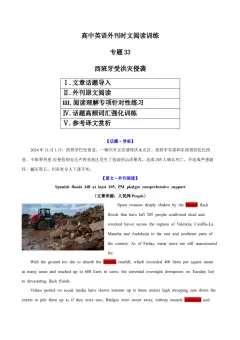
A renowned scroll painting, the Ming Dynasty (1368-1644) version of Riverside Scene at Qingming
Festival by painter Qiu Ying, made its long-awaited return to Suzhou, East China's Jiangsu Province, on Tuesday, a
decade after it was last displayed in the city.
  This display is the centerpiece of a major exhibition titled Suzhou Textile Commissioner, showcasing the ancient
city's glorious textile history during the Ming and Qing (1644-1911) dynasties, according to a press release issued
by Suzhou Museum on Tuesday. Co-organized by 10 cultural institutions, including the Palace Museum and the
National Museum of China, the exhibition features over 90 precious relics, with Qiu's masterpiece taking pride of
读时文精读
place.
  Painted by Qiu Ying, a native Suzhou painter and one of the "Four Great Painting Masters of the Ming Dynasty,"
the scroll depicts the prosperity of Suzhou more than 400 years ago.
  Song Dynasty (960-1279) painter Zhang Zeduan's work of the same name reveals the lifestyles of people from of
all walks of life in the then prosperous capital Bianjing, today's Kaifeng in Central China's Henan Province, during
the Qingming Festival. Qiu's work focuses on his hometown of Suzhou, capturing over 2,200 figures engaged in
daily activities, from farmers tilling fields on the outskirts of town to vendors hawking goods in bustling markets,
and even scenes of weddings and traditional operas.
  "This scroll is a living record of Suzhou's commercial and handicraft prosperity during the Ming Dynasty," Yang
Yumeng, a curator in the museum's Collections Preservation Department, told the Global Times. "Its return is a
homecoming for a cultural treasure closely tied to the city's identity."
  For some visitors who missed the display of Zhang's scroll at the Palace Museum in 2025, seeing Qiu Ying's
version at the Suzhou Museum has fulfilled their long-cherished wish. "The last time that this scroll was shown in
Suzhou, we displayed only sections of it. But this time, visitors can see it fully unfurled," Yang said, adding that the
scroll, housed in the Liaoning Provincial Museum, will only be on display until April 26.
  The exhibition, marking the 20th anniversary of the Suzhou Museum's main venue, aims to reinterpret the role of
"Suzhou Weaving," a historical institution long simplified as a silk supplier to the imperial court. Going for a
deeper dive, the exhibition reveals the institution's multifaceted role as a hub connecting the imperial palace with
Jiangnan's handicraft networks and local society, according to the press release.
  Following Qiu's scroll, Qing Dynasty painter Xu Yang's Emperor Qianlong's Southern   prosperity during the
Qing Dynasty.
  The exhibition, running until June 21, also includes three sections introducing the history, functions and
craftsmanship of Suzhou weaving, along with special lectures and study activities.
  To facilitate visits, the museum will launch free shuttle services between its main and west venues starting on
Saturday for ticket holders, to allow more visitors to appreciate the city's profound cultural heritage through the
centuries-old relics.
【原创·语法填空】
A renowned scroll painting, the Ming Dynasty (1368-1644) version of Riverside Scene at Qingming
Festival by painter Qiu Ying, 1._______ (make ) its long-awaited return to Suzhou, East China's Jiangsu
Province, on Tuesday, a decade 2._______ it was last displayed in the city.
  This display is the centerpiece of a major exhibition titled Suzhou Textile Commissioner, 3._______
(showcase ) the ancient city's glorious textile history during the Ming and Qing (1644-1911) dynasties,
according to a press release issued by Suzhou Museum on Tuesday. The exhibition features over 90 precious
relics, 4._______ Qiu's masterpiece taking pride of place.
  5._______(paint) by Qiu Ying, a native Suzhou painter and one of the "Four Great Painting Masters of the
Ming Dynasty," the scroll depicts the 6._______(prosperous) of Suzhou more than 400 years ago.
  Song Dynasty (960-1279) painter Zhang Zeduan's work of the same name reveals the lifestyles of people from of
all 7._______(walk) of life in the then prosperous capital Bianjing, today's Kaifeng in Central China's Henan
Province, during the Qingming Festival. Qiu's work focuses on his hometown of Suzhou, capturing over 2,200
figures engaged in daily activities, from farmers tilling fields on the outskirts of town to vendors hawking goods in
bustling markets, and even scenes of weddings and 8._______(tradition) operas.
  "This scroll is a living record of Suzhou's commercial  9._______ handicraft prosperity during the Ming
Dynasty," Yang Yumeng, a curator in the museum's Collections Preservation Department said. "Its return is a
homecoming for a cultural treasure 10._______(close) tied to the city's identity."
【答案】1.made 2.after 3.showcasing 4.with 5.Painted 6.prosperity 7.walks 8.traditional 9.and 10.closely
1.made 考查动词时态。
——
一幅著名的卷轴画
明代画家仇英版的《清明上河图》,在周二(时隔十年后)
终于重返其长期期待的展示地苏州(中国东部江苏省)。根据后面的时间状语on Tuesday 可知,此处用一
般过去时。故填made。
2.after 考查状语从句的连词。在周二(时隔十年后)终于重返其长期期待的展示地苏州(中国东部江苏
省)。根据句意填after。故填after。
3.showcasing 考查现在分词。
“
”
据苏州博物馆周二发布的新闻稿称,此次展示是一场名为苏州织造的大型展
览的核心,该展览旨在展示这座古城在明清时期辉煌的纺织历史。此处This display 和showcase 是主动关
系,故用现在分词作状语。故填showcasing。
4.with 考查介词。本次展览展出了90 余件珍贵文物,其中邱先生的代表作尤为引人注目。此处是with+名
词+现在分词的复合结构。故填with。
5.Painted 考查过去分词。
“
”
这幅卷轴由明代四大家之一、苏州本地画家仇英绘制,描绘了400 多年前苏州
的繁荣景象。根据句意此处是被动关系,故填Painted。
6.prosperity 考查词形转换。冠词后用名词形式,故填prosperity。
7.walks 考查名词复数。此处all walks of life 意为:各行各业。故填walks。
8.traditional 考查词形转换。 修饰名词operas 用形容词,故填traditional。
9.and 考查连词。此处commercial 和handicraft 是并列关系。故填and。
10.closely 考查词形转换。修饰tied 用副词形式。故填closely。
【课标词汇积累】
1.renowned adj. 有名的,享有声誉的;有声望的
Our school library has recently acquired a collection of books from a renowned historian, which has greatly
engaged students interested in ancient civilizations and inspired many to pursue deeper research projects.
我们学校图书馆最近购入了一批来自一位著名历史学家的藏书,这极大地吸引了那些对古代文明感兴趣的
学生,并激励了许多人进行更深层次的研究项目。
2.decade n. 十年
The science fair this year will feature projects that summarize the most significant technological advancements of
the last decade, encouraging students to connect their studies with real-world innovations.
今年的科学展览会将重点展示总结过去十年最重大技术进步的课题,鼓励学生们将他们的学习与现实世界
的创新联系起来。
3.display v. 陈列,展示;显示;显露n. 展览;表演
The art club will display their semester-end paintings in the main hall next week, and the title of this exhibition is
“Colors of Youth,” reflecting their creative journey.
艺术俱乐部将于下周在主大厅展示他们期末的绘画作品,这次展览的标题是“青春的色彩”,反映了他们
的创作历程。
4.title n. 标题;头衔;vt. 加标题;赋予头衔;把…称为
His research paper, under the title “Sustainable Campus Initiatives,” was released in the school journal and
received widespread praise for its practical suggestions.
他以“可持续校园倡议”为标题的研究论文在学校期刊上发布了,并因其切实可行的建议而获得了广泛赞
誉。
5.glorious adj. 辉煌的;荣誉的;极好的
The school’s glorious tradition of academic excellence is celebrated every year during the founders’ day
ceremony, which helps to engage new students with the institution’s history.
学校学术卓越的光荣传统每年都在校庆日典礼上得到颂扬,这有助于让新生了解学校的历史。
6.release v. 释放;松开n. 释放;发行;排放;解脱
After months of preparation, the student council will release the detailed schedule for the cultural festival, which
is always a prosperous event full of diverse activities.
经过数月的准备,学生会将发布文化节的详细日程表,这始终是一个充满各种活动的、热闹纷呈的盛会。
7.precious adj. 宝贵的;珍奇的;值得珍视的
The feedback from my mentor on my thesis draft is precious, and I plan to display her annotated notes in my
study as a constant source of inspiration.
我的导师对我论文初稿的反馈非常宝贵,我计划将她批注的笔记放在书房里展示,作为持续的灵感来源。
8.prosperous adj. 繁荣的,兴旺的;富裕的;幸福的,运气好的;良好的
We hope the new campus partnership program will lead to a more prosperous learning environment, engage
local industries, and provide students with practical experience.
我们希望新的校园合作项目将带来一个更加繁荣的学习环境,吸引本地产业参与,并为学生提供实践经
验。
9.engage v. (使)参与;吸引;适应;引起(注意、兴趣)
Teachers are using interactive software to engage students more effectively in virtual classrooms, making the
display of complex data much more understandable.
老师们正使用互动软件来更有效地吸引学生参与虚拟课堂,使得复杂数据的展示更加易于理解。
10.feature n. 特征;特写v. 以…为特征;占重要地位
A key feature of our school’s success over the last decade has been its ability to engage students in
interdisciplinary projects that solve real-world problems.
我们学校在过去十年取得成功的一个关键特点是它能够吸引学生参与解决实际问题的跨学科项目。
【课标词汇训练】
根据语境,从上面的“课标词汇”中选用合适的单词及其正确形式将句子补充完整。
1.The _____________ professor’s lecture on environmental science was so precious an opportunity that the
auditorium was packed with students eager to learn from his decades of research.
这位著名教授关于环境科学的讲座是一次如此宝贵的机会,以至于礼堂里挤满了渴望从他数十年的研究中
学习的学生。
2.Over the past _____________, our university has undergone a prosperous transformation, with new research
centers and dormitories being built to accommodate the growing number of students.
在过去的十年里,我们大学经历了一次蓬勃的发展,新建了多个研究中心和宿舍楼,以容纳不断增长的学
生数量。
3.To fully engage the audience, the drama team decided not only to _____________ their performance on stage but
also to release behind-the-scenes documentaries online.
为了充分吸引观众,戏剧团队决定不仅要在舞台上展示他们的表演,还会在线发布幕后纪录片。
4.Winning the national mathematics competition was a glorious achievement for her, and the _____________ of
champion has motivated her to tackle even more complex problems.
赢得全国数学竞赛对她来说是一项辉煌的成就,而冠军的称号激励她去攻克更复杂的问题。
5.Looking back at the prosperous and _____________ history of our student-led innovation lab fills current
members with a sense of pride and responsibility.
回顾我们学生主导的创新实验室繁荣而辉煌的历史,让现在的成员充满了自豪感和责任感。
6.The university press plans to _____________ a series of precious interview transcripts with retired professors,
feature their invaluable insights on teaching and learning.
大学出版社计划发布一系列对退休教授的珍贵访谈记录,重点呈现他们关于教学的无价见解。
7.In this fast-paced digital age, the  _____________ time we spend in face-to-face discussions with classmates and
teachers is crucial for deep learning.
在这个快节奏的数字时代,我们与同学和老师进行面对面讨论的宝贵时间对于深度学习至关重要。
8.The _____________ exchange of ideas in our seminar classes, where every student feels encouraged to speak, is a
feature of our department’s teaching philosophy.
我们研讨课上繁荣的思想交流,即每个学生都受到鼓励发言,是我们系教学理念的一个特色。
9.To _____________ with the community, the biology club will release a monthly podcast feature interesting
findings from their local ecosystem surveys.
为了与社区互动,生物俱乐部将每月发布一期播客,重点介绍他们当地生态系统调查中有趣的发现。
10.The upcoming career fair will _____________ workshops from renowned alumni, offering precious advice on
navigating the job market after graduation.
即将举行的招聘会将重点推出由知名校友主持的工作坊,为毕业后如何应对就业市场提供宝贵的建议。
Keys:
1.renowned 2.decade 3.display 4.title 5.glorious 6.release 7.precious 8.prosperous 9.engage10.feature
【参考译文】

——
一幅著名的卷轴画
明代画家仇英版的《清明上河图》,在周二(时隔十年后)终于重返其长期期
“
待的展示地苏州(中国东部江苏省)。据苏州博物馆周二发布的新闻稿称,此次展示是一场名为苏州织
”
造的大型展览的核心,该展览旨在展示这座古城在明清时期辉煌的纺织历史。此次展览由包括故宫博物院
和中国国家博物馆在内的10 家文化机构联合举办,展出了90 多件珍贵文物,其中仇英的杰作占据着最显
要的位置。
“
”
这幅卷轴由明代四大家之一、苏州本地画家仇英绘制,描绘了400 多年前苏州的繁荣景象。宋代画
家张择端的同名作品展现了当时繁荣的都城汴京(今中国中部河南省开封市)在清明节期间各阶层人民的
生活风貌。而仇英的作品则聚焦于他的家乡苏州,刻画了超过2200 个人物从事日常活动的场景,从在城郊
耕种的农民,到在繁华市场中叫卖货物的商贩,甚至还包括婚礼和传统戏曲的场景。
对于许多错过了2025 年故宫博物院张择端版《清明上河图》展出的观众而言,在苏州博物馆欣赏仇
“
英版本的作品实现了他们长久以来的心愿。上一次该画卷在苏州展出时,我们仅展示了局部。但这一次,
”
观众可以观赏到完全展开的全卷,杨先生表示,并补充说这幅藏于辽宁省博物馆的画卷将只展出至4 月26
日。
“
”
此次展览旨在重新诠释苏州织造这一历史机构的作用,它长期以来被简单视为宫廷的丝绸供应部
门。据新闻稿介绍,展览更深入地揭示了该机构作为连接皇宫与江南手工业网络及地方社会的枢纽所具有
的多重角色。本次展览亦是为庆祝苏州博物馆主馆区开放20 周年。
继仇英画卷之后,清代画家徐扬的《乾隆南巡图》也将展出,以呈现清朝时期的江南繁荣景象。
展览将持续至6 月21 日,除展出作品外,还设有三个单元介绍苏州织造的历史、职能与工艺,并举办专题
讲座和研究活动。
为方便参观,博物馆将从周六起为持票观众提供主馆与西馆之间的免费接驳服务,让更多观众能通过
这些历史悠久的文物,领略苏州深厚的文化遗产。
Passage1 阅读理解
By the late 1960s, abstract painter Harold Cohen had represented Britain at important festivals with his oil
paintings and was seeking a new challenge. “Maybe there are more interesting things going on outside my studio
than inside it,” he thought. Cohen turned from the canvas to the screen, using computers to find new ways of
creating art. In the late 1960s, he created a program that he named Aaron. It was the first artificial intelligence
software in the world of fine art, and Cohen first presented Aaron in 1974 at the University of California, Berkeley.
Now, with AI dominating the headlines, a new exhibition at New York’s Whitney Museum of American Art,
“Harold Cohen: Aaron”, running through June 2024, draws attention to Cohen’s pioneering work. The Whitney is
练好题精练
offering something deeper than most previous Aaron exhibits: a real-time experience, in which visitors can watch
the software produce art.
Cohen seeded Aaron with all sorts of knowledge: about basic objects, physics, and fundamental techniques
of drawing. Aaron uses this knowledge to follow instructions, complete tasks, and make decisions like human
beings — a very different approach from today’s generative AI art programs, which don’t draw from scratch (从头
开始) but rather rely on databases of images. Versions of Aaron still generate output, but anything done after
Cohen’s death in 2016 is not considered genuine.
The Whitney is performing two versions of Cohen’s software, along with the art that each produced before
Cohen died. The 2001 version, Aaron KCAT, generates images of figures and plants and projects them onto a wall
more than ten feet high, while the 2007 version produces jungle-like scenes. The software will also create art
physically, on paper, for the first time since the 1990s. “It is absolutely thrilling,” said Christiane Paul, the
museum’s director of digital art, “to have one of those remarkable treasures of digital art in the collection.”
1.What was Aaron born out of?
A.The university’s support.
B.The museum’s donation.
C.Cohen’s imagination.
D.Cohen’s curiosity.
2.What can visitors do in the “Harold Cohen: Aaron” exhibition?
A.Observe Aaron creating art on the spot.
B.Generate images with the help of Aaron.
C.Learn about the physical rules in art.
D.See the original 196Os version of Aaron.
3.What makes Aaron different from modern AI art programs?
A.Its ability to assign tasks.
B.Its use of modern techniques.
C.Its capability to make choices.
D.Its dependence on existing database.
4.What does the underlined word “projects” in the last paragraph mean?
A.Plans.
B.Throws.
C.Displays.
D.Draws.
【答案】1.D    2.A    3.C    4.C
【解析】这是一篇说明文。主要说明了抽象画家 Harold Cohen 创造了世界上首个美术领域的 AI 程序
Aaron,该程序能自主创作。如今纽约一博物馆展出其作品,让观众实时观看 AI 作画,展现了他的开创
性贡献。
1.细节理解题。根据第一段“By the late 1960s, abstract painter Harold Cohen had represented Britain at
important festivals with his oil paintings and was seeking a new challenge. “Maybe there are more interesting
things going on outside my studio than inside it,” he thought.(到了20 世纪60 年代末,抽象派画家哈罗德·科恩
凭借其油画作品代表英国参加了重要的艺术展览,并且他正在寻求新的挑战。“或许我的工作室之外还有
更多有趣的事情发生,而并非仅仅局限于工作室之内。”他这样想道)”可知,他出于好奇与探索欲创造了
Aaron。故选D。
2.细节理解题。根据第二段“The Whitney is offering something deeper than most previous Aaron exhibits: a
real-time experience, in which visitors can watch the software produce art.(惠特尼博物馆此次展出的作品比以往
大多数亚伦的展览内容都要丰富得多:这是一个实时互动体验,参观者可以亲眼目睹软件生成艺术作品的
过程)”可知,观众可以现场观看Aaron 创作艺术。故选A。
3.细节理解题。根据倒数第二段“Aaron uses this knowledge to follow instructions, complete tasks, and make
decisions like human beings — a very different approach from today’s generative AI art programs, which don’t
draw from scratch (从头开始) but rather rely on databases of images.(Aaron 利用这些知识来遵循指令、完成任
务并做出决策,就像人类一样——这与当今的生成式人工智能艺术程序有着截然不同的方式。这些程序并
非从零开始创作,而是依赖于图像数据库)”可知,Aaron 能做选择,这是和现代AI 艺术程序的区别。故选
C。
4.词句猜测题。根据划线词上文“The 2001 version, Aaron KCAT, generates images of figures and plants(2001
年版的“亚伦·KCAT”能够生成人物和植物的图像)”以及后文“them onto a wall more than ten feet high, while
the 2007 version produces jungle-like scenes(把他们……超过十英尺高的墙壁上;而2007 年版则能呈现出丛
林般的景象)”可知,2001 年版的“亚伦·KCAT”能够生成人物和植物的图像,并将其投射、展示到超过十英
尺高的墙壁上;而2007 年版则能呈现出丛林般的景象。故划线词意思是“投射、展示”。故选C。
Passage2 阅读理解
More than three centuries after she made an adventurous transatlantic voyage to study butterflies, a rare copy
of the hand-coloured masterwork by the great naturalist and artist Maria Merian is returning to Amsterdam.
Metamorphosis of the Suriname is one of the most fascinating ( 有吸引力的) books in natural history. It
included some 60 richly coloured plates illustrating the different stages of development that she had observed in
Suriname’s insects. Metamorphosis of the Suriname is a work of art and scientific scholarship. Merian recorded the
local names of plants and insects she studied. In contrast to other European naturalists, she credited local people
with helping her discover the colony’s wildlife, although didn’t name individuals.
Born in 1647 in Frankfurt, Germany, Merian learned to paint in her artist father’s workshop, and became
fascinated by silkworms, moths and butterflies. At that time, insects were believed to spring forth magically from
mud, waste and plant matter in a process known as “spontaneous generation”. While Merian was not the first to
show the transformation from egg to adult insect, her artistic talents helped to bring this message to a wider
audience. The pioneering work of Merian was celebrated for its scientific accuracy and for bringing a new standard
of precision to scientific illustration.
In 1691, Merian moved to Amsterdam and opened her own studio. She worked as an independent artist and
prepared specimens for a growing market of collectors. In Amsterdam, Merian had access to some of the finest
natural history collections in the world. As she associated with famous scholars, physicians and botanists, ideas for
her own voyage of discovery began to take shape. At 52, she embarked on ( 开始) a self-funded voyage to
Suriname, driven by curiosity about the lives of insects.
Her image would be dismissed as a fantasy. In the 18th century, people responded: “that’s what you get when
you send a woman to tropical places. She probably made that up”. But scientists later confirmed her findings. The
spider plate was a very good example of how Merian worked. She was a really good observer.
5.What do we know about Metamorphosis of the Suriname?
A.It won a book award for art.
B.It listed the names of local helpers.
C.It recorded Merian’s transatlantic voyage.D.It was based on Merian’s own observations.
6.What was the significance of Merian’s work?
A.It had extremely high artistic value.
B.It was the first natural history book.
C.It shaped our understanding of insects.
D.It introduced a creative research theory.
7.What can be inferred about nature study in Merian’s time?
A.It lacked convincing evidence.
B.It was conducted in tough places.
C.It was considered the domain of men.
D.It greatly improved women’s social status.
【答案】5.D    6.C    7.C
【解析】这是一篇记叙文。文章讲述了伟大的博物学家和艺术家玛丽亚·梅里安所著的彩色手作珍品《苏里
南昆虫变态图谱》在三百多年后重返阿姆斯特丹的故事。
5.细节理解题。根据第二段“It included some 60 richly coloured plates illustrating the different stages of
development that she had observed in Suriname’s insects (这本书包含约60 幅色彩丰富的插图,描绘了她在苏
里南观察到的昆虫生长的不同阶段)”可知,《苏里南昆虫变态图谱》是基于梅里安自身的观察写成的。故
选D。
6.推理判断题。根据第三段“At that time, insects were believed to spring forth magically from mud, waste and
plant matter in a process known as spontaneous generation. While Merian was not the first to show the
transformation from egg to adult insect, her artistic talents helped to bring this message to a wider audience. The
pioneering work of Merian was celebrated for its scientific accuracy and for bringing a new standard of precision to
scientific illustration (当时,人们认为昆虫是从泥土、废弃物和植物中通过“自然发生说”神奇地产生的。
虽然梅里安并非第一个揭示昆虫从卵到成虫蜕变过程的人,但她的艺术才能让这一结论被更广泛的受众知
晓。梅里安这项开创性的工作因其科学准确性,以及为科学插图树立了新的精准标准而备受赞誉)”可知,
梅里安的著作纠正了当时人们对昆虫起源的错误认知,让更多人了解昆虫的真实生长过程,其意义在于重
塑了人们对昆虫的认知。故选C。
7.推理判断题。根据最后一段“Her image would be dismissed as a fantasy. In the 18th century, people
responded: that’s what you get when you send a woman to tropical places. She probably made that up (她所描绘的
景象曾被斥为幻想。在18 世纪,人们这样回应:让一个女人去热带地区,就会出现这种结果。她可能是编
造出来的)”可知,在梅里安所处的时代,人们会因为她是女性而质疑她的研究成果,由此可推断,当时的
自然研究领域被认为是男性的专属领域。故选C。
Passage 3 阅读七选五
阅读下面短文,在空白处填入1 个适当的单词或括号内单词的正确形式。
A porcelain (瓷器) painter is also called a china painter or decorator because china plates are made from
porcelain and often used as the object on which to create the painting. A variety of objects can be used for porcelain
painting.

 1
Porcelain was first created in China. It’s known for its hardness and whiteness. Although porcelain was
freely traded, Chinese kept the ingredients and process for making porcelain secret for hundreds of years. The
explorer Marco Polo reportedly introduced porcelain to Europe.

 2

  With time going by, more and more
people around the world were eager to buy porcelain, including decorative ones.
Decorative porcelain objects began to be mass-produced in factories, where porcelain painters could always
find work. Wars and bad economic times finally led to the reduction in the creation and buying of decorative
porcelain.

 3

  Today, there are porcelain painting classes, schools, videos, and clubs.
Like other artists, a porcelain painter can choose any subject for his or her art.

 4

  There are also
complicated designs of the painters’ own choosing.


 5

  Generally, first choose the right porcelain paint, and then have porcelain pieces washed and
dried. Next, draw an outline of a design and paint the design. Then, the porcelain must be fired at extremely high
temperatures. After it cools, the painter applies another layer of paint and then gets the porcelain fired again. The
painting and firing can be repeated many times, until the desired beautiful look is achieved.
A.What can be used to paint his or her design?
B.There it was immediately prized for its beauty.
C.Painted porcelain can thus be extremely expensive.
D.In the 1950s, decorative porcelain became popular again.
E.How can a painter finish the creation of decorative porcelain?
F.However, traditionally, people mainly choose flowers, birds, etc.
G.The common ones include jewelry boxes, cups and serving dishes.
【答案】1.G    2.B    3.D    4.F    5.E
【解析】本文是一篇说明文。文章主要介绍了瓷器画家及其工作,包括瓷器的起源、历史、装饰性瓷器的
生产与流行趋势的变化、瓷器画家可以选择的绘画主题,以及完成一件装饰性瓷器创作的大致步骤。
1.空前“A variety of objects can be used for porcelain painting.(瓷器绘画可选用多种物品作为创作对象。)”
指出瓷器绘画可以使用多种物品。选项G“The common ones include jewelry boxes, cups and serving dishes.(常
见的包括首饰盒、杯子和餐具。)”进一步列举了常见的瓷器绘画物品,与前文内容紧密相连。故选G。
2.空前“The explorer Marco Polo reportedly introduced porcelain to Europe.(据记载,探险家马可・波罗将瓷
器引入欧洲。)”指出据说是马可·波罗将瓷器引入了欧洲。选项B“There it was immediately prized for its
beauty.(在那里,它因其美丽立即受到珍视。)”承接“引入欧洲”的结果,说明欧洲对瓷器的重视,逻辑连
贯。故选B。
3.空前“Wars and bad economic times finally led to the reduction in the creation and buying of decorative
porcelain.(然而,战争和经济萧条最终导致装饰瓷器的生产和购买减少。)”提到战争和经济衰退导致装饰瓷
器减少。选项D“In the 1950s, decorative porcelain became popular again.(20 世纪50 年代,装饰瓷器再次流
行起来。)”说明在20 世纪50 年代,装饰性瓷器再次流行起来,与前文内容形成转折,并引出后文关于现
代瓷器绘画的介绍。故选D。
4.空前“Like other artists, a porcelain painter can choose any subject for his or her art.(与其他艺术家一样,瓷
器画师可以为自己的艺术选择任何主题。)”指出画家可选择任何主题。选项F“However, traditionally, people
mainly choose flowers, birds, etc.(但传统上,人们主要选择花鸟等。)”说明传统上,人们主要选择花卉、鸟
类等作为创作主题,与前文内容形成对比,并介绍了传统上的选择。故选F。
5.空处为段首句,为本段主要内容。根据下文“Generally, first choose the right porcelain paint, and then have
porcelain pieces washed and dried. Next, draw an outline of a design and paint the design. Then, the porcelain must
be fired at extremely high temperatures. After it cools, the painter applies another layer of paint and then gets the
porcelain fired again. The painting and firing can be repeated many times, until the desired beautiful look is
achieved(一般来说,首先选择合适的瓷器颜料,然后将瓷器物件清洗并晾干。接下来,绘制设计轮廓并上
色。之后,瓷器必须在极高温度下烧制。冷却后,画师再涂一层颜料,然后再次烧制。这一绘画和烧制过
程可以重复多次,直至达到理想的美观效果。)”可知,本段详细描述了瓷器绘画的步骤(选择颜料、清洗
瓷器、绘制轮廓、烧制等)。选项E“How can a painter finish the creation of decorative porcelain?(画家如何完
成装饰瓷器的创作?)”作为问题引出后文的具体步骤,与后文内容紧密相连。故选E。
Passage 4 完形填空
阅读下面短文,从每题所给的 A、B、C、D 四个选项中选出最佳选项。
(2026 届山东潍坊市高三一模)Some people were born gifted, but I wasn’t. Well into my sixties, I was
1

  searching for something I did really well. When my friend advised me to join an art class, I

 2

  but
finally decided to have a go.
Now here I was staring at a

 3

  canvas (画布), with a photograph of a sunflower beside it,
wondering what I was doing in this class. “Grid off (分格) the photo and canvas into squares,” Debbie, my teacher,
walked us through the

 4

  of painting. As I followed the instructions, I thought back on my past

 5
to make artwork. In junior high, I eagerly chose art, but my enthusiasm was

 6

 . The teacher’s harsh
criticism quickly made me drop the class. Then in college, I

 7

  a drawing class but barely kept up, leaving
my confidence

 8

  again. After that, my creative energies were restricted only to secret

 9

 .
This time, I wouldn’t let that happen again. I gridded off my picture and painted just one

 10


  at a
time. My shaky hands gradually

 11


  and found their rhythm. Little by little, a cheerful sunflower came to
life. Debbie had told us, “Don’t think of it as part of a bigger picture. And don’t guess at where it

 12


  with
the rest.” A single sunflower had brought me more

 13


  than an entire field of flowers.
The sunflower finally

 14


  and bloomed (开花) within me: I was a late bloomer, finally uncovering
a truth we too often forget — take small steps and dreams have no

 15


  limit.
1.A.already
B.still
C.ever
D.just
2.A.resolved
B.accepted
C.hesitated
D.yielded
3.A.blank
B.strange
C.rough
D.painted
4.A.trends
B.chores
C.tests
D.basics
5.A.attempts
B.excuses
C.promises
D.reactions
6.A.short-sighted
B.short-lived
C.ever-growing
D.far-reaching
7.A.missed
B.skipped
C.designed
D.braved
8.A.on alert
B.on purpose
C.in pieces
D.in chains
9.A.hobbies
B.careers
C.collections
D.rules
10.A.photo
B.square
C.sunflower
D.class
11.A.steadied
B.froze
C.ached
D.sweated
12.A.conflicts
B.competes
C.agrees
D.fits
13.A.joy
B.luck
C.patience
D.fame
14.A.took shape
B.took root
C.died out
D.faded away
15.A.status
B.gender
C.age
D.ability
【答案】
1.B    2.C    3.A    4.D    5.A    6.B    7.D    8.C    9.A    10.B    11.A
12.D    13.A    14.B    15.C
【解析】本文是一篇记叙文。文章讲述了作者在六十多岁时,尽管过去在艺术创作上屡遭挫折,但仍然决
定尝试上艺术课。在老师的指导下,作者通过分格绘画的方法,逐渐找到了绘画的节奏和信心,最终成功
画出了一朵向日葵。这次经历让作者意识到,只要从小事做起,梦想就没有年龄限制。
1.考查副词词义辨析。句意:直到六十多岁,我仍然在寻找我真正擅长的事情。A. already 已经;B. still
仍然;C. ever 曾经;D. just 仅仅。根据后文“searching for something I did really well”可知,作者在六十多
岁时,仍然在寻找自己真正擅长的事情。故选B 项。
2.考查动词词义辨析。句意:当我的朋友建议我参加一个艺术班时,我犹豫了一下,但最终还是决定试
一试。A. resolved 决定;B. accepted 接受;C. hesitated 犹豫;D. yielded 屈服。根据后文“but finally
decided to have a go”可知,作者最初对参加艺术班是犹豫的。故选C 项。
3.考查形容词词义辨析。句意:现在,我盯着一块空白的画布,旁边放着一张向日葵的照片,心里纳闷
我正在这个班里做什么。A. blank 空白的;B. strange 奇怪的;C. rough 粗糙的;D. painted 描画的。根据后
文“wondering what I was doing in this class”可知,作者盯着空白的画布,不知道自己该做什么。故选A 项。
4.考查名词词义辨析。句意:“把照片和画布分成方格,”我的老师黛比给我们讲解绘画的基本知识。
A. trends 趋势;B. chores 家务;C. tests 测试;D. basics 基本知识。根据前文“Grid off (分格) the photo and
canvas into squares”以及后文“As I followed the instructions”可知,老师是在讲解绘画的基本知识。故选D
项。
5.考查名词词义辨析。句意:当我按照指示操作时,我回想起过去尝试制作艺术品的经历。A. attempts 尝
试;B. excuses 借口;C. promises 承诺;D. reactions 反应。根据后文“In junior high, I eagerly chose art, but”
可知,作者回想起过去尝试制作艺术品的经历。故选A 项。
6.考查形容词词义辨析。句意:在初中时,我急切地选择了艺术,但我的热情很快就消退了。A. short-
sighted 短视的;B. short-lived 短暂的;C. ever-growing 不断增长的;D. far-reaching 深远的。根据后文“The
teacher’s harsh criticism quickly made me drop the class.”可知,老师的严厉批评让作者很快放弃了艺术课,说
明作者的热情很快就消退了,也就是这热情是短暂的。故选B 项。
7.考查动词词义辨析。句意:然后在大学时,我勇敢地参加了一个绘画课,但几乎跟不上,再次让我的
信心破碎。A. missed 错过;B. skipped 跳过;C. designed 设计;D. braved 勇敢面对。根据后文“but barely
kept up”可知前后转折,所以尽管作者几乎跟不上,但还是勇敢地参加了绘画课。故选D 项。
8.考查介词短语辨析。句意同上。A. on alert 警惕;B. on purpose 故意;C. in pieces 破碎;D. in chains 被
束缚着。根据前文“barely kept up”以及后文“again”可知,作者几乎跟不上绘画课,再次让信心破碎。故
选C 项。
9.考查名词词义辨析。句意:从那以后,我的创造力仅限于秘密的爱好。A. hobbies 爱好;B. careers 职业;
C. collections 收藏;D. rules 规则。根据前文“my creative energies were restricted”可知,作者的创造力受到
了限制,只能从事一些秘密的爱好。故选A 项。
10.考查名词词义辨析。句意:我把图片分格,一次只画一个方格。A. photo 照片;B. square 方格;C.
sunflower 向日葵;D. class 班级。根据前文“Grid off the photo and canvas into squares”可知,作者把图片和
画布分成了方格,一次只画一个方格。故选B 项。
11.考查动词词义辨析。句意:我颤抖的手逐渐稳定下来,找到了节奏。A. steadied 使稳定;B. froze 冻结;
C. ached 疼痛;D. sweated 出汗。根据后文“found their rhythm”可知,作者的手逐渐稳定下来,找到了绘画
的节奏。故选A 项。
12.考查动词词义辨析。句意:不要把它想象成更大画面的一部分,也不要猜测它与其余部分的契合点。
A. conflicts 冲突;B. competes 竞争;C. agrees 同意;D. fits 契合。根据前文“Don’t think of it as part of a
bigger picture.”可知,老师建议作者不要把它想象成更大画面的一部分,也就是不要猜测它与其余部分的契
合点。故选D 项。
13.考查名词词义辨析。句意:一朵向日葵给我带来的快乐比一整片花田还要多。A. joy 快乐;B. luck 运
气;C. patience 耐心;D. fame 名声。根据前文“a cheerful sunflower came to life”可知,作者画出了向日葵,
这朵向日葵给作者带来了快乐。故选A 项。
14.考查动词短语辨析。句意:向日葵终于在我心中生根发芽,开花了:我是一朵大器晚成的花,终于悟
出一个我们常常遗忘的道理——从小事做起,梦想从没有年龄限制。A. took shape 成形;B. took root 生根;
C. died out 灭绝;D. faded away 消失。根据后文“and bloomed within me”可知,向日葵在作者心中生根发
芽,开花了。故选B 项。
15.考查名词词义辨析。句意同上。A. status 地位;B. gender 性别;C. age 年龄;D. ability 能力。根据前
文“I was a late bloomer”可知,作者把自己比作一朵大器晚成的花,说明梦想没有年龄限制。故选C 项。
Passage 5 语法填空
阅读下面短文,在空白处填入1 个适当的单词或括号内单词的正确形式。(2026 届安徽省合肥一六八中学
高三一模)
Riverside Scene at Qingming Festival, one of the top ten ancient Chinese paintings, shows the prosperity of
Bianjing,

 1

  capital of the Song Dynasty. This national treasure was created by Zhang Zeduan, a native of
Shandong Province who studied painting in his early years in Bianjing.
The ancient painting,

 2

  (measure) 528 centimeters long and 24.8 centimeters wide, is noted for its
reasonable arrangement and perfect

 3

  (compose). With the painting gradually unfolded, the first thing
4

  (catch) the eye is the early spring scenery outside Bianjing streams, bridges, boats and sprouting ( 发芽)
trees. Some travelers

 5

  (hurry) on their way in the thin fog, presenting a typical picture of the Qingming
Festival.
At the end of the country road comes the middle part — the Bianhe River. The arched bridge stands like a
rainbow over the river with streams of people bustling about. Under the bridge

 6

  (be) many boats
competing for the right of way.
The last part is the crowded and noisy downtown,

 7

  streets are lined with government mansions,
residential courtyards, workshops, teahouses and grocery stores witnessing people from all walks of life going
about various business. So incredibly alive does the painting look that it seems as if we could see the people
walking by and hear

 8

  they are talking about.
Riverside Scene at Qingming Festival serves as a window

 9

  the Song Dynasty, providing very
10


  (value) materials for future generations to understand and study Chinese people's economic and social life
over 800 years ago.
【答案】
1.the    2.measuring    3.composition    4.to catch    5.are hurrying    6.are    7.whose

8.what    9.to    10.valuable
【解析】本文是一篇说明文。文章主要讲述了《清明上河图》这幅中国古代名画的内容、艺术特色及其历
史价值。
1.考查冠词。句意:《清明上河图》是中国古代十大名画之一,它展现了北宋都城汴京的繁华景象。空
格后“capital of the Song Dynasty” (宋朝的都城)是对“Bianjing(汴京)”的同位语,需用定冠词the 修饰。故
填the。
2.考查非谓语动词。句意:这幅古画长528 厘米,宽24.8 厘米,以其合理的布局和完美的构图而著称。
此处为非谓语动词作定语,measure 与逻辑主语painting 之间为主动关系,故用现在分词形式作后置定语,
故填measuring。
3.考查名词。句意:这幅古画长528 厘米,宽24.8 厘米,以其合理的布局和完美的构图而著称。此处与
arrangement 并列,作介词for 的宾语。compose 的名词形式为composition“构图”。故填composition。
4.考查非谓语动词。句意:随着画卷的逐渐展开,首先映入眼帘的是汴京郊外的早春景色——溪流、桥
梁、船只和发芽的树木。“the+序数词+名词+不定式”表示“第几个做某事的”,此处表示“第一个吸引
眼球的事情”,故该空是动词不定式。故填to catch。
5.考查时态语态和主谓一致。句意:一些旅客在薄雾中匆匆赶路,这正是清明节时常见的景象。空处为
句子的谓语动词,画作《清明上河图》捕捉的是瞬间的动态画面——“旅客在薄雾中赶路”,因此用现在
进行时。且主语travelers 为复数,be 动词为are。故填are hurrying。
6.考查主谓一致。句意:桥下有许多船只在争路。“Under the bridge”是地点状语,置于句首时句子要用
完全倒装,句子的主语是“many boats”为复数,句子陈述一般事实,所以用一般现在时,be 动词用are。
故填are。
7.考查定语从句。句意:最后一部分是拥挤喧闹的市中心,这里的街道两旁排列着官府宅邸、民居院落、
作坊、茶馆和杂货店,见证着各行各业的人们忙着各式营生。此处为定语从句修饰先行词downtown,且先
行词在从句中作定语,应用关系代词whose 引导该从句。故填whose。
8.考查宾语从句。句意:这幅画看起来栩栩如生,令人难以置信,仿佛我们能看到路过的人,听得到他
们在谈论什么。hear 后接宾语从句,从句中“talking about”缺少宾语,表示“讨论的内容”,所以用what
引导该从句。故填what。
9.考查介词。句意:《清明上河图》如同一扇通往宋朝的窗口,为后世理解与研究800 多年前中国人的经
济社会生活提供了极其珍贵的资料。serve as a window to...“作为通往……的窗口”。故填to。
10.考查形容词。句意:《清明上河图》如同一扇通往宋朝的窗口,为后世理解与研究800 多年前中国人
的经济社会生活提供了极其珍贵的资料。value 是名词,此处需要形容词valuable “有价值的”来修饰名词
materials。故填valuable。