时文阅读与高考模拟冲刺试卷03(生态环保)
第一部分  阅读(共两节,满分50 分)
第一节 (共15 小题;每小题2.5 分,满分37.5 分)
阅读下列短文,从每题所给的A、B、C 和D 四个选项中,选出最佳选项。
A
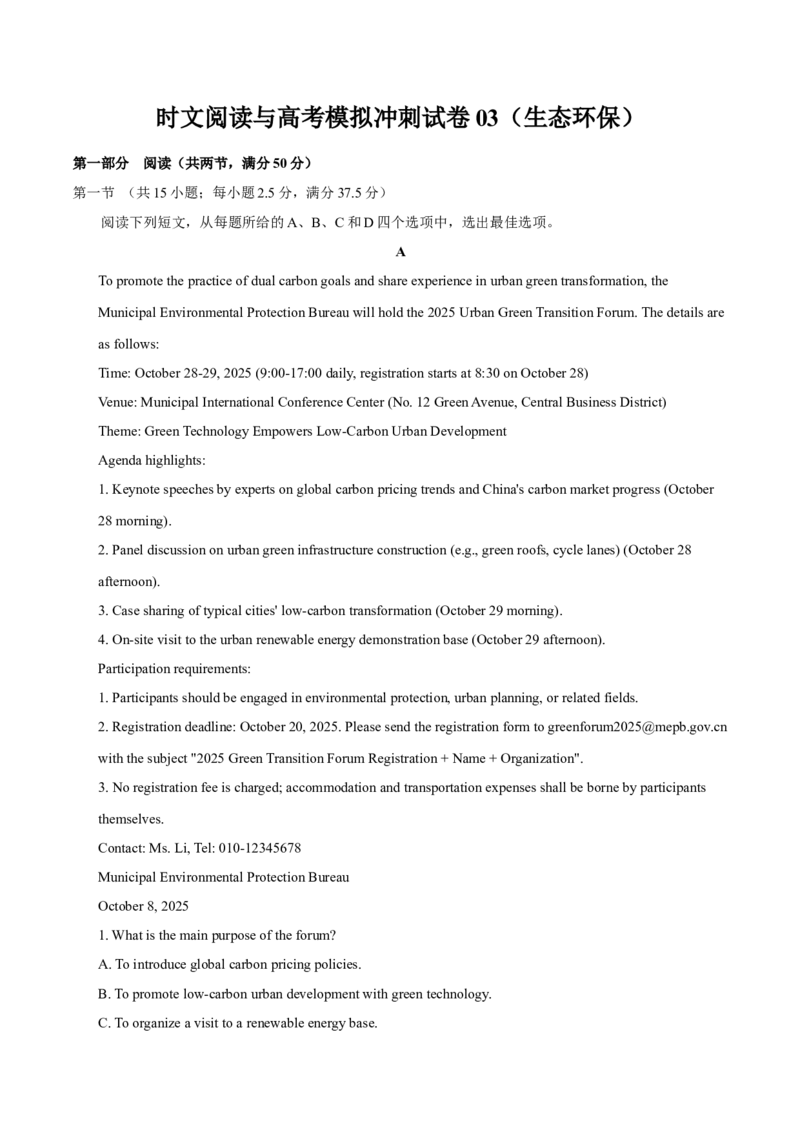
To promote the practice of dual carbon goals and share experience in urban green transformation, the
Municipal Environmental Protection Bureau will hold the 2025 Urban Green Transition Forum. The details are
as follows:
Time: October 28-29, 2025 (9:00-17:00 daily, registration starts at 8:30 on October 28)
Venue: Municipal International Conference Center (No. 12 Green Avenue, Central Business District)
Theme: Green Technology Empowers Low-Carbon Urban Development
Agenda highlights:
1. Keynote speeches by experts on global carbon pricing trends and China's carbon market progress (October
28 morning).
2. Panel discussion on urban green infrastructure construction (e.g., green roofs, cycle lanes) (October 28
afternoon).
3. Case sharing of typical cities' low-carbon transformation (October 29 morning).
4. On-site visit to the urban renewable energy demonstration base (October 29 afternoon).
Participation requirements:
1. Participants should be engaged in environmental protection, urban planning, or related fields.
2. Registration deadline: October 20, 2025. Please send the registration form to greenforum2025@mepb.gov.cn
with the subject "2025 Green Transition Forum Registration + Name + Organization".
3. No registration fee is charged; accommodation and transportation expenses shall be borne by participants
themselves.
Contact: Ms. Li, Tel: 010-12345678
Municipal Environmental Protection Bureau
October 8, 2025
1. What is the main purpose of the forum?
A. To introduce global carbon pricing policies.
B. To promote low-carbon urban development with green technology.
C. To organize a visit to a renewable energy base.
D. To collect suggestions on urban planning.
2. When will the panel discussion on urban green infrastructure be held?
A. At 8:30 on October 28.
B. In the morning of October 28.
C. In the afternoon of October 28.
D. In the morning of October 29.
3. What should participants do to register?
A. Pay the registration fee in advance.
B. Send the form to the specified email before October 20.
C. Contact Ms. Li to confirm accommodation.
D. Submit the form on the forum day.
B
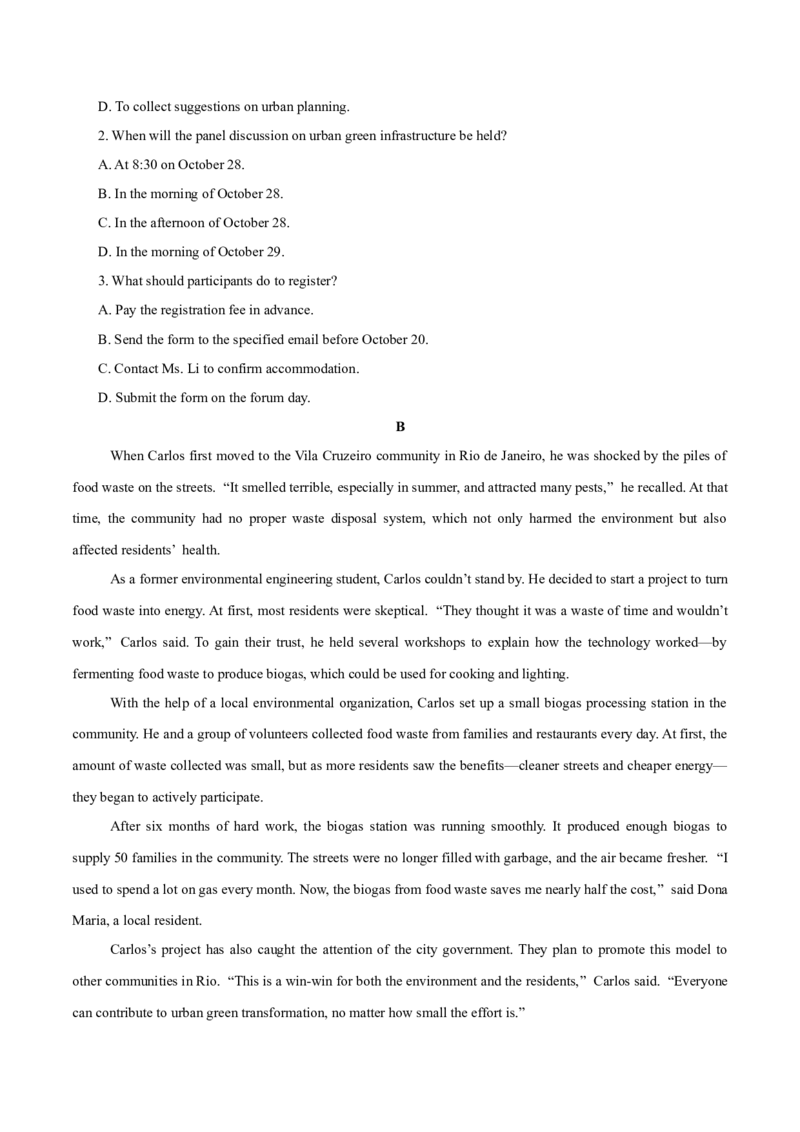
When Carlos first moved to the Vila Cruzeiro community in Rio de Janeiro, he was shocked by the piles of
food waste on the streets. “It smelled terrible, especially in summer, and attracted many pests,” he recalled. At that
time, the community had no proper waste disposal system, which not only harmed the environment but also
affected residents’ health.
As a former environmental engineering student, Carlos couldn’t stand by. He decided to start a project to turn
food waste into energy. At first, most residents were skeptical. “They thought it was a waste of time and wouldn’t
work,” Carlos said. To gain their trust, he held several workshops to explain how the technology worked—by
fermenting food waste to produce biogas, which could be used for cooking and lighting.
With the help of a local environmental organization, Carlos set up a small biogas processing station in the
community. He and a group of volunteers collected food waste from families and restaurants every day. At first, the
amount of waste collected was small, but as more residents saw the benefits—cleaner streets and cheaper energy—
they began to actively participate.
After six months of hard work, the biogas station was running smoothly. It produced enough biogas to
supply 50 families in the community. The streets were no longer filled with garbage, and the air became fresher. “I
used to spend a lot on gas every month. Now, the biogas from food waste saves me nearly half the cost,” said Dona
Maria, a local resident.
Carlos’s project has also caught the attention of the city government. They plan to promote this model to
other communities in Rio. “This is a win-win for both the environment and the residents,” Carlos said. “Everyone
can contribute to urban green transformation, no matter how small the effort is.”
4. What made Carlos decide to start his green project?
A. The poor waste disposal in his community.
B. His desire to make money from new technology.
C. The invitation from a local environmental organization.
D. His interest in biogas production.
5. How did Carlos gain residents’ trust at first?
A. By offering free biogas to residents.
B. By holding workshops to explain the technology.
C. By asking the government to support his project.
D. By showing them the clean streets in other communities.
6. What can we infer from Dona Maria's words?
A. She used to have no access to gas.
B. The biogas project has reduced her living costs.
C. She is in charge of collecting food waste.
D. She doubts the sustainability of the project.
7. What is the city government’s attitude towards Carlos’s project?
A. Critical
B. Indifferent
C. Supportive
D. Doubtful.
C
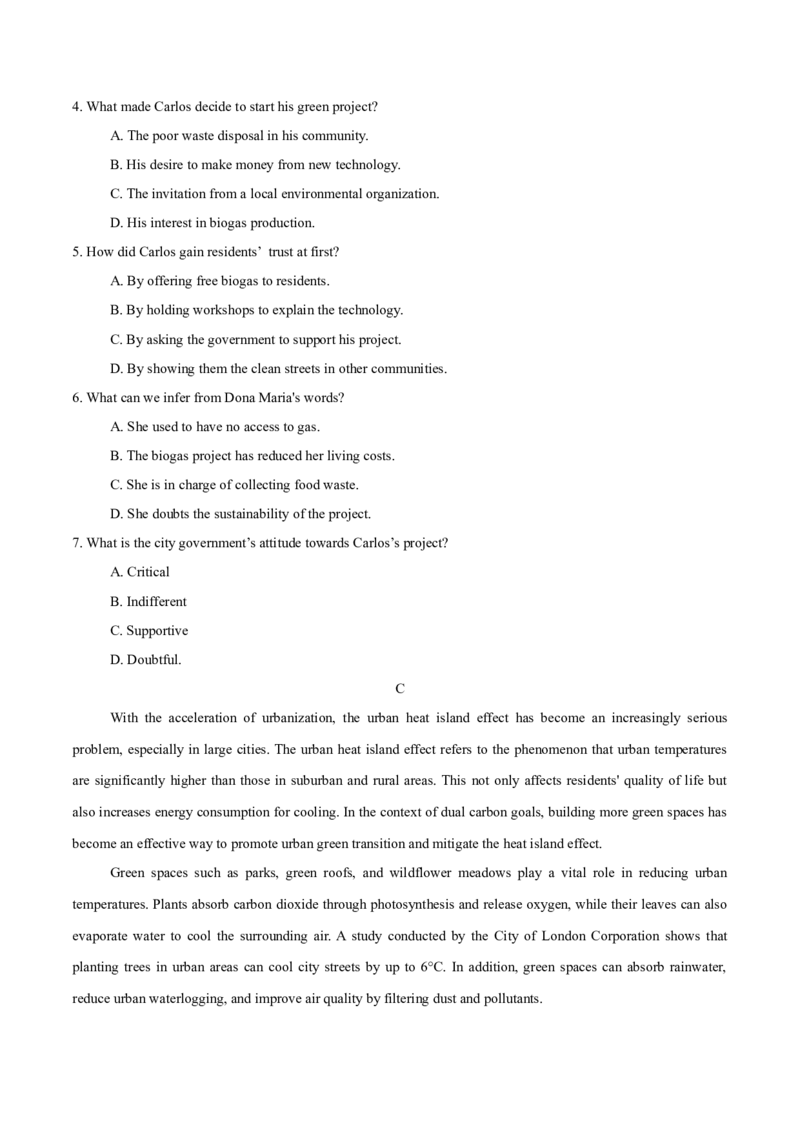
With the acceleration of urbanization, the urban heat island effect has become an increasingly serious
problem, especially in large cities. The urban heat island effect refers to the phenomenon that urban temperatures
are significantly higher than those in suburban and rural areas. This not only affects residents' quality of life but
also increases energy consumption for cooling. In the context of dual carbon goals, building more green spaces has
become an effective way to promote urban green transition and mitigate the heat island effect.
Green spaces such as parks, green roofs, and wildflower meadows play a vital role in reducing urban
temperatures. Plants absorb carbon dioxide through photosynthesis and release oxygen, while their leaves can also
evaporate water to cool the surrounding air. A study conducted by the City of London Corporation shows that
planting trees in urban areas can cool city streets by up to 6°C. In addition, green spaces can absorb rainwater,
reduce urban waterlogging, and improve air quality by filtering dust and pollutants.
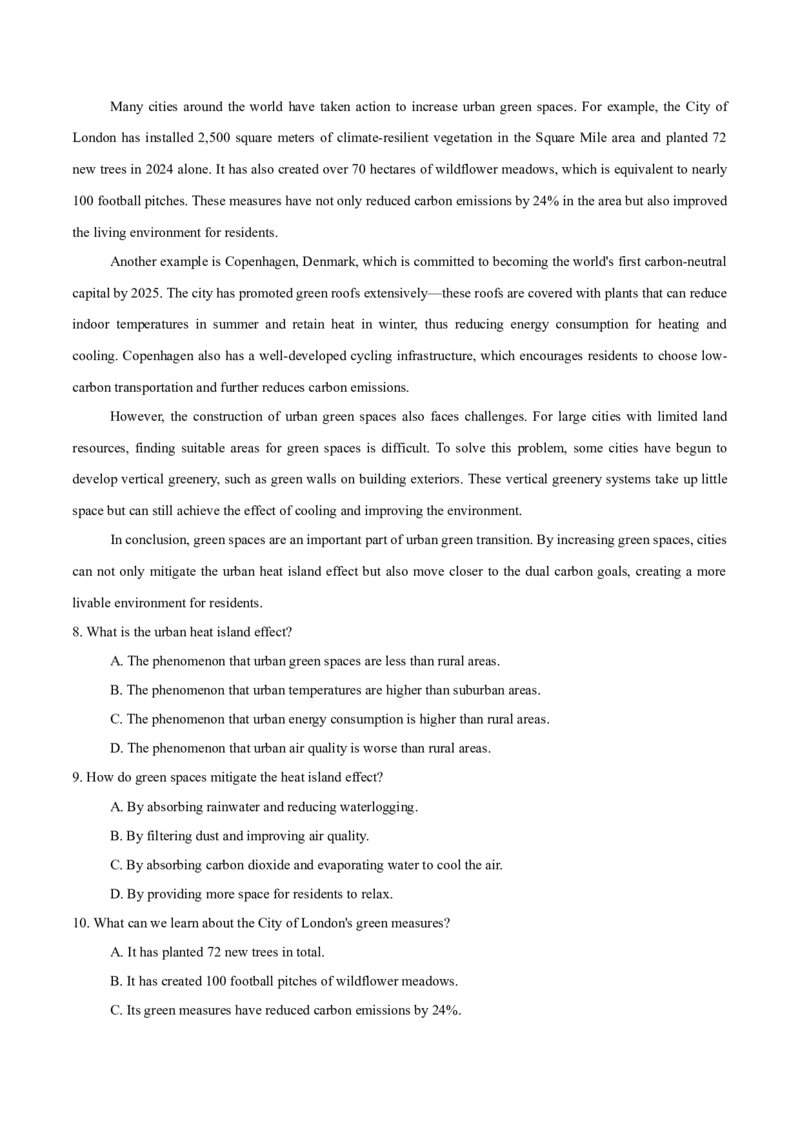
Many cities around the world have taken action to increase urban green spaces. For example, the City of
London has installed 2,500 square meters of climate-resilient vegetation in the Square Mile area and planted 72
new trees in 2024 alone. It has also created over 70 hectares of wildflower meadows, which is equivalent to nearly
100 football pitches. These measures have not only reduced carbon emissions by 24% in the area but also improved
the living environment for residents.
Another example is Copenhagen, Denmark, which is committed to becoming the world's first carbon-neutral
capital by 2025. The city has promoted green roofs extensively—these roofs are covered with plants that can reduce
indoor temperatures in summer and retain heat in winter, thus reducing energy consumption for heating and
cooling. Copenhagen also has a well-developed cycling infrastructure, which encourages residents to choose low-
carbon transportation and further reduces carbon emissions.
However, the construction of urban green spaces also faces challenges. For large cities with limited land
resources, finding suitable areas for green spaces is difficult. To solve this problem, some cities have begun to
develop vertical greenery, such as green walls on building exteriors. These vertical greenery systems take up little
space but can still achieve the effect of cooling and improving the environment.
In conclusion, green spaces are an important part of urban green transition. By increasing green spaces, cities
can not only mitigate the urban heat island effect but also move closer to the dual carbon goals, creating a more
livable environment for residents.
8. What is the urban heat island effect?
A. The phenomenon that urban green spaces are less than rural areas.
B. The phenomenon that urban temperatures are higher than suburban areas.
C. The phenomenon that urban energy consumption is higher than rural areas.
D. The phenomenon that urban air quality is worse than rural areas.
9. How do green spaces mitigate the heat island effect?
A. By absorbing rainwater and reducing waterlogging.
B. By filtering dust and improving air quality.
C. By absorbing carbon dioxide and evaporating water to cool the air.
D. By providing more space for residents to relax.
10. What can we learn about the City of London's green measures?
A. It has planted 72 new trees in total.
B. It has created 100 football pitches of wildflower meadows.
C. Its green measures have reduced carbon emissions by 24%.
D. It has installed 2,500 square meters of vertical greenery.
11. What challenge do cities face in building green spaces?
A. Lack of technical support
B. Limited land resources
C. High construction costs
D. Residents’ opposition
D
Under the background of global climate change, the dual carbon goals (peak carbon dioxide emissions and
carbon neutrality) have become a common goal of the international community. Urban green transition, as an
important part of achieving these goals, cannot be achieved by a single country or region alone. Global cooperation
is indispensable for promoting urban green transition and addressing climate challenges.
Firstly, global cooperation can promote the sharing of green technology. Different countries and cities have
different advantages in green technology research and development and application. For example, China has made
remarkable achievements in renewable energy technologies such as wind power and photovoltaic power, while
European countries have rich experience in urban green infrastructure construction such as green roofs and cycling
systems. Through global cooperation, countries can share their advanced technologies and experience, avoiding
repeated research and development and accelerating the popularization of green technologies in urban areas around
the world.
Secondly, global cooperation can help solve the problem of unbalanced development in urban green
transition. Developing countries and their cities often face difficulties such as lack of funds and technology in
promoting green transition. Developed countries can provide financial support and technical assistance to
developing countries, helping them build green infrastructure and promote low-carbon development. For instance,
the Paris Agreement's Article 6.4 mechanism provides a platform for international carbon credit transactions, which
can bring about 20 billion US dollars of climate financing opportunities for developing countries every year,
supporting their urban green transition projects.
Some people may argue that each country's national conditions are different, and the model of urban green
transition should be based on its own actual situation, so global cooperation is not necessary. However, although
national conditions vary, the core goal of urban green transition—reducing carbon emissions and protecting the
environment—is the same. Global cooperation does not mean copying the model of other countries, but rather
learning from each other's strengths and adapting to local conditions to form a suitable transition path. Moreover,
climate change is a global issue that affects all countries. If each country acts independently, it will be difficult to
achieve the global dual carbon goals.
In addition, global cooperation can strengthen policy coordination among countries. At present, some
countries have implemented carbon border adjustment mechanisms, such as the EU's CBAM. Without policy
coordination, these mechanisms may lead to trade frictions and hinder the process of urban green transition.
Through global cooperation, countries can formulate consistent policy frameworks and standards, promoting the
smooth progress of urban green transition.
In conclusion, global cooperation is crucial for urban green transition under dual carbon goals. Only through
joint efforts of all countries can we effectively address climate change and build a sustainable future for mankind.
12. What is the main argument of the passage?
A. The dual carbon goals are a common global goal.
B. Global cooperation is necessary for urban green transition.
C. Different countries have different green technology advantages.
D. Policy coordination can avoid trade frictions.
13. What is the advantage of global cooperation in green technology?
A. It can reduce the cost of technology research and development.
B. It can help developed countries occupy more markets.
C. It can promote the popularization of advanced green technologies.
D. It can help developing countries copy developed countries' models.
14. What does the author think of the view that global cooperation is unnecessary?
A. It is reasonable because national conditions are different.
B. It is incorrect because climate change is a global issue.
C. It is acceptable if countries can find their own paths.
D. It is understandable but needs to be adjusted.
15. What is the function of the EU's CBAM mentioned in the passage?
A. To provide financial support for developing countries.
B. To promote the sharing of green technologies.
C. To illustrate the importance of policy coordination.
D. To solve the problem of unbalanced development.
第二节(共5 小题:每小题2. 5 分, 满分12. 5 分)
    阅读下面短文, 从短文后的选项中选出可以填入空白处的最佳选项。选项中有两项为多余选项。
Urban green transition is not only the responsibility of governments and enterprises but also closely related to
every citizen. Everyone can contribute to it through daily actions.  16  Here are some practical suggestions for
you.
17  Choosing low-carbon transportation methods is one of the most direct ways. For short-distance travel,
you can walk or ride a bike. For long-distance travel, you can take public transportation such as buses and subways
instead of driving private cars. This can not only reduce carbon emissions but also improve your physical health.
Reduce food waste and practice circular economy. As we know, a large amount of food waste will produce
methane, a greenhouse gas, during decomposition.  18  You can plan your meals in advance to avoid buying
more food than needed. For the food waste that cannot be avoided, you can use it to make compost for potted plants
at home.
Save energy in daily life. Small changes in daily life can save a lot of energy.  19  Turn off the lights and
electrical appliances when you leave the room. Use energy-saving lamps instead of incandescent lamps. Adjust the
temperature of air conditioners appropriately—setting it to 26°C in summer and 20°C in winter can save a lot of
electricity.
Participate in urban greening activities.  20  You can join volunteer activities to plant trees or maintain
community green spaces. You can also grow some plants on your balcony or windowsill, which can not only purify
the air but also add greenery to the city.
In short, every small action of ours can contribute to urban green transition. Let's work together to build a low-
carbon and livable city.
A. Choose low-carbon transportation
B. Green spaces are important for the city
C. These actions may seem small, but their cumulative effect is great
D. Energy conservation is the key to reducing carbon emissions
E. Therefore, reducing food waste is crucial for urban green transition
F. Planting trees is beneficial to improving air quality
G. You can also encourage your family and friends to join you.
第二部分 语言运用(共两节,满分30 分)
第一节(共15 小题:每小题1 分,满分15 分)
    阅读下面短文, 从每题所给的A、B、C、D 四个选项中选出可以填入空白处的最佳选项。
When I first moved to Berlin, I was impressed by the city's efforts in green transition. The streets are lined
with trees, and there are many cycling lanes    2  1

 for residents. As I learned more about the city's green policies, I
decided to    2  2

 my own lifestyle to be more low-carbon.
At first, I found it difficult to
  2  3

 driving my car. But I soon realized that taking the subway was more
convenient and cheaper. I also started riding a bike to work on sunny days.
  2  4

 , I not only reduced my carbon
footprint but also got more exercise.
I also began to pay attention to    2  5    energy at home. I replaced all the incandescent lamps with energy-saving
ones and   2  6    to turn off the lights when I left a room. My roommate laughed at me at first, saying that these small
actions wouldn't   2  7    much. But I insisted, and gradually, he was 2  8

 by me and started to join in.
Last month, I participated in a community greening activity. We planted over 50 trees in a local park. It was
hard work, but when I saw the young saplings standing in a row, I felt a great sense of
  2  9
   . The park manager
told us that these trees would absorb a lot of carbon dioxide and    3  0  t

 he air quality in the area.
Berlin's green transition has taught me that everyone can make a   3  1

 . It's not just about big policies and
large-scale projects; small changes in daily life can also
  3  2
   to a greener city. I have also   3  3

 many of my
friends to adopt low-carbon lifestyles. Some of them have started using reusable shopping bags, while others have
begun to grow plants at home.
I believe that    3  4

 more and more people join in the green transition, our cities will become more livable and
sustainable.   3  5

 , we can achieve the dual carbon goals and protect our planet for future generations.
21. A. designed
B. bought
C. borrowed
D. stored
22. A. change
B. keep
C. make
D. find
23. A. start
B. stop
C. continue
D. enjoy
24. A. As a result
B. On the contrary    C. In addition
D. For example
25. A. wasting
B. saving
C. using
D. producing
26. A. forgot
B. refused
C. remembered
D. failed
27. A. matter
 B. help
C. work
D. happen
28. A. annoyed
B. influenced
C. confused
D. worried
29. A. achievement    B. sadness
C. pressure
D. humor
30. A. worsen
B. affect
C. improve
D. reduce
31. A. mistake
B. difference
C. promise
D. decision
32. A. contribute
B. lead
C. belong
D. refer
33. A. forced
B. invited
C. persuaded
D. ordered
34. A. if
B. though
C. unless
D. until
35. A. Suddenly
B. Eventually
C. Recently
D. Luckily
第二节(共10 小题:每小题1. 5 分, 满分15 分)
    阅读下面短文, 在空白处填入1 个适当的单词或括号内单词的正确形式。
Read the following passage and fill in the blanks with the appropriate form of the words given in the brackets
or the correct words according to the context.
Urban green transition has become a global trend in recent years. Many cities around the world   36

  (take)
active measures to promote low-carbon development. One of the important measures is 37

  (build) more urban
green spaces.
Green spaces, such as parks and green roofs, are beneficial to the environment in many ways. They can absorb
carbon dioxide,   38
    i
  s a major greenhouse gas, and release oxygen. They can also cool the urban environment by
39


 (evaporate) water from their leaves. A recent study shows that urban green spaces can reduce local
temperatures by 2 to 6°C,   40
     (depend) on the size and type of the green space.
In China, the government has attached great importance to urban green transition. Since 2020, many cities
41
     (launch) projects to increase urban green coverage. For example, Shanghai has built many vertical green walls
on the exteriors of buildings, which not only save land resources but also improve the city's appearance. These
green walls can also reduce the energy    42
     (consume) of buildings by keeping them cool in summer.
Citizens also play an important role in urban green transition. We can choose to walk or ride bikes instead of
43

  (drive) cars. We can also participate in tree-planting activities. Every small action we take   44
     (help) to
make the city greener. Only when the government, enterprises and citizens work together   4  5

 we achieve the
goal of urban green transition and realize the dual carbon goals.
第三部分  写作(满分15 分)
假定你是李华,你所在的学校将举办一场“绿色校园,低碳生活”主题活动。请你根据以下提示,给
学校的外教Smith 先生写一封邮件,邀请他参加活动并做一个简短的演讲。
提示:1. 活动时间:11 月10 日下午2:30-4:30
2. 活动地点:学校多功能报告厅
3. 演讲主题:国外校园低碳生活的实践经验
4. 活动目的:提高学生的低碳环保意识,推动绿色校园建设
注意:1. 词数80 左右;
2. 可适当增加细节,使行文连贯;
3. 开头和结尾已给出,不计入总词数。
Dear Mr. Smith,
I’m Li Hua, a student from Class 2, Grade 3.


Yours sincerely,
Li Hua