主题02 跨文化沟通
01 话题词汇佳句
02 时文热点阅读(全文翻译,词汇积累,长难句分析)
03 高考真题链接
04 话题阅读精练
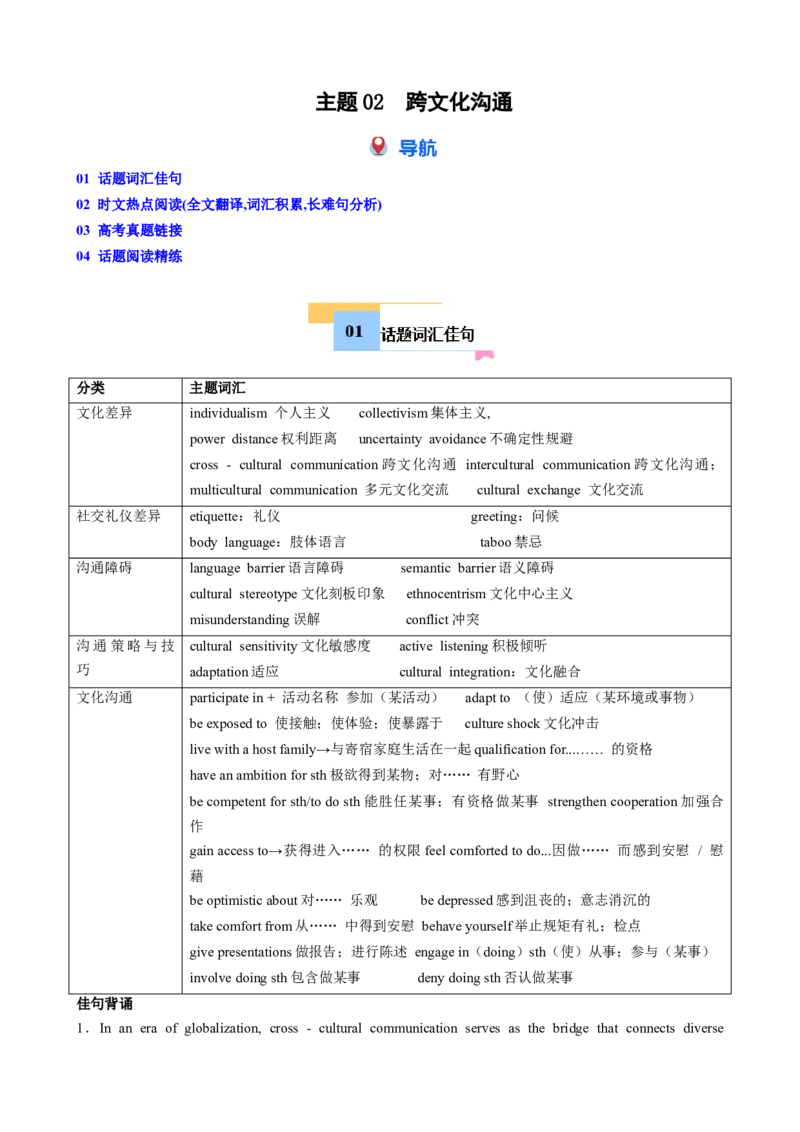
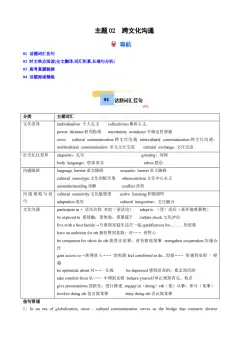
分类
主题词汇
文化差异
individualism 个人主义 collectivism 集体主义,
power distance 权利距离 uncertainty avoidance 不确定性规避
cross - cultural communication 跨文化沟通 intercultural communication 跨文化沟通;
multicultural communication 多元文化交流 cultural exchange 文化交流
社交礼仪差异
etiquette:礼仪 greeting:问候
body language:肢体语言 taboo 禁忌
沟通障碍
language barrier 语言障碍 semantic barrier 语义障碍
cultural stereotype 文化刻板印象 ethnocentrism 文化中心主义
misunderstanding 误解 conflict 冲突
沟通策略与技
巧
cultural sensitivity 文化敏感度 active listening 积极倾听
adaptation 适应 cultural integration:文化融合
文化沟通
participate in + 活动名称 参加(某活动) adapt to (使)适应(某环境或事物)
be exposed to 使接触;使体验;使暴露于 culture shock 文化冲击
live with a host family→与寄宿家庭生活在一起qualification for...…… 的资格
have an ambition for sth 极欲得到某物;对…… 有野心
be competent for sth/to do sth 能胜任某事;有资格做某事 strengthen cooperation 加强合
作
gain access to→获得进入…… 的权限feel comforted to do...因做…… 而感到安慰 / 慰
藉
be optimistic about 对…… 乐观 be depressed 感到沮丧的;意志消沉的
take comfort from 从…… 中得到安慰 behave yourself 举止规矩有礼;检点
give presentations 做报告;进行陈述 engage in(doing)sth(使)从事;参与(某事)
involve doing sth 包含做某事 deny doing sth 否认做某事
佳句背诵
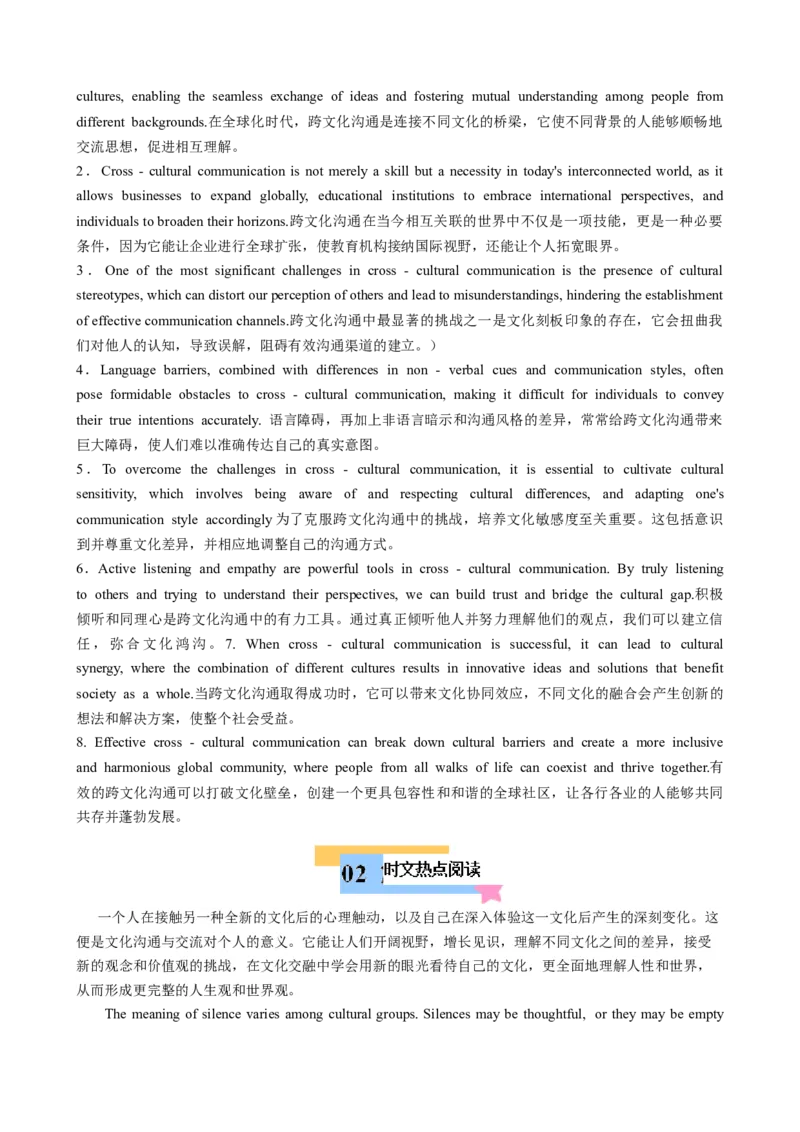
1.In an era of globalization, cross - cultural communication serves as the bridge that connects diverse
cultures, enabling the seamless exchange of ideas and fostering mutual understanding among people from
different backgrounds.在全球化时代,跨文化沟通是连接不同文化的桥梁,它使不同背景的人能够顺畅地
交流思想,促进相互理解。
2.Cross - cultural communication is not merely a skill but a necessity in today's interconnected world, as it
allows businesses to expand globally, educational institutions to embrace international perspectives, and
individuals to broaden their horizons.跨文化沟通在当今相互关联的世界中不仅是一项技能,更是一种必要
条件,因为它能让企业进行全球扩张,使教育机构接纳国际视野,还能让个人拓宽眼界。
3 .One of the most significant challenges in cross - cultural communication is the presence of cultural
stereotypes, which can distort our perception of others and lead to misunderstandings, hindering the establishment
of effective communication channels.跨文化沟通中最显著的挑战之一是文化刻板印象的存在,它会扭曲我
们对他人的认知,导致误解,阻碍有效沟通渠道的建立。)
4.Language barriers, combined with differences in non - verbal cues and communication styles, often
pose formidable obstacles to cross - cultural communication, making it difficult for individuals to convey
their true intentions accurately. 语言障碍,再加上非语言暗示和沟通风格的差异,常常给跨文化沟通带来
巨大障碍,使人们难以准确传达自己的真实意图。
5.To overcome the challenges in cross - cultural communication, it is essential to cultivate cultural
sensitivity, which involves being aware of and respecting cultural differences, and adapting one's
communication style accordingly 为了克服跨文化沟通中的挑战,培养文化敏感度至关重要。这包括意识
到并尊重文化差异,并相应地调整自己的沟通方式。
6.Active listening and empathy are powerful tools in cross - cultural communication. By truly listening
to others and trying to understand their perspectives, we can build trust and bridge the cultural gap.积极
倾听和同理心是跨文化沟通中的有力工具。通过真正倾听他人并努力理解他们的观点,我们可以建立信
任,弥合文化鸿沟。7. When cross - cultural communication is successful, it can lead to cultural
synergy, where the combination of different cultures results in innovative ideas and solutions that benefit
society as a whole.当跨文化沟通取得成功时,它可以带来文化协同效应,不同文化的融合会产生创新的
想法和解决方案,使整个社会受益。
8. Effective cross - cultural communication can break down cultural barriers and create a more inclusive
and harmonious global community, where people from all walks of life can coexist and thrive together.有
效的跨文化沟通可以打破文化壁垒,创建一个更具包容性和和谐的全球社区,让各行各业的人能够共同
共存并蓬勃发展。
一个人在接触另一种全新的文化后的心理触动,以及自己在深入体验这一文化后产生的深刻变化。这
便是文化沟通与交流对个人的意义。它能让人们开阔视野,增长见识,理解不同文化之间的差异,接受
新的观念和价值观的挑战,在文化交融中学会用新的眼光看待自己的文化,更全面地理解人性和世界,
从而形成更完整的人生观和世界观。
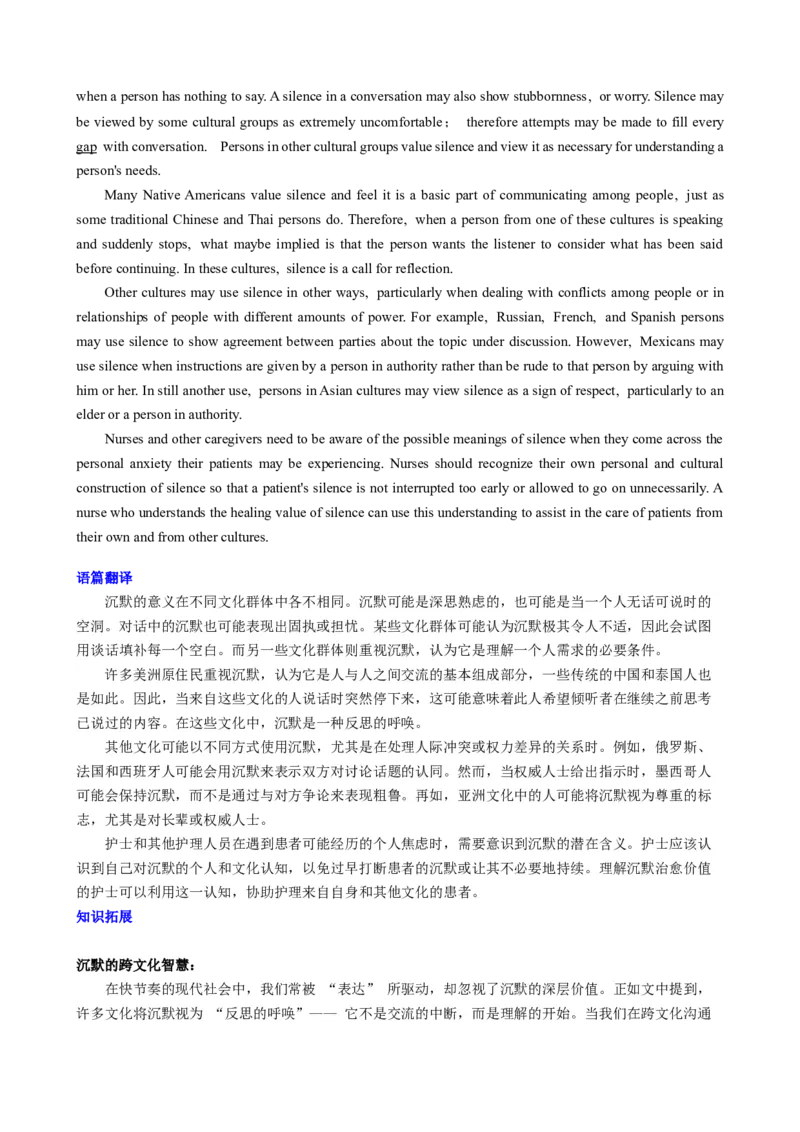
The meaning of silence varies among cultural groups. Silences may be thoughtful, or they may be empty
when a person has nothing to say. A silence in a conversation may also show stubbornness, or worry. Silence may
be viewed by some cultural groups as extremely uncomfortable; therefore attempts may be made to fill every
gap with conversation. Persons in other cultural groups value silence and view it as necessary for understanding a
person's needs.
Many Native Americans value silence and feel it is a basic part of communicating among people, just as
some traditional Chinese and Thai persons do. Therefore, when a person from one of these cultures is speaking
and suddenly stops, what maybe implied is that the person wants the listener to consider what has been said
before continuing. In these cultures, silence is a call for reflection.
Other cultures may use silence in other ways, particularly when dealing with conflicts among people or in
relationships of people with different amounts of power. For example, Russian, French, and Spanish persons
may use silence to show agreement between parties about the topic under discussion. However, Mexicans may
use silence when instructions are given by a person in authority rather than be rude to that person by arguing with
him or her. In still another use, persons in Asian cultures may view silence as a sign of respect, particularly to an
elder or a person in authority.
Nurses and other caregivers need to be aware of the possible meanings of silence when they come across the
personal anxiety their patients may be experiencing. Nurses should recognize their own personal and cultural
construction of silence so that a patient's silence is not interrupted too early or allowed to go on unnecessarily. A
nurse who understands the healing value of silence can use this understanding to assist in the care of patients from
their own and from other cultures.
语篇翻译
沉默的意义在不同文化群体中各不相同。沉默可能是深思熟虑的,也可能是当一个人无话可说时的
空洞。对话中的沉默也可能表现出固执或担忧。某些文化群体可能认为沉默极其令人不适,因此会试图
用谈话填补每一个空白。而另一些文化群体则重视沉默,认为它是理解一个人需求的必要条件。
许多美洲原住民重视沉默,认为它是人与人之间交流的基本组成部分,一些传统的中国和泰国人也
是如此。因此,当来自这些文化的人说话时突然停下来,这可能意味着此人希望倾听者在继续之前思考
已说过的内容。在这些文化中,沉默是一种反思的呼唤。
其他文化可能以不同方式使用沉默,尤其是在处理人际冲突或权力差异的关系时。例如,俄罗斯、
法国和西班牙人可能会用沉默来表示双方对讨论话题的认同。然而,当权威人士给出指示时,墨西哥人
可能会保持沉默,而不是通过与对方争论来表现粗鲁。再如,亚洲文化中的人可能将沉默视为尊重的标
志,尤其是对长辈或权威人士。
护士和其他护理人员在遇到患者可能经历的个人焦虑时,需要意识到沉默的潜在含义。护士应该认
识到自己对沉默的个人和文化认知,以免过早打断患者的沉默或让其不必要地持续。理解沉默治愈价值
的护士可以利用这一认知,协助护理来自自身和其他文化的患者。
知识拓展
沉默的跨文化智慧:
在快节奏的现代社会中,我们常被 “表达” 所驱动,却忽视了沉默的深层价值。正如文中提到,
许多文化将沉默视为 “反思的呼唤”—— 它不是交流的中断,而是理解的开始。当我们在跨文化沟通
中遇到沉默时,不妨将其视为一个 “暂停键”:给他人空间整理思绪,也让自己有机会深度倾听。这种
对 “沉默” 的包容,本质上是对 “差异” 的尊重,正如护理人员需理解患者沉默的含义,我们在生
活中也需学会解读沉默背后的文化密码与个人情感。
沉默作为自我对话的契机
从个人成长角度看,沉默是心灵的 “留白”。当我们被外界声音淹没时,沉默能帮助我们剥离浮躁,
回归内心的真实需求。就像美洲原住民文化中,沉默是沟通的基础 —— 唯有先与自己对话,才能真正
理解他人。在人际关系中,适时的沉默并非冷漠,而是用 “不打扰” 的温柔给予对方尊重,这种智慧
在冲突化解中尤为珍贵(如墨西哥人用沉默代替争执)。
文化差异对沟通的影响:
不同文化背景下,人们的沟通方式和习惯存在显著差异。除了沉默的含义不同,在语言表达的直接
与间接、身体语言的使用等方面也有体现。例如,在一些欧美文化中,人们更倾向于直接表达自己的观
点,而在亚洲和拉丁美洲的部分文化中,人们可能更委婉含蓄。
沉默在谈判中的运用:
在国际商务谈判中,不同国家的谈判者对沉默的运用和理解也有所不同。例如,日本谈判者常常会
利用沉默来观察对方的反应,给对方施加心理压力;而美国谈判者可能不太习惯长时间的沉默,会急于
打破沉默继续交流。
跨文化医疗中的沟通:
在医疗场景中,医护人员了解不同文化中沉默的含义至关重要。这有助于他们更好地理解患者的需
求和情绪,避免因误解而影响治疗效果。例如,一些文化中患者的沉默可能表示对医生权威的尊重,而
在另一些文化中可能是对治疗方案有疑虑但不愿直接表达。
社交媒体时代对沉默的挑战:
在当今社交媒体高度发达的时代,人们似乎越来越难以接受沉默。即时通讯和社交平台让人们时刻
保持联系,沉默往往被视为不积极参与或冷漠的表现。但从不同文化的角度来看,这种观念可能需要重
新审视。
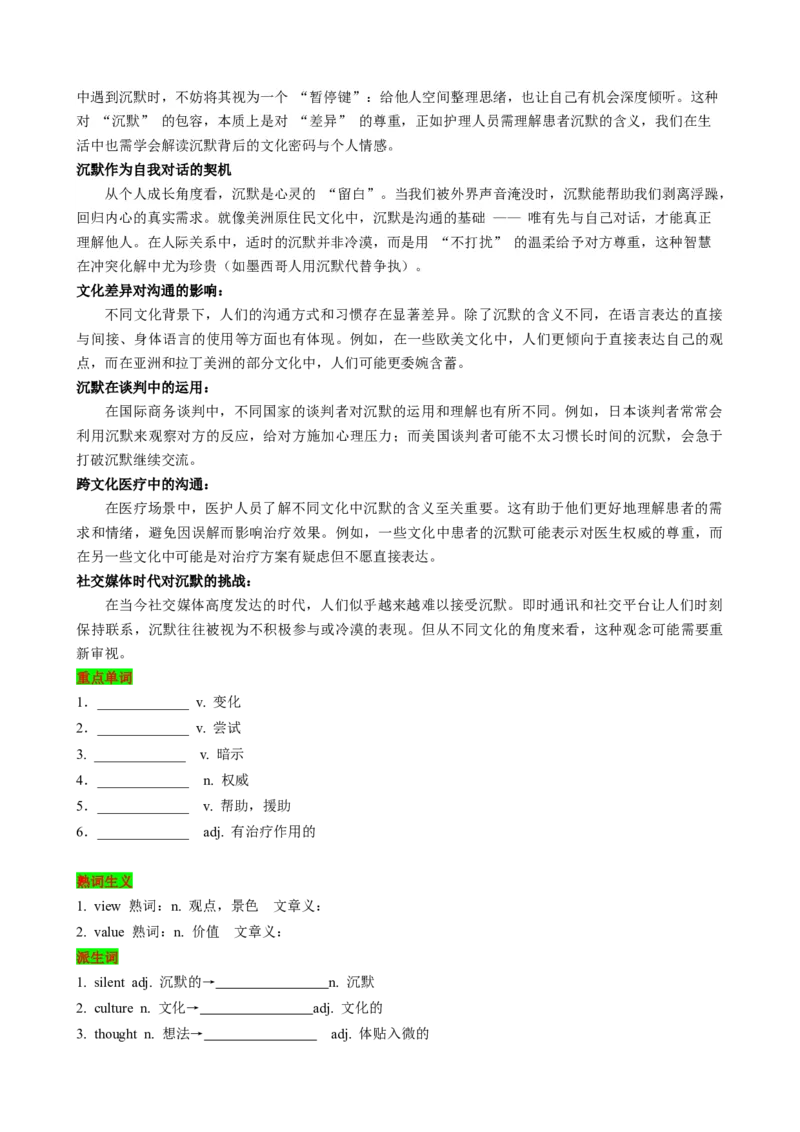
重点单词
1._____________ v. 变化
2._____________ v. 尝试
3. _____________ v. 暗示
4._____________ n. 权威
5._____________ v. 帮助,援助
6._____________ adj. 有治疗作用的
熟词生义
1. view 熟词:n. 观点,景色 文章义:
2. value 熟词:n. 价值 文章义:
派生词
1. silent adj. 沉默的→ n. 沉默
2. culture n. 文化→ adj. 文化的
3. thought n. 想法→ adj. 体贴入微的
4.comfort n. &v. 宽慰,舒适→comfortable adj. 舒适的→ adj. 不舒服的
5. stubborn adj. 固执的→ n. 固执
6. tradition n. 传统→ adj. 传统的
7.reflect v. 沉思,反思→ n. 沉思
8. anxious adj. 焦虑的,渴望的→ n. 焦虑
合成词
1. relation+ ship→relationship n. 关系
重点短语
1. 把……看作,视为
2. 讨论
3. 而不是
4. 对……粗鲁
5. 偶遇
长难句分析
Therefore, when a person from one of these cultures is speaking and suddenly stops, what maybe implied is that
the person wants the listener to consider what has been said before continuing.
分析:本句包含多个从句。when a person from one of these cultures is speaking and suddenly stops 是 从
句,其中from one of these cultures 是后置定语修饰person;what maybe implied 是 从句,在句中
作主语;is 是系动词;that the person wants the listener to consider what has been said before continuing 是
从句,作is 的表语,在这个表语从句中,what has been said before continuing 是 从句,作consider
的宾语。
译文:因此,当来自这些文化中的某个人正在说话并突然停下来时,可能暗示的是这个人希望听众在继
续之前考虑一下所说的内容。
Passage 1
(2024 年全国新高考I 卷 B)
“I am not crazy,” says Dr. William Farber, shortly after performing acupuncture ( 针灸) on a rabbit. “I am
ahead of my time.” If he seems a little defensive, it might be because even some of his coworkers occasionally
laugh at his unusual methods. But Farber is certain he’ll have the last laugh. He’s one of a small but growing
number of American veterinarians( 兽医) now practicing “holistic” medicine – combining traditional Western
treatments with acupuncture, chiropractic(按摩疗法) and herbal medicine.
Farber, a graduate of Colorado State University, started out as a more conventional veterinarian. He became
interested in alternative treatments 20 years ago when he suffered from terrible back pain. He tried muscle-
relaxing drugs but found little relief. Then he tried acupuncture, an ancient Chinese practice, and was amazed that
he improved after two or three treatments. What worked on a veterinarian seemed likely to work on his patients.
So, after studying the techniques for a couple of years, he began offering them to pets.
Leigh Tindale’s dog Charlie had a serious heart condition. After Charlie had a heart attack, Tindale says, she
was prepared to put him to sleep, but Farber’s treatments eased her dog’s suffering so much that she was able to
keep him alive for an additional five months. And Priscilla Dewing reports that her horse, Nappy, “moves more
easily and rides more comfortably” after a chiropractic adjustment.
Farber is certain that the holistic approach will grow more popular with time, and if the past is any indication,
he may be right: Since 1982, membership in the American Holistic Veterinary Medical Association has grown
from 30 to over 700. “Sometimes it surprises me that it works so well,” he says. “I will do anything to help an
animal. That’s my job.”
24. What do some of Farber’s coworkers think of him?
A. He’s odd.
B. He’s strict.
C. He’s brave.
D. He’s rude.
25. Why did Farber decide to try acupuncture on pets?
A. He was trained in it at university.
B. He was inspired by another veterinarian.
C. He benefited from it as a patient.
D. He wanted to save money for pet owners.
26. What does paragraph 3 mainly talk about?
A. Steps of a chiropractic treatment.
B. The complexity of veterinarians’ work.
C. Examples of rare animal diseases.
D. The effectiveness of holistic medicine.
27. Why does the author mention the American Holistic Veterinary Medical Association?
A. To prove Farber’s point.
B. To emphasize its importance.
C. To praise veterinarians.
D. To advocate animal protection.
【语篇导读】本文是一篇夹叙夹议文。兽医William Farber 奉行中西医结合的整体医学疗法,用针灸、按
摩等方式治疗动物并取得了良好疗效。
24. A 推理判断题。根据第一段第一句I am not crazy 以及第三句中的.... some of his coworkers occasionally
laugh at his unusual method 可知,Farber 的一些同事认为他很怪异(odd),因此A 选项正确。
25. C 推理判断题。根据第二段内容可知,20 年前有段时间Farber 背部疼痛难忍,用药无效后尝试接受
中医针灸治疗并取得很好的治疗效果。他受到启发,经过多年研习后,将此疗法应用于动物,因此C 选
项正确。
26. D 主旨大意题。第三段通过两个具体的治疗案例说明整体医学疗法对于动物治疗的有效性,因此D 选
项正确。
27. A 推理判断题。从最后一段可知,兽医William Farber 确信整体医学将会越来越受欢迎。自1982 年以
来,美国整体医疗兽医协会会员人数的增长印证了这一观点,因此A 选项正确。
重点单词
1. adj. 疯狂的
2. v. 实行,奉行/n. 惯常做法;
3. v. (使)减轻;
4. n. 方法;
5. v. 提倡
6. adj. 可替代的
派生词
1. defend v. 保卫,防御→ defense n. 防御,保卫 → adj. 存有戒心的;
2. occasion n. (某事发生的)时刻,时候;<正式>时机→occasional adj. 偶尔→ adv. 偶尔,有时
3. convention n. 传统→ adj. 传统的;
4. relieve v. 缓解→ n. (痛苦等的)减轻
5. suffer v. 遭受→ n. 疼痛;
6. indicate v. 预测→ n. 迹象;
熟词生义
1.graduate v. 毕业 (此文指代“n. ”
2. condition n. 情形(此文指代“” ”
合成词
1.member+ ship→ n. 会员;
重点短语
1.ahead of one's time
2.have the last laugh
3.start out as
长难句分析
He became interested in alternative treatments 20 years ago when he suffered from terrible back pain.
分析:when 引导 从句修饰20 years ago。
翻译:20 年前,他遭受严重的背痛时,他对替代疗法产生了兴趣。
Passage 2
(2025 年普通高等学校招生全国统一考试(1 月浙江卷)
One of the most common mistakes in communication is trying to do too much. ___36___ There’s no value in
delivering any kind of communication, whether written, spoken, formal, or informal, if the message doesn’t come
across clearly. Being clear and brief — while maintaining interest and including everything your listeners need to
know — is a high-level communication skill.
Here are some tips worth following in order to communicate more effectively.
Keep your audience in mind.
Your audience will naturally be more interested and engaged when you tailor your communications to their
interests. ___37___ This will engage their desire to understand and interact with the information.
Don’t use ten words when one will do.
Even the most engaged and committed audience will eventually get bored. Keeping your message simple and
clear will make it easier for people to understand. ___38___ However, they’re hearing it for the first time. Keep it
simple.
___39___
If you’ve ever worked as an instructor, manager, trainer or coach, you’ll know that there are few better ways
to learn new information than to teach it. Ask the audience to contribute their ideas or to take a role in explaining
new concepts and policies to others. Allow them to lead discussions and meetings to develop their communication
skills.
Consider the best method to deliver your message.
If the information you’re communicating isn’t urgent, consider sending an email. Written communication
will give your audience more time to review it, think it over, and follow up with questions. ___40___
Building effective communication skills takes time, but the effects are worth the effort.
A. Be patient.
B. Get the audience involved.
C. The best messages are often simple.
D. Speak directly to what matters to them.
E. You may be surprised by what your listeners offer.
F. It will also give them a handy record to refer back to.
G. As the speaker, you already know what you’re going to say.
【语篇导读】本文是一篇说明文,讲述了有效沟通的方式。
36. C 空白处前提到,在沟通中最常见的错误之一就是试图做得太多;空白处后讲的是“如果信息没有清
晰地传达出来,那么任何形式的沟通,无论是书面的、口头的、正式的或非正式的,都没有价值”。由
此可知,空白处强调的应是不要传达过多内容,要注重信息的清晰传达, C 项“最好的信息往往是简单
的”符合语境。
37. D 根据空白处前可知,要根据听众的兴趣决定沟通内容,再结合空白处后“这将激发他们理解信息并
与之互动的欲望”可知,D 项“直接讲述对他们重要的事情”进一步说明了要针对听众感兴趣的内容进
行沟通,符合语境。
38. G 根据小标题可知,本段围绕沟通内容要简洁展开。根据空白处后可知,这里是将讲话者和听众进行
对比,讲话者已经知道内容,而听众是第一次听,所以要简单明了。G 项“作为讲话者,你已经知道自
己要说什么”,与下文逻辑连贯。
39. B 空白处为该段的小标题。根据本段后两句可知,本段建议讲话者让听众积极贡献想法参与到讨论中
来。 B 项“让听众参与进来”最能概括本段内容。
40. F 根据小标题可知,本段建议沟通者考虑传递信息的最佳方式。空白处前提到,书面沟通能让听众有
更多时间回顾、认真思考并提出问题来跟进。F 项“这也会为他们提供一份方便查阅的记录”,进一步说
明了书面沟通的另一个好处,与上文衔接紧密。
重点单词
1. ________ v. 传递
2. ________ adj. 紧急的
3. ________ adj. 简洁的
熟词生义
tailor 熟义:n. 裁缝;文章义:v. ________
派生词
1. engage v. 引起,吸引→________ adj. 投入的
2. commit v. 犯罪,犯错→________ adj. 专注的,坚定的
3. instruct v. 指示,吩咐→________ n. 讲师
4. hand n. 手v.传递→________ adj. 便利的
5. communicate v. 交流→________ n. 交流;沟通
6. effect n. 影响→________ adj. 有效的
重点短语
1. ________________被理解
2. ________________将......记在心中
3. tailor... to ________________
4. ________________与……互动
5. ________________仔细考虑
6. ________________对……取进一步行动
7. ________________查阅
长难句分析
1. There’s no value in delivering any kind of communication, whether written, spoken, formal, or informal, if the
message doesn’t come across clearly.
分析:本句是复合句。“There’s no value in doing sth.”是固定句型,表示“________________”,其中in
后接动名词短语delivering any kind of communication 作________;“whether written, spoken, formal, or
informal”是省略结构,完整形式为“whether it is written, spoken, formal, or informal”,作插入语;“if the
message doesn’t come across clearly”是if 引导的________从句。
翻译: 如果信息传达不清晰,那么进行任何形式的交流,无论是书面的、口头的、正式的还是非正式的,
都没有价值。 、
2. Being clear and brief — while maintaining interest and including everything your listeners need to know — is a
high - level communication skill.
分析:本句是主系表结构。“Being clear and brief”是动名词短语作________;“while maintaining interest
and including everything your listeners need to know”是省略结构,完整形式为“while you are maintaining
interest and including everything your listeners need to know”,作________;“your listeners need to know”是
________,修饰先行词everything;“is”是系动词,“a high - level communication skill”是表语。
句意: 保持清晰简洁——同时保持趣味性并涵盖听众需要了解的所有内容——是一种高级的沟通技巧。
Passage 1
(2026 届河北省衡水市高三上学期第二次调研考试(二模)The Galle Trilingual Inscription has been
officially inscribed (刻写) in the UNESCO Memory of the World Register. The stele (石碑) was constructed over
600 years ago during Zheng He’s expeditions.
The stele’s rounded top features two dragons playing with a pearl. It is the only one surviving overseas that is
related to Zheng’s voyages. It’s still distinguishable today. It tells us that Zheng paid respect to religious sites and
made celebration offerings during his visits. Carved in three languages — Chinese, Tamil and Persian — the stele
has a historical value beyond words.
“There are many multilingual inscriptions in the world, but most of them are bilingual,” says Wang Hongmin
from the National Archives Administration of China. “Among the tri-lingual ones, only two include Chinese. The
Galle Trilingual Inscription is the only one inscribed in Chinese, Persian and Tamil.”
The inscription records Zheng’s offerings of equal value to several deities (神祇). “This practice reflects the
Zheng’s respect for religious diversity,” says Wang Deyan from the North China University of Technology.
This year marks the 620th anniversary of Zheng’s voyages. The explorer first set sail from Nanjing in 1405
and traveled as far as the eastern coast of Africa. At the time, Ceylon (now Sri Lanka) served as a key maritime
center in the Indian Ocean. It played a vital role in connecting Asian countries with the Arab world. Wang Deyan
added.
“Experts generally agree that Zheng stopped in Ceylon on almost every voyage,” notes Wang Deyan. “He
was on cordial terms with the local people. Their interactions not only facilitated cultural exchanges but also
laid a solid foundation for trade between China and Ceylon at that time.”
China and Sri Lanka have maintained a long-standing and close partnership in the study and preservation of
the Galle Trilingual Inscription. It is a symbol of the historical relationship between the two nations and a
reminder to cherish cultural diversity.
1 Why is the Galle Trilingual Inscription special?
A. It is inscribed in three languages.
B. It has complicated structure.
C. It was built by local people.
D. It can still be recognized.
2. What role does paragraph 5 play in the text?
A. Detailing the stele’s features.
B. Providing historical context.
C. Describing preservation efforts.
D. Highlighting international cooperations.
3. Which can replace the underlined phrase in paragraph 6?
A. Deeply absorbed by.
B. In cautious reliance on.
C. Constantly disturbed by.
D. In a friendly relationship with.
4. What can be inferred about the stele from the last paragraph?
A. It shows cultural ties.
B. It is newly discovered.
C. It is stored in two countries.
D. It records conflicts between nations.
Passage 2
(2025-2026 学年重庆市第八中学高三上学期9 月月考英语试卷)
The concept of witches, far from being a single uniform image, reflects profound cultural diversity.
Historically, Western societies often portrayed witches as evil figures linked to dark forces. The European witch
trials of the 16th–17th centuries showed this fear clearly, leading to widespread harm driven by superstition (迷信)
and religious beliefs.
By contrast, many non-Western cultures mix witch-like figures into their spiritual lives. In West Africa, the
Yoruba term Aje (meaning “witch”) describes women with natural supernatural abilities — seen with mixed
feelings as both healers and possible dangers. Similarly, Indigenous traditions in the Americas respect shamans —
people who use spiritual power to help their communities. This blurs the line between “witch” and “wise person”.
In Asia, there are more complex views. Japan’s miko (shrine maidens) use divine energy to purify spaces,
while Indonesian dukun (traditional healers) combine folk medicine with rituals. These roles, though sometimes
looked down upon, stress the balance between humans and nature.
Modern reinterpretation movements have changed the story too. Groups like Wiccans now see witchcraft as
a nature-focused spirituality, promoting gender equality and care for the environment. This shift highlights a
universal truth: how we see “witches” reveals our societal values — our fears, spiritual needs, and the ongoing
tension between tradition and progress.
In the end, the global picture of witchcraft shows humanity’s desire to explain the unknown. It turns the
witch from a scary villain into a multifaceted symbol of cultural identity.
1.What can be inferred about European witch trials?
A.They promoted cultural exchange.
B.They were based on scientific evidence.
C.They celebrated women’s spiritual power.
D.They reflected religious fears and superstitions.
2.What is paragraph 2 mainly about?
A.The history of European witch hunts.
B.The similarities between witches and shamans.
C.Non-Western spiritual perspectives on witch-like figures.
D.The dangerous influence of West African supernatural Aje.
3.Why does the text mention Wiccans in the modern context?
A.To criticize their environmental practices.
B.To show a nature-focused reinterpretation.
C.To compare and promote gender equality.
D.To demonstrate they follow traditional witch trials.
4.What can we learn about global perspectives on witches?
A.They reveal all cultures fear witches equally.
B.They demonstrate modern science’s superiority.
C.They prove Western views are the most accurate.
D.They show humanity’s enduring quest to understand the mystery.
Passage 3
(2025-2026 学年云南民族大学附属高级中学高三上学期第二次联考英语试题)
How to Deal with Culture Shock While Abroad
It is very common for students to experience culture shock — a feeling of anxiety and discomfort when
faced with an unfamiliar culture. Preparing in advance by learning about local customs and social norms can
significantly ease the adjustment process. 1
Embrace cultural differences.
One of the most valuable benefits of studying abroad is gaining meaningful insight into a different culture.
You don’t have to agree with or adopt every cultural difference you encounter — the key is to acknowledge their
existence and show genuine respect. 2 It will help you appreciate what makes each culture unique,
ultimately deepening your cross-cultural understanding and personal growth.
3
Cultural differences should not be barriers to forming meaningful connections. Actively befriending local
people can dramatically reduce feelings of loneliness. Local friends can introduce you to aspects of daily life,
traditions, and perspectives that most tourists completely miss. These relationships will also provide you with
natural opportunities to practice and improve your language skills in authentic, real-life situations.
Take a cultural class.
4 You might choose to learn how to make traditional Vietnamese egg coffee, practice basic Chinese
kungfu moves, or dance the passionate Argentine tango. These hands-on experiences offer enjoyable and
immersive (沉浸式的) ways to understand what is important to the local people and how their history has shaped
their contemporary way of life.
Visit landmarks of cultural importance.
Make time to visit sites of deep historical and cultural significance, such as the Berlin Wall or Ground Zero
in New York. 5 Understanding the history builds empathy and explains your host country’s society.
By actively engaging with the local culture, you can turn culture shock into personal growth, returning
home with a broader perspective and lasting memories.
A.Make local friends.
B.Learn the language.
C.Explore culture in a structured class.
D.Maintain an open and curious mindset.
E.Here are some practical and effective tips.
F.Checking in with your friends and family can bring you comfort.
G.These powerful places tell significant stories about a nation’s past.
Passage 4
(2026 届福建省福州市高三上学期第一次质量检测英语试题)I used to be an angry person. I’m now
talkative and ____1____, but for nearly 20 years I lived with a quiet anger.
It started with my parents, who ____2____ everything: what I wore, where I went, what I thought. As
immigrants from Bangladesh, they believed that was the best way to ____3____ their daughter. I even had to
fight to go to university, which men in my community were given as a ____4____. Gradually, I found myself
easily ____5____ with my mother and emotionally guarded.
I considered therapy ( 治疗), but my cultural background does not sit with western techniques. I can’t
imagine explaining my anger to my mother or ____6____ some form of apology. Instead, I ____7____ I had to
live with my anger.
Then in 2023, I walked into a boxing gym for my novel. The coach taught me basic punches (拳打). When I
punched he kept shouting. “Hit harder! Let me hear you!” I cried out loud — a(n) ____8____ sound so different
from everything I’d been taught. In that moment, I didn’t have to be silent or delicate. I could be as fierce and
angry as I wanted. I felt decades of anger ____9____.
After two years of boxing, I’m happier and ____
1 0____
. Boxing has given ____
1 1____
. Where once I felt
down, I now know that an hour in the ____
1 2____
will recognize me. After decades of battling anger, I’ve found
____
1 3____
.
Someone asks if I’ll ever ____
1 4____
in a boxing match. I say I only box for fun. What I don’t say is that
I’ve already ____
1 5____
the longest fight of my life.
1. A. sociable
B. responsible
C. creative
D. honest
2. A. favored
B. controlled
C. supported
D. remembered
3. A. praise
B. comfort
C. protect
D. feed
4. A. surprise
B. demand
C. present
D. right
5. A. connected
B. annoyed
C. confused
D. pleased
6. A. expecting
B. whispering
C. posting
D. refusing
7. A. regretted
B. hoped
C. accepted
D. forgot
8. A. empty
B. ugly
C. soft
D. childish
9. A. arise
B. lift
C. start
D. increase
10. A. quicker
B. calmer
C. more curious
D. more generous
11. A. wealth
B. fame
C. balance
D. credit
12. A. gym
B. library
C. store
D. office
13. A. youth
B. peace
C. love
D. truth
14. A. quit
B. compete
C. rest
D. cry
15. A. picked
B. witnessed
C. stopped
D. won
Passage 5
(2026 届湖北省武汉市部分高中高三上学期九月调研考试英语试题)Hillary Krieger was sitting in her
parents’ house with her friend, David. The man ____1____ squirted (喷溅) orange juice all over himself. “I
shouted, ‘Oh, the orange just orbisculated,’” she later ____2____ . David was thrown into ____3____, “It did
what?”
Curious herself, Hillary quickly grabbed a dictionary and ____4____ to the “O” section — only to freeze.
The word was nowhere to be found.____5____, she marched into her father’s study. Wearing an awkward smile,
he admitted he’d ____6____ the word back in college, never imagining it would ____7____— yet he’d used it
naturally around the family for years and everyone had ____8____ it was real.
At first, Hillary felt frustrated, wondering how many other make-up words had ____9____ her vocabulary
without her noticing. But that frustration faded fast. Soon, she began to see “orbisculate” not as a mistake, but as a
____
1 0____
— a small window into her father’s inventive soul. “It speaks to his ____
1 1____
,” she believes.
“Even when something is annoying-like orange juice in your eye — he found a way to laugh at it, turning a
____
1 2____
moment into something fun.”
Two decades later, Hillary’s father passed away. Sorrow settled over her, but so did ____
1 3____
:
“Orbisculate” deserved a place in the dictionary. Her goal wasn’t just to get a word ____
1 4____
; it was to keep
her father’s joy alive. This, she thought, was the best way to ____
1 5____
him.
1. A. carefully
B. intentionally
C. accidentally
D. constantly
2. A. recalls
B. comments
C. complains
D. insists
3. A. panic
B. confusion
C. desperation
D. embarrassment
4. A. contributed
B. responded
C. applied
D. turned
5. A. On time
B. At random
C. In disbelief
D. With admiration
6. A. chosen
B. invented
C. misused
D. encountered
7. A. stick
B. improve
C. transform
D. disappear
8. A. denied
B. pretended
C. suspected
D. assumed
9. A. slipped into
B. escaped from
C. broken down
D. gone against
10. A. secret
B. lesson
C. gift
D. challenge
11. A. adaptability
B. productivity
C. creativity
D. responsibility
12. A. messy
B. cheerful
C. critical
D. memorable
13. A. relief
B. patience
C. sympathy
D. determination
14. A. revised
B. defined
C. translated
D. corrected
15. A. assist
B. honor
C. contact
D. accompany
Passage 6
昨天,你和交换生Eric 交谈时把他说的fish story 误解成了a story about fish,而该习语的真正含义是an
amazing story that isn’t true。请你把这件尴尬的事写一篇短文并把它发表在你校英语论坛上。
注意:
1. 词数:80—100 词左右;
2. 可以适当发挥,以使短文连贯。
___________________________________________________________________________________________
___________________________________________________________________________________________
___________________________________________________________________________________________
___________________________________________________________________________________________
___________________________________________________________________________________________
_____
Passage 7
阅读下面短文, 在空白处填入括号内单词的正确形式。
Birthday traditions are various across the regions and countries with 2 (significance) Chinese
populations. In China's Fujian province, a person's 16th birthday marks his passage into adulthood. This 3
(believe) dates back to the Qing Dynasty. In Singapore, younger people in the Chinese community celebrate their
big day according to the Western calendar, while the older 4 (generate) chooses to mark it according to
the lunar calendar.
There is one thing everyone can agree on, however: a bowl of “longevity noodles”. “Sometimes 5
(remarkable) made as a single strand ( 股), this is a birthday food 6 (common) found in Chinese
communities,” says editor Simon Li. There are other things that you need to keep in mind. For example, don't
even think about splitting (分割) the cake in half. Chinese culture values 7 (connect) and harmony, so
it's best to avoid slicing all the way through to the opposite side of the cake when dividing it into pieces for guests.
Passage 8
阅读下面材料,根据其内容和所给段落开头语续写两段,使之构成一篇完整的短文。
Studying abroad in Canada, I never thought that the small chopsticks would become a unique barrier in my
cross-cultural adaptation.
For a Chinese student, using chopsticks to eat is the most natural thing. But here, every time I ate in the
cafeteria and skillfully picked up food with chopsticks, the foreign classmates around me always cast curious and
slightly confused looks, and from time to time, there were whispers: “How do they do that?” At first, I would
smile and briefly explain how to use chopsticks to them. But as the number of times increased, the sense of
strangeness brought about by cultural differences gradually made me feel uncomfortable. Even for a moment, I
hesitated to switch to a knife and fork to eat in order to fit in.
During a group dinner, everyone sat around the restaurant. I habitually reached out for chopsticks. Jack,
who was in the same group, saw this and exclaimed excitedly: “Hey, let’s see your magic with chopsticks!” As he
spoke, he also picked up a pair of chopsticks and clumsily imitated. But before he could pick up anything, the
chopsticks slipped from his hand. The other classmates laughed, and my face burned. I lowered my head to eat
awkwardly, but my heart was in a mess. I realized that in their eyes, chopsticks were just a novel “performance
prop (道具)”, and I, as a “foreigner” using chopsticks, seemed to have become an object of observation.
After that, when facing others’ curiosity about chopsticks, I lost the initial enthusiasm to share and just
casually smiled. I was afraid of this excessive attention, afraid that my cultural habits would become an “outsider
label” in the eyes of others. I even began to deliberately reduce the number of times I used chopsticks in public,
trying to make myself “fit in” with the local dining style.
注意:
1.续写词数应为150 个左右;
2.请按如下格式在答题卡的相应位置作答。
Until one day, the school held an international cultural festival.
___________________________________________________________________________________________
___________________________________________________________________________________________
___________________________________________________________________________________________
I started to patiently explain how to hold chopsticks and what they symbolize.
___________________________________________________________________________________________
___________________________________________________________________________________________
___________________________________________________________________________________________