专题11 阅读理解记叙文、新闻报道
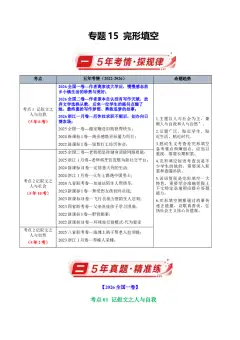
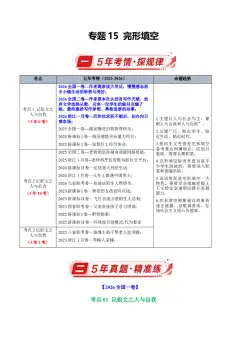
考点
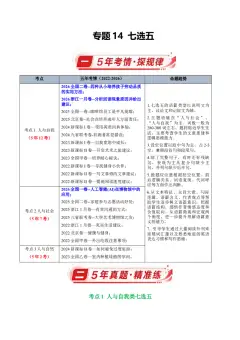
五年考情(2021-2025)
命题趋势
考点1 人与自我类
记叙文
(5 年10 考)
2025 全国一卷---写作教师教学认知突破之旅;
2025 八省联考卷—退休邮递员被铭记;
2023 全国甲卷—DIY 成为女性新宠;
2023 全国甲卷改错the 改为a;
2023 全国乙卷—风景摄影师趣闻;
2023 浙江1 月卷—家中零浪费生活方式;
2022 新课标II 卷—记者生活趣事;
2022 天津卷—接纳自己才能成长;
2022 浙江6 月卷—工作中学会接纳自己;
2021 浙江6 月卷—演员演艺生涯。
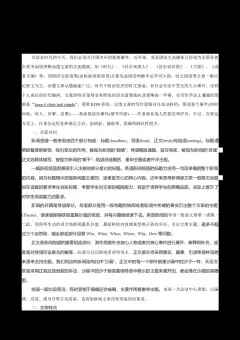
1.高考英语阅读理解记叙类文
章一般包括人物传记、哲理
故事等。人物传记类文章描
述某个人的生平事迹,奋斗
历程;哲理故事类文章通过
一个小故事,说明一个道
理。
2.从命题上看,记叙文阅读理
解以细节理解和推理判断为
主,以观点态度、写作意
图、词义猜测和代词指代为
辅。
3.英语记叙文以描写叙述为
主,主要描写人物、事件、
地点或过程。其特点是:主
题往往隐藏在字里行间;文
章主旨要通过任务事件来提
炼。
4.故事类文章通常会传达某些
道理、感悟或者教训,而这
些往往会通过主要人物在面
对冲突、解决困难或问题时
的表现体现出来。
5.作为新闻类文章的灵魂,导
语为我们提供了丰富的解题
线索。我们不能错过任何一
个细节,重点甄别who 、
what、when、where、why、
how 六要素,了解新闻的主要
考点2 人与社会类
记叙文
(5 年4 考)
2025 全国二卷---医院学校学生益处;
2025 浙江1 月卷--帮孩子建立健康饮食习惯;
2022 全国甲卷—悉尼发展遇到的问题;
2022 全国乙卷—书评。
考点3 人与自然类
记叙文
(5 年4 考)
2024 新课标I 卷—中医针灸治疗动物;
2023 新课标II 卷—学校科学项目;
2022 北京卷—保护自然活动治愈自己;
2021 浙江6 月卷—把大自然推销给孩子。
考点4 新闻报道类
(5 年2 考)
2024 新课标II 卷—创新打印吸引顾客;
2023 浙江1 月卷—一款电脑辩论程序。
内容。
考点01 人与自我类记叙文
【2025 全国一卷】
In my ninth-grade writing class last year, I met a cowboy who saved his town, a strict father who demanded
his son earn straight A’s, and a modern-day Juliet who died of heartbreak after her parents rejected the love of her
young life. More than once, I found myself wondering just how my students, who’d created these people, knew
their subjects so well.
But things were different for their first essay, which was about the question: “Why is writing important?”
Most of the essays filled less than one page, and few contained a sentence that could be interpreted as a thesis (论
点) statement. I was shocked. Then I realized that the problem was the question itself. They could have written
pages on the necessity of computers, but writing, in and of itself, simply didn’t strike them as important. This
would have to change.
As a new unit started, I asked everyone to write a persuasive piece on a health-related topic of their choice.
This time they found the exercise much more interesting. For the next two assignments, a personal-narrative unit
followed by a creative-writing workshop, I only required that the piece meet the specifications of its genre (体裁)
and that it contain a thesis. The results were staggering. The students took on diverse topics and turned in stories,
10 to 20 pages each, with characters that broadened my view and touched my heart.
I walked into class believing that writing is important as a means of communication. However, my students
demonstrated something more important to me. When the final bell rang in June, I walked away with a yearbook
full of messages about writing’s most powerful significance — the ability to connect people, to put us in another’s
skin, to teach us what it means to be human.
24. Who are the people mentioned at the beginning of paragraph 1?
A. Ninth graders.
B. Students’ parents.
C. Modern writers.
D. Fictional characters.
25. Why did the students perform poorly in writing their first essay?
A. They were not given enough time.
B. They had a very limited vocabulary.
C. They misunderstood the question.
D. They had little interest in the topic.
26. What does the underlined word “staggering” in paragraph 3 mean?
A. Mixed.
B. Amazing.
C. Similar.
D. Disturbing.
27. What does the author’s experience show?
A. Teaching is learning.
B. Still waters run deep.
C. Knowledge is power.
D. Practice makes perfect.
【2025 八省联考卷】
Jim Johnson, a mail carrier, was an institution in the leafy Westmoreland, Westhaven and Westover Hills
neighborhoods. just north of downtown Wilmington, where he delivered much more than the mail. He knew all the
kids and their pets by name; he carried in the groceries; he took note of unlocked doors, offered gardening advice,
and taught more than a few young boys the art of the curveball. When he wasn't doing all that, Jim was running
across a checkerboard of green lawns(草坪) to ensure the local postal service did not fall short of its daily promise.
Though the postal service is often disparaged now, the trust in local postal service lives on. In many
communities, that trust is won every day when life-saving medicine, greeting cards, social security checks, college
acceptance letters-even the bills-appear in mailboxes in front of the houses.
After more than three decades, Jim approached his final days on the job much like any other. He drove a boxy
postal truck to North DuPont Road for the first unofficial stop of the day. Butch, a dog who belonged to one of the
neighbors, was waiting just like every day before. And just like every day before, he got into the jump seat and
they were off. On the route, Jim and Butch had become inseparable. Now, the dog and the mailman would ride off
to retirement together. At every stop, Jim accepted the parting good wishes of families that had become his own.
There were tears and laughter, and hugs filled with warm memories.
It’s been 33 years since Jim left the route, but we are still reminded of the deep bond established between
community and letter carrier. That’s what the postal service means to us.
24. What do we know about Jim Johnson from the first paragraph?
A. He’s open-minded.
B. He’s sharp-eyed.
C. He’s warm-hearted.
D. He’s strong-willed.
25. What does the underlined word “disparaged” in paragraph 2 mean?
A. Refused.
B. Criticized.
C. Investigated.
D. Suspended.
26. What did Jim do besides daily delivery on his final days of work?
A. He drove Butch to its owner.
B. He sent presents to his friends.
C. He prepared a retirement party.
D. He said goodbye to the neighbors.
27. What is the author’s purpose in writing the text?
A. To remember a respected mail carrier.
B. To record an unforgettable experience.
C. To raise funds for the postal service.
D. To call for harmony in the community.
【2023 全国甲卷】
Terri Bolton is a dab hand when it comes to DIY (do-it-yourself). Skilled at putting up shelves and piecing
together furniture, she never pays someone else to do a job she can do herself.
She credits these skills to her late grandfather and builder Derek Lloyd. From the age of six, Terri, now 26,
accompanied Derek to work during her school holidays. A day’s work was rewarded with £ 5 in pocket money. She
says: “I’m sure I wasn’t much of a help to start with painting the rooms and putting down the flooring throughout
the house. It took weeks and it was backbreaking work, but I know he was proud of my skills.”
Terri, who now rents a house with friends in Wandsworth, South West London, says DIY also saves her from
losing any deposit when a tenancy (租期) comes to an end. She adds: “I’ve moved house many times and I always
like to personalise my room and put up pictures. So, it’s been useful to know how to cover up holes and repaint a
room to avoid any charges when I’ve moved out.”
With millions of people likely to take on DIY projects over that coming weeks, new research shows that more
than half of people are planning to make the most of the long, warm summer days to get jobs done. The average
spend per project will be around £ 823. Two thirds of people aim to improve their comfort while at home. Two
fifth wish to increase the value of their house. Though DIY has traditionally been seen as male hobby, the research
shows it is women now leading the charge.
24. Which is closest in meaning to “a dab hand” in paragraph 1?
A. An artist.
B. A winner.
C. A specialist.
D. A pioneer.
25. Why did Terri’s grandfather give her £ 5 a day?
A. For a birthday gift.
B. As a treat for her work.
C. To support her DIY projects.
D. To encourage her to take up a hobby.
26. How did Terri avoid losing the deposit on the house she rented?
A. By making it look like before.
B. By furnishing it herself.
C. By splitting the rent with a roommate.
D. By cancelling the rental agreement.
27. What trend in DIY does the research show?
A. It is becoming more costly.
B. It is getting more time-consuming.
C. It is turning into a seasonal industry.
D. It is gaining popularity among females.
【2023 全国乙卷】
Living in Iowa and trying to become a photographer specializing in landscape ( 风景) can be quite a
challenge, mainly because the corn state lacks geographical variation.
Although landscapes in the Midwest tend to be quite similar, either farm fields or highways, sometimes I find
distinctive character in the hills or lakes. To make some of my landscape shots, I have traveled up to four hours
away to shoot within a 10-minute time frame. I tend to travel with a few of my friends to state parks or to the
countryside to go on adventures and take photos along the way.
Being at the right place at the right time is decisive in any style of photography. I often leave early to seek the
right destinations so I can set up early to avoid missing the moment I am attempting to photograph. I have missed
plenty of beautiful sunsets/sunrises due to being on the spot only five minutes before the best moment.
One time my friends and I drove three hours to Devil’s Lake, Wisconsin, to climb the purple quartz ( 石英)
rock around the lake. After we found a crazy-looking road that hung over a bunch of rocks, we decided to
photograph the scene at sunset. The position enabled us to look over the lake with the sunset in the background.
We managed to leave this spot to climb higher because of the spare time until sunset. However, we did not mark
the route (路线) so we ended up almost missing the sunset entirely. Once we found the place, it was stressful
getting lights and cameras set up in the limited time. Still, looking back on the photos, they are some of my best
shots though they could have been so much better if I would have been prepared and managed my time wisely.
24. How does the author deal with the challenge as a landscape photographer in the Midwest?
A. By teaming up with other photographers.
B. By shooting in the countryside or state parks.
C. By studying the geographical conditions.
D. By creating settings in the corn fields.
25. What is the key to successful landscape photography according to the author?
A. Proper time management.
B. Good shooting techniques.
C. Adventurous spirit.
D. Distinctive styles.
26. What can we infer from the author trip with friends to Devil’s Lake?
A. They went crazy with the purple quartz rock.
B. They felt stressed while waiting for the sunset.
C. They reached the shooting spot later than expected.
D. They had problems with their equipment.
27. How does the author find his photos taken at Devil’s Lake?
A. Amusing.
B. Satisfying.
C. Encouraging.
D. Comforting.
【2022 新课标II 卷】
We journalists live in a new age of storytelling, with many new multimedia tools. Many young people don’t
even realize it’s new. For them, it’s just normal.
This hit home for me as I was sitting with my 2-year-old grandson on a sofa over the Spring Festival holiday.
I had brought a children’s book to read. It had simple words and colorful pictures — a perfect match for his age.
Picture this: my grandson sitting on my lap as I hold the book in front so he can see the pictures. As I read, he
reaches out and pokes (戳) the page with his finger.
What’s up with that? He just likes the pictures, I thought. Then I turned the page and continued. He poked the
page even harder. I nearly dropped the book. I was confused: Is there something wrong with this kid?
Then I realized what was happening. He was actually a stranger to books. His father frequently amused the
boy with a tablet computer which was loaded with colorful pictures that come alive when you poke them. He
thought my storybook was like that.
Sorry, kid. This book is not part of your high-tech world. It’s an outdated, lifeless thing. An antique, like your
grandfather. Well, I may be old, but I’m not hopelessly challenged, digitally speaking. I edit video and produce
audio. I use mobile payment. I’ve even built websites.
There’s one notable gap in my new-media experience, however: I’ve spent little time in front of a camera,
since I have a face made for radio. But that didn’t stop China Daily from asking me last week to share a personal
story for a video project about the integration of Beijing, Tianjin and Hebei province.
Anyway, grandpa is now an internet star — two minutes of fame! I promise not to let it go to my head. But I
will make sure my 2-year-old grandson sees it on his tablet.
24. What do the underlined words “hit home for me” mean in paragraph 2?
A. Provided shelter for me.
B. Became very clear to me.
C. Took the pressure off me.
D. Worked quite well on me.
25. Why did the kid poke the storybook?
A. He took it for a tablet computer.
B. He disliked the colorful pictures.
C. He was angry with his grandpa.
D. He wanted to read it by himself.
26. What does the author think of himself?
A. Socially ambitious.
B. Physically attractive.
C. Financially independent.
D. Digitally competent.
27. What can we learn about the author as a journalist?
A. He lacks experience in his job.
B. He seldom appears on television.
C. He manages a video department.
D. He often interviews internet stars.
【2022 天津卷】
I’m an 18-year-old pre-medical student, tall and good-looking, with two short story books and quite a number
of essays my credit. Why am I singing such praises of myself? Just to explain that he attainment of self-pride
comes from a great deal of self-love, and to attain it, one must first learn to accept oneself as one is. That was
where my struggle began.
Born and raised in Africa ,I had always taken my African origin as burden. My self-dislike was further
fueled when my family had to relocate to Norway, where I attended a high school. Compared to all the white girls
around me, with their golden hair and delicate lips, I, a black girl, had curly hair and full, red lips. My nose often
had a thin sheet of sweat on it, whatever the weather was. I just wanted to bury myself in my shell crying “I’m so
different!”
What also contributed to my self-dislike was my occasional stuttering (口吃), which had weakened my self-
confidence. It always stood between me and any fine opportunity. I’d taken it as an excuse to avoid any public
speaking sessions, and unknowingly let it rule over me.
Fortunately, as I grew older, there came a turning point. One day a white girl caught my eye on the school bus
when she suddenly turned back. To my astonishment, she had a thin sheet of sweat on her nose too, and it was in
November! “Wow,” I whispered to myself, “this isn’t a genetic(遗传的) disorder after all. It’s perfectly normal.”
Days later, my life took an-other twist(转折). Searching the internet for stuttering cures, I accidentally learned that
such famous people as Isaac Newton and Winston Churchill also stuttered. I was greatly relieved and then an idea
suddenly hit me—if I’m smart, I shouldn’t allow my stuttering to stand between me and my success.
Another boost to my self-confidence came days later as I was watching the news about Oprah Winfrey, the
famous talk show host and writer—she’s black too! Whenever I think of her story and my former dislike of my
color, I’m practically filled with shame.
Today, I’ve grown to accept what I am with pride; it simply gives me feeling of uniqueness. The idea of self-
love has taken on a whole new meaning for me: there’s always something fantastic about us, and what w need to
do is learn to appreciate it.
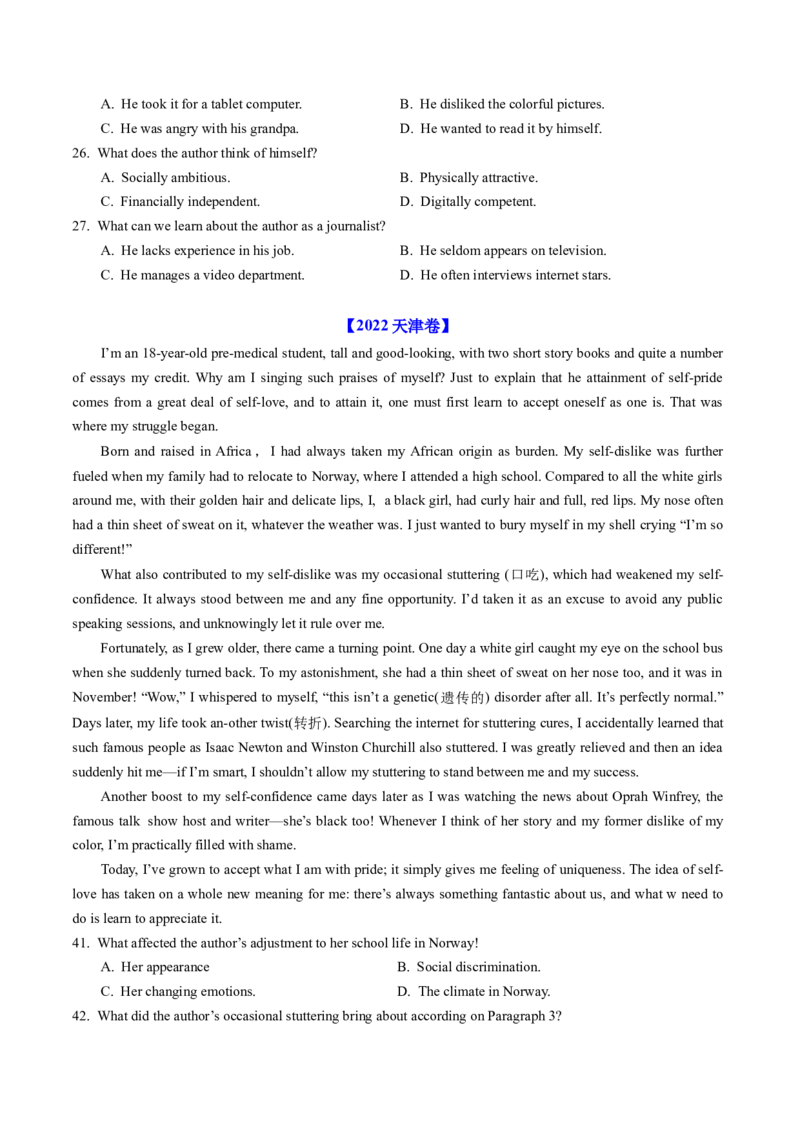
41. What affected the author’s adjustment to her school life in Norway!
A. Her appearance
B. Social discrimination.
C. Her changing emotions.
D. The climate in Norway.
42. What did the author’s occasional stuttering bring about according on Paragraph 3?
A. Her lack of self-confidence.
B. Her loss of interest in school.
C. Her unwillingness to greet her classmates.
D. Her desire for chances to improve herself.
43. How did the author feel on noticing the similarity between her and ne girl on the bus?
A. Blessed and proud.
B. Confused and afraid.
C. Amazed and relieved.
D. Shocked and ashamed.
44. What lesson did the author learn from the cases of Newton and Churchill?
A. Great minds speak alike.
B. Stuttering is no barrier to success.
C. Wisdom counts more than hard work.
D. Famous people can’t live with their weaknesses.
45. What can best summarize the message contained in the passage?
A. Pride comes before a fall.
B. Where there is a will, there is a way.
C. Self-acceptance is based on the love for oneself.
D. Self-love is key to the attainment of self-pride.
【2022 浙江6 月卷】
Pasta and pizza were on everyone’s lunch menu in my native land of Italy. Everyone who had such a lunch
was fair-skinned and spoke Italian. A few years later, as I stood in the lunch line with my kindergarten class in a
school in Brooklyn, I realized things were no longer that simple. My classmates ranged from those kids with pale
skin and large blue eyes to those with rich brown skin and dark hair. The food choices were almost as diverse as
the students. In front of me was an array of foods I couldn’t even name in my native language. Fearing that I would
pick out something awful, I desperately tried to ask the boy ahead of me for a recommendation. Unfortunately,
between us stood the barrier of language.
Although my kindergarten experience feels like a century ago, the lessons I learned will stick in my mind
forever. For the past three summers, I have worked in a government agency in New York. New immigrants much
like the little girl in the lunch line flooded our office seeking help. I often had to be an interpreter for the Italian-
speaking ones. As I served the role of vital communication link, I was reminded of my desperate struggle to
converse before I learned English. I watched with great sympathy as elderly Italians tried to hold a conversation in
Italian with people who did not speak the language. It suddenly became very clear to me how lucky I was to be
fluent in two languages.
In New York, a multicultural city, students like me are blessed with a chance to work with a diverse
population. In my English to Italian translations, I’ve learned about social programs that I didn’t know existed.
This work expanded my mind in ways that are impossible inside the four walls of a classroom. Walking through
the streets of Brooklyn today, I am no longer confused by this city’s sounds and smells. Instead, enjoy its diversity.
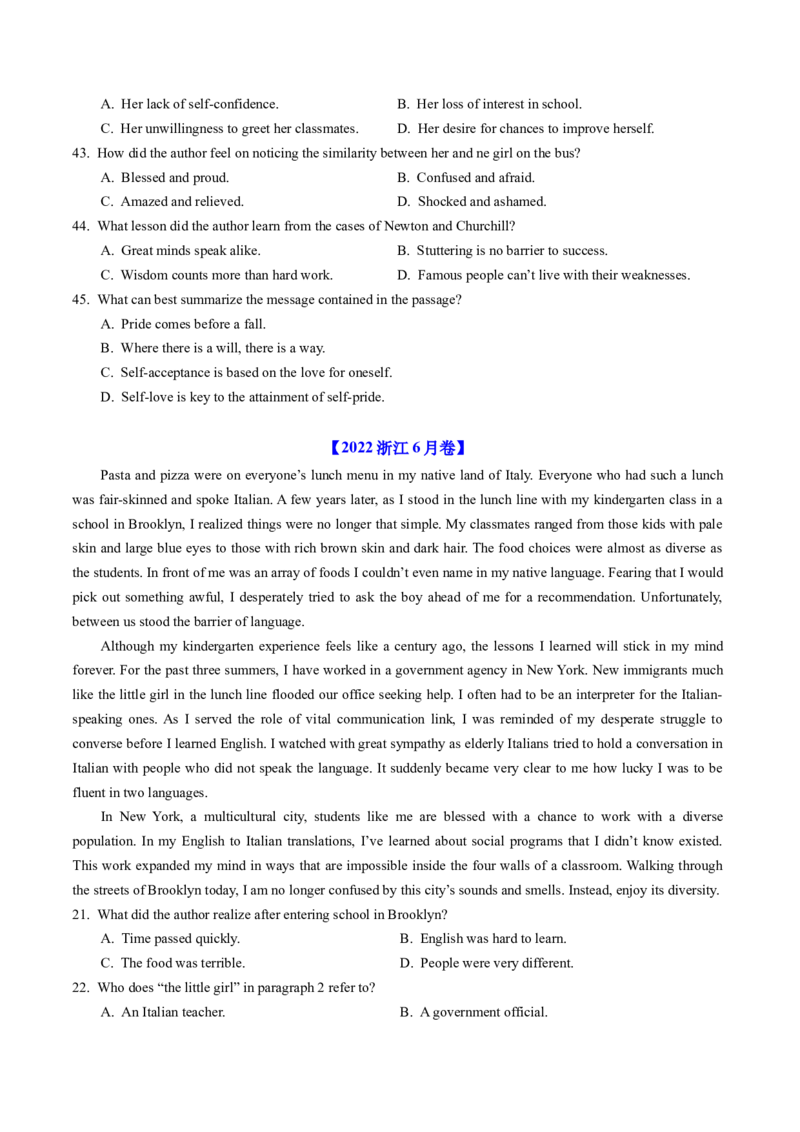
21. What did the author realize after entering school in Brooklyn?
A. Time passed quickly.
B. English was hard to learn.
C. The food was terrible.
D. People were very different.
22. Who does “the little girl” in paragraph 2 refer to?
A. An Italian teacher.
B. A government official.
C. The author herself.
D. The author’s classmate.
23. How did the summer job benefit the author?
A. It strengthened her love for school.
B. It helped sharpen her sense of direction.
C. It opened her eyes to the real world.
D. It made her childhood dream come true.
【2021 浙江6 月卷】
Leslie Nielsen’s childhood was a difficult one, but he had one particular shining star in his life — his uncle,
who was a well-known actor. The admiration and respect his uncle earned inspired Nielsen to make a career (职
业)in acting. Even though he often felt he would be discovered to be a no-talent, he moved forward, gaining a
scholarship to the Neighborhood Playhouse and making his first television appearance a few years later in 1948.
However, becoming a full-time, successful actor would still be an uphill battle for another eight years until he
landed a number of film roles that finally got him noticed.
But even then, what he had wasn’t quite what he wanted. Nielsen always felt he should be doing comedy but
his good looks and distinguished voice kept him busy in dramatic roles. It wasn’t until1980 - 32 years into his
career — that he landed the role it would seem he was made for in Airplane! That movie led him into the second
half of his career where his comedic presence alone could make a movie a financial success even when movie
reviewers would not rate it highly.
Did Nielsen then feel content in his career? Yes and no. He was thrilled to be doing the comedy that he always
felt he should do, but even during his last few years, he always had a sense of curiosity, wondering what new role
or challenge might be just around the corner. He never stopped working, never retired.
Leslie Nielsen’s devotion to acting is wonderfully inspiring. He built a hugely successful career with little
more than plain old hard work and determination. He showed us that even a single desire, never given up on, can
make for a remarkable life.
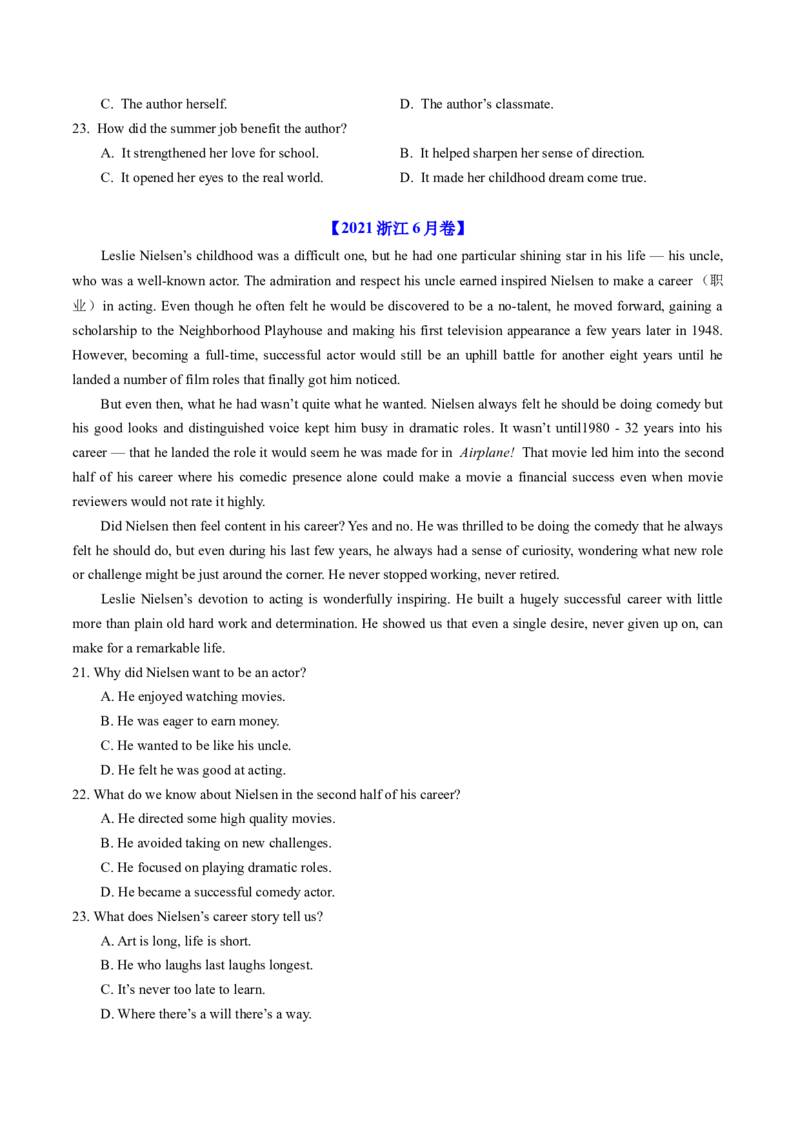
21. Why did Nielsen want to be an actor?
A. He enjoyed watching movies.
B. He was eager to earn money.
C. He wanted to be like his uncle.
D. He felt he was good at acting.
22. What do we know about Nielsen in the second half of his career?
A. He directed some high quality movies.
B. He avoided taking on new challenges.
C. He focused on playing dramatic roles.
D. He became a successful comedy actor.
23. What does Nielsen’s career story tell us?
A. Art is long, life is short.
B. He who laughs last laughs longest.
C. It’s never too late to learn.
D. Where there’s a will there’s a way.
考点02 人与社会类记叙文
【2025 全国二卷】
Kathy Ho teaches high school inside Lucile Packard Children’s Hospital Stanford (LPCH). “Sometimes I
don’t like saying that I’m a teacher,” says Ho. “People get in their minds an idea of what teachers do, but that’s not
really what it is here.”
“Here” is room 386, where each year, about 500 LPCH patients also become students. The hospital school is
free of parents, doctors, and medical procedures. It’s a place of learning. About half of Ho’s students stay for a
week or less; others are there for more than a year. Most of Ho’s students will recover, which means that preparing
them to return to school is an increasingly important component of care.
Still, in room 386, academics don’t come first. Physical health and mental health are the priority. “If you’re
scared about something and thinking only about that, there’s no way you’re going to be able to learn,” Ho says.
“I’m a coach, an adviser, and a comforter, and that’s what it means to be a hospital teacher.”
There are up to 30 students at any given time in Ho’s class. She generally works with their regular teachers to
get lessons and tests being used at their home schools. Some teachers don’t give the kids any assignments; they
express sympathy instead. “I feel like it is a disservice to the kids,” Ho says. “They think their teachers don’t care
about their schoolwork.”
Ho recognizes the psychological benefit of helping kids keep up with their peers ( 同龄人) outside the
hospital. “I actually think the medicine is only a small piece for some problems,” says Julie Good, director of pain
management services at LPCH. “It’s about problem-solving around what it means to have a full life. Those kids
have dreams. School can keep those dreams alive by giving kids a way to learn and grow.”
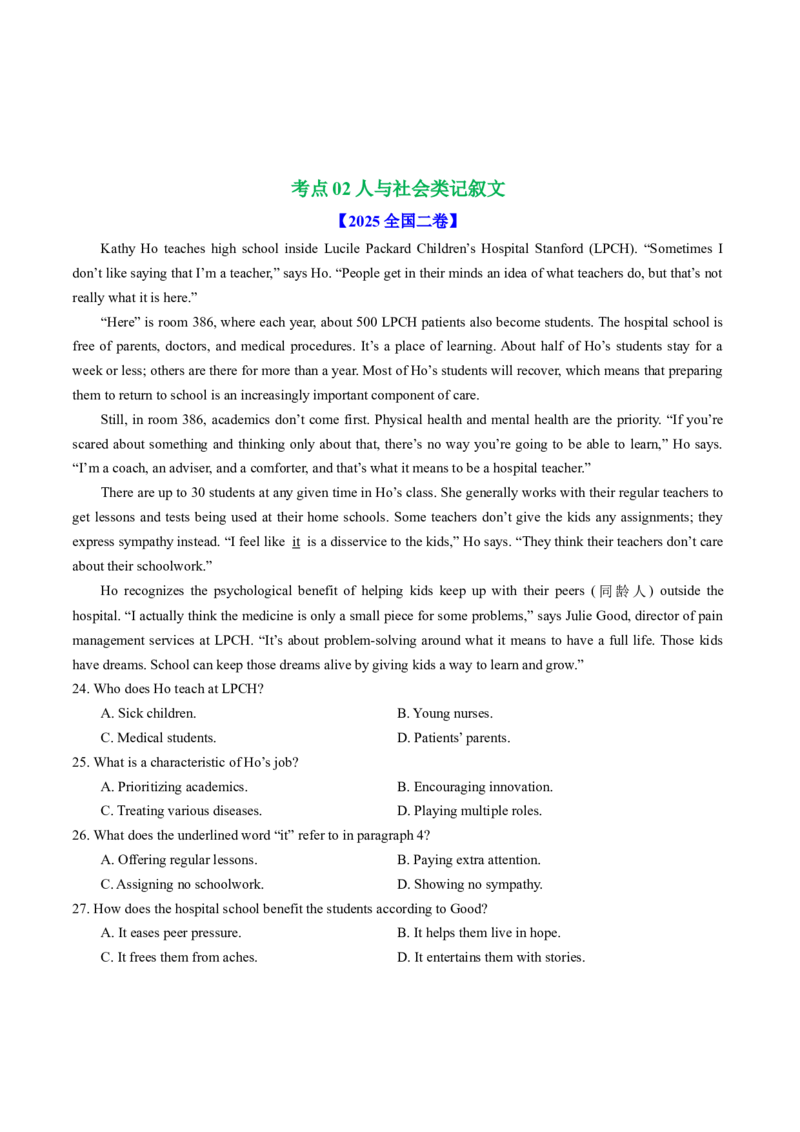
24. Who does Ho teach at LPCH?
A. Sick children.
B. Young nurses.
C. Medical students.
D. Patients’ parents.
25. What is a characteristic of Ho’s job?
A. Prioritizing academics.
B. Encouraging innovation.
C. Treating various diseases.
D. Playing multiple roles.
26. What does the underlined word “it” refer to in paragraph 4?
A. Offering regular lessons.
B. Paying extra attention.
C. Assigning no schoolwork.
D. Showing no sympathy.
27. How does the hospital school benefit the students according to Good?
A. It eases peer pressure.
B. It helps them live in hope.
C. It frees them from aches.
D. It entertains them with stories.
【2025 浙江1 月卷】
When I was a child I was often told what not to eat. “You don’t want to get fat” was on constant repeat
throughout my childhood. It really messed up my relationship with food – something that took me years to
overcome. Because of this, I’m careful not to connect what my kids weigh with their worth as people. I encourage
my daughter to make healthy snack choices and often dissuade ( 劝阻) her from a second dessert. But one day
when I heard her saying “I think I’m too fat,” my heart sank. It made me wonder if giving her advice on snacks
was having an unintentionally negative impact.
According to Charlotte Markey, a professor of psychology, food is one of the rare subjects where, as parents,
saying less is more. “There are so many things in parenting that are good to talk through, but I’m not convinced
that food is one of them,” she says. “It just creates some worries and insecurities in kids that aren’t necessarily
healthy.”
Instead, she recommends applying a well-known concept among nutrition experts called the “Division of
Responsibility,” where parents provide a variety of mostly healthy foods to their kids at fixed times, and the kids
themselves decide what and how much they want to consume – even if that means occasionally eating more
cookies than carrots.
Allowing kids to eat what they want also exposes them to the natural consequences of their decisions. “When
your child says, ‘My stomach hurts,’ you can say, ‘Well you had a lot of sugary foods and you might feel better if
you made some other choices,’” says Markey. “Let them feel like they have some control over it.”
I’ve been trying out these strategies and I’ve found that when I’m less restrictive, they do make better
decisions. “Feeding is a long game,” says Markey. “The food you have available makes a huge difference. Even if
they don’t eat it, they’re seeing it. And then all of a sudden it clicks.”
24. What can be inferred about the author from the first paragraph?
A. She is upset by her kids’ weight.
B. She is critical of the way she was fed.
C. She is interested in making food.
D. She is particular about what she eats.
25. Which of the following would Markey disapprove of?
A. Allowing kids to eat cookies occasionally.
B. Offering various foods to kids at fixed times.
C. Explaining to kids the risks of taking snacks.
D. Talking with kids about school at mealtimes.
26. What should kids do according to the “Division of Responsibility”?
A. Make diet decisions on their own.
B. Share their food with other kids.
C. Eat up what is provided for them.
D. Help their parents do the dishes.
27. What does the author think of the strategies she has been following?
A. Costly.
B. Complex.
C. Workable.
D. Contradictory.
【2022 全国甲卷】
Sometime in the early 1960s, a significant thing happened in Sydney, Australia. The city discovered its
harbor. Then, one after another, Sydney discovered lots of things that were just sort of there — broad parks, superb
beaches, and a culturally diverse population. But it is the harbor that makes the city.
Andrew Reynolds, a cheerful fellow in his early 30s, pilots Sydney ferryboats for a living. I spent the whole
morning shuttling back and forth across the harbor. After our third run Andrew shut down the engine, and we went
our separate ways — he for a lunch break, I to explore the city.
“I’ll miss these old boats,” he said as we parted.
“How do you mean?” I asked.
“Oh, they’re replacing them with catamarans. Catamarans are faster, but they’re not so elegant, and they’re
not fun to pilot. But that’s progress, I guess.”
Everywhere in Sydney these days, change and progress are the watchwords ( 口号), and traditions are
increasingly rare. Shirley Fitzgerald, the city’s official historian, told me that in its rush to modernity in the 1970s,
Sydney swept aside much of its past, including many of its finest buildings. “Sydney is confused about itself,” she
said. “We can’t seem to make up our minds whether we want a modern city or a traditional one. It’s a conflict that
we aren’t getting any better at resolving (解决).”
On the other hand, being young and old at the same time has its attractions. I considered this when I met a
thoughtful young businessman named Anthony. “Many people say that we lack culture in this country,” he told me.
“What people forget is that the Italians, when they came to Australia, brought 2000 years of their culture, the
Greeks some 3000 years, and the Chinese more still. We’ve got a foundation built on ancient cultures but with a
drive and dynamism of a young country. It’s a pretty hard combination to beat.”
He is right, but I can’t help wishing they would keep those old ferries.
32. What is the first paragraph mainly about?
A. Sydney’s striking architecture.
B. The cultural diversity of Sydney.
C. The key to Sydney’s development.
D. Sydney’s tourist attractions in the 1960s.
33. What can we learn about Andrew Reynolds?
A. He goes to work by boat.
B. He looks forward to a new life.
C. He pilots catamarans well.
D. He is attached to the old ferries.
34. What does Shirley Fitzgerald think of Sydney?
A. It is losing its traditions.
B. It should speed up its progress.
C. It should expand its population.
D. It is becoming more international.
35. Which statement will the author probably agree with?
A. A city can be young and old at the same time.
B. A city built on ancient cultures is more dynamic.
C. modernity is usually achieved at the cost of elegance.
D. Compromise should be made between the local and the foreign.
【2022 全国乙卷】
In 1916, two girls of wealthy families, best friends from Auburn, N. Y.—Dorothy Woodruff and Rosamond
Underwood—traveled to a settlement in the Rocky Mountains to teach in a one-room schoolhouse. The girls had
gone to Smith College. They wore expensive clothes. So for them to move to Elkhead, Colo. to instruct the
children whose shoes were held together with string was a surprise. Their stay in Elkhead is the subject of Nothing
Daunted: The Unexpected Education of Two Society Girls in the West by Dorothy Wickenden, who is a magazine
editor and Dorothy Woodruff’s granddaughter.
 Why did they go then? Well, they wanted to do something useful. Soon, however, they realized what they had
undertaken.
They moved in with a local family, the Harrisons, and, like them, had little privacy, rare baths, and a blanket
of snow on their quilt when they woke up in the morning. Some mornings, Rosamond and Dorothy would arrive at
the schoolhouse to find the children weeping from the cold. In spring, the snow was replaced by mud over ice.
In Wickenden’s book, she expanded on the history of the West and also on feminism, which of course
influenced the girls’ decision to go to Elkhead. A hair-raising section concerns the building of the railroads, which
entailed (牵涉) drilling through the Rockies, often in blinding snowstorms. The book ends with Rosamond and
Dorothy’s return to Auburn.
Wickenden is a very good storyteller. The sweep of the land and the stoicism (坚忍) of the people move her to
some beautiful writing. Here is a picture of Dorothy Woodruff, on her horse, looking down from a hill top: “When
the sun slipped behind the mountains, it shed a rosy glow all around them. Then a full moon rose. The snow was
marked only by small animals: foxes, coyotes, mice, and varying hares, which turned white in the winter.”
24. Why did Dorothy and Rosamond go to the Rocky Mountains?
A. To teach in a school.
B. To study American history.
C. To write a book.
D. To do sightseeing.
25. What can we learn about the girls from paragraph 3?
A. They enjoyed much respect.
B. They had a room with a bathtub.
C. They lived with the local kids.
D. They suffered severe hardships.
26. Which part of Wickenden’s writing is hair-raising?
A. The extreme climate of Auburn.
B. The living conditions in Elkhead.
C. The railroad building in the Rockies.
D. The natural beauty of the West.
27. What is the text?
A. A news report.
B. A book review.
C. A children’s story.
D. A diary entry.
考点3 人与自然类记叙文
【2024 新课标I 卷】
“I am not crazy,” says Dr. William Farber, shortly after performing acupuncture (针灸) on a rabbit. “I am
ahead of my time.” If he seems a little defensive, it might be because even some of his coworkers
occasionally laugh at his unusual methods. But Farber is certain he’ll have the last laugh. He’s one of a small
but growing number of American veterinarians ( 兽医) now practicing “holistic” medicine – combining
traditional Western treatments with acupuncture, chiropractic (按摩疗法) and herbal medicine.
Farber, a graduate of Colorado State University, started out as a more conventional veterinarian. He
became interested in alternative treatments 20 years ago when he suffered from terrible back pain. He tried
muscle-relaxing drugs but found little relief. Then he tried acupuncture, an ancient Chinese practice, and was
amazed that he improved after two or three treatments. What worked on a veterinarian seemed likely to work
on his patients. So, after studying the techniques for a couple of years, he began offering them to pets.
Leigh Tindale’s dog Charlie had a serious heart condition. After Charlie had a heart attack, Tindale says,
she was prepared to put him to sleep, but Farber’s treatments eased her dog’s suffering so much that she was
able to keep him alive for an additional five months. And Priscilla Dewing reports that her horse, Nappy,
“moves more easily and rides more comfortably” after a chiropractic adjustment.
Farber is certain that the holistic approach will grow more popular with time, and if the past is any
indication, he may be right: Since 1982, membership in the American Holistic Veterinary Medical
Association has grown from 30 to over 700. “Sometimes it surprises me that it works so well,” he says. “I
will do anything to help an animal. That’s my job.”
24. What do some of Farber’s coworkers think of him?
A. He’s odd.
B. He’s strict.
C. He’s brave.
D. He’s rude.
25. Why did Farber decide to try acupuncture on pets?
A. He was trained in it at university.
B. He was inspired by another veterinarian.
C. He benefited from it as a patient.
D. He wanted to save money for pet owners.
26. What does paragraph 3 mainly talk about?
A. Steps of a chiropractic treatment.
B. The complexity of veterinarians’ work.
C. Examples of rare animal diseases.
D. The effectiveness of holistic medicine.
27. Why does the author mention the American Holistic Veterinary Medical Association?
A. To prove Farber’s point.
B. To emphasize its importance.
C. To praise veterinarians.
D. To advocate animal protection.
考点03 人与自然类记叙文
【2023 新课标I 卷】
When John Todd was a child, he loved to explore the woods around his house, observing how nature solved
problems. A dirty stream, for example, often became clear after flowing through plants and along rocks where tiny
creatures lived. When he got older, John started to wonder if this process could be used to clean up the messes
people were making.
After studying agriculture, medicine, and fisheries in college, John went back to observing nature and asking
questions. Why can certain plants trap harmful bacteria ( 细菌)? Which kinds of fish can eat cancer-causing
chemicals? With the right combination of animals and plants, he figured, maybe he could clean up waste the way
nature did. He decided to build what he would later call an eco-machine.
The task John set for himself was to remove harmful substances from some sludge ( 污泥). First, he
constructed a series of clear fiberglass tanks connected to each other. Then he went around to local ponds and
streams and brought back some plants and animals. He placed them in the tanks and waited. Little by little, these
different kinds of life got used to one another and formed their own ecosystem. After a few weeks, John added the
sludge.
He was amazed at the results. The plants and animals in the eco-machine took the sludge as food and began to
eat it! Within weeks, it had all been digested, and all that was left was pure water.
Over the years, John has taken on many big jobs. He developed a greenhouse — like facility that treated
sewage (污水) from 1,600 homes in South Burlington. He also designed an eco-machine to clean canal water in
Fuzhou, a city in southeast China.
“Ecological design” is the name John gives to what he does. “Life on Earth is kind of a box of spare parts for
the inventor,” he says. “You put organisms in new relationships and observe what’s happening. Then you let these
new systems develop their own ways to self-repair.”
4. What can we learn about John from the first two paragraphs?
A. He was fond of traveling.
B. He enjoyed being alone.
C. He had an inquiring mind.
D. He longed to be a doctor.
5. Why did John put the sludge into the tanks?
A. To feed the animals.
B. To build an ecosystem.
C. To protect the plants.
D. To test the eco-machine.
6. What is the author’s purpose in mentioning Fuzhou?
A. To review John’s research plans.
B. To show an application of John’s idea.
C. To compare John’s different jobs.
D. To erase doubts about John’s invention.
7. What is the basis for John’s work?
A. Nature can repair itself.
B. Organisms need water to survive.
C. Life on Earth is diverse.
D. Most tiny creatures live in groups.
【2023 新课标II 卷】
Turning soil, pulling weeds, and harvesting cabbage sound like tough work for middle and high school kids.
And at first it is, says Abby Jaramillo, who with another teacher started Urban Sprouts, a school garden program at
four low-income schools. The program aims to help students develop science skills, environmental awareness, and
healthy lifestyles.
Jaramillo’s students live in neighborhoods where fresh food and green space are not easy to find and fast food
restaurants outnumber grocery stores. “The kids literally come to school with bags of snacks and large bottles of
soft drinks,” she says. “They come to us thinking vegetables are awful, dirt is awful, insects are awful.” Though
some are initially scared of the insects and turned off by the dirt, most are eager to try something new.
Urban Sprouts’ classes, at two middle schools and two high schools, include hands-on experiments such as
soil testing, flower-and-seed dissection, tastings of fresh or dried produce, and work in the garden. Several times a
year, students cook the vegetables they grow, and they occasionally make salads for their entire schools.
Program evaluations show that kids eat more vegetables as a result of the classes. “We have students who say
they went home and talked to their parents and now they’re eating differently,” Jaramillo says.
She adds that the program’s benefits go beyond nutrition. Some students get so interested in gardening that
they bring home seeds to start their own vegetable gardens. Besides, working in the garden seems to have a
calming effect on Jaramillo’s special education students, many of whom have emotional control issues. “They get
outside,” she says, “and they feel successful.”
4. What do we know about Abby Jaramillo?
A. She used to be a health worker.
B. She grew up in a low-income family.
C. She owns a fast food restaurant.
D. She is an initiator of Urban Sprouts.
5. What was a problem facing Jaramillo at the start of the program?
A. The kids’ parents distrusted her.
B. Students had little time for her classes.
C. Some kids disliked garden work.
D. There was no space for school gardens.
6. Which of the following best describes the impact of the program?
A. Far-reaching.
B. Predictable.
C. Short-lived.
D. Unidentifiable.
7. What can be a suitable title for the text?
A. Rescuing School Gardens
B. Experiencing Country Life
C. Growing Vegetable Lovers
D. Changing Local Landscape
【2023 浙江1 月卷】
Live with roommates? Have friends and family around you? Chances are that if you’re looking to live a more
sustainable lifestyle, not everyone around you will be ready to jump on that bandwagon.
I experienced this when I started switching to a zero waste lifestyle five years ago, as I was living with my
parents, and I continue to experience this with my husband, as he is not completely zero waste like me. I’ve
learned a few things along the way though, which I hope you’ll find encouraging if you’re doing your best to
figure out how you can make the change in a not-always-supportive household.
Zero waste was a radical lifestyle movement a few years back. I remember showing my parents a video of
Bea Johnson, sharing how cool I thought it would be to buy groceries with jars, and have so little trash! A few days
later, I came back with my first jars of zero waste groceries, and my dad commented on how silly it was for me to
carry jars everywhere. It came off as a bit discouraging.
Yet as the months of reducing waste continued, I did what I could that was within my own reach. I had my
own bedroom, so I worked on removing things I didn’t need. Since I had my own toiletries (洗漱用品), I was able
to start personalising my routine to be more sustainable. I also offered to cook every so often, so I portioned out a
bit of the cupboard for my own zero waste groceries. Perhaps your household won’t entirely make the switch, but
you may have some control over your own personal spaces to make the changes you desire.
As you make your lifestyle changes, you may find yourself wanting to speak up for yourself if others
comment on what you’re doing, which can turn itself into a whole household debate. If you have individuals who
are not on board, your words probably won’t do much and can often leave you feeling more discouraged.
So here is my advice: Lead by action.
24. What do the underlined words “jump on that bandwagon” mean in the first paragraph?
A. Share an apartment with you.
B. Join you in what you’re doing.
C. Transform your way of living.
D. Help you to make the decision.
25. What was the attitude of the author’s father toward buying groceries with jars?
A. He disapproved of it.
B. He was favorable to it.
C. He was tolerant of it.
D. He didn’t care about it.
26. What can we infer about the author?
A. She is quite good at cooking.
B. She respects others’ privacy.
C. She enjoys being a housewife.
D. She is a determined person.
27. What is the text mainly about?
A. How to get on well with other family members.
B. How to have one’s own personal space at home.
C. How to live a zero waste lifestyle in a household.
D. How to control the budget when buying groceries.
【2022 北京卷】
My name is Alice. Early last year, I was troubled by an anxiety that crippled ( 削弱 ) my ability to do
anything. I felt like a storm cloud hung over me. For almost a year I struggled on, constantly staring at this wall
that faced me. My perfectionist tendencies were the main root of this: I wanted to be perfect at whatever I did,
which obviously in life is not possible, but it consumed me.
One day, I attended a presentation by wildlife conservationist Grant Brown at my high school. His
presentation not only awed and inspired me, but also helped emerge an inner desire to make a difference in the
world. I joined a pre-presentation dinner with him and that smaller setting allowed me to slowly build up my
courage to speak one-on-one with him—an idea that had seemed completely impossible. This first contact was
where my story began.
A month later, Brown invited me to attend the World Youth Wildlife Conference. Looking back, I now see
that this would be the first in a series of timely opportunities that my old self would have let pass, but that this new
and more confident Alice enthusiastically seized. Shortly after I received his invitation, applications to join the
Youth for Nature and the Youth for Planet groups were sent around through my high school. I decided to commit to
completing the applications, and soon I was a part of a growing global team of young people working to protect
nature. Each of these new steps continued to grow my confidence.
I am writing this just six months since my journey began and I’ve realised that my biggest obstacle ( 障碍 )
this whole time was myself. It was that voice in the back of my head telling me that one phrase that has stopped so
many people from reaching their potential: I can’t. They say good things come to those who wait; I say: grab every
opportunity with everything you have and be impatient. After all, nature does not require our patience, but our
action.
24. What was the main cause for Alice’s anxiety?
A. Her inability to act her age.
B. Her habit of consumption.
C. Her desire to be perfect.
D. Her lack of inspiration.
25. How did Grant Brown’s presentation influence Alice?
A. She decided to do something for nature.
B. She tasted the sweetness of friendship.
C. She learned about the harm of desire.
D. She built up her courage to speak up.
26. The activities Alice joined in helped her to become more ________.
A. intelligent
B. confident
C. innovative
D. critical
27. What can we learn from this passage?
A. Practice makes perfect.
B. Patience is a cure of anxiety.
C. Action is worry’s worst enemy.
D. Everything comes to those who wait.
【2021 浙江6 月卷】
We live in a town with three beaches. There are two parks less than 10 minutes’ walk from home where
neighbourhood children gather to play. However, what my children want to do after school is pick up a screen —
any screen — and stare at it for hours. They are not alone. Today’s children spend an average of four and a half
hours a day looking at screens, split between watching television and using the Internet.
In the past few years, an increasing number of people and organisations have begun coming up with plans to
counter this trend. A couple of years ago, film-maker David Bond realised that his children, then aged five and
three, were attached to screens to the point where he was able to say "chocolate" into his three-year-old son’s ear
without getting a response. He realised that something needed to change, and, being a London media type,
appointed himself "marketing director for Nature". He documented his journey as he set about treating nature as a
brand to be marketed to young people. The result was Project Wild Thing, a film which charts the birth of the
Wild Network a group of organisations with the common goal of getting children out into nature.
"Just five more minutes outdoors can make a difference," David Bond says. "There is a lot of really
interesting evidence which seems to be suggesting that if children are inspired up to the age of seven, then being
outdoors will be a habit for life." His own children have got into the habit of playing outside now: "We just send
them out into the garden and tell them not to come back in for a while."
Summer is upon us. There is an amazing world out there, and it needs our children as much as they need it.
Let us get them out and let them play.
24. What is the problem with the author’s children?
A. They often annoy the neighbours.
B. They are tired of doing their homework.
C. They have no friends to play with.
D. They stay in front of screens for too long.
25. How did David Bond advocate his idea?
A. By making a documentary film.
B. By organizing outdoor activities.
C. By advertising in London media.
D. By creating a network of friends.
26. Which of the following can replace the underlined word "charts" in paragraph 2
A. records
B. predicts
C. delays
D. confirms
27. What can be a suitable title for the text?
A. Let Children Have Fun
B. Young Children Need More Free Time
C. Market Nature to Children
D. David Bond: A Role Model for Children
考点04 新闻报道类阅读
【2024 新课标II 卷】
Do you ever get to the train station and realize you forgot to bring something to read? Yes, we all have our
phones, but many of us still like to go old school and read something printed.
Well, there’s a kiosk (小亭) for that. In the San Francisco Bay Area, at least.
“You enter the fare gates (检票口) and you’ll see a kiosk that is lit up and it tells you can get a one-minute, a
three-minute, or a five-minute story,” says Alicia Trost, the chief communications officer for the San Francisco
Bay Area Rapid Transit — known as BART. “You choose which length you want and it gives you a receipt-like
short story.”
It’s that simple. Riders have printed nearly 20,000 short stories and poems since the program was launched
last March. Some are classic short stories, and some are new original works.
Trost also wants to introduce local writers to local riders. “We wanted to do something where we do a call to
artists in the Bay Area to submit stories for a contest,” Trost says. “And as of right now, we’ve received about 120
submissions. The winning stories would go into our kiosk and then you would be a published artist.”
Ridership on transit (交通) systems across the country has been down the past half century, so could short
stories save transit?
Trost thinks so.
“At the end of the day all transit agencies right now are doing everything they can to improve the rider
experience. So I absolutely think we will get more riders just because of short stories,” she says.
And you’ll never be without something to read.
24. Why did BART start the kiosk program?
A. To promote the local culture.
B. To discourage phone use.
C. To meet passengers’ needs.
D. To reduce its running costs.
25. How are the stories categorized in the kiosk?
A. By popularity.
B. By length.
C. By theme.
D. By language.
26. What has Trost been doing recently?
A. Organizing a story contest.
B. Doing a survey of customers.
C. Choosing a print publisher.
D. Conducting interviews with artists.
27. What is Trost’s opinion about BART’s future?
A. It will close down.
B. Its profits will decline.
C. It will expand nationwide.
D. Its ridership will increase.
【2023 浙江1 月卷】
A machine can now not only beat you at chess, it can also outperform you in debate. Last week, in a public
debate in San Francisco, a software program called Project Debater beat its human opponents, including Noa
Ovadia, Israel’s former national debating champion.
Brilliant though it is, Project Debater has some weaknesses. It takes sentences from its library of documents
and prebuilt arguments and strings them together. This can lead to the kinds of errors no human would make. Such
wrinkles will no doubt be ironed out, yet they also point to a fundamental problem. As Kristian Hammond,
professor of electrical engineering and computer science at Northwestern University, put it: “There’s never a stage
at which the system knows what it’s talking about.”
What Hammond is referring to is the question of meaning, and meaning is central to what distinguishes the
least intelligent of humans from the most intelligent of machines. A computer works with symbols. Its program
specifies a set of rules to transform one string of symbols into another. But it does not specify what those symbols
mean. Indeed, to a computer, meaning is irrelevant. Humans, in thinking, talking, reading and writing, also work
with symbols. But for humans, meaning is everything. When we communicate, we communicate meaning. What
matters is not just the outside of a string of symbols, but the inside too, not just how they are arranged but what
they mean.
Meaning emerges through a process of social interaction, not of computation, interaction that shapes the
content of the symbols in our heads. The rules that assign meaning lie not just inside our heads, but also outside, in
society, in social memory, social conventions and social relations. It is this that distinguishes humans from
machines. And that’s why, however astonishing Project Debater may seem, the tradition that began with Socrates
and Confucius will not end with artificial intelligence.
28. Why does the author mention Noa Ovadia in the first paragraph?
A. To explain the use of a software program.
B. To show the cleverness of Project Debater.
C. To introduce the designer of Project Debater.
D. To emphasize the fairness of the competition.
29. What does the underlined word “wrinkles” in paragraph 2 refer to?
A. Arguments.
B. Doubts.
C. Errors.
D. Differences.
30. What is Project Debater unable to do according to Hammond?
A. Create rules.
B. Comprehend meaning.
C. Talk fluently.
D. Identify difficult words.
31. What can we learn from the last paragraph?
A. Social interaction is key to understanding symbols.
B. The human brain has potential yet to be developed.
C. Ancient philosophers set good examples for debaters.
D. Artificial intelligence ensures humans a bright future.