大题 阅读理解记叙文 新闻报道
02 /
历年考情
记叙文类文章描述的是一件具体事情的发生、发展和结局,通常有时间、地点、人物、事件等。有些文
章是按事件发展的经过为主线叙述的,在叙述的过程中有详有略;有些文章是按时间的顺序叙述的,
有顺叙、倒叙等。从总体上来讲,文章的难度通常不大,在阅读过程中,我们一直在某个线索的引导
下,随着作者的思路去了解一个故事或一件事情的始末,因此会感到比较轻松。
命题规律
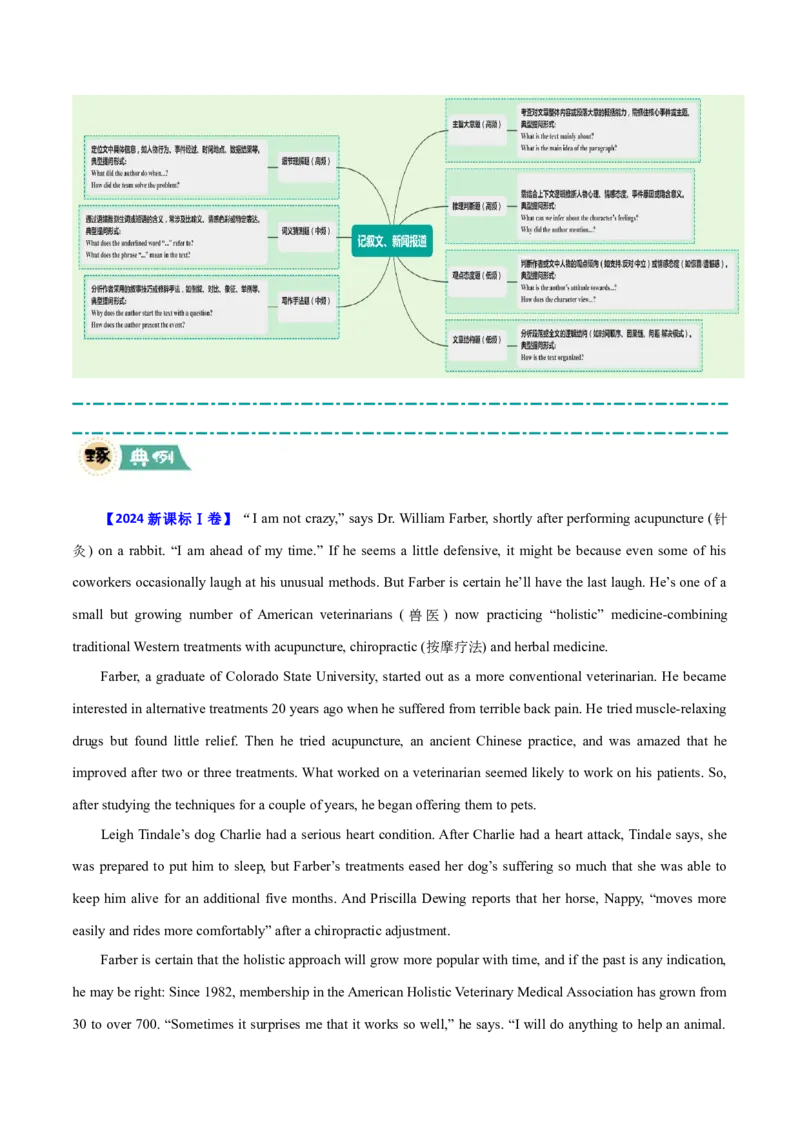
阅读理解记叙文/新闻报道常见的有细节理解、词义猜测、主旨大意、推理判断、作者意图等题型。除了推
论或词义辨识题,记叙文命题的顺序一般都会按照文章的脉络和故事发展的顺序层层推进,否则就会觉得
别扭,逻辑不通。同时,记叙文需要事件的发展过程作支撑,一半以上的题目都会用来检测考生对故事的
了解,因此,我们必须弄明白整件事情的发展脉络。而其余像主旨大意、作者意图之类的题目,则取决于
文章的落句,集中考查对作者所发的感触的理解。
考向预测
预测2025年高考记叙文阅读理解试题难度会保持相对稳定,但会继续考查细节理解题、推理判断题主
旨大意题和词义猜测题等题型。【2024新课标Ⅰ卷】“I am not crazy,” says Dr. William Farber, shortly after performing acupuncture (针
灸) on a rabbit. “I am ahead of my time.” If he seems a little defensive, it might be because even some of his
coworkers occasionally laugh at his unusual methods. But Farber is certain he’ll have the last laugh. He’s one of a
small but growing number of American veterinarians (兽医) now practicing “holistic” medicine-combining
traditional Western treatments with acupuncture, chiropractic (按摩疗法) and herbal medicine.
Farber, a graduate of Colorado State University, started out as a more conventional veterinarian. He became
interested in alternative treatments 20 years ago when he suffered from terrible back pain. He tried muscle-relaxing
drugs but found little relief. Then he tried acupuncture, an ancient Chinese practice, and was amazed that he
improved after two or three treatments. What worked on a veterinarian seemed likely to work on his patients. So,
after studying the techniques for a couple of years, he began offering them to pets.
Leigh Tindale’s dog Charlie had a serious heart condition. After Charlie had a heart attack, Tindale says, she
was prepared to put him to sleep, but Farber’s treatments eased her dog’s suffering so much that she was able to
keep him alive for an additional five months. And Priscilla Dewing reports that her horse, Nappy, “moves more
easily and rides more comfortably” after a chiropractic adjustment.
Farber is certain that the holistic approach will grow more popular with time, and if the past is any indication,
he may be right: Since 1982, membership in the American Holistic Veterinary Medical Association has grown from
30 to over 700. “Sometimes it surprises me that it works so well,” he says. “I will do anything to help an animal.That’s my job.”
24. What do some of Farber’s coworkers think of him?
A. He’s odd. B. He’s strict. C. He’s brave. D. He’s rude.
25. Why did Farber decide to try acupuncture on pets?
A. He was trained in it at university. B. He was inspired by another veterinarian.
C. He benefited from it as a patient. D. He wanted to save money for pet owners.
26. What does paragraph 3 mainly talk about?
A. Steps of a chiropractic treatment. B. The complexity of veterinarians’ work.
C. Examples of rare animal diseases. D. The effectiveness of holistic medicine.
27. Why does the author mention the American Holistic Veterinary Medical Association?
A. To prove Farber’s point. B. To emphasize its importance.
C. To praise veterinarians. D. To advocate animal protection.
1.关注细节
记叙文中有大量的事件发展过程中的细节,包括记叙文的 5W(what, who, when, where, why)要素。因
此我们作答细节题的时候,就没有那么复杂,一般只需要由前到后,从上到下,一题一题地做就可以
了。
2.注重联系
在做题过程中,我们大都不能在文中找到与题干一字不差的词语或句子。这时我们需要认真研究问
题,抓住题干中的关键词语,然后到文中准确地找到与之相关的语句,或是疑似语句的位置,接着去左
顾,或右盼,在前句或后句寻找线索。
3.读懂表象
如前所述,主旨大意题或推理判断、作者意图题等实际上是同一类型的问题,或者说是可用同种方法
解答的题型。在解答此类题目的时候,不可被题干的表象所迷惑,要像剥洋葱一样,一层一层地剥;在
四个可选项中,一个一个地去证实,去排除。
4.挖掘意义
每年的高考阅读题中,特别是记叙文的阅读题,都会出现一至两道词义猜测题。而这
些词汇往往是你素昧平生的,或者和你有点头之交,在文中却另有新意的,总之,猜的
是那些在高考词汇表要求之外的词汇。小小的一个词,一个短语,考核的不是你的语法
的熟练程度,也不是你的记忆力,而是你对文章通篇或者一个段落的整体把握和变通能
力。
【2025届河南省郑州市中原区郑州中学高三上学期 12月模拟预测】My mother, who wasn’t good at
driving and using technology, planned to drive for Uber, an online platform that provides ride-hailing (打车)
services.
One day on her way home from grocery shopping, she turned on the app, which matched her quickly with arider named Matthew. As she made her way toward him, the panic seized her — the silent navigation (导航), the
distracting screen and the swipe/ tap confusion. It was just too much. Naturally, she turned off her phone. She did
not cancel the ride, nor did she contact him to explain. She turned her car and raced toward home.
A few minutes later, Mom turned on her phone to check her text messages. She had several missed calls from
Matthew, who had been watching her on his screen and had seen her drive in the opposite direction for the past five
minutes.
Matthew called again. She hesitated, and then picked up the phone. “Why are you driving in the opposite
direction?” he asked. “Listen,” she explained. “This is my first time with Uber, and I don’t know how to use it.”
Then Mom found the destination and Matthew got in the car. Matthew was a handsome man in his early
thirties with a kind face. Mom told Matthew he would need to manage the technology if he wanted to arrive on
time.
“So, start the trip,” she requested and tossed her phone to Matthew. He was glad of service. They laughed,
talked and eventually arrived at Yorkdale — although at the wrong entrance.
“I’m sorry,” she said. “It’s OK,” laughed Matthew. “Everyone is a beginner at some point.” He ended the
trip, returned her phone and started to climb out of the car.
“Matthew,” she called from her window, “you’d better not rate me one star.” “I’m rating you five right now!”
he said and he really did.
Matthew disappeared into the mall, smiling. She smiled, too, proud that her first ride was such a success.
24.Why did the author’s mother turn off her phone?
A.She was at a loss what to do then.
B.She had difficulty in finding Matthew.
C.She couldn’t get in touch with Matthew.
D.She had something urgent to deal with.
25.What did Matthew do before he met the author’s mother?
A.He canceled the order. B.He followed her car home.
C.He issued a warning. D.He phoned her several times.
26.What can we learn about the author’s mother and Mattew’s trip?
A.It took shorter than usual. B.It led to a lasting friendship.
C.They had a great time during it. D.They didn’t get along well during it.
27.Which of the following words can best describe Matthew?
A.Humorous. B.Understanding. C.Intelligent. D.Responsible.Passage(1)
【安徽省合肥市第一中学 2024-2025学年高三上学期 12月阶段性诊断检测】In the bustling city of
Shanghai, a unique café is set to open its doors. Unlike any other, this café operates in complete darkness, offering a
sensory experience like no other. It is staffed by baristas who are visually impaired, with a mission to raise
awareness about the challenges they face and the strength they possess.
Upon entering, customers are greeted with walking sticks to navigate the dark interior. For the next few
minutes, the world fades away, and one must rely on senses other than sight to savor the coffee. “Feel the long table
with your hands,” instructs a guide, “and find your seat on the bench.”
The coffee itself is a journey of taste and memory. “Does it remind you of white rabbit candy?” asks a
barista, referring to a popular Chinese sweet. The answer is often a delighted “Yes,” as the familiar flavor sparks a
connection.
One of the baristas, Zhang Zhiwen, lost her vision at 28 due to an accident. It was a devastating blow, but her
father’s question, “Can you see that trash can in front of you? ”sparked a change. With determination, she identified
the object, and her father’s response, “Exactly. Since you can see, I’ll take you around the world,” marked the
beginning of a new chapter in her life. Along with five other visually impaired baristas, she has turned her life
around and now runs the café. Their stories are unique, yet they share a common goal: to make others understand
the world through their eyes.
Chen Siying another barista, expresses the café’s purpose: “We want our customers to experience what we
feel. Our lives are a reflection of what you’ll find inside the café. We aim to share the experiences of visually
impaired individuals.”
Chen Tong, a visitor, reflects on the experience: “In this room, sight is irrelevant. You engage with the world
through hearing, touching, smelling, and tasting. It’s a reminder of the challenges faced by the visually impaired.”
The café is scheduled to open on Wednesday, December 4th. For those interested in this extraordinary
experience, reservations can be made online.
4.What did Zhang Zhiwen’s father do to inspire her after she lost her vision?
A.He took her on a trip around the world.B.He introduced her to a new hobby to distract her from her loss.
C.He bought her a special coffee to cheer her up.
D.He asked her if she could see a trash can, reminding her of her remaining sight.
5.What does Chen Siying want customers to understand through their experience at the café?
A.The importance of sight in daily life.
B.The joy of working with visually impaired baristas.
C.The challenges faced by the visually impaired.
D.The variety of coffee flavors available.
6.What can be inferred about the visitors’ experience at the café?
A.They are likely to feel uncomfortable and disoriented.
B.They will gain a new appreciation for the senses other than sight.
C.They will become experts in making coffee in the dark.
D.They will feel pity for the visually impaired baristas.
7.What is the main message conveyed by the article about the café?
A.The café is a place for visually impaired individuals to so wait.
B.The café is a platform to educate the public about visual impairment.
C.The café is a business venture that employs visually impaired individuals.
D.The café is a unique place for, coffee enthusiasts to-try new flavors.
Passage(2)
【广东省红岭中学2024-2025学年高三下学期第五次统一考试】Life had always been about action for
former teacher Billy Keenan, who had served in the Army before. He mastered musical instruments including the
flute, guitar, bass guitar and piano. As a competitive triathlete and surfer, he completed numerous 5K, 10K and half-
marathon runs. “I was at the peak of my powers,” he said.
But on Sept. 14, 2013, his life changed in an instant while surfing at the Jersey Shore. “I rode that wave, fell
off my board, hit my head on the ocean floor,” Keenan said. “Everything faded to black.” Keenan woke up in a
hospital room two and a half weeks later. He had been paralyzed (瘫痪的) from the shoulders down and the
medical team didn’t expect him to regain independent breathing.
Keenan called it one of the worst days of his life, saying it was “a lot of darkness.” When a parent of a
former student visited him at the hospital, they handed him the phone. It was New York Police Department
Detective Steven McDonald, who survived a shooting in 1986. He eventually forgave his attacker. But he too was
paralyzed. He became a public speaker, preaching the importance of forgiveness.That day, he had advice for Keenan. At a recent talk at Berkeley College, Keenan recalled what McDonald
had told him. “The only reason you survive is when you’re better, when you’re stronger, when your rehab is over,
you’re going to come back and contribute in a significant way,” he said. “Don’t ever forget that in the end, there
will be life.”
Looking back on his life, Keenan realized he had been accustomed to what he called “deliberate discomfort.”
Drawing on his own faith and that reminder from McDonald, Keenan overcame the odds. Four months after his
accident, he was able to breathe on his own again.
In 2015, Keenan went back to teaching, but later retired. When McDonald died in January 2017, Keenan
decided to start helping others by becoming a motivational speaker. He published an autobiography in 2023 —
“The Road to Resilience: The Billy Keenan Story” — and is already working on his next book, a new coming-of-
age story called “I Am Iron Man.”
4.What is the purpose of the first paragraph?
A.To introduce Keenan’s basic situations before injury.
B.To make a contrast to indicate Keenan’s later terrible situation.
C.To inform the readers that Keenan stood out with talent and skill.
D.To indicate why Keenan was eventually injured.
5.What do we know about Keenan after his injury?
A.He was paralyzed all over his body.
B.He came back to consciousness after three weeks.
C.He was expected to breathe independently soon by his medical team.
D.He had used to accept paralysis and sufferings to be his fate.
6.What does the underlined word “rehab” in Paragraph 4 probably mean?
A.Regret. B.Reflection.
C.Recovery. D.Rescue.
7.What message is mainly conveyed by Keenan’s story?
A.Life is never easy for those who dream.
B.What doesn’t kill you makes you stronger.
C.Helping others is the way we help ourselves.
D.Only a life lived for others is a life worthwhile.
Passage(3)
【河北省沧衡名校联盟2024-2025学年高三下学期开学考试】In rural North Carolina, a research farmgrows new blueberry varieties for gardeners and farmers alike. And the berries — well, they have to be harvested.
In the morning about 30 volunteers gathered near a blueberry field to listen to researcher Bill Cline, who
offered the best technique for gathering the fruit. “Attach the bucket so that you have both hands free to pick. Just
cup your hands, roll them off with your thumbs and down into the bucket,” he instructed.
This research farm is part of North Carolina State University, and the fruit isn’t sold. It’s donated, and these
volunteers are here to help. “And you might get to take a blueberry or two home at the end of the deal, and we
really appreciate your being out here,” Cline told the volunteers.
Bonzak is one of a group of volunteer gardeners today. To them, the research farm provides a unique
opportunity to learn. As the buckets are filled with blueberries, Cline brings out more boxes to transport the berries
to the food bank.
“They are the largest blueberries I’ve ever seen,” Bonzak said. Cline explained that this variety is called
Pinnacle and can grow to the size of a quarter. “It is not widely planted. It’s not a real high yielder (高产品种), but
what it does have is exceptional flavor and size,” he said.
On this 50-acre farm, there are thousands of bushes of different varieties being tested at any time. Cline says
it’s a big effort to find a new variety with the ideal characteristics of climate adaptability, disease resistance, yield,
and flavor. “It takes a lot of time and patience to develop,” he noted.
“Thanks to the help of these volunteers, the blueberries were harvested and transported to food banks,
enriching the tables and diets of low-income families in the local community. These volunteers not only harvest the
fruit but also serve as a bridge, connecting the research outcomes of local farms with the dining tables of local
residents, ensuring that the fruits of scientific progress are shared with those who need them most,” he added.
4.What was Bill Cline doing in Paragraph 2?
A.Tasting the new blueberry variety. B.Teaching volunteers on harvesting.
C.Selling blueberries to the customers. D.Studying techniques for growing blueberries.
5.What do we know about the Pinnacle blueberry variety?
A.It has a high yield. B.It is widely grown.
C.It has a unique taste. D.It is resistant to disease.
6.How does the research farm benefit the local community?
A.It provides poor families with nutritious food.
B.It attracts visitors and tourists to the local area.
C.It enables residents to learn gardening techniques.D.It increases residents’ income by selling blueberries.
7.What is the best title of the text?
A.The Pinnacle Blueberry Enters the Market
B.Researchers Develop New Blueberry Varieties
C.Master Gardeners Learn About Blueberry Harvesting
D.Volunteers Pick Blueberries on Research Farms for Food Banks
Passage(4)
【湖南师范大学附属中学2024-2025学年高三下学期2月月考】Last year, my husband and I decided to
make our 12-storey building more of a community. We live in a small rented apartment in Park Merced, a large
housing development. I would call us lower-middle-class. A lot of nurses, bus drivers, and tradesmen live here,
many of them 1st or 2nd generation immigrants (移民).
We’re all renters. Renters come and go and tend not to see the buildings they live in as their home. But it can
be done. We started with a monthly two-hour social in the building lobby on the second Fridays of each month.
Some people came, between 15-30 each time. The events lasted two hours, but there wasn’t much to do besides
talking, eating snacks and drinking juice. The socials were nice, but most residents gave them a miss.
Then one day I was on the nearby campus of San Francisco State University. A young man from a social club
for students had a big sign about “Building Community”. I asked him, “How do you do that?” He said they tried to
get people to share something about themselves with at least one other person. That made a lot of sense to me.
I bought a large world map. At the social, I taped it on the lobby wall with signs that said “Where We’re
From. Put a green sticker where you were born and yellow stickers where your grandparents were born.” People put
up their stickers and looked where other people came from. We left the map up overnight, and the next day,
Saturday, more people played. I planned to leave the map and stickers up for a month or more. They certainly made
the lobby more interesting than the housing project look it usually has.
I see that there will be challenges, but I also know that a strong community will help us live good lives. I
have the time and energy to do this work.
4.What trouble did the author have building a community?
A.The community was poor. B.She lacked enough money.
C.Renters had no sense of belonging. D.Her neighbors were all immigrants.
5.How did the author find her earlier events?
A.Fruitful. B.Ordinary. C.Inspiring. D.Messy.6.What did the author do in order to change the socials?
A.Sharing friendly stickers. B.Adding foods and drinks.
C.Adopting a sharing game. D.Asking some neighbors for help.
7.Which of the following best describes the author?
A.Insightful and determined. B.Responsible and strict.
C.Demanding and ambitious. D.Knowledgeable and modest.
Passage(5)
【湖南省长沙四大名校 2024-2025学年高三下学期 2月月考】Every winter season, I feel a rush of
emotions and memories flood back as I look at the old scarf my mother used to wear. It was a simple woolen scarf,
frayed at the edges and a bit faded in color, but to me, it held a world of meaning.
My mother was a hardworking woman. She would wake up before the crack of dawn to prepare breakfast for
the family, then rush off to her job at the local factory. Despite the long hours and tiring work, she always managed
to come home with a smile on her face, ready to listen to our stories and help us with our homework. I remember
how she would wrap that scarf around her neck on cold mornings, as if it were a shield against the harsh elements.
One Christmas, I decided to save up my pocket money to buy her a new scarf. I spent hours in the store,
carefully choosing one that I thought would match her eyes and bring out the warmth in her smile. When I finally
presented it to her, her eyes lit up like stars. She immediately put it on and proudly showed it off to my father and
siblings, as if it were the most precious gift she had ever received. But even though she had the new scarf, she still
kept the old one, saying that it held too many memories to let go.
As the years passed, the scarf became a symbol of our bond. Whenever I saw it, I would think of the
countless times my mother had comforted me with a hug when I was sad, or cheered me on when I was facing a
challenge. She was my constant support, my rock in the stormy sea of life. Friends would come and go, but my
mother was always there, ready to offer a kind word or a shoulder to cry on.
Now, I am a father with two kids. Whenever the winter winds blow, I take out that old scarf and hold it close
to my heart. It reminds me of my mother's love, unwavering and unconditional. And I realize that the best gifts in
life are not the ones that are bought with money, but the ones that are wrapped in love and memories. Just like my
mother's scarf, which may be worn out and old, but to me, it is a treasure that I will cherish forever.
4.How did the author surprise his mom at Christmas?
A.By saving his pocket money. B.By helping with household chores.
C.By taking her on a trip. D.By giving her a new scarf.5.What does the underlined word “frayed” in paragraph 1 mean?
A.Torn. B.Decorated. C.Colorful. D.Soft.
6.What can we infer about the author's mother?
A.She lives an economical life. B.She values family and memories.
C.She doesn't like new things. D.She is strict with her children.
7.What is the main idea of the passage?
A.The author's happy childhood.
B.The author's memories of his mother's scarf.
C.The relationship between the author and his mother.
D.The importance of buying proper gifts for parents.
Passage(6)
【江西省吉安市六校协作体2025学年高三上学期1月联考】Tait’s journey to being a baking kid began
back in2018 when, aged 14, she was struck down by mental illness. With medication and therapy(疗法), and
under the guidance of parents, Tait began exploring activities that might help her find a path through the daily
anxiety attacks and depression. Gardening, drawing, knitting were among the things she tried. But nothing quite
seemed to last long enough or give her a sense of hope or delight.
A turning point came when his father Alex clipped a simple bread recipe from a magazine. When he read it,
Tait felt excited and got stuck in. The effect was nothing short of magic.
“Baking filled my time and put me in a really calm state, but it also gave me a huge sense of purpose when
all I really felt like was a burden,” she says.
Tait’s newfound zeal rapidly capped her family’s appetite for bread, so she began gifting her bread to lucky
locals in her home town. Word quickly spread and the free bread turned into a paid-for subscription service. Alex
quit his job as a tutor to become his daughter’s business partner, and after opening several successful pop-up stores
(快闪店), the pair drew on their global social media following to crowd fund a brick-and-mortar store in 2019.
It was an instant success, selling out daily and she wrote a book. However, ensuring long-term viability(生
存能力) would have meant scaling up in a way that neither father nor daughter liked. So instead, after four years
of 5 am starts and 12- hour days, they shut up shop last summer.
Tait has since scaled back to basics, selling her bakes at twice-weekly pop-up store. She runs the Orange
Bakery from a Watlington’s abandoned factory, which is also the center for Breaducating Britain. So far they have
distributed around 40,000 free bread kits through more than 200 different organisations to schools, prisons andindividuals.
24.Why did Tait try painting at first?
A.To develop her interest. B.To explore her potentials.
C.To deal with her mental problems. D.To achieve her childhood dream.
25.What does the underlined word “zeal” in paragraph 4 probably mean?
A.Fact. B.Passion. C.Aim. D.Element.
26.What happened to Tait after four years of hard work?
A.She closed up her shop. B.She expanded her store.
C.She invested in many organisations. D.She opened several pop-up shops.
27.Which of the following can best describe Tait?
A.Modest and sociable. B.Charitable and honest.
C.Talented and hard-working. D.Generous and helpful.
Passage(7)
【江西省九江市十校联考 2024-2025 学年高三下学期 2 月月考】When Chen Dan gazed upon the
Pyramid of Khafre and the Great Sphinx, she felt the pages of history textbooks come to life.
In the Sahara, she enjoyed a peaceful and secluded afternoon, riding in a vehicle at high speeds through the
desert known as dune enjoying the sunset, disconnecting from the world as her mobile phone had no signal. These
are unforgettable memories from her 15-day journey across Egypt with her friends in March. “I’ m most impressed
by Egyptian hospitality,” says the 32-year-old traveler from Hefei, Anhui province.
During the trip, she rubbed elbows with the locals. A group of youngsters struck up conversations, took
photos and waved goodbye as they parted ways on opposite sides of the road. At a pastry shop, kind strangers
offered to translate the menu when they noticed the group’s difficulty in reading it.
Like Chen, more Chinese tourists are traveling to Egypt to explore the mysterious pyramids, temples,
museums and the Nile River. The number of Chinese visitors to Egypt was 265,000 from January to September, an
increase of 65 percent compared to the same period last year.
Amr El-Kady, CEO of the Egyptian Tourism Authority, estimates that the country will receive over 300,000
Chinese tourists by the end of this year, aiming for over 15 million global visitors. The tourism bureau will continue
to strengthen cooperation with Chinese authorities and tourism operators. They will participate in tourism fairs in
China and enhance their marketing strategies through conferences and seminars.
“Tourism acts as a vital bridge, fostering cultural exchanges and mutual understanding between the twocountries,” says Sherif Fathy, Egypt’s minister of tourism and antiquities (古迹). He recently attended the China
Outbound Travel & Tourism Market 2024 in Beijing.
He says that as one of the countries participating in the Belt and Road Initiative, Egypt views China as a key
partner in businesses such as tourism. Egypt has released a series of initiatives and measures to attract more
Chinese tourists.
4.What does the underlined word in paragraph 2 mean?
A.undisturbed B.tough C.disappointed D.entertaining
5.What is the Egyptian’s attitude to Chen?
A.Indifferent B.Distant C.Sensitive D.Enthusiastic
6.Why will the Egyptian tourism bureau participate in tourism fairs in China?
A.They want to sell more souvenirs to Chinese people.
B.They want to attract more Chinese to visit Egypt.
C.They hope more Egyptians will visit China.
D.They hope to learn more marketing strategies.
7.Which of the following might be the best title of the article?
A.Chinese Tourists Experience Ancient Egypt Coming to Life
B.Chinese Tourists Flooding into the World’s Destinations
C.Egyptians Present Hospitality to Visiting Tourists.
D.Egypt is Making Full Efforts to Develop its Tourism.
Passage(8)
【浙江省诸暨市牌头中学等多校2024-2025学年高三下学期2月适应性考试】Erin Willman, who lost
her vision at fifteen, faced numerous challenges as people often told her what she cannot do, but she wanted to
show them what she can do. Turned down from job applications due to her blindness, Erin decided to create her
own path. Within a year, she established White Cane Coffee, becoming its CEO and proving that her disability
would not hinder her ambitions.
White Cane Coffee has grown from an idea born on a tough day into a thriving business with Erin’s coffee
available in multiple cities. Beyond selling high-quality coffee, the company champions inclusiveness by creating
employment opportunities for blind and disabled individuals, equipping them with valuable skills and boosting
their confidence. The company’s commitment to inclusiveness is evident in its unique product labeling; each
package features Braille, making it one of the pioneering companies to label all products this way. This initiativeaddresses Erin’s belief that visually impaired individuals should be able to shop independently.
The company provides jobs at a livable wage, offering freedoms and enriching the lives of employees who
are often unfairly deprived of such opportunities elsewhere. Erin’s team emphasizes that their mission goes beyond
wages — it instills hope and demonstrates the value of every employee as part of a larger effort. Profits from White
Cane Coffee do more than just support the staff; they also contribute to leader dog training, community work with
children, and fundraising for non-profits.
Erin’s vision extends beyond personal success; her ultimate goal is to effect global change. She prioritizes
social impact over material wealth, aiming to use her position to improve lives. Erin and her team remain thankful
for the fantastic support from their community and disability support providers. And more importantly, they are
proud of how much they accomplish in providing resources and empowerment to disabled people. They hope to
continue to create additional jobs, which will help even more people become independent. To that end, they are
working on some very exciting projects to help gain the footing necessary to jump to the next level as a company.
4.Why did Erin start her own coffee company?
A.To make a living. B.To help those in need.
C.To showcase her abilities. D.To promote Braille education.
5.What distinguishes White Cane Coffee’s products?
A.They have lower prices. B.They offer free package for the blind.
C.They have special package for champions. D.They provide convenience for blind customers.
6.How does this company contribute to society?
A.Offering high-paying jobs to employees. B.Expanding globally and increasing sales.
C.Supporting independence for the needed. D.Selling coffee in multiple international cities.
7.What words can be used to describe Erin?
A.Dependent and ambitious. B.Competitive and powerful.
C.Determined and considerate. D.Pessimistic and materialistic.
Passage(1)
【2024 浙江 1 月卷】When was the last time you used a telephone box? I mean to make an actual phone
,
call — not to shelter from the rain. Ages ago right? The last time I used a phone box for its intended purpose
was…2006. I was conducting auditions (试演) for my play in my tiny old shared house in London. Hoping toimpress some talented actors to come and work for me for nothing, I spread some throws over the sofas and lit
candles to make it seem a bit more ”young professional”.
As I rushed outdoors to empty the wastepaper baskets, the door swung shut behind me. Suddenly I was locked
outside. My mobile phone was inside, but luckily there was a telephone box across the street. So, I called Directory
Assistance, got put through to our landlady’s managing agent, and had a spare key sent to me with just enough time
to get back in before the actors arrived.
As it has been many years since I last used one, I should hardly be surprised that then are no longer any public
telephones near my house. The last one standing has just been turn into a “mini community library”: any passer-by
can “borrow” a book from its shelves return it later, or replace it with another title from their own collection.
For a few months after the “library” opened, I didn’t bother taking a look, as I had assumed that it would be
stuffed full of cheese love stories. Then I noticed fork conducting spring cleans dropping boxes of voluminous
books on various subjects there. And these books were free. This unbeatable price-point encouraged me to
experiment with dozens of titles that I would never normally consider buying. And I’ve discovered some great
books!
If I ever get trapped outside my house again, my local telephone box will, sadly no longer be able to connect
me with my keys. But it can certainly keep me entertained while I wait for my wife to rescue me.
4. What does the underlined word “it” in the first paragraph refer to?
A. The play. B. The shared house.
C. The sofa. D. The telephone box.
5. Why did the author use the telephone box in 2006?
A. To place an urgent call. B. To put up a notice.
C. To shelter from the rain. D. To hold an audition.
6. What do we know about the “mini community library”?
A. It provides phone service for free. B. Anyone can contribute to its collection.
C. It is popular among young readers. D. Books must be returned within a month.
7. Why did the author start to use the “library”?
A. He wanted to borrow some love stories.
B. He was encouraged by a close neighbour.
C. He found there were excellent free books.
D. He thought it was an ideal place for reading.
Passage(2)【2023年新高考全国Ⅰ卷】When John Todd was a child, he loved to explore the woods around his house,
observing how nature solved problems. A ditry stream, for example, often became clear after flowing through
plants and along rocks where tiny creatures lived. When he got older, John started to wonder if this process could
be used to clean up the messes people were making.
After studying agriculture, medicine, and fisheries in college, John went back to observing nature and asking
questions. Why can certain plants trap harmful bacteria (细菌)? Which kinds of fish can eat cancer-causing
chemicals? With the right combination of animals and plants, he figured, maybe he could clean up waste the way
nature did. He decided to build what he would later call an eco-machine.
The task John set for himself was to remove harmful substances from some sludge (污泥). First, he
constructed a series of clear fiberglass tanks connected to each other. Then he went around to local ponds and
streams and brought back some plants and animals. He placed them in the tanks and waited. Little by little, these
different kinds of life got used to one another and formed their own ecosystem. After a few weeks, John added the
sludge.
He was amazed at the results. The plants and animals in the eco-machine took the sludge as food and began to
eat it! Within weeks, it had all been digested, and all that was left was pure water.
,
Over the years John has taken on many big jobs. He developed a greenhouse-like facility that treated sewage
(污水) from 1,600 homes in South Burlington. He also designed an eco-machine to clean canal water in Fuzhou, a
city in southeast China.
“Ecological design” is the name John gives to what he does. “Life on Earth is kind of a box of spare parts for
the inventor,” he says. “You put organisms in new relationships and observe what’s happening. Then you let these
new systems develop their own ways to self-repair.”
4. What can we learn about John from the first two paragraphs?
A. He was fond of traveling. B. He enjoyed being alone.
C. He had an inquiring mind. D. He longed to be a doctor.
5. Why did John put the sludge into the tanks?
A. To feed the animals. B. To build an ecosystem.
C. To protect the plants. D. To test the eco-machine.
6. What is the author’s purpose in mentioning Fuzhou?
A. To review John’s research plans. B. To show an application of John’s idea.
C. To compare John’s different jobs. D. To erase doubts about John’s invention.7. What is the basis for John’s work?
A. Nature can repair itself. B. Organisms need water to survive.
C. Life on Earth is diverse. D. Most tiny creatures live in groups.
Passage(3)
【2023年新高考全国Ⅱ卷】Turning soil, pulling weeds, and harvesting cabbage sound like tough work for
middle and high school kids. And at first it is, says Abby Jaramillo, who with another teacher started Urban
Sprouts, a school garden program at four low-income schools. The program aims to help students develop science
skills, environmental awareness, and healthy lifestyles.
Jaramillo’s students live in neighborhoods where fresh food and green space are not easy to find and fast food
restaurants outnumber grocery stores. “The kids literally come to school with bags of snacks and large bottles of
soft drinks,” she says. “They come to us thinking vegetables are awful, dirt is awful, insects are awful.” Though
some are initially scared of the insects and turned off by the dirt, most are eager to try something new.
Urban Sprouts’ classes, at two middle schools and two high schools, include hands-on experiments such as soil
testing, flower-and-seed dissection, tastings of fresh or dried produce, and work in the garden. Several times a year,
students cook the vegetables they grow, and they occasionally make salads for their entire schools.
Program evaluations show that kids eat more vegetables as a result of the classes. “We have students who say
they went home and talked to their parents and now they’re eating differently,” Jaramillo says.
She adds that the program’s benefits go beyond nutrition. Some students get so interested in gardening that
they bring home seeds to start their own vegetable gardens. Besides, working in the garden seems to have a calming
effect on Jaramillo’s special education students, many of whom have emotional control issues. “They get outside,”
she says, “and they feel successful.”
4. What do we know about Abby Jaramillo?
A. She used to be a health worker. B. She grew up in a low-income family.
C. She owns a fast food restaurant. D. She is an initiator of Urban Sprouts.
5. What was a problem facing Jaramillo at the start of the program?
A. The kids’ parents distrusted her. B. Students had little time for her classes.
C. Some kids disliked garden work. D. There was no space for school gardens.
6. Which of the following best describes the impact of the program?
A. Far-reaching. B. Predictable.
C. Short-lived. D. Unidentifiable.
7. What can be a suitable title for the text?A. Rescuing School Gardens B. Experiencing Country Life
C. Growing Vegetable Lovers D. Changing Local Landscape
Passage(4)
【2023年全国乙卷】 Living in Iowa and trying to become a photographer specializing in landscape (风景)
can be quite a challenge, mainly because the corn state lacks geographical variation.
Although landscapes in the Midwest tend to be quite similar, either farm fields or highways, sometimes I find
distinctive character in the hills or lakes. To make some of my landscape shots, I have traveled up to four hours
away to shoot within a 10-minute time frame. I tend to travel with a few of my friends to state parks or to the
countryside to go on adventures and take photos along the way.
Being at the right place at the right time is decisive in any style of photography. I often leave early to seek the
right destinations so I can set up early to avoid missing the moment I am attempting to photograph. I have missed
plenty of beautiful sunsets/sunrises due to being on the spot only five minutes before the best moment.
One time my friends and I drove three hours to Devil’s Lake, Wisconsin, to climb the purple quartz (石英)
rock around the lake. After we found a crazy-looking road that hung over a bunch of rocks, we decided to
photograph the scene at sunset. The position enabled us to look over the lake with the sunset in the background. We
managed to leave this spot to climb higher because of the spare time until sunset. However, we did not mark the
route (路线) so we ended up almost missing the sunset entirely. Once we found the place, it was stressful getting
lights and cameras set up in the limited time. Still, looking back on the photos, they are some of my best shots
though they could have been so much better if I would have been prepared and managed my time wisely.
4. How does the author deal with the challenge as a landscape photographer in the Midwest?
A. By teaming up with other photographers. B. By shooting in the countryside or state parks.
C. By studying the geographical conditions. D. By creating settings in the corn fields.
5. What is the key to successful landscape photography according to the author?
A. Proper time management. B. Good shooting techniques.
C. Adventurous spirit. D. Distinctive styles.
6. What can we infer from the author trip with friends to Devil’s Lake?
A. They went crazy with the purple quartz rock.
B. They felt stressed while waiting for the sunset.
C. They reached the shooting spot later than expected.
D. They had problems with their emipment.
7. How does the author find his photos taken at Devil’s Lake?A. Amusing. B. Satisfying.
C. Encouraging. D. Comforting.
Passage(5)
【2023年全国甲卷】Terri Bolton is a dab hand when it comes to DIY (do-it-yourself). Skilled at putting up
shelves and piecing together furniture, she never pays someone else to do a job she can do herself.
She credits these skills to her late grandfather and builder Derek Lloyd. From the age of six, Terri, now 26,
accompanied Derek to work during her school holidays. A day’s work was rewarded with £5 in pocket money. She
says: “I’m sure I wasn’t much of a help to start with, painting the rooms and putting down the flooring throughout
the house. It took weeks and is was backbreaking work, but I know he was proud of my skills.”
Terri, who now rents a house with friends in Wandsworth, South West London, says DIY also saves her from
losing any deposit when a tenancy (租期) comes to an end. She adds: “I’ve moved house many times and I always
like to personalise my room and put up pictures, so, it’s been useful to know how to cover up holes and repaint a
room to avoid any charges when I’ve moved out.”
With millions of people likely to take on DIY projects over that coming weeks, new research shows that more
than half of people are planning to make the most of the long, warm summer days to get jobs done. The average
spend per project will be around £823. Two thirds of people aim to improve their comfort while at home. Two fifth
wish to increase the value of their house. Though DIY has traditionally been seen as male hobby, the research
shows it is women now leading the charge.
24. Which is closest in meaning to “a dab hand” in paragraph 1?
A. An artist. B. A winner. C. A specialist. D. A pioneer.
25. Why did Terri’s grandfather give her £5 a day?
A. For a birthday gift. B. As a treat for her work.
C. To support her DIY projects. D. To encourage her to take up a hobby.
26. How did Terri avoid losing the deposit on the house she rented?
A. By making it look like before. B. By furnishing it herself.
C. By splitting the rent with a roommate. D. By cancelling the rental agreement.
27. What trend in DIY does the research show?
A. It is becoming more costly. B. It is getting more time-consuming.
C. It is turning into a seasonal industry. D. It is gaining popularity among females.