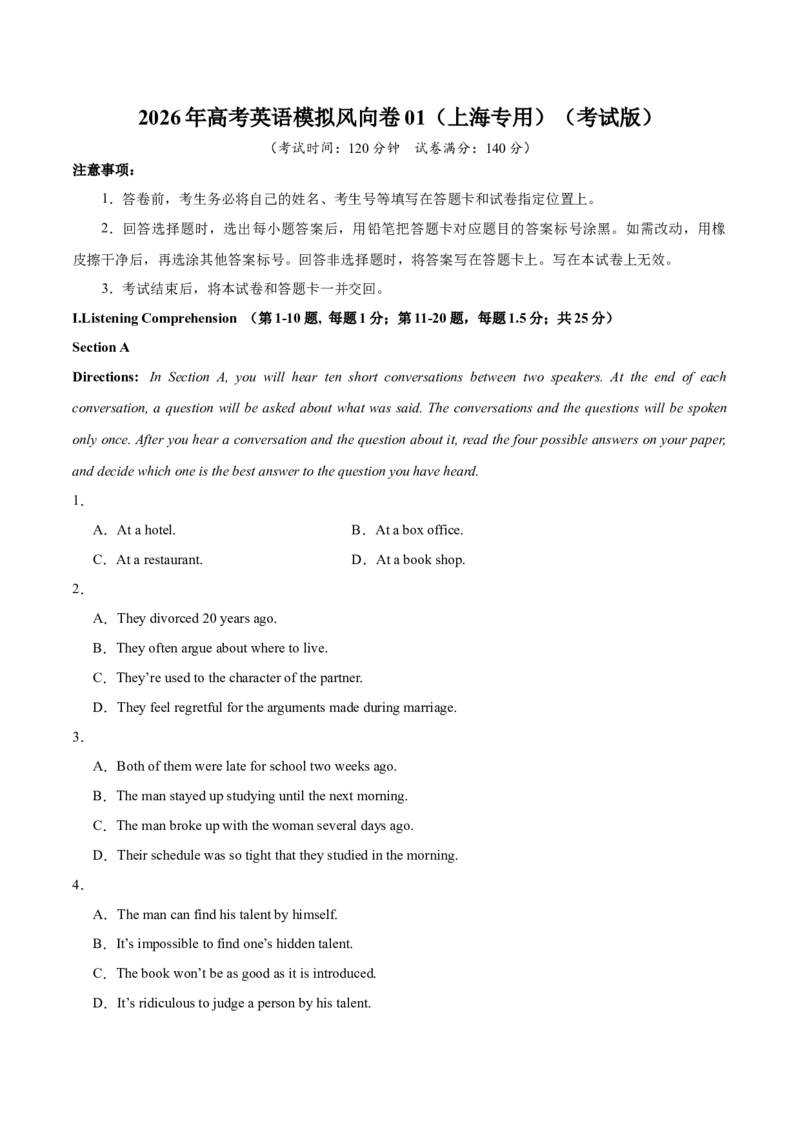
2026 年高考英语模拟风向卷01(上海专用)(考试版)
(考试时间:120 分钟  试卷满分:140 分)
注意事项:
1.答卷前,考生务必将自己的姓名、考生号等填写在答题卡和试卷指定位置上。
2.回答选择题时,选出每小题答案后,用铅笔把答题卡对应题目的答案标号涂黑。如需改动,用橡
皮擦干净后,再选涂其他答案标号。回答非选择题时,将答案写在答题卡上。写在本试卷上无效。
3.考试结束后,将本试卷和答题卡一并交回。
I.Listening Comprehension (第1-10 题, 每题1 分;第11-20 题,每题1.5 分;共25 分)
Section A
Directions: In Section A, you will hear ten short conversations between two speakers. At the end of each
conversation, a question will be asked about what was said. The conversations and the questions will be spoken
only once. After you hear a conversation and the question about it, read the four possible answers on your paper,
and decide which one is the best answer to the question you have heard.
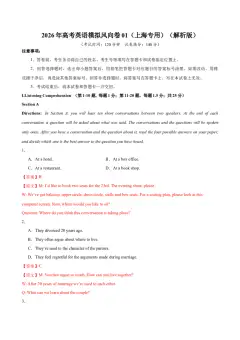
1.
A.At a hotel.
B.At a box office.
C.At a restaurant.
D.At a book shop.
2.
A.They divorced 20 years ago.
B.They often argue about where to live.
C.They’re used to the character of the partner.
D.They feel regretful for the arguments made during marriage.
3.
A.Both of them were late for school two weeks ago.
B.The man stayed up studying until the next morning.
C.The man broke up with the woman several days ago.
D.Their schedule was so tight that they studied in the morning.
4.
A.The man can find his talent by himself.
B.It’s impossible to find one’s hidden talent.
C.The book won’t be as good as it is introduced.
D.It’s ridiculous to judge a person by his talent.
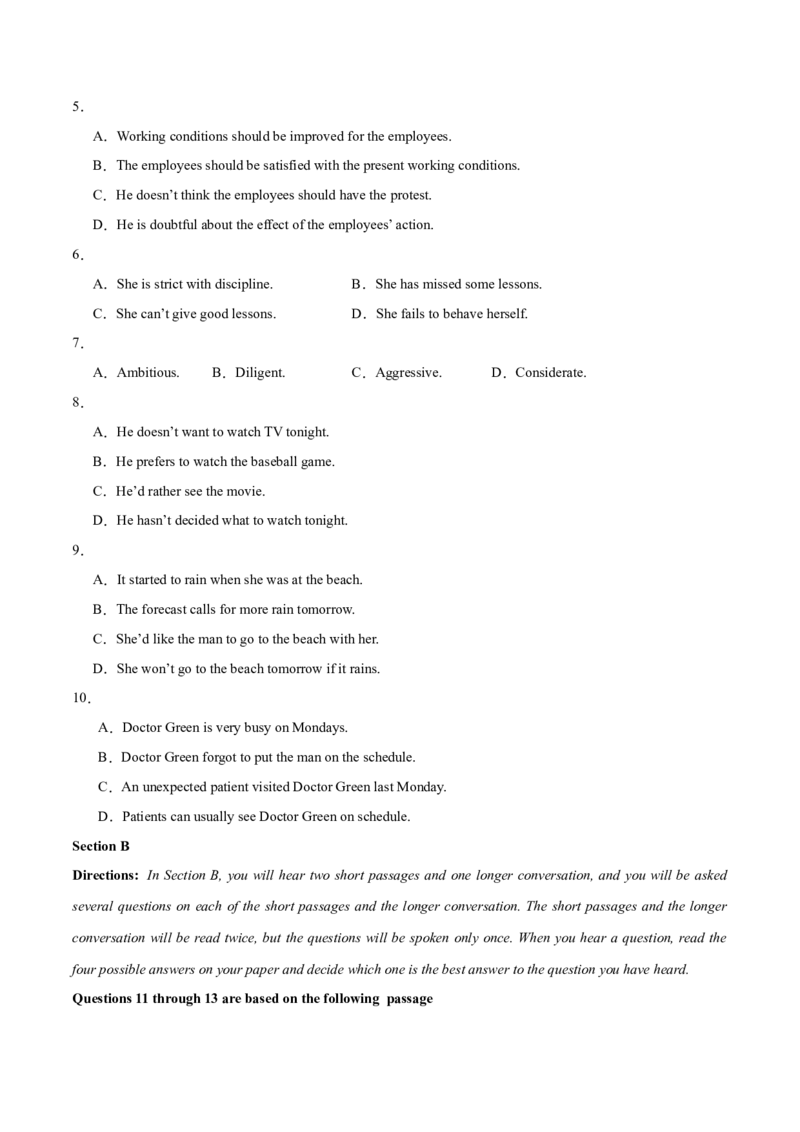
5.
A.Working conditions should be improved for the employees.
B.The employees should be satisfied with the present working conditions.
C.He doesn’t think the employees should have the protest.
D.He is doubtful about the effect of the employees’ action.
6.
A.She is strict with discipline.
B.She has missed some lessons.
C.She can’t give good lessons.
D.She fails to behave herself.
7.
A.Ambitious.
B.Diligent.
C.Aggressive.
D.Considerate.
8.
A.He doesn’t want to watch TV tonight.
B.He prefers to watch the baseball game.
C.He’d rather see the movie.
D.He hasn’t decided what to watch tonight.
9.
A.It started to rain when she was at the beach.
B.The forecast calls for more rain tomorrow.
C.She’d like the man to go to the beach with her.
D.She won’t go to the beach tomorrow if it rains.
10.
A.Doctor Green is very busy on Mondays.
B.Doctor Green forgot to put the man on the schedule.
C.An unexpected patient visited Doctor Green last Monday.
D.Patients can usually see Doctor Green on schedule.
Section B
Directions: In Section B, you will hear two short passages and one longer conversation, and you will be asked
several questions on each of the short passages and the longer conversation. The short passages and the longer
conversation will be read twice, but the questions will be spoken only once. When you hear a question, read the
four possible answers on your paper and decide which one is the best answer to the question you have heard.
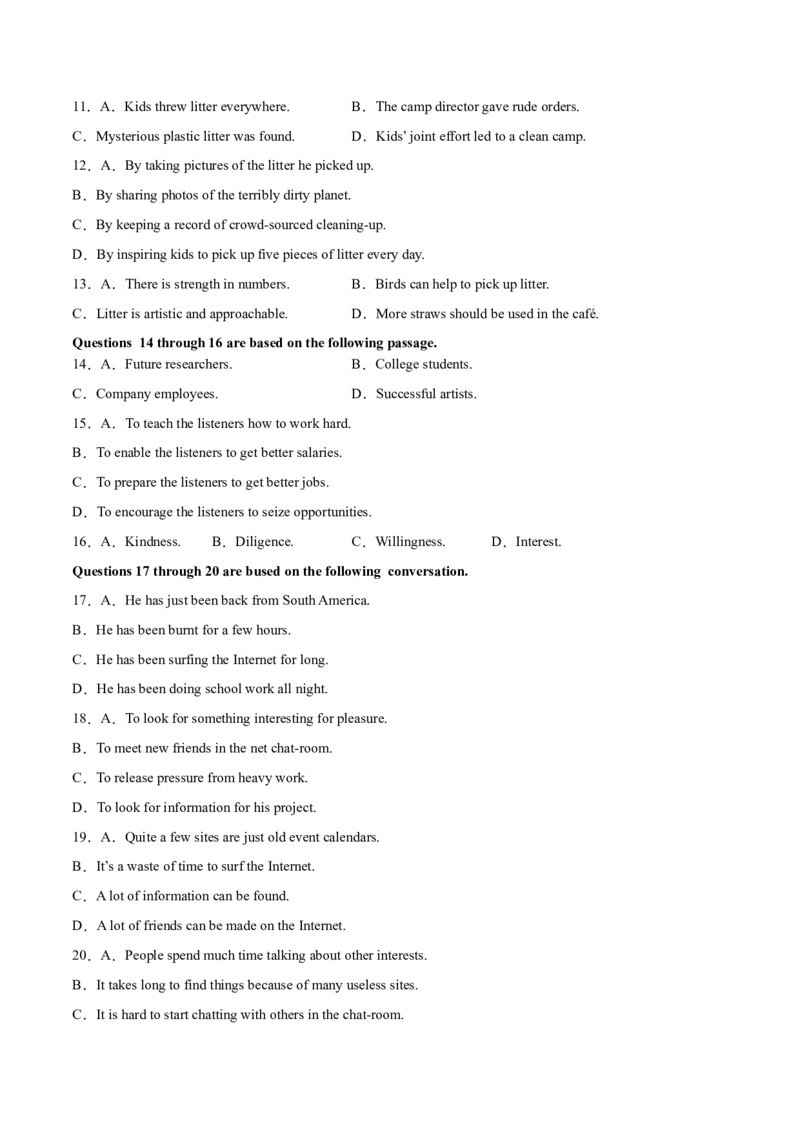
Questions 11 through 13 are based on the following passage
11.A.Kids threw litter everywhere.
B.The camp director gave rude orders.
C.Mysterious plastic litter was found.
D.Kids’ joint effort led to a clean camp.
12.A.By taking pictures of the litter he picked up.
B.By sharing photos of the terribly dirty planet.
C.By keeping a record of crowd-sourced cleaning-up.
D.By inspiring kids to pick up five pieces of litter every day.
13.A.There is strength in numbers.
B.Birds can help to pick up litter.
C.Litter is artistic and approachable.
D.More straws should be used in the café.
Questions 14 through 16 are based on the following passage.
14.A.Future researchers.
B.College students.
C.Company employees.
D.Successful artists.
15.A.To teach the listeners how to work hard.
B.To enable the listeners to get better salaries.
C.To prepare the listeners to get better jobs.
D.To encourage the listeners to seize opportunities.
16.A.Kindness.
B.Diligence.
C.Willingness.
D.Interest.
Questions 17 through 20 are bused on the following conversation.
17.A.He has just been back from South America.
B.He has been burnt for a few hours.
C.He has been surfing the Internet for long.
D.He has been doing school work all night.
18.A.To look for something interesting for pleasure.
B.To meet new friends in the net chat-room.
C.To release pressure from heavy work.
D.To look for information for his project.
19.A.Quite a few sites are just old event calendars.
B.It’s a waste of time to surf the Internet.
C.A lot of information can be found.
D.A lot of friends can be made on the Internet.
20.A.People spend much time talking about other interests.
B.It takes long to find things because of many useless sites.
C.It is hard to start chatting with others in the chat-room.
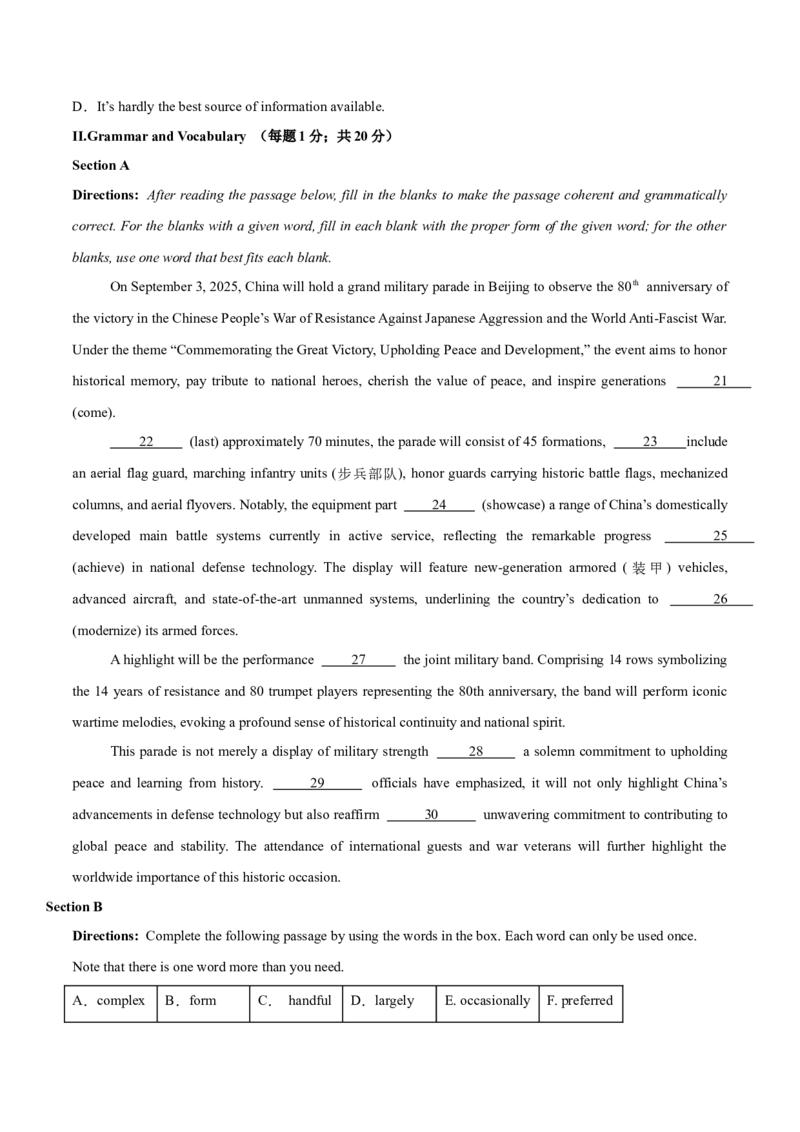
D.It’s hardly the best source of information available.
II.Grammar and Vocabulary (每题1 分;共20 分)
Section A
Directions: After reading the passage below, fill in the blanks to make the passage coherent and grammatically
correct. For the blanks with a given word, fill in each blank with the proper form of the given word; for the other
blanks, use one word that best fits each blank.
On September 3, 2025, China will hold a grand military parade in Beijing to observe the 80 th anniversary of
the victory in the Chinese People’s War of Resistance Against Japanese Aggression and the World Anti-Fascist War.
Under the theme “Commemorating the Great Victory, Upholding Peace and Development,” the event aims to honor
historical memory, pay tribute to national heroes, cherish the value of peace, and inspire generations     21

(come).
    22     (last) approximately 70 minutes, the parade will consist of 45 formations,     23    include
an aerial flag guard, marching infantry units (步兵部队), honor guards carrying historic battle flags, mechanized
columns, and aerial flyovers. Notably, the equipment part     24     (showcase) a range of China’s domestically
developed main battle systems currently in active service, reflecting the remarkable progress     25

(achieve) in national defense technology. The display will feature new-generation armored ( 装甲) vehicles,
advanced aircraft, and state-of-the-art unmanned systems, underlining the country’s dedication to     26

(modernize) its armed forces.
A highlight will be the performance     27     the joint military band. Comprising 14 rows symbolizing
the 14 years of resistance and 80 trumpet players representing the 80th anniversary, the band will perform iconic
wartime melodies, evoking a profound sense of historical continuity and national spirit.
This parade is not merely a display of military strength     28     a solemn commitment to upholding
peace and learning from history.     29     officials have emphasized, it will not only highlight China’s
advancements in defense technology but also reaffirm      30      unwavering commitment to contributing to
global peace and stability. The attendance of international guests and war veterans will further highlight the
worldwide importance of this historic occasion.
Section B
Directions: Complete the following passage by using the words in the box. Each word can only be used once.
Note that there is one word more than you need.
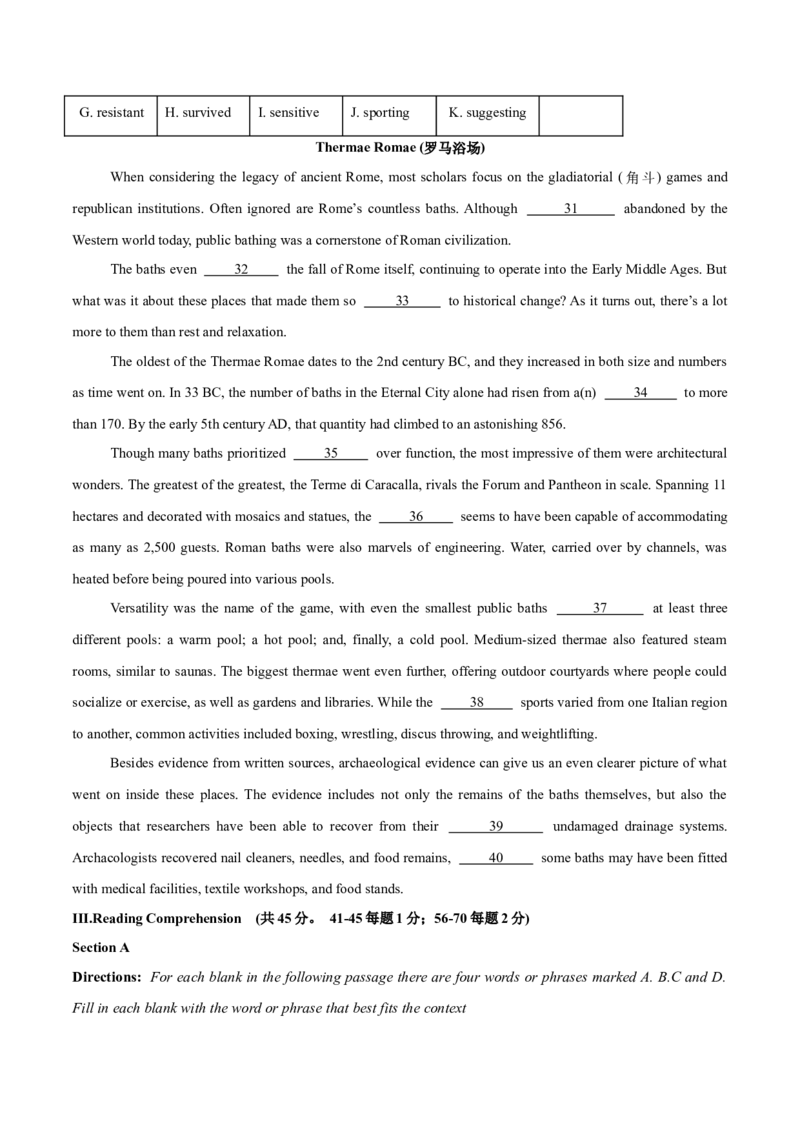
A.complex
B.form
C. handful
D.largely
E. occasionally
F. preferred
 G. resistant
H. survived
I. sensitive
J. sporting
K. suggesting
Thermae Romae (罗马浴场)
When considering the legacy of ancient Rome, most scholars focus on the gladiatorial ( 角斗) games and
republican institutions. Often ignored are Rome’s countless baths. Although     31     abandoned by the
Western world today, public bathing was a cornerstone of Roman civilization.
The baths even     32     the fall of Rome itself, continuing to operate into the Early Middle Ages. But
what was it about these places that made them so     33     to historical change? As it turns out, there’s a lot
more to them than rest and relaxation.
The oldest of the Thermae Romae dates to the 2nd century BC, and they increased in both size and numbers
as time went on. In 33 BC, the number of baths in the Eternal City alone had risen from a(n)     34     to more
than 170. By the early 5th century AD, that quantity had climbed to an astonishing 856.
Though many baths prioritized     35     over function, the most impressive of them were architectural
wonders. The greatest of the greatest, the Terme di Caracalla, rivals the Forum and Pantheon in scale. Spanning 11
hectares and decorated with mosaics and statues, the     36     seems to have been capable of accommodating
as many as 2,500 guests. Roman baths were also marvels of engineering. Water, carried over by channels, was
heated before being poured into various pools.
Versatility was the name of the game, with even the smallest public baths     37     at least three
different pools: a warm pool; a hot pool; and, finally, a cold pool. Medium-sized thermae also featured steam
rooms, similar to saunas. The biggest thermae went even further, offering outdoor courtyards where people could
socialize or exercise, as well as gardens and libraries. While the     38     sports varied from one Italian region
to another, common activities included boxing, wrestling, discus throwing, and weightlifting.
Besides evidence from written sources, archaeological evidence can give us an even clearer picture of what
went on inside these places. The evidence includes not only the remains of the baths themselves, but also the
objects that researchers have been able to recover from their     39     undamaged drainage systems.
Archacologists recovered nail cleaners, needles, and food remains,     40     some baths may have been fitted
with medical facilities, textile workshops, and food stands.
III.Reading Comprehension  (共45 分。 41-45 每题1 分;56-70 每题2 分)
Section A
Directions: For each blank in the following passage there are four words or phrases marked A. B.C and D.
Fill in each blank with the word or phrase that best fits the context
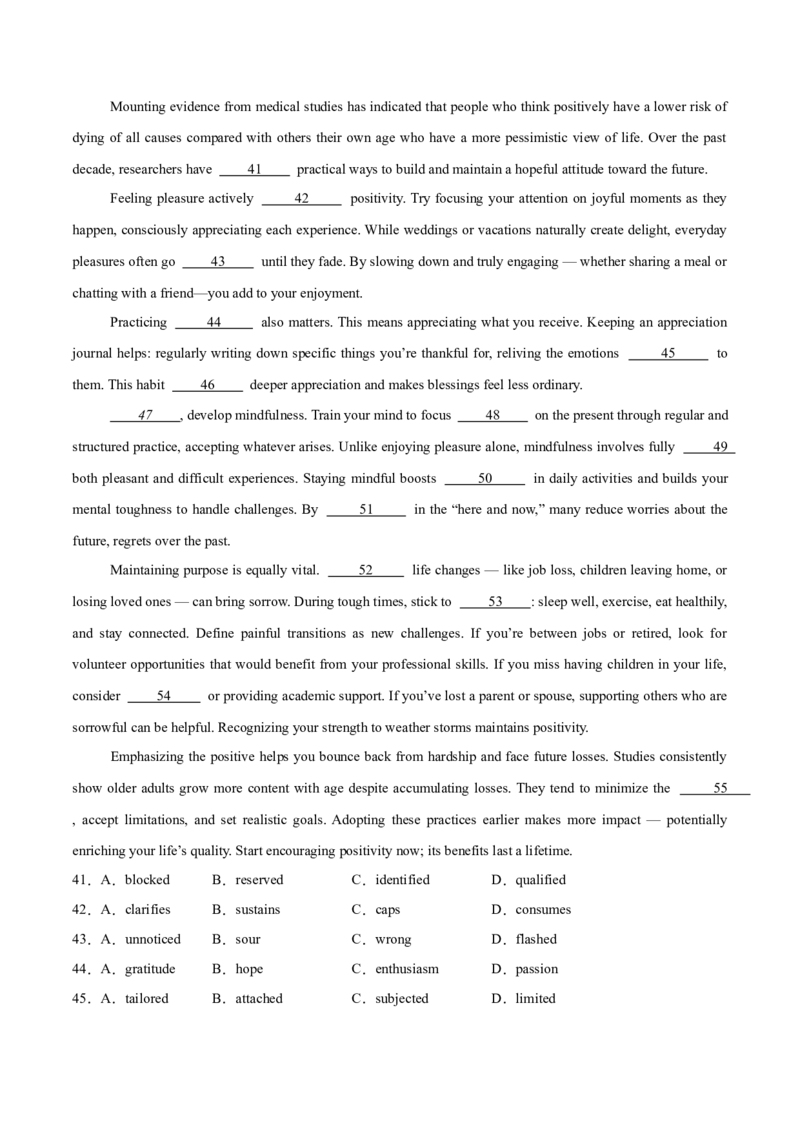
Mounting evidence from medical studies has indicated that people who think positively have a lower risk of
dying of all causes compared with others their own age who have a more pessimistic view of life. Over the past
decade, researchers have     41     practical ways to build and maintain a hopeful attitude toward the future.
Feeling pleasure actively     42     positivity. Try focusing your attention on joyful moments as they
happen, consciously appreciating each experience. While weddings or vacations naturally create delight, everyday
pleasures often go     43     until they fade. By slowing down and truly engaging — whether sharing a meal or
chatting with a friend—you add to your enjoyment.
Practicing     44     also matters. This means appreciating what you receive. Keeping an appreciation
journal helps: regularly writing down specific things you’re thankful for, reliving the emotions     45     to
them. This habit      46     deeper appreciation and makes blessings feel less ordinary.
    47    , develop mindfulness. Train your mind to focus     48     on the present through regular and
structured practice, accepting whatever arises. Unlike enjoying pleasure alone, mindfulness involves fully     49
both pleasant and difficult experiences. Staying mindful boosts     50     in daily activities and builds your
mental toughness to handle challenges. By     51     in the “here and now,” many reduce worries about the
future, regrets over the past.
Maintaining purpose is equally vital.     52     life changes — like job loss, children leaving home, or
losing loved ones — can bring sorrow. During tough times, stick to     53    : sleep well, exercise, eat healthily,
and stay connected. Define painful transitions as new challenges. If you’re between jobs or retired, look for
volunteer opportunities that would benefit from your professional skills. If you miss having children in your life,
consider     54     or providing academic support. If you’ve lost a parent or spouse, supporting others who are
sorrowful can be helpful. Recognizing your strength to weather storms maintains positivity.
Emphasizing the positive helps you bounce back from hardship and face future losses. Studies consistently
show older adults grow more content with age despite accumulating losses. They tend to minimize the     55

, accept limitations, and set realistic goals. Adopting these practices earlier makes more impact — potentially
enriching your life’s quality. Start encouraging positivity now; its benefits last a lifetime.
41.A.blocked
B.reserved
C.identified
D.qualified
42.A.clarifies
B.sustains
C.caps
D.consumes
43.A.unnoticed
B.sour
C.wrong
D.flashed
44.A.gratitude
B.hope
C.enthusiasm
D.passion
45.A.tailored
B.attached
C.subjected
D.limited
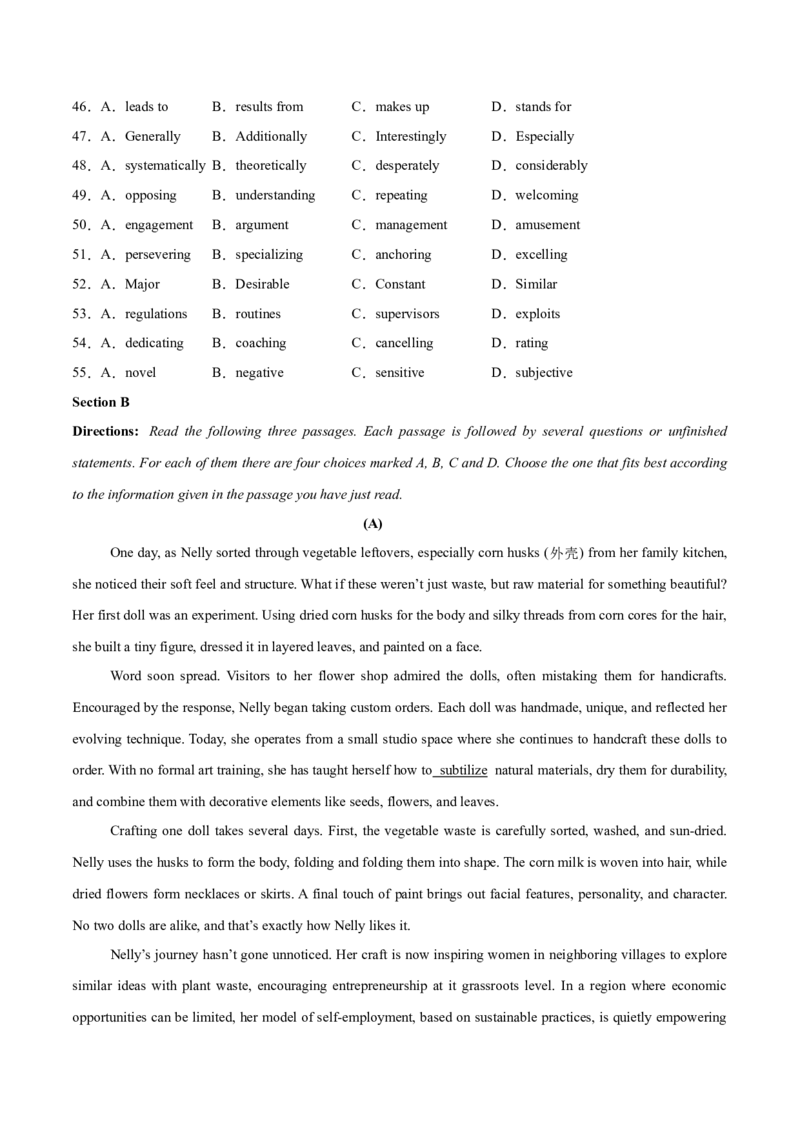
46.A.leads to
B.results from
C.makes up
D.stands for
47.A.Generally
B.Additionally
C.Interestingly
D.Especially
48.A.systematically B.theoretically
C.desperately
D.considerably
49.A.opposing
B.understanding
C.repeating
D.welcoming
50.A.engagement
B.argument
C.management
D.amusement
51.A.persevering
B.specializing
C.anchoring
D.excelling
52.A.Major
B.Desirable
C.Constant
D.Similar
53.A.regulations
B.routines
C.supervisors
D.exploits
54.A.dedicating
B.coaching
C.cancelling
D.rating
55.A.novel
B.negative
C.sensitive
D.subjective
Section B
Directions: Read the following three passages. Each passage is followed by several questions or unfinished
statements. For each of them there are four choices marked A, B, C and D. Choose the one that fits best according
to the information given in the passage you have just read.
(A)
One day, as Nelly sorted through vegetable leftovers, especially corn husks (外壳) from her family kitchen,
she noticed their soft feel and structure. What if these weren’t just waste, but raw material for something beautiful?
Her first doll was an experiment. Using dried corn husks for the body and silky threads from corn cores for the hair,
she built a tiny figure, dressed it in layered leaves, and painted on a face.
Word soon spread. Visitors to her flower shop admired the dolls, often mistaking them for handicrafts.
Encouraged by the response, Nelly began taking custom orders. Each doll was handmade, unique, and reflected her
evolving technique. Today, she operates from a small studio space where she continues to handcraft these dolls to
order. With no formal art training, she has taught herself how to subtilize natural materials, dry them for durability,
and combine them with decorative elements like seeds, flowers, and leaves.
Crafting one doll takes several days. First, the vegetable waste is carefully sorted, washed, and sun-dried.
Nelly uses the husks to form the body, folding and folding them into shape. The corn milk is woven into hair, while
dried flowers form necklaces or skirts. A final touch of paint brings out facial features, personality, and character.
No two dolls are alike, and that’s exactly how Nelly likes it.
Nelly’s journey hasn’t gone unnoticed. Her craft is now inspiring women in neighboring villages to explore
similar ideas with plant waste, encouraging entrepreneurship at it grassroots level. In a region where economic
opportunities can be limited, her model of self-employment, based on sustainable practices, is quietly empowering
women to earn from their own homes, using nothing but kitchen scraps and creative instinct.
56.Which word can best describe Nelly’s doll-making craft?
A.Sustainable.
B.Conventional.
C.Portable.
D.Luxurious.
57.What does the underlined word “subtilize” in paragraph 2 mean?
A.Handle.
B.Protect.
C.Analyze.
D.Supply.
58.Why does Nelly want no two dolls to be alike?
A.To follow market trends.
B.To reduce production costs.
C.To meet customers’ demands.
D.To maintain artistic individuality.
59.How does Nelly’s model benefit women in her region?
A.By providing factory jobs.
B.By offering government allowances.
C.By enabling home-based income.
D.By helping them establish brand awareness.
(B)
By 1865 MEMBERSHIP OFFICE
Langham’s legend dates back to 1865, when The Langham, London opened as Europe’s first
“Grand Hotel”. For over 140 years, this flagship hotel has been at the forefront of charming.
Today, all Langham properties worldwide show the same philosophy, reflecting elegance in
design, innovation in hospitality, genuine service and fascination of the senses.
ABOUT 1865
1865 is our way of saying thank-you for your support to our collection of hotels. Bringing
you exclusive benefits and recognition, we ensure your stay with us is especially
comfortable and uniquely memorable.
EXPLORER
Guests who are just beginning to get to know us by staying once in our properties will be
invited to become Explorer members.
GATEWAY
Stay 3 times at any of our properties within a 12-month period and you will be entitled to
Gateway membership.
VOYAGER
To enrol as Voyager member, simply gather a total of 5 stays within 12 months.
DESTINY
This membership rank is reserved for the top 1% of Voyager members who show the highest
level of commitment by staying in our superior-category rooms and suites(套房). Exclusive
to a chosen few, Destiny membership is offered by invitation only.
1865 MEMBERSHIP
BENEFITS AT-A-GLANCE
EXPLORER
GATEWAY
VOYAGER
DESTINY
In-room broadband Internet
access
*
*
*
*
Late check-out¹ -
*(4pm)
* (6pm)
* (8pm)
Personalized room preferences
*
*
*
Personalized welcome services
-
* (one)
* (two)
Upgrade to next room
category²
*
*
One-way coach service³
*
Exclusive gift
*
Notes:
1. Depending on room availability
2. After becoming a Voyager member, when staying 5 or more times within a 12-month
period
3. Between the city airport and the property, and valid with confirmed coach booking only
4. All benefits are restricted to the registered 1865 member.
Remarks: Some of the above benefits do not apply to Eaton Smart, New Delhi Airport
Transit Hotel. To explore the benefits of this hotel, please visit 1865.langhamhotels.com.
60.To have 1865 membership, guests need to ________.
A.register at 1865.langhamhotel.com.
B.visit Langham three times in a year.
C.have five stays in Langham yearly.
D.stay in Langham properties once.
61.Which of the following statements is TRUE according to the given information?
A.Gateway members have 4pm late check-out priority any time they want.
B.Members can get the benefits listed in the table at all Langham’s properties.
C.The very first hotel of Langham collection was built in 1865 in Britain.
D.Top 1% Voyagers with super residence record can apply for Destiny membership.
62.Tony, on their honeymoon trip, wants to surprise his wife with a bunch of roses on arriving at the hotel. Tony
at least needs to have the membership of________.
A.EXPLORER
B.GATEWAY
C.VOYAGER
D.DESTINY
(C)
The Octopus Organization, inspired by the remarkably adaptive, curious, and intelligent sea dweller. That
animal, whose arms can think and act independently yet work in perfect concert, offers a model for building
companies that can thrive in complexity and embrace continuous change. Octopus Orgs tap the intelligence of their
people, integrating a range of efforts naturally and gracefully. They sense subtle signals, learning and shifting
course at speed to navigate uncertainty.
A complex world is like the ocean, the home of the octopus — where a small shift in the current can create
unpredictable effects miles away. The shifts and unpredictability make it difficult to navigate; you can only sense,
respond, and learn from the flow. This is the world the Octopus Org is designed for, an environment where success
comes not from rigid control but from distributed intelligence, continuous learning, and adaptation.
To get a sense of what this looks like in a business setting, think of how most companies structure strategy
meetings. The very design of the typical meeting room — dominated by a large screen for presentations, often with
no whiteboard in sight — signals that it is a space for the consumption of information, not the creation of ideas.
Speakers adhere to a set agenda, deliver carefully prepared slides, and stick to their assigned time. Questions are
reserved for the end and are often perfunctory (草率的, 敷衍的) or performative. The information flow is tightly
controlled and consistently structured.
In the Octopus Org, by comparison, meetings have clearly defined outcomes but not always a fixed agenda.
Leaders encourage people to surface ideas rapidly and ask provocative questions. You’ll often find a diverse group
from across the company — frontline workers and executives, new and old voices — gathered around a whiteboard
contributors build on and challenge one another’s arguments. Conversation flows, tangents are explored, and
unexpected connections emerge.
And look at how Tin Man Orgs, where a company’s strategy can be optimized through analysis,
specialization, and control, with no inherent uncertainty, treat innovation as a department, creating innovation labs
that are physically and culturally isolated. Teams develop ideas in isolation and then hand them off to “the
business” for implementation. Octopus Orgs, in contrast, understand that innovation is a distributed capability, the
daily, obsessive work of meeting customer needs in ever better ways. They create mechanisms for invention
everywhere, entrusting small, decentralized teams with end-to-end ownership of customer problems. This ensures
the people closest to the customer are the ones who experiment, learn, and build what’s coming next.
Ultimately, all of these Octopus Org behaviors orbit around a single, nonnegotiable question: “Does this
create more value for our customers?” The obsessive focus drives employee engagement, which in turn fuels the
innovation and resilience needed to thrive. The rewards are cultural, profound, and measurable.
63.The description of the octopus’s arms serves to illustrate ________.
A.the distributed yet unified intelligence
B.sensing subtle signals amid uncertainty
C.the evolution in complex, unpredictable settings
D.continuous learning and adaptation to change
64.A retail company wants to become more “Octopus-like”. Which of these changes would be most in line with
that goal?
A.Stick to clearly defined goal and set time.
B.Focus on slides and controlled flow.
C.Create a specialized lab for innovation. D.Use whiteboards for diverse collaboration.
65.How does Octopus Orgs differ from Tin Man Orgs in innovation?
A.By relying on analysis and control.
B.By treating innovation as a department.
C.By seeing innovation as everyone’s job. D.By focusing on customer value first.
66.What’s the main idea of the passage?
A.Why traditional meeting structures prevent innovation.
B.How to succeed in unpredictable business conditions.
C.A model for building companies in a complex world.
D.A focus on building distributed innovation capabilities
Section C
Directions: Complete the following passage by using the sentences in the box Each sentence can only be used
once. Note that there are two sentences more than you need.
Pedestrian: a word fitted to the most dull, tedious and monotonous moments of life. We don’t want to live
pedestrian lives. Yet maybe we should. Many of history’s great thinkers have been pedestrians. Henry David
Thoreau and William Wordsworth, Samuel Taylor Coleridge and Walt Whitman, Friedrich Nietzsche and Virginia
Woolf — all were writers who tied the working of their minds to the steady movement of their feet.     67
How many of us today are able to free ourselves from the page and head out the door when we rise from our
desks? Even observing the dictates of nature, breathing deeply out in the open air as we set our legs into motion, it’s
likely we need to accomplish the undertaking as quickly and efficiently as possible. But in so doing, perhaps we
still miss the essence of the activity itself. We abandon the art of walking.
‘Walking with a purpose’ is usually regarded as a positive thing, taken as a sign that people are focused, with
eyes on an end-goal or prize. But the art of walking is not about purpose or aim.     68     The art of walking is
all about this purposeless purpose.
These days, it’s difficult to understand the point of doing something, or doing anything, without an
underlying aim. The desperate attempt to get somewhere, and to be on time about it, amounts to a Sisyphean
struggle against the clock: when we reach a destination, we must immediately set off again, intent on the next
stopping place. The point of the journey is no more than to ‘get there’.
And walking is increasingly shaped by technological gadgets worn on wrists or gripped in hands.     69
To live with eyes on the screen is to be attached, stuck in the frame, taking in what is presented to us and re-
presented to us again. But representation is not experience. To live life through representations is to live passively,
to receive rather than to experience. It is also, we fear, to live the life of a follower. Instead of asking What do I see?
How might I tell you? we are told instead how to see, and often what to feel — much of that is determined by
algorithm.
The art of walking is contrary to ‘screening’ the world we live in, and there is no pre-programmed set of
rules or calculations involved.     70     We don’t need to visit a museum in order to be absorbed in artful
perception and contemplation. We can just step out the front door, pay attention, and perceive and feel for
ourselves.
A.This, according to Kant, is the freedom of any form of art.
B.Walking with disinterest requires a little effort in the beginning, and it comes with practice.
C.In doing so, they were in step with the opposing forces of motion and rest, a force written into the laws of
nature.
D.As Immanuel Kant maintained, the creation and comprehension of beauty is embodied in ‘a purposiveness
without a definite purpose’.
E.They walk for a variety of purposes, from practical ones like commuting or walking the dog, to symbolic acts
like joining a protest march.
F.We spend an increasing amount of time ‘screening’ the world — taking in most of life through a contracted
frame that captures objects of immediate interest.
IV.Summary Writing   (共10 分)
Directions: Read the following passage. Summarize the main idea and the main point( s)of the passage in no more
than 60 words. Use your own words as far as possible.
Kids Losing Fine Motor Skills?
Amy Hornbeck can tell something is off the moment her students step into the classroom. Once, kids arrived
with pockets full of rocks and items collected during outdoor adventures. Now, they come with their eyes glued to a
screen. And it shows: they can’t zip their coats, turn the pages of a book, or even hold a spoon properly. Today’s
children are losing critical fine motor skills—the small, precise movements required to tie a shoelace, write with a
pen, or build a tower. Here’s what parents need to know.
Time spent on screens—whether phones, tablets, eBooks, or TV—all adds up to time kids aren’t crafting,
drawing, and building. While learning math or creating digital art can be educational, it doesn’t develop the fine
motor control that comes from writing, cutting, or coloring.
Hornbeck adds that kids’ decreasing ability to focus on a task, especially one requiring effort, is a key
contributor to declining fine motor skills. Take puzzles, for example. Completing one involves strategy, flipping
pieces, and trial and error. But Hornbeck says, “A lot of kids simply say, ‘Nope.’ They’re used to playing on a
computer, which spins the piece for you.” She adds, “Tablets provide a lot more immediate support than is available
in real life.”
Convenience in parenting has also impacted skill development, says Hornbeck. Elastic pants without zippers
or buttons save time on busy mornings, and pre-packaged snacks eliminate mess — but these shortcuts deprive kids
of opportunities to practice zipping, buttoning, or using tools.
Hornbeck suggests parents get children off their screens. Also, parents should look for opportunities to
challenge their children and insert fine motor activities into daily tasks, such as cutting coupons or cooking
together, looking for stones on the way to school, pouring cups, and squeezing sponges in the bath, etc.
____________________________________________________________________________________________
____________________________________________________________________________________________
____________________________________________________________________________________________
____________________________________________________________________________________________
____________________________________________________________________________________________
____________________________________________________________________________________________
V.Translation (共15 分。第1 小题和第2 小题,每题3 分;第3 题4 分;第4 题5 分。)
Directions:Translate the following sentences into English, using the words given in the brackets
72.校门口,妈妈往她包里塞了一副手套和一条羊毛围巾。(pack) (汉译英)

73.这位工程师将心血倾注于芯片研发,不断攻坚克难,赢得了“时代楷模”的美名。(invest) (汉译
英)

74.这款基于中国古典小说的游戏让许多外国玩家感受到了东方魅力。(expose)(汉译英)

75.在失重的环境中,吃饭喝水皆非易事,但中国人对吃的挚爱让我们的宇航员在空间站里成功吃上了烧
烤盛宴。(so...that...) (汉译英)

VI.Guided Writing  (共25 分)
76.Directions: Write an English composition in 120-150 words according to the instructions given below in
Chinese.
假如你是浦汇中学的学生会主席李华。下周德国Bayern 中学的师生将在来沪访问的期间,造访学校半天。
学校打算安排一次文化交流活动。现在拟从三个备选方案中选一个:
(1)剪纸教学;(2)舞龙(Dragon Dance)表演;(3)足球友谊赛。
请写一封信给校长,信的内容包括:①你推荐的方案;②你推荐的理由。
____________________________________________________________________________________________
____________________________________________________________________________________________
____________________________________________________________________________________________
____________________________________________________________________________________________