2026 年高考英语模拟风向卷01(广东专用)(考试版)
满分120 分,考试时间120 分钟。
注意事项:
1.答卷时,考生应清晰识字过的词汇或者书写自己的学校、班级、姓名座位号和考号填写在答题卡相应的
位置上,再用2B 铅笔把号码对应填涂黑。
2.选择题每小题选出答案区后,用2B 铅笔把答案卡上对应题目的答案标号涂黑;如需改动,用橡皮擦干净
后,再选涂其他答案;不能答在试卷上。
3.非选择题必须用黑色字迹的钢笔或签字笔作答,答案必须写在答题卡各题目指定区域内的相应位置上;
如需改动,先划掉原来的答案,然后再写上新的答案;不准使用铅笔或涂改液。不按以上要求作答的答案
无效。
4.考生必须保证答题卡的整洁,考试结束后,将试卷和答题卡一并交回。
第二部分 阅读(共两节,满分50 分)
第一节(共15 小题;每小题2.5 分,满分37.5 分)
阅读下列短文,从每题所给的A、B、C、D 四个选项中选出最佳选项。
A
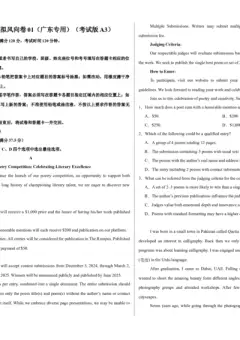
The Rumpus Poetry Competition: Celebrating Literary Excellence
The Rumpus is excited to announce the launch of our poetry competition, an opportunity to support both
emerging and established poets. With a long history of championing literary talent, we are eager to discover new
voices and share them with our readers.
Prizes and Recognition:
First-Place Winner: The top poet will receive a $1,000 prize and the honor of having his/her work published
on therumpus.net.
Honorable Mentions: Up to five honorable mentions will each receive $200 and publication on our platform.
Additional Publication Opportunities: All entries will be considered for publication in The Rumpus.
Published poets will receive a standard contributor payment of $50.
Submission Guidelines:
Submission Period: The Rumpus will accept contest submissions from December 5, 2024, through March 2,
2025. Finalists will be contacted in May 2025. Winners will be announced publicly and published by June 2025.
Requirements: Submit 2–4 poems per entry, combined into a single document. The entire submission should
not exceed 10 pages. Poems must contain only the poem title(s) and poem(s) without the author’s name or contact
information anywhere on the submission itself. While we embrace diverse page presentations, we may be unable to
publish poems with special formatting.
Multiple Submissions: Writers may submit multiple groups of poems, but each entry requires a $20
submission fee.
Judging Criteria:
Our respectable judges will evaluate submissions based on creativity, originality, and the emotional impact of
the work. We seek to publish the single best poem or set of 2–3 poems that resonate (回响) deeply with readers.
How to Enter:
To participate, visit our website to submit your best poems. Ensure your submission suitable for the
guidelines. We look forward to reading your work and celebrating the beauty of poetry together.
Join us in this celebration of poetry and creativity. Submit your poems and be part of The Rumpus
community.
1.How much does a poet earn with a honorable mention and a published poem?
A.$50.
B.$200.
C.$250.
D.$1,000.
2.Which of the following could be a qualified entry?
A.A group of 4 poems totaling 12 pages.
B.The submission containing 3 poems with usual text formatting.
C.The poems with the author’s real name and address in the document.
D.The entry including 2 poems with contact information submitted on schedule.
3.What can be inferred from the judging criteria for the competition?
A.A set of 2–3 poems is more likely to win than a single poem.
B.The author’s previous publications influence the judges’ decisions.
C.Judges value both emotional depth and innovative ideas in the poems.
D.Poems with standard formatting may have a higher chance of being recognized.
B
I was born in a small town in Pakistan called Quetta in 1980. When I was a little boy of about ten years old. I
developed an interest in calligraphy. Back then we only had a TV channel with limited programs, One of the
programs was about learning calligraphy. I was engaged and spent several years learning different calligraphy
scripts (笔迹) in the Urdu language.
After graduation, I came to Dubai, UAE. Falling in love with the architecture and high-rise buildings, I
wanted to shoot the amazing beauty form different angles. So I bought a camera and learned photography, joined
photography groups and attended workshops. After few years, I got bored of photographing landscapes and
cityscapes.
Seven years ago, while going through the photography blogs and looking through others’ works. I read the
term called “light painting”. a photography technique that allows you to draw in space. I started experimenting with
that and soon it hit me: why not bring back my passion for calligraphy using light painting technique? Since that
day. I’ve been drawing light calligraphy. To achieve the best results. I decided to build the lights myself. The best
part about my work is that they are not photoshopped. I prefer to get the results straight out of the camera. I don’t
even turn over the images. To achieve that, I have to write in reverse (倒置) and that took a lot of practice to get it
right.
Currently, I’m working on the idea of bringing abandoned places back to life, including buildings which
have lost their charm and are hidden in darkness. Through my photography, I try to employ light calligraphy by
writing a word that attaches a deep meaning to those places and telling stories behind them. In this way, I hope
people will revisit these places and appreciate the real reason for their construction.
4.What can be implied from the author’s experience in Quetta?
A.He had access to plenty art resources.
B.He was fond of calligraphy channels.
C.He grasped scripts of many languages.
D.He was willing to dig into calligraphy.
5.What made the author interested in taking pictures in Dubai?
A.Visual impacts of structures.
B.Remarkable urban planning.
C.Mysterious building stories.
D.Odd angles of architecture.
6.How did the author enhance the effects of light calligraphy?
A.By learning from others.
B.By sticking to originality.
C.By beautifying his photos.
D.By drawing in open space.
7.What is the author’s role in practising his current idea?
A.A writer putting down real thoughts.
B.An educator spreading sound values.
C.An artist regenerating forgotten sites.
D.A historian looking for ignored areas.
C
When Martin Roth started as a forest ranger in the 1980s, his job was to care for the forest to ensure
continuity for decades, even centuries. Now, with climate change, it’s more about planning for an uncertain future.
“It’s disaster management,” says Roth, for whom the 3,000 acres of forest serve as testing ground for high-tech
solutions, earning him the nickname “digital forest ranger.”
After a severe storm, the clock starts ticking: Damaged trees should be removed before the arrival of bark
beetles, which grow in dead trees and can destroy entire forests. While it once took Roth about 2.5 hours to cover
an acre on foot, drones (无人机) now let him survey the entire 3,000 acres in several days, so he can quickly locate
damaged trees, inform owners of affected plots, and send updates to workers.
Roth’s exploration goes beyond drones. His recent project is combining body camera with AI. “Usually you
mark the trees, they’re cut down, and you have no idea how much wood you’ll get, what quality, and which
species,” he explains. AI now “sees” through his body cam, recognizes tree species, estimates wood production,
and sends real-time information to his phone.
Since up to half of European tree species are unsuited to rising temperatures and extended dry periods, Roth
has also begun experimenting with new species, planting them in small groups and keeping track of them in his
system. As forest areas expand, interventions are needed, but there aren’t enough employees to keep it all straight.
“Either I know it, or the computer knows it, or no one knows it and it’s lost,” he says.
Roth’s expertise in tackling the challenges of modern forestry with technology is increasingly sought after—
colleagues reach out for advice, and he lectures on the topic at universities. But he warns that technology can never
replace a wander through the forest: “I should never believe that the digital twin is reality. I always have to do a
reality check.”
8.What was Roth’s job when he started his career?
A.Sustaining forest health.
B.Predicting the forest’s future.
C.Managing disasters.
D.Seeking high-tech solutions.
9.What does Roth use drones to do?
A.Identify dead tree species.
B.Remove harmful insects.
C.Collect data of forest damage.
D.Inform owners of their loss.
10.What point is Roth trying to make with his words in paragraph 4?
A.Forests are a cure for climate change.
B.Experienced workers are in great need.
C.Forest expansion is successfully controlled.
D.Technology is key to tracking forest information.
11.Why does Roth warn about the use of technology in forestry?
A.It may replace human workers.
B.It may need too much checking.
C.It may provide false information.
D.It may deny chances of forest walks.
D
Staring at the bookcases in my study, packed with so many great books that had remained unread, I heard a
loud voice in my head — “Shame on you! How can you leave these masterpieces unread?”
The first book I picked up was Montaigne’s Essays. To my surprise I discovered in the margins (页边空白)
what clearly was my own faded hand-writing. So I was actually reading it again, but what I was rereading seemed
entirely new. I also found sentences underlined. Only this time I wondered: Why did I underline this sentence? It’s
the next one that is important!
Clearly, my way of reading the text had shifted, and I myself had changed over the years. This raised the
larger question of rereading. It comes in many forms. There’s voluntary rereading, the result of a willful decision to
revisit a book one has admired, or a book that has left one with some unanswered questions. This kind of planned
revisit could also be for confirming certain details in the text, or for checking on the moves of a given character. A
devoted teacher might also wish to refresh his closeness to a work, and thus avoid teaching through the same old
written notes with soporific (让人瞌睡的) effects.
Contrarily, there’s involuntary rereading. The original reading was either forgotten or so totally absorbed that
the new chance encounter with the text produced surprise and astonishment. My reaction to the renewed reading no
longer corresponded to the original experience, and I was no longer sure that I recognized myself as the same
reader.
Then there are what one might call subconscious ( 潜意识的) rereadings, those that occur without the
specific act of reading, much as the memory of a tune can keep coming back to the mind without its actually being
heard again. This form of remembered contact with a book can accompany us during a lifetime and continue to
strengthen and shape us. Much in the same manner, we may over the years recite to ourselves poems learnt by heart
long ago, which have become part of our self-recognition.
All of these ways of reading are valuable. Renewed contact with a novel or a poem can activate the search
for a better knowledge of the self. The new reading a form of revision, uncovers the change in us. The newness is
not in the text. It is we who have evolved. In the process of rereading, our outlook has also been significantly
changed. Rereading makes it possible for us to see the world around us, ourselves included, in a new light.
12.According to the author, what could be a purpose of voluntary rereading?
A.To improve the quality of teaching.
B.To learn from admirable characters.
C.To collect details for writing novels.
D.To help making important decisions.
13.According to Paragraph 4, what can involuntary rereading bring about?
A.Unexpected reading experience.
B.Total concentration on new books.
C.Changed preferences for books.
D.Enhanced reading skills.
14.What can be learnt about subconscious rereading?
A.It prevents memory from fading.
B.It helps make who we are.
C.It involves actual reading.
D.It works best with poetry and music.
15.What could be the best title for the passage?
A.Accessing Masterpieces through Rereading.
B.Rereading: Voluntary or Involuntary?
C.Rereading: Pursuit of Truth.
D.Transformative Power of Rereading.
第二节(共5 小题, 每小题2. 5 分, 共12. 5 分)
阅读下面短文, 从短文后的选项中选出可以填入空白处的最佳选项。选项中有两项为多余选项。
We’ve all been there—you’ve sent a message and it’s marked “read”, but you haven’t heard anything back.
What’s the deal? While being left on read (已读不回) can be confusing, it’s also pretty common.     16     Here
are a few tips.
Expect the best. Remind yourself that the person is probably just busy. Ask yourself if you actually know
their schedule. There could be some time commitments you aren’t aware of. Here are a few other reasons for a
delayed response.     17     They put their phone away to focus on work or school. They accidentally forgot to
reply. Maybe they thought about what they wanted to say but didn’t actually text it.
Resist the temptation (诱惑) to double-text.     18     If you send a lot of follow-up texts, it’ll be hard
for them to keep up and they might get stressed. Leave them with just one text to catch up on—the other person
will probably appreciate your patience.
Read over your previous messages. See if there are any confusing texts that you need to clarify. It’s okay if
you review your message again and notice that it might have been a little unclear—it happens!    19
    20     Keep it out of sight and get some peace of mind. Don’t let it upset or confuse you. If you get
your mind off any notifications, you’ll be able to brainstorm new ways to spend your time.
A.Put your phone away.
B.Fix your attention closely on text responses.
C.Give them a little space so they have a chance to reply.
D.They want to give you a longer response but can’t right now.
E.Ask yourself why being left on “read” frustrates or confuses you.
F.You can keep the situation from bothering you until you hear back.
G.You might feel relieved when you find something that is easy to misread.
第三部分 语言运用(共两节, 满分30 分)
第一节(共15 小题;每小题1 分, 共15 分)
阅读下面短文,从每题所给的A、B、C、D 四个选项中选出可以填入空白处的最佳选项。
Maya’s biggest dream was to open a community center where children and adults alike could learn and grow.
She pictured a place where everyone could    21    education, arts, and sports, regardless of their backgrounds
or financial situations. However, turning this dream into reality was no easy job.
Maya worked    22    to raise funds for the community center. She organized various events to gather
support.    23    her continuous efforts, the funds were never enough. She faced numerous    24    from
potential donors and encountered many difficulties. One night, a terrible storm    25    over the village, causing
great damage. People thought Maya would abandon her dream. However, she maintained her unbroken spirit. Maya
26    the local government for support. She    27    her vision with passion and persuasion, highlighting the
community center’s benefits to the village. Her efforts    28   : the local authorities were moved by her    29
and agreed to help fund the project. With renewed hope and the village’s support, construction of the community
center began. Maya worked alongside the builders,    30    her heart into every brick and beam (横梁). The
center symbolized hope and the power of a    31    community.
Years later, the community center stood proudly in the heart of the village, alive with    32   . Children
laughed as they played sports, adults attended    33    to learn new skills, and artists found a place to create and
inspire. Mays’s dream had become a reality, all thanks to her    34    spirit and efforts. Reflecting on her
journey, Maya realized that every challenge she had faced strengthened her    35    and brought her closer to her
dream.
21.A.promote
B.master
C.access
D.evaluate
22.A.carelessly
B.effortlessly
C.aimlessly
D.tirelessly
23.A.Despite
B.With
C.Besides
D.Like
24.A.Encouragements B.rejections (拒绝) C.criticisms
D.surprises
25.A.hung
B.skipped
C.swept
D.climbed
26.A.approached
B.admired
C.praised
D.searched
27.A.presented
B.pursued
C.postponed
D.possessed
28.A.set off
B.paid off
C.kicked off
D.took off
29.A.promise
B.imagination
C.commitment
D.situation
30.A.breaking
B.pouring
C.tricking
D.hiding
31.A.buy
B.diverse
C.competitive
D.united
32.A.independence B.confidence
C.inspiration
D.activity
33.A.ceremonies
B.workshops
C.parties
D.universities
34.A.unbreakable
B.unforgettable
C.unpredictable
D.unbearable
35.A.cooperation
B.bond
C.resolve
D.position
第二节(共10 小题;每小题1. 5 分, 满分15 分)
阅读下面短文,在空白处填入1 个适当的单词或括号内单词的正确形式。
Yangko, a rural Chinese folk dance with a history    36    (date) back thousands of years, originates from
farming life in ancient times. The dance relates to sacrifices to the farmland god when people prayed for a good
harvest. As time passed, the    37    (origin) dance developed, taking in various artistic forms and skills,
including opera, acrobatics and martial arts, and eventually turned into the type of Yangko    38    is seen today.
   39    (preserve) this Chinese folk culture, it was included in the inaugural(首批的)items of national
intangible cultural heritage in 2006. It is    40    (common) performed in northern China during festivals,
especially for Chinese New Year and the Lantern Festival. Performances or competitions    41    (organize) in
towns and villages to express people’s joy and their hope for a better life.
Yangko employs drumming, Suona, dancing and singing. Content is based    42    folk stories and
legends. Costumes are richly-colored and opera-styled, enabling    43    (character) to be easily identified.
During a performance, the actors will dance and sing, following lively rhythms. Highly skilled and interesting acts
such as stilt( 高跷)walking    44    carrying a wedding sedan chair( 花轿)are also included. As a part of
traditional Chinese culture, Yangko     45     (concentrate) the group consciousness of the Chinese people, and
has outstanding historical and cultural value.
第四部分 写作(共两节,满分40 分)
第一节(满分15 分)
46.为激励学生追求梦想、成就自我,你校英文报计划征集相关英文标语 (slogan) 。请你就此写一则征稿
启事,内容包括:
1. 标语要求;
2. 投稿方式及截止日期。
注意:
1. 写作词数应为 80 左右;
2. 可以适当增加细节,以使行文连贯。
Slogans Wanted
____________________________________________________________________________________________
____________________________________________________________________________________________
____________________________________________________________________________________________
____________________________________________________________________________________________
____________________________________________________________________________________________
第二节(满分25 分)
47.阅读下面材料,根据其内容和所给段落开头语续写两段,使之构成一篇完整的短文。
Twelve-year-old Tina often ignored advice from her parents and insisted she was always right. She usually
bossed her brother and sister around and was mean to her friends. As a result, her personality drove them away
because no one could tolerate her behaviour.
Tina’s arrogance ( 傲慢) often landed her in trouble. Whenever her father, an experienced mathematics
teacher, tried to give her some advice, she would roll her eyes and reply only that she did not need his help. Her
father would sigh in resignation. Tina would then stay up late to complete her homework and often overslept the
next morning. Although she usually managed to submit it, she would be punished for reporting late to school. At
times, she would be sent off class.
Tina’s arrogance also annoyed her coach. At a particularly intense training session, her Track and Field coach
offered her guidance, pointing out ways to improve her running technique. Habitually, Tina refused to take his
advice. Not long after, she felt a sharp pain in her knee. “I will prove Coach wrong! I am sure my method is the
right one!” Tina thought to herself. However, as she continued to run, the pain intensified, and soon enough, she
had to drag her feet through every step she took. Even when her teammate Sarah told her not to overdo it, she
brushed her off, saying, “Mind your own business.” At that, the coach shook his head disapprovingly. He could not
understand why Tina insisted on her ways.
Later that night, the pain in the knee kept her awake. As she lay in bed, she found it impossible to find a
comfortable position. It was painful every time she moved. It was then that she realized the consequences of her
opinionatedness. She had never listened to her coach and her teammates. She realized that she had no friends to
seek comfort from. Tina sobbed uncontrollably as this thought raced through her mind. How desperately she needed
someone to talk to!
注意:
(1)续写词数应为150 个左右;
(2)请按如下格式在答题卡的相应位置作答。
At that very moment, Tina’s mother appeared, looking concerned.
____________________________________________________________________________________________
____________________________________________________________________________________________
____________________________________________________________________________________________
____________________________________________________________________________________________
____________________________________________________________________________________________
Recognizing the need to change, Tina decided to do something.
____________________________________________________________________________________________
____________________________________________________________________________________________
____________________________________________________________________________________________
____________________________________________________________________________________________
____________________________________________________________________________________________