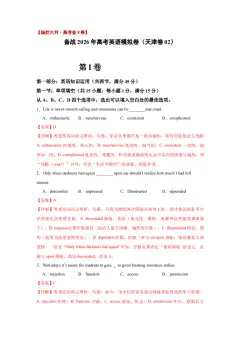
2026 年高考英语模拟风向卷02(天津专用)(考试版)
(考试时间:100 分钟  试卷满分:120 分)
注意事项:
1.本试卷分第Ⅰ卷(选择题)和第Ⅱ卷(非选择题)两部分。答卷前,考生务必将自
己的姓名、准考证号填写在答题卡上。
2.回答第Ⅰ卷时,选出每小题答案后,用2B 铅笔把答题卡上对应题目的答案标号涂
黑。如需改动,用橡皮擦干净后,再选涂其他答案标号。写在本试卷上无效。
3.回答第Ⅱ卷时,将答案写在答题卡上。写在本试卷上无效。
4.考试结束后,将本试卷和答题卡一并交回。
第一部分:英语知识运用(共两节,满分45 分)
第一节:单项填空(共15 小题;每小题1 分,满分15 分)
从A、B、C、D 四个选项中,选出可以填入空白处的最佳选项。
1.With a strong spirit of innovation, Chinese scientists are ________ making breakthroughs in
the development of new technologies.
A.constantly
B.strangely
C.casually
D.relatively
2.At the ongoing international technology conference, many a research team ______ innovative
solutions to global energy challenges.
A.are presenting
B.is presenting
C.was presenting
D.were presenting
3.—I didn’t see her yesterday.
—Of course, you _________ , because she had gone on a trip.
A.couldn’t
B.may not have
C.can’t have
D.mustn’t have
4.The athlete, ________ by the coach repeatedly for his carelessness in training, finally decided
to focus on improving his weak points.
A.having been criticized
B.being criticized
C.criticized
D.to have been criticized
5.______ to make a hasty decision, the committee chose to delay approving the proposal until
further discussion.
A.Wanting not
B.Not wanted
C.Not wanting
D.Having not wanted
6.You can only realize how hard this job is ______ you really experience it.
A.unless
B.until
C.when
D.before
7.So far, about 40 houses have fallen down under the weight of the snow, with 22 people
______.
A.reported injured B.reported injuring
C.reporting injured
D.reporting injuring
8.Regulations often meet resistance in the rigid system, ______ bossy employers may be
challenged by employees.
A.which
B.where
C.whose
D.that
9.A series of experiments ________ in the coming weeks to test the new vaccine's effectiveness.
A.are conducting
B.conducted
C.will be conducted
D.had conducted
10.Some young people in America are expected to leave ______ could be life’s most important
decision — marriage — entirely up to luck.
A.which
B.that
C.what
D.as
11.________ the government increases funding for renewable energy, the carbon emission goals
cannot be achieved.
A.Even if
B.Whereas
C.Now that
D.Unless
12.By the time the rescue team arrived at the earthquake site, over 50 survivors ________ from
the rubble.
A.have been pulled
B.were pulled
C.had been pulled
D.would be pulled
13.— The professor’s lecture on AI ethics was way over my head.
— ________. Maybe we can discuss the slides after class.
A.That’s a relief
B.I’m with you there
C.Don’t push it
D.You’re on the right track
14.What puzzled the archaeologists was ________ the ancient city had been abandoned so
abruptly.
A.where
B.how
C.when
D.why
15.Paper cutting, ________ over centuries in China, is time-honored and has a glorious history.
A.having developed
B.being developed
C.developed D.to
develop
第二节:完形填空(共20 小题;每小题1.5 分,满分30 分)
阅读下面短文,掌握其大意,然后从16-35 各题所给的A、B、C、D 四个选项中,选出最
佳选项。
Last night I was driving from Harrisburg to Lewisburg, a     16     of about eighty
miles. It was late and I was in a hurry. However, if anyone asked me how fast I was     17    ,
I’d say I was not over-speeding. Several times I got    18     behind a slow- moving truck on a
narrow road, and I was holding my fists tightly with    19    .
At one point along an open highway, I    20     crossroads with a traffic light. I was
alone on the road by now, but as I     21     the light, it turned red and I braked to a stop. I
looked left, right and behind me. Nothing. No cars, no suggestion of headlights, but there I sat,
waiting for the light to     22    , the only human being for at least a mile in any    23    .
I started    24     why I refused to run the light. I was not afraid of being    25    ,
because there was obviously no police-man around, and there certainly would have been no    26
in going through it.
Much later that night, after I    27     a group of my friends in Lewisburg and climbed
into bed near midnight, the question of why I’d stopped for that light    28     me. I think I
stopped because it’s part of a contract we all have with each other. It’s not only the    29     but
it’s an arrangement we have, and we trust each other to     30     it: we don’t go through red
lights. Like most of us, I’m more likely to be    31     from doing something bad by the social
convention that    32     it than by any law against it.
It’s amazing that we ever    33     each other to do the right thing, isn’t it? And we do,
too! Trust is our    34     preference.
I was so     35     of myself for stopping for the red light that night.
16.A.flight
B.distance
C.road
D.length
17.A.thinking
B.driving
C.complaining
D.running
18.A.stopped
B.changed
C.stuck
D.lost
19.A.horror
B.strength
C.understanding
D.impatience
20.A.ran off
B.came to
C.passed by
D.left behind
21.A.passed
B.watched
C.approached
D.found
22.A.stop
B.change
C.turn
D.die
23.A.way
B.side
C.city
D.direction
24.A.wondering
B.suspecting
C.struggling
D.regretting
25.A.abused
B.fined
C.injured
D.killed
26.A.danger
B.sign
C.time
D.record
27.A.met with
B.got over
C.got rid of
D.called back
28.A.turned out to
B.came back to
C.referred to
D.occurred to
29.A.virtue
B.suggestion
C.law
D.order
30.A.honor
B.solve
C.break
D.judge
31.A.stopped
B.protected
C.rejected
D.frightened
32.A.speaks of
B.stands by
C.takes in
D.disapproves of
33.A.suspect
B.trust
C.teach
D.care
34.A.only
B.first
C.lucky
D.living
35.A.sorry
B.doubtful
C.sure
D.proud
第二部分:阅读理解(共20 小题;每小题2.5 分,满分50 分)
阅读下列短文,从每题所给的A、B、C、D 四个选项中,选出最佳选项。
A
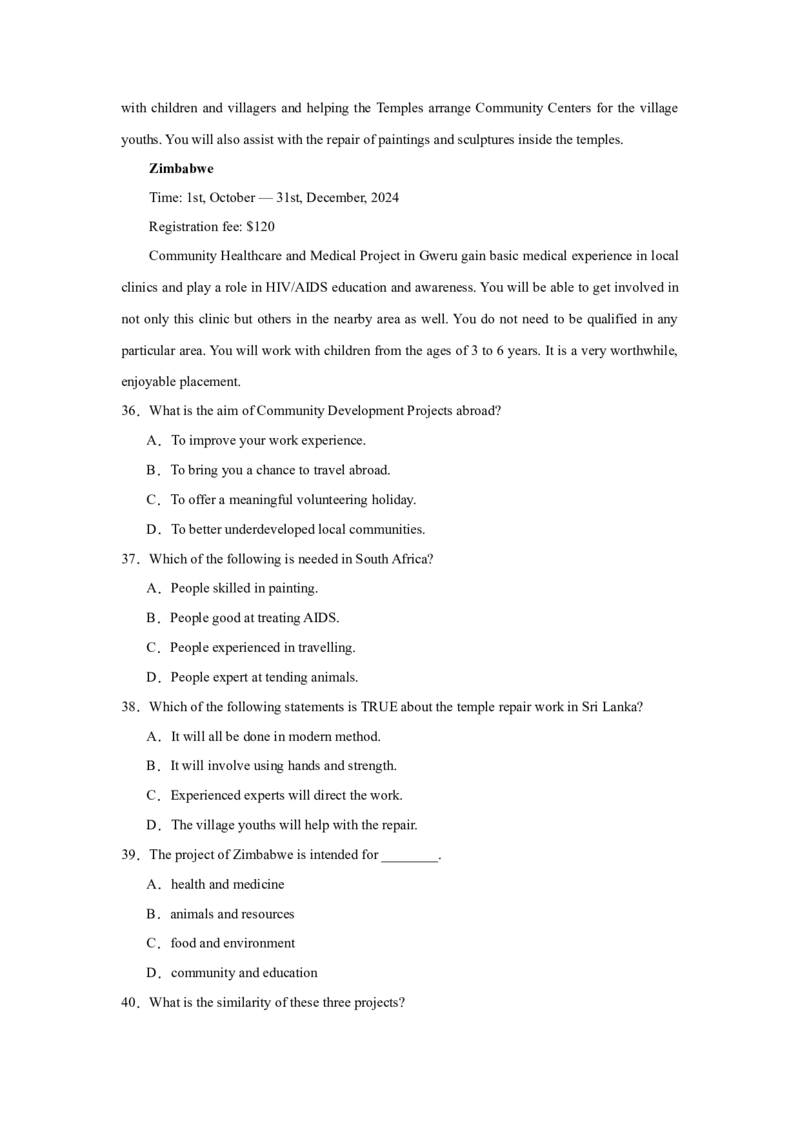
Community Development Projects Overseas
The aim of Community Development Projects abroad in Temple Conservation, DIY and
more is to improve poorer local communities. You can do them as part of your work experience,
gap year or career break, or just as a volunteering holiday.
South Africa
Time: 1st, March — 31st, May 2024
Registration fee: $65
Maintenance/Handyman/DIY skills, this project would love to have you! The project is truly
unique. You will assist an Animal Rehabilitation Center that desperately needs any help it can get
and you will be benefiting the animals at the same time! And, of course, the location is very
unusual. And finally, conservation are lovely people to work with!
Sri Lanka
Time: 1st, May — 31st, July 2024
Registration fee: Free
Buddhist Temple Repair and Construction, Project in Kandy
Rebuild and repair Buddhist temple in and around Kandy. This unique and fascinating project
offers an opportunity to learn about Sri Lankan construction using traditional manual methods,
without using modern machines.
Work includes construction, repairing temples, cleaning in and around temples, interacting
with children and villagers and helping the Temples arrange Community Centers for the village
youths. You will also assist with the repair of paintings and sculptures inside the temples.
Zimbabwe
Time: 1st, October — 31st, December, 2024
Registration fee: $120
Community Healthcare and Medical Project in Gweru gain basic medical experience in local
clinics and play a role in HIV/AIDS education and awareness. You will be able to get involved in
not only this clinic but others in the nearby area as well. You do not need to be qualified in any
particular area. You will work with children from the ages of 3 to 6 years. It is a very worthwhile,
enjoyable placement.
36.What is the aim of Community Development Projects abroad?
A.To improve your work experience.
B.To bring you a chance to travel abroad.
C.To offer a meaningful volunteering holiday.
D.To better underdeveloped local communities.
37.Which of the following is needed in South Africa?
A.People skilled in painting.
B.People good at treating AIDS.
C.People experienced in travelling.
D.People expert at tending animals.
38.Which of the following statements is TRUE about the temple repair work in Sri Lanka?
A.It will all be done in modern method.
B.It will involve using hands and strength.
C.Experienced experts will direct the work.
D.The village youths will help with the repair.
39.The project of Zimbabwe is intended for ________.
A.health and medicine
B.animals and resources
C.food and environment
D.community and education
40.What is the similarity of these three projects?
A.They require specific skills.
B.They charge a registration fee.
C.They have the same length of time.
D.They need fluency in foreign languages.
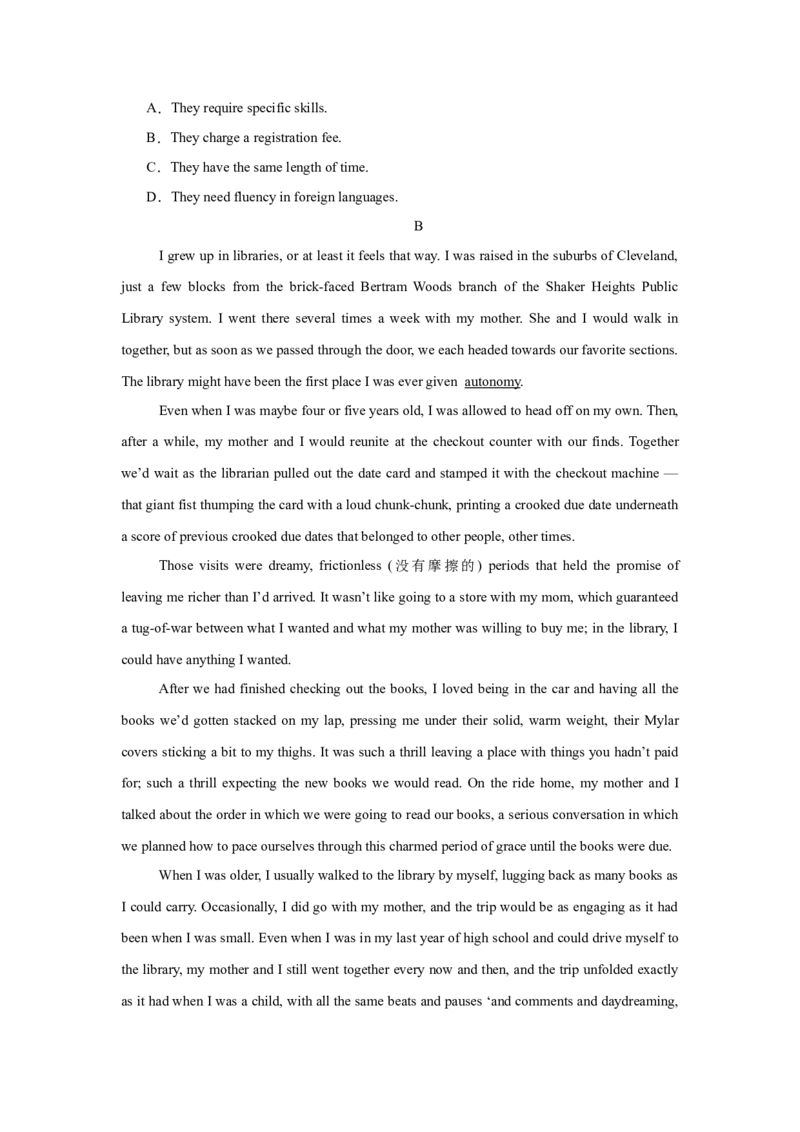
B
I grew up in libraries, or at least it feels that way. I was raised in the suburbs of Cleveland,
just a few blocks from the brick-faced Bertram Woods branch of the Shaker Heights Public
Library system. I went there several times a week with my mother. She and I would walk in
together, but as soon as we passed through the door, we each headed towards our favorite sections.
The library might have been the first place I was ever given autonomy.
Even when I was maybe four or five years old, I was allowed to head off on my own. Then,
after a while, my mother and I would reunite at the checkout counter with our finds. Together
we’d wait as the librarian pulled out the date card and stamped it with the checkout machine —
that giant fist thumping the card with a loud chunk-chunk, printing a crooked due date underneath
a score of previous crooked due dates that belonged to other people, other times.
Those visits were dreamy, frictionless ( 没有摩擦的) periods that held the promise of
leaving me richer than I’d arrived. It wasn’t like going to a store with my mom, which guaranteed
a tug-of-war between what I wanted and what my mother was willing to buy me; in the library, I
could have anything I wanted.
After we had finished checking out the books, I loved being in the car and having all the
books we’d gotten stacked on my lap, pressing me under their solid, warm weight, their Mylar
covers sticking a bit to my thighs. It was such a thrill leaving a place with things you hadn’t paid
for; such a thrill expecting the new books we would read. On the ride home, my mother and I
talked about the order in which we were going to read our books, a serious conversation in which
we planned how to pace ourselves through this charmed period of grace until the books were due.
When I was older, I usually walked to the library by myself, lugging back as many books as
I could carry. Occasionally, I did go with my mother, and the trip would be as engaging as it had
been when I was small. Even when I was in my last year of high school and could drive myself to
the library, my mother and I still went together every now and then, and the trip unfolded exactly
as it had when I was a child, with all the same beats and pauses ‘and comments and daydreaming,
the same perfect rhythm we’d followed so many times before. After my mother passed away two
years ago, I plunged into a deep shadow of grief for a long time. When I miss my mother these
days, I like to picture us in the car together, going for one more magnificent trip to Bertram
Woods, during which we talked, laughed — as if she were still in my company, giving me
inexhaustible strength.
41.In this passage, the word “autonomy” (paragraph 1) is closest in meaning to “________”.
A.vitality
B.freedom
C.inspiration
D.entitlement
42.It can be inferred from the second and third paragraphs that ________.
A.the author and her mother borrowed books that no other people had ever read before
B.the author and her mother were dreaming of going to the library
C.the author and her mother would play some games when they were shopping
D.the author would fail to buy what she wanted in the store
43.After the author and her mother left the library, ________.
A.they would plan to read their newly-borrowed books with feverish enthusiasm
B.they would have a serious conversation about which book attracted them the most
C.they would be anxious to recommend to each other the books they had borrowed
D.they would agree on buying the books they had just borrowed if they enjoyed them
44.How does the author feel when she imagines herself in the car with her mother on the way to
the library?
A.Grieved.
B.Shocked.
C.Miserable.
D.Comforted.
45.Following the last paragraph of this article, what would the author most likely go on to write
about?
A.One specific memory of a childhood trip to the library.
B.The fond childhood memories of her mother taking good care of her.
C.How her affection for going to the library has endured into her own motherhood.
D.Why her own child made up their mind to become a librarian after finishing college.
C
A new study published in the Journal of Marriage and Family claims that all that time you
spend parenting just doesn’t matter. But it’s a claim that, despite the enthusiastic and widespread
coverage by the media, does not hold water.
The research suggests that child outcomes (including behavior problems, emotional
problems, and academic performance) are barely connected with the time that parents spend with
their children. The researchers examined the time diaries of 1,600 children, looking at parenting
time and outcomes when the kids were aged 3 to 11 in 1997, and again in 2002, when they were
between 8 and 16. (A time diary is a detailed report of all activities you carry out in a day. )
This research largely reflects the failure of the authors to correctly measure parental input.
It just looked at time diaries from two particular days-one a weekday and the other a weekend day.
Trying to get a sense of the time you spend parenting from a single day’s diary is a bit like
trying to measure your income from a single day. If yesterday was payday, you looked rich, but if
it’s not, you would be reported as poor. You get a clearer picture only by looking at your income
— or your parenting time—over a more meaningful period.
What you did yesterday should not be taken as representative of what you did last year,
This is why most high-quality studies of parenting time focus instead on how often parents read to
their children, play with them or help their with homework over a period of a month or longer —
long enough to represent their different approaches to parenting.
As an exhausted parent who doesn’t get enough time to work out, and who hasn’t seen a
movie for months, I understand why so many of us might seize on studies suggesting that we
should take more time for ourselves. Perhaps we should. But I agree with Ariel Kalil, a
developmental psychologist, on the suggestion “that when parents spend high-quality time with
their children, their children are more likely to succeed.”
46.By saying in Paragraph 1 “ ... it’s a claim that ... does not bold water”, the author means the
claim is not ________.
A.reasonable
B.surprising
C.confusing
D.usual
47.The study was conducted to explore the link between ________.
A.children’s habits and parents’ influence B.parenting time and child outcomes
C.time diaries and child development
D.daily activities and children’s problems
48.How is Paragraph 4 mainly developed?
A.By giving descriptions.
B.By analyzing the cause.
C.By making a comparison.
D.By offering research findings.
49.The author may agree that high-quality studies of parenting time should ________.
A.be completed in one month.
B.adopt some different approaches.
C.concentrate mainly on learning time.
D.be based on data of a longer time period.
50.What can we learn about the author’s life?
A.He goes to bed early every night.
B.He has little interest in movies.
C.He has little time for himself.
D.He leads a very easy life.
D
It is an ancient Chinese tradition to cherish grain. In ancient China, farming promoted the
development of civilization so people regarded grain as a God. The ancient people firmly believed
that “food is the most important thing for the people”. The earth God “She” and the grain God “Ji”
were the earliest gods worshipped by our ancestors and the country was called “Sheji”.
Chinese believe in food conservation. Scholars have strongly advocated that “every single
grain is fruit of hard work” and nothing should be wasted. Strong daily practices are associated
with “respecting” the grain. Families that run out of rice never leave their container completely
empty. There is always a little rice left in it. Parts of the poultry ( 家禽) and livestock that are
unsuitable to be the main dishes are always deliciously cooked.
Food also helps bring people together. In Chinese culture, “Ju” (get together)is a very
particular word. There are many ways to get together, but the word “Can” is usually added to it in
case of festivals, birthday celebrations, moving to new houses, weddings and funeral. “Ju
Can”(get together and have dinner) is an important way for Chinese families to bond.
But these ordinarily frugal (节俭的) people often end up wasting food during “Ju Can”.
Some reports show that the annual waste of grain in China is close to 6% of the total grain output,
of which, the waste rate of a large party is as high as 38%. The food waste is driven by people’s
flamboyant nature — they think the plates must be full and taking away packed food from a party
is “disgraceful”. The dishes at a dinner party have become a symbol of a person’s wealth and
having too many dishes at the menu has become fashionable, thus promoting waste.
Small to a person, a family, big to a country, the whole human race, to survive, to develop,
we have to be frugal. Being frugal does not mean being mean, it simply means one is wise enough
not to waste food. If the culture of diligence and frugality is more widespread in all countries, it
would provide for a stronger foundation for national security and family happiness.
51.Why does the author mention “Sheji” in Paragraph 1?
A.To prove China enjoys a long history.
B.To explain Chinese tradition of cherishing food.
C.To show farming promoted Chinese civilization.
D.To clarify who is the earliest god in China.
52.What does the author intend to show with the example of parts of the poultry and livestock?
A.Chinese cuisine is diverse.
B.Chinese don’t waste food.
C.The ancient Chinese lived a difficult life.
D.Chinese are skillful at cooking delicious food.
53.What is Paragraph 4 mainly about?
A.The disgraceful behaviour in “Ju Can”.
B.The human nature revealed in food waste.
C.How much food Chinese people waste in “Ju Can”.
D.The food waste in “Ju Can” and the reason behind it.
54.The underlined word “flamboyant” in Paragraph 4 can be understood as  .
A.showy
B.generous
C.unique
D.hardworking
55.What does the author most likely want to tell us?
A.Farming is crucial to China’s development.
B.Food plays a vital role in bringing people together.
C.We should cherish food and form the habit of frugality.
D.We mustn’t leave the container completely empty in case of turning out of food.
第二部分:写作(共两节,满分35 分)
第一节:阅读表达(共5 小题;每小题2 分,满分10 分)
阅读下面短文,并根据短文内容完成下列各题。
Growing up in Saudi Arabia, 44-year-old photographer Jody MacDonald has always had a
strong interest in the desert. “I have always wanted to spend some time in the Sahara,” MacDonald
said. “There are still so many unexplored areas in the Sahara Desert. These relatively unexplored
places are so rare these days and hold the very fundamentals of exploration, which attract me. So
finally I made the journey.” MacDonald started her journey in Mauritania’s capital city
Nouakchott, and headed inland where she and her team jumped on the world’s longest cargo train
( 货运列车) for a 435-mile journey on the Mauritania Railway. “The train was dirty and
uncomfortable but it was such an interesting and unique way to travel through the vast desert by
train,” said MacDonald.
MacDonald and her group had to face many challenges on their journey. Except for the dirt
and discomfort, the travelers also had to deal with the intense heat, violent winds and even
dangerous sandstorms. “I was out taking photographs and within minutes, the wind increased to
more than 100 miles an hour,” MacDonald said. “I thought my skin was going to be torn off
because of the rain and blowing sand. It felt like sandpaper on my skin. I have never experienced
winds that strong before. There was once a time when I wanted to give up.”
She dealt with the harsh (恶劣的) conditions by trying not to travel in the middle of the day
and wore headscarves to protect herself from the sun and blowing sand. “The weather definitely
dictates when and where you travel,” said MacDonald. Even with all the challenges, the
photographer managed to record amazing images of the beautiful but harsh landscapes of
Mauritania, and its fascinating cultures and communities.
56.Why did MacDonald tour the Sahara? (no more than 10 words)
57.How did MacDonald feel on the cargo train? (no more than 5 words)
58.Why did MacDonald once decide to give up her journey? (no more than 10 words)
59.What does the underlined word in the last paragraph mean? (1 word)
60.How does MacDonald’s story inspire you in life? Please explain. (no more than 20 words)
第二节:书面表达(满分25 分)
61.假如你是晨光中学的学生李津,你校英文报向同学们约稿,讨论影响自身成长的因素。
请你写一篇英语短文给报纸投稿。
内容提示:
(1)陈述影响你成长的因素,如:家庭、学校、社会、朋友、书籍等(不少于两点);
(2)谈谈这些因素如何影响了你的成长(需举例说明)。
注意:词数不少于100;文章的开头已给出(不计入词数)。
The process of growing up is complex for every person,
_______________________________________________________________________________
_______________________________________________________________________________
_______________________________________________________________________________
_______________________________________________________________________________
_____________________________________