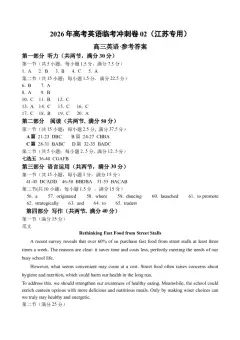
2026 年高考英语模拟风向卷02(江苏专用)(解析版)
(考试时间:120 分钟  试卷满分:150 分)
注意事项:
1.本试卷分第Ⅰ卷(选择题)和第Ⅱ卷(非选择题)两部分。答卷前,考生务必将自己的姓名、准
考证号填写在答题卡上。
2.回答第Ⅰ卷时,选出每小题答案后,用2B 铅笔把答题卡上对应题目的答案标号涂黑。如需改动,
用橡皮擦干净后,再选涂其他答案标号。写在本试卷上无效。
3.回答第Ⅱ卷时,将答案写在答题卡上。写在本试卷上无效。
4.考试结束后,将本试卷和答题卡一并交回。
第一部分 听力(共两节,满分 30 分)
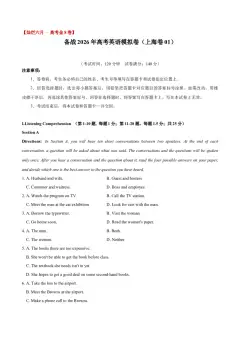
做题时,请先将答案标在试卷上。录音内容结束后,你将有两分钟的时间将试卷上的答案转涂到答题
卡上。
第一节(共5 小题;每小题1.5 分,满分7.5 分)
听下面5 段对话。每段对话后有一个小题,从题中所给的A、B、C 三个选项中选出最佳选项。听完每段对
话后,你都有10 秒钟的时间来回答有关小题和阅读下一小题。每段对话读两遍。
1.How does the woman probably sound in the end?
A.Awkward.
B.Confused.
C.Angry.
2.What are the speakers mainly talking about?
A.Smart shopping.
B.Digital receipt.
C.Data analysis.
3.What will the boy do next?
A.Help draft the poster.
B.Buy rubbish bags.
C.Collect plastic bottles.
4.What will the two speakers do tonight?
A.To see a film after dinner.
B.To watch TED shows at home.
C.To
have a walk along the beach.
5.What aspect does the woman suggest the man emphasize in his speech?
A.The benefits of using social media.
B.The importance of physical security.
C.The risks of sharing personal information online.
第二节(共15 小题;每小题1.5 分,满分22.5 分)
听下面 5 段对话或独白。每段对话或独白后有几个小题,从题中所给的A、B、C 三个选项中选出最佳选
项,并标在试卷的相应位置。听每段对话或独白前,你将有时间阅读各个小题,每小题 5 秒钟;听完后,
各小题将给出 5 秒钟的作答时间。每段对话或独白读两遍。
听下面一段较长对话,回答以下小题。
6.What might the man be?
A.A publisher.
B.A writer.
C.An editor.
7.What is the woman doing?
A.Cheering the man up.
B.Doing an interview.
C.Recommending a book.
听下面一段对话,回答以下小题。
8.Where does the conversation take place?
A.In a classroom.
B.In a cafeteria.
C.In a dormitory building.
9.Who did the woman originally plan to have dinner with?
A.Her parents.
B.Her roommates.
C.Several other new students.
听下面一段对话,回答以下小题。
10.What is wrong with the woman’s computer?
A.It makes a strange noise.
B.It always has a blue screen.
C.It lacks the latest operating system.
11.What does the woman want to know?
A.The update time.
B.The laptop model.
C.The repair cost.
12.What does the man offer to do for the woman?
A.Give her a reasonable repair price.
B.Repair her computer today.
C.Ring her up tomorrow.
听下面一段对话,回答以下小题。
13.What was the primary design purpose of the companion robot?
A.To accompany the old. B.To do household chores.
C.To provide medical reminders.
14.What was the unexpected finding from the user feedback?
A.Perfect robots perform better.
B.Emotional bonds matter most.
C.Medical help is the top concern.
15.What is the new focus of the project?
A.Making processors faster.
B.Improving personal connection.
C.Adding more advanced functions.
16.When will the new version be available for purchase?
A.In January, 2026.
B.In March, 2026.
C.In June, 2026.
听下面一段独白,回答以下小题。
17.Which subject is proper this year?
A.My bedroom.
B.My favorite animal.
C.My favorite park.
18.What is the maximum age limit to enter the competition?
A.8 years old.
B.12 years old.
C.15 years old.
19.What can the winners get this year?
A.Membership in the club.
B.A family ticket to London Zoo.
C.Free countryside magazines.
20.What’s the purpose of the talk?
A.To encourage children to organize a club.
B.To inform children of the competition.
C.To apologize for the changes this year.
第二部分  阅读(共两节,满分50 分)
第一节(共15 小题;每小题2.5 分,满分37.5 分)
阅读下列短文,从每题所给的A、B、C、D 四个选项中选出最佳选项。
A
A groundbreaking study published in The Lancet Public Health reveals that walking 7,000 steps daily can
significantly enhance brain function and lower the risk of major diseases, challenging the widely accepted but
unscientific 10,000-step standard.
Key Findings:
After analyzing data from more than 160,000 adults globally, researchers discovered that compared to just
2,000 steps per day, achieving 7,000 steps leads to:
•25% lower risk of heart disease
•6% reduced chance of cancer
•38% decreased dementia risk
•22% lower likelihood of depression
Lead researcher Dr. Melody Ding clarifies that the 10,000-step target traces back to a 1960s Japanese
pedometer (计步器) marketing strategy rather than medical evidence.
Health Expert Opinions:
Dr. Daniel Bailey (Brunel University London) recommends 7,000 steps as a “realistic and regular” daily
goal, rather than occasional intense efforts.
Dr. Andrew Scott (University of Portsmouth) advises that while “more movement is better”, consistency
matters most.
Prof. Azeem Majeed (Imperial College London) highlights that routine daily activities like gardening or
cleaning also contribute meaningfully in the long run.
Practical Advice:
Make it social: Walk with friends/family to stay motivated and enjoy quality time.
Start small: Even 4,000 daily steps show measurable health improvements over inactivity.
Focus on feeling good: Regular walker Jon Stride emphasizes that mental well-being benefits outweigh strict
step counts.
While official guidelines recommend 150 weekly exercise minutes, this study shows regular 7,000-step
walking provides major health benefits. The key is consistent movement — whether through walking, daily tasks,
or other activities — without overemphasizing perfect numbers. Small, sustainable efforts make the real difference.
21.How many steps per day can significantly lower disease risks according to the study?
A.2,000 steps.
B.4,000 steps.
C.7,000 steps.
D.10,000 steps.
22.What do health experts emphasize in walking advice?
A.Impressive records.
B.Official guidance.
C.Intensive movement.
D.Sustainable habits.
23.What is recommended to make walking more enjoyable?
A.Sharing walks with friends.
B.Starting with small goals.
C.Focusing on step counts.
D.Setting MUST-DO daily tasks.
B
At 75, Joan Elizabeth couldn’t decide what to do next to keep her mind sharp and body fit. As a lifelong
teacher, she could either return to the role of student by taking a college course, or try initial training for Les Mills’
BODYFLOW, a new generation yoga class. She chose the latter. She was looking for a new challenge and new
experience.
Stepping back into the role of student made her both excited and nervous. Her goal was not to earn full
certification, but rather to experience a Les Mills initial training and expand her knowledge base. Her many years of
dance and fitness helped her feel confident about learning the choreography (编舞) required for the training. “My
approach was to learn the track as a dance to be performed on stage,” she explained.
Physical fitness has always been a central part of Joan’s life. She’s been a dancer, choreographer, and
physical education teacher. She added Tai Chi instructor to her resume (简历) in her 70s when she earned a Tai Chi
certification. “My father was a master in Tai Chi Chuan. He was a strong influence in my returning to Tai Chi,” said
Joan. “I wanted to rearrange my fitness program and get back to my roots. Tai Chi has helped me mentally and
emotionally focus on balance, core strength, relaxation, meditation, and better sleep patterns.”
While Joan attended as a student, she ended up teaching the entire group many valuable lessons. Les Mills
Instructor Jessica Griffin said Joan showed her what is possible in fitness and life. “She truly inspired the rest of us
and showed us age is not a factor,” says Griffin. “We are all capable, even as senior citizens, to continue our
growth, knowledge, and learning.”
24.What was Joan’s goal for BODYFLOW?
A.To get certification.
B.To boost confidence.
C.To gain new knowledge.
D.To become a choreographer.
25.What can we infer about Joan from Paragraph 3?
A.She disliked dancing.
B.She was weak in fitness.
C.She had rich experiences.
D.She feared learning choreography.
26.What made Joan learn Tai Chi?
A.Her love for yoga.
B.Her teaching career.
C.Her students’ request.
D.Her father’s influence.
27.What does the text mainly convey?
A.Practice makes perfect.
B.It’s never too old to learn.
C.Rome was not built in a day.
D.Where there is a will, there is a way.
C
When I asked my 15-year-old cousin about her ideal occupation, she gave me an unusual answer, saying that
she dreams of becoming an online celebrity, which reminded me of a new girl band called “Sunshine”. These teens
have quickly got an ill fame across China because of their “unattractive” and “fat” appearance and laughably bad
singing skills. But rather than wither at the offence coming from their 430,000 followers on Weibo, they seem to
bloom on the criticism.
And following Sunshine’s explosion, numerous new bands like “Power Girls” and “Love-wings” starring
average-looking adolescent girls started popping up on people’s mobiles. Lots of ordinary, disadvantaged Chinese
teens with no skills but big dreams have looked to unlikely role models such as the Sunshine girls as proof that all it
takes is a little self-confidence to get your name in the headlines. It’s incredible to witness so many young Chinese
girls make spectacles of themselves online in a desperate attempt to stand out from thousands of potential stars.
This kind of grassroots self-promotion is fantastic for Chinese youth who may not otherwise have any
opportunities or privileges to be outstanding in China’s competitive society, but for those well-educated kids, there
is a rising concern among parents that social networking is distracting them from academics.
Sadly, these so-called stars quickly disappear from people’s attention once a new band pops up. Besides, they
are likely to leave behind the online record of their ridiculous and sometimes scandalous behavior. Prospective
employers and even potential husbands or wives will eventually see these photos and videos, which could affect
their futures.
The good news is that, in today’s Internet age, fame and fortune are easily attainable for otherwise
unqualified kids, but the bad news is that their narcissistic (自恋的) addictions to social media will interfere with
learning knowledge and real-life skills, leaving an entire generation of wired youth with absolutely no other
alternative once their online followers forget about them.
28.What does the underlined word “wither” in paragraph 1 mean?
A.Fade.
B.Succeed.
C.Tease.
D.Please.
29.Why does the rise of online celebrities fascinate the youth?
A.Because it promotes the youth’s self-confidence.
B.Because they possess certain performance skills.
C.Because they tend to ignore their academic studies.
D.Because it presents a potential path to success.
30.What challenges might these so-called stars face?
A.They might face increased academic pressure.
B.Their future potential might be damaged.
C.They might get tired of public attention.
D.Their future employers might laugh at them.
31.What does the author imply in the last paragraph?
A.Change does not happen over time.
B.Being qualified ensures success.
C.Trends can promote learning.
D.Addiction affects a generation.
D
Winter often brings the familiar discomfort of fever, aching limbs, and a runny nose, all signs of the flu. This
illness is caused by flu viruses, which invade our bodies and infect our cells. For a long time, the exact moment of
infection remained a mystery. Now, using a newly developed observation method, scientists have captured this
process in remarkable detail, revealing a surprising interaction between the virus and the cell it attacks.
Instead of being a passive victim, the cell appears to play an active role in its own infection. The virus begins
by “surfing” across the cell’s outer surface. It moves from one special part to another, searching for a location rich
in entry points. This process allows the virus to find the most efficient path inside. The virus achieves this by
tricking the cell; it hijacks a normal cellular process that the cell uses to bring in essential substances. Because this
process is vital for the cell’s survival, it cannot simply be shut down, leaving the cell vulnerable to the virus’s clever
strategy.
Once the virus attaches to a suitable spot, the cell’s outer layer begins to form a small pocket, shaped and
supported by a special protein. This pocket grows larger, wrapping itself around the virus until it is completely
enclosed in a small bubble. The cell then pulls this bubble inward, where it dissolves and releases the virus to begin
its harmful work. Scientists were astonished to find that the cell actively assists this entry. It sends key proteins to
the virus’s location and its surface even pushes upward, as if trying to seize the virus. These movements become
stronger if the virus attempts to drift away.
This breakthrough was made possible by a new tool that combines two powerful observation technologies.
Unlike older methods, which could only show frozen moments or lacked detail, this new technique provides a live,
high-resolution view of the viral entry. It reveals the complex and active “dance” between the virus and the cell in a
way never seen before.
The ability to watch infection as it happens has huge potential for medical research. Scientists can now use
this tool to test new antiviral medicines directly on cells, observing in real time whether the drugs can effectively
block the virus from entering. This technology could also be applied to study other viruses and even vaccines,
offering a powerful new way to understand and fight infectious diseases.
32.Why do cells seem to assist the virus according to the passage?
A.They are tricked by the virus.
B.They want to be infected.
C.The virus is too strong to resist.
D.They are trying to capture the virus.
33.What is the main advantage of the new observation tool?
A.It is cheaper and easier to use.
B.It can completely destroy viruses.
C.It offers live, detailed views of the process.
D.It works without using any cells.
34.What does the “viral surfing” process mainly involve?
A.Resting on the cell surface.
B.Destroying the cell’s outer layer.
C.Searching for a suitable entry point.
D.Avoiding being caught by the cell.
35.What potential impact does the new method have on medicine?
A.It will cure all flu patients immediately.
B.It may speed up the development of new drugs.
C.It will make all other research tools useless.
D.It can prevent viruses from entering the body.
第二节(共5 小题;每小题2.5 分,满分12.5 分)
阅读下面短文,从短文后的选项中选出可以填入空白处的最佳选项。选项中有两项为多余选项。
In today’s world, there are many voices of opposition to the regulations on wearing school uniforms. Some
argue uniforms are restrictive and take away individuality.     36
Uniforms reduce peer ( 同辈) pressure and conflict. When students come to school dressed in their own
clothes, they may feel pressure to keep up with the latest trends or worry about what their peers might think. This
can lead to feelings of anxiety and social exclusion.     37     No one child is better or worse off because of
what they are wearing. This removes the constant comparisons and competition that can be stressful for some
students, and instead, establishes a sense of belonging and community.
Wearing a uniform also simplifies the lives of parents and teachers. There is no more worrying about what to
wear or stressing about finding the perfect clothing for a special occasion. Parents can distribute more time and
resources to their children’s education, and teachers can focus on teaching, rather than policing students’ dress
codes.     38     Sustainability and reusability are their main characteristics.
When students wear the same uniform, they feel a sense of belonging and identity with their school.     39
Uniforms reflect the values and principles of a school, such as teamwork, discipline, and respect, which are
essential for a positive and productive learning environment.
    40     It requires careful consideration of the benefits and drawbacks, as well as consultation with all
interested parties. By weighing the pros and cons, schools can make an informed decision that prioritizes the well-
being of all students.
A.Virtually, uniforms benefit at least three sides.
B.This can lead to a sense of pride in their school.
C.However, adopting a school uniform policy is not easy.
D.Uniforms reduce waste and the impact of fast fashion.
E.By wearing uniforms, they are on a same level playing field.
F.Nowadays, simple uniforms have already taken schools by storm.
G.Others claim school uniforms create a positive learning environment.
第三部分  语言运用(共两节,满分30 分)
第一节  (共15 小题;每小题1 分,满分15 分)
阅读下面短文,从每题所给的A、B、C、D 四个选项中选出可以填入空白处的最佳选项。
Last winter, I was having a difficult week. Work pressure was building up, and personal problems made me
feel overwhelmed. One evening, I decided to walk through the park to clear my mind.
The park was nearly empty, covered in fresh snow. The only sound was the     41     of my boots on the
frozen path. I was so absorbed in my thoughts that I barely noticed the world around me until I saw an elderly
woman feeding birds by a frozen pond.
As I passed by, she looked up and smiled. “Beautiful, isn’t it?” she said. Her     42     took me by
surprise.
“I suppose so,” I replied coldly, not really wanting conversation.
But she     43    , “Each season has its own magic. Winter teaches us the beauty of     44    .”
Something in her tone made me pause. We talked about simple things - the frost on branches, the birds in
cold weather. Her words weren’t     45    , but they carried wisdom.
When I left, she said, “Remember, even in the coldest moments, there’s warmth to be found if you     46
it.” That brief meeting stayed with me.
The next morning, I suddenly bought a coffee for a homeless man I usually     47    . His grateful smile
filled me with     48    .
That encounter     49     something in me. I began to notice how often we     50     chances for
small kindnesses. A     51     decision to be more present can change everything.
Now I see that life’s most valuable lessons come from     52     moments of connection. By     53

our light with others, we don’t lose our own; we make the world     54    . Sometimes the smallest moments
teach us the most     55     lessons.
41.A.crunch
B.whisper
C.echo
D.splash
42.A.appearance
B.gesture
C.judgment
D.question
43.A.went on
B.went out
C.went away
D.went by
44.A.silence
B.nature
C.change
D.strength
45.A.complicated
B.clear
C.meaningful
D.original
46.A.look for
B.give up
C.turn down
D.put away
47.A.helped
B.noticed
C.respected
D.ignored
48.A.relief
B.pride
C.warmth
D.satisfaction
49.A.awakened
B.killed
C.protected
D.tested
50.A.wait for
B.look for
C.miss
D.create
51.A.quick
B.difficult
C.conscious
D.random
52.A.quiet
B.exciting
C.formal
D.public
53.A.hiding
B.sharing
C.discovering
D.protecting
54.A.darker
B.safer
C.brighter
D.smaller
55.A.temporary
B.academic
C.complex
D.profound
第二节(共10 小题;每小题1. 5 分, 满分15 分)
阅读下面材料,在空白处填入适当的内容(1 个单词)或所给单词的正确形式。
The People’s Liberation Army Air Force (PLAAF) marked its 76th anniversary on November 11th. Founded
on Nov. 11, 1949, it     56     (start) with only a handful of outdated planes, having evolved into a modern
force     57     (equip) with world-leading aircraft over the past seven decades. It now places growing emphasis
58     intelligent, information-driven capabilities.     59     (celebrate) the anniversary, the PLAAF released a
microfilm named Dreaming Far, showcasing a threeaircraft formation of the Xuanlong-08 drone and two manned
fighter jets (J-16 and J-20). This was the first time the PLAAF had published footage of manned and unmanned
aircraft teaming up,     60     quickly captured nationwide attention.
AI has become     61     key tool to hone pilots’ skills since     62     (technology) advancement
was applied to the PLAAF. In simulated air combat against AI, pilot Ma Xiao faced unprecedented ( 前所未有的)
challenges, noting that the AI “is working     63     (aggressive) and never makes mistakes.”
With AI’s     64     (assist), pilots have made remarkable progress in real-combat-oriented training. The
PLAAF’s transformation from mechanization to information     65     from air defense to offensive-defensive
capabilities reflects its commitment to keeping pace with future warfare. As a comment put it, “In the past, we
looked to foreign forces; now we look to ourselves.”
第四部分 写作(共两节, 满分40 分)
第一节(满分15 分)
66.假如你是李华,上周五你参加了学校举办的“旧物改造创意比赛(upcycling competition)”,请你给你的
英国笔友Frank 写信分享,内容包括:
(1)你的参赛作品;
(2)感受和收获。
注意:
(1)写作词数应为80 个左右;
(2)请按如下格式在答题卡的相应位置作答。
Dear Frank,
____________________________________________________________________________________________
____________________________________________________________________________________________
____________________________________________________________________________________________
____________________________________________________________________________________________
____________________________________________________________________________________________
Yours sincerely,
Li Hua
第二节(满分25 分)
67.阅读下面材料,根据其内容和所给段落开头语续写两段,使之构成一篇完整的短文。
It was the last day before moving into the new house. Mr. and Mrs. Martin wanted to make it warm and
lovely, so they decided to do some decorating themselves. That morning, Mrs. Martin stood at the door, reminding
her busy husband. “Don’t climb too high, don’t move heavy boxes, and don’t forget to rest,” she said again and
again, before she eventually headed out to buy curtains.
Earlier, their daughter Emily had called. She said she was tied up with her job in another city, but promised,
“Don’t worry, we’ll celebrate together soon.” The couple missed her, of course, but they smiled at each other and
agreed it would be meaningful to get the new home ready, a warm welcome awaiting their daughter’s arrival.
Mr. Martin waved goodbye to his wife and went back to his decorating work, confident and full of energy at
first. But soon the living room turned into a battlefield. Boxes, nails, a hammer and screwdrivers lay everywhere.
Paint splashed onto the floor, and the wall looked like a child’s drawing. And several photo frames were scattered
on the ground.
“A spider!” Mr. Martin climbed onto a shaky stool to chase it away-his wife hated those things — but instead
he slipped and broke a photo frame. “Ouch, my back!” he groaned, sweat trickling down his forehead. He began to
wonder whether he was really able to do this job alone.
Then came a sharp smell from the kitchen. “Oh no, my cake!” Mr. Martin dragged himself to open the oven.
The cake, which he had planned to surprise his wife, was now nothing but a hard black rock. He stared at it,
shaking his head. “Should I admit the mess? Or pretend nothing happened?” he whispered. Suddenly, the door
creaked open. Mrs. Martin stepped inside with the new curtains in her arms.
注意:
(1)续写词数应为150 左右;
(2)请按如下格式在答题卡的相应位置作答。
Paragraph 1: For a moment, Mrs. Martin stood frozen.
____________________________________________________________________________________________
____________________________________________________________________________________________
____________________________________________________________________________________________
Paragraph 2: With the new curtains finally in place, the doorbell rang.
____________________________________________________________________________________________
____________________________________________________________________________________________
____________________________________________________________________________________________