2026 年高考英语模拟风向卷03(全国一卷)(考试版A3)
(考试时间:120 分钟  试卷满分:150 分)
注意事项:
1.答卷前,考生务必将自己的姓名、准考证号等填写在答题卡和试卷指定位置上。
2.回答选择题时,选出每小题答案后,用铅笔把答题卡上对应题目的答案标号涂黑。如需改动,用
橡皮擦干净后,再选涂其他答案标号。回答非选择题时,将答案写在答题卡上。写在本试卷上无效。
3.考试结束后,将本试卷和答题卡一并交回
第一部分  听力(共两节,满分 30 分)
做题时,先将答案标在试卷上。录音内容结束后,你将有两分钟的时间将试卷上的答案转涂到答题卡上。
第一节(共5 小题;每小题1.5 分,满分7.5 分)
听下面5 段对话。每段对话后有一个小题,从题中所给的A、B、C 三个选项中选出最佳选项。听完每
段对话后,你都有10 秒钟的时间来回答有关小题和阅读下一小题。每段对话读两遍。
1.How does the woman find the rule now?
A.Helpful.
B.Strict.
C.Unfair.
2.What is the man’s suggestion?
A.Arriving early.
B.Sitting at the back.
C.Booking tickets in advance.
3.What does the woman suggest the man do?
A.Practice more.
B.Ask his teacher for help.
C.Adjust the height of the seat.
4.Where will the man probably be tomorrow afternoon?
A.At his classroom.
B.At a friend’s home.
C.At the school library.
5.What does Mrs. Dunphy suggest?
A.Performing a comedy.
B.Organizing the party.
C.Signing up for a dance.
第二节(共15 小题;每小题1.5 分,满分22.5 分)
听下面5 段对话或独白。每段对话或独白后有几个小题,从题中所给的A、B、C 三个选项中选出最佳
选项。听每段对话或独白前,你将有时间阅读各个小题,每小题5 秒钟;听完后,各小题将给出5 秒钟的作
答时间。每段对话或独白读两遍。
听第6 段材料,回答第6、7 题。
6.What is the relationship between the speakers?
A.Family relatives.
B.Fellow passengers.
C.Crew members.
7.What does the woman agree to do with the man?
A.Accept his medical help. B.Attend his wedding.
C.Change seats with him.
听第7 段材料,回答第8、9 题。
8.What motivated the man to rewrite his introduction?
A.His teacher’s instruction.B.His classmates’ reaction.
C.The woman’s suggestion.
9.What are the speakers mainly talking about?
A.Improving a speech.
B.Solving pollution problems. C.Developing the writing ability.
听第8 段材料,回答第10 至13 小题。
10.What does the man recommend?
A.A guided boat tour.
B.A ride on the London Eye.
C.A tour of the Tower of London.
11.How will the woman travel to London?
A.By train.
B.By ship.
C.By plane.
12.What will the woman probably do after her Thames trip?
A.Have a meal at Borough Market.
B.Watch the changing of the guard.
C.Visit the Southbank Skatepark.
13.What does the man think of the National Portrait Gallery?
A.Its works are difficult to understand.
B.It has great historical value.
C.It’s a bit too traditional.
听第9 段材料,回答第14 至17 题。
14.What type of event did the man recently attend?
A.A family wedding.
B.A graduation ceremony.
C.An opening of a restaurant.
15.What is the relationship between the man and Sasha?
A.Mother and son.
B.Cousins.
C.Brother and sister.
16.Who mainly designed the menu?
A.The hotel.
B.Sasha and Will.
C.The man’s mother.
17.What is the man’s attitude toward the actions of his cousins?
A.Disapproving.
B.Indifferent.
C.Amused.
听第10 段材料,回答第18 至20 题。
18.What is the speaker mainly talking about?
A.His feeling after receiving an award.
B.His passion for different music types.
C.His experience about travelling around.
19.What did the speaker most recently announce to the public?
A.A single song.
B.A three-song record.
C.A twelve-song collection.
20.Who will speak next?
A.A young musician.
B.The speaker’s wife.
C.The host of the ceremony.
第二部分  阅读(共两节, 满分50 分)
第一节(共15 小题;每小题2.5 分, 满分37.5 分)
阅读下列短文, 从每题所给的A、B、C 和D 四个选项中选出最佳选项。
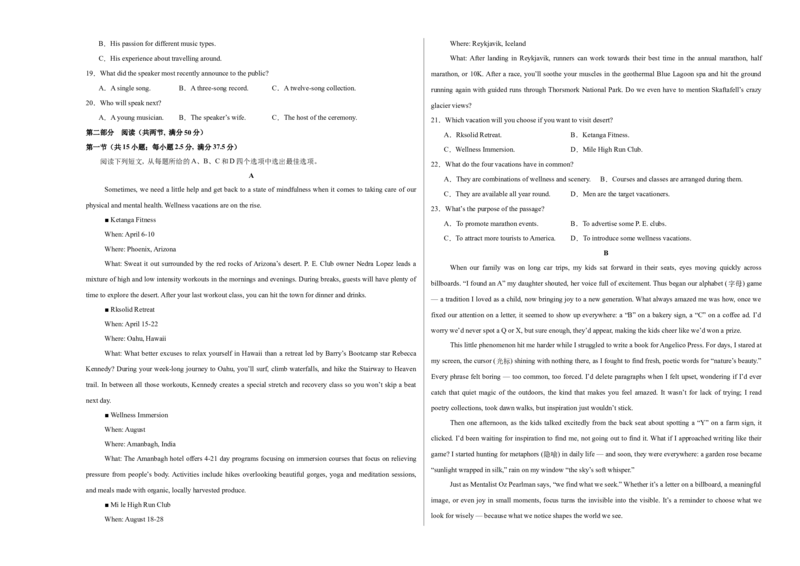
A
Sometimes, we need a little help and get back to a state of mindfulness when it comes to taking care of our
physical and mental health. Wellness vacations are on the rise.
■ Ketanga Fitness
When: April 6-10
Where: Phoenix, Arizona
What: Sweat it out surrounded by the red rocks of Arizona’s desert. P. E. Club owner Nedra Lopez leads a
mixture of high and low intensity workouts in the mornings and evenings. During breaks, guests will have plenty of
time to explore the desert. After your last workout class, you can hit the town for dinner and drinks.
■ Rksolid Retreat
When: April 15-22
Where: Oahu, Hawaii
What: What better excuses to relax yourself in Hawaii than a retreat led by Barry’s Bootcamp star Rebecca
Kennedy? During your week-long journey to Oahu, you’ll surf, climb waterfalls, and hike the Stairway to Heaven
trail. In between all those workouts, Kennedy creates a special stretch and recovery class so you won’t skip a beat
next day.
■ Wellness Immersion
When: August
Where: Amanbagh, India
What: The Amanbagh hotel offers 4-21 day programs focusing on immersion courses that focus on relieving
pressure from people’s body. Activities include hikes overlooking beautiful gorges, yoga and meditation sessions,
and meals made with organic, locally harvested produce.
■ Mi le High Run Club
When: August 18-28
Where: Reykjavik, Iceland
What: After landing in Reykjavik, runners can work towards their best time in the annual marathon, half
marathon, or 10K. After a race, you’ll soothe your muscles in the geothermal Blue Lagoon spa and hit the ground
running again with guided runs through Thorsmork National Park. Do we even have to mention Skaftafell’s crazy
glacier views?
21.Which vacation will you choose if you want to visit desert?
A.Rksolid Retreat.
B.Ketanga Fitness.
C.Wellness Immersion.
D.Mile High Run Club.
22.What do the four vacations have in common?
A.They are combinations of wellness and scenery.
B.Courses and classes are arranged during them.
C.They are available all year round.
D.Men are the target vacationers.
23.What’s the purpose of the passage?
A.To promote marathon events.
B.To advertise some P. E. clubs.
C.To attract more tourists to America.
D.To introduce some wellness vacations.
B
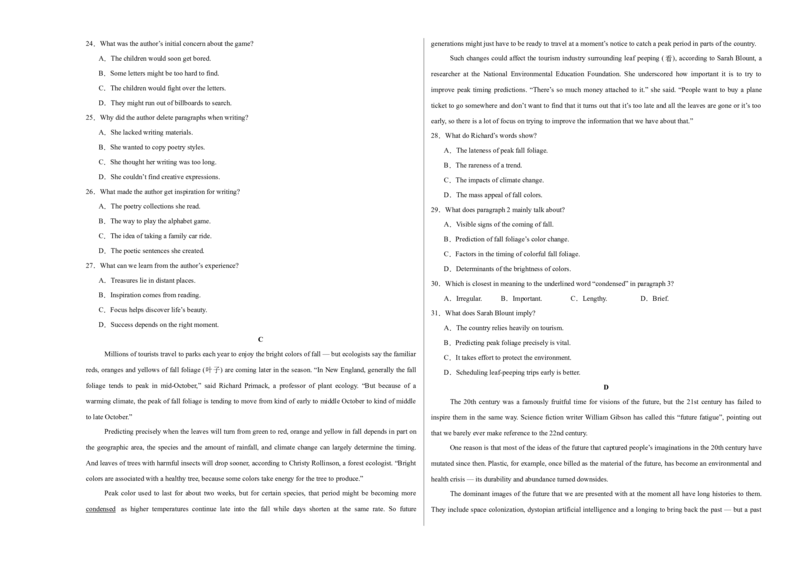
When our family was on long car trips, my kids sat forward in their seats, eyes moving quickly across
billboards. “I found an A” my daughter shouted, her voice full of excitement. Thus began our alphabet (字母) game
— a tradition I loved as a child, now bringing joy to a new generation. What always amazed me was how, once we
fixed our attention on a letter, it seemed to show up everywhere: a “B” on a bakery sign, a “C” on a coffee ad. I’d
worry we’d never spot a Q or X, but sure enough, they’d appear, making the kids cheer like we’d won a prize.
This little phenomenon hit me harder while I struggled to write a book for Angelico Press. For days, I stared at
my screen, the cursor (光标) shining with nothing there, as I fought to find fresh, poetic words for “nature’s beauty.”
Every phrase felt boring — too common, too forced. I’d delete paragraphs when I felt upset, wondering if I’d ever
catch that quiet magic of the outdoors, the kind that makes you feel amazed. It wasn’t for lack of trying; I read
poetry collections, took dawn walks, but inspiration just wouldn’t stick.
Then one afternoon, as the kids talked excitedly from the back seat about spotting a “Y” on a farm sign, it
clicked. I’d been waiting for inspiration to find me, not going out to find it. What if I approached writing like their
game? I started hunting for metaphors (隐喻) in daily life — and soon, they were everywhere: a garden rose became
“sunlight wrapped in silk,” rain on my window “the sky’s soft whisper.”
Just as Mentalist Oz Pearlman says, “we find what we seek.” Whether it’s a letter on a billboard, a meaningful
image, or even joy in small moments, focus turns the invisible into the visible. It’s a reminder to choose what we
look for wisely — because what we notice shapes the world we see.
24.What was the author’s initial concern about the game?
A.The children would soon get bored.
B.Some letters might be too hard to find.
C.The children would fight over the letters.
D.They might run out of billboards to search.
25.Why did the author delete paragraphs when writing?
A.She lacked writing materials.
B.She wanted to copy poetry styles.
C.She thought her writing was too long.
D.She couldn’t find creative expressions.
26.What made the author get inspiration for writing?
A.The poetry collections she read.
B.The way to play the alphabet game.
C.The idea of taking a family car ride.
D.The poetic sentences she created.
27.What can we learn from the author’s experience?
A.Treasures lie in distant places.
B.Inspiration comes from reading.
C.Focus helps discover life’s beauty.
D.Success depends on the right moment.
C
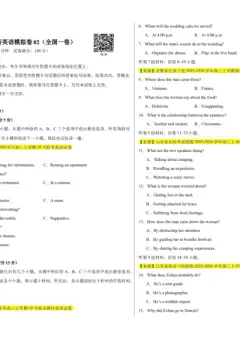
Millions of tourists travel to parks each year to enjoy the bright colors of fall — but ecologists say the familiar
reds, oranges and yellows of fall foliage (叶子) are coming later in the season. “In New England, generally the fall
foliage tends to peak in mid-October,” said Richard Primack, a professor of plant ecology. “But because of a
warming climate, the peak of fall foliage is tending to move from kind of early to middle October to kind of middle
to late October.”
Predicting precisely when the leaves will turn from green to red, orange and yellow in fall depends in part on
the geographic area, the species and the amount of rainfall, and climate change can largely determine the timing.
And leaves of trees with harmful insects will drop sooner, according to Christy Rollinson, a forest ecologist. “Bright
colors are associated with a healthy tree, because some colors take energy for the tree to produce.”
Peak color used to last for about two weeks, but for certain species, that period might be becoming more
condensed as higher temperatures continue late into the fall while days shorten at the same rate. So future
generations might just have to be ready to travel at a moment’s notice to catch a peak period in parts of the country.
Such changes could affect the tourism industry surrounding leaf peeping (看), according to Sarah Blount, a
researcher at the National Environmental Education Foundation. She underscored how important it is to try to
improve peak timing predictions. “There’s so much money attached to it.” she said. “People want to buy a plane
ticket to go somewhere and don’t want to find that it turns out that it’s too late and all the leaves are gone or it’s too
early, so there is a lot of focus on trying to improve the information that we have about that.”
28.What do Richard’s words show?
A.The lateness of peak fall foliage.
B.The rareness of a trend.
C.The impacts of climate change.
D.The mass appeal of fall colors.
29.What does paragraph 2 mainly talk about?
A.Visible signs of the coming of fall.
B.Prediction of fall foliage’s color change.
C.Factors in the timing of colorful fall foliage.
D.Determinants of the brightness of colors.
30.Which is closest in meaning to the underlined word “condensed” in paragraph 3?
A.Irregular.
B.Important.
C.Lengthy.
D.Brief.
31.What does Sarah Blount imply?
A.The country relies heavily on tourism.
B.Predicting peak foliage precisely is vital.
C.It takes effort to protect the environment.
D.Scheduling leaf-peeping trips early is better.
D
The 20th century was a famously fruitful time for visions of the future, but the 21st century has failed to
inspire them in the same way. Science fiction writer William Gibson has called this “future fatigue”, pointing out
that we barely ever make reference to the 22nd century.
One reason is that most of the ideas of the future that captured people’s imaginations in the 20th century have
mutated since then. Plastic, for example, once billed as the material of the future, has become an environmental and
health crisis — its durability and abundance turned downsides.
The dominant images of the future that we are presented with at the moment all have long histories to them.
They include space colonization, dystopian artificial intelligence and a longing to bring back the past — but a past
that never was. This makes sense given the climate anxiety and dread about the future felt by many people. The
future has started to feel like it is closing off rather than opening out.
Jean- Louis Missika, a former deputy mayor of Paris, has written that “when the future is dark, people turn to
an idealised past, a lost golden age. Nostalgia ( 怀旧) becomes a refuge against dangers, a cocoon against the
announced declines.”
It’s not that absolutely no new future visions have emerged this century. But it is notable that no major,
forward-looking future visions have taken root in our collective imagination since smartphones came to dominate
our way of communicating.
I think about the future for a living and it is my experience that unified visions of desirable futures can inspire
people to bring about change. They act as motivators and imagination engines. We can use them to visualise the
society we want and then commit to work towards that future. Unifying visions of the future are also effectively used
in architectural pictures, ads and TV shows; Star Trek has inspired technologists for decades.
We’re in a crucial transition — from fossil fuels to renewables. This can feel terrifying, but also motivating.
There are plenty of hotspots of innovation today: look at the rise of rooftop solar energy in Pakistan, where
households and small businesses are energetically embarking on the shift to renewables.
But we lack integration: future thinking that assembles these innovations together into unified visions, puts
them in a social context and then constructs from the present into the future.
In my new book, I look at four future visions being developed today: more-than-human futures reimagines
our relationship with nature; degrowth redesigns the role of the economy; solarpunk recharges cultural innovation;
and the metaverse immerses us in vivid digital worlds.
But the future doesn’t stop with these — there should be many more visions emerging. We need to seed them,
grow them and see what shape they take when we tell stories of the future once again.
32.Why does future fail to attract people in the 21st century?
A.Because nostalgia replaces hope for tomorrow.
B.Because it repeats old dreams in the 20th century.
C.Because 20th-century visions have turned problematic.
D.Because climate fear has destroyed people’s confidence.
33.What can be learned from the passage?
A.The energy shift plays a key role in future thinking.
B.Looking backward helps build stronger communities.
C.The absence of shared visions holds back future progress.
D.Rapid technological growth has restored people’s optimism.
34.Regarding the “future fatigue”, the author is ________.
A.concerned
B.critical
C.doubtful
D.approving
35.What is the author’s main purpose in writing this article?
A.To explain why “future fatigue” exists.
B.To promote her new book about future visions.
C.To warn against widespread fatigue towards future.
D.To inspire collective imagination of future narratives.
第二节(共5 小题;每小题2. 5 分, 满分12. 5 分)
阅读下面短文, 从短文后的选项中选出可以填入空白处的最佳选项。选项中有两项为多余选项。
It is rightly said “Time and Tide wait for none”. But a number of people today have difficulty successfully
managing time.     36     Now let’s take a look at a list of 4 skills you should master about time management.
Set priorities.
Write out all the tasks you need to get through for the day and then prioritize them in accordance with their
level of significance.     37     Meanwhile, it also assists to guarantee that the most important things are done on
time.
    38
Certain activities, though seemingly harmless, significantly affect productivity. Instagram and Facebook, for
instance, could easily consume hours that are better spent on studying or rest. To combat this, using time
management tools that track how much time you spend online highlights areas for improvement.
Do less.
This is a trick from Leo Babauta, who started the blog Zen Habits. In his opinion, doing less doesn't mean
“less is more”. It means “less is better”.     39     This is achieved by slowing down and concentrating only on
those things. Once you do, make every action count. As a result, you'll be creating more value instead of just fodder.
Relax at Appropriate Intervals.
Control your performance over time by taking more pauses. According to Nathaniel Kleitman, a sleep
scientist, “our brains naturally desire rest after every 90 minutes of hard activity.” Your mind will let you understand
that you require a break when you start to feel sleepy, restless, hungry or lose concentration regardless of whether or
not you have such a timer set.     40
Embrace these strategies, adapt them to your specific needs, and reclaim control over your time management.
Your future self will thank you for it!
A.Stay creative.
B.Eliminate Time-wasters.
C.Be aware of what needs to be done.
D.You can not apply that to time management.
E.It may improve the chances of achieving objectives.
F.You realize it’s time to step back when you start feeling like this.
G.This in turn, leads to a decline in production as well as a rise in their anxiety levels.
第三部分 语言运用(共两节,满分30 分)
第一节(共15 小题,每小题1 分,满分15 分)
阅读下面短文, 从每题所给的A、B、C 和D 四个选项中选出可以填入空白处的最佳选项。
One day, Fran, my wife, put a container of popcorn in the microwave.    41    , she set it for two hours
instead of the     42     two minutes. In another room, Farlie, a six-month-old furry (毛茸茸的) rescue dog, was
gently     43     me with her nose, and I was slow to respond.     44    , I followed her into the kitchen. It
was thick with black     45     — and getting thicker by the moment. We were taking     46     and
becoming very impressed with Farlie.
Then, one spring morning, my wife and I were working in a room where Farlie was not allowed, so we were
47     to see the dog leaning and cocking her head in the door,     48     it forward as far as she could reach.
We shoed her away, and Farlie,     49     but seemingly unwilling, moved down the hall.
A moment passed, and again I felt a tap on the back of my legs. Turning to scold (责骂) the dog, I realized that,
yet again, I was being pushed to      50     . Then, we heard very faint cries for      51
Again, Farlie gently pushed me with her nose, and the three of us proceeded outside where we found the next-
door neighbour, a(n)      52      amputee (截肢者), lying on the ground. Her wheelchair had      53

when she was attempting to move out of her apartment.
“My guardian angel (天使)!” The neighbour      54      her arms around our dog’s neck.
“A guardian angel in a      55      coat,”I agreed.
41.A.Purposely
B.Obviously
C.Carefully
D.Eagerly
42.A.intended
B.valued
C.extended
D.borrowed
43.A.pushing
B.biting
C.smelling
D.greeting
44.A.Immediately
B.Happily
C.Finally
D.Gratefully
45.A.fog
B.cloud
C.water
D.smoke
46.A.note
B.place
C.time
D.advice
47.A.pleased
B.excited
C.surprised
D.satisfied
48.A.passing
B.pressing
C.handing
D.carrying
49.A.brave
B.angry
C.understanding
D.obedient
50.A.avoid
B.hide
C.follow
D.escape
51.A.comfort
B.help
C.excuse
D.sympathy
52.A.courageous
B.adapted
C.recent
D.independent
53.A.tipped
B.stopped
C.folded
D.approached
54.A.rested
B.waved
C.steadied
D.snaked
55.A.leather
B.fur
C.rain
D.cotton
第二节(共10 小题;每小题1.5 分 ,满分15 分)
阅读下面短文,在空白处填入1 个适当的单词或括号内单词的正确形式。Many foreign experts said the
water discharge will have an insignificant impact    56    the environment and human health. But with the
discharge starting Thursday, public fears and concern    57    (share) in its Asian neighbours, where many still
bear strong hate of Japan’s World War Ⅱ aggression.
In response to the release, China    58    (ban) seafood from Japan and said it would “cause damage and
harm to the global marine environment    59    cannot be predicted”.
Hong Kong and Macau said they were banning seafood from Fukushima and nine other Japanese prefectures.
North Korea’s Foreign Ministry called the release    60    “crime against humanity” and said Japan would be
61    (whole) responsible for its “catastrophic consequences”.
In South Korea, heated domestic political argument has erupted over its own government’s    62
(approve) of the Japanese plan. Liberal critics accused the conservative government    63    (lead) by President
Yoon Suk Yeol of pushing    64    (improve) ties with Japan at the sacrifice (牺牲) of public health. Surveys of
South Koreans show that more than 80% of respondents oppose the Japanese discharge plan    65    more than
60% said they won’t eat seafood after the water release begins.
第四部分 写作(共两节, 满分40 分)
第一节(满分15 分)
66.假定你是李华,上周你班举办了英文歌曲演唱大赛。请你为校英语报写一篇报道,内容包括:
1. 时间、地点;
2. 比赛情况;
3. 活动反响。
注意:1.词数80 左右;2.请在答题卡的相应位置做答。


第二节(满分25 分)
阅读下面材料,根据其内容和所给段落开头语续写两段,使之构成一篇完整的短文。
Every student has one or two teachers in their lives that have influenced them in one way or another. Such
teachers have the highest place in their lives and the students do respect such teachers all their lives. I also have a
teacher that I respect, and she has influenced me a lot. I was in my schooling age when I came across my English
teacher, Miss Alveena. She was very kind and sweet, especially to her students.
The most adoring aspect of her teaching was that she never ignored her weak students. She gave them extra
time and extra attention so that they could be brought back on track. We were in O-Levels and I was very weak in
English. When we talked about the English of O-Levels, it was even harder for me to get through. I was very
worried about my grades in English and I was not aware that my teacher was even more worried compared to me
about my results.
One day she called me to her office and calmly asked me about my problems. Usually the teachers inquire of
the children in such a tone and manner that it confuses the students and they don’t tell their problems to the teacher,
but the way she asked me made me so relaxed that I told her all my problems and the things in which I was having
problems and I was weak. When I told her all my questions, she asked me to stay after school for 2 hours daily so
that I could get the correction of my errors. She had two very little kids, so it was hard for her to stay late in the
school. However, in order to help me, she used to stay at school for almost 2 to 3 hours longer daily.
注意:
(1)续写词数应为150 个左右;
(2)请按如下格式在答题卡的相应位置作答。
Her devotion to her students was not hidden.
_____________________________________________________________________________________________
_____________________________________________________________________________________________
_____________________________________________________________________________________________
_____________________________________________________________________________________
When I came out of the examination hall, I was surprised to see Miss Alveena waiting for me.
_____________________________________________________________________________________________
_____________________________________________________________________________________________
_____________________________________________________________________________________________
_____________________________________________________________________________________