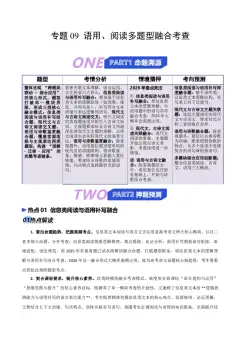
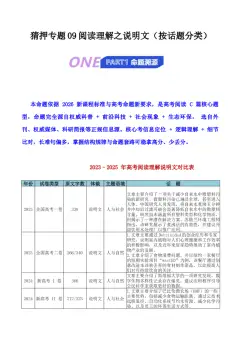
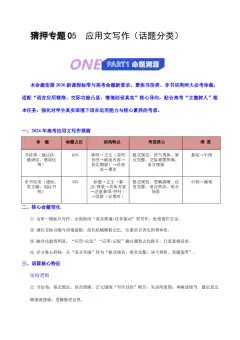
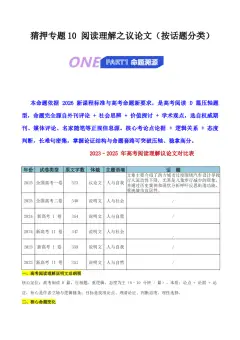
猜押热点专题02
2026 高考英语阅读理解A 篇预测新增考点
非连续性文本
简单来说,非连续性文本就是不是以完整、连贯的大段文字叙述为主,而是用多种形式组合呈现信息
的文本。
它的核心特点:
① 不连续、碎片化,信息分散在不同板块
② 多以直观、简洁的方式传递内容
③ 常和图表、数据、标识结合在一起
常见类型
① 图表类:统计图、表格、柱状图、折线图、饼图
② 标识类:路标、说明书、菜单、价目表、海报
③ 信息类:广告、时刻表、地图、流程图、简历
④ 生活类:药品说明书、快递单、购票信息、使用手册
和连续性文本的区别
连续性文本:记叙文、议论文、散文、小说等,句子连贯、段落完整,按顺序阅读。
非连续性文本:信息不连贯,需要读者筛选、整合、对比、归纳来理解。
主要用途
① 提取关键信息
② 看懂图表数据
③ 对比分析信息
④ 解决实际生活问题
根据《普通高中英语课程标准(2017 年版 2025 年修订)》的要求,2026 年高考英语阅
读理解A 篇对 “非连续性文本 / 多模态文本” 的核心修订要点有以下变化:
一、语篇形态:从纯文本 → 图文 / 多源复合
A 篇固定为多模态应用文
主体:非连续性文本(图表、表格、数据、流程图、时刻表、海报、网页片段)
形式:文字 + 图片 + 符号 + 版式复合呈现
典型组合:活动通知 / 广告 / 指南 + 数据 / 日程 / 地图 / 票价表
删除低频次纯文本(菜单、食谱等),新增新媒体类(网页、公众号推文、短评)
二、能力要求:从 “信息查找” → “读 + 看 + 整合”
新课标在 “语言能力” 中明确新增:
判断多模态语篇中画面、图像、声音、符号、色彩等非文字材料传达的意义
A 篇考查重点升级为:
读图 / 读表能力:从柱状图、折线图、表格中提取数据、对比、趋势、极值
跨模块信息匹配:文字描述
 图表数据
 图示信息 互证、互查、定位
↔
↔
非文字符号解读:图标、箭头、编号、高亮、版式、字体、颜色的功能与含义
多源信息快速筛选:在碎片化信息中定位关键词、排除干扰、精准匹配
三、命题特征(2026 高考 A 篇)
主题:人与社会 / 人与自我(活动、旅游、服务、课程、公告、招聘)
体裁:应用文(广告 / 指南 / 通知 / 行程 / 手册 / 网页)
模态组合(高频)
文字 + 数据表格 / 对比表
文字 + 行程 / 时刻表 / 流程图
文字 + 地图 / 路线图 / 标识图示
文字 + 海报 / 宣传页 / 网页截图
题干设计
直接信息题:图文双证定位(Where / When / How much / Who)
图表理解题:What can we learn from the table / graph?
信息比对题:Which is true / false according to Text 1 & Chart?
目的 / 意图题:What’s the purpose of the poster / text?
四、与旧课标核心差异
表格
维度
2020 版课标
2025 版课标(2026 高考)
A 篇定位
简单应用文(纯文本为主)
多模态 / 非连续性文本专属考查
图文关系
图为辅、可有可无
图 = 关键信息载体,答案常藏于图中
能力要求
读文字、找细节
读 + 看 + 整合 + 推断(数字化媒介素养)
情境
简化虚构
真实生活场景(网页、海报、票务、课程)
五、备考核心方向
① 专项训练 “图文互查”:看到图表先标标题、单位、极值、对比项
② 熟悉高频模态:表格、柱状图、折线图、流程图、地图、日程、网页
③ 提速技巧:先题后文→定位关键词→图文双核对
④ 主题覆盖:活动、旅游、课程、服务、招聘、公告、票务等

预测考点1:国际旅行购票信息

Travel Ticket Information for Students Going Abroad
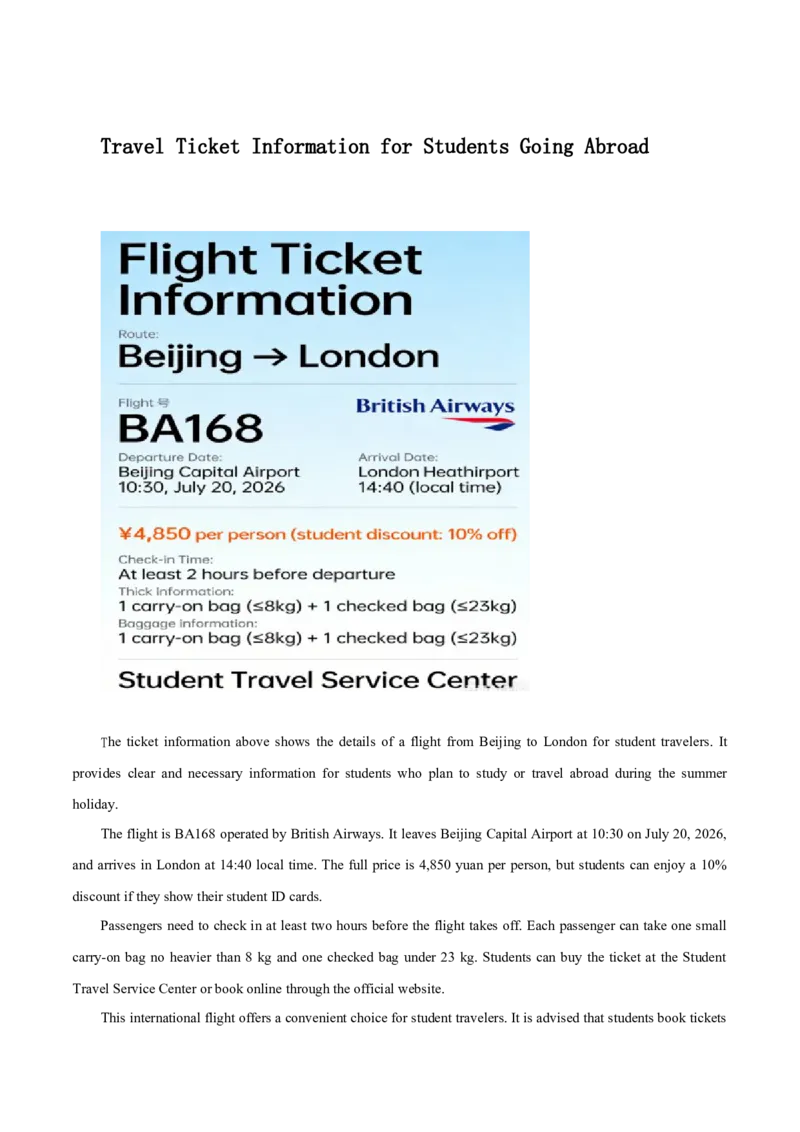
The ticket information above shows the details of a flight from Beijing to London for student travelers. It
provides clear and necessary information for students who plan to study or travel abroad during the summer
holiday.
The flight is BA168 operated by British Airways. It leaves Beijing Capital Airport at 10:30 on July 20, 2026,
and arrives in London at 14:40 local time. The full price is 4,850 yuan per person, but students can enjoy a 10%
discount if they show their student ID cards.
Passengers need to check in at least two hours before the flight takes off. Each passenger can take one small
carry-on bag no heavier than 8 kg and one checked bag under 23 kg. Students can buy the ticket at the Student
Travel Service Center or book online through the official website.
This international flight offers a convenient choice for student travelers. It is advised that students book tickets
early to get better prices and prepare all required documents in advance to make the trip smooth and enjoyable.
1.
What is the flight number from Beijing to London?
A. BA186   B. BA168   C. BA861   D. BA681
2.
When will the flight depart from Beijing?
A. 10:30, July 20    B. 14:40, July 20    C. 10:30, July 14    D. 14:40, July 10
3.
How much discount can students get?
A. 5% off   B. 10% off    C. 15% off    D. 20% off
4.
What is the weight limit for the checked bag?
A. ≤8 kg    B. ≤18 kg   C. ≤23 kg    D. ≤28 kg
5.
What is the writer’s suggestion for students?
A.Book tickets at the last minute.
B.Take as many bags as possible.
C.Prepare documents ahead of time.
D. Buy tickets without student ID.
预测考点2:网页截图阅读
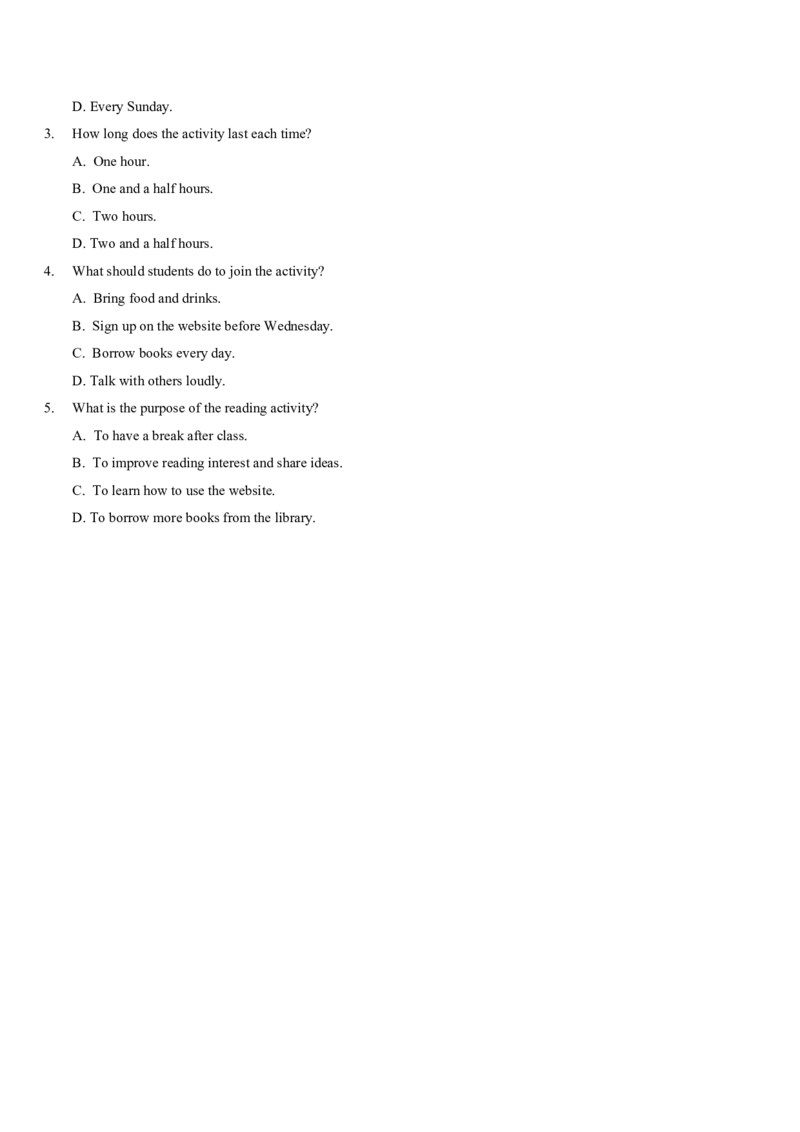
School Library After-school Reading Activity
This web page shows the online notice about the after-school reading activity in our school library. It offers
clear information for students who love reading and want to take part in group reading activities.
The reading activity is held every Friday from 4:00 pm to 5:30 pm in the school library reading room. Its main
purpose is to help students develop their reading interest and share ideas with each other.
To take part in this activity, students need to sign up on the library website before Wednesday every week.
There are also some basic rules for all members. Everyone should keep quiet and not bring food or drinks into the
reading room. Besides, it is important to borrow and return books on time.
This activity provides a wonderful chance for students to read more and make new friends with the same
interest. All book lovers are welcome to join it.
1.
Where can we get the information about the reading activity?
A. From a storybook.
B. From a school library website.
C. On a classroom notice.
D. In a newspaper.
2.
When is the reading activity held?
A. Every Monday.
B. Every Wednesday.
C. Every Friday.
D. Every Sunday.
3.
How long does the activity last each time?
A. One hour.
B. One and a half hours.
C. Two hours.
D. Two and a half hours.
4.
What should students do to join the activity?
A. Bring food and drinks.
B. Sign up on the website before Wednesday.
C. Borrow books every day.
D. Talk with others loudly.
5.
What is the purpose of the reading activity?
A. To have a break after class.
B. To improve reading interest and share ideas.
C. To learn how to use the website.
D. To borrow more books from the library.
预测考点3:社交媒体帖子
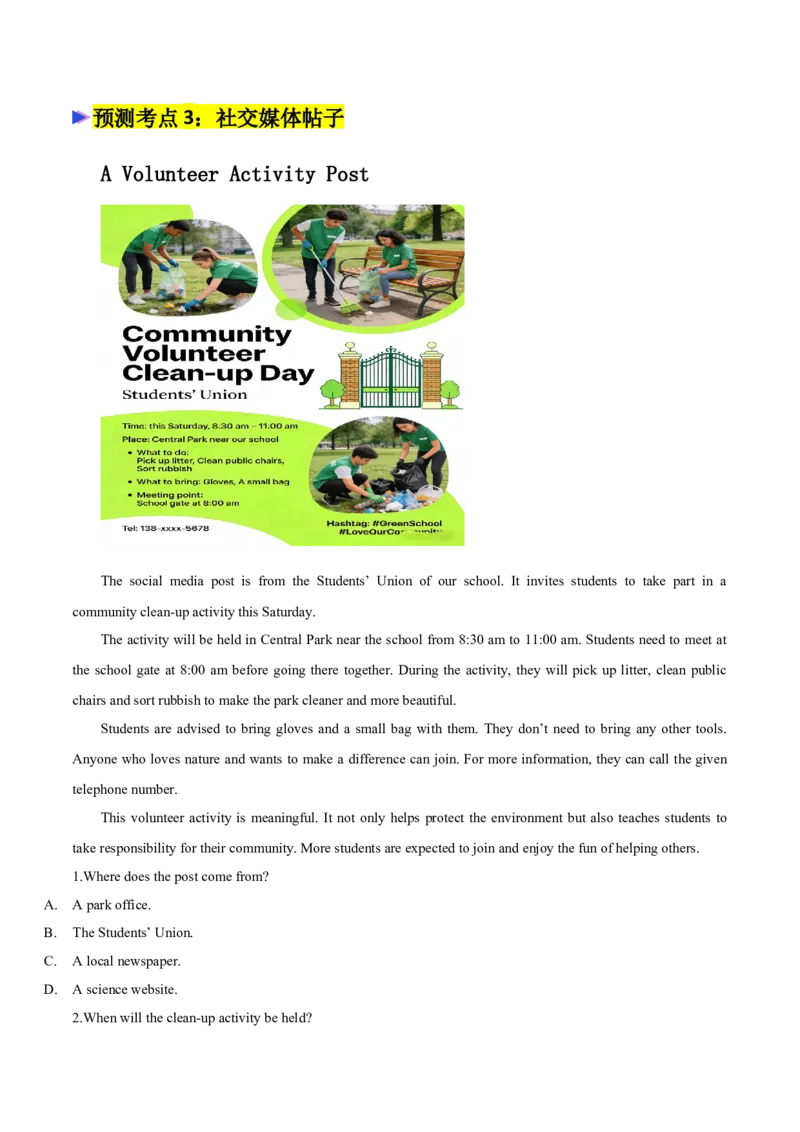
A Volunteer Activity Post
The social media post is from the Students’ Union of our school. It invites students to take part in a
community clean-up activity this Saturday.
The activity will be held in Central Park near the school from 8:30 am to 11:00 am. Students need to meet at
the school gate at 8:00 am before going there together. During the activity, they will pick up litter, clean public
chairs and sort rubbish to make the park cleaner and more beautiful.
Students are advised to bring gloves and a small bag with them. They don’t need to bring any other tools.
Anyone who loves nature and wants to make a difference can join. For more information, they can call the given
telephone number.
This volunteer activity is meaningful. It not only helps protect the environment but also teaches students to
take responsibility for their community. More students are expected to join and enjoy the fun of helping others.
1.Where does the post come from?
A.
A park office.
B.
The Students’ Union.
C.
A local newspaper.
D.
A science website.
2.When will the clean-up activity be held?
A. Next Sunday.
B. This Saturday.
C. Every Friday.
D. On weekdays.
3.Where will students meet first?
A. At Central Park.
B. In the classroom.
C. At the school gate.
D. In the library.
4.What do students need to bring?
A. Drinks and food.
B. Gloves and a small bag.
C. Different rubbish.
D. Public chairs.
5.What is the purpose of the activity?
A. To have fun in the park.
B. To clean the community and learn responsibility.
C. To make new friends online.
D. To learn how to use social media.
预测考点4:书籍短评阅读
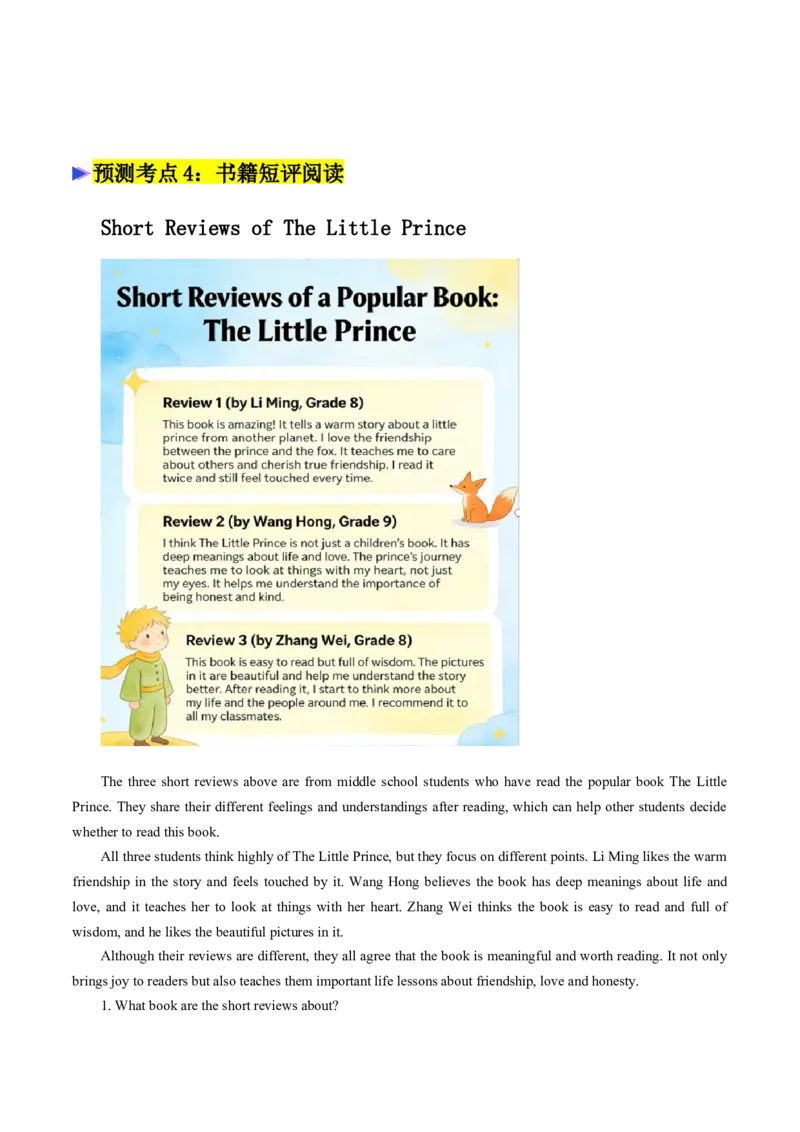
Short Reviews of The Little Prince
The three short reviews above are from middle school students who have read the popular book The Little
Prince. They share their different feelings and understandings after reading, which can help other students decide
whether to read this book.
All three students think highly of The Little Prince, but they focus on different points. Li Ming likes the warm
friendship in the story and feels touched by it. Wang Hong believes the book has deep meanings about life and
love, and it teaches her to look at things with her heart. Zhang Wei thinks the book is easy to read and full of
wisdom, and he likes the beautiful pictures in it.
Although their reviews are different, they all agree that the book is meaningful and worth reading. It not only
brings joy to readers but also teaches them important life lessons about friendship, love and honesty.
1. What book are the short reviews about?
A. Harry Potter    B. The Little Prince     C. Tom Sawyer    D. Alice in Wonderland
2. Who wrote the first review?
A. Li Ming.    B. Wang Hong.    C. Zhang Wei.    D. The writer.
3. What does Li Ming like most about the book?
A. The beautiful pictures.     B. The deep meanings about life.
C. The friendship between the prince and the fox.    D. The easy language.
4. What does Wang Hong learn from the book?
A. To care about others.        B. To look at things with her heart.
C. To read more books.        D. To make more friends.
5. What do all three students agree on?
A. The book is difficult to read.    B. The book is meaningless.
C. The book is worth reading.      D. The book has no pictures.
预测考点5:APP 界面信息
English Learning Go App
The picture shows the main interface of English Learning Go, a popular English study app for middle school
students. It clearly records students’ daily learning progress and helps them form good learning habits.
The user of the app is Li Hua from Grade 8. Today he has spent 45 minutes studying English and learned 32
new words. He has finished three tasks: word memory, short listening practice and daily reading. However, he
hasn’t done the speaking exercise yet.
The app also gives a useful suggestion: Li Hua should review the words he learned in 10 minutes. Besides,
there is a reminder for him to study at least 30 minutes every day to keep improving.
This app makes learning English easier and more convenient. It helps students plan their time well and shows
their progress clearly. More and more students choose to use it to improve their English.
1.
What is the name of the app?
A. English Learning Go   B. English Study Time  C. Word Memory   D. Daily Reading
2.
How long did Li Hua study today?
A. 30 minutes   B. 45 minutes    C. 32 minutes   D. 10 minutes
3.
Which task is NOT finished by Li Hua?
A. Word memory    B. Listening practice   C. Speaking exercise    D. Daily reading
4.
What is the app’s suggestion for Li Hua?
A. Learn more words tomorrow
B. Review words in 10 minutes
C. Stop studying for today
D. Do listening again
5.
What can we know from the text?
A. Li Hua is in Grade 9
.B. The app reminds students to study 10 minutes a day.
B. The app helps students learn English well.
D. Li Hua finished all tasks today.
预测考点6:
网站跟帖
・
/ 评论区
Comments on the School Art Festival
The main post introduces the school art festival held by the Art Club, and the four comments below show
different students’ ideas about this activity.
The art festival will be held on the playground next Friday afternoon. There will be different kinds of shows,
including singing, dancing, painting shows and handicraft shows.
Linda looks forward to the singing shows and plans to go with her friends. Tom is interested in painting shows
and expects more works next time. Anna is a dancer who will take part in the activity and hopes others will come to
support her. Jack thinks the activity is great but wishes it could end earlier.
These comments show students’ great interest in the art festival. It is a good chance for them to enjoy
themselves and show their talents.
1.
Who holds the school art festival?
A. The Sports Club
B. The Art Club
C. The Music Club
D. The Students’ Union
2.
When will the art festival be held?
A. Next Friday morning
B. Next Friday afternoon
C. This Sunday
D. Next Saturday
3.
What shows is Linda looking forward to most?
A. Singing shows
B. Dancing shows
C. Painting shows
D. Handicraft shows
4.
What will Anna do in the art festival?
A. Watch the shows
B. Take photos
C. Dance in the show
D. Paint pictures
5.
What is Jack’s hope for the activity?
A. It can be more interesting
B. It can end earlier
C. There can be more songs
D. It can be held in the hall
预测考点7:校园图书馆布局示意图
 Schematic Diagram: School Library Layout
The schematic diagram above shows the first-floor layout of our school library. It helps students and teachers
find different areas quickly and use the library in a proper way.
When you enter the library, the Borrow & Return Desk is the first counter on your left. On the left side of the
library, there are two areas: the Reading Room for silent reading and the Reference Book Area with textbooks and
dictionaries, which can only be read in the library.
On the right side, you can find the Story Book Area (where you can borrow novels and picture books) and the
Newspaper & Magazine Area. The back area is the Teacher’s Reading Corner, and students are not allowed to go
there.
There are also some basic rules for using the library: no food or drinks, keep quiet, borrow no more than 2
books at a time, and return them within 14 days. Following these rules can make the library a good place for
everyone to read and study.
1. Where is the Borrow & Return Desk?
A. On the right of the entrance.   B. The first counter on the left of the entrance.
C. In the back area.            D. Next to the Story Book Area.
2. Which area is for silent reading?
A. Reference Book Area.   B. Story Book Area.
C. Reading Room.         D. Newspaper & Magazine Area.
3. What can we do in the Reference Book Area?
A. Borrow textbooks.       B. Read dictionaries in the library.
C. Talk with classmates.     D. Borrow picture books.
4. Which area is not open to students?
A. Teacher’s Reading Corner.     B. Story Book Area.
C. Reading Room.             D. Newspaper & Magazine Area.
5. How many books can students borrow at most once?
A. 1.    B. 2.    C. 3.    D. 4.
预测考点8:柱状图
The bar chart clearly illustrates the average number of hours that junior high school students spend on four
different kinds of after-school activities every week, including sports, homework, reading, and screen time. The
data provides a direct and visual reflection of how students arrange their spare time after class, which can help us
understand their daily life and study habits better.
According to the chart, students spend the most hours on homework every week, reaching 15 hours. It is not
surprising because homework is the main task for students, and they have to spend plenty of time finishing it to
improve their study. Next comes screen time, which includes using mobile phones, watching TV, and playing
computer games, taking up 12 hours per week. Many students are interested in digital products, so they often use
electronic devices to relax in their free time.
Sports is also an important part of students’ after-school life, with 10 hours every week. Doing sports not only
helps students keep healthy but also releases pressure from study. However, the time spent on reading is the lowest
among the four activities, only 6 hours per week. It seems that students do not pay much attention to reading in
their spare time, and fewer of them take reading as a regular hobby.
In general, homework and screen time take up most of students’ after-school hours, while reading receives the
least attention. To live a healthier and more meaningful life, students should reduce unnecessary screen time and
spend more time reading. At the same time, keeping doing sports regularly can help them stay energetic both in
body and mind.
1.Which activity takes students the most time every week?
A. Sports.    B. Homework.   C. Screen time.    D. Reading.
2.How many hours do students spend on reading in a week?
A. 6 hours.   B. 10 hours.   C. 12 hours.   D. 15 hours.
3.Why do many students use electronic devices in their free time?
A.To finish homework quickly.     B.To improve their reading skills.
C.To relax themselves.            D. To do more exercise.
4.What can we infer from the text?
A.Students have already had a healthy daily habit.
B.Most students have formed the hobby of reading.
C.Doing sports helps students feel less stressed from study.
D.Students spend more time reading than doing sports.
5.What is the main purpose of the text?
A.To show how students use their after-school time.
B.To tell students to spend more time on digital products.
C.To explain why homework takes so much time.
D.To introduce different kinds of after-school activities.
预测考点9:饼图
The pie chart shows how middle school students divide their daily 60-minute exercise time among four
different activities: running, ball games, yoga & stretching, and walking. It helps us learn about students’ daily
sports choices and healthy living habits.
According to the chart, ball games take up the largest part of daily exercise time, 24 minutes, which is 40% of
the total. Many students love basketball, football and badminton, so they spend much time on ball games.
Running is the second most popular activity, making up 30% of the time. That is 18 minutes a day. It is easy to
do and helps students build up their body. Walking takes up 20%, about 12 minutes, as many students walk to
school or walk after meals. Yoga and stretching have the smallest share, only 10% (6 minutes), because fewer
students choose these gentle activities.
In general, most students prefer active sports such as ball games and running. To keep in better health,
students are advised to keep doing exercise every day and try different kinds of sports.
1.Which activity takes up the most exercise time?
A. Walking.    B. Running.    C. Ball games.    D. Yoga.
2.How long do students spend running every day?
A. 6 minutes.    B. 12 minutes.  C. 18 minutes.   D. 24 minutes.
3.What is the writer’s suggestion?
A.Give up all gentle sports.
B.Keep exercising and try different sports.
C.Only focus on running and walking.
D. Spend more time on study instead of sports.
预测考点10:趋势图(折线图)
Line Chart 趋势图
Students’ Labor Education and Life Skills Development
The line chart shows the changes in students’ labor education comprehensive scores from 2022 to 2025. The
scores cover three parts: housework participation, sense of responsibility and basic life skills.
In 2022, the average score was only 55. Many students paid little attention to housework and lacked
independent living abilities. As labor education was widely carried out in schools, students’ awareness began to
improve greatly. The score rose to 65 in 2023 and increased to 78 in 2024.
In 2025, the score reached 89, showing a clear upward trend. More students are willing to take on housework,
look after family members and finish daily tasks on their own. They have learned to cook, tidy up and solve simple
life problems by themselves.
The rising trend means that students are becoming more responsible and independent. Labor education not
only improves their life skills but also helps them understand the value of hard work. It is strongly suggested that
teenagers should keep taking part in labor activities to become more capable and responsible.
1.
What does the line chart mainly show?
A. Students’ daily exercise time.
B. The development of students’ labor education scores.
C. Different kinds of housework students do.
D. Ways to improve students’ study habits.
2.
What was the average score in 2022?
A. 55.    B. 65.    C. 78.   D. 89.
3.
What can we learn about the scores from 2022 to 2025?
A. They fell slowly.
B. They kept rising.
C. They stayed the same.
D. They changed up and down.
4.
Which of the following is NOT included in the score?
A. Housework participation.
B. Sense of responsibility.
C. Life skills.
D. Exam grades.
5.
What is the writer’s purpose in writing the text?
A. To advise students to take part in labor and be more responsible.
B. To show how to get higher scores in exams.
C. To explain why students dislike doing housework.
D. To introduce after-school activities for students.
预测考点11:海报
Poster:English Volunteer Service Recruitment
The poster above shows the details of the English volunteer service recruitment for middle school students.
This activity is held to help students improve their oral English skills, develop a sense of responsibility and promote
cross-cultural communication between Chinese and foreign friends.
The recruitment lasts from June 1 to June 15, 2026, and the service time is from July 1 to July 30. Volunteers
need to work 3 hours a day, 5 days a week. Before the official service, all volunteers must take part in a training
program from June 20 to June 25 to master basic service skills and communication skills.
To join the volunteer service, students must be in Grade 7 to 9, have good oral English and be responsible,
patient and friendly. The main service contents include guiding foreign guests to visit, helping them solve
communication problems and introducing Chinese culture and campus life in English.
This volunteer service is a good chance for students to practice English in real life. It not only helps them
improve their communication ability but also lets them learn to take responsibility and understand different
cultures. All qualified students are welcome to apply.
1. What is the theme of the English volunteer service?
A. Improving students’ exam scores.
B. Assisting foreign guests and promoting cross-cultural communication.
C. Organizing after-school activities for students.
D. Helping students learn Chinese culture.
2. How long does the recruitment last?      A. 5 days.   B. 15 days.    C. 30 days.   D. 6 days.
3. What is a necessary requirement for volunteers?
A. Being in Grade 10.             B. Having good written English.
C. Being responsible and friendly.   D. Having foreign friends.
4. When will the volunteer training be held?
A. June 1–June 15.       B. July 1–July 30.     C. June 20–June 25.          D. July 20–July 25.
5. What can students get from the volunteer service?
A. A lot of money.           B. Improved oral English and a sense of responsibility.
C. A chance to travel abroad.   D. Better exam results.
预测考点12:跨境合作协议条款
A Cross-border Education Cooperation Agreement
The agreement above is a cross-border education cooperation agreement between China No.2 Middle School
and London West High School in the UK. It aims to promote cultural and educational exchange between the two
schools and help students and teachers learn from each other.
The cooperation will last for 3 years, from September 1, 2026 to August 31, 2029. There are three main parts
of the cooperation. First, 10 students from each school will have an exchange program every year, and each
exchange will last for 2 weeks. Second, 5 teachers from each school will visit the other school and give lessons for
one month annually. Third, the two schools will share online courses, including English, History and Art.
According to the agreement, each school will pay for its own students’ and teachers’ travel and
accommodation costs. For more information about the cooperation, people can contact Ms. Wang from China No.2
Middle School or Mr. Brown from London West High School.
This cross-border cooperation is meaningful. It not only helps students experience different cultures but also
improves teachers’ teaching skills. It builds a bridge between the two schools and promotes international
educational exchange.
1. Which two schools sign the cooperation agreement?
A. China No.1 Middle School and London East High School.
B. China No.2 Middle School and London West High School.
C. China No.2 Middle School and Paris High School.
D. China No.3 Middle School and London West High School.
2. How long will the cooperation last?
A. 1 year.   B. 2 years.   C. 3 years.   D. 4 years.
3. How many students will exchange every year from each school?
A. 5.   B. 10.   C. 15.   D. 20.
4. What kind of courses will the two schools share?
A. English, Math and Art.     B. English, History and Art.
C. Math, History and Music.   D. English, Science and Art.
5. Who will pay for the students’ travel fees?
A. China No.2 Middle School.         B. London West High School.
C. Each school pays for its own students. D. The two schools share the cost together.
预测考点13:·国际组织官方网站内容
The above content is from the official website of the Global Education Aid Organization (GEAO), an
international non-profit group focusing on global education equity. Its official website is designed to let people
know about its missions, projects and ways to participate, so as to attract more support from all over the world.
GEAO has been working for nearly 20 years to help students and teachers in poor areas. Its core missions
include providing learning materials, training teachers and building schools. At present, it has two key projects:
building primary schools in Africa and training teachers in Southeast Asia.
People around the world can help GEAO in two ways: donating money or volunteering. The minimum
donation is $10, which will be used to buy textbooks and build school buildings. Volunteers need to be over 18
years old and serve for 1-3 months in poor areas. For more details, people can contact GEAO through the email,
phone or official website provided.
1. When was GEAO founded?
A. In 2000.    B. In 2005.    C. In 2010.    D. In 2020.
2. Which of the following is NOT a core mission of GEAO?
A. Providing free textbooks.
B. Training local teachers.
C. Building universities.
D. Building primary schools.
3. How long will the Africa Primary School Building Project last?
A. 1 year.    B. 2 years.   C. 3 years.   D. 4 years.
4. What is the minimum donation to GEAO?
A. $5.   B. $10.    C. $15.    D. $20.
5. Who can be a volunteer for GEAO?
A. A 16-year-old student.
B. A 19-year-old college student.
C. A 17-year-old high school student.
D. A 15-year-old teenager.
预测考点14:学术论文摘要
The above content is the abstract of an academic paper published in the Journal of Middle School Education. It
briefly introduces the research purpose, research objects, research process and research conclusions of the paper.
The abstract is a core part of an academic paper, which can help readers quickly understand the main content of the
paper without reading the full text. This study focuses on the impact of after-school reading on middle school
students’ language ability, providing a useful reference for middle school English teaching and students’ self-
improvement.
1.What is the main purpose of the study?
A. To explore the relationship between after-school reading and students’ math ability
B. To explore the relationship between after-school reading and students’ language ability
C. To study the impact of homework on students’ language ability
D. To study the difference between the experimental group and the control group
2.How many students were selected as research objects?
A. 100 B. 200 C. 300 D. 400
3.How long did the study last?
A. 1 month B. 2 months C. 3 months D. 4 months
4.What was the average score increase of the experimental group?
A. 5% B. 10% C. 15% D. 20%
5.Which of the following is NOT a benefit of regular after-school reading?
A. Improving vocabulary accumulation
B. Enhancing reading comprehension
C. Improving writing ability
D. Reducing study pressure