初中英语常见动词短语归纳
 A)动词+ 介词
    agree with 同意......的意见(想法);符合
    base on 以......(为)根据
    listen to 听......
    get to 到达......
    fall off (从......)掉下
    help ... with ...帮助(某人)做(某事)
    knock at /on 敲(门、窗)
    laugh at 嘲笑
    learn ... from ...向......学习
    live on 继续存在;靠......生活
    look after 照顾,照看
    look at 看;观看
    look for 寻找
    look like 看起来像
    pay for (sth.)付钱;支付
    point at 指示;指向
    point to 指向......
    prefer to ...宁愿(选择);更喜欢
    quarrel with (和某人)吵架
    regard ... as ...把......当作......;当作
    stop ... from 阻止......做......
    talk about 说话;谈话;谈论
    talk with 与......交谈
    think about 考虑
    think of 认为;想起
    B)动词+ 副词
    ask for 请求;询问
    carry on 坚持下去;继续下去
    cut down 砍倒
    clean up 清除;收拾干净
    come down 下来;落
    come along 来;随同
    come in 进来
    come on 来吧;跟着来;赶快
    come out 出来;出现;(花)开;发(芽)
    come over 过来;顺便来访
    drop off 放下(某物);下车
    eat up 吃光;吃完
    fall behind 落在......后面;输给别人
    fall down 跌倒;从......落下
    find out 查出(真相)
    get back 回来;取回
    get down 下来;落下;把......取下来
    get off 下来;从......下来
    get on 上(车)
    get up 起床
    give up 放弃
    go on 继续
    go out 出去
    go over 过一遍;仔细检查
    grow up 长大;成长
    hand in 交上来
    hold on (口语)等一等; (打电话时)不挂断
    hurry up 赶快
    look out 留神;注意
    look over (仔细)检查
    look up 向上看;抬头看
    pass on 传递;转移到......
    pick up 拾起;捡起
    put away 放好;把......收起来
    put on 穿上;戴上;(戏剧等)上演;放(唱片等)
    put down 把(某物)放下来
    put up 挂起;举起
    run away 流失;逃跑;逃走
    rush out 冲出去
    set off 出发;动身;启程
    send up 发射;把......往上送
    shut down 把......关上
    sit down 坐下
    slow down 减缓;减速
    take off 脱掉(衣服)
    take out 取出
    throw about 乱丢;抛撒
    trip over (被......)绊倒
    try on 试穿(衣服、鞋等);试戴(帽子等)
    try out 试验;尝试
    turn down 关小;调低
    turn on 打开(电灯、收音机、煤气、自来水等)
    turn off 关(电灯、收音机、煤气、自来水等)
    turn over (使)翻过来
    wake up 醒来
    wear out 把......穿旧;磨坏
    work out 算出;制订出
    write down 写下......
    C) be + 形容词+ 介词
    be angry with 对(某人)发脾气
    be interested in 对......感兴趣
    be able to 能;会
    be afraid of 害怕
    be amazed at 对......感到惊讶
    be excited about 对......感到兴奋
    be filled with 用......充满
    be full of 充满......的
    be good at (= do well in )在......方面做得好;善于
    be late for 迟到
    be made in 在......生产或制造
    be made of 由......组成;由......构成
    be pleased with 对......感到满意
    be proud of 以......自豪(高兴)
    be used for 用于
    D)动词+ 名词/ 代词
    beg one\'s pardon 请原谅;对不起
    do morning exercises 做早操
    do one\'s homework 做作业
    enjoy oneself (= have a good time)过得快乐;玩得愉快
    give a concert 开音乐会
    go boating 去划船
    go fishing 去钓鱼
    go hiking 去徒步旅行
    go skating 去滑冰
    go shopping (去)买东西
    have a cold (患)感冒
    have a cough (患)咳嗽
    have a headache (患)头痛
    have a try 尝试;努力
    have a look 看一看
    have a rest 休息
    have a seat (= take a seat ) 就坐;坐下
初中英语常用动词短语
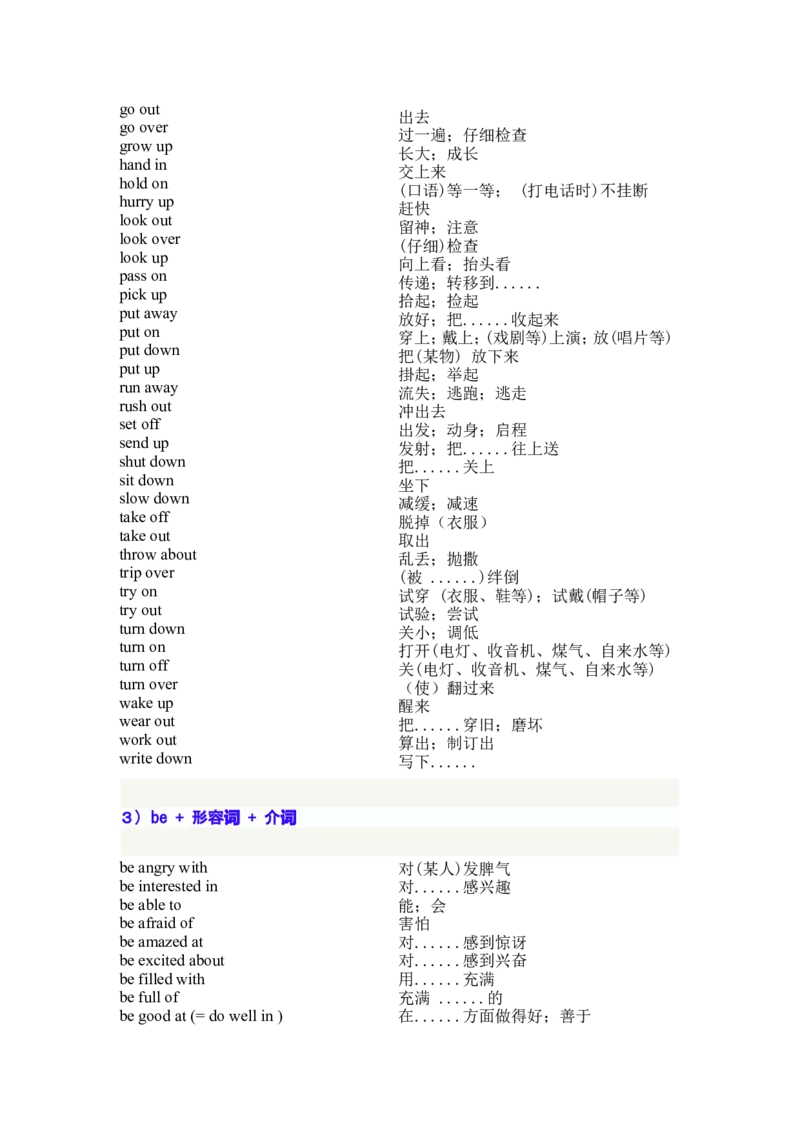
1)

动词+ 介词
agree with
base on
同意......的意见(想法);符合
以......(为)根据
listen to
get to
fall off
help ... with ...
knock at /on
laugh at
learn ... from ...
live on
look after
look at
look for
look like
pay for (sth.)
point at
point to
prefer to ...
quarrel with
regard ... as ...
stop ... from
talk about
talk with
think about
think of
听......
到达......
(从......)掉下
帮助(某人)做(某事)
敲(门、窗)
嘲笑
向......学习
继续存在;靠......生活
照顾,照看
看;观看
寻找
看起来像
付钱;支付
指示;指向
指向......
宁愿(选择); 更喜欢
(和某人)吵架
把......当作......;当作
阻止......做......
说话;谈话;谈论

与......交谈
考虑
认为;想起
2)

动词+ 副词
ask for
carry on
cut down
clean up
come down
come along
come in
come on
come out
come over
drop off
eat up
fall behind
fall down
find out
get back
get down
get off
get on
get up
give up
go on
请求;询问
坚持下去;继续下去
砍倒
清除;收拾干净
下来;落
来;随同
进来
来吧;跟着来;赶快

出来 ;出现;(花) 开;发(芽)
过来;顺便来访
放下(某物);下车
吃光;吃完
落在......后面;输给别人
跌倒;从......落下
查出(真相)

回来;取回
下来;落下;把......取下来
下来;从......下来
上(车)
起床
放弃
继续
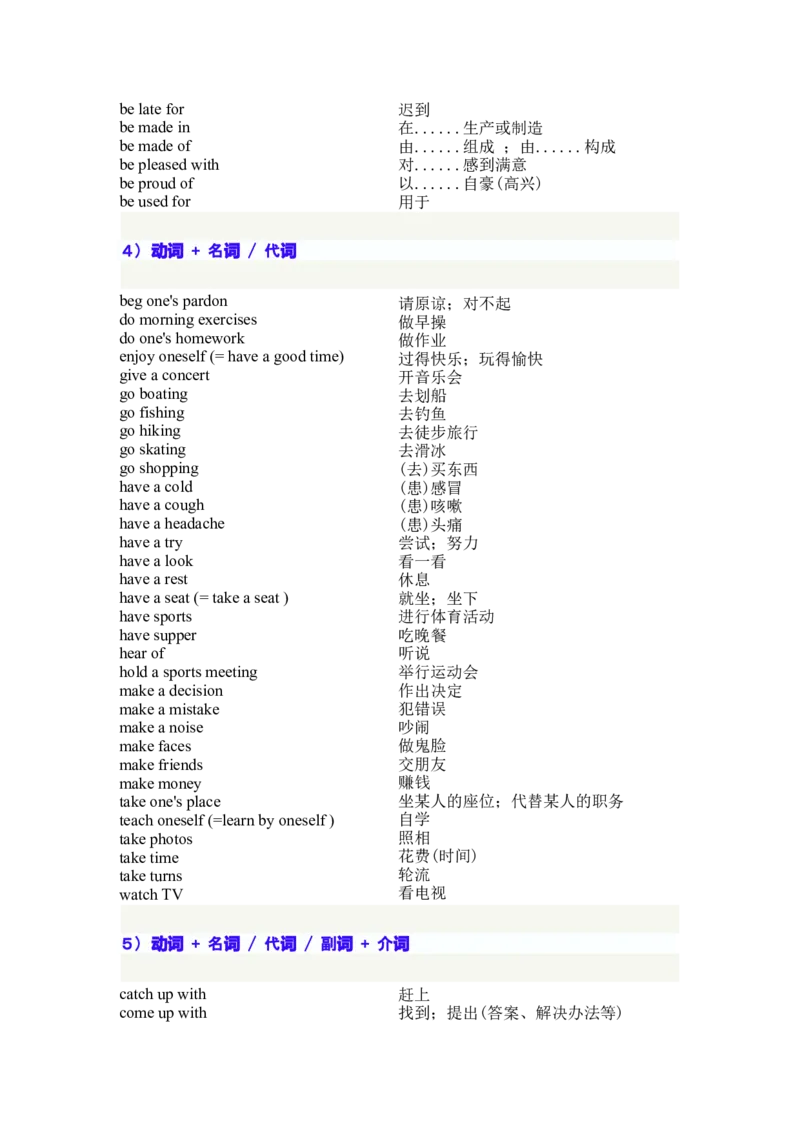
go out
go over
grow up
hand in
hold on
hurry up
look out
look over
look up
pass on
pick up
put away
put on
put down
put up
run away
rush out
set off
send up
shut down
sit down
slow down
take off
take out
throw about
trip over
try on
try out
turn down
turn on
turn off
turn over
wake up
wear out
work out
write down
出去
过一遍;仔细检查
长大;成长
交上来
(口语)等一等; (打电话时)不挂断
赶快
留神;注意
(仔细)检查
向上看;抬头看
传递;转移到......
拾起;捡起
放好;把......收起来
穿上;戴上;(戏剧等)上演;放(唱片等)
把(某物) 放下来
掛起;举起
流失;逃跑;逃走

冲出去
出发;动身;启程

发射;把......往上送
把......关上
坐下
减缓;减速
脱掉(衣服)

取出
乱丢;抛撒
(被 ......)绊倒
试穿 (衣服、鞋等);试戴(帽子等)
试验;尝试
关小;调低
打开(电灯、收音机、煤气、自来水等)
关(电灯、收音机、煤气、自来水等)
(使)翻过来

醒来
把......穿旧;磨坏
算出;制订出
写下......
3) be + 形容

词+ 介词
be angry with
be interested in
be able to
be afraid of
be amazed at
be excited about
be filled with
be full of
be good at (= do well in )
对(某人)发脾气
对......感兴趣
能;会
害怕
对......感到惊讶
对......感到兴奋
用......充满
充满 ......的
在......方面做得好;善于
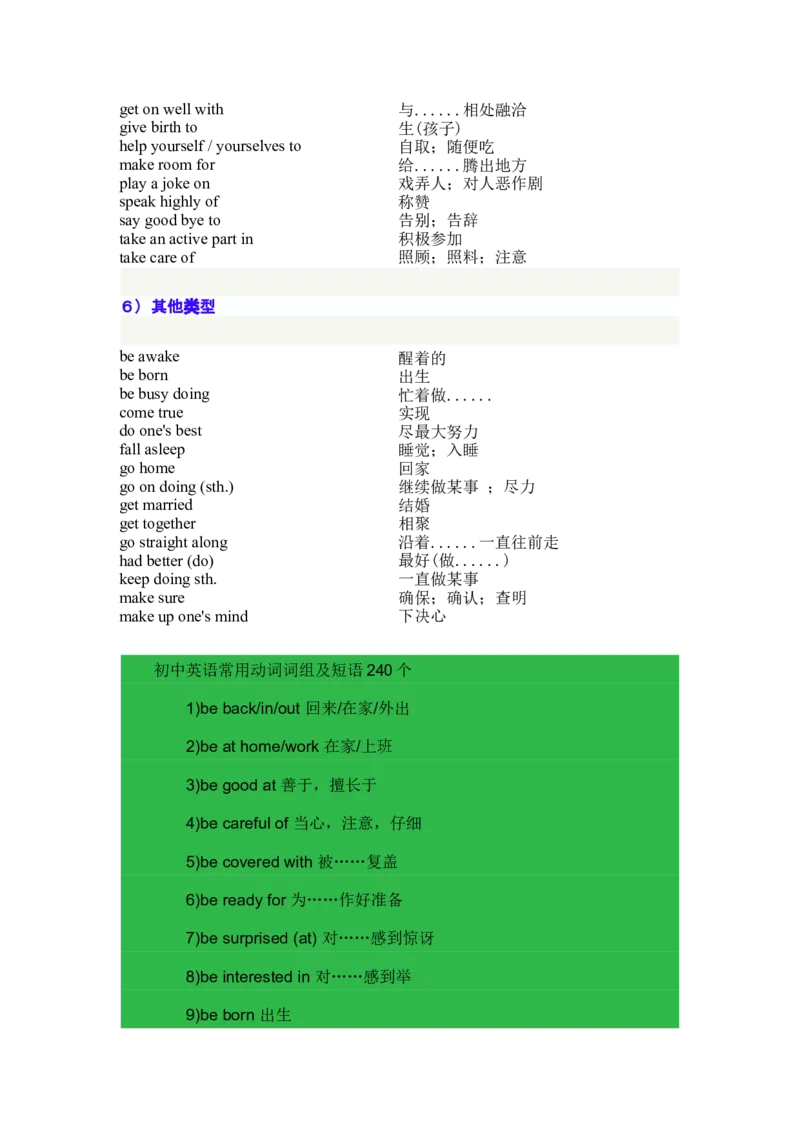
be late for
be made in
be made of
be pleased with
be proud of
be used for
迟到
在......生产或制造
由......组成 ;由......构成
对......感到满意
以......自豪(高兴)
用于
4)

动词+ 名

词/ 代词
beg one's pardon
do morning exercises
do one's homework
enjoy oneself (= have a good time)
give a concert
go boating
go fishing
go hiking
go skating
go shopping
have a cold
have a cough
have a headache
have a try
have a look
have a rest
have a seat (= take a seat )
have sports
have supper
hear of
hold a sports meeting
make a decision
make a mistake
make a noise
make faces
make friends
make money
take one's place
teach oneself (=learn by oneself )
take photos
take time
take turns
watch TV
请原谅;对不起
做早操
做作业
过得快乐;玩得愉快
开音乐会
去划船
去钓鱼
去徒步旅行
去滑冰
(去)买东西
(患)感冒
(患)咳嗽
(患)头痛
尝试;努力
看一看
休息
就坐;坐下
进行体育活动
吃晚餐
听说
举行运动会
作出决定
犯错误
吵闹
做鬼脸
交朋友
赚钱
坐某人的座位;代替某人的职务
自学
照相
花费(时间)
轮流
看电视
5)

动词+ 名

词/ 代

词/ 副

词+ 介词
catch up with
come up with
赶上
找到;提出(答案、解决办法等)
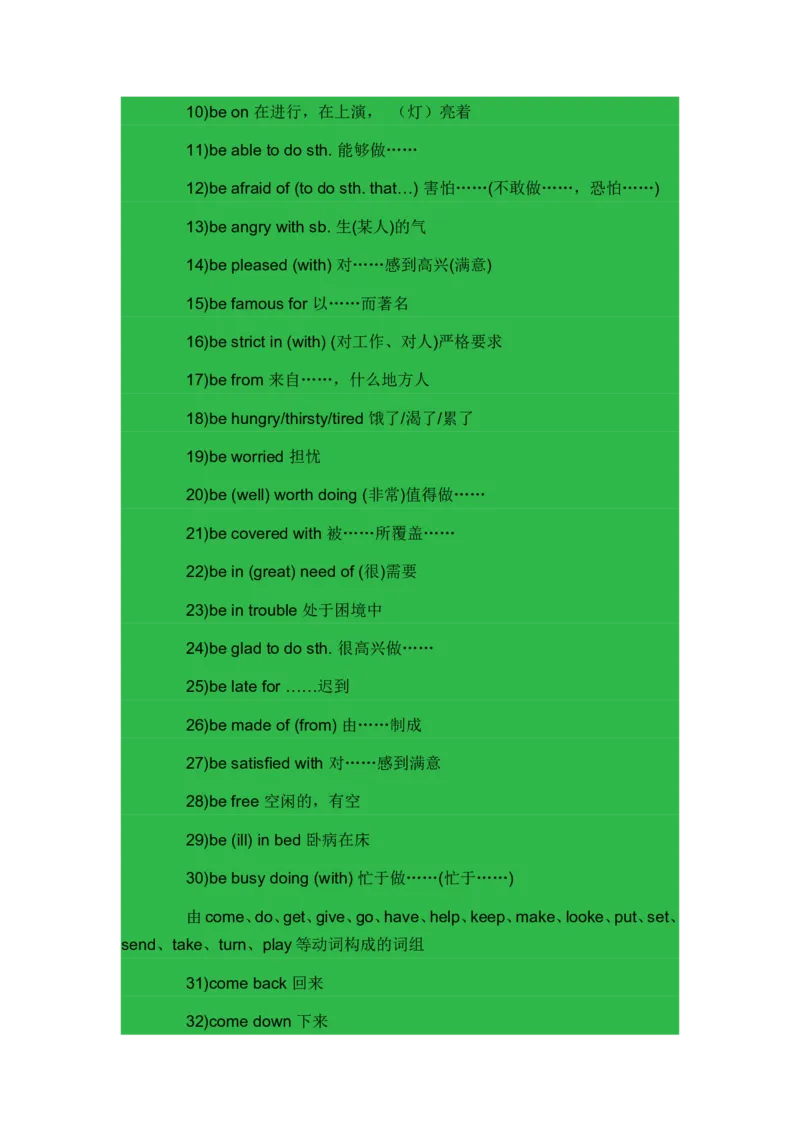
get on well with
give birth to
help yourself / yourselves to
make room for
play a joke on
speak highly of
say good bye to
take an active part in
take care of
与......相处融洽
生(孩子)
自取;随便吃
给......腾出地方
戏弄人;对人恶作剧
称赞
告别;告辞
积极参加
照顾;照料;注意
6) 其他
型
类
be awake
be born
be busy doing
come true
do one's best
fall asleep
go home
go on doing (sth.)
get married
get together
go straight along
had better (do)
keep doing sth.
make sure
make up one's mind
醒着的
出生
忙着做......
实现
尽最大努力
睡觉;入睡
回家
继续做某事 ;尽力
结婚
相聚
沿着......一直往前走
最好(做......)
一直做某事
确保;确认;查明

下决心
初中英语常用动词词组及短语240 个
  1)be back/in/out 回来/在家/外出
  2)be at home/work 在家/上班
  3)be good at 善于,擅长于
  4)be careful of 当心,注意,仔细
  5)be covered with 被……复盖
  6)be ready for 为……作好准备
  7)be surprised (at) 对……感到惊讶
  8)be interested in 对……感到举
  9)be born 出生
  10)be on 在进行,在上演, (灯)亮着
  11)be able to do sth. 能够做……
  12)be afraid of (to do sth. that…) 害怕……(不敢做……,恐怕……)
  13)be angry with sb. 生(某人)的气
  14)be pleased (with) 对……感到高兴(满意)
  15)be famous for 以……而著名
  16)be strict in (with) (对工作、对人)严格要求
  17)be from 来自……,什么地方人
  18)be hungry/thirsty/tired 饿了/渴了/累了
  19)be worried 担忧
  20)be (well) worth doing (非常)值得做……
  21)be covered with 被……所覆盖……
  22)be in (great) need of (很)需要
  23)be in trouble 处于困境中
  24)be glad to do sth. 很高兴做……
  25)be late for ……迟到
  26)be made of (from) 由……制成
  27)be satisfied with 对……感到满意
  28)be free 空闲的,有空
  29)be (ill) in bed 卧病在床
  30)be busy doing (with) 忙于做……(忙于……)
  由come、do、get、give、go、have、help、keep、make、looke、put、set、
send、take、turn、play 等动词构成的词组
  31)come back 回来
  32)come down 下来
  33)come in 进入,进来
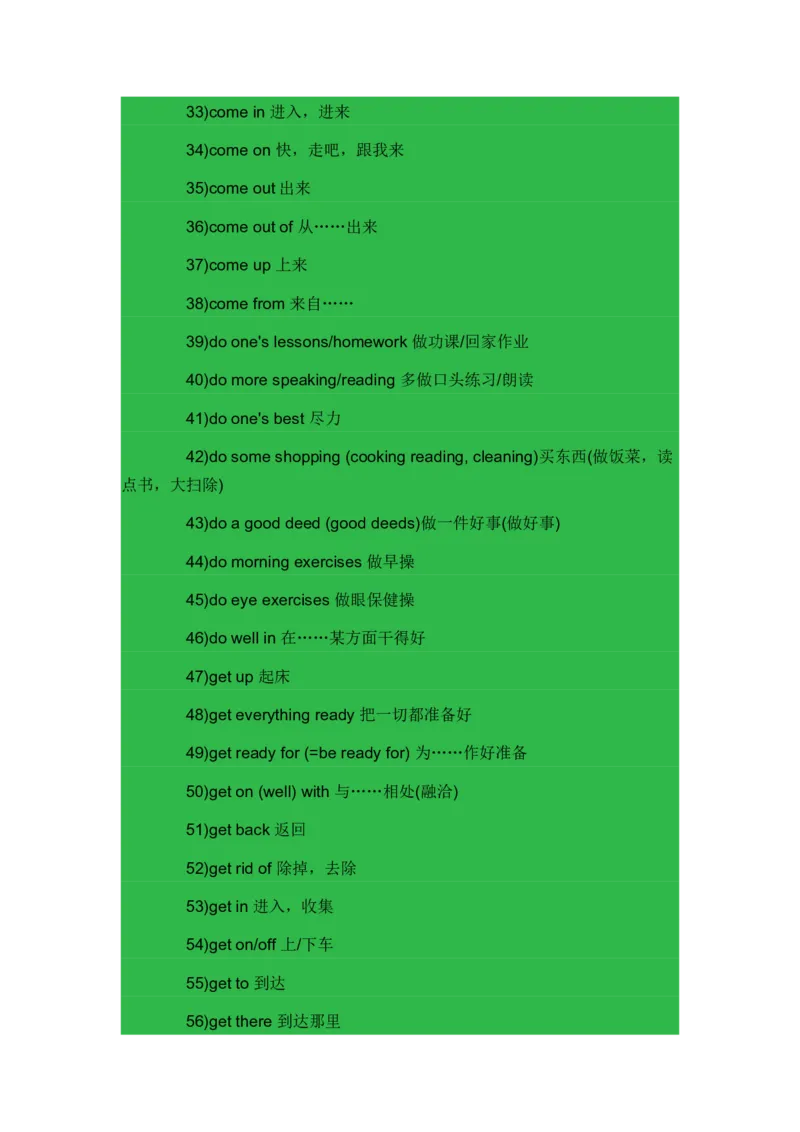
  34)come on 快,走吧,跟我来
  35)come out 出来
  36)come out of 从……出来
  37)come up 上来
  38)come from 来自……
  39)do one's lessons/homework 做功课/回家作业
  40)do more speaking/reading 多做口头练习/朗读
  41)do one's best 尽力
  42)do some shopping (cooking reading, cleaning)买东西(做饭菜,读
点书,大扫除)
  43)do a good deed (good deeds)做一件好事(做好事)
  44)do morning exercises 做早操
  45)do eye exercises 做眼保健操
  46)do well in 在……某方面干得好
  47)get up 起床
  48)get everything ready 把一切都准备好
  49)get ready for (=be ready for) 为……作好准备
  50)get on (well) with 与……相处(融洽)
  51)get back 返回
  52)get rid of 除掉,去除
  53)get in 进入,收集
  54)get on/off 上/下车
  55)get to 到达
  56)get there 到达那里
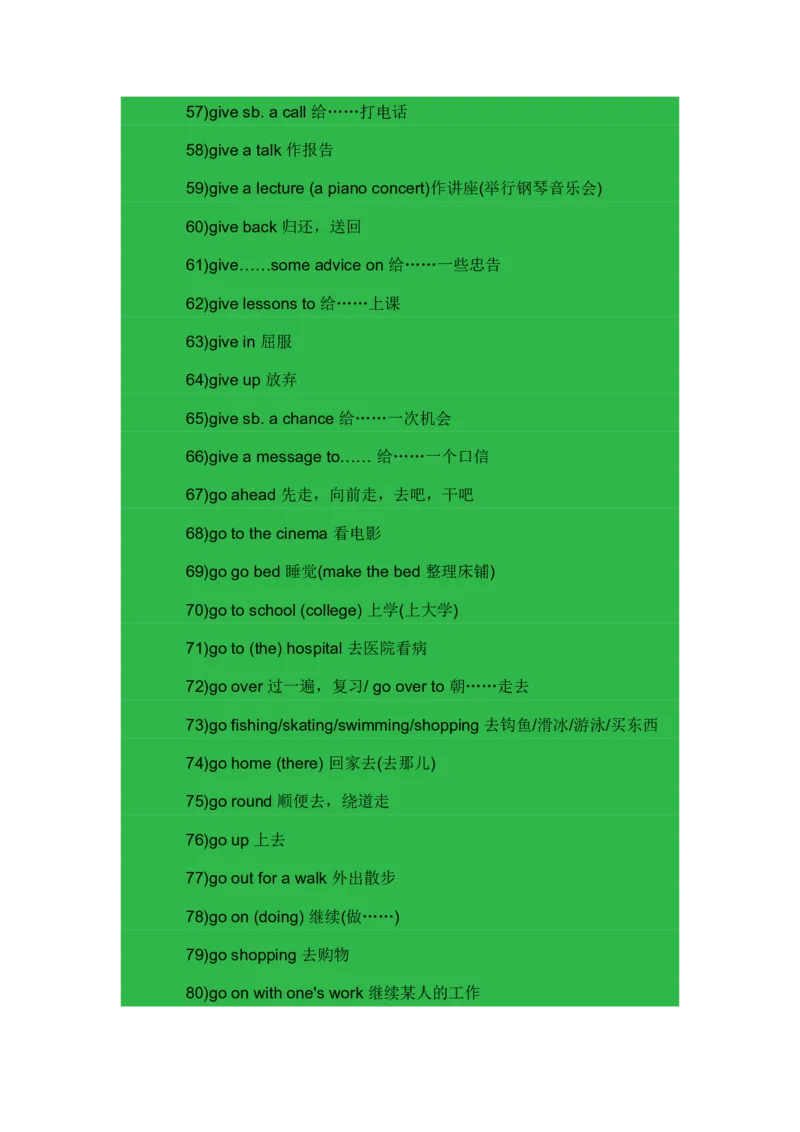
  57)give sb. a call 给……打电话
  58)give a talk 作报告
  59)give a lecture (a piano concert)作讲座(举行钢琴音乐会)
  60)give back 归还,送回
  61)give……some advice on 给……一些忠告
  62)give lessons to 给……上课
  63)give in 屈服
  64)give up 放弃
  65)give sb. a chance 给……一次机会
  66)give a message to…… 给……一个口信
  67)go ahead 先走,向前走,去吧,干吧
  68)go to the cinema 看电影
  69)go go bed 睡觉(make the bed 整理床铺)
  70)go to school (college) 上学(上大学)
  71)go to (the) hospital 去医院看病
  72)go over 过一遍,复习/ go over to 朝……走去
  73)go fishing/skating/swimming/shopping 去钩鱼/滑冰/游泳/买东西
  74)go home (there) 回家去(去那儿)
  75)go round 顺便去,绕道走
  76)go up 上去
  77)go out for a walk 外出散步
  78)go on (doing) 继续(做……)
  79)go shopping 去购物
  80)go on with one's work 继续某人的工作
  81)go upstairs/downstairs 上/下楼
  82)(the lights) go out (灯)熄了
  83)have a lesson (lessons)/a meeting 上课/开会
  84)have a football match (basketball match) 举行一场足球(蓝球)赛
  85)have dictation 听见
  86)have a try 试一试
  87)have a good/wonderful time 玩得很高兴
  88)have a lecture (a piano concert) 听讲座(听钢琴音乐会)
  89)have a report (talk) on 听一个关于……的报告
  90)have a glass of water (a cup of tea) 喝一杯水,(一杯茶)
  91)have breakfast/lunch/supper /dinner 吃早饭/午饭/晚饭
  92)have a meal (three meals) 吃一顿饭(三餐饭)
  93)have bread and milk for breakfast 早饭吃面包和牛奶
  94)have (have got) a headache 头痛
  95)have a fever 发烧
  96)have a cough (a cold) 咳嗽(感冒)
  97)have a look (at) 看一看……
  98)have a rest (a break) 休息一会儿(工间或课间休息)
  99)have a talk 谈话
  100)have a swim/walk 游泳/散步
  101)have sports 进行体育锻炼
  102)have a sports meet (meeting) 开运动会
  103)have something done 让人(请人)做……
  104)have a test/an exam 测验/考试
  105)have an idea 有了个主意
  106)had better do sth. (not do sth.) 最好做……(最好不要做……)
  107)have a word with 与……谈几句话
  108)help sb. with sth. 在……方面帮助……
  109)help sb. (to) do sth. 帮助……做……
  110)help oneself to some chicken/fish/meat 请随便吃点鸡/鱼/肉
  111)help each other 互相帮助
  112)have nothing to do 无事可做
  113)keep up with 跟上……,不落后于……
  114)keep silent/quiet 保持沉默/安静
  115)keep sb. doing sth. 使……一直做……
  116)keep one's diary 记日记
  117)make a noise (a lot of noise, much noise, noises)吵闹(十分嘈杂,
响声)
  118)make a living 谋生
  119)make sb. do sth. 迫使某人做……
  120)make faces (a face)做鬼脸
  121)make friends (with)与……交朋友
  122)make a mistake (mistakes)犯错误
  123)make room/space for 给……腾出地方
  124)make a sentence (sentences)with 用……造句
  125)make a fire 生火
  126)be made from/of 由……制成
  127)be made in 在……地方制造
  128)look out of (outside) 往外看(看外面)
  129)look up a word (in the dictionary) 查字典
  130)look up 往上看,仰望
  131)look after 照管,照看,照顾
  132)look for 寻找
  133)look like 看上去像
  134)look fine/well/tired/worried 看起来气色好/健康/疲劳/忧虑
  135)look out 当心,小心
  136)look on …as… 把……当作……看待
  137)look around 朝四周看
  138)look at 看着……
  139)put on 穿上(衣服),戴上(帽子),上演(戏剧)
  140)put up 建造,搭起,挂起,举起,张帖
  141)put into 使进入,输入
  142)put one's heart into 全神贯注于
  143)put…down… 把……放下
  144)put…into… 把……译成
  145)set up 竖起,建起
  146)set off 出发,动身
  147)set out 出发
  148)set an example for 为……树立榜样
  149)send for 派人去请(叫)
  150)send out 放出,发出
  151)end up 把……往上送,发射
  152)take one's advice 听从某人劝告
  153)take out 拿出,取出
  154)take down 拿下
  155)take place 发生
  156)take one's place 坐……的座位,代替某人职务
  157)take the place of 代替……
  158)take a walk/rest 散步/休息
  159)take it easy 别紧张
  160)take sth.with sb. 随身带着
  161)take sb. to a park/London for one's holidays 带某人去公园/伦敦
度假
  162)take care of 关心,照顾,保管
  163)take a look (a last look) at 看一看(最后看一眼)
  164)take an exam 参加考试
  165)take away 拿走
  166)take back 收回,带回
  167)take hold of 抓住……
  168)take off 脱下(衣,帽,鞋等)拿掉
  169)take (an active) part in (积极)参加(活动)
  170)take photos 拍照
  171)take some medicine 服药
  172)take a bus/train, boat/ 乘公共汽车,火车/船
  173)turn on 开,旋开(电灯,收音机等)
  174)turn off 关上(电灯,收音机等)
  175)turn in 交出,上交
  176)turn…into… 变成
  177)turn to 翻到,转向
  178)turn down (把音量)调低
  179)turn…over 把……翻过来
  180)play basketball 打篮球,football 踢足球,volleyball 打排球
  181)play games 做游戏
  182)play the piano (the violin) 弹钢琴(拉小提琴)
  183)play with snow 玩雪
  184)play a joke (on) 对……开玩笑
  由其他动词构成的词组
  185)think over 仔细考虑
  186)arrive at/in a place 到达某处
  187)eat up 吃完,吃光
  188)do well in 在……干得好
  189)enjoy doing sth. like doing sth. 喜欢做某事 喜欢干某事
  190)find out 发现,查出(真相等)
  191)finish off 吃完,喝完
  192)stop doing sth. 停止做某事
  193)stop to do sth. 停下来去做某事
  194)hold a meting 举行会议
  195)hold up 举起
  196)hurry up 赶快,快点
  197)enter for 报名参加
  198)langht at 嘲笑
  199)be used to 习惯于
  200)used to 过去常常
  201)wake…up 唤醒
  202)work out 算出
  动词短语
  203)ask for 向……要……,请求
  204)ask for leave 请假
  205)send for 派人去请(叫)
  206)pay for 付……的款
  207)wait for 等候
  208)thank for 为……感谢
  209)apologize to sb. for sth. 为某事向某人道歉
  210)look for 寻找
  211)leave…for 离开……去……
  212)fall off 跌落
  213)catch cold 着凉,伤风
  214)catch up with 赶上
  215)agree with sb. 赞成,同意某人的意见
  216)filled……with 把……装满
  217)tell sb. about sth. 告诉某人某事
  218)talk about 谈论……
  219)think about 考虑……
  220)worry about 担忧……
  221)look after 照料
  222)run after 追赶,跟在后面跑
  223)read after 跟……读
  224)smile at 对……微笑
  225)knock at 敲(门、窗)
  226)shout at 对……大喊(嚷)
  227)throw away 扔掉
  228)work hard at 努力做……
  229)wait in line 排队等候
  230)change…into… 变成
  231)hurry into… 匆忙进入
  232)hurry up 快点
  233)run into… 跑进
  234)hear of 听说
  235)hear from 收到……来信
  236)think of 认为,考虑
  237)catch hold of 抓住
  238)instead of 代替……
  239)hand in 交上来
  240)stay in bed 卧病在床
初中英语介词用法总结
介词(preposition):也叫前置词。在英语里,它的搭配能力最强。但不能单独
做句子成分需和名词或代词(或相当于名词的其他词类、短语及从句)构成介词
短语,才能在句中充当成分。
 介词的种类:
 (1)  简单介词:about, across, after, against, among, around, at,
before, behind, below, beside, but, by, down, during, for, from, in, of, on, over,
near, round, since, to, under, up, with 等等。
 (2)  合成介词:inside, into, outside, throughout, upon, without, within
 (3)  短语介词:according to, along with, apart from, because of, in
front of, in spite of, instead of, owing to, up to, with reguard to
 (4)  分词介词:considering, reguarding, including, concerning
 介词短语:
构成例句 介词+名词 We go to school from Monday to Saturday. 介词+代
词 Could you look for it instead of me? 介词+动名词 He insisted on staying
home. 介词+连接代/副词 I was thinking of how we could get there. 介词+不定
式/从句 He gives us some advice on how to finish it.
 介词的用法:
一、介词to 的常见用法
1.动词+to
a)动词+ to
adjust to 适应,
attend to 处理;照料,
agree to 赞同,
amount to 加起来达…,
belong to 属于,
come to 达到,
drink to 为…干杯,
get to 到达,
happen to 发生在某人身上,
hold to 紧握,
lead to 通向,
listen to 听,
occur to 想起,
object to 反对,
point to 指向,
respond to 回答,
refer to 参考;指的是…;涉及,
reply to 回答,
see to 负责,
stick to 坚持,
turn to 求助,
write to 给某人写信。
 b)动词(+sth.)+to+sb.
announce to 通知某人, describe to 向某人描述, explain to 向某人解释,
express to 对某人表达, mention to 提及, nod to 向某人点头, report to 报告, say
to 告知, shout to 对某人大叫, suggest to 对某人提建议,speak to 与某人交谈,
talk to 跟某人谈话, whisper to 和某人低声耳语。

c)动词+sth./sb.+ to +sth./sb.
add to 增加, compare to 比作, carry to 运送至, devote to 致力于,introduce
to 介绍给, invite to 邀请参加, join to 连接到, leave to 委托给,reduce to 下降至,
sentence to 判处, take to 带到。
 2. be +形容词/过去分词+ to
 be alive to 觉察;晓得,
be attentive to 注意;留心,
be awake to 知晓,
be blind to 缺乏眼光,
be close to 紧挨着,
be common to 对某人来说很普通,
be contrary to 违反;反对,
be devoted to 致力,
be deaf to 不愿意听,
be equal to 有…的力量,
be exposed to 暴露;遭受,
be fair to 对…公平,
be familiar to 对某人来说熟悉,
be grateful to 对某人心存感激,
be good to 对…有好处,
be harmful to 对…有危害,
be important to 对…重要,
be kind to 友好对待,
be known to 周知于,
be married to 嫁给,
be moved to 转移到,
be near to 靠近,
be necessary to 对…有必要,
be opposite to 在对面,
be opposed to 反对,
be pleasant to 合某人之意,
be proper to 专属,
be polite to 礼貌待人,
be rude to 粗暴对待,
be relative to 与…有关,
be strange to 不习惯,
be similar to 类似,
be suitable to 适合,
be true to 忠实,
be thankful to 感激,
be useful to 对…有用,
be used to 习惯。
3.to+名词构成的词组
 to a degree 在某种程度上, to date 到现在为止,to one’s feet 跳起来,to
one’s mind 照…看来, to one’s surprise 使…吃惊,to one’s taste 符合胃口, to
oneself 独自享用, to order 定做,to the letter 不折不扣地, to the point 中肯地
 二、at 的常见用法 at 构成的词组比较多,要细心区分。
1.动词+ at
arrive at 抵达,call at 访问某地, catch at(it)当场抓住, come at 攻击, fire at 向…
开火,glance at 瞟一眼, glare at 怒目而视, grieve at 忧伤,knock at 敲,laugh at
嘲笑, look at 看一眼, pull at 拉扯, rejoice at 对…高兴,smile at 向某人微笑,
shoot at 朝…射击, stare at 怒目而视,thrust at 刺向, tear at 撕, tremble at 颤抖,
wonder at 吃惊,work at 工作。
2. be +形容词/过去分词+ at
be angry at 恼怒于, be alarmed at 对…保持警觉,be astonished at 对…吃惊, be
bad at 不擅长, be clever at 对某事很灵巧,be delighted at 高兴,be disgusted at
厌恶, be disappointed at 对…失望,be good at 擅长, be impatient at 对…不够
耐心, be mad at 狂热于,be pleased at 对…感到高兴, be present at 出席, be
satisfied at 满意,be surprised at 吃惊, be shocked at 对…非常震惊,be terrified
at 受到…的恐吓,be quick at 对…很机敏。
3.at+名词构成的词组
at a distance 在一定距离,at a loss 不知所措, at a time 一次,at all 一点也不,
at any cost 不惜一切代价,at best 最好也只是,at first 起初,at hand 手头,at
heart 在内心里,at home 在家;无拘束,at last 最后,at least 至少,at most 最多,
at once 马上,at present 目前。
三、介词on 的常见用法
 on 的用法比较重要,本文介绍它的一些常见用法:
 1.动词+on
 a)动词+ on 要认真区分下面一些词组
 act on 对…有作用, bring on 促使;导致, call on 拜访某人,count on 依赖,
carry on 执行,depend on 取决, feed on 以…为生,figure on 料想;推断, go on 继
续,have on 穿着, insist on 坚持,keep on 继续, lean on 依赖, live on 以…为生,
pull on 迅速穿上,put on 穿上, switch on 接通(电源), take to 喜欢;养成;轻易学
会,turn on 接通(电源), work on 操作, wait on 侍候。
 b)动词+sb.(sth.)+ on +sb.(sth.)
 base on 以…为基础, congratulate on 恭贺, fix on 固定, have mercy on 怜
悯,have pity on 怜惜, keep watch on 监视, spend on 把时间、精力花在某方面。
2.be+形容词+on 的词组
be dependent on 依赖, be hard on 对某人苛刻,be impressed on 对…印象深刻,
be keen on 渴望, be strict on 对…严格。
3.on+名词构成的词组
 on board 乘(车,飞机),on call 听候召唤, on duty 值班, on earth 到底, on
fire 着火, on foot 步行,on guard 在岗,on hire 雇用,on holiday 度假
四、介词in 的常见用法
 1.动词+in
 a)动词+ in
 believe in 信任, break in 碎成,bring in 引起;产生;带来, call in 下令收回,
fill in 填充,get in 收获, hand in 上缴, involve in 涉及, lie in 在于, result in 导致,
share in 共享,succeed in 成功, take in 卷起;订阅, turn in 归还当局。
 b)动词+sb./time/money+ in
 help sb. in 帮助某人做某事, spare time/money in 匀出时间或钱做某
事,spend time/money in 花时间或钱做某事,waste time/money in 浪费时间或钱
做某事。
 2. be +形容词+ in
 be active in 活跃于,be absorbed in 专心致志, be busy in 忙碌, be born in
出生于,be concerned in 牵涉, be clothed in 穿着, be disappointed in 对…失
望,be diligent in 勤于, be experienced in 在…有经验, be employed in 任职
于,be engaged in 忙碌, be expert in 某方面的专家, be excellent in 在…优秀,be
interested in 对…有兴趣, be lacking in 缺乏, be rich in 富有,be slow in 迟缓, be
successful in 在某方面成功, be skilled in 精于,be strict in 严于, be weak in 弱于。
 3. in +名词
 in advance 提前,in all 总共,in balance 总而言之,in bed 卧床,in body 亲
自,in brief 简明扼要,in case 万一, in charge 主管,in danger 有危险, in debt 负
债, in despair 失望,in force 大量地;有效,in full 全部地, in flower 开花,in
general 一般说来,in itself 本身, in love 恋爱, in order 井然有序, in person 亲
自,in public 公开地, in progress 有进展, in practice 从实践上看, in rags 穿着破
衣,in research 探索, in return 作为报答,in ruins 一片废墟,in short 总之,in theory
从理论上看, in trouble 有麻烦, in tears 眼泪汪汪,in time 及时, in turn 按顺序, in
vain 白白地,in view 看得见。
五、介词from 的常见用法
 from 的用法可不能小瞧,你不一定知道下面这些词组意义。
 1.动词+from
 a)动词+ from
 come from 来自,date from 追溯, depart from 违背, die from 死于, escape
from 逃出,fall from 自…跌落, hang from 垂挂, hear from 收到来信,learn from 向
某人学习, return from 自某地返回,rise from 自…冒出, result from 起因于,
suffer from 忍受。
 b)动词+ sth./sb. +from + sth./ sb. /a place
 borrow from 向…借, choose from 选自, excuse from 免除, keep from 阻止
做,prevent from 不准做, protect from 不受…之害, receive from 收到,remove
from 移动;除去, save from 保全;拯救, separate from 分离开来,stop from 阻止。
 2. be +形容词+ from
 be absent from 缺席,be different from 与众不同, be far from 更不用说, be
hidden from 躲避,be made from 用…制成, be tired from 因…而疲倦。
3.from…to…
 from bad to worse 每况愈下,from beginning to end 自始至终,from cover
to cover 从头到尾,from China to Peru 到处,from day to day 一天一天地,from
door to door 挨家挨户,from end to end 从头至尾,from first to last 自始至终,
from hand to mouth 勉强糊家,from head to foot 从头到脚,from mouth to
mouth 广泛流传,from sun to sun 从日出到日落,from start to finish 从头开始,
from top to toe 从头到脚,from time to time 不时地,from top to bottom 彻底地。

六、介词for 的常见用法
 1.动词+for
 a)动词+for
 account for 解释;说明, answer for 对…负责,apply for 申请;请
求,apologize for 为…而道歉, beg for 请求, call for 要求,care for 在意, enter for
报名参加, fight for 为…而战, hope for 希望,inquire for 查询;求见, leave for 离开
某地到另一地, look for 寻找, long for 盼望,mistake for 误认为, plan for 计划做某
事, prepare for 为…作准备,provide for 为…提供, reach for 伸手去拿, run for 竞
选, stand for 象征,search for 搜寻, send for 派人去请, speak for 陈述意见、愿望
 take for 当作, wish for 希望, wait for 等待。
 b)动词+sb.+ for +sth.
 ask for 要求得到,blame for 因…责备, excuse for 宽恕, forgive for 谅解,
pardon for 原谅,pay for 花钱买, praise for 称赞, punish for 对…进行惩罚,push
for 催逼,reward for 酬谢, thank for 对…表示谢意。
 2. be +形容词+for
 be anxious for 急于做, be eager for 渴望, be bad for 有害于,be
convenient for 便于, be good for 利于, be famous for 以…出名,be fit for 适合于,
be grateful for 对…心存感激, be impatient for 对…不耐烦,be late for 迟到, be
necessary for 有必要, be ready for 作好准备,be sorry for 为…而后悔, be
responsible for 对…负责,be suitable for 适合于, be unfit for 不适合, be useful
for 对…有作用。
3.for+名词构成的词组
 for all 尽管,for a song 非常便宜地,for certain 确切地,for company 陪着,
for ever 永远,for example 例如,for fear 以免,for fair 肯定地,for free 免费,for
fun 为了好玩,for good 永远,for instance 比方,for luck 祝福,for life 终身,for
long 长久,for nothing 白白地,for once 有生第一次,for oneself 替自己,for
pleasure 为了消遣,for reason 因为…理由,for sale 供出售,for shame 真不害臊,
for short 简称,for sport 好玩,for sure 确切地。
4.动词+副词/名词+for 构成的短语
 be in for 将遇到,make up for 弥补,go in for 从事,look out for 提防,take
sth. for granted 把…当作理所当然,have an ear for 音感好,have a gift for 有某
方面的天赋
初中英语教材后接动名词和不定式作宾语的动词
一、有些动词只能接不定式做宾语。例如:
help,hope,ask,refuse,decide,promise,wish,pretend,expect,learn,plan,manage,
agree,fail,offer,happen,seem 等。例如:  He refused to speak on the radio.
二、有些动词或短语只接动名词做宾语:
mind,finish,enjoy,suggest,consider,miss,keep(on),avoid,stand(忍受),allow,
practice ,give up,put off,look forward to,feel like,prevent…from,can't
help,be/get used to ,be worth doing,be busy doing
 例如:
His wife doesn't allow smoking inside the room and often advised him to give up
smoking.
I'm looking forward to hearing from you soon.
She doesn't feel like eating anything,being ill for a few days.
三、有些动词后面既可接不定式,又可接动名词,其意义基本相同,区别不大。如;
like,love,hate,prefer. begin,start.
    注意:begin 和start 本身为进行时,或后面动词为心理变化意义的动词
时,须接不定式。
例如:When we came in, they were beginning to have supper.
After his explanation, I began to understand it / realize that I was wrong.
四、有些词后面既可以接不定式.亦可接动名词,但其意义有很大区别,须特别注
意:
A.remember,forget,接动名词,表示完成意义(=having done),接不定式,表示将
来意义:
例如:Please remember to bring me the book I want next time.    I remember seeing
her (=having seen her) somewhere before.
B.mean:mean to do=want to do 打算,想要……;mean doing:意味着,就是
例如:I am sorry, I didn't mean to hurt your feelings,  Learning a foreign
language doesn't mean just working in class.
C.stop:stop to do 停下来,要干另一件事,不定式作目的状语;stop doing 停止
干……,动名词作宾语。例如: After some time, they stopped walking and had a
rest.
After walking some time, they stopped to have a rest.
D.try:try to do,努力,试图干……事;try doing:试着干……事。 例如:He
searched everywhere and tried to find his key.  He came to the city from the
countryside and tried to find a job.
 E.want,need,require 接动名词表示被动意义,表示"需要、该……";接不定式,
表示"想,要干……"。 例如:The room wants cleaning. The matter needs
thinking over.(=to be
thought over)
F.go on:go on to do 继续干和原来不同的另一件事,不定式作目的状语。go on
doing 继续干原来同一件事,动名词作宾语。例如: After a smoke,he went on
telling us that interesting story.  After writing his English composition he went on to
work out his maths problems.
G.动词advise,allow,permit,forbid 后面接单宾语时用动名词,接复合宾语时用
动词不定式。例如:Doctors advise giving up smoking to benefit one's
health.
The doctor advised him to give up smoking so as to improve his health.    She doesn't
allow (permit) smoking in her room.=She doesn't allow (permit)anyone to smoke in
her room.