专题 08 高考英语作文:传统文化——24 节气
目录
Part 1 24节气英文表达 24solar terms..........................................................................................................2
一、 24节气的基本信息......................................................................................................................2
二、 24节气的中英文例句..................................................................................................................3
三、 24节气The 24 solar terms英文介绍..........................................................................................3
1. 雨水The rains.............................................................................................................................3
2. 惊蛰Insects awaken...................................................................................................................4
3. 春分Vernal Equinox..................................................................................................................4
4. 清明Clear and bright.................................................................................................................4
5. 谷雨Gain rain.............................................................................................................................4
6. 立夏Summer begins..................................................................................................................4
7. 夏至the summer solstice............................................................................................................5
8. 小暑Slight heat..........................................................................................................................5
9. 立秋Beginning of Autumn........................................................................................................5
10. 处暑End of Heat......................................................................................................................5
11. 白露White Dew.......................................................................................................................6
12. 秋分The Autumnal equinox....................................................................................................6
13. 寒露The cold dew....................................................................................................................6
14. 霜降The cold dew....................................................................................................................7
Part 2立春Start of Spring...............................................................................................................................7
一、 了解立春Knowing about the Start of Spring...............................................................................8
二、 立春习俗Customs around the Start of Spring..............................................................................8
Part 3 小雪 Minor Snow..............................................................................................................................10
一、 雪很轻Light snow.......................................................................................................................11
二、 戴帽子和围巾Wearing hats and scarves....................................................................................11
三、 喝汤Drinking soup.....................................................................................................................12
四、 吃糯米糕Eating glutinous rice cake...........................................................................................12
五、 制作腊肉Making preserved pork...............................................................................................13六、 制作咸菜Making pickled vegetables.........................................................................................14
七、 避免食用辛辣的食物Avoiding spicy food................................................................................14
Part 1 24 节气英文表达 24solar terms
一、24 节气的基本信息
1. 立春the Beginning of Spring (1st solar term)Feb.3,4, or 5
2. 雨水Rain Water (2nd solar term)Feb.18,19 or 20
3. 惊蜇the Waking of Insects (3rd solar term)Mar.5,6, or 7
4. 春分the Spring Equinox (4th solar term)Mar.20,21 or 22
5. 清明 Pure Brightness,Clear Brightness(5th solar term)Apr.4,5 or 6
6. 谷雨 Grain Rain (6th solar term)Apr.19,20 or 21
7. 立夏the Beginning of Summer(7th solar term)May 5,6 or 7
8. 小满 Grain Full, Lesser Fullness of Grain (8th solar term)May 20,21 or 22
9. 芒种 Grain in Ear, Grain in Beard(9th solar term)Jun.5,6 or 7
10. 夏至Summer Solstice, the Summer Solstice(10th solar term)Jun.21 or 22
11. 小暑Minor Heat, Lesser Heat(11th solar term)Jul.6,7or 8
12. 大暑Major Heat, Greater Heat(12th solar term)Jul.22,23 or 24
13. 立秋 Beginning of Autumn, the Beginning of Autumn (13th solar term)Aug.7,8 or 9
14. 处暑End of Heat, the End of Heat (14th solar term)Aug.22,23 or 24
15. 白露White Dew(15th solar term)Sep.7,8 or 9
16. 秋分(Autumn Equinox, the Autumn Equinox(16th solar term)Sep.22,23 or 24
17. 寒露Cold Dew(17th solar term)Oct.8 or 9
18. 霜降Frost's Descent(18th solar term)Oct.23 or 24
19. 立冬Beginning of Winter, the Beginning of Winter(19th solar term)Nov.7 or 8
20. 小雪 Minor Snow, Lesser Snow(20th solar term)Nov.22 or 23
21. 大雪Major Snow, Greater Snow(21th solar term)Dec.6,7 or 8
22. 冬至Winter Solstice, the Winter Solstice(22th solar term)Dec.21,22 or 2323. 小寒 Minor Cold, Lesser Cold(23th solar term)Jan.5,6 or 7
24. 大寒Major Cold, Greater Cold (24th solar term)Jan.20 or 2
二、24 节气的中英文例句
1. - 春分 (Spring Equinox): Spring Equinox is a significant day in the Chinese lunar calendar as it divides
the year into two equal parts.
2. - Spring Equinox is a significant day in the Chinese lunar calendar as it divides the year into two equal
parts.
3. - 清明 (Clear Brightness): Clear Brightness is a time when the weather gets warmer and the land is in a
beautiful state.
4. - Clear Brightness is a time when the weather gets warmer and the land is in a beautiful state.
5. - 小满 (Grain Full): Grain Full is a time when grain is ripe
三、24 节气 The 24 solar terms 英文介绍
In the ancient times, there was a general name for a group of seasons,i.e. the Twenty-four Solar
Terms from the Beginning of Spring to Great Cold. It shows the relationship between universe,
season,climate and agriculture, which is unique creation by Chinese ancestors. To date, it has
functioned as a complete set of weather calendar to guide the agricultural production in China.
1. 雨水 The rains
At this point, the rise of temperature, ice and snow melt, precipitation increased, hence the name
for the rains.
2. 惊蛰 Insects awaken
After the"insects awaken", it is "spring" day warm,at the beginning of spring thunder sounded,awakened dormant period of hibernation in the soil of a variety of insects, the winter will start hatching
eggs thus the "insects awaken"is reflect natural phenomena of a solar term.
3. 春分 Vernal Equinox
"Each year at the vernal equinox day, tens of millions of people around the world will do the egg
"test.
4. 清明 Clear and bright
"Rains fall slightly as The Qingming festival comes, and passers-by with lowered spirits go. "Tang
dynasty poet Du Mu eternal scene,vivid images of the outline of Clear and bright rain"
5. 谷雨 Gain rain
Grain rain solar term name, from the ancients gave birth to the
"valleys" rain said, said this period of precipitation to crop growth
is very important. But the grain rain valley, millet is not only a kind
of crops, but is the floorboard of the crops.
6. 立夏 Summer begins
People used to place on the summer begins as temperature
increased significantly, in the hot summer will, thunderstorm, entered the peak solar to grow crops is one
of the most important solar terms. After the summer begins,is a critical period of early rice/accumulates
ZaiCha, sooner or later-and this time the rain comes and amount of rainfall. and' closely related to the
harvest in the future.7. 夏至 the summer solstice
Every year on June 21 or 22, for the summer solstice, the sun and the tropic of cancer is in the
northern hemisphere daylight on the longest day of the year, across the south, from sunrise to sunset is
mostly for fourteen hours. Summer solstice day although the longest day, the sun Angle is the highest, but
it's not the hottest time of the year.
8. 小暑 Slight heat
Before and after slight heat, 1 save much thunderstorms weather, is a severe thunderstorms weather
phenomenon,often associated with short accompanied by strong winds, heavy rain, and' sometimes hail.
9. 立秋 Beginning of Autumn
The autumn begin, the thirteenth throttle of the twenty-four solar calendar in the lunar calendar, is the
first throttle of autumn, marking the official start of the season of Meng Qiu: "autumn" means the summer
to cool. To the beginning of autumn, trees began to leaves, therefore "leaves Zhiqiu" idioms. From the
perspective of characters, the word "Qiu" is composed of "Wo" and "fire", which is the meaning of grain
maturity. Autumn is a transitional season from hot to cool, and then from cool to cold.
10.处暑 End of Heat
Stopping of Heat, is the "hot summer", is meant to leave. It is the fourteenth solar terms in the
twenty-four solar terms of the lunar calendar, and the time point is the Gregorian calendar August 23rd. It
is a reflection of the temperature change of the solar term. "Contains hiding terminate meaning,
chushuben said the end of a hot summer day. "At the stop, the heat so far and the check." "Location" is the
meaning of termination. It means that the heat will pass away, and the summer heat will end. The
temperature will decrease in most parts of China. Heat stroke is different from heat stroke, heat stroke,
and cold and cold weather. It represents the solar terms from hot to cold.11.白露 White Dew
Bailu is the fifteenth solar terms in the twenty-four solar terms of the lunar calendar. Dew is caused
by temperature drop and condensation of water vapor on the ground or near objects. So, the White Dew is
actually a characterization of the weather has been cooler. After arriving at Bailu, the Yin and Qi gradually
increased. The dew in the morning was thickening day by day, and it condensed into a layer
of white water droplets, so it was called Bailu.
12.秋分 The Autumnal equinox
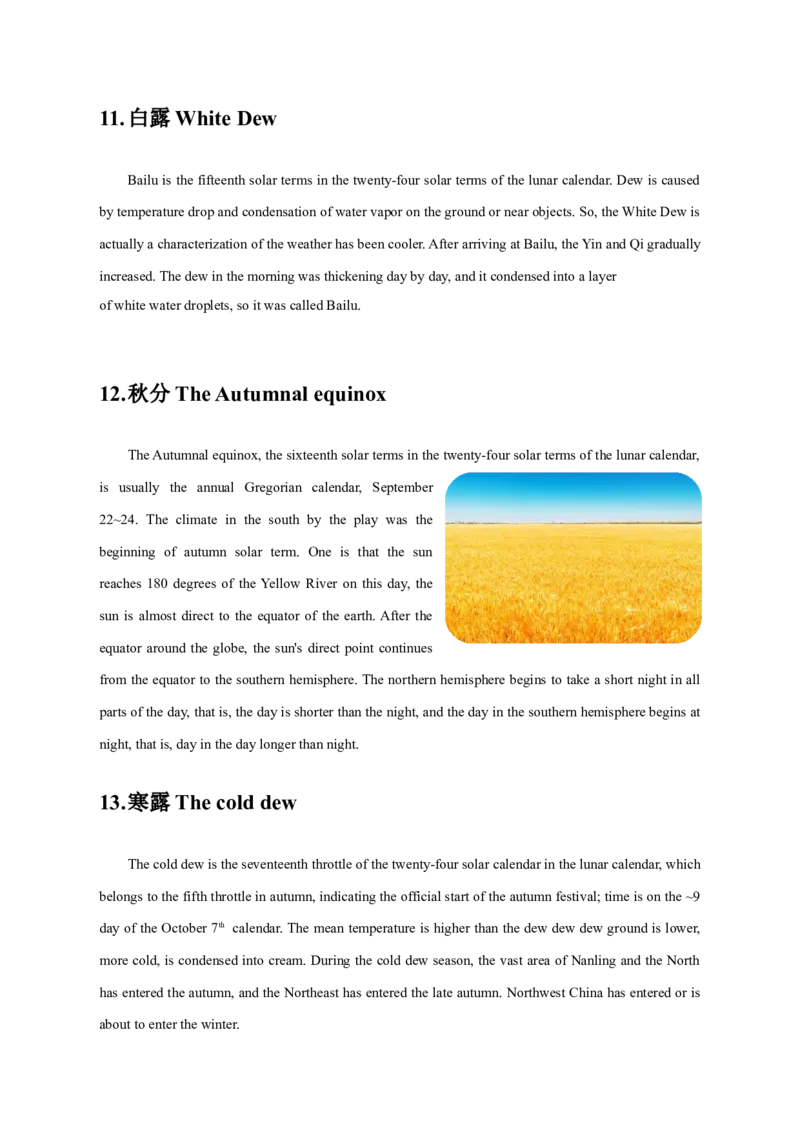
The Autumnal equinox, the sixteenth solar terms in the twenty-four solar terms of the lunar calendar,
is usually the annual Gregorian calendar, September
22~24. The climate in the south by the play was the
beginning of autumn solar term. One is that the sun
reaches 180 degrees of the Yellow River on this day, the
sun is almost direct to the equator of the earth. After the
equator around the globe, the sun's direct point continues
from the equator to the southern hemisphere. The northern hemisphere begins to take a short night in all
parts of the day, that is, the day is shorter than the night, and the day in the southern hemisphere begins at
night, that is, day in the day longer than night.
13.寒露 The cold dew
The cold dew is the seventeenth throttle of the twenty-four solar calendar in the lunar calendar, which
belongs to the fifth throttle in autumn, indicating the official start of the autumn festival; time is on the ~9
day of the October 7th calendar. The mean temperature is higher than the dew dew dew ground is lower,
more cold, is condensed into cream. During the cold dew season, the vast area of Nanling and the North
has entered the autumn, and the Northeast has entered the late autumn. Northwest China has entered or is
about to enter the winter.14.霜降 The cold dew
The cold dew is the seventeenth throttle of the twenty-four solar calendar in the lunar calendar,
which belongs to the fifth throttle in autumn, indicating the official start of the autumn festival; time is on
the ~9 day of the October 7th calendar. The mean temperature is higher than the dew dew dew ground is
lower,
more cold, is condensed into cream. During the cold dew season, the vast area of Nanling and the North
has entered the autumn, and the Northeast has entered the late autumn. Northwest China has entered or is
about to enter the winter.
Part 2 立春 Start of Spring
Get a glimpse of Chinese culture from 24 solar terms.
从二十四节气中一瞥中华文化。
Today’s episode is the Start of Spring.
本集为立春。
一年之计在于春,一日之计在于晨。
——立春(Start of Spring.)
1. The traditional Chinese lunar calendar divides a year into 24 solar cycles. 传统的中国农历将一年分为
24个节气。
2. Start of Spring (立春), the first solar term of the year, begins this year on Feb 4th .“立春”是一年中的第
一个节气,今年的“立春”节气从2月4日开始。
一、了解立春 Knowing about the Start of Spring
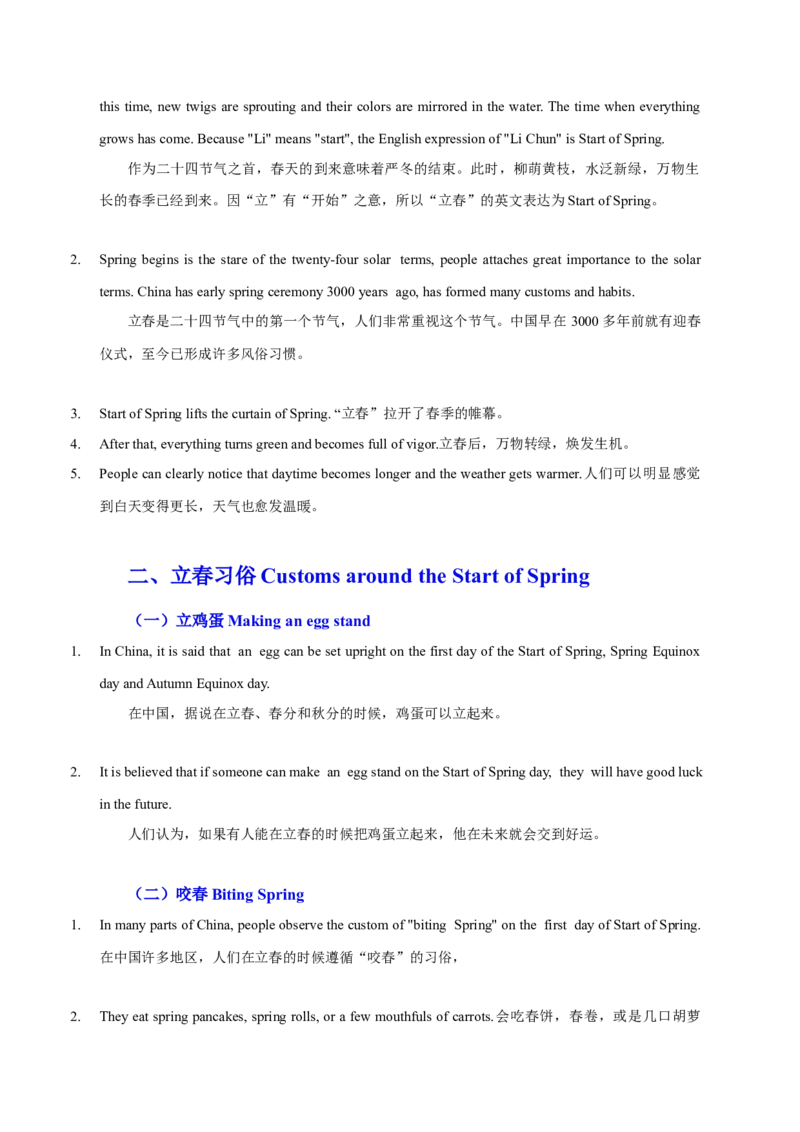
1. As the first of the twenty-four solar terms, the arrival of the spring means the end of the harsh winter. Atthis time, new twigs are sprouting and their colors are mirrored in the water. The time when everything
grows has come. Because "Li" means "start", the English expression of "Li Chun" is Start of Spring.
作为二十四节气之首,春天的到来意味着严冬的结束。此时,柳萌黄枝,水泛新绿,万物生
长的春季已经到来。因“立”有“开始”之意,所以“立春”的英文表达为Start of Spring。
2. Spring begins is the stare of the twenty-four solar terms, people attaches great importance to the solar
terms. China has early spring ceremony 3000 years ago, has formed many customs and habits.
立春是二十四节气中的第一个节气,人们非常重视这个节气。中国早在 3000多年前就有迎春
仪式,至今已形成许多风俗习惯。
3. Start of Spring lifts the curtain of Spring. “立春”拉开了春季的帷幕。
4. After that, everything turns green and becomes full of vigor.立春后,万物转绿,焕发生机。
5. People can clearly notice that daytime becomes longer and the weather gets warmer.人们可以明显感觉
到白天变得更长,天气也愈发温暖。
二、立春习俗 Customs around the Start of Spring
(一)立鸡蛋Making an egg stand
1. In China, it is said that an egg can be set upright on the first day of the Start of Spring, Spring Equinox
day and Autumn Equinox day.
在中国,据说在立春、春分和秋分的时候,鸡蛋可以立起来。
2. It is believed that if someone can make an egg stand on the Start of Spring day, they will have good luck
in the future.
人们认为,如果有人能在立春的时候把鸡蛋立起来,他在未来就会交到好运。
(二)咬春Biting Spring
1. In many parts of China, people observe the custom of "biting Spring" on the first day of Start of Spring.
在中国许多地区,人们在立春的时候遵循“咬春”的习俗,
2. They eat spring pancakes, spring rolls, or a few mouthfuls of carrots.会吃春饼,春卷,或是几口胡萝卜。
(三)拜春Welcoming Spring
1. People in China began holding a special ceremony on the first day of Start of Spring about 3,000 years
ago.三千年前,中国人开始在立春当天举行特殊仪式。
2. They made sacrifices to Gou Mang, the god of Spring, who is in charge of agriculture.人们拜祭主宰农业
的春神“句芒(读gōu máng)”。
3. By the Qing Dynasty (1644-1911), welcoming spring had become an important folk activity.直到清朝,
“拜春”已成为重要的民间活动。
4. In Beijing, government officials welcomed spring in the wild field near Dongzhimen (the east gate of
Beijing).京城的政府官员都必须去东直门外五里“东郊”的“春场” 迎春。
拓展任务Explore the Start of Spring by yourself
1. Which season do you like the most? Why?2. Do you know the taboos of the Start of Spring?
Part 3 小雪 Minor Snow
24节气:关于小雪你可能不知道的7件事
24 Solar Terms: 7 things you may not know about Minor Snow
The traditional Chinese solar calendar divides the year into 24 solar terms. Minor Snow,
(Chinese: 小雪), the 20th solar term of the year, begins this year on Nov 22 and ends on Dec 6.
Minor Snow refers to the time when it starts to snow, mostly in China's northern areas, and the
temperature continues to drop.
Here are seven things you should know
about Minor Snow.
【名师点睛】
solar calendar 【太阳历】
Minor Snow 【小雪】
refer to 【指的是】
divide into 【分为】
【译文】 中国传统的阳历将一年分为
24个节气。小雪(中文:小雪), 一年中的第20个节气,从今年11月22日开始,到12月6日结
束。小雪是指开始下雪的时间,主要是在中国北方地区,气温持续下降。关于小雪,你应该知道
七件事。
一、雪很轻 Light snow
An ancient Chinese book about plants explains that "in Minor Snow, the weather is cold and it is
going to snow, while the earth is not frozen enough and the snow is light." The temperature in most areas
in the north drops to zero degrees and below. Meanwhile, in the lower and middle reaches of the YellowRiver, the average time of the first snow falls during the Minor Snow solar term. The snow is light and
frozen at night, but melts quickly during the day.
【名师点睛】
explain that【宾语从句】
while表示转折,译为然而,过渡词meanwhile表示同时。
【译文】 中国一本关于植物的古书解释说,“小雪时,天气很冷,会下雪,而地球还没有结
冰,雪很轻。”北方大部分地区的气温都降到零度以下。同时,在黄河下游和中游地区,小雪节
气期间的平均初雪时间。雪很轻,夜间结冰,但白天很快融化。
二、戴帽子和围巾 Wearing hats and scarves
In China, starting in Minor Snow, the wind blows from the northeast a lot. Because it's still not
bitterly cold, many people do not wear hats or scarves yet. In fact, according to an old Chinese saying,
"the head is the place where all passages of the body gather". It's sensible to keep one's head warm.
【名师点睛】
Starting 非谓语,表示时间的开始;
bitterly 副词,修饰形容词cold;
In fact 连词,事实上;
an old Chinese saying 老话说、俗话说;
it’s sensible to do 句型:做…是很明智的。
【译文】
在中国,从小雪开始,风经常从东北吹来。因
为现在还没有严寒,许多人还没有戴帽子或围巾。事实上,根据中国的一句老话,“头部是身体
所有通道聚集的地方”。保持头脑温暖是明智的。三、喝汤 Drinking soup
During Minor Snow, indoor heating begins to work, which
means the air indoors is dry and most people might find their nose and
mouth feels a bit dry. According to practices in traditional Chinese
medicine, this accumulation of "inner heat" in one's body can cause
problems, including oral ulcers and breakouts. The solution is to drink
more hot soup, such as cabbage and bean curd soup, spinach and bean curd soup, and mutton and radish
soup.
【名师点睛】
which连接定语从句;
According to practices in traditional Chinese medicine 根据中医的实践,Chinese Medicine 中医;
inner heat 内热;
the solution is to 解决办法是…
【译文】
小雪期间,室内供暖开始工作,这意味着室内空气干燥,大多数人可能会觉得鼻子和嘴巴有
点干。根据中医的实践,这种体内“内热”的积聚会导致口腔溃疡和溃疡等问题。解决办法是多
喝热汤,如白菜豆腐汤、菠菜豆腐汤、羊肉萝卜汤。
四、吃糯米糕 Eating glutinous rice cake
In some areas of South China, people have glutinous rice cakes around Minor Snow. In ancient
times, glutinous rice cakes were a traditional festival offering to the bull god.
【名师点睛】
Glutinous rice cakes 糯米糕;a traditional festival offering 古代传统祭祀
品;the bull god 牛神。
【译文】
在中国南方的一些地区,人们在小雪周围吃糯米糕。在古代,
糍粑是祭祀牛神的传统节日。五、制作腊肉 Making preserved pork
After Minor Snow, the temperature declines sharply and the air
becomes dry. It is the best time to start making preserved pork, which
by the Chinese Spring Festival would be ready to enjoy. In the past, when
storage conditions were poor, people developed many ways to store food and preserved pork is one
such example. So even in the bitter winter, the whole family could enjoy meat. Some even say
preserved pork tastes more delicious than fresh meat.
【名师点睛】
Declines sharply 副词修饰动词,急剧下降;
It is the best time to do做…的最佳时期;
which 定语从句,指的是preserved pork,腊肉。storage conditions 储存条件,poor一词多义,可
译为:差、可怜的;
in the bitter winter 在寒冬;
【译文】
小雪过后,气温急剧下降,空气变得干燥。现在是开始制作腊肉的最佳时机,到了中国春
节,腊肉就可以享用了。在过去,当储存条件较差时,人们开发了许多储存食物的方法,腊肉就
是其中一个例子。因此,即使在寒冷的冬天,全家人也可以享用肉类。有些人甚至说,腊肉比鲜
肉更好吃。
六、制作咸菜 Making pickled vegetables
For thousands of years, the people of Nanjing, Jiangsu province, have welcomed Minor Snow
with pickled vegetables made in different ways.
Nanjing is known for its pickled vegetables. In the past, due to inconvenient transportation, vegetables
sold in Nanjing were few and expensive. Thus people there made pickled vegetables for the winter.
【名师点睛】 For thousands of years作为时间标志,需要使用现在完成时,故后文使用have welcomed;
made in different ways 省略(which is)的省略句,用不同方式制作的咸菜;
be known for 以…而闻名;due to 由于;
【译文】
几千年来,江苏省南京市的人们用不同的方式制作的咸菜来迎接小雪。
南京以咸菜闻名。过去,由于交通不便,南京出售的蔬菜少而贵。因此,那里的人们为冬
天做咸菜。
七、避免食用辛辣的食物 Avoiding spicy food
On cold days, people may crave some hot and spicy food to keep warm. Experts say it's wise not
to eat overly spicy food, since that will increase your inner heat.
【名师点睛】
To do表目的,为了取暖;
it’s wise to do 做…是明智的 ;
since连词;因为。
【译文】
在寒冷的日子里,人们可能会想吃一些辛辣的食物来 保
暖。专家表示,不要吃太辣的食物是明智的,因为这会增 加
你的内在热量。