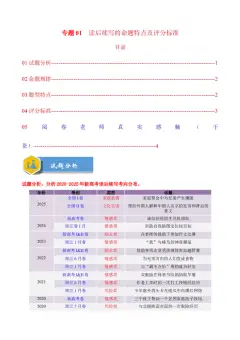
考点分析
解题技巧
话题突破03 文化节日(听力专练)

     这类对话或独白通常围绕一个具体的节日或文化事件展开,其考点可以归纳为以下三大核心方面:
1. 节日基本信息
这是最基础的考点,旨在考查学生对关键事实性信息的抓取能力。
类型: 音乐节、艺术节、电影节、戏剧节、传统节日(中秋、端午、圣诞等)、特殊节庆(番茄节、
风筝节等)。
时间: 开始/结束的日期、具体在哪一天、持续多长时间。
地点: 在哪个城市、公园、广场或特定场馆举行。
人物: 活动的参与者、组织者、表演者或目标受众(如:适合家庭、儿童或成人)。
2. 节日活动与细节
这是考查最深入、最频繁的部分,涉及节日的具体内容和流程。
核心活动: 表演、比赛、游行、游行、烟花、美食展等。
活动安排: 不同日期/时间段分别有什么活动。(例如:“头两天是歌舞表演,后三天是比赛”)
习俗与传统: 特定节日的独特习俗(如:端午节吃粽子、赛龙舟;元宵节吃汤圆、赏灯)。
物品准备: 需要准备什么(如:穿旧衣服参加番茄节、用红纸袋做礼物袋)。
奖品与奖励: 比赛的奖品是什么(奖金、奖牌、奖杯等)。
3. 个人观点与经历
这部分考查学生对说话人态度、感受和意图的理解。
感受与评价: 说话人认为节日“好玩”、“无聊”、“令人失望”、“比去年好/差”。
偏好与原因: 喜欢或不喜欢某个节日的原因(如:喜欢夏季节日的烧烤氛围,不喜欢传统节日的送
礼压力)。
个人经历: 回忆过去参加的经历,或描述即将参与的计划。
建议与意图: 说话人建议做什么、下一步打算做什么。
技巧1 读题预测,锁定关键词
在听力开始前,快速浏览问题和选项,预测对话主题。用笔圈出问题中的疑问词(What, When, Who,
Why, How)和选项中的关键词。例如: 看到选项是“On the 25th.” / “On the 27th.” / “On the
29th.”,立刻意识到要重点关注 日期,并准备好记录。
技巧2 边听边记,简化信息
在听的过程中,用自己能看懂的简写、符号或中文快速记录关键信息。例如: 听到“...beginning on
twenty-fifth and will last for five days”,立刻记下 25 → 5d 或 25 (+5),即可轻松推算出结束日期是
29 号。
语料总结
技巧3 抓住信号词,把握逻辑脉络
说话人经常会使用一些信号词来引出关键信息。
时间顺序: first, then, after that, finally, before, after...
转折与对比: but, however, actually, in fact, unlike...
原因与结果: because, so, the reason is, that's why...
举例: for example, such as, like...
技巧4 识别“同义替换”,理解言外之意
听力原文中的用词常常不会和选项完全一致,而是会进行同义替换。
词汇替换: 原文 “a comedy” = 选项 “funny”。
句式转换: 原文 “Children might find it rather frightening.” = 选项 “It may frighten children.”
概括总结: 原文描述一系列农耕指导 = 选项 “To guide farming activities.”
技巧5 理解说话人语气和意图
注意说话人的语调、重音和所用词汇,以判断其态度是积极、消极还是中立。
积极词汇: great, fantastic, wonderful, incredible, my favorite, can't wait...
消极词汇: disappointing, not as good as, a pity, too bad, frightening...
建议与意图: “We should...” , “Why don't we...?” , “I'll try to...” , “I'm going to...”
技巧6 注意区分“文化节日”与“文化传统”
正如我们之前分析的,要能区分:文化节日: 一个具体的事件,有明确的时间、地点和活动安排
(如:哈尔滨冰雕节、斯特雷顿戏剧节)。
文化传统/知识: 关于习俗和知识体系的介绍(如:二十四节气的来历和功能、清明节的习俗)。
解题方法本质相同,但意识到后者更侧重于“是什么”和“为什么”,而非“何时何地举办”。
高频核心词汇库
节日基
本信息
类型
Music Festival (音乐节)
Art Festival (艺术节)
Film / Movie Festival (电影节)
Drama Festival (戏剧节) / Play (话剧)
Food Festival / Fair (美食节)
Traditional Festival (传统节日)
International Kite Festival (国际风筝节)
Spring Festival (春节)
Lantern Festival (元宵节)
Dragon Boat Festival (端午节)
Mid-Autumn Festival (中秋节)
Christmas (圣诞节)
Easter (复活节)
时间
When is it? / Dates: It starts/begins on... and ends/finishes on... It
lasts for... days.
地点
Where is it held? / Location: in [City], at [Park], on
[Square], in the main square (主广场)
人物
For whom? / Participants: suitable for children/families (适合
儿童/家庭), organizer (组织者), performer (表演者)
节日活
动与细
节
核心活
动
Performance ( 表演) :singing performance ( 歌唱表演) ,
dancing performance (舞蹈表演)
Concert (音乐会)
Competition / Contest (比赛):kite competition (风筝比赛)
Parade (游行)
Fireworks (烟花)
Exhibition / Show (展览)
Ceremony (仪式)
活动安
排:
Schedule / Timetable (时间表)
Last for... days (持续...天)
Be held in... (在...举办)
Take place (举行)
习俗与
传统
Eat sticky rice dumplings (zongzi) (吃粽子)
Watch dragon boat races (看龙舟赛)
Eat sweet rice balls (tangyuan) (吃汤圆)
Admire the moon (赏月) / lanterns (赏灯)
物品准
备
wear old clothes (穿旧衣服), cover... with plastic (用塑料覆
盖...)
奖品与
奖励
win first prize ( 赢得一等奖), get a medal ( 获得奖牌),
receive money/award (获得奖金/奖项)
个人观
点与经
历
感受与
评价
积极
fantastic 太棒了,极好的
wonderful 精彩的,美妙的
incredible 难以置信的(好),不可思议的
my favorite 我最喜欢的
the best... ever 有史以来最棒的...
消极
disappointing 令人失望的
boring 无聊的
not as good as... 不如...好
a pity 真遗憾
强化训练
too bad 太糟糕了,真可惜
frightening 吓人的,令人害怕的
偏好原
因
I like... because...  我喜欢...因为...
I prefer...  我更喜欢...
The reason I don't like... is that...  我不喜欢...的原因是...
核心句式与表达
询问信
息
When/Where is the [festival] held? 这个【节日】在何时/何地举行?
What activities are there? 都有些什么活动?
How long does it last? 它要持续多久?
Which one is suitable for children? 哪一个适合儿童?
How much is the ticket? 票价是多少?
陈述事
实 (独白
高频)
The festival starts on [date] and lasts for [number] days. 这个节日从【日
期】开始,持续【数字】天。
It is held in [place] every year. 它每年在【地点】举行。
The main event is a [competition/parade]. 主要活动是一场【比赛/游
行】。
The winner will receive a prize of [amount]. 获胜者将获得【金额】的奖
金。/ 获胜者将得到【奖品】作为奖励。
表达观
点与感
受
喜欢/赞赏
It's my favorite festival. 这是我最喜欢的节日。
I had a wonderful/great time. 我玩得非常开心。
The performance was fantastic/incredible. 表演太棒了/简直
不可思议。
不喜欢/ 失
望
It wasn't as good as I expected. 它没有我预期的那么好。
I was a little disappointed. 我有点失望。
The music wasn't as good as last year's. 音乐不如去年的
好。
感
到
惊
讶/害怕
I was surprised by... 我对……感到惊讶。
Children might find it frightening. 孩子们可能会觉得这很
吓人。
提出建
议与意
图
We should go and see it. 我们应该去看看。
Why don't we stay for a few more days? 我们为什么不在这儿多待几天
呢?
I'm going to give my best performance. 我会献上我最精彩的表演。
I plan to watch the dragon boat race. 我计划去看龙舟比赛。

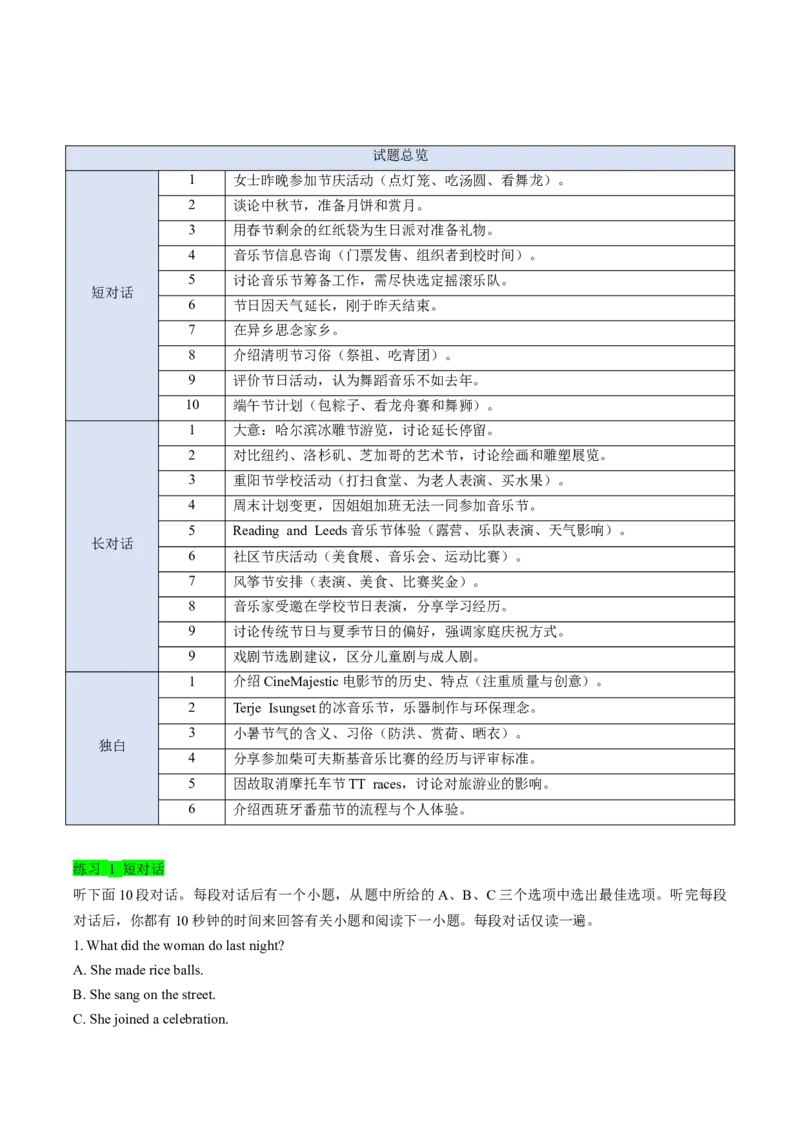
试题总览
短对话
1
女士昨晚参加节庆活动(点灯笼、吃汤圆、看舞龙)。
2
谈论中秋节,准备月饼和赏月。
3
用春节剩余的红纸袋为生日派对准备礼物。
4
音乐节信息咨询(门票发售、组织者到校时间)。
5
讨论音乐节筹备工作,需尽快选定摇滚乐队。
6
节日因天气延长,刚于昨天结束。
7
在异乡思念家乡。
8
介绍清明节习俗(祭祖、吃青团)。
9
评价节日活动,认为舞蹈音乐不如去年。
10
端午节计划(包粽子、看龙舟赛和舞狮)。
长对话
1
大意:哈尔滨冰雕节游览,讨论延长停留。
2
对比纽约、洛杉矶、芝加哥的艺术节,讨论绘画和雕塑展览。
3
重阳节学校活动(打扫食堂、为老人表演、买水果)。
4
周末计划变更,因姐姐加班无法一同参加音乐节。
5
Reading and Leeds 音乐节体验(露营、乐队表演、天气影响)。
6
社区节庆活动(美食展、音乐会、运动比赛)。
7
风筝节安排(表演、美食、比赛奖金)。
8
音乐家受邀在学校节日表演,分享学习经历。
9
讨论传统节日与夏季节日的偏好,强调家庭庆祝方式。
9
戏剧节选剧建议,区分儿童剧与成人剧。
独白
1
介绍CineMajestic 电影节的历史、特点(注重质量与创意)。
2
Terje Isungset 的冰音乐节,乐器制作与环保理念。
3
小暑节气的含义、习俗(防洪、赏荷、晒衣)。
4
分享参加柴可夫斯基音乐比赛的经历与评审标准。
5
因故取消摩托车节TT races,讨论对旅游业的影响。
6
介绍西班牙番茄节的流程与个人体验。
练习 1 短对话
听下面10 段对话。每段对话后有一个小题,从题中所给的A、B、C 三个选项中选出最佳选项。听完每段
对话后,你都有10 秒钟的时间来回答有关小题和阅读下一小题。每段对话仅读一遍。
1. What did the woman do last night?
A. She made rice balls.
B. She sang on the street.
C. She joined a celebration.
2. What festival are the speakers talking about?
A. The Spring Festival,
B. The Lantern Festival.
C. The Mid-Autumn Festival.
3. What event are the speakers preparing for?
A. The spring festival.
B. A birthday party.
C. Christmas day.
4. When will the woman meet the organizer?
A. On the 6th.
B. On the 10th.
C. On the 28th.
5. What did the man forget to do?
A. Contact the organizer.
B. Make an advertisement.
C. Choose some performers.
6. When did the festival finish?
A. Yesterday.                        B. One week ago.
C. Two weeks ago.
7. Where is the woman from?
A. Britain.
B. China.
C. Australia.
8. What are the speakers mainly talking about?
A. A festival.
B. An ancestor.
   C. A food.
9. What did the man think of the festival this year?
A. It was great as a whole.
B. It was better than last year’s.
C. The dance music was the best.
10. What will the woman probably do on the Dragon Boat Festival?
A. Make some traditional Chinese snacks.
B. Watch some performances.
C. Take part in lion dances.
练习2  中长对话
听下面6 段对话或独白。每段对话或独自后有几个小题,从题中所给的A、B、C 三个选项中选出最佳选项,
并标在试卷的相应位置。听每段对话或独白前,你将有时间阅读各个小题,每小题5 秒钟;听完后,各小
题将给出5 秒钟的作答时间。每段对话或独自读两遍。
Dialogue 1
听下面一段较长对话,回答以下小题。
6. What surprises the man?
A. The snow towers.
B. The big snowman.
C. The cartoon characters.
7.What does the man suggest doing?
A. Staying longer.
B. Saving some money.
C. Checking the weather.
Dialogue 2
听下面一段较长对话,回答以下小题。
14. Which art festival was the biggest according to the woman?
A. The one in New York.
B. The one in Los Angeles.
C. The one in Chicago.
15. What did the speakers miss from the art exhibition?
A. Oil paintings.
B. Watercolor paintings.
C. Sculptures.
16. Who enjoys making chalk art?
A. The woman’s uncle.
B. The man’s niece.
C. The man’s friend.
17. Why is the woman going to pay for the taxi?
A. She has extra money this month.
B. The man will pay for the next one.
C. It is her turn to pay.
Dialogue 3
听下面一段较长对话,回答以下小题。
10. What did the woman do before lunchtime?
A. She tidied a place up.
B. She bought some fruit.
C. She sang a song to the elderly
11. What will the man do next?
A. Play basketball.
B. Go to hospital.
C. Join the woman.
12. What do the speakers mainly talk about?
A. Respect for the old.
B. The holiday plan.
C. Housework chores.
Dialogue 4
听下面一段较长对话,回答以下小题。
8. What will the man do on Sunday?
A. Have dinner with his friend.
B. Attend a music festival.
C. Go to the cinema.
9. What is the woman's problem?
A. Her car broke down.
B. She's asked to work overtime.
C. Her sister can't give her a ride.
10. How will the woman go to the National Park?
A. By bus.
B. By subway.
C. By taxi.
Dialogue 5
听下面一段较长对话,回答以下小题。
13. How long did Reading and Leeds Festival last?
A. Three days.
B. Four days.
C. Five days.
14. Why did the woman set off on Thursday evening?
A. To enjoy some live bands.
B. To avoid being caught in the rain.
C. To find a good place in the campsite.
15. What does the woman think of the festival?
A. Disappointing.
B. Enjoyable.
C. Average.
16. Who does the man like?
A. The Darkness.
B. Franz Ferdinand.
C. Morrissey.
Dialogue 6
听下面一段较长对话,回答以下小题。
10. Why did the man arrive late?
A. He got stuck in traffic.
B. He couldn’t find a parking place.
C. He had to take another route.
11. What event did the man miss?
A. A sports event.
B. A food fair.
C. A concert.
12. Where are the speakers probably?
A. In a park.
B. In a restaurant.
C. In a television station.
Dialogue 7
听下面一段较长对话,回答以下小题。
10. When will the festival end?
A. On the 25th.
B. On the 27th.
C. On the 29th.
11. What activity is available from the third day of the festival?
A. A kite competition.
B. A dancing show.
C. A singing performance.
12. What is the prize this year?
A. A medal.
B. Some money.
C. A gold kite.
Dialogue 8
听下面一段较长对话,回答以下小题。
10. What is probably the man?
A. A teacher.
B. A composer.
C. A singer.
11. What inspired the man to learn classical music at first?
A. Music videos.
B. Live concerts.
C. Online courses.
12. What is the man going to do next?
A. Watch a video.
B. Make a presentation.
C. Give a performance.
Dialogue 9
听下面一段较长对话,回答以下小题。
14. What does the man like about the summer festival?
A. Swimming in the pool.
B. Barbecuing with friends.
C. Watching the parade.
15. Why doesn’t the man like traditional holidays?
A. They happen in uncomfortable places.
B. They are too expensive to afford.
C. They feel like a requirement.
16. How does the woman’s family celebrate traditional holidays?
A. By making gifts for each other.
B. By buying expensive things.
C. By holding a pool party.
17. What does the woman imply in the end?
A. Families can have their own ways of celebrating holidays.
B. Traditional holidays are more comfortable.
C. Gifts are better than promises.
Dialogue 10
听下面一段较长对话,回答以下小题。
6. Which play is suitable for children?
A. Fire and Flood.
B. Silly Sailor.
C. The Mystery of Muldoon.
7. What does the man say about Silly Sailor?
A. It is a comedy.
B. It may frighten the old.
C. It won an award two years ago.
练习3 独白
Passage 1
听下面一段独白,回答以下小题。
17. When was the first CineMajestic festival held?
A. In the 1960s.
B. In the 1970s.
C. In the 1980s.
18. How is CineMajestic festival different from others?
A. It has a long history.
B. It's commercially successful.
C. It values quality and creativity.
19. What can be found at CineMajestic?
A. Silent films.               B. Experimental films.            C. Commercial films.
20. What impressed the speaker most at CineMajestic this year?
A. Its artistic risks.            B. Its quantity of films.            C. Its variety of stories.
Passage 2
听下面一段独白,回答以下小题。
17. Where does the ice used by Terje Isungset come from?
A. Factories.
B. His house.
C. The nature.
18. What gave Terje Isungset the inspiration for ice music?
A. A concert.
B, A musician's work,
C.A flowing waterfall.
19, What was the duration of the 18th Ice Music Festival Norway?
A. Two days.
B. Three days.
C. Four days.
20, How does Terje Isungset deal with the ice instruments after the show?
A. Sell them to the audience. B. Return them to the wild.
C. Keep them for viewing.
Passage 3
听下面一段独白,回答以下小题。
18.What does Minor Heat mean?
A.The extreme hot point is coming.
B.The hottest period is over.
C.The hottest season is coming.
19.Which activity is unnecessary during Minor Heat?
A.Earthquake relief.
B.Flood control.
C.Drought relief.
20.What can people do during Minor Heat?
A.Hang the clothes out in the shade.
B.Play with fireflies at home.
C.Appreciate the lotus flower.
Passage 4
听下面一段独白,回答以下小题。
17. Where was Open Tchaikovsky Competition held in 1986?
A. In Moscow.
B. In Chelyabinsk.
C. In Berlin.
18. What does Maxim say about the competition he attended at 10?
A. It inspired many young musicians.
B. It was the music event of his dreams.
C. It was a life-changing experience.
19. Which kind of music are the young players required to play?
A. Rock music.
B. Pop music.
C. Classical music.
20. What does Maxim value most in young players’ performance?
A. Expressiveness.
B. Smoothness.
C. Completeness.
Passage 5
听下面一段独白,回答以下小题。
18. How old is the festival?
A. Under 30 years.
B. Over 100 years.
C. About 150 years.
19. What is the TT?
A. A tourist festival.
B. A shopping festival.
C. A motor cycle festival.
20. Who is Judith Curtis’s friend?
A. Laurence.
B. Anne.
C. James.
Passage 6
听下面一段独白,回答以下小题。
17. Who is the speaker probably?
A. A teacher.
B. A writer.
C. A reporter.
18.What do people do at the festival?
A. They recycle plastic.
B. They wear their new clothes.
C. They throw tomatoes at each other.
19. How long does the festival last?
A. About one hour.
B. About two hours.
C. About three hours.
20. What does Antonio usually do on the evening of the festival?
A. He dances with others.
B. He enjoys fireworks.
C. He cooks local food.