专题 22 祈使句和省略句(知识清单)
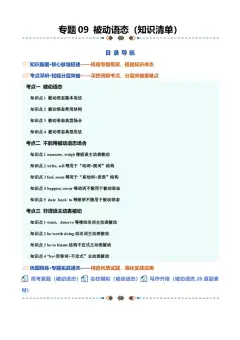
目 录 导 航
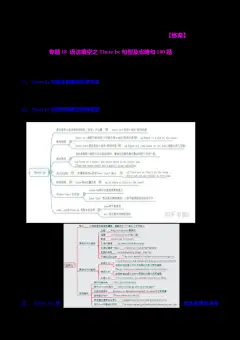
01知识脑图·核心脉络搭建——梳理专题框架,搭建知识体系
02考点深研·知能分层突破——深挖高频考点,分层突破重难点
考点一 祈使句
知识点1 祈使句用法概述
知识点2 Do型祈使句
知识点3 Don’t/Never型祈使句
知识点4 Let型祈使句
知识点5祈使句+and/or+陈述句
知识点6 No+名词/doing祈使句
考点二 省略句
知识点1 省略介词的高频句型
知识点2 定语从句的省略用法
知识点3 宾语从句的省略用法
知识点4 虚拟语气的省略用法
知识点5 并列句的省略用法
知识点6 动词不定式to的省略
03优题精练·专题实战通关——精选优质试题,强化实战应用
高考真题(祈使句和省略句)
名校模拟(祈使句和省略句)
原创语法填空(祈使句和省略句)知识脑图·核心脉络搭建考点深研·知能分层突破
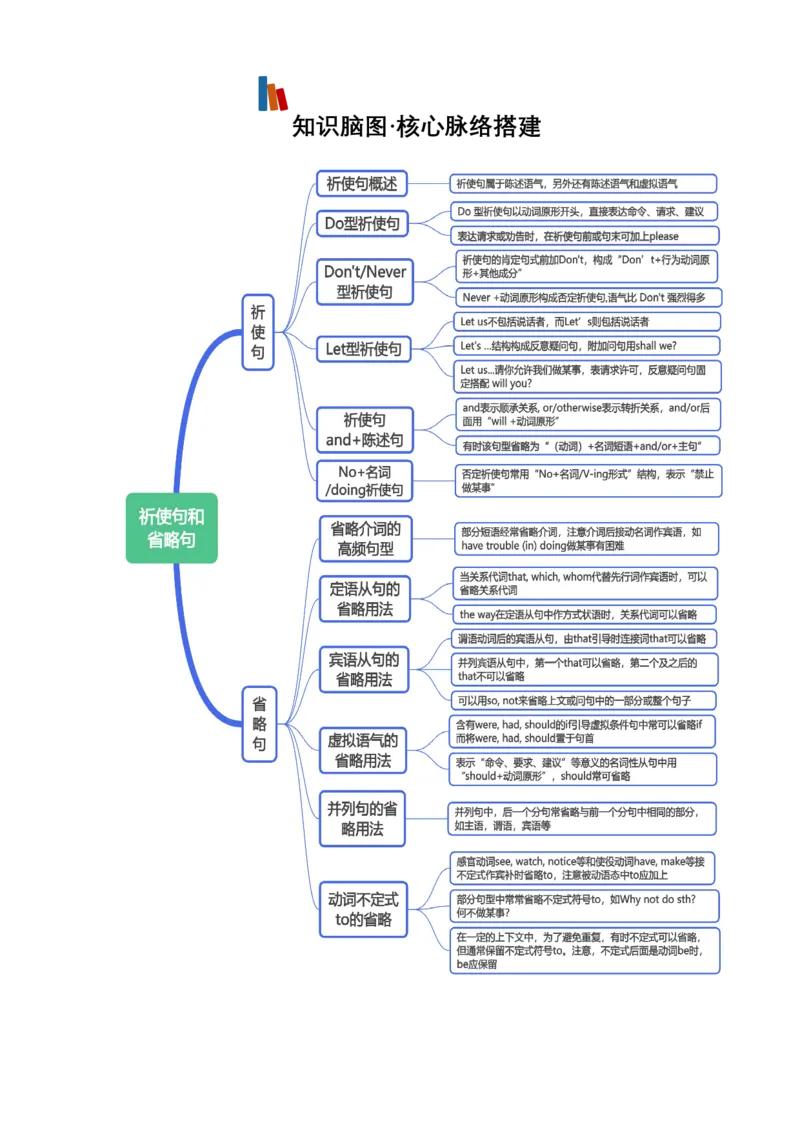
考点一 祈使句
知识点1 祈使句用法概述
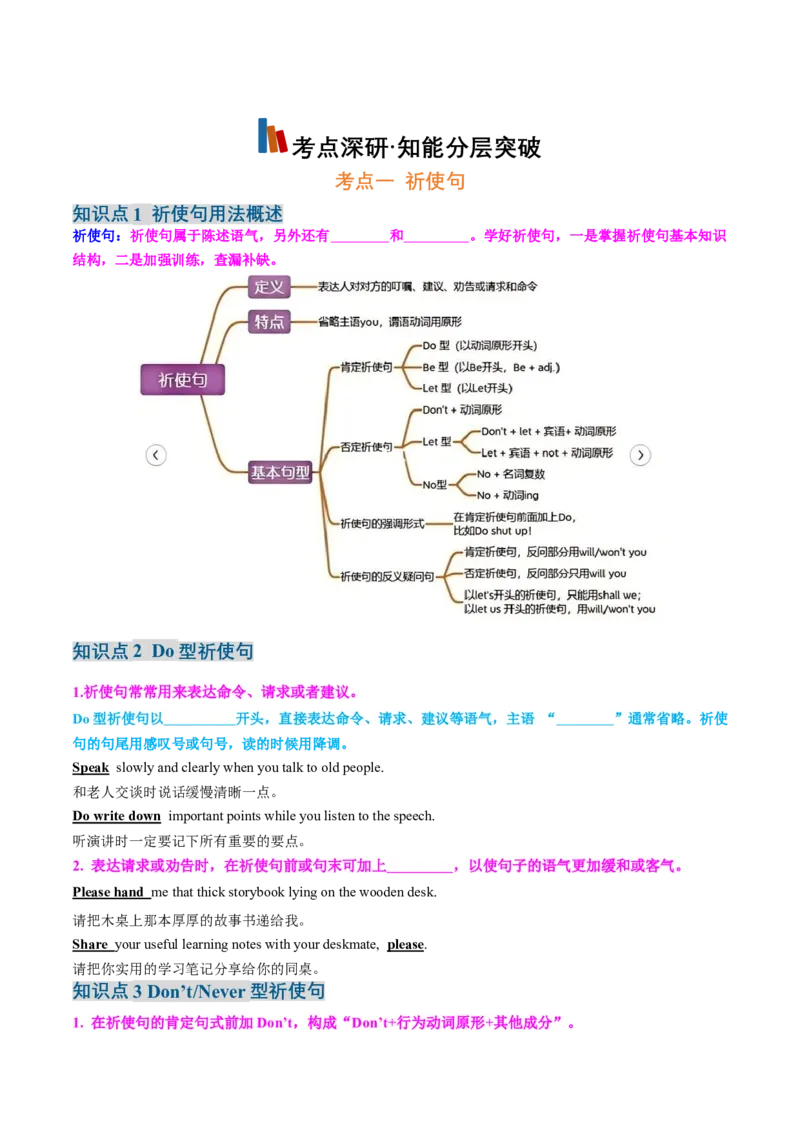
祈使句:祈使句属于陈述语气,另外还有 和 。学好祈使句,一是掌握祈使句基本知识
结构,二是加强训练,查漏补缺。
知识点2 Do型祈使句
1.祈使句常常用来表达命令、请求或者建议。
Do型祈使句以 开头,直接表达命令、请求、建议等语气,主语 “ ”通常省略。祈使
句的句尾用感叹号或句号,读的时候用降调。
Speak slowly and clearly when you talk to old people.
和老人交谈时说话缓慢清晰一点。
Do write down important points while you listen to the speech.
听演讲时一定要记下所有重要的要点。
2. 表达请求或劝告时,在祈使句前或句末可加上 ,以使句子的语气更加缓和或客气。
Please hand me that thick storybook lying on the wooden desk.
请把木桌上那本厚厚的故事书递给我。
Share your useful learning notes with your deskmate, please.
请把你实用的学习笔记分享给你的同桌。
知识点3 Don’t/Never型祈使句
1. 在祈使句的肯定句式前加Don’t,构成“Don’t+行为动词原形+其他成分”。Don’t +行为动词原形+其他,用来劝阻、禁止他人做某事,可搭配 缓和语气。
Don’t throw any rubbish everywhere in our beautiful school garden.
不要在美丽的校园花园里随地乱扔任何垃圾。
Please don’t leave your textbooks and stationery on the classroom desk.
请不要把课本文具随意留在教室课桌上。
2. Never开头祈使句语气更强烈。
以 Never +动词原形 开头构成 祈使句,语气比 Don’t强烈得多,表严禁、绝不,可搭配
please。
Never ignore the importance of wearing a seatbelt.
绝不要忽视系安全带的重要性。
Never cross the street without watching the traffic lights first.
过马路前不看红绿灯的行为绝对不能有。
★易错提醒:否定祈使句构成反意疑问句,附加问句用肯定形式。
Never litter in the park, will you? 绝对不要在公园乱扔垃圾,好吗?
知识点4 Let型祈使句
带有第一人称主语的祈使句通常以Let开头,其结构为:
1. Let+me/us+谓语动词原形或Let’s+谓语(动词原形)+其它。Let us 说话者,而Let’s则
说话者。
Let me share my useful learning experience with all of you here.
让我在这里和大家分享我的实用学习经验。
Let us spend more time reading books instead of watching short videos.
请允许我们多花读书时间,少刷短视频。
Let’s walk slowly along the lake and enjoy the soft sunset wind.
咱们沿着湖边慢走,享受温柔的傍晚晚风。
2. Let’s …结构构成反意疑问句,附加问句用 ?。
Let’s +动词原形… 表提议 “咱们一起……”,包含说话人和听话人,反意疑问句固定用shall we?
Let’s put away all books and tidy up this messy desk, shall we?
咱们收好书本整理这张乱糟糟的桌子,好吗?
3. Let us... 后接 (当表示 “请求对方允许我们做某事”时):
Let us...请你允许我们(不包含听话人你)做某事,表请求许可,反意疑问句固定搭配 will you?
Let us visit the museum alone this Sunday, will you?
请允许我们周日独自去博物馆,可以吗?
知识点5 祈使句+and/or+陈述句
“祈使句+and/or+陈述句”该句型相当于“if 引导的条件状语从句+主句”。
1. and表示 关系, or/otherwise表示 关系,and/or后面用“ ”。
Save water every day, and we can protect the planet.
每天节约用水,我们就能保护地球。
Wear a coat, or you’ll catch a cold.穿上外套,不然你会感冒的。
Follow the rules, or you’ll get into trouble.
遵守规则,否则你会惹上麻烦。
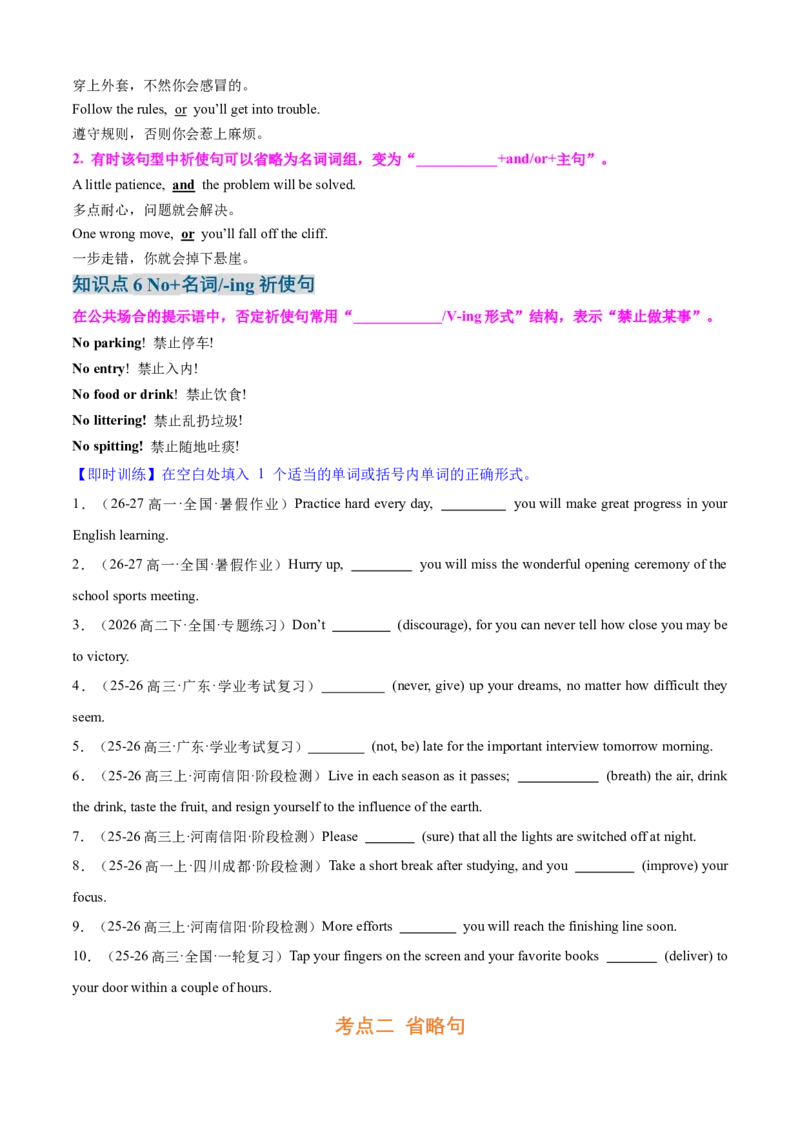
2. 有时该句型中祈使句可以省略为名词词组,变为“ +and/or+主句”。
A little patience, and the problem will be solved.
多点耐心,问题就会解决。
One wrong move, or you’ll fall off the cliff.
一步走错,你就会掉下悬崖。
知识点6 No+名词/-ing祈使句
在公共场合的提示语中,否定祈使句常用“ /V-ing形式”结构,表示“禁止做某事”。
No parking! 禁止停车!
No entry! 禁止入内!
No food or drink! 禁止饮食!
No littering! 禁止乱扔垃圾!
No spitting! 禁止随地吐痰!
【即时训练】在空白处填入 1 个适当的单词或括号内单词的正确形式。
1.(26-27高一·全国·暑假作业)Practice hard every day, you will make great progress in your
English learning.
2.(26-27高一·全国·暑假作业)Hurry up, you will miss the wonderful opening ceremony of the
school sports meeting.
3.(2026高二下·全国·专题练习)Don’t (discourage), for you can never tell how close you may be
to victory.
4.(25-26高三·广东·学业考试复习) (never, give) up your dreams, no matter how difficult they
seem.
5.(25-26高三·广东·学业考试复习) (not, be) late for the important interview tomorrow morning.
6.(25-26高三上·河南信阳·阶段检测)Live in each season as it passes; (breath) the air, drink
the drink, taste the fruit, and resign yourself to the influence of the earth.
7.(25-26高三上·河南信阳·阶段检测)Please (sure) that all the lights are switched off at night.
8.(25-26高一上·四川成都·阶段检测)Take a short break after studying, and you (improve) your
focus.
9.(25-26高三上·河南信阳·阶段检测)More efforts you will reach the finishing line soon.
10.(25-26高三·全国·一轮复习)Tap your fingers on the screen and your favorite books (deliver) to
your door within a couple of hours.
考点二 省略句知识点1 省略介词的高频句型
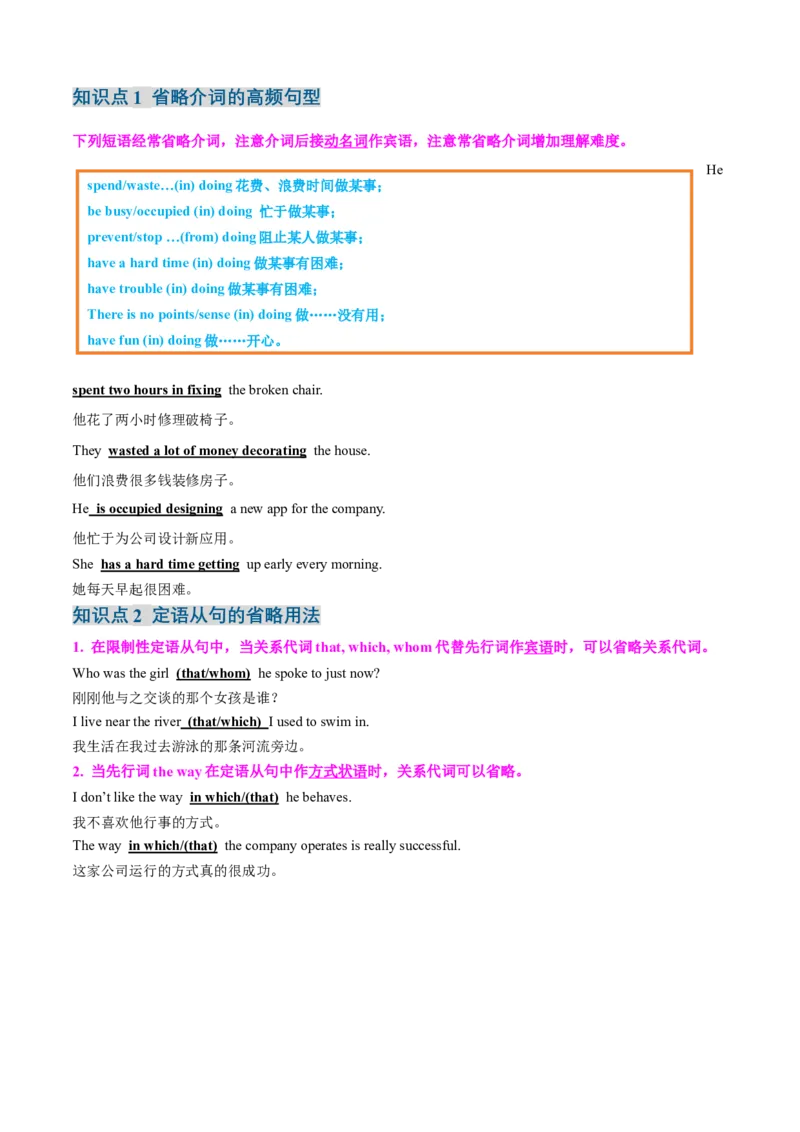
下列短语经常省略介词,注意介词后接动名词作宾语,注意常省略介词增加理解难度。
He
spend/waste…(in) doing花费、浪费时间做某事;
be busy/occupied (in) doing 忙于做某事;
prevent/stop …(from) doing阻止某人做某事;
have a hard time (in) doing做某事有困难;
have trouble (in) doing做某事有困难;
There is no points/sense (in) doing做……没有用;
have fun (in) doing做……开心。
spent two hours in fixing the broken chair.
他花了两小时修理破椅子。
They wasted a lot of money decorating the house.
他们浪费很多钱装修房子。
He is occupied designing a new app for the company.
他忙于为公司设计新应用。
She has a hard time getting up early every morning.
她每天早起很困难。
知识点2 定语从句的省略用法
1. 在限制性定语从句中,当关系代词that, which, whom代替先行词作宾语时,可以省略关系代词。
Who was the girl (that/whom) he spoke to just now?
刚刚他与之交谈的那个女孩是谁?
I live near the river (that/which) I used to swim in.
我生活在我过去游泳的那条河流旁边。
2. 当先行词the way在定语从句中作方式状语时,关系代词可以省略。
I don’t like the way in which/(that) he behaves.
我不喜欢他行事的方式。
The way in which/(that) the company operates is really successful.
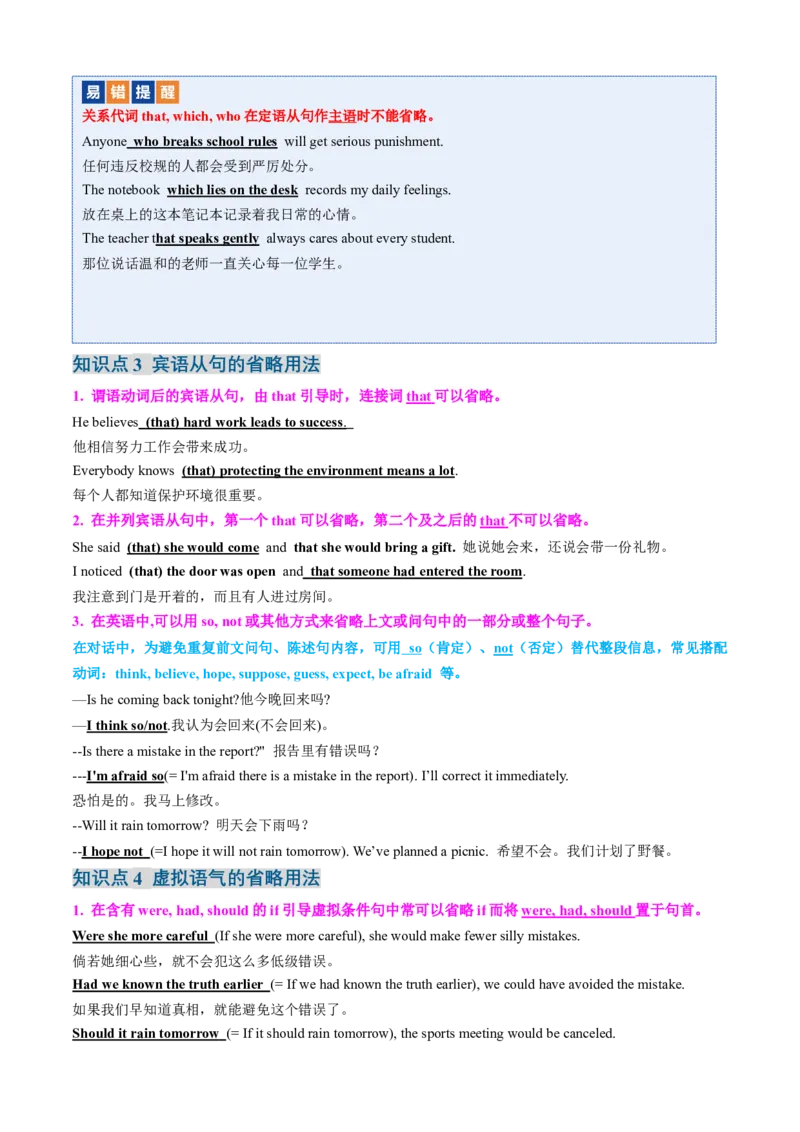
这家公司运行的方式真的很成功。关系代词that, which, who在定语从句作主语时不能省略。
Anyone who breaks school rules will get serious punishment.
任何违反校规的人都会受到严厉处分。
The notebook which lies on the desk records my daily feelings.
放在桌上的这本笔记本记录着我日常的心情。
The teacher that speaks gently always cares about every student.
那位说话温和的老师一直关心每一位学生。
知识点3 宾语从句的省略用法
1. 谓语动词后的宾语从句,由that引导时,连接词that 可以省略。
He believes (that) hard work leads to success .
他相信努力工作会带来成功。
Everybody knows (that) protecting the environment means a lot.
每个人都知道保护环境很重要。
2. 在并列宾语从句中,第一个that可以省略,第二个及之后的that 不可以省略。
She said (that) she would come and that she would bring a gift. 她说她会来,还说会带一份礼物。
I noticed (that) the door was open and that someone had entered the room .
我注意到门是开着的,而且有人进过房间。
3. 在英语中,可以用so, not或其他方式来省略上文或问句中的一部分或整个句子。
在对话中,为避免重复前文问句、陈述句内容,可用 so (肯定)、not(否定)替代整段信息,常见搭配
动词:think, believe, hope, suppose, guess, expect, be afraid 等。
—Is he coming back tonight?他今晚回来吗?
—I think so/not.我认为会回来(不会回来)。
--Is there a mistake in the report?" 报告里有错误吗?
---I'm afraid so(= I'm afraid there is a mistake in the report). I’ll correct it immediately.
恐怕是的。我马上修改。
--Will it rain tomorrow? 明天会下雨吗?
-- I hope not (=I hope it will not rain tomorrow). We’ve planned a picnic. 希望不会。我们计划了野餐。
知识点4 虚拟语气的省略用法
1. 在含有were, had, should的if引导虚拟条件句中常可以省略if而将were, had, should 置于句首。
Were she more careful (If she were more careful), she would make fewer silly mistakes.
倘若她细心些,就不会犯这么多低级错误。
Had we known the truth earlier (= If we had known the truth earlier), we could have avoided the mistake.
如果我们早知道真相,就能避免这个错误了。
Should it rain tomorrow (= If it should rain tomorrow), the sports meeting would be canceled.万一明天下雨,运动会就会取消。
2. 表示“命令、要求、建议”等意义的名词性从句中用“should+动词原形”,should 常可省略。
He suggests that we (should) take more exercise every single day. (宾语从句)
他建议我们每天都要进行足量的体育锻炼。
The manager’s order was that all staff (should) arrive before eight. (表语从句)
经理下达命令全体员工八点之前抵达岗位。
It is important that students (should) respect every hard-working teacher. (主语从句)
学生尊敬每一位辛勤付出的老师尤为重要。
知识点5 并列句的省略用法
在并列句中,后一个分句常省略与前一个分句中相同的部分,如主语,谓语,宾语等,以使句子更加
简洁明了。
He works as a doctor and his wife (works) a teacher.
他是个医生,他妻子是个老师。
My brother stayed up late and (he) managed to finish the important project.
我哥哥熬夜很晚,并且完成了一项重要的项目。
The one side of the board is painted red and the other (side of the board was painted) yellow.
这个板子的一面被粉刷成红色,另一面被粉刷成黄色。
Jim won the first prize and Peter (won) the second (prize) .
吉姆赢得了一等奖,彼得赢得了二等奖。
知识点6 动词不定式to的省略
1. 感官动词see, watch, notice等和使役动词have, make等接不定式作宾补时 省略 t o,注意被动语态中
to应加上。
I saw him cross the road.
我看见他过了马路。
→He was seen to cross the road.
有人看见他过了马路。
The teacher made the students clean the classroom.
老师让学生们打扫教室。
→The students were made to clean the classroom.
学生们被要求打扫教室。
2. 在一些高频句型中常常省略不定式符号to:
may as well do sth 最好还是做……
had better do 最好做某事
do nothing but do sth别无选择只好做某事
can’t help but do sth. 禁不住做某事
Why not do sth? 何不做某事?
prefer to do…rather than do sth 宁愿做……而不愿做……
would rather do…than do… 宁愿做……而不愿做……It’s raining. You might as well stay here.
在下雨,你最好还是待在这里。
He was so tired that he could do nothing but sleep.
他太累了,只能睡觉。
When I saw the funny movie, I couldn’t help but laugh.
我看那部搞笑电影时,忍不住笑了。
I prefer to walk to school rather than take a bus.
我宁愿步行去上学也不愿坐公交车。
3. 在一定的上下文中,为了避免重复,有时不定式可以省略,但通常保留不定式符号to。注意,不定
式后面是动词be时, be 应保留 。
He can’t swim as fast as he used to (swim) .
他游泳不如以前快了。
My parents encouraged me to apply for the job, and I decided to .
我父母鼓励我申请那份工作,我决定申请。
Being kind is more important than just pretending to be.
善良比仅仅假装善良更重要。
【即时训练】在空白处填入 1 个适当的单词或括号内单词的正确形式。
1.(26-27高一·全国·暑假作业)The problem, if (handle) properly, will be solved soon.
2.(25-26高一下·江苏无锡·期中)Unless (permit) by the school authority, no students are allowed
to take photos or videos in the teaching building.
3.(25-26高一下·江苏扬州·阶段检测)Though (face) with countless failures, she never gave up.
4.(25-26高一下·江苏扬州·阶段检测)If (leave) in the sun for too long, the ice cream will melt
completely.
5.(25-26 高一下·天津·阶段检测)When (apply) for the scholarship, you need to submit a
completed form, a personal statement, and proof of academic achievement by the deadline.
6.(25-26高二下·全国·课后作业)If (choose) as the class monitor, I will try my best to help my
classmates.
7.(2026高三·全国·专题练习)The driver wanted to park his car near the roadside but was asked by the police
not .
8.(23-24 高一下·全国·课后作业)To my relief,the new medicine bought from Japan helped
(relief) the pain of my brother’s injured leg.
9.(15-16高一·全国·课后作业)—You should have thanked her before you left.—I meant _______, but when I was leaving I couldn’t find her anywhere.
10.(25-26高三上·全国·课后作业)He never expected to have much difficulty (find) one who shared
common interests with him.
11.(21-22高一上·吉林长春·期中)We all should spend more time (stay) together with our family
members.
12.(21-22高二上·全国·课前预习)Come to Dollywood to have fun (learn) all about America’s
historical southeastern culture!
13.(21-22高一上·全国·单元测试)There’s no use (protest). I won’t change my mind.
14.(21-22高一上·江苏扬州·期末)Tim is having trouble (balance) his project and schoolwork.
15.(25-26高二下·全国·课后作业)Misunderstandings arising from lack of social communication, unless
_____________(handle) properly, may lead to serious problems.
优题精练·专题实战通关
高考真题分类精炼(祈使句和省略句)
1.(2008·湖南·高考真题)_______ the website of the Fire Department in your city, and you will learn a lot
about Firefighting.
A.Having searched B.To search C.Searching D.Search
2.(2009·江苏·高考真题)– What’s the matter with Della?
– Well, her parents wouldn’t allow her to go to the party, but she still _________.
A.hopes to B.hopes so C.hopes not D.hopes for
3.(2012·湖南·高考真题)Close the door of fear behind you, and you _____ the door of faith open before you.
A.saw B.have seen C.will see D.are seeing
4.(2018·北京·高考真题)In any unsafe situation, simply ________ the button and a highly-trained agent will
get you the help you need.
A.press B.to press
C.pressing D.pressed
5.(2014·北京·高考真题) __ carefully if any change occurs when doing experiments in the lab.
A.Observe B.To observe
C.Observed D.Observing
6.(2013·上海·高考真题)________ at the photos, illustrations, title and headings and you can guess what thereading is about.
A.To look B.Looking C.Having looked D.Look
7.(2014·天津·高考真题)Give me a chance, ________ I’ll give you a wonderful surprise.
A.if B.or C.and D.while
8.(2012·重庆·高考真题)Before you quit your job, ________ how your family would feel about your decision.
A.consider B.considering
C.to consider D.considered
9.(2014·湖南·高考真题)______ what you’re doing today important, because you’re trading a day of your life
for it
A.Make B.To make
C.Making D.Made
10.(2014·广西·高考真题)______me tomorrow and I’ll let you know the lab result.
A.Calling B.Call C.To call D.Having called
11.(2008·全国·高考真题)Stand over there ___ you’ll be able to see the oil painting better.
A.but B.till C.and D.or
12.(2011·山东·高考真题)Find ways to praise your children often,______you’ll find they will open their
hearts to you.
A.till B.or
C.and D.but
13.(2010·四川·高考真题)If you have a job,______ yourself to it and finally you'll succeed.
A.do devote B.don't devote
C.devoting D.not devoting
14.(2007·辽宁·高考真题)Help others whenever you can _______ you will make the world a nicer place to
live in.
A.and B.or C.unless D.but
15.(2009·湖南·高考真题)Please do me a favor— _______ my friend Mr. Smith to Youth Theater at 7:30
tonight.
A.to invite B.inviting
C.invite D.invited
16.(2010·海南·高考真题)We all know that, __________, the situation will get worse.
A.not if dealt carefully with B.if not carefully dealt with
C.if dealt not carefully with D.not if carefully dealt with
17.(2015·北京·高考真题)If ___for the job, you’ll be informed soon.A.to accept B.accept
C.accepting D.accepted
18.(2014·湖南·高考真题)(2014·湖南)Children, when_________ by their parents, are allowed to enter the
stadium.
A.to be accompanied B.to accompany
C.accompanying D.accompanied
19.(2013·新课标Ⅰ·高考真题)(2013·新课标全国卷Ⅰ)The driver wanted to park his car near the roadside
but was asked by the police ________.
A.not to do B.not to
C.not do D.do not
20.(2010·全国·高考真题)Though_________to see us, the professor gave us a warm welcome.
A.surprising B.was surprised C.surprised D.being surprised
名校模拟分类精炼(祈使句和省略句)
1.(26-27高一·全国·暑假作业)Let's go for a walk, we?
2.(26-27高一·全国·暑假作业)Let us have a rest, (will) you?
3.(26-27高一·全国·暑假作业)When you’ve finished with that book, don’t forget to put it back on the shelf,
?
4.(26-27高一·全国·暑假作业)Don’t smoke in the meeting room, ?
5.(25-26高三上·全国·一轮复习)— The new windows need washing.
— Well, let’s wash them together, ?
6.(25-26高一上·全国·课后作业)—Sorry, I’m not feeling well and I don’t think I can finish.
—Don’t worry. Let us do it for you, ?
7.(23-24高一上·山东济宁·阶段检测)Don’t refer to your notes when answering questions, you?
8.(25-26高一下·江苏南通·期中)Though seriously (affect) by the sudden bad news, she tried
her best to calm down and finish the work on time.
9.(25-26高一下·江苏无锡·期中)If (give) more time, we could have worked out the problem.
10.(25-26高二下·全国·课后作业)While (seat) on the bench, they chatted about their childhood
memories
11.(25-26高二下·全国·课后作业)If not (handle) properly, this small mistake could lead to serious
problems.
12.(25-26高二下·重庆·期中)The button on the remote control only works when (press) firmly; a
light touch won’t activate it.13.(25-26 高二下·江苏·期中)When (speak) by a stranger, they can function as a means of
attracting your attention.
14.(19-20高一下·山东济宁·开学考试)—Will you be able to finish your project today?
—I hope .
15.(15-16高一·全国·课后作业)—You should have thanked her before you left.
—I meant _______, but when I was leaving I couldn’t find her anywhere.
原创重点语法填空(祈使句和省略句)
阅读下面短文,在空白处填入1个适当的单词或括号内单词的正确形式。
As temperatures rise across China, a new trend is taking hold. Outdoor sports, 1 draw citizens out
of gyms and into the wilderness, test people’s physical limits and reconnect them with nature.
One standout in this trend, the Spartan Race, has exploded in 2 (popular) in many Chinese cities.
So far, the race, along with its muddy routes, high walls, and various obstacles, 3 (gain) significant
attraction online as well. Last month, the Spartan China series 4 (land) in Changchun while on October
16-17, the Spartan Kids World Championship will be held 5 the second time at Yunding Snow Park in
Hebei Province.
Each event challenges participants to complete distances 6 (range) from 5 to 50 kilometers, with
some intensely demanding obstacles depending on the race category. In practice, the race involves climbing,
hanging, and carrying sandbags, 7 total return to nature from gyms.
Liu Mingyi, chief expert at the China Youth Sports and Physical Education Center, said that the rise of
outdoor running 8 (competition) is far from accidental. “In the past, people stayed indoors, lifting
weights in gyms. Now, there’s a growing desire 9 (break) free from concrete buildings.” Liu commented.
“These mud-stained events offer not just wildness, 10 a kind of close dialogue with nature.”