文档文本内容
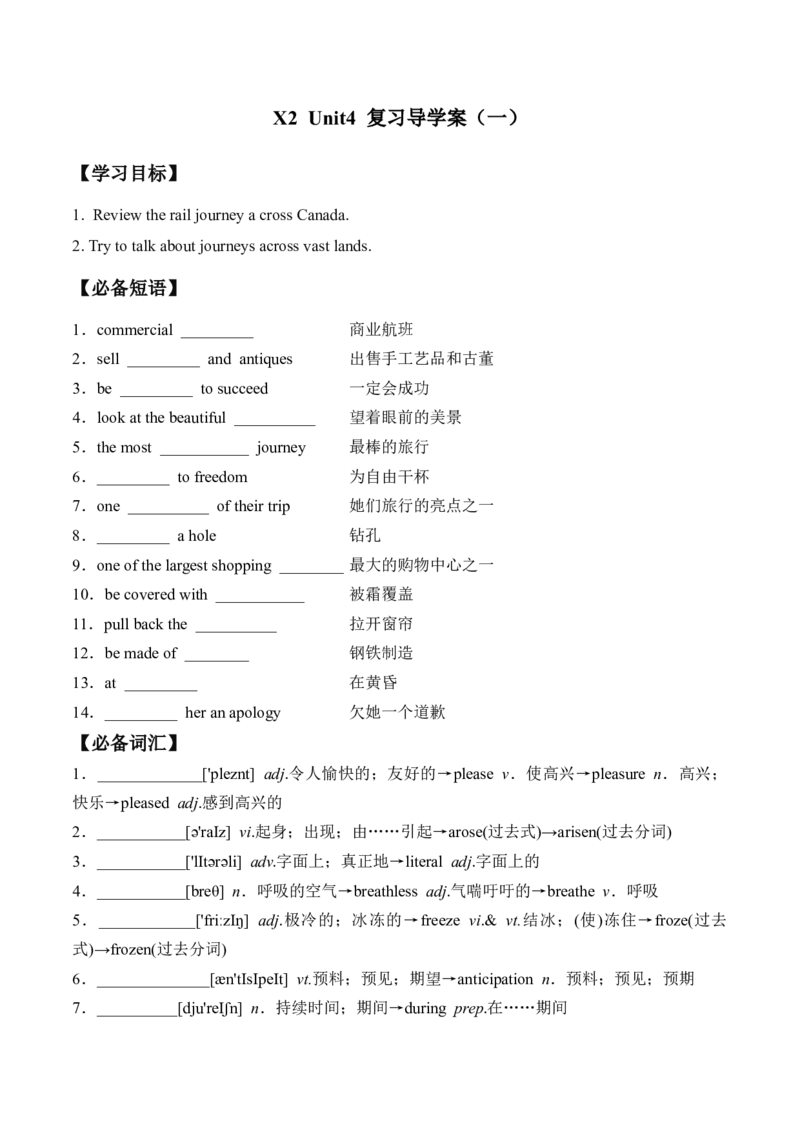
X2 Unit4 复习导学案(一)
【学习目标】
1. Review the rail journey a cross Canada.
2. Try to talk about journeys across vast lands.
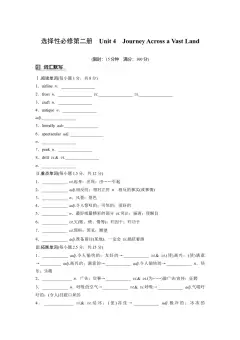
【必备短语】
1.commercial _________ 商业航班
2.sell _________ and antiques 出售手工艺品和古董
3.be _________ to succeed 一定会成功
4.look at the beautiful __________ 望着眼前的美景
5.the most ___________ journey 最棒的旅行
6._________ to freedom 为自由干杯
7.one __________ of their trip 她们旅行的亮点之一
8._________ a hole 钻孔
9.one of the largest shopping ________ 最大的购物中心之一
10.be covered with ___________ 被霜覆盖
11.pull back the __________ 拉开窗帘
12.be made of ________ 钢铁制造
13.at _________ 在黄昏
14._________ her an apology 欠她一个道歉
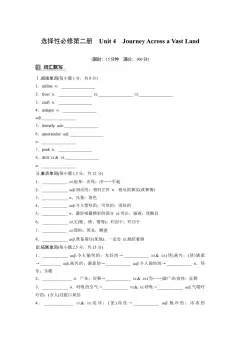
【必备词汇】
1._____________['pleznt] adj.令人愉快的;友好的→please v.使高兴→pleasure n.高兴;
快乐→pleased adj.感到高兴的
2.___________[ə'raIz] vi.起身;出现;由……引起→arose(过去式)→arisen(过去分词)
3.___________['lItərəli] adv.字面上;真正地→literal adj.字面上的
4.___________[breθ] n.呼吸的空气→breathless adj.气喘吁吁的→breathe v.呼吸
5.____________['friːzIŋ] adj.极冷的;冰冻的→freeze vi.& vt.结冰;(使)冻住→froze(过去
式)→frozen(过去分词)
6.______________[æn'tIsIpeIt] vt.预料;预见;期望→anticipation n.预料;预见;预期
7.__________[dju'reIʃn] n.持续时间;期间→during prep.在……期间8.__________[prə'siːd] vi.行进;继续做→proceedings n.(常用复数)事件;行动;诉讼;(会
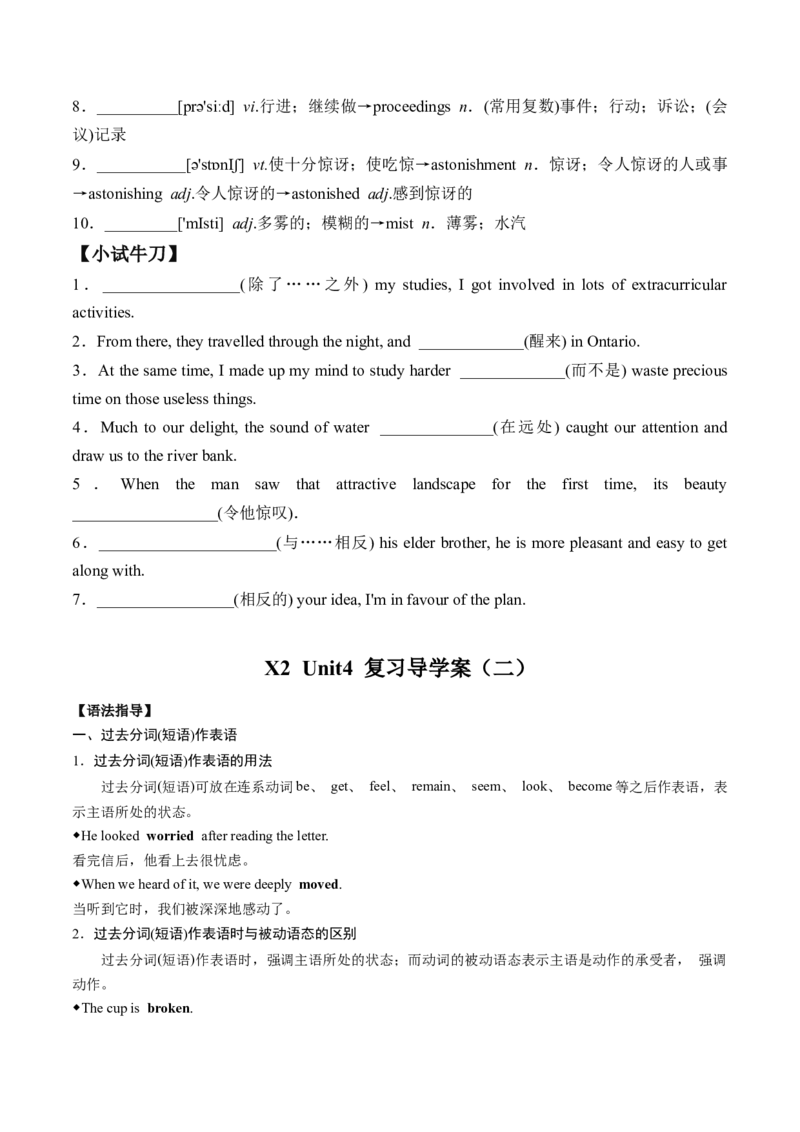
议)记录
9.___________[ə'stɒnIʃ] vt.使十分惊讶;使吃惊→astonishment n.惊讶;令人惊讶的人或事
→astonishing adj.令人惊讶的→astonished adj.感到惊讶的
10._________['mIsti] adj.多雾的;模糊的→mist n.薄雾;水汽
【小试牛刀】
1._________________(除了……之外) my studies, I got involved in lots of extracurricular
activities.
2.From there, they travelled through the night, and _____________(醒来) in Ontario.
3.At the same time, I made up my mind to study harder _____________(而不是) waste precious
time on those useless things.
4.Much to our delight, the sound of water ______________(在远处) caught our attention and
draw us to the river bank.
5 . When the man saw that attractive landscape for the first time, its beauty
__________________(令他惊叹).
6.______________________(与……相反) his elder brother, he is more pleasant and easy to get
along with.
7._________________(相反的) your idea, I'm in favour of the plan.
X2 Unit4 复习导学案(二)
【语法指导】
一、过去分词(短语)作表语
1.过去分词(短语)作表语的用法
过去分词(短语)可放在连系动词be、 get、 feel、 remain、 seem、 look、 become等之后作表语,表
示主语所处的状态。
◆He looked worried after reading the letter.
看完信后,他看上去很忧虑。
◆When we heard of it, we were deeply moved.
当听到它时,我们被深深地感动了。
2.过去分词(短语)作表语时与被动语态的区别
过去分词(短语)作表语时,强调主语所处的状态;而动词的被动语态表示主语是动作的承受者, 强调
动作。
◆The cup is broken.杯子碎了。(系表结构,表状态)
◆The cup was broken by Tom.
杯子是汤姆打碎的。(被动语态,表动作)
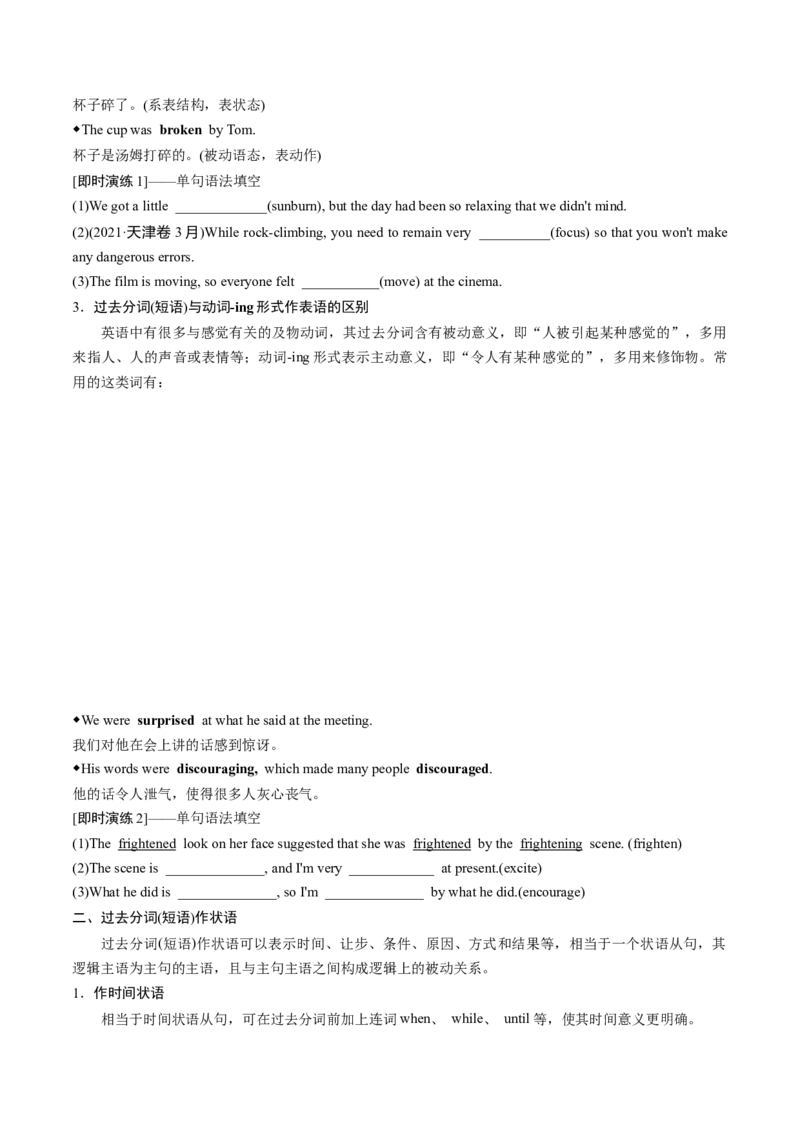
[即时演练1]——单句语法填空
(1)We got a little _____________(sunburn), but the day had been so relaxing that we didn't mind.
(2)(2021·天津卷3月)While rock-climbing, you need to remain very __________(focus) so that you won't make
any dangerous errors.
(3)The film is moving, so everyone felt ___________(move) at the cinema.
3.过去分词(短语)与动词-ing形式作表语的区别
英语中有很多与感觉有关的及物动词,其过去分词含有被动意义,即“人被引起某种感觉的”,多用
来指人、人的声音或表情等;动词-ing形式表示主动意义,即“令人有某种感觉的”,多用来修饰物。常
用的这类词有:
◆We were surprised at what he said at the meeting.
我们对他在会上讲的话感到惊讶。
◆His words were discouraging, which made many people discouraged.
他的话令人泄气,使得很多人灰心丧气。
[即时演练2]——单句语法填空
(1)The frightened look on her face suggested that she was frightened by the frightening scene. (frighten)
(2)The scene is ______________, and I'm very ____________ at present.(excite)
(3)What he did is ______________, so I'm ______________ by what he did.(encourage)
二、过去分词(短语)作状语
过去分词(短语)作状语可以表示时间、让步、条件、原因、方式和结果等,相当于一个状语从句,其
逻辑主语为主句的主语,且与主句主语之间构成逻辑上的被动关系。
1.作时间状语
相当于时间状语从句,可在过去分词前加上连词when、 while、 until等,使其时间意义更明确。◆Ordinary soap, used correctly, can deal with bacteria effectively.
=When it is used correctly, ordinary soap can deal with bacteria effectively.
普通肥皂被正确使用的时候,也是可以有效除菌的。
2.作原因状语
相当于原因状语从句或并列句。
◆Absorbed in painting, John didn't notice evening approaching.
=Because John was absorbed in painting, he didn't notice evening approaching.
=John was absorbed in painting, so he didn't notice evening approaching.
由于专心画画,约翰没有注意到夜幕正在降临。
3.作条件状语
相当于条件状语从句,可加连词if、 unless等转换成条件状语从句。
◆Used with care, one tin will last for six weeks.
=If it is used with care, one tin will last for six weeks.
如果用得仔细的话,一个罐子可以用六周。
4.作让步状语
相当于让步状语从句,有时可加although、 though、 even if、 even though、 whether...or等连词转换
成让步状语从句。
◆Defeated by his opponent, he never gave up any hope.
=Although he was defeated by his opponent, he never gave up any hope.
尽管被对手击败,但是他从未放弃过希望。
5.作方式、伴随状语
相当于and连接的并列句。
◆She accepted the gift, deeply moved.
=She accepted the gift, and she was deeply moved.
她接受了礼物,被深深地感动了。
有些过去分词(短语)因来源于系表结构,作状语时不强调被动而重在描述主语的状态。这样的过去分
词(短语)常见的有lost(迷路)、 seated(坐)、 hidden(躲)、 lost/absorbed in(沉溺于)、 dressed in(穿着)、
tired of(厌烦)等。
◆Lost in thought, he didn't hear the bell.
由于陷入沉思之中,他没有听到铃声。
[即时演练3]——句型转换
(1)When it is seen from the top of the hill, the town looks more beautiful.
→_______________________________, the town looks more beautiful.
(2)Because they were deeply moved by the film, the children began to cry.
→___________________________________, the children began to cry.