X2 Unit5 复习导学案(一)
【学习目标】
1. Learn to deal with an emergency situation.
2. Write a story about first aid.
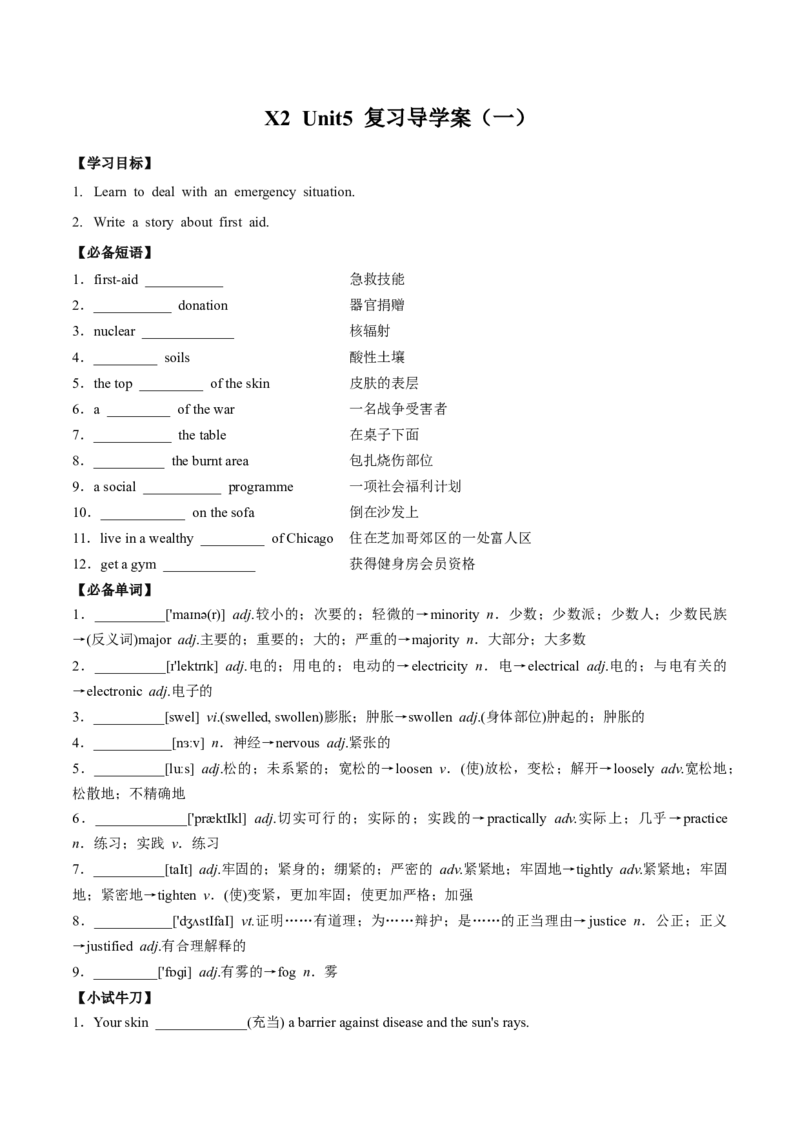
【必备短语】
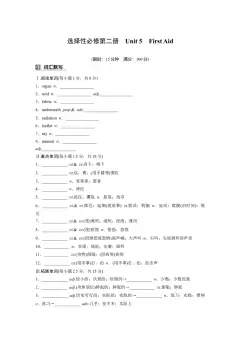
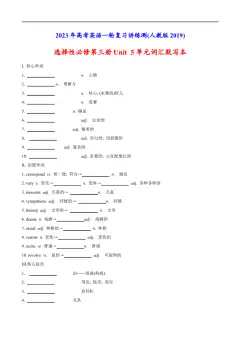
1.first-aid ___________ 急救技能
2.___________ donation 器官捐赠
3.nuclear _____________ 核辐射
4._________ soils 酸性土壤
5.the top _________ of the skin 皮肤的表层
6.a _________ of the war 一名战争受害者
7.___________ the table 在桌子下面
8.__________ the burnt area 包扎烧伤部位
9.a social ___________ programme 一项社会福利计划
10.____________ on the sofa 倒在沙发上
11.live in a wealthy _________ of Chicago 住在芝加哥郊区的一处富人区
12.get a gym _____________ 获得健身房会员资格
【必备单词】
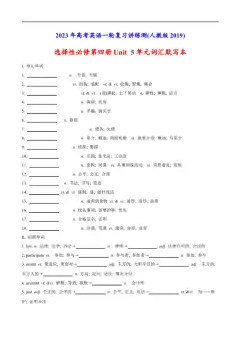
1.__________['maɪnə(r)] adj.较小的;次要的;轻微的→minority n.少数;少数派;少数人;少数民族
→(反义词)major adj.主要的;重要的;大的;严重的→majority n.大部分;大多数
2.__________[ɪ'lektrɪk] adj.电的;用电的;电动的→electricity n.电→electrical adj.电的;与电有关的
→electronic adj.电子的
3.__________[swel] vi.(swelled, swollen)膨胀;肿胀→swollen adj.(身体部位)肿起的;肿胀的
4.___________[nɜːv] n.神经→nervous adj.紧张的
5.__________[luːs] adj.松的;未系紧的;宽松的→loosen v.(使)放松,变松;解开→loosely adv.宽松地;
松散地;不精确地
6._____________['præktIkl] adj.切实可行的;实际的;实践的→practically adv.实际上;几乎→practice
n.练习;实践 v.练习
7.__________[taIt] adj.牢固的;紧身的;绷紧的;严密的 adv.紧紧地;牢固地→tightly adv.紧紧地;牢固
地;紧密地→tighten v.(使)变紧,更加牢固;使更加严格;加强
8.___________['dʒʌstIfaI] vt.证明……有道理;为……辩护;是……的正当理由→justice n.公正;正义
→justified adj.有合理解释的
9._________['fɒɡi] adj.有雾的→fog n.雾
【小试牛刀】
1.Your skin _____________(充当) a barrier against disease and the sun's rays.2.Burns are divided into three types, ________________(取决于) the depth of skin damage.
3.Your skin is where you feel cold, heat or pain and it gives you your ___________________(触觉).
4.The discovery of the new evidence __________(导致) the thief's being caught.
5.To _________________(确保) that he was at home, I called him up in advance.
6.Teenagers who are addicted to the Internet are more likely to ____________(患……病) depression.
7.With the help of Tom's friends, he was able to ___________________________(帮助汤姆站起身来).
8.He was driving along the road when a boy fell off a school bus, _______________________(面朝下).
X2 Unit5 复习导学案(二)
【语法指导】
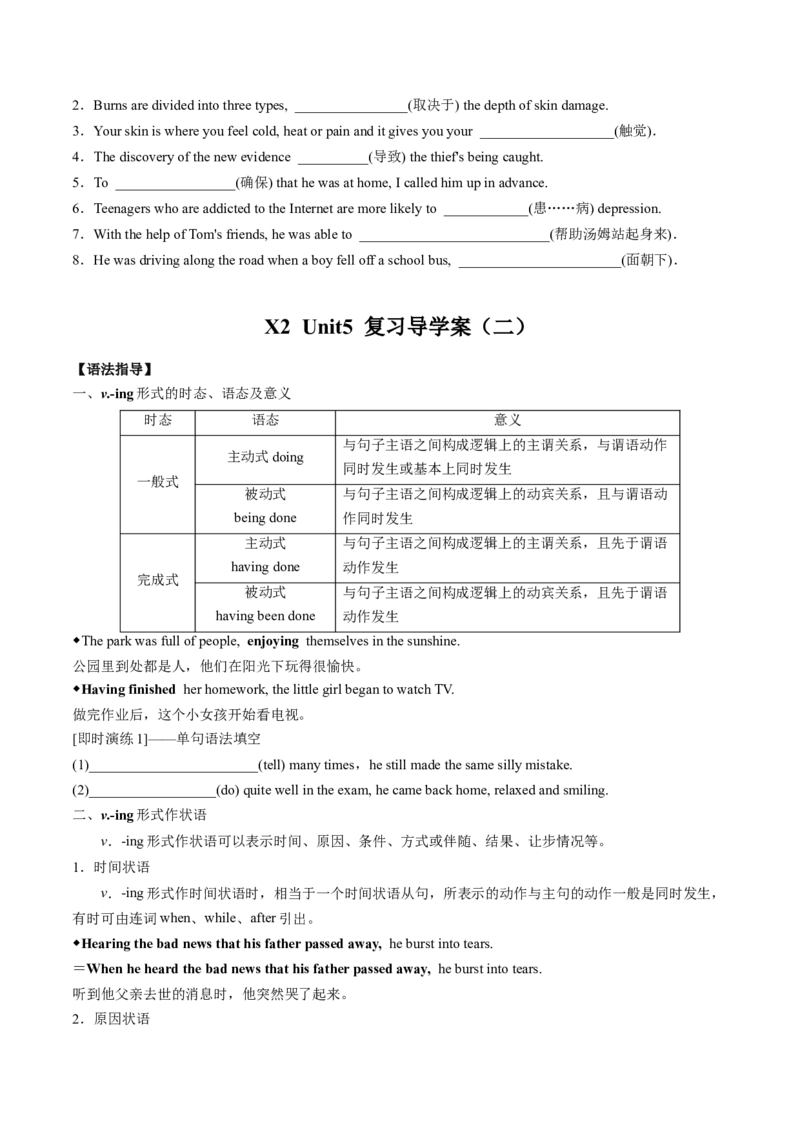
一、v.-ing形式的时态、语态及意义
时态 语态 意义
与句子主语之间构成逻辑上的主谓关系,与谓语动作
主动式doing
同时发生或基本上同时发生
一般式
被动式 与句子主语之间构成逻辑上的动宾关系,且与谓语动
being done 作同时发生
主动式 与句子主语之间构成逻辑上的主谓关系,且先于谓语
having done 动作发生
完成式
被动式 与句子主语之间构成逻辑上的动宾关系,且先于谓语
having been done 动作发生
◆The park was full of people, enjoying themselves in the sunshine.
公园里到处都是人,他们在阳光下玩得很愉快。
◆Having finished her homework, the little girl began to watch TV.
做完作业后,这个小女孩开始看电视。
[即时演练1]——单句语法填空
(1)________________________(tell) many times,he still made the same silly mistake.
(2)__________________(do) quite well in the exam, he came back home, relaxed and smiling.
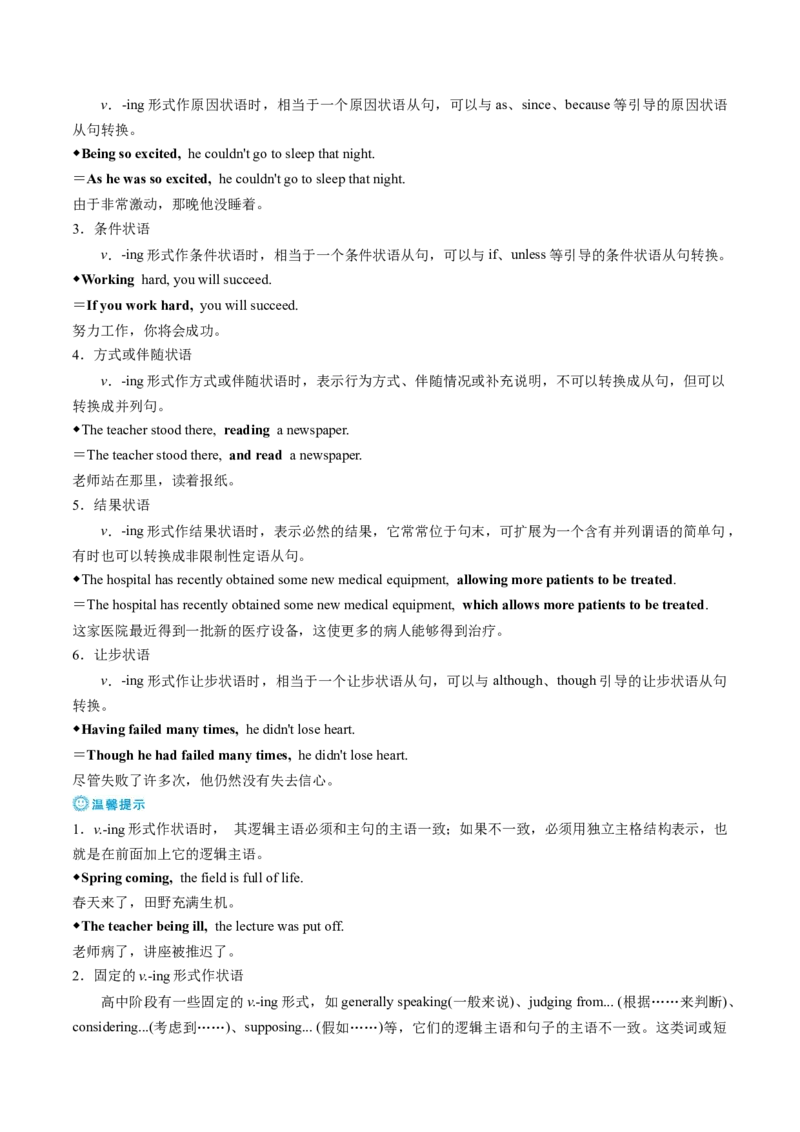
二、v.-ing形式作状语
v.-ing形式作状语可以表示时间、原因、条件、方式或伴随、结果、让步情况等。
1.时间状语
v.-ing形式作时间状语时,相当于一个时间状语从句,所表示的动作与主句的动作一般是同时发生,
有时可由连词when、while、after引出。
◆Hearing the bad news that his father passed away, he burst into tears.
=When he heard the bad news that his father passed away, he burst into tears.
听到他父亲去世的消息时,他突然哭了起来。
2.原因状语v.-ing形式作原因状语时,相当于一个原因状语从句,可以与as、since、because等引导的原因状语
从句转换。
◆Being so excited, he couldn't go to sleep that night.
=As he was so excited, he couldn't go to sleep that night.
由于非常激动,那晚他没睡着。
3.条件状语
v.-ing形式作条件状语时,相当于一个条件状语从句,可以与if、unless等引导的条件状语从句转换。
◆Working hard, you will succeed.
=If you work hard, you will succeed.
努力工作,你将会成功。
4.方式或伴随状语
v.-ing形式作方式或伴随状语时,表示行为方式、伴随情况或补充说明,不可以转换成从句,但可以
转换成并列句。
◆The teacher stood there, reading a newspaper.
=The teacher stood there, and read a newspaper.
老师站在那里,读着报纸。
5.结果状语
v.-ing形式作结果状语时,表示必然的结果,它常常位于句末,可扩展为一个含有并列谓语的简单句,
有时也可以转换成非限制性定语从句。
◆The hospital has recently obtained some new medical equipment, allowing more patients to be treated.
=The hospital has recently obtained some new medical equipment, which allows more patients to be treated.
这家医院最近得到一批新的医疗设备,这使更多的病人能够得到治疗。
6.让步状语
v.-ing形式作让步状语时,相当于一个让步状语从句,可以与 although、though引导的让步状语从句
转换。
◆Having failed many times, he didn't lose heart.
=Though he had failed many times, he didn't lose heart.
尽管失败了许多次,他仍然没有失去信心。
1.v.-ing形式作状语时, 其逻辑主语必须和主句的主语一致;如果不一致,必须用独立主格结构表示,也
就是在前面加上它的逻辑主语。
◆Spring coming, the field is full of life.
春天来了,田野充满生机。
◆The teacher being ill, the lecture was put off.
老师病了,讲座被推迟了。
2.固定的v.-ing形式作状语
高中阶段有一些固定的v.-ing形式,如generally speaking(一般来说)、judging from... (根据……来判断)、
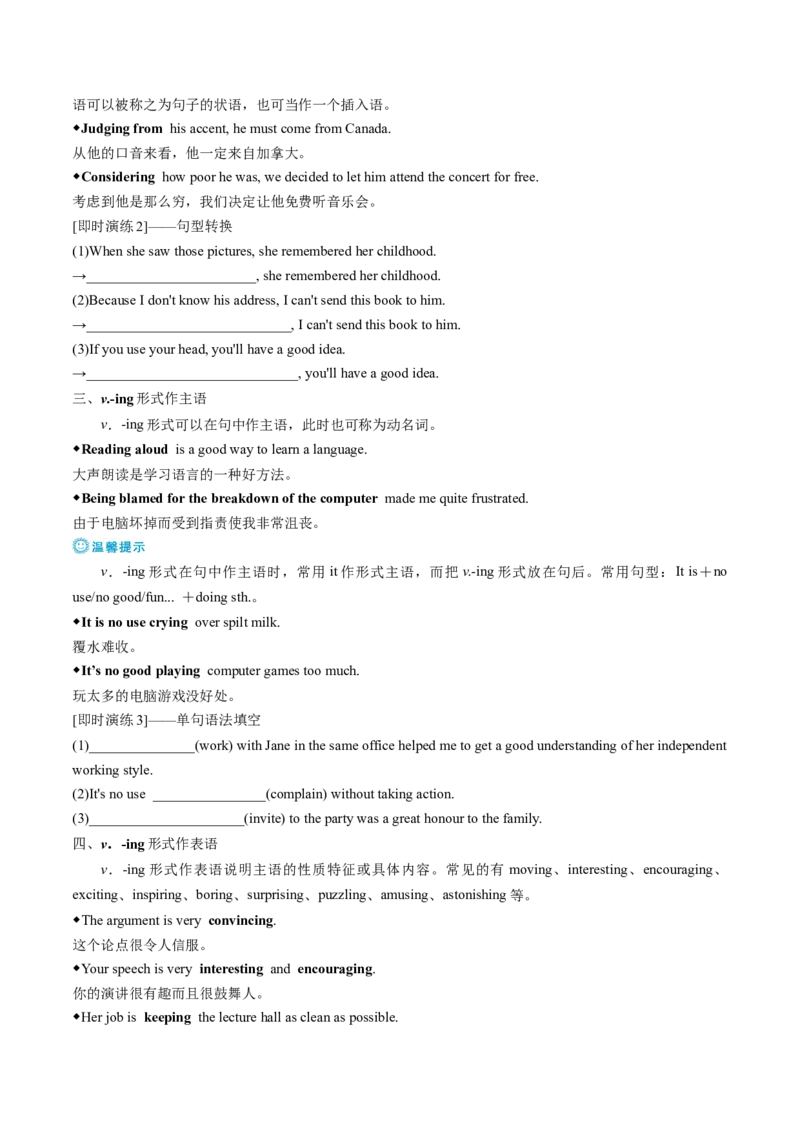
considering...(考虑到……)、supposing... (假如……)等,它们的逻辑主语和句子的主语不一致。这类词或短语可以被称之为句子的状语,也可当作一个插入语。
◆Judging from his accent, he must come from Canada.
从他的口音来看,他一定来自加拿大。
◆Considering how poor he was, we decided to let him attend the concert for free.
考虑到他是那么穷,我们决定让他免费听音乐会。
[即时演练2]——句型转换
(1)When she saw those pictures, she remembered her childhood.
→________________________, she remembered her childhood.
(2)Because I don't know his address, I can't send this book to him.
→_____________________________, I can't send this book to him.
(3)If you use your head, you'll have a good idea.
→______________________________, you'll have a good idea.
三、v.-ing形式作主语
v.-ing形式可以在句中作主语,此时也可称为动名词。
◆Reading aloud is a good way to learn a language.
大声朗读是学习语言的一种好方法。
◆Being blamed for the breakdown of the computer made me quite frustrated.
由于电脑坏掉而受到指责使我非常沮丧。
v.-ing形式在句中作主语时,常用 it作形式主语,而把v.-ing形式放在句后。常用句型:It is+no
use/no good/fun... +doing sth.。
◆It is no use crying over spilt milk.
覆水难收。
◆It’s no good playing computer games too much.
玩太多的电脑游戏没好处。
[即时演练3]——单句语法填空
(1)_______________(work) with Jane in the same office helped me to get a good understanding of her independent
working style.
(2)It's no use ________________(complain) without taking action.
(3)______________________(invite) to the party was a great honour to the family.
四、v.-ing形式作表语
v.-ing形式作表语说明主语的性质特征或具体内容。常见的有 moving、interesting、encouraging、
exciting、inspiring、boring、surprising、puzzling、amusing、astonishing等。
◆The argument is very convincing.
这个论点很令人信服。
◆Your speech is very interesting and encouraging.
你的演讲很有趣而且很鼓舞人。
◆Her job is keeping the lecture hall as clean as possible.=Keeping the lecture hall as clean as possible is her job.
她的工作是尽量使报告厅保持干净。
[即时演练4]——单句语法填空
(1)Going into hospital can be very ________________(frighten) for a child.
(2)Henry's job is ______________________________(teach) physics in a local middle school.
(3)Your task is ______________(clean) the old car over there on your own.
五、v.-ing形式作宾语
v.-ing形式既可作动词宾语,又可作介词宾语。
1.v.-ing形式作动词宾语
◆I hope you will consider travelling to China when you are free.
我希望你在有空的时候考虑来中国旅行。
2.v.-ing形式作介词宾语
◆He insisted on settling the conflict in a peaceful way.
他坚持以和平方式解决冲突。
◆I am looking forward to being admitted to a key university.
我盼望着被一所重点大学录取。
口诀记忆只跟v.-ing形式作宾语的动词
避免错过少延期(avoid、miss、postpone)
建议完成多练习(advise/suggest、finish、practise)
喜欢想象禁不住(enjoy、imagine、can't help)
承认否定与嫉妒(admit、deny、envy)
逃避冒险莫原谅(escape、risk、excuse)
忍受保持不介意(stand、keep、mind)
[即时演练5]——单句语法填空
(1)The key to _______________(solve) the problem is to meet the demand made by the customers.
(2)He devotes himself to ____________(look) into the matter.
(3)She likes spending much money ___________(buy) clothes for herself.
六、v.-ing形式作宾语补足语
v.-ing形式作宾语补足语时,表示一个正在进行的主动动作或一种状态,作宾语补足语的 v.-ing形式
与其前的宾语存在逻辑上的主动关系。
1.表示感觉和心理状态的动词, 即“感官动词(组)”, 常见的有see、hear、feel、smell、find、notice、
observe、look at、listen to等。
◆I saw the little boy crying there.
我看到那个小男孩正在那儿哭。
◆When we returned, we found a stranger standing in front of the house.
当我们回来时,我们发现一个陌生人站在房子前面。v.-ing形式和不定式作宾语补足语的区别
在see、hear、feel、watch、notice等感官动词后,既可用v.-ing形式构成复合宾语,也可用不带to的
不定式构成复合宾语,两者之间有一定的区别。
(1)用v.-ing形式时,表示动作正在进行
◆He saw a girl getting in the car at that time.
那时他看见一个女孩正在上车。
(2)用不带to的不定式时,表示动作发生了,即动作的全过程结束了。
◆He saw a girl get in the car.
他看见一个女孩上了车。
2.表示“叫、让、使”等指使意义的动词,即“使役动词”, 常见的有have、set、keep、get、leave等。
◆It's very cold. We should have the fire burning all the time.
天很冷。我们应该让火一直燃烧着。
◆We can't have the young man speaking to his mother in such a rude manner.
我们不能让那个年轻人用如此无礼的方式跟他的母亲说话。
3.用于“with复合结构”中,其结构和表示意义如下:
with+宾语+doing(表示主动或进行);
with+宾语+done(表示被动或完成);
with+宾语+to do(表示将来)。
◆With so many people looking at her, she felt nervous.
这么多人看着她,她感到紧张。
[即时演练6]——单句语法填空/句型转换
(1)I felt someone ___________(pat) me on the shoulder.
(2)When he passed the swimming pool, he saw someone ______________(swim) in it.
(3)I heard Mary ___________(sing) a song in the next room last night.
七、v.-ing形式作定语
v.-ing形式作后置定语时,它和被修饰词之间有逻辑上的主动关系,表示被修饰词所进行的动作,相
当于一个定语从句。
1.前置定语(放在所修饰的名词前)
v.-ing形式作前置定语表示被修饰词的某种用途或者正在进行的动作。
◆In summer I often swim in the swimming pool.(表示用途)
夏天我经常在游泳池游泳。
◆She glanced at the sleeping child and then hurried away.(表示正在进行)
她瞥了一眼睡着的孩子,随即匆匆离开了。
2.后置定语(放在所修饰的名词后)
v.-ing形式作后置定语时,相当于一个定语从句,可以与that、which、who等引导的定语从句转换。
◆The boy playing football on the playground is my younger brother.=The boy that/who is playing football on the playground is my younger brother.
正在操场上踢足球的那个男孩是我的弟弟。
◆The national park has a large collection of wildlife, ranging from butterflies to elephants.
=The national park has a large collection of wildlife, which ranges from butterflies to elephants.
国家公园有许多的野生动物,从蝴蝶到大象都有。
◆The meeting being held now is of great significance.
=The meeting which/that is being held now is of great significance.
正在举行的会议非常重要。
[即时演练7]——单句语法填空/句型转换
(1)The topic _______________________(discuss) now has drawn some experts' attention.
(2)Grandma came into my bedroom with a __________(walk) stick in her hand.