文档文本内容
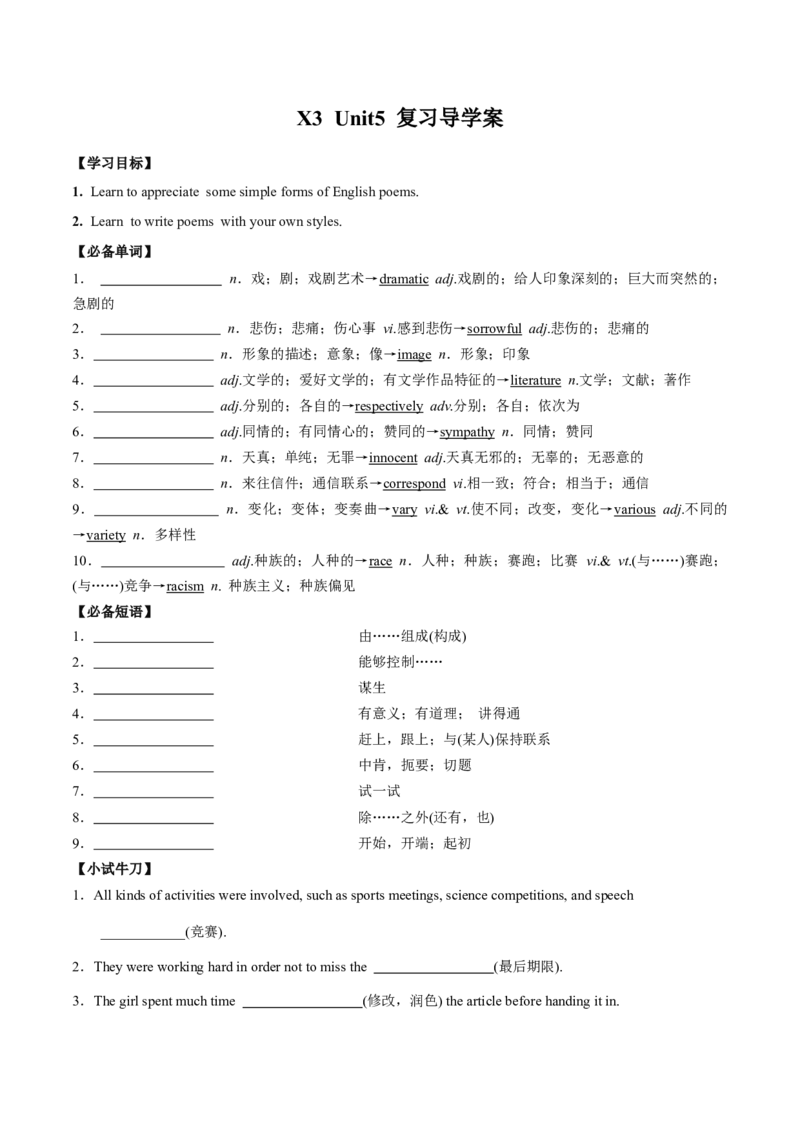
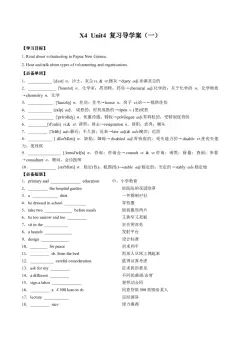
X3 Unit5 复习导学案
【学习目标】
1. Learn to appreciate some simple forms of English poems.
2. Learn to write poems with your own styles.
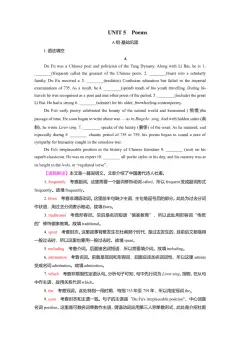
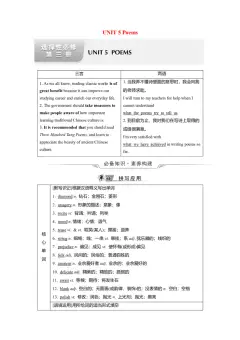
【必备单词】
1. n.戏;剧;戏剧艺术→dramatic adj.戏剧的;给人印象深刻的;巨大而突然的;
急剧的
2. n.悲伤;悲痛;伤心事 vi.感到悲伤→sorrowful adj.悲伤的;悲痛的
3. n.形象的描述;意象;像→image n.形象;印象
4. adj.文学的;爱好文学的;有文学作品特征的→literature n.文学;文献;著作
5. adj.分别的;各自的→respectively adv.分别;各自;依次为
6. adj.同情的;有同情心的;赞同的→sympathy n.同情;赞同
7. n.天真;单纯;无罪→innocent adj.天真无邪的;无辜的;无恶意的
8. n.来往信件;通信联系→correspond vi.相一致;符合;相当于;通信
9. n.变化;变体;变奏曲→vary vi.& vt.使不同;改变,变化→various adj.不同的
→variety n.多样性
10. adj.种族的;人种的→race n.人种;种族;赛跑;比赛 vi.& vt.(与……)赛跑;
(与……)竞争→racism n. 种族主义;种族偏见
【必备短语】
1. 由……组成(构成)
2. 能够控制……
3. 谋生
4. 有意义;有道理; 讲得通
5. 赶上,跟上;与(某人)保持联系
6. 中肯,扼要;切题
7. 试一试
8. 除……之外(还有,也)
9. 开始,开端;起初
【小试牛刀】
1.All kinds of activities were involved, such as sports meetings, science competitions, and speech
____________(竞赛).
2.They were working hard in order not to miss the (最后期限).
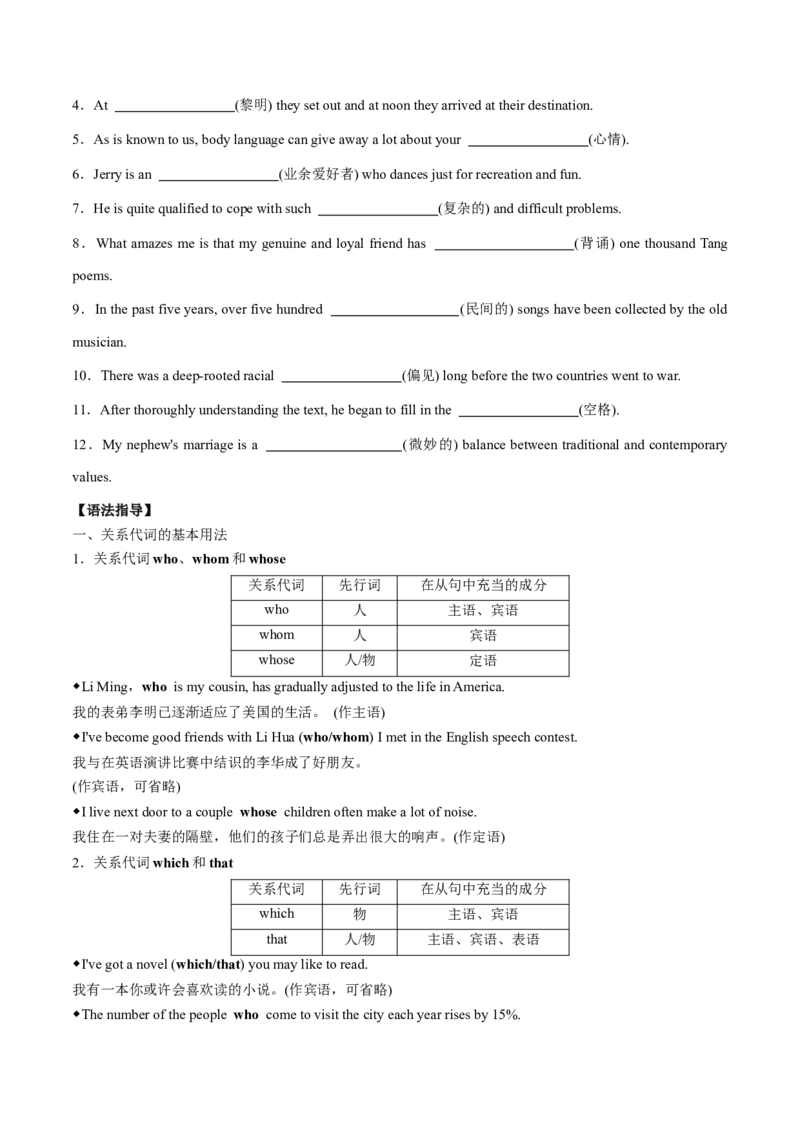
3.The girl spent much time (修改,润色) the article before handing it in.4.At (黎明) they set out and at noon they arrived at their destination.
5.As is known to us, body language can give away a lot about your (心情).
6.Jerry is an (业余爱好者) who dances just for recreation and fun.
7.He is quite qualified to cope with such (复杂的) and difficult problems.
8.What amazes me is that my genuine and loyal friend has (背诵) one thousand Tang
poems.
9.In the past five years, over five hundred (民间的) songs have been collected by the old
musician.
10.There was a deep-rooted racial (偏见) long before the two countries went to war.
11.After thoroughly understanding the text, he began to fill in the (空格).
12.My nephew's marriage is a (微妙的) balance between traditional and contemporary
values.
【语法指导】
一、关系代词的基本用法
1.关系代词who、whom和whose
关系代词 先行词 在从句中充当的成分
who 人 主语、宾语
whom 人 宾语
whose 人/物 定语
◆Li Ming,who is my cousin, has gradually adjusted to the life in America.
我的表弟李明已逐渐适应了美国的生活。 (作主语)
◆I've become good friends with Li Hua (who/whom) I met in the English speech contest.
我与在英语演讲比赛中结识的李华成了好朋友。
(作宾语,可省略)
◆I live next door to a couple whose children often make a lot of noise.
我住在一对夫妻的隔壁,他们的孩子们总是弄出很大的响声。(作定语)
2.关系代词which和that
关系代词 先行词 在从句中充当的成分
which 物 主语、宾语
that 人/物 主语、宾语、表语
◆I've got a novel (which/that) you may like to read.
我有一本你或许会喜欢读的小说。(作宾语,可省略)
◆The number of the people who come to visit the city each year rises by 15%.来这座城市游玩的人数每年增加15%。(指人,作主语)
[即时演练1]——用适当的关系代词填空
(1)Children ________ are not active in exercise will gain weight quickly.
(2)Happiness often come to those ________ are good at recognising their strengths.
二、关系副词的基本用法
1.关系副词when、where和why
关系副词 先行词 在从句中充当的成分
when 表示时间的名词 时间状语
where 表示地点的名词 地点状语
why 表示原因的名词(reason) 原因状语
◆We don't know the exact time when the English Evening will be held.
我们不知道英语晚会举行的确切时间。(时间状语)
◆(2021·浙江卷6月)There are two parks less than 10 minutes' walk from home where neighbourhood children
gather to play.
从家里步行不到10分钟就有两个公园, 附近的孩子们聚集在那里玩耍。(地点状语)
◆I am writing to inform you of the reasons why our school's drama club is popular with us students.
我写信告知你我们学校的戏剧俱乐部受我们学生欢迎的原因。 (原因状语)
2.关系副词when、where和why可转换为“介词+which”
when、where可根据先行词、从句的谓语及句意使用适当的介词,但是关系副词why只可转换为“for+
which”。
◆He will never forget the days when/in which he learned drama.
他永远不会忘记他学习戏剧的那段时光。
[即时演练2]——用适当的关系副词填空
(1)His teacher didn't know the reason _______ he failed in the test.
(2)The song brought the time back to me _______ I was taken good care of by my grandparents.
三、“介词+关系代词”引导定语从句
1. “介词+关系代词”结构中的关系代词通常用which或whom, 不用that。
◆I'll never forget the days on which we studied together.
我永远忘不了我们一起学习的日子。
[即时演练3]——将下列句子升级为定语从句
(1)The man has two daughters, and both of them work as teachers.
→The man has two daughters, _______________ work as teachers.