35. The Modern Family 现代家庭
Father leaves for work in the morning after breakfast. The two children take the bus to school, and mother
stays home cooking and cleaning until father and the kids return home in the evening. This is the traditional
picture of a happy family living in Britain. But is it true
today?
The answer is no! The past 20 years have seen great
changes in the lives and structure of families in Britain.
The biggest change has been caused by divorce. As
many as 2 out of 3 marriages now end in divorce, leading
to a situation where many children live with one parent
and only see the other at weekends or holidays.
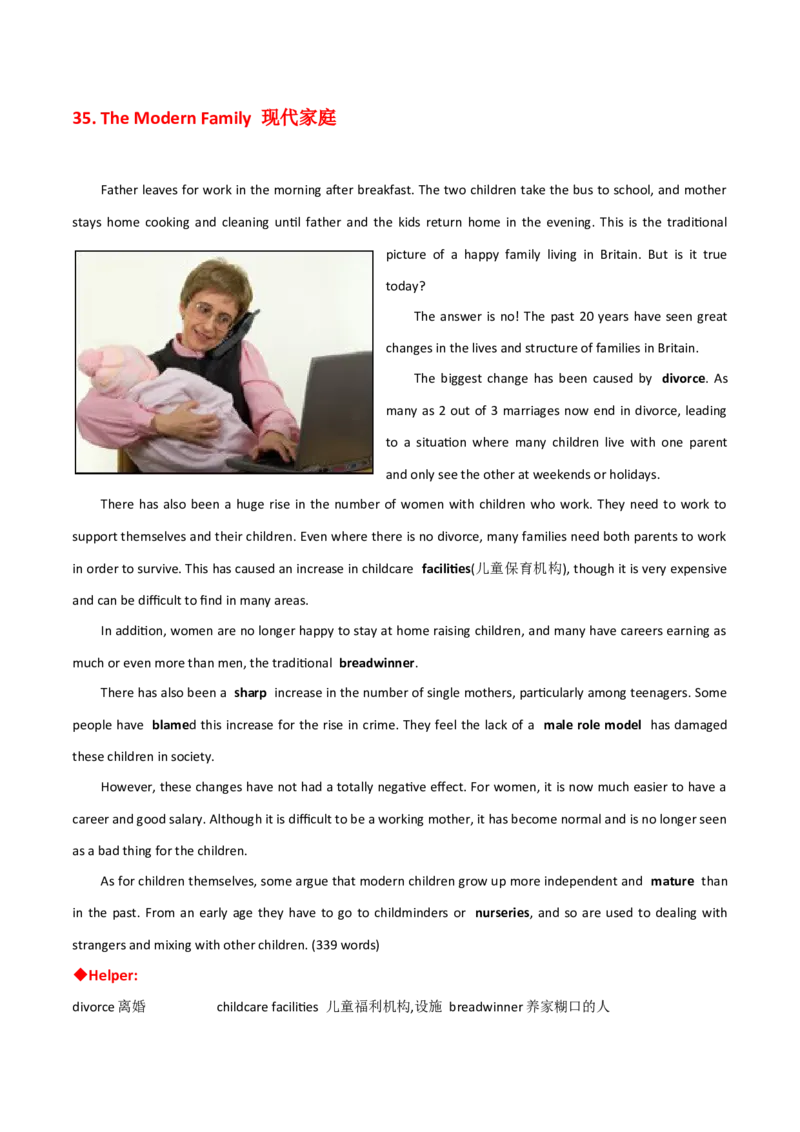
There has also been a huge rise in the number of women with children who work. They need to work to
support themselves and their children. Even where there is no divorce, many families need both parents to work
in order to survive. This has caused an increase in childcare facilities(儿童保育机构), though it is very expensive
and can be difficult to find in many areas.
In addition, women are no longer happy to stay at home raising children, and many have careers earning as
much or even more than men, the traditional breadwinner.
There has also been a sharp increase in the number of single mothers, particularly among teenagers. Some
people have blamed this increase for the rise in crime. They feel the lack of a male role model has damaged
these children in society.
However, these changes have not had a totally negative effect. For women, it is now much easier to have a
career and good salary. Although it is difficult to be a working mother, it has become normal and is no longer seen
as a bad thing for the children.
As for children themselves, some argue that modern children grow up more independent and mature than
in the past. From an early age they have to go to childminders or nurseries, and so are used to dealing with
strangers and mixing with other children. (339 words)
◆Helper:
divorce离婚 childcare facilities 儿童福利机构,设施 breadwinner养家糊口的人sharp急剧的;明显的 blame谴责;归咎 male role model 男性角色模范
mature成熟的 nurser y ['nə:səri] 托儿所
◆Brief Introduction:
爸爸早饭后外出工作,孩子们乘车上学,妈妈在家做家务。这是传统英国家庭幸福生活的画面。而如
今已经不同了,过去的20年见证了英国家庭结构和生活的巨大变化。最大的变化是由离婚引起的。2/3的
婚姻如今都以离婚告终,导致单亲家庭的增多。另一个大的变化就是有孩子的职业女性数量上升。离婚就
意味着女性需要赚钱养活自己和她们的孩子。即使不离婚,很多家庭同样需要夫妻双方都参加工作才能维
持。这又造成儿童福利机构的增加。此外,女性也不再乐于在家带孩子,有些女性比过去养家糊口的男人
赚的钱还要多。单身妈妈的急剧增加曾使人们把它和犯罪率的上升联系起来,他们认为缺少父亲的模范榜
样作用会毁了孩子们。尽管如此,这些改变并没有带来绝对负面的影响。对女性来说,现在要有自己的事
业并且拿到高薪变得容易多了。尽管做一名职业母亲并不轻松,但这已经是正常现象,也没有人再觉得这
对孩子有什么不好。就孩子本身来说,有些人认为和过去相比现在的孩子在成长中更加独立和成熟。他们
很小的时候就不得不被寄养在托儿所,因此更早地习惯与陌生人相处以及融入到其他孩子当中去。
◆ Exercises:
从所给的A、B、C、D四个选项中选出最佳答案。
1. In traditional British family, are breadwinners who work to support the families in Britain.
A. men B. women C. both men and women D. either men or women
2. What is the main cause of the changes in British family structures and life?
A. work B. childcare C. divorce D. housework
3. The author’s attitude towards the changes of the families in Britain is .
A. supportive B. critical C. opposed D. neutral
4. The last two paragraphs show that _________.
A. he who plays with fire gets burnt easily B. no pains no gains
C. every coin has two sides D. practice makes perfect
5. Which of the following can take the place of the title of the passage?
A. Working Women in Britain B. The Changes of British Families
C. Social Problems Caused by Divorce D. Life of Single Mothers
◆Keys and Explanations:
1-5 ACDCB
1. 选A。细节理解题。由第一段首句“Father leaves for work in the morning after breakfast.”第五段的thanmen, the traditional breadwinner.可知“传统的英国家庭中,养家活口的人是男人”。
2. 选C。细节理解题。由第三段首句“The biggest change has been caused by divorce.”可知“英国家庭的生
活方式和家庭结构的变化是由离婚导致的”。
3. 选D。作者态度题。作者向我们阐述了现代英国家庭和过去相比发生的一系列变化,以及不同人对这些
变化所持的不同态度。但并未明确表明自己的态度和立场,故D项最合适。
4. 选C。推理判断题。A“玩火者必自焚”,强调做某事所造成的不良后果;B“不劳则不获”,强调付出的
作用;C“每枚硬币都有正反面”,强调对事情要一分为二,凡事都有优劣;D“熟能生巧”,强调练习的
重要性。根据主题句However, these changes have not had a totally negative effect.“然而这些变化并不完全
只有负面的影响”,接着列举了积极的方面,像对于妇女找工作变得更容易,对于孩子自身的发展,如
独立性和交流都是有益的。故选C。
5. 选B。主旨大意题。本文主要描写了当代英国家庭生活和结构变化情况,第一段用过去的情况开头,目
的是让读者对照,紧接着在第二段给出否定的回答,一直到最后本文都是在说明英国现代生活和家庭结
构的变化。A、D项片面;C没有确切的依据,只是在第六段提到有人认为“单身妈妈的急剧增加曾使人
们把它和犯罪率的上升联系起来,他们认为缺少父亲的模范榜样作用会毁了孩子们”,但不足以做标
题。故选B。36. American Hospitality美国人的待客之道
An American friend has invited you to visit his family. You've never been to an American's home before, and
you're not sure what to do. Should you take a gift? How should you dress? What time should you arrive? What
should you do when you get there? Glad you asked. When you're the guest, you should just make yourself at
home. That's what hospitality is all about: making people feel at home when they're not.
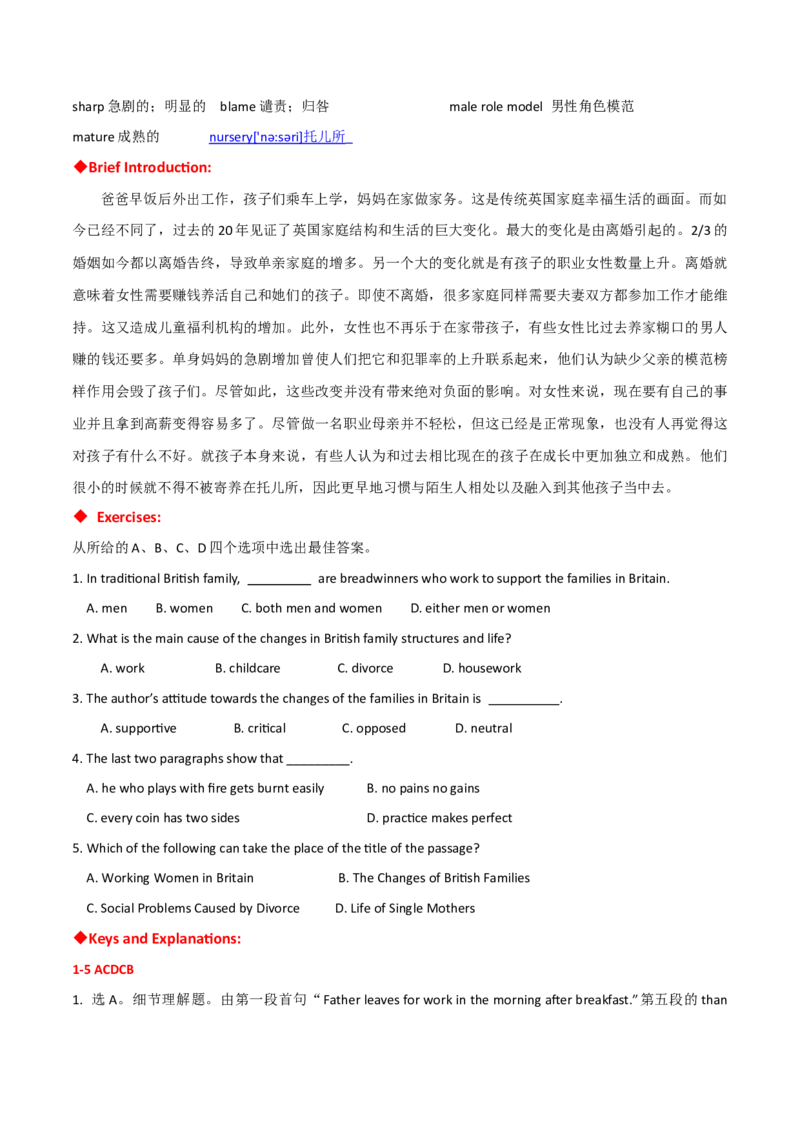
The question of whether or not to bring a gift often makes guests squirm. Giving your host a gift is not just a
social nicety in some cultures—it's expected. But in American
culture, a guest is not obligated to bring a present. Of
course, some people do bring a small token of
appreciation to their host. Appropriate gifts for general
occasions might be flowers, candy or—if the family has small
children—toys. If you choose not to bring a gift, don't worry.
No one will even notice.
American hospitality begins at home----- especially
when it involves food. Most Americans agree that good home cooking beats restaurant food any day. When
invited for a meal, you might ask, "Can I bring anything?" Unless it's a potluck, where everyone brings a dish, the
host will probably respond, "No, just yourself." For most informal dinners, you should wear comfortable, casual
clothes. Plan to arrive on time, or else call to inform your hosts of the delay. During the dinner conversation, it's
customary to compliment the hostess on the wonderful meal. Of
course, the biggest compliment is to eat lots of food!
When you've had plenty, you might offer to clear the table or wash
the dishes. But since you're the guest, your hosts may not let you.
Instead, they may invite everyone to move to the living room for
dessert with tea or coffee. After an hour or so of general chit-chat, it's
probably time to head for the door. You don't want to wear out your
welcome. And above all, don't go snooping around the house. It's more polite to wait for the host to offer you a
guided tour. But except for housewarmings, guests often don't get past the living room.Americans usually like to have advance notice when people come to see them. Only very close friends drop
by unannounced. This is especially true if the guests want to stay for a few days. Here's a good rule for
houseguests: Short stays are best. As one 19th century French writer put it, "The first day a man is a guest, the
second a burden , the third a pest . " Even relatives don't usually stay for several weeks at a time. While you're
staying with an American family, try to keep your living area neat and tidy. Your host family will appreciate your
consideration. And they may even invite you back!
Most Americans consider themselves hospitable people. Folks in the southern United States, in particular,
take pride in entertaining guests. In fact, "southern hospitality" has become legendary. But in all parts of America,
people welcome their guests with open arms. So don't be surprised to find the welcome mat out for you. Just
don't forget to wipe your feet. (533 words)
◆Helper:
hospitality [hɔspi'tæliti] 盛情,好客 squirm [skwə:m]局促不安 obligate使负义务, 强制
token表示 appreciation 感谢 appropriate适当的
involve与…有关 potluck每人带一道菜的聚餐 compliment恭维
dessert(作为正餐最后的)食品 chit-chat谈话;闲谈 snoop窥探
housewarming乔迁庆宴 burden负担 pest令人讨厌的人
consideration体谅 legendary传说的 mat垫子
◆ Exercises:
从所给的A、B、C、D四个选项中选出最佳答案。
1. When you visit a family, it’s a common practice to______.
A. take a gift B. dress up C. arrive on time D. eat as little as possible
2. If you are a good host, you’ll ______.
A. try to persuade your guest to eat as much as possible
B. try to make your guest feel at home
C. try to satisfy all your guest’s needs
D. refuse your guest to do any housework
3. If you don't want to wear out your welcome, you should ______.
A. offer to clear the table or wash the dishes
B. not go snooping around the house
C. ask your host to visit your familyD. say goodbye to your host in time
4. The underlined sentence "The first day a man is a guest, the second a burden, the third a pest." means
______.
A. staying too long does great harm to the host
B. a host’s real hospitality can be tested by time
C. a guest is not a relative after all
D. there is no real hospitality at all in the world
5. From the passage, we know ______.
A. American people are hospitable, you can visit a family at any time
B. people in the southern United States are more hospitable
C. they always use the welcome mat to show their respect
D. you can stay a few days to show your good relationship
◆Brief Introduction:
以前从未去过美国人的家,你不确定该怎么做。该带一个礼物吗?该怎么穿?该几点到?到了那里该
做什么?很高兴你发问。你若是客人,只要使自己感到自在就好了。待客之道就是这样:虽然不是在家
里,却使客人有宾至如归之感。
是否带礼物的问题常使客人不安。在某些文化中,送主人礼物不只是社交礼节——还是必要的。但是
在美国文化中,客人并不一定要带礼物。
美国人的待客之道从家里开始——尤其是和食物有关。大多数美国人都同意,无论如何,好的家常菜
胜过餐馆的菜。
当你吃得差不多时,或许可以主动表示要帮忙清理桌子或洗碗盘,但你既是客人,你的主人可能不会
让你这样做。还有最重要的是不要在屋子里四处窥探,等主人邀请你参观才较有礼貌。可是除了乔迁喜宴
之外,客人通常都只待在客厅里。
美国人通常喜欢访客事先通知他们,只有非常亲密的朋友才会不请自来,尤其在客人要待好几天时更
是如此。最好不要久留,如同十九世纪一位法国作家所写的:“第一天是客人,第二天是负担,第三天就
是讨厌鬼了。”
大多数美国人都认为他们是好客之人。尤其是美国的南方人更以款待客人自豪,事实上,“南方的款
待”是人们所津津乐道口口相传的。不过在美国各地,人们都展开双臂欢迎他们的客人,所以当你发现有
WELCOME字样的鞋垫为你而放时,不要惊讶,只是别忘了把你的脚擦干净就是了。
◆Keys and Explanations:1-5 CBDAB
1.选 C。答案 A 可以根据第二段第三句排除;从第三段 For most informal dinners, you should wear
comfortable, casual clothes.可知 B 错;从 Plan to arrive on time, or else call to inform your hosts of the
delay.可知C对;从第三段的最后两句可排除D。
2. 选B。推理判断题。要抓住本文的中心:待客之道是宾至如归,让宾客有在家的感觉是最好的待客之
道,其它讲法都有失偏颇。
3. 选D。细节理解题。首先要结合上一句After an hour or so of general chit-chat, it's probably time to head for
the door.理解wear out your welcome是指本来对你的热情会因呆的时间太长渐渐消耗掉,避免这样的
结构就是适时离开。推理判断题。
4. 选A。细节理解题。根据前句Short stays are best.再结合本句具体理解可得出答案。
5. 选B。综合判断题。从倒数第二段可排除A及D;从最后一段可排除C,并可知B为正确答案。