Chapter I China in Brief 中国概况
Lesson 1 Brief Introduction to China中国简介
Name of the
The People's Republic of China
country
Beijing is the capital of the People's Republic of China. 43.5 meters above sea level, Beijing
covers an area of 16,808 square kilometers and has a resident population of 21.7 million (the
year 2017). Under the city's control there are 10 districts and 8 counties.
Beijing's history as a city can date back to 3,000 years ago. Its time-honored history left Beijing
plenty of historical relics and colorful customs. As the center of the country, here gathers the
offices of the Party, the Government and the Military, as well as headquarters of national
Capital city
companies, industrial associations and financial institutions. Beijing is in the central place of the
nation's financial decisions and macro-control. It is also China's most prosperous city in terms of
science, education and culture, because it covers all subjects of sciences and has strong research
capabilities. Beijing is the communication pivot between China and the international community
and, the most important center for international exchanges.
China has a population over 1.39 billion people (the year 2017), and over 58.52% of the total
Population (the year 2017) are distributed in urban area. Strict population controls was in place for
several decades, but now two-child policy has been carried out.
China has a territory area of 9.6 million square km, second to Russia and Canada, with a sea
Area
area of about 4.73 million square kilometers.
Location In East Asia, border on the west Pacific Ocean
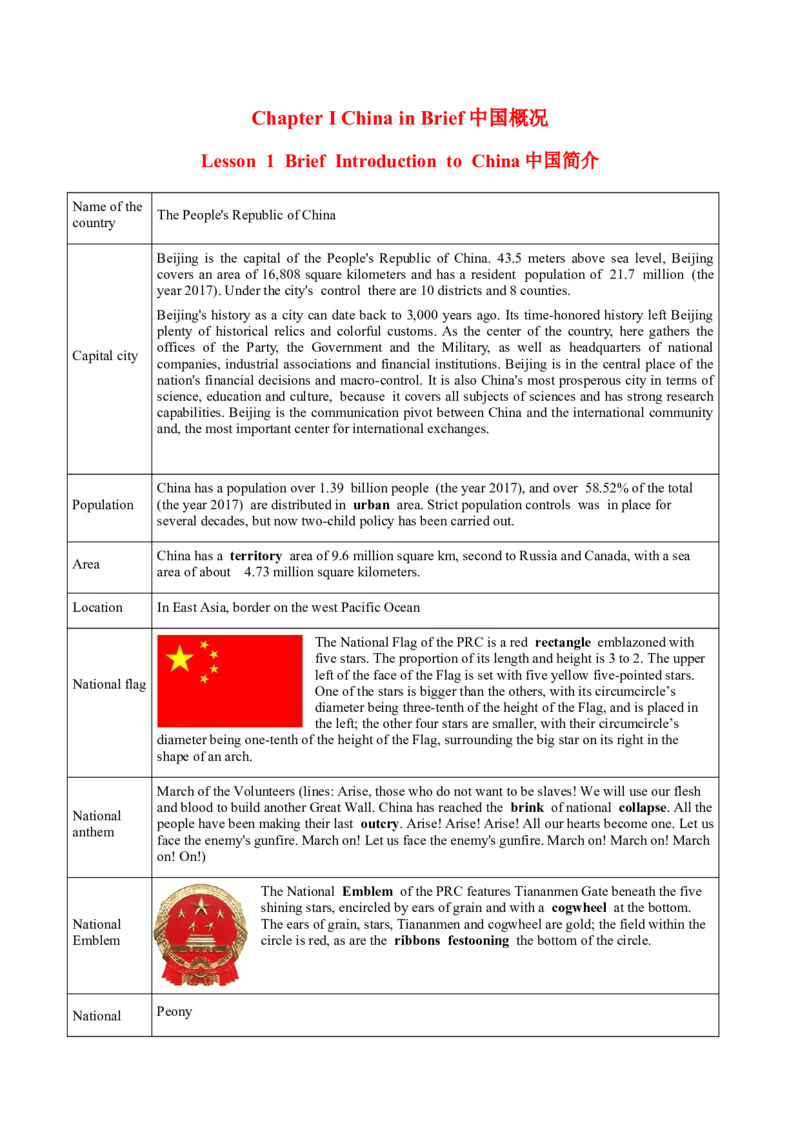
The National Flag of the PRC is a red rectangle emblazoned with
five stars. The proportion of its length and height is 3 to 2. The upper
left of the face of the Flag is set with five yellow five-pointed stars.
National flag
One of the stars is bigger than the others, with its circumcircle’s
diameter being three-tenth of the height of the Flag, and is placed in
the left; the other four stars are smaller, with their circumcircle’s
diameter being one-tenth of the height of the Flag, surrounding the big star on its right in the
shape of an arch.
March of the Volunteers (lines: Arise, those who do not want to be slaves! We will use our flesh
and blood to build another Great Wall. China has reached the brink of national collapse. All the
National
people have been making their last outcry. Arise! Arise! Arise! All our hearts become one. Let us
anthem
face the enemy's gunfire. March on! Let us face the enemy's gunfire. March on! March on! March
on! On!)
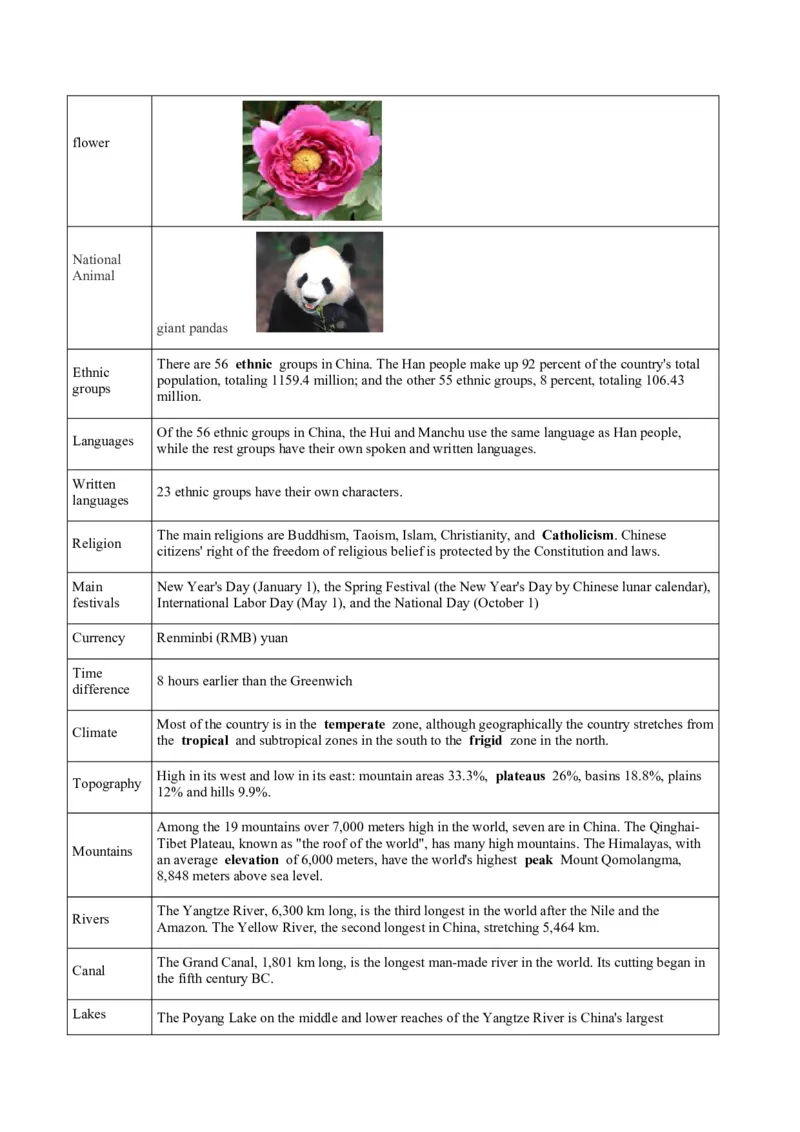
The National Emblem of the PRC features Tiananmen Gate beneath the five
shining stars, encircled by ears of grain and with a cogwheel at the bottom.
National The ears of grain, stars, Tiananmen and cogwheel are gold; the field within the
Emblem circle is red, as are the ribbons festooning the bottom of the circle.
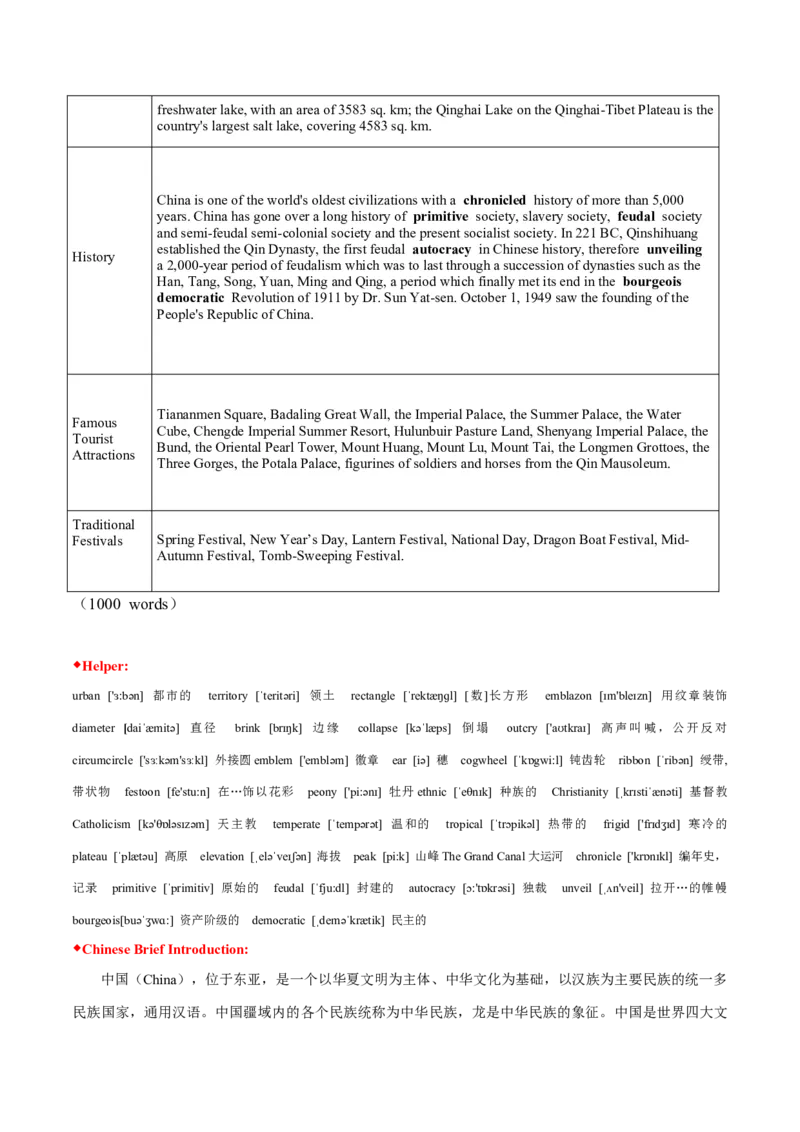
National Peonyflower
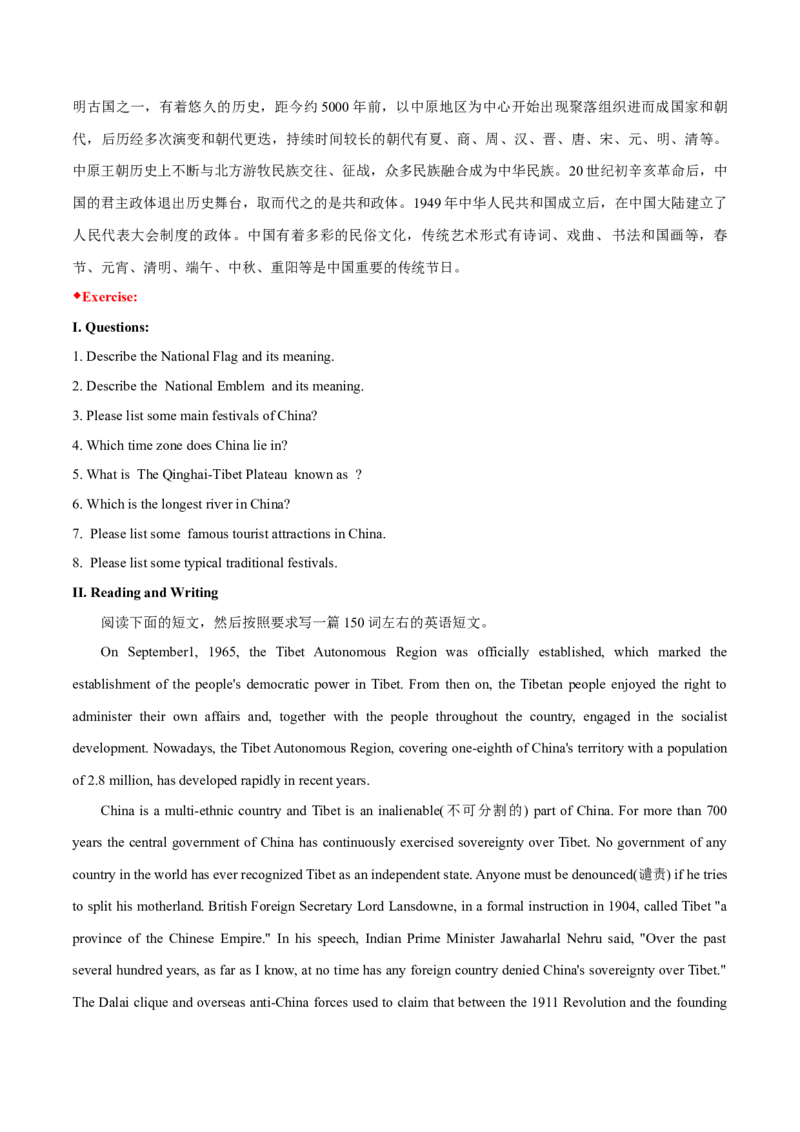
National
Animal
giant pandas
There are 56 ethnic groups in China. The Han people make up 92 percent of the country's total
Ethnic
population, totaling 1159.4 million; and the other 55 ethnic groups, 8 percent, totaling 106.43
groups
million.
Of the 56 ethnic groups in China, the Hui and Manchu use the same language as Han people,
Languages
while the rest groups have their own spoken and written languages.
Written
23 ethnic groups have their own characters.
languages
The main religions are Buddhism, Taoism, Islam, Christianity, and Catholicism. Chinese
Religion
citizens' right of the freedom of religious belief is protected by the Constitution and laws.
Main New Year's Day (January 1), the Spring Festival (the New Year's Day by Chinese lunar calendar),
festivals International Labor Day (May 1), and the National Day (October 1)
Currency Renminbi (RMB) yuan
Time
8 hours earlier than the Greenwich
difference
Most of the country is in the temperate zone, although geographically the country stretches from
Climate
the tropical and subtropical zones in the south to the frigid zone in the north.
High in its west and low in its east: mountain areas 33.3%, plateaus 26%, basins 18.8%, plains
Topography
12% and hills 9.9%.
Among the 19 mountains over 7,000 meters high in the world, seven are in China. The Qinghai-
Tibet Plateau, known as "the roof of the world", has many high mountains. The Himalayas, with
Mountains
an average elevation of 6,000 meters, have the world's highest peak Mount Qomolangma,
8,848 meters above sea level.
The Yangtze River, 6,300 km long, is the third longest in the world after the Nile and the
Rivers
Amazon. The Yellow River, the second longest in China, stretching 5,464 km.
The Grand Canal, 1,801 km long, is the longest man-made river in the world. Its cutting began in
Canal
the fifth century BC.
Lakes The Poyang Lake on the middle and lower reaches of the Yangtze River is China's largestfreshwater lake, with an area of 3583 sq. km; the Qinghai Lake on the Qinghai-Tibet Plateau is the
country's largest salt lake, covering 4583 sq. km.
China is one of the world's oldest civilizations with a chronicled history of more than 5,000
years. China has gone over a long history of primitive society, slavery society, feudal society
and semi-feudal semi-colonial society and the present socialist society. In 221 BC, Qinshihuang
established the Qin Dynasty, the first feudal autocracy in Chinese history, therefore unveiling
History
a 2,000-year period of feudalism which was to last through a succession of dynasties such as the
Han, Tang, Song, Yuan, Ming and Qing, a period which finally met its end in the bourgeois
democratic Revolution of 1911 by Dr. Sun Yat-sen. October 1, 1949 saw the founding of the
People's Republic of China.
Tiananmen Square, Badaling Great Wall, the Imperial Palace, the Summer Palace, the Water
Famous
Cube, Chengde Imperial Summer Resort, Hulunbuir Pasture Land, Shenyang Imperial Palace, the
Tourist
Bund, the Oriental Pearl Tower, Mount Huang, Mount Lu, Mount Tai, the Longmen Grottoes, the
Attractions
Three Gorges, the Potala Palace, figurines of soldiers and horses from the Qin Mausoleum.
Traditional
Festivals Spring Festival, New Year’s Day, Lantern Festival, National Day, Dragon Boat Festival, Mid-
Autumn Festival, Tomb-Sweeping Festival.
(1000 words)
◆Helper:
urban ['ɜ:bən] 都市的 territory [ˈteritəri] 领土 rectangle [ˈrektæŋɡl] [数]长方形 emblazon [ɪm'bleɪzn] 用纹章装饰
diameter [daiˈæmitə] 直径 brink [brɪŋk] 边缘 collapse [kəˈlæps] 倒塌 outcry ['aʊtkraɪ] 高声叫喊,公开反对
circumcircle ['sɜːkəm'sɜːkl] 外接圆emblem ['embləm] 徽章 ear [iə] 穗 cogwheel [ˈkɒgwi:l] 钝齿轮 ribbon [ˈribən] 绶带,
带状物 festoon [fe'stu:n] 在…饰以花彩 peony ['pi:ənɪ] 牡丹ethnic [ˈeθnɪk] 种族的 Christianity [ˌkrɪstiˈænəti] 基督教
Catholicism [kə'θɒləsɪzəm] 天主教 temperate [ˈtempərət] 温和的 tropical [ˈtrɔpikəl] 热带的 frigid ['frɪdʒɪd] 寒冷的
plateau [ˈplætəu] 高原 elevation [ˌeləˈveɪʃən] 海拔 peak [pi:k] 山峰The Grand Canal大运河 chronicle ['krɒnɪkl] 编年史,
记录 primitive [ˈprimitiv] 原始的 feudal [ˈfju:dl] 封建的 autocracy [ɔ:'tɒkrəsi] 独裁 unveil [ˌʌn'veil] 拉开…的帷幔
bourgeois[buəˈʒwɑ:] 资产阶级的 democratic [ˌdeməˈkrætik] 民主的
◆Chinese Brief Introduction:
中国(China),位于东亚,是一个以华夏文明为主体、中华文化为基础,以汉族为主要民族的统一多
民族国家,通用汉语。中国疆域内的各个民族统称为中华民族,龙是中华民族的象征。中国是世界四大文明古国之一,有着悠久的历史,距今约5000年前,以中原地区为中心开始出现聚落组织进而成国家和朝
代,后历经多次演变和朝代更迭,持续时间较长的朝代有夏、商、周、汉、晋、唐、宋、元、明、清等。
中原王朝历史上不断与北方游牧民族交往、征战,众多民族融合成为中华民族。20世纪初辛亥革命后,中
国的君主政体退出历史舞台,取而代之的是共和政体。1949年中华人民共和国成立后,在中国大陆建立了
人民代表大会制度的政体。中国有着多彩的民俗文化,传统艺术形式有诗词、戏曲、书法和国画等,春
节、元宵、清明、端午、中秋、重阳等是中国重要的传统节日。
◆Exercise:
I. Questions:
1. Describe the National Flag and its meaning.
2. Describe the National Emblem and its meaning.
3. Please list some main festivals of China?
4. Which time zone does China lie in?
5. What is The Qinghai-Tibet Plateau known as ?
6. Which is the longest river in China?
7. Please list some famous tourist attractions in China.
8. Please list some typical traditional festivals.
II. Reading and Writing
阅读下面的短文,然后按照要求写一篇150词左右的英语短文。
On September1, 1965, the Tibet Autonomous Region was officially established, which marked the
establishment of the people's democratic power in Tibet. From then on, the Tibetan people enjoyed the right to
administer their own affairs and, together with the people throughout the country, engaged in the socialist
development. Nowadays, the Tibet Autonomous Region, covering one-eighth of China's territory with a population
of 2.8 million, has developed rapidly in recent years.
China is a multi-ethnic country and Tibet is an inalienable(不可分割的) part of China. For more than 700
years the central government of China has continuously exercised sovereignty over Tibet. No government of any
country in the world has ever recognized Tibet as an independent state. Anyone must be denounced(谴责) if he tries
to split his motherland. British Foreign Secretary Lord Lansdowne, in a formal instruction in 1904, called Tibet "a
province of the Chinese Empire." In his speech, Indian Prime Minister Jawaharlal Nehru said, "Over the past
several hundred years, as far as I know, at no time has any foreign country denied China's sovereignty over Tibet."
The Dalai clique and overseas anti-China forces used to claim that between the 1911 Revolution and the foundingof the People's Republic of China in 1949, Tibet became a country "exercising full authority." However, many
historical facts denied such a fallacy(谬论). The so-called "Tibetan independence" which the Dalai clique and
overseas anti-China forces spread is nothing but a fiction of the imperialists who committed aggression against
China in modern history. Never will they succeed.
[写作内容]
1. 以约30个词概括短文的要点。
2. 然后以约120个词就 “西藏是中国领土不可分割的一部分” 的主题发表看法,并包括如下要点:
(1) 自古以来,西藏就是中国的领土,西藏历史源远流长;
(2) 在中央政府的大力支持下,西藏在经济、政治、文化等方面都得到了很好的发展;
(3) 达赖分裂祖国的行为必将受到热爱和平的中国人民和全世界华人的强烈谴责;
(4) 作为中学生,你认为该怎么做?
[写作要求]
(1) 可以使用实例或其他论述方法支持你的论点, 也可以参照阅读材料的
内容,但不得直接引用原文中的句子;
(2) 标题自定。
[评分标准]
概括准确,语言规范,内容合适,篇章连贯。
III. Written work:
1. 根据提示, 写一篇介绍台湾的短文,词数在120左右。
(1) 台湾的地理位置:太平洋西部北临中国东海,东南接南海,与福建隔台湾海峡(strait)相望。
(2) 台湾是我国最大的岛屿。其面积约三万六千平方千米,人口两千多万。
(3) 自然资源丰富,香蕉,稻米,茶叶等农产品驰名中外。
(4) 风景优美,气候宜人,世界各地的游客纷至沓来。台湾自古以来就是我国的一部分。岛内绝大多
数居民来自福建和广东。海峡两岸人民都有统一祖国的强烈 愿望
2. 根据下面的提示,写一篇题为“我们伟大的社会主义(socialist)祖国”的短文。
字数:80—100。
提示:(1) 我国有十三亿多人口,是世界上最大的国家之一。首都是北京。(2) 我国人民勤劳勇敢,具
有光荣的革命传统(tradition)。(3) 一九四九年解放后,我国发生了巨大的变化。(4) 我国人民为了把自
己的国家建设成为一个强大的社会主义国家,正在辛勤劳动。
3. 书面表达:
根据提示,写一篇100~120词的短文,介绍中国的情况。(1)中国位于亚洲的东部,是世界上第三大国家,面积有9,600,000平方公里,境内河流中长江和黄河
是两条最长最重要的河流。西部有大面积的沙漠。
(2)中国历史悠久,有56个民族,十多亿人口,其中汉族人口最多。
(3)北京是中国的首都。
(4)中国是个发展中国家。全国人民会把自己的国家建设得更加富强。
参考词汇:长江 Yangtze River 黄河 Yellow River
短文的开头已经为你写好。
China is situated in the east of Asia. __________________________
Suggested answers:
II. Reading and Writing
Tibet is a part of China
The establishment of the Tibet Autonomous Region has enabled the local people to become masters of their
own affairs, which promotes the development of Tibet. Tibet is part of China, never to be independent.As we all know, Tibet has been an inalienable part of the Chinese territory since ancient times. It has a long
history. Before its liberation, there was no modern industry or highways. However, since the founding of the Tibet
Autonomous Region, Tibet has witnessed significant progress in economic, political and cultural development,
thanks to the great support from the central government.
To our dissatisfaction, the Dalai clique and some overseas anti-China forces has done something that is against
the will of all peace-loving Chinese people at home and abroad. They are bound to be strongly denounced.
As middle school students, we also strongly protest anyone who splits our motherland. Meanwhile, we must
study hard and try our best to make our country more powerful.
III. Written work:
1.Taiwan is situated in the west of the Pacific Ocean. North of it lies the East China Sea and southeast of it the
South Sea. The Taiwan Strait separates Taiwan from Fujian. Taiwan is the largest island in China, which has an area
of about 36,000 square kilometers and has a population of over 20,000,000. It’s rich in natural resources. Bananas,
rice, tea and so on are famous all over the world. The scenery is so beautiful and the climate is so pleasant that
travelers throughout the world come for a visit. Taiwan has been part of China since ancient times. Most people of
the island came from Fujian and Guangdong. All the people on both sides of the strait have a strong wish to unite
our motherland.
2. Our Great Socialist Motherland
Our great motherland is one of the largest countries in the world. It has a population of over thirteen hundred
million. Peking is its capital. We Chinese people are brave and hardworking. We have a glorious revolutionary
tradition. We drove out Japanese invaders and overthrew Kuomingtang government. In 1949 the People’s Republic
of China was founded. Since then great changes have taken place in our motherland. Now our country is getting
stronger and stronger. We Chinese people are working hard to make our motherland into a powerful socialist
country.