热点话题2.2 餐桌礼仪(二)
Catalogue
(1)优雅的就餐方式
(2)别具一格的餐桌礼仪
(3)从就餐看一个人的个性
(4)筷子的历史,象征意义及使用禁忌
(5)去美国家庭做客的注意事项
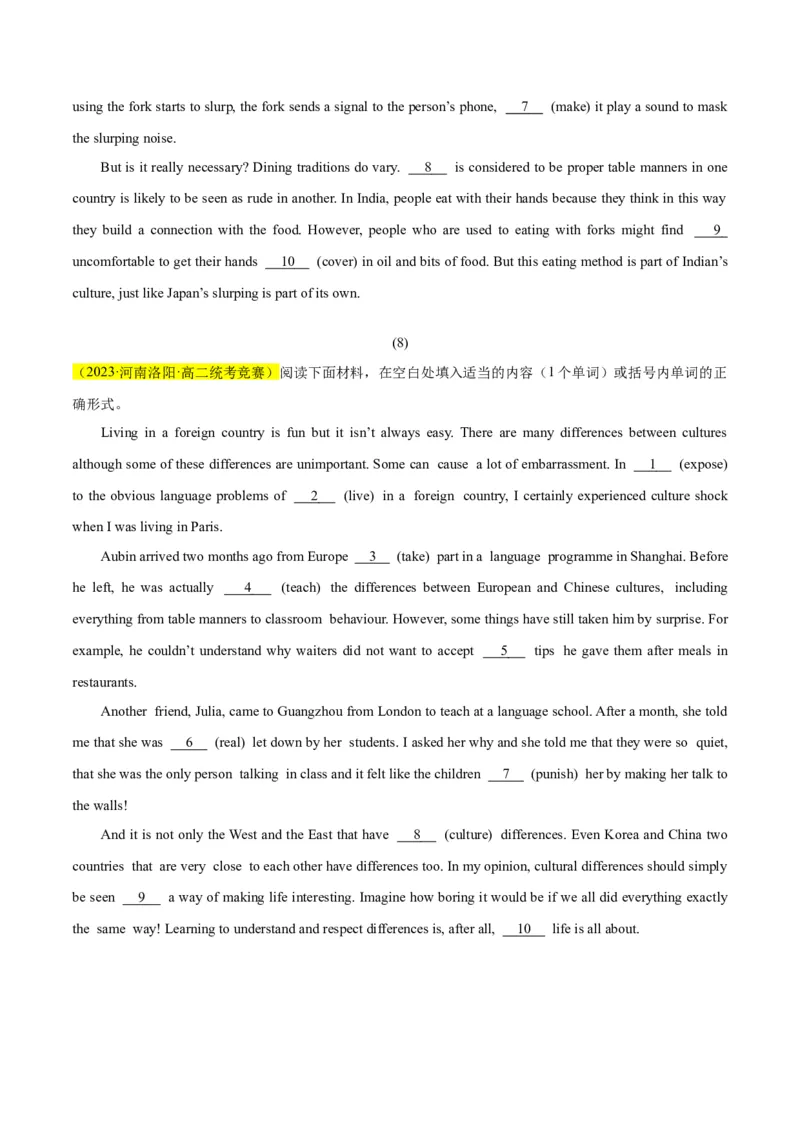
(6)中英在社会、文化的差异
(7)日本人发明的消音叉子
(8)从朋友的经历看文化冲击
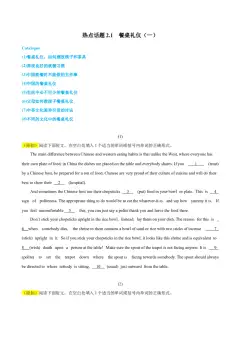
(1)
(原创)阅读下面短文,在空白处填入1个适当的单词或括号内单词的正确形式。
It is not good manners to pick up too much food at a time. You should behave 1 (elegant). When taking
food, don’t nudge or push against your neighbor. Don’t let 2 food splash or let soup or sauce drip onto the
table.
When eating, you should close your mouth 3 (chew) food well before you swallow it, 4 is not
only a requirement of etiquette, but also better for digestion. You should by no means open your mouth wide, fill it
with large pieces of food and eat up greedily. Don’t put too much food into your mouth at a time to avoid 5
(leave) a gluttonous impression. Neither should you stretch your neck, open your mouth wide and extend your
tongue to catch food you 6 (lift) to your mouth. When removing bones 7 other inedible parts of the
meal from your mouth, use 8 (chopstick) or a hand to take them and put them on a side plate (or the table) in
front of you, instead of spitting them directly onto the table or the ground.
If there is food around your mouth, use a tissue or a napkin to wipe it, instead of licking it 9 your
tongue. When chewing food, don’t make noises. It is 1 0 (good) not to talk with others with your mouth full.
Be temperate in laughing lest you spew your food or the food goes down your windpipe and causes choking.
(2)
(原创)阅读下面短文,在空白处填入1个适当的单词或括号内单词的正确形式。
The history of Chinese dining traditions is as old as the beginning of Chinese cooking. The Chinese claim that
they were on the first civilizations to develop a proper orientation of etiquettes. They have worked so hard todevelop government 1 (accept) table manners. These manners are followed all over the China and people
like to use it 2 (proper).
The phenomenon of “dining and winning” is quite older in the Chinese tradition, and it is not 3
(surprise) that Chinese have developed proper sets of rules for the social interaction. They make their own rules
which are usually different from the rest of the world. They don’t feel any harm in 4 (offend) with
the other cultures. What’s good about Chinese culture is 5 once one thing is made as a rule, it will be
followed all over the country.
In China, whether you are doing a dinner of one single family 6 multiple families, it involves a proper
set of rules. However, it may differ a bit in region to region due to slight differences in
the culture. The earlier part of the Chinese dinning etiquette 7 (bring) in China by Yilli. It is believed 8
(reach) in China during 1027-221 BCE.
The current Chinese Dinning manners are a 9 (combine) of years of hard work. For thousands of years, it
kept 10 developing and it will continue like this forever. They make changes in their every system
with the passage of time.
All this is done to keep on improving the etiquettes. However, changes never bring a complete new thing as it
does have footsteps from the past.
(3)
(原创)(2015春·辽宁锦州·高一统考期中 阅读改编)阅读下面材料,在空白处填入适当的内容(1个单
词)或括号内单词的正确形式。
It’s said that one can know the nature of both man and woman by their 1 (behave) at table. Indeed table
manners are closely related to one’s life and one’s job. As the saying goes “When in Rome, do as the Romans
do”, English learners should know 2 the proper table manners are in western countries if 3 (invite) to a
dinner party. The following are some suggestions that may be helpful to you.
The first important thing you need to know is when to begin 4 (eat). Before dinner, the hostess usually
serves guests first and herself last. So do not eat as soon as you are served but wait until the hostess has also been
served and has picked up her fork as 5 signal to begin. But at a large dinner party where there are many
guests, the hostess may ask everyone to begin as soon as they are served. If you want to talk while eating, your
mouth should 6 (certain) not be full of food because it 7 (consider) very bad manners. But it is
possible 8 (speak) with a little food in the mouth. When you have to answer a question, naturally you mustwait until the food in your mouth is eaten.
When a dish is passed to you 9 a fork in the plate, you should use it to take your food. Do not take too
much at a time and make sure that the other guests can have enough food. Anyway, good table manners are very
important 1 0 they are not so simple as we thought.
(4)
(2020·高二单元测试)阅读下面材料,在空白处填入适当的内容(1个单词)或括号内单词的正确形式。
Chopsticks are shaped pairs of equal-length sticks that have been used in the kitchen and on the table in almost
all of East Asia for over 6,000 years. First 1 (use) by the Chinese, chopsticks later spread to other locations
2 (include) Japan, Korea, Malaysia, Singapore, Thailand and Vietnam.
In ancient China, chopsticks signified far more than tools 3 take food to the mouth, and they also
signified status and rules “can” and “can’t”. During the Northern Song Dynasty, 4 official named Tang Su
once had dinner with the emperor. He was not well informed in noble table manners and 5 (lay) down his
chopsticks horizontally on the table before the emperor did. As a result, he was sent to a frontier area as a 6
(punish).
Actually, there were over a dozen taboos concerning chopsticks. For example, they could not be placed 7
(vertical) into a dish, as this was a way of making sacrifices to the dead. Diners could not tap 8 push a dish
with chopsticks, nor use a chopstick as a fork. When taking food, they could not let their chopsticks go from one
dish to another or cross over 9 of others. When diners wanted 1 0 (put) down their chopsticks during a
meal, they would place them lengthways on a chopstick holder or on the plate on their right-hand side. Many of
these chopstick taboos are valid to this day.
(5)
(2022·山东·高一专题练习)阅读下面短文,在空白处填入1个适当的单词或括号内单词的正确形式。
Nowadays, more and more people have chances to travel, study, work or even live abroad. It is necessary for
you to keep in mind these general 1 (rule) for polite behaviour.
If you 2 (invite) to an American friend’s home for dinner, first of all, arrive on time (but not early).
When you’re invited to someone’s home for a meal, 3 is polite to bring a small gift. Flowers or candies are
always appropriate. If you have an attractive item 4 (make) in your native country, your host or hostess
would certainly enjoy receiving that as a gift.
5 (wear) proper clothes and a beautiful smile is simply not enough. Table manners are also of great
6 (important). Do not open your mouth to talk, unless you have swallowed your food. Also chew food with your
mouth 7 (close). When you want to get the food that is at a distance, do not stretch your hands to reach 8
it. Instead, ask for the food to be passed to you.
Don’t leave 9 (immediate) after dinner, but don’t overstay your welcome, either. When your friends
seem to be getting tired and running out of conversation, take their behaviour as a signal to leave. The next day, callor write 1 0 thank-you note to say how much you enjoyed the evening.
(6)
(2020春·安徽蚌埠·高二蚌埠二中校考期中)阅读下面材料,在空白处填入适当的内容(1个单词)或括
号内单词的正确形式。
As the communication between China and Britain is becoming 1 (increasing) frequent, the differences
between them 2 (cause) a heated discussion in the past few years.
Firstly, table manners are the essential procedure in everyone’s daily life. We get used to 3 (use)
chopsticks while Englishmen use knife and forks. It’s not polite to burst into laughter when eating in Britain, 4
indicates you don’t respect others. 5 the contrary, we laugh and talk during a meal. What’s more, in Britain,
we have to wander along the left side of the road, but traffic in our country keeps to the right. In addition, for
Chinese students, 6 they have experienced in studying is an organized learning style. Students are required to
follow a clear plan. 7 (compare) with Chinese education, British education is 8 flexible and
imaginative. Students there are encouraged 9 (discuss) the subject they want to learn. Last but not least, in
China, “thank you” is not frequently used between friends and family members while “thank you” is widely used in
Britain.
There is no sense in debating which is better. We owe these manners 1 0 a long history, so you should do
as the Romans do.
(7)
(2020春·广东汕头·高一金山中学校考期中)阅读下面材料,在空白处填入适当的内容(1个单词)或括
号内单词的正确形式。
It’s interesting when you think about how Japan is a nation that appreciates the virtues of silence and good
manners, and yet when it comes to eating noodles, Japanese people can be the 1 (loud) in the world.
According to lifestyle website grapee.jp, slurping (发出“哧溜”声) when eating noodles 2
(encourage) in Japanese culture. It’s believed that taking air into your mouth can enhance the flavor of the noodles,
and that it helps cool down the noodles. It’s also considered to be a way to show gratitude for the dish. Sometimes,
just making the noise alone seems to make the noodles more 3 (enjoy).
It wasn’t until a new expression – “noodle harassment(骚扰)”-- came out last year on social media 4
Japanese people started to realize that the slurping noise is making some foreign 5 (visit) uncomfortable.
As a response, Japanese instant noodle maker Nissin introduced a so-called noise-canceling fork last month.
The fork, which looks like an electric toothbrush, is connected wirelessly 6 a smart phone. When the personusing the fork starts to slurp, the fork sends a signal to the person’s phone, 7 (make) it play a sound to mask
the slurping noise.
But is it really necessary? Dining traditions do vary. 8 is considered to be proper table manners in one
country is likely to be seen as rude in another. In India, people eat with their hands because they think in this way
they build a connection with the food. However, people who are used to eating with forks might find 9
uncomfortable to get their hands 1 0 (cover) in oil and bits of food. But this eating method is part of Indian’s
culture, just like Japan’s slurping is part of its own.
(8)
(2023·河南洛阳·高二统考竞赛)阅读下面材料,在空白处填入适当的内容(1个单词)或括号内单词的正
确形式。
Living in a foreign country is fun but it isn’t always easy. There are many differences between cultures
although some of these differences are unimportant. Some can cause a lot of embarrassment. In 1 (expose)
to the obvious language problems of 2 (live) in a foreign country, I certainly experienced culture shock
when I was living in Paris.
Aubin arrived two months ago from Europe 3 (take) part in a language programme in Shanghai. Before
he left, he was actually 4 (teach) the differences between European and Chinese cultures, including
everything from table manners to classroom behaviour. However, some things have still taken him by surprise. For
example, he couldn’t understand why waiters did not want to accept 5 tips he gave them after meals in
restaurants.
Another friend, Julia, came to Guangzhou from London to teach at a language school. After a month, she told
me that she was 6 (real) let down by her students. I asked her why and she told me that they were so quiet,
that she was the only person talking in class and it felt like the children 7 (punish) her by making her talk to
the walls!
And it is not only the West and the East that have 8 (culture) differences. Even Korea and China two
countries that are very close to each other have differences too. In my opinion, cultural differences should simply
be seen 9 a way of making life interesting. Imagine how boring it would be if we all did everything exactly
the same way! Learning to understand and respect differences is, after all, 1 0 life is all about.答案与解析
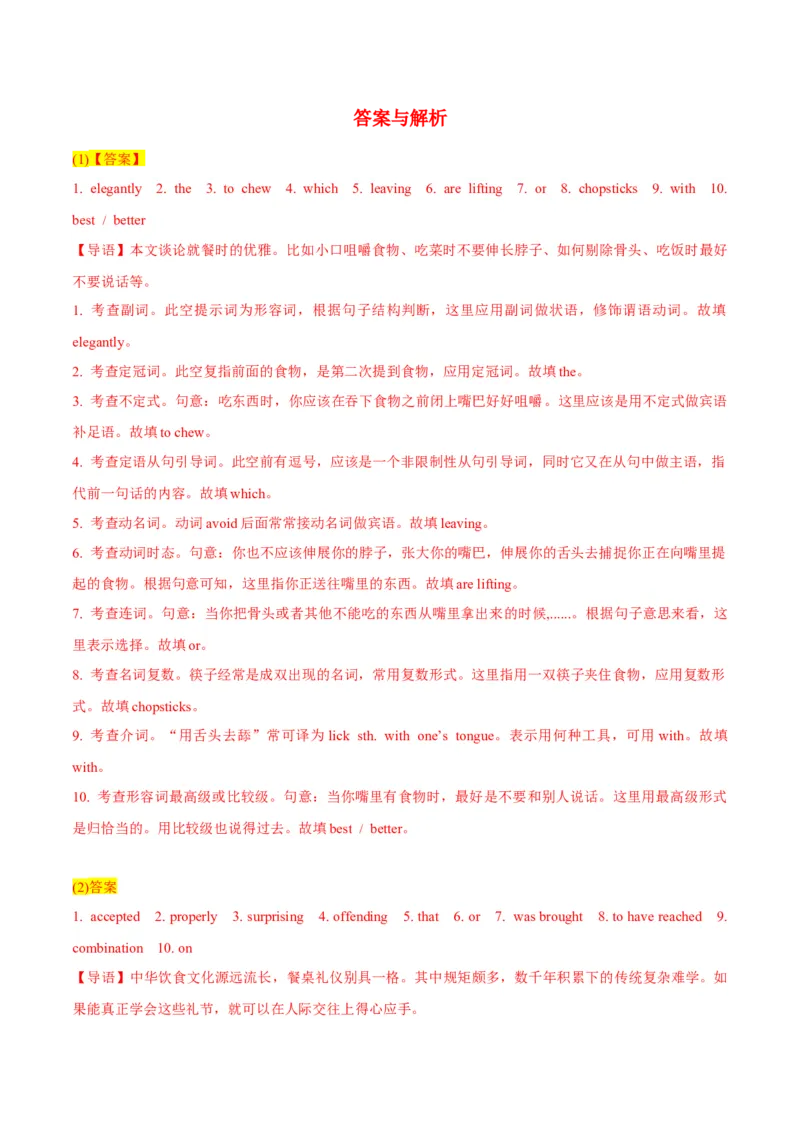
(1)【答案】
1. elegantly 2. the 3. to chew 4. which 5. leaving 6. are lifting 7. or 8. chopsticks 9. with 10.
best / better
【导语】本文谈论就餐时的优雅。比如小口咀嚼食物、吃菜时不要伸长脖子、如何剔除骨头、吃饭时最好
不要说话等。
1. 考查副词。此空提示词为形容词,根据句子结构判断,这里应用副词做状语,修饰谓语动词。故填
elegantly。
2. 考查定冠词。此空复指前面的食物,是第二次提到食物,应用定冠词。故填the。
3. 考查不定式。句意:吃东西时,你应该在吞下食物之前闭上嘴巴好好咀嚼。这里应该是用不定式做宾语
补足语。故填to chew。
4. 考查定语从句引导词。此空前有逗号,应该是一个非限制性从句引导词,同时它又在从句中做主语,指
代前一句话的内容。故填which。
5. 考查动名词。动词avoid后面常常接动名词做宾语。故填leaving。
6. 考查动词时态。句意:你也不应该伸展你的脖子,张大你的嘴巴,伸展你的舌头去捕捉你正在向嘴里提
起的食物。根据句意可知,这里指你正送往嘴里的东西。故填are lifting。
7. 考查连词。句意:当你把骨头或者其他不能吃的东西从嘴里拿出来的时候,......。根据句子意思来看,这
里表示选择。故填or。
8. 考查名词复数。筷子经常是成双出现的名词,常用复数形式。这里指用一双筷子夹住食物,应用复数形
式。故填chopsticks。
9. 考查介词。“用舌头去舔”常可译为lick sth. with one’s tongue。表示用何种工具,可用with。故填
with。
10. 考查形容词最高级或比较级。句意:当你嘴里有食物时,最好是不要和别人说话。这里用最高级形式
是归恰当的。用比较级也说得过去。故填best / better。
(2)答案
1. accepted 2. properly 3. surprising 4. offending 5. that 6. or 7. was brought 8. to have reached 9.
combination 10. on
【导语】中华饮食文化源远流长,餐桌礼仪别具一格。其中规矩颇多,数千年积累下的传统复杂难学。如
果能真正学会这些礼节,就可以在人际交往上得心应手。1. 考查过去分词。句意:他们如此努力地培养政府认可的餐桌礼仪。提示词是动词,又用在名词前,可考
虑用现在分词或过去分词。这里用前面的名词一起,构成一个复合词,表示“被政府认可的”。故填
accepted。
2. 考查副词。此空提示词为形容词,又放在句子最后,根据句子结构判断,这里应用副词做状语,修饰谓
语动词。故填properly。
3. 考查形容词。句子主语是it,这里可以构成It is surprising that ...这个句型,表示“令人感到惊讶的
是......”。故填surprising。
4. 考查动名词。此空在介词in后面,当然应该用动名词形式做介词宾语。故填offending。
5. 考查表语从句。句意:中国文化的好处在于,一旦一件事情被定为规则,它就会被全国所遵循。此空应
该是表语从句引导词,在从句中不充当任何成分,只起连接词作用。故填that。
6. 考查连词。Whether ... or ...,表示“要么......要么......”,一种两可的选择。故填or。
7. 考查主谓一致、动词时态和语态。句意:中国早期的用餐礼仪是由Yilli带到中国的。句子主语是一个
表物的名词,应该用被动。再根据上下文的时态判断,这里应用一般过去时。故填was brought。
8. 考查不定式。此空可以和前面的结构一起,构成“It’s believed to do ...”句型。另外句子中有时间状语
during 1027-221 BCE,应用完成时。故填to have reached。
9. 考查名词。此空前有冠词,后有介词,说明应该用名词形式。故填combination。
10. 考查介词。keep on doing......是一个习惯搭配,意为“继续做......”。故填on。
(3)【答案】
1. behavio(u)rs 2. what 3. invited 4. eating / to eat 5. a 6. certainly 7. is considered 8. to speak
9. with 10. and
【导语】从一个人就餐的习惯看一个人的个性。本文从就餐时间、就餐方式、就餐习惯等方面,说明从就
餐就可以看出一个人的品行、习惯等。
1.考查名词。根据句子结构判断,此空前有一个介词,这里应该用名词形式。另外前面有their修饰,说明
是男性和女性的习惯。故填behavio(u)rs。
2. 考查宾语从句。此空应该是宾语从句引导词,它同时又在宾语从句中做表语,应该用连接代词。故填
what。
3. 考查过去分词。句意:......如果被邀请参加晚会。这里相当于一个条件状语从句的省略 if they are
invited to a dinner party. 故填invited。
4. 考查非谓语。begin / start后可接动名词或不定式做宾语。故填eating / to eat。
5. 考查不定冠词。句意:所以不要一上菜就吃,而是等到女主人也上菜了,并且拿起她的叉子作为开始的信号。这里指女主人发出动筷的信号。故填a。
6. 考查副词。此空用在谓语中,应该用副词形式。故填certainly。
7. 考查时态和语态。根据句子结构判断,这里应该是被动语态。再看上下文的时态来看,应该用一般现
在时。故填is considered。
8. 考查不定式。It is possible to do ...是一个常用的句型,表示“做什么是可能的”。故填to speak。
9. 考查介词。句意:当盘子里有一把叉子递给你时,你应该用它来取你的食物。表示用什么工具,常用
with。故填with。
10. 考查连词。句意:无论如何,良好的餐桌礼仪是非常重要的,而且它们并不像我们想象的那么简单。
这里表示顺连,意为:“而且”。故填and。
(4)【答案】
1. used 2. including 3. that 4. an 5. laid 6. punishment 7. vertically 8. or 9. those 10. to put
【分析】这是一篇说明文。文章介绍了筷子的历史,对地位的象征以及使用筷子的禁忌。
1. 考查过去分词。句意:筷子最初是中国人使用的,后来传到日本、韩国、马来西亚、新加坡、泰国和越
南等地。句中主语chopsticks和动词use是被动关系,此处是过去分词作状语,故填used。
2. 考查介词。句意:筷子最初是中国人使用的,后来传到日本、韩国、马来西亚、新加坡、泰国和越南等
地。此处指其他地区包括日本、韩国、马来西亚、新加坡、泰国和越南。表示“包括”,故填including。
3. 考查定语从句。句意:在中国古代,筷子不仅仅是将食物送入口中的工具,它还象征着“能”和“不
能”的地位和规则。分析句子结构,3 take food to the mouth是一个定语从句,修饰先行词tools,关
系词在从句中作主语,指物,用that引导该从句,所以填that。
4. 考查冠词。句意:在北宋时期,一位名叫唐肃的官员与皇帝共进晚餐。此处泛指“一个叫唐肃的官员”,
official开头音标是元音音标,用不定冠词an表示“一个”,故填an。
5. 考查动词时态。句意:他不了解高贵的餐桌礼仪,在皇帝之前把筷子水平地放在桌子上。此处叙述过去
发生的事,与句中was时态一致也用一般过去时,故填laid。
6. 考查名词。句意:结果,他被送到边境地区接受惩罚。该空作介词as的宾语,用名词,指作为一种惩
罚,故填punishment。
7. 考查副词。句意:例如,它们不能垂直放置在盘子里,因为这是一种祭祀死者的方式。此处修饰动词
place用副词,指垂直地放置,故填vertically。
8. 考查连词。句意:用餐者不能用筷子敲击或推菜,也不能把筷子当作叉子使用。此处指用餐者不能用筷
子敲打或用筷子推菜,表示或者,故填or。
9. 考查代词。句意:在吃东西的时候,他们不能让筷子从一个盘子到另一个盘子,或者跨越别人的盘子。those此处代指别人的盘子。故填those。
10. 考查动词不定式。句意:当用餐者在用餐过程中想要放下筷子时,他们会把筷子纵向放置在筷子架上
或右手边的盘子上。动词want后加动词不定式,表示想要做某事,故填to put。
(5)【答案】
1. rules 2. are invited 3. it 4. made 5. Wearing 6. importance 7. closed 8. for 9. immediately
10. a
【导语】这是一篇说明文。本文主要讲述了去美国家庭做客的注意事项:准时到达;带点礼物;穿着得体;
适时离开等。
1. 考查名词复数。句意:你有必要记住这些礼貌行为的一般规则。根据空格前these可知,此处可数名词
rule要用复数形式。故填rules。
2. 考查被动语态。句意:如果你被邀请到一位美国朋友家共进晚餐,首先,要准时(但不要早到)。分析
句子可知,空格处为条件状语从句中的谓语,动词invite与主语you之间是被动关系,且在条件状语从句
中,根据句意,要用一般现在时的被动语态(be done)。因主语为you,故填are invited。
3. 考查代词形式主语。句意:当你被邀请去别人家吃饭时,带个小礼物是礼貌的。分析句子可知,真正的
主语是动词不定式短语to bring a small gift,应用 it作形式主语。故填it。
4. 考查过去分词。句意:如果你有一件本国制造的漂亮物品,主人或女主人肯定会很高兴收到它作为礼物。
非谓语动词make与item之间是被动关系,应用其过去分词短语作后置定语。故填made。
5. 考查动名词。句意:仅仅穿着合适的衣服和一个美丽的微笑是不够的。分析句子可知,此处为主语,应
用wear的动名词形式作主语。句首字母大写,故填Wearing。
6. 考查名词。句意:餐桌礼仪也很重要。“of+抽象名词”构成的短语相当于该抽象名词的同根形容词,
即of great importance=very important,本句中用作表语。故填importance。
7. 考查过去分词转化的形容词。句意:除非你吞下食物,否则不要开口说话。咀嚼食物时也要闭上嘴。分
析句子可知,此处是“with+名词+过去分词”构成的with+复合结构,close与mouth之间是被动关系,应
用其过去分词作宾语补足语。故填closed。
8. 考查介词。句意:当你想要在远处得到食物时,不要伸手去够它。reach for意为“伸出……以触及”,
是固定搭配,符合句意。故填for。
9. 考查副词。句意:不要一吃完饭就走,但也不要逗留太久不受欢迎。leave是动词,应用immediate的副
词修饰。故填immediately。
10. 考查冠词。句意:第二天,打电话或写一封感谢信,告诉对方你那晚过得有多开心。note是可数名词,
单数形式前加不定冠词表示泛指。thank-you的读音以辅音音素开头,故填a。(6)【答案】
1. increasingly 2. have caused 3. using 4. which 5. On 6. what 7. Compared 8. more 9. to
discuss 10. to
【导语】这是一篇说明文。文章讲述了中国和英国之间在社会、文化等方面的差异。
1. 考查副词。句意:随着中英交流日益频繁,中英之间的分歧在过去几年引起了激烈的讨论。分析可知,
“frequent”意为“频繁的”,为形容词,应使用副词来修饰,作其状语。故填increasingly。
2. 考查时态。句意:随着中英交流日益频繁,中英之间的分歧在过去几年引起了激烈的讨论。“in the past
few years”现在完成时时间状语,主语“the differences”为复数名词。故填have caused。
3. 考查动名词。句意:我们习惯于用筷子,而英国人用刀叉。“get used to doing sth”是固定搭配,意为
“习惯于做某事”,动名词作宾语。故填using.
4. 考查非限制性定语从句。句意:在英国吃饭时突然大笑是不礼貌的,这表明你不尊重别人。分析可知,
该句“___4___ indicates you don’t respect others”为非限制性定语从句,先行词为之前主句“It’s not polite to
burst into laughter when eating in Britain”,在从句中作主语,应用关系代词which引导,意为“这”。故填
which。
5. 考查介词和固定短语。句意:相反,我们在吃饭时笑着说话。“on the contrary”是固定短语,意为“与
此相反”。故填On。
6. 考查名词性从句。句意:此外,对于中国学生来说,他们在学习中所经历的是一种有组织的学习方式。
该句“___6___ they have experienced in studying”为主语从句,从句中谓语“have experienced”缺少宾语,应
用连接代词what引导从句。故填what。
7. 考查非谓语。句意:与中国的教育相比,英国的教育更加灵活,更加富有想象力。分析可知,
“___8___ (compare) with Chinese education”应是句子状语,所填动词与主语之间为被动关系,应用过去分
词作状语。故填Compared.
8. 考查比较级。句意:与中国的教育相比,英国的教育更加灵活,更加富有想象力。结合状语“___8___
(compare) with Chinese education”可知,将中国教育与英国教育两者相比较,应使用比较级。故填more。
9. 考查不定式。encourage sb. to do ...意为“鼓励......做什么”,变成被动结构后就是be encouraged to
do ...。故填to discuss。
10. 考查固定短语和介词。句意:我们把这些礼节归功于悠久的历史,所以你应该入乡随俗。“owe…to”
是固定短语,意为“归功于”。故填to。
(7)【答案】1. loudest 2. is encouraged 3. enjoyable 4. that 5. visitors 6. to 7. making 8. What 9. it 10.
covered
【导语】这是一篇说明文,短文介绍了日本人吃面条时会发出“哧溜”声,日本人开始意识到吃面条时发
出“哧溜”声使得一些外国游客感觉不舒适,所以发明了一款消音叉子。
1. 考查形容词的最高级。句意:然而,当说到吃面条时,日本人可能是世界上声音最响亮的人群了。这里
空格前面有定冠词the,后面有in the world.说明是某一范围内最……的情况,用最高级。故填loudest。
2. 考查时态和语态。句意:吃面条时发出“哧溜”声在日本文化中是被鼓励的。eating noodles与谓语
encourage是被动关系,且句子为一般现在时。故填is encouraged。
3. 考查形容词。句意:有时候,吃面声音很大看起来只会使得面条更令人享受。这里用形容词作make的
宾语补足语。而所给词为enjoy动词,应该改写为形容词enjoyable。故填enjoyable。
4. 考查强调句型。句意:直到去年在社交媒体上出现了一个新的短语——面条骚扰,日本人开始意识到吃
面条时发出“哧溜”声使得一些外国游客感觉不舒适。这里使用的是强调句型it was… that…。故填that。
5. 考查名词作宾语。根据句子的意思“发出哧溜声使得一些外国游客不舒服”可以推知此处应该使用名词
形式visitors作making的宾语。且有some修饰。故填visitors。
6. 考查固定搭配。句意:这把看起来像电动牙刷的叉子,是使用无线和一部智能手机进行连接。这里考查
固定搭配is connected to结构。故填to。
7. 考查非谓语动词。句意:当人们使用这把叉子开始“哧溜”着吃面条时,叉子发送信号给私人手机,这
样使得手机发出一种声音掩盖“哧溜”声。make与前面的句子,在逻辑上是主动关系,所以用现在分词。
故填making。
8. 考查主语从句。句意:在一个国家被认为是正确的餐桌礼仪的行为可能在另一个国家看起来是粗鲁的行
为。整个句子的结构主干是…is likely to be seen。此主干前面是主语,主语从句中缺少主语,所以用what
来充当主语。故填What。
9. 考查形式宾语。句意:然而,使用叉子的人们会发现让他们的双手覆盖油水和一些食物残渣。这里句子
的结构是使用形式主语it作find的宾语。而真正宾语的主语是to get their hands covered in oil and bits of
food.故填it。
10. 考查过去分词。句意:然而,使用叉子的人们会发现让他们的双手覆盖油水和一些食物残渣。cover与
hands在逻辑上是被动关系。所以用过去分词。故填covered。
(8)【答案】
1. exposure 2. living 3. to take 4. taught 5. the 6. really 7. were punishing 8. cultural 9. as
10. what【导语】这是一篇说明文。文章列举了作者的几个朋友的经历来说明文化冲击。
1.考查名词。句意:在异国他乡生活的明显语言问题中,我在巴黎生活时确实经历了文化冲击。根据
“obvious language problems of living in a foreign country”可知,此处指在国外时面临语言问题,“面临,
遭受”用短语in exposure to。故填exposure。
2. 考查动名词。此空用在介词之后,提示词又是动词,因此应该用动名词形式。故填living。
3. 考查不定式。句意:Aubin两个月前从欧洲来到上海参加一个语言节目。说明他来上海的目的,用不定
式做目的状语。故填to take。
4. 考查动词语态。句意:在他离开之前,他实际上被教导了欧洲和中国文化之间的差异,包括从餐桌礼仪
到课堂行为的一切。结合句意表示“教”用动词teach,主语he和teach之间为被动关系,空处填过去分词
taught和was构成一般过去时的被动语态。故填taught。
5. 考查定冠词。此空后有一个定语从句he gave them来修饰,说明是表示强调,特指他给出的建议。故填
the。
6. 考查副词。此空用在谓语中间,修饰谓语,应该用副词形式。故填really。
7. 考查动词和语态。句意同上。根据“by making her talk to the walls!”推知,Julia认为学生通过不讲话的
方式来惩罚她,动词punish“惩罚”和were构成过去进行时,表示过去一段时间一直发生的动作。故填
were punishing。
8. 考查形容词。此空用来修饰名词,应该用形容词形式。故填cultural。
9. 考查介词。句意:在我看来,文化差异应该被简单地看作是让生活变得有趣的一种方式。结合句意可
知,此处考查短语be seen as“被看作”。故填as。