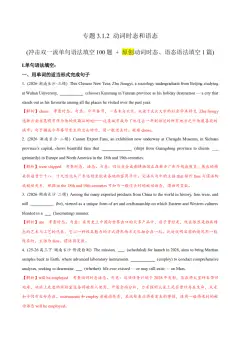
专题3.2.2 非谓语动词之-ed 分词
(冲击双一流单句语法填空100 题 + 原创-ed 语法填空1 篇)
I.单句语法填空:
一、用单词的适当形式完成句子
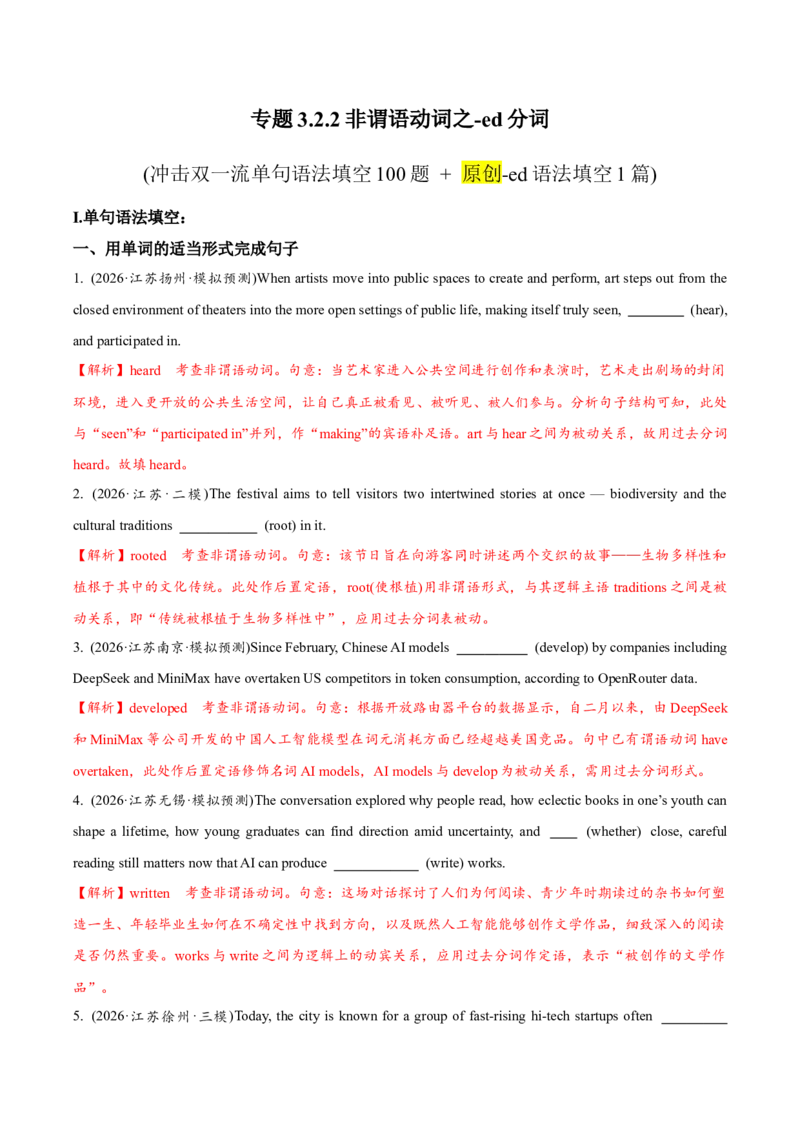
1. (2026·江苏扬州·模拟预测)When artists move into public spaces to create and perform, art steps out from the
closed environment of theaters into the more open settings of public life, making itself truly seen,          (hear),
and participated in.
【解析】heard  考查非谓语动词。句意:当艺术家进入公共空间进行创作和表演时,艺术走出剧场的封闭
环境,进入更开放的公共生活空间,让自己真正被看见、被听见、被人们参与。分析句子结构可知,此处
与“seen”和“participated in”并列,作“making”的宾语补足语。art 与hear 之间为被动关系,故用过去分词
heard。故填heard。
2. (2026·江苏·二模)The festival aims to tell visitors two intertwined stories at once — biodiversity and the
cultural traditions


  (root) in it.
【解析】rooted  考查非谓语动词。句意:该节日旨在向游客同时讲述两个交织的故事——生物多样性和
植根于其中的文化传统。此处作后置定语,root(使根植)用非谓语形式,与其逻辑主语traditions 之间是被
动关系,即“传统被根植于生物多样性中”,应用过去分词表被动。
3. (2026·江苏南京·模拟预测)Since February, Chinese AI models


  (develop) by companies including
DeepSeek and MiniMax have overtaken US competitors in token consumption, according to OpenRouter data.
【解析】developed  考查非谓语动词。句意:根据开放路由器平台的数据显示,自二月以来,由DeepSeek
和MiniMax 等公司开发的中国人工智能模型在词元消耗方面已经超越美国竞品。句中已有谓语动词have
overtaken,此处作后置定语修饰名词AI models,AI models 与develop 为被动关系,需用过去分词形式。
4. (2026·江苏无锡·模拟预测)The conversation explored why people read, how eclectic books in one’s youth can
shape a lifetime, how young graduates can find direction amid uncertainty, and     (whether) close, careful
reading still matters now that AI can produce


  (write) works.
【解析】written  考查非谓语动词。句意:这场对话探讨了人们为何阅读、青少年时期读过的杂书如何塑
造一生、年轻毕业生如何在不确定性中找到方向,以及既然人工智能能够创作文学作品,细致深入的阅读
是否仍然重要。works 与write 之间为逻辑上的动宾关系,应用过去分词作定语,表示“被创作的文学作
品”。
5. (2026·江苏徐州·三模)Today, the city is known for a group of fast-rising hi-tech startups often


(refer) to as the Six Little Dragons, including AI developer DeepSeek and robotics companies Unitree.
【解析】referred  考查非谓语动词。句意:如今,这座城市以一群迅速崛起的高科技初创企业而闻名,这
些企业常被称为“六小龙”,其中包括人工智能开发商叠纸科技和机器人公司宇树科技。“ startups”与
“refer to”之间是被动关系,即初创企业被称为……,所以用过去分词referred 作后置定语。
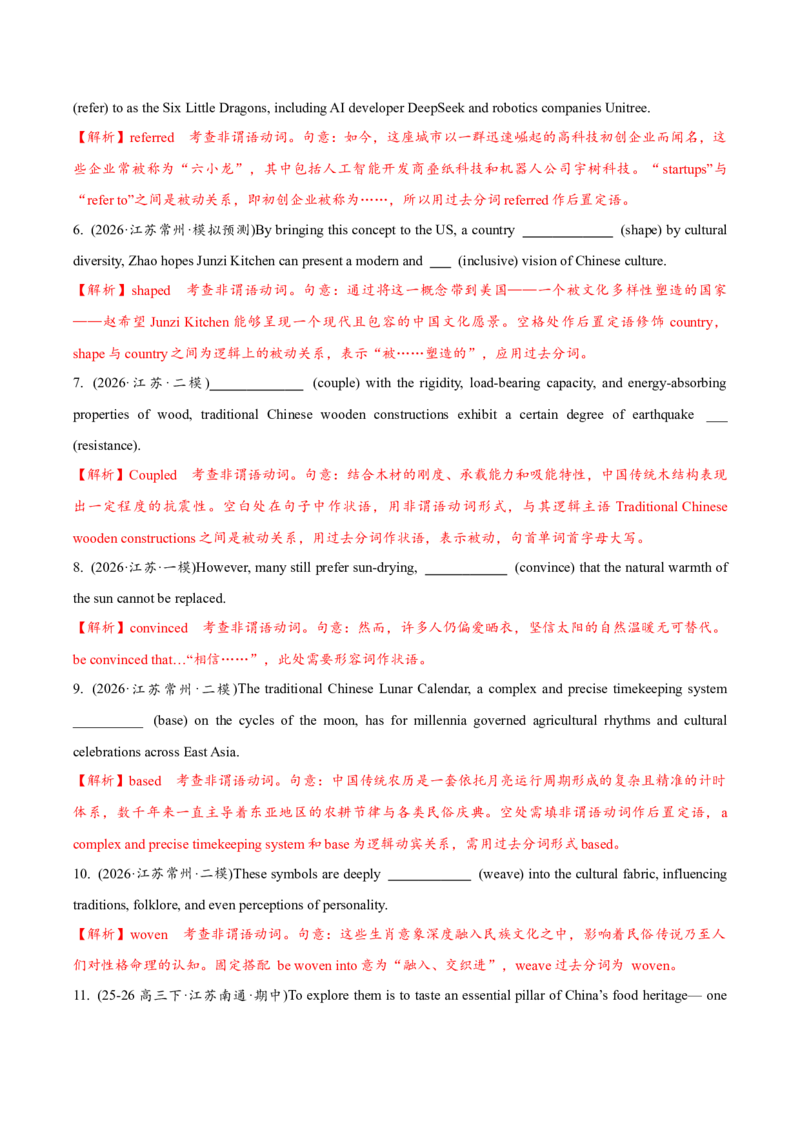
6. (2026·江苏常州·模拟预测)By bringing this concept to the US, a country


  (shape) by cultural
diversity, Zhao hopes Junzi Kitchen can present a modern and     (inclusive) vision of Chinese culture.
【解析】shaped  考查非谓语动词。句意:通过将这一概念带到美国——一个被文化多样性塑造的国家
——赵希望Junzi Kitchen 能够呈现一个现代且包容的中国文化愿景。空格处作后置定语修饰country,
shape 与country 之间为逻辑上的被动关系,表示“被……塑造的”,应用过去分词。
7. (2026· 江苏· 二模)


  (couple) with the rigidity, load-bearing capacity, and energy-absorbing
properties of wood, traditional Chinese wooden constructions exhibit a certain degree of earthquake ___
(resistance).
【解析】Coupled  考查非谓语动词。句意:结合木材的刚度、承载能力和吸能特性,中国传统木结构表现
出一定程度的抗震性。空白处在句子中作状语,用非谓语动词形式,与其逻辑主语Traditional Chinese
wooden constructions 之间是被动关系,用过去分词作状语,表示被动,句首单词首字母大写。
8. (2026·江苏·一模)However, many still prefer sun-drying,


  (convince) that the natural warmth of
the sun cannot be replaced.
【解析】convinced  考查非谓语动词。句意:然而,许多人仍偏爱晒衣,坚信太阳的自然温暖无可替代。
be convinced that…“相信……”,此处需要形容词作状语。
9. (2026·江苏常州·二模)The traditional Chinese Lunar Calendar, a complex and precise timekeeping system
__________ (base) on the cycles of the moon, has for millennia governed agricultural rhythms and cultural
celebrations across East Asia.
【解析】based  考查非谓语动词。句意:中国传统农历是一套依托月亮运行周期形成的复杂且精准的计时
体系,数千年来一直主导着东亚地区的农耕节律与各类民俗庆典。空处需填非谓语动词作后置定语,a
complex and precise timekeeping system 和base 为逻辑动宾关系,需用过去分词形式based。
10. (2026·江苏常州·二模)These symbols are deeply


  (weave) into the cultural fabric, influencing
traditions, folklore, and even perceptions of personality.
【解析】woven  考查非谓语动词。句意:这些生肖意象深度融入民族文化之中,影响着民俗传说乃至人
们对性格命理的认知。固定搭配 be woven into 意为“融入、交织进”,weave 过去分词为 woven。
11. (25-26 高三下·江苏南通·期中)To explore them is to taste an essential pillar of China’s food heritage— one
__________ (preserve) through time and folk wisdom.
【解析】preserved  考查非谓语动词。句意:探索它们就是品尝中国饮食遗产的一个重要支柱——一个通
过时间和民间智慧保存下来的支柱。分析句子结构可知,句中已有谓语动词is,所以此处应用非谓语动词,
one (指代an essential pillar)与preserve 之间是被动关系,所以用过去分词preserved 作后置定语,修饰
one。故填preserved。
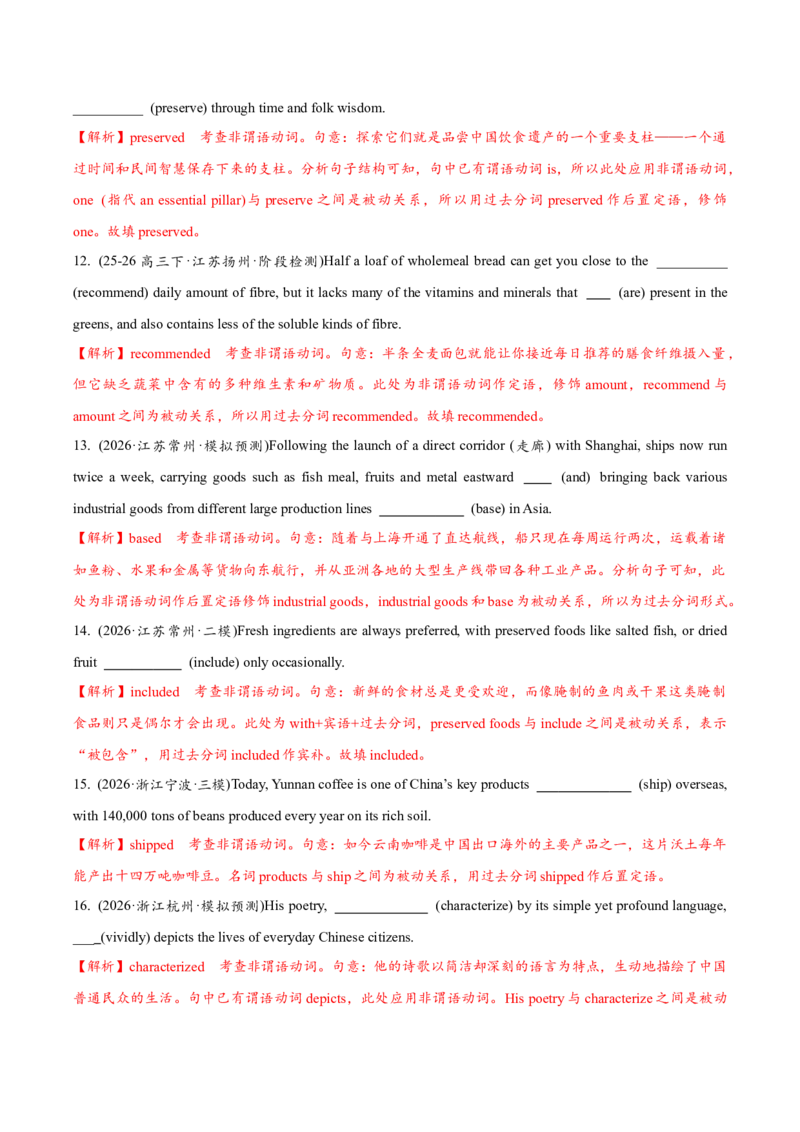
12. (25-26 高三下·江苏扬州·阶段检测)Half a loaf of wholemeal bread can get you close to the __________
(recommend) daily amount of fibre, but it lacks many of the vitamins and minerals that     (are) present in the
greens, and also contains less of the soluble kinds of fibre.
【解析】recommended  考查非谓语动词。句意:半条全麦面包就能让你接近每日推荐的膳食纤维摄入量,
但它缺乏蔬菜中含有的多种维生素和矿物质。此处为非谓语动词作定语,修饰amount,recommend 与
amount 之间为被动关系,所以用过去分词recommended。故填recommended。
13. (2026·江苏常州·模拟预测)Following the launch of a direct corridor (走廊) with Shanghai, ships now run
twice a week, carrying goods such as fish meal, fruits and metal eastward     (and) bringing back various
industrial goods from different large production lines


  (base) in Asia.
【解析】based  考查非谓语动词。句意:随着与上海开通了直达航线,船只现在每周运行两次,运载着诸
如鱼粉、水果和金属等货物向东航行,并从亚洲各地的大型生产线带回各种工业产品。分析句子可知,此
处为非谓语动词作后置定语修饰industrial goods,industrial goods 和base 为被动关系,所以为过去分词形式。
14. (2026·江苏常州·二模)Fresh ingredients are always preferred, with preserved foods like salted fish, or dried
fruit


  (include) only occasionally.
【解析】included  考查非谓语动词。句意:新鲜的食材总是更受欢迎,而像腌制的鱼肉或干果这类腌制
食品则只是偶尔才会出现。此处为with+宾语+过去分词,preserved foods 与include 之间是被动关系,表示
“被包含”,用过去分词included 作宾补。故填included。
15. (2026·浙江宁波·三模)Today, Yunnan coffee is one of China’s key products


  (ship) overseas,
with 140,000 tons of beans produced every year on its rich soil.
【解析】shipped  考查非谓语动词。句意:如今云南咖啡是中国出口海外的主要产品之一,这片沃土每年
能产出十四万吨咖啡豆。名词products 与ship 之间为被动关系,用过去分词shipped 作后置定语。
16. (2026·浙江杭州·模拟预测)His poetry,


  (characterize) by its simple yet profound language,
___ (vividly) depicts the lives of everyday Chinese citizens.
【解析】characterized  考查非谓语动词。句意:他的诗歌以简洁却深刻的语言为特点,生动地描绘了中国
普通民众的生活。句中已有谓语动词depicts,此处应用非谓语动词。His poetry 与characterize 之间是被动
关系,即诗歌被以……为特点,所以用过去分词characterized 作后置定语,修饰His poetry。
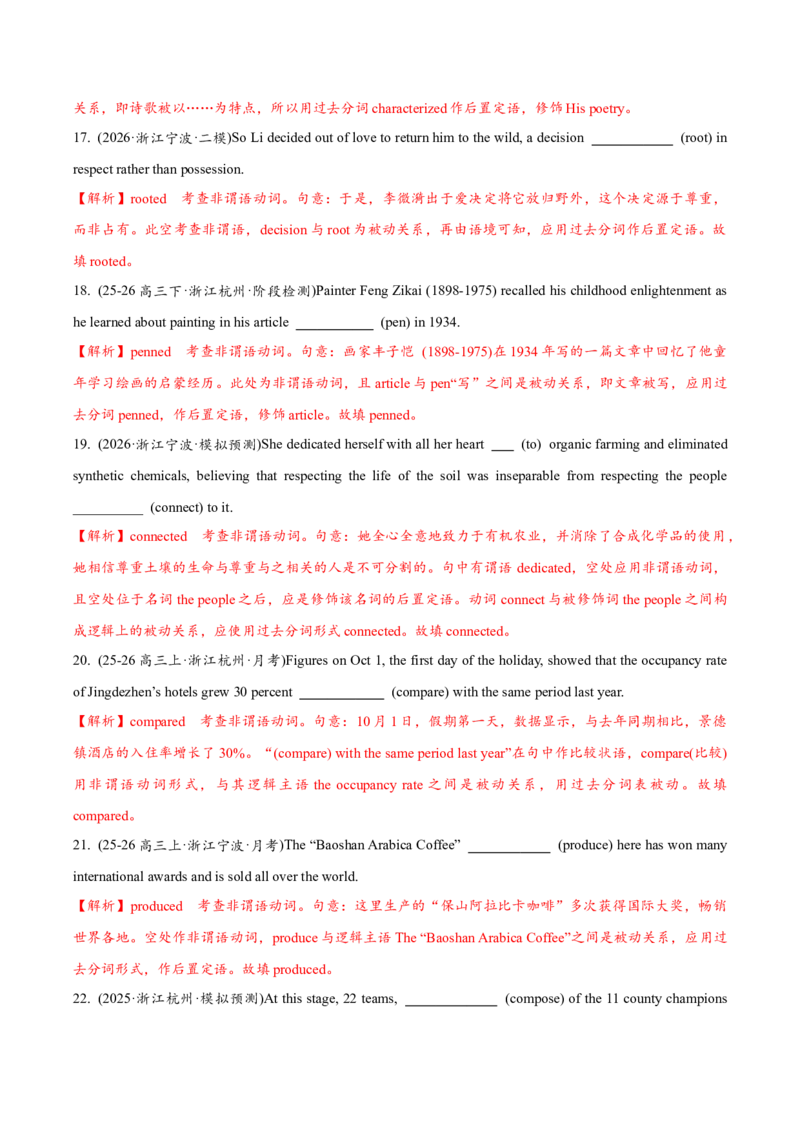
17. (2026·浙江宁波·二模)So Li decided out of love to return him to the wild, a decision


  (root) in
respect rather than possession.
【解析】rooted  考查非谓语动词。句意:于是,李微漪出于爱决定将它放归野外,这个决定源于尊重,
而非占有。此空考查非谓语,decision 与root 为被动关系,再由语境可知,应用过去分词作后置定语。故
填rooted。
18. (25-26 高三下·浙江杭州·阶段检测)Painter Feng Zikai (1898-1975) recalled his childhood enlightenment as
he learned about painting in his article


  (pen) in 1934.
【解析】penned  考查非谓语动词。句意:画家丰子恺 (1898-1975)在1934 年写的一篇文章中回忆了他童
年学习绘画的启蒙经历。此处为非谓语动词,且article 与pen“写”之间是被动关系,即文章被写,应用过
去分词penned,作后置定语,修饰article。故填penned。
19. (2026·浙江宁波·模拟预测)She dedicated herself with all her heart     (to) organic farming and eliminated
synthetic chemicals, believing that respecting the life of the soil was inseparable from respecting the people
__________ (connect) to it.
【解析】connected  考查非谓语动词。句意:她全心全意地致力于有机农业,并消除了合成化学品的使用,
她相信尊重土壤的生命与尊重与之相关的人是不可分割的。句中有谓语dedicated,空处应用非谓语动词,
且空处位于名词the people 之后,应是修饰该名词的后置定语。动词connect 与被修饰词the people 之间构
成逻辑上的被动关系,应使用过去分词形式connected。故填connected。
20. (25-26 高三上·浙江杭州·月考)Figures on Oct 1, the first day of the holiday, showed that the occupancy rate
of Jingdezhen’s hotels grew 30 percent


  (compare) with the same period last year.
【解析】compared  考查非谓语动词。句意:10 月1 日,假期第一天,数据显示,与去年同期相比,景德
镇酒店的入住率增长了30%。“(compare) with the same period last year”在句中作比较状语,compare(比较)
用非谓语动词形式,与其逻辑主语the occupancy rate 之间是被动关系,用过去分词表被动。故填
compared。
21. (25-26 高三上·浙江宁波·月考)The “Baoshan Arabica Coffee”


  (produce) here has won many
international awards and is sold all over the world.
【解析】produced  考查非谓语动词。句意:这里生产的“保山阿拉比卡咖啡”多次获得国际大奖,畅销
世界各地。空处作非谓语动词,produce 与逻辑主语The “Baoshan Arabica Coffee”之间是被动关系,应用过
去分词形式,作后置定语。故填produced。
22. (2025·浙江杭州·模拟预测)At this stage, 22 teams,


  (compose) of the 11 county champions
and 11 city-level joint teams, are competing in a mixed format     (for) the ultimate provincial title.
【解析】composed  考查非谓语动词。句意:第二阶段——城市锦标赛——从8 月8 日持续到2 月,在这
个阶段,22 支队伍,包括11 支县级冠军队伍和11 支市级联合队伍,将以混合赛制争夺最终的省级冠军。
分析句子结构可知,compose 在句中应用非谓语动词形式,与逻辑主语22 teams 构成被动关系,应用过去
分词作定语。故填composed。
23. (25-26 高三上·浙江杭州·阶段检测)This term,


  (borrow) from Tagalog in the Philippines,
describes the intense urge to pinch or squeeze something     (adorable).
【解析】borrowed  考查非谓语动词。句意:这个词是从菲律宾的他加禄语借来的,用来形容想捏捏可爱
的东西的强烈冲动。句中谓语是describes,空格处用非谓语动词,term 和borrow 之间是逻辑动宾关系,因
此空格处用过去分词表被动,作后置定语,故填borrowed。
24. (2025·浙江宁波·三模)A video posted on the Internet shows a small man-like pottery figure,


(refer) to as “Mini Ultraman (奥特曼)” due to its exterior.
【解析】referred  考查非谓语动词。句意:网上发布的一段视频显示了一个像人一样的小陶俑,因其外观
被称为“迷你奥特曼”。句中谓语是shows,空格处用非谓语动词,figure 和refer 之间是逻辑动宾关系,
因此用过去分词表被动,作后置定语,故填referred。
25. (2025·浙江杭州·一模)


  (Bear) in 1998, Zhu began sharing her life through videos on Bilibili in
2019, initially focusing on videos that showed popular makeup from the ancient China to modern times.
【解析】Born  考查非谓语动词。句意:1998 年出生的朱若萱于2019 年开始在哔哩哔哩通过视频分享生
活,最初专注于展示从中国古代到现代的流行妆容。句中已有谓语动词began,空处为非谓语动词,bear
和Zhu 之间为逻辑动宾关系,应用过去分词,作状语,句首单词首字母大写。故填Born。
26. (2026·湖北黄冈·模拟预测)There are rock paintings of straight lines and human figures


  (paint)
in red ochre (赭石) inside the cave.
【解析】painted  考查非谓语动词。句意 :洞穴内部有用红色赭石绘制的直线和人物岩画。此处为非谓
语,paint 与rock paintings 之间为被动关系,再由语境可知,应用过去分词painted 作后置定语。
27. (2026·湖北荆州·模拟预测)    (Unlike) past crazes for foreign symbols, this phenomenon centers on
adopting lifestyle habits


  (root) in traditional Chinese wisdom, reflecting a deeper, more
participatory engagement with Chinese culture.
【解析】rooted  考查非谓语动词。句意:与以往对外国符号的狂热不同,这一现象的核心是采用植根于
中国传统智慧的生活习惯。空处作后置定语修饰habits,逻辑主语habits 与root 之间是被动关系,应用过去
分词作后置定语。
28. (2026·湖北襄阳·模拟预测)In Chinese culture, water is a fundamental symbol representing nature and
harmony, deeply


  (involve) in philosophy and mythology.
【解析】involved  考查非谓语动词。句意:在中华文化中,水是象征自然与和谐的基本意象,深深融入
哲学与神话之中。此处用固定搭配be involved in 表示“参与,卷入”,作状语,省略be,用过去分词
involved。
29. (2026·湖北荆州·模拟预测)Despite the common presence of smartphones,     (a) significant number of
individuals experience anxiety when __________ (face) with making or receiving a phone call.
【解析】faced  考查状语从句的省略。句意:尽管智能手机无处不在,仍有相当一部分人在接打电话时会
感到焦虑。固定搭配 be faced with 表示“面临,面对”;when 引导时间状语从句,主语和主句主语一致,
且含有被动词时,可以省略从句的主语和be 动词。所以该空处需要过去分词faced。
30. (2026·湖北·三模)


  (price) from $1.19 to $4.99, its products are far cheaper than     (those) of
local competing brands.
【解析】Priced  考查非谓语动词。句意:其产品定价在1.19 美元至4.99 美元之间,远低于当地竞争品牌
的产品。主语its products 与price 之间为被动关系,需用过去分词作状语,句首首字母大写。
31. (2026·湖北武汉·一模)The steady rhythm of the drums,


  (combine) with carefully designed
movements, created a strong sense of history and discipline.
【解析】combined  考查非谓语动词。句意:稳定的鼓声节奏,结合精心设计的动作,营造出强烈的历史
感和规整感。固定搭配be combined with 表示与……结合,此处去掉be 动词,用过去分词作后置定语。
32. (2026·湖北黄冈·二模)The latter includes a flexible program


  (provide) by the Open University
of China, with graduates     (receiving) both a state-recognized associate or bachelor’s degree     (and) a
professional cooking certificate.
【解析】provided  考查非谓语动词。句意:后者包括由中国开放大学提供的灵活课程,课程结束后,学
员将获得由国家认可的副学士学位或学士学位,以及一份专业烹饪证书。此处program 与provide 构成被动
关系,故用过去分词作定语。
33. (25-26 高三下·湖北襄阳·阶段检测)It was at a conference held last week that a leading scientist emphasized
Yang’s unique ability to reveal profound truths


  (draw) from elegant mathematics.
【解析】drawn  考查非谓语动词。句意:在上周举行的一次会议上,一位顶尖科学家强调了杨振宁从优
雅的数学中揭示深刻真理的独特能力。本空作后置定语,修饰名词truths,truths 与draw“获取”之间为被
动关系,用过去分词drawn。故填drawn。
34. (25-26 高三下·湖北宜昌·阶段检测)When     (evaluating) calligraphy, experts look for “spirit resonance”
(气韵) — a quality extremely difficult to define, yet instantly recognizable to the


  (train) eye.
【解析】trained  考查非谓语动词。句意:在评价书法时,专家们寻找“气韵”——一种极难定义但训练
有素的人一眼就能认出的品质。空处需填形容词作定语,修饰名词eye,trained 意为“训练有素的”,是
过去分词转化的形容词。故填trained。
35. (2026 高三下·湖北随州·专题练习)His words deepened my belief: art


  (root) in a culture’s
finest traditions possesses a timeless power to move anyone.
【解析】rooted  考查非谓语动词。句意:他的话加深了我的信念:植根于一种文化最优秀传统的艺术,
具有打动任何人的永恒力量。分析句子结构可知,此处为非谓语动词作后置定语,be rooted in 意为“植根
于”,此处省略be 动词,用过去分词短语作定语。故填rooted。
36. (2026·湖北孝感·二模)


  (know) for its rose-red lean meat, ivory-white fat and delicate flavour,
Xuanwei ham enjoys great     (popularity) at home and abroad.
【解析】Known  考查非谓语动词。句意:宣威火腿以其玫瑰红的瘦肉、雪白的脂肪和细腻的风味而闻名,
深受国内外消费者的喜爱。动词know 在句中作状语,与逻辑主语Xuanwei ham 为被动关系,应填过去分
词形式,并注意句首字母大写。故填Known。
37. (2026 高三下·湖北襄阳·专题练习)The Tang poems,


  (translate) with the master touch of Xu
Yuanchong, speak softly in two voices — one Chinese, one English — each echoing (回响) with calm, beauty, and
quiet     (depth).
【解析】translated  考查非谓语动词。句意:这些唐诗,在许渊冲大师的笔触下被翻译出来,用两种声音
轻声诉说——中文与英文——每一种都回荡着宁静、美感与深沉的底蕴。空处为非谓语动词作后置定语,
修饰名词Tang poems,且Tang poems 与translate 之间是被动关系,故用过去分词。故填translated。
38. ( 湖北华师一附中2025-2026 高三下)    (To achieve) a successful creation, each stroke demands
unwavering confidence, swift execution and a profound mastery of technique


  (train) through years
of practice.
【解析】trained  考查非谓语动词。句意:为了创作出成功的作品,每一笔都需要坚定的信心、利落的运
笔,以及经多年练习练就的精湛技法。空处为非谓语动词形式担当后置定语;被修饰词“a profound
mastery of technique”和动词“train”之间为被动关系,用过去分词形式。故填trained。
39. (25-26 高三下·湖南衡阳·阶段检测)Here, the once dusty,


  (expose) rock surfaces became
covered with thick, healthy vegetation.
【解析】exposed  考查非谓语动词。句意:这里,曾经尘土飞扬、裸露的岩石坡面如今长满繁茂茁壮的植
被。此处作定语修饰rock surfaces,expose 和rock surfaces 是被动关系,用过去分词exposed。
40. (2026·湖南常德·三模)You make it by pouring hot water over the


  (dry) leaves of a tea plant.
For centuries people believed that tea could cure illnesses, and they used it as medicine.
【解析】dried  考查过去分词作状语。句意:你可以用热水泡干的茶叶来冲茶。根据常识可知茶叶是烘干
的,要用dried 作定语,被烘干的,故填dried。
41. (2026·湖南长沙·三模)Beijing Language and Culture University invited Wei Chunrong, the veteran Kunqu
Opera actress from the Northern Kunqu Opera Theatre, to deliver a lecture


  (title) “The Contemporary
Expression of 600-Year-Old Kunqu Opera” on Wednesday.
【解析】titled  考查非谓语动词。句意:北京语言大学于周三特邀北方昆曲剧院资深昆曲表演艺术家魏春
荣开展题为《六百年昆曲的现代表达》的讲座。此处非谓语作后置定语,lecture 和title 之间为被动关系,
所以用过去分词titled。
42. (25-26 高三下·湖南株洲·阶段检测)These workshops,


  (distribute) across 2,005 county-level
regions, have generated employment for more than 1.2 million people in related industries.
【解析】distributed  考查非谓语动词。句意:这些分布在两千零五个县级区域内的工坊,已为相关行业一
百二十多万人解决了就业问题。主语these workshops 与distribute 为被动关系,用过去分词distributed 作后
置定语。
43. (2026·湖南长沙·一模)Most of these energy     (resources) are shipped to Asian countries, China, India,
Japan and South Korea


   (include).
【解析】included  考查非谓语动词。句意:这些能源资源大多运往亚洲国家,包括中国、印度、日本和
韩国。此处用过去分词included 作后置定语补充说明,逻辑上后面列举的国家是“被包含”在亚洲国家范
围内,存在被动逻辑,故用included。
44. (25-26 高三下·湖南常德·阶段检测)A photography exhibition


  (title) Blooming in the Sun is
currently running at the September Art Gallery in Shenzhen and     (will last) until September 30, 2022.
【解析】titled  考查非谓语动词。句意:一场名为“盛开在阳光下”的摄影展正在深圳九月美术馆展出,
将持续到2022 年9 月30 日。句中is 是谓语动词,设空处应该使用非谓语动词。exhibition 与title 之间是被
动关系,故使用过去分词作后置定语。故填titled。
45. (2026·湖南长沙·三模)For example, Wa cuisine,


  (influence) by Myanmar, has a distinct
Burmese (缅甸) flavour.
【解析】influenced  考查非谓语动词。句意:例如,受缅甸影响的佤族美食有着独特的缅甸风味。句子主
语Wa cuisine 与influence 之间为被动关系,此处用过去分词作后置定语。故填influenced。
46. (2026·湖南长沙·二模)There are folding, round and rectangular fans


  (make) of paper, cloth
and sandalwood, sometimes inlaid with shells     (or) attached with wood carvings.
【解析】made  考查非谓语动词。句意:有折叠式、圆形和长方形的扇子,它们由纸、布和檀木制成,有
时还会镶嵌贝壳或配上木雕装饰。此处make 与fans 构成被动关系,故用过去分词作定语。
47. (2026·重庆永川·二模)Beyond its solidity, the ancient Chinese also applied mechanical principles in the
mortise and tenon buildings, adapting their practices


  (base) on local conditions.
【解析】based  考查非谓语动词。句意:除了坚固性之外,古代中国人还在榫卯建筑中应用了力学原理,
并根据当地条件调整他们的做法。该空是后置定语,修饰前面的名词 their practices(他们的做法)。动
词 base(以……为基础)与所修饰的名词 practices 之间是被动关系(做法被基于当地条件),因此使用
过去分词形式 based 作后置定语,构成 practices based on local conditions,意为“基于当地条件的做
法”。这里的 based on 可以看作一个固定搭配的过去分词短语,相当于 which were based on 的省略形
式。故填based。
48. (25-26 高三下·湖南长沙·阶段检测)The mission,


  (schedule) for launch in 2028, aims to bring
Martian samples back to Earth, where advanced laboratory instruments     (will be employed) to conduct
comprehensive analyses, seeking to determine     (whether) life ever existed — or may still exist — on Mars.
【解析】scheduled  考查非谓语动词。句意:这项任务计划于2028 年发射,旨在将火星样本带回地球,地
球上先进的实验室设备将被投入使用,开展全面分析,力求探明火星上是否曾经存在生命,或是如今仍有
生命存在。mission 与schedule 为被动关系,用过去分词scheduled 作后置定语。
49. (2026·广东深圳·模拟预测)Hardly finding Chinese instruments


  (play) on the streets in Paris,
she took along her guzheng     (and) began her street performances to sharpen her skills.
【解析】played  考查非谓语动词。句意:在巴黎的大街上几乎看不到有人演奏中国乐器,她带着她的古
筝开始了她的街头表演,以提高她的技能。空白处在句子中作宾补,且与其逻辑主语instruments 之间为逻
辑上的动宾关系,用过去分词。故填 played。
50. (2026·广东汕头·模拟预测)Li Shuangsheng led the way downhill and stopped by the roadside to wait for his
son. Ten minutes later, Li Xuyao appeared,


  (cover) in mud.
【解析】covered  考查非谓语动词。句意:李双生带头走下山,在路边停下来等他的儿子。十分钟后,浑
身是泥的李叙尧出现了。此处Li Xuyao 与cover 构成被动关系,故用过去分词作状语。故填covered。
51. (25-26 高三下·广东广州·阶段检测)A Latin translation of The Tao Te Ching,


  (forget) in the
British Library for more than 300 years, has recently been rediscovered and published through the efforts of Misha
Tadd, a scholar at Nankai University.
【解析】forgotten  考查非谓语动词。句意:一部尘封在大英图书馆300 多年的《道德经》拉丁文译本,
近日在南开大学学者米沙·塔德的努力下被重新发现并出版。名词translation 与动词forget 之间为被动关系,
需用过去分词作后置定语,故填forgotten。
52. (2026 高三下·广东汕头·专题练习)Every painful muscle and early wake-up call proved we deserved the joy
__________ (earn) step by step, as a blessing.
【解析】earned  考查非谓语动词。句意:每一块酸痛的肌肉和每一次早起都证明,我们配得上一步一步
挣来的快乐。句子已有谓语deserved,joy 与earn 是被动关系,用过去分词作后置定语。故填earned。
53. (25-26 高三下·广东河源·阶段检测)The rhythmic hum of the train felt like the heartbeat of a nation moving
forward, yet staying


  (root) in its culture.
【解析】rooted  考查非谓语动词。句意:火车有节奏的嗡嗡声就像一个国家向前跳动的心脏,但却深深
植根于它的文化中。stay 为系动词,空处需填非谓语动词作表语,stay rooted in 为固定短语,意为“植根
于”,此处需填过去分词形式。故填rooted。
54. (25-26 高三下·广东茂名·月考)Like the singsong Singlish


  (speak) by the Singaporeans, Hong
Kong people have created their own language having terms only     (locals) can understand.
【解析】spoken  考查非谓语动词。句意:和新加坡人所说的抑扬顿挫的新加坡式英语一样,香港人创造
出了属于自己的独特语言,里面有着只有当地人才懂的表达。空处是非谓语动词,Singlish 和speak 之间是
被动关系,应用过去分词,作后置定语。故填spoken。
55. (25-26 高三下·广东汕头·开学考试)They prove that Chinese cultural narratives are striking international
audiences increasingly,


  (back) by widespread recognition of Chinese culture’s contemporary value.
【解析】backed  考查非谓语动词。句意:它们印证了中华优秀文化叙事正日益打动国际受众,而这一切
的背后,是中华文化当代价值获得了广泛认同。此处back 与上文构成被动关系,用过去分词作状语,修饰
上文句子,故填backed。
56. (25-26 高三下·广东深圳·阶段检测)


  (root) in history yet shining with contemporary brilliance,
CHINA establishes a link between Jingdezhen’s porcelain legacy and a confident cultural future.
【解析】Rooted  考查非谓语动词。句意:《CHINA》植根于历史,又闪耀着当代光芒,它在景德镇的陶
瓷遗产与自信的文化未来之间建立了连接。主语CHINA 与root 之间是被动关系,故用过去分词作状语。
首字母大写。故填Rooted。
57. (25-26 高三上·广东广州·期末)These gray-and-white robots,


  (arm) with cameras and sensors,
mark the latest innovation in Beijing’s effort     (to build) a smarter and safer city.
【解析】armed  考查非谓语动词。句意:这些灰白相间的机器人配备了摄像头和传感器,是北京建设更
智能、更安全城市所做努力中的最新创新。robots 与arm 之间是被动关系,“be armed with”表示“配备
有……”,此处用过去分词短语作后置定语,省略be 动词。故填armed。
58. (2026·广东汕头·一模)Traditional wooden buildings


  (decorate) with red lanterns, along with
the sound of local musicians performing Naxi instruments, display the region’s most distinctive culture     (that)
seems frozen in time.
【解析】decorated  考查非谓语动词。句意:传统的木质建筑上装饰着红色灯笼,同时还有当地乐手演奏
纳西族乐器的声音,这一切展现了该地区最为独特的文化,这种文化仿佛凝固在了时间之中。此处
decorate 与buildings 构成被动关系,故用过去分词作定语。故填decorated。
59. (25-26 高三上·广东广州·期末)This progress signals a bright future for snow sports,


  (fuel) by
post-Olympic enthusiasm and increasing public participation.
【解析】fueled  考查非谓语动词。句意:这一进展预示着冰雪运动的光明未来,受到后奥运热情和公众
参与度不断提高的推动。此处与a bright future for snow sports 为逻辑动宾关系,应用fuel“推动”的过去分
词,作后置定语。故填fueled。
60. (2026·山东·三模)The Xinjiang Uygur Autonomous Region Museum,


  (locate) in the regional
capital Urumqi, brings this history to life, presenting heritage     (as) a bridge between past encounters and
present-day understanding.
【解析】located  考查非谓语动词。句意:位于首府乌鲁木齐的新疆维吾尔自治区博物馆,将这些历史生
动地呈现出来。 locate“位于”与其逻辑主语 The Xinjiang Uygur Autonomous Region Museum 之间为被动关
系,be located in“坐落于,位于”,故用过去分词located 作后置定语。
61. (2026·山东·模拟预测)


  (support) by continuous government policies, China keeps strengthening
rural infrastructure and improving agricultural     (productivity).
【解析】Supported  考查非谓语动词。句意:依托国家持续出台的各项扶持政策,我国不断完善农村基础
设施建设、提升农业生产效率。空处作状语,需用非谓语动词形式,China 和support 为逻辑动宾关系,需
用过去分词,位于句首,首字母需大写。
62. (2026·山东日照·模拟预测)Impressively, when I tried my hand at the traditional art of paper-making there, I
felt the flow of a craft


  (pass) down for generations.
【解析】passed  考查非谓语动词。句意:令我印象深刻地是,当我尝试当地传统造纸术时,我感受到一
门手艺代代相传的脉络。空格处作后置定语修饰craft,craft 与pass down 之间为被动关系,且“代代相
传”为已完成状态,应用过去分词。
63. (2026·山东日照·模拟预测)The dish dates back to ancient China,


  (mention) in Ming Dynasty
texts The Journey to the West, which is a famous novel,     (and) enjoyed in royal courts.
【解析】mentioned  考查非谓语动词。句意:这种菜肴起源于古代中国,曾在明代小说《西游记》中有所
提及,曾受到皇室的青睐。分析句子可知,此处为非谓语动词作后置定语修饰The dish,The dish 和
mention 为被动关系,所以为过去分词形式。
64. (2026·山东淄博·三模)With average wind speeds


  (reduce) by half, vegetation coverage in the
area has grown to 80 percent.
【解析】reduced  考查非谓语动词。句意:平均风速降低了一半,该地区的植被覆盖率已达到80%。此处
为with 复合结构,wind speeds 与reduce 之间是被动关系,用过去分词reduced 作宾语补足语。
65. (2026·山东济南·模拟预测)The term Xuan paper first appeared in a book


  (title) On Famous
Paintings through the Ages,     (where) Zhang Yanyuan, a scholar in Tang Dynasty, described Xuan paper as an
ideal carrier for calligraphy and painting.
【解析】titled  考查非谓语动词。句意:“宣纸”一词最早出现在《历代名画论》一书中,唐代学者张延
元将宣纸描述为书画的理想载体。分析句子结构可知,动词title 与其所修饰的名词a book 之间是动宾关系,
故用过去分词作后置定语。故填titled。
66. (2026·山东济南·二模)The medicine,


  (know) as tongxinluo, is made of extracts derived from
seven herbs and various animals.
【解析】known  考查非谓语动词。句意:这种名为通心络的药是由七种草药和各种动物的提取物制成的。
“(know) as tongxinluo”作后置定语,修饰The medicine,know (将……称为)是非谓语动词,与其逻辑主语
The medicine 之间是被动关系,用过去分词表被动。故填known。
67. (2026·山东青岛·一模)Hope is a humble seed; when


  (plant) in fertile ground, it transfigures
(美化……的外表) into new life bearing fruits of change.
【解析】planted  考查状语从句的省略。句意:希望是一粒卑微的种子,种在肥沃的土地上,就会变成新
的生命,结出变化的果实。本句是when 引导的时间状语从句的省略,其完整的形式是when it is planted in
fertile ground,it 代指上文的hope,和动词plant 之间是被动关系,所以用被动语态;从句的主语和主句的
主语一致,且从句中有be 动词,所以省略从句中的主语和be 动词。故填planted。
68. (25-26 高三下·山东·阶段检测)Xuan paper, well-known for its exceptional quality, longevity and vital role in
Chinese calligraphy and painting, is a widely


  (recognize) cultural symbol.
【解析】recognized  考查过去分词充当定语。句意:宣纸以其卓越品质、耐久性及在书画中的核心作用,
成为广受认可的文化符号。横线前有冠词后有名词,这里需要填入形容词,应该将recognize 变成过去分词,
从而充当定语修饰名词symbol。故填recognized。
69. (25-26 高三下·山东临沂·月考)The few sculptures


  (create) from rock have been brought in
from elsewhere.
【解析】created  考查非谓语动词。句意:只有极少数的雕像是由岩石雕刻而成的,它们是从其他地方运
来的。分析句子可知,此处为非谓语动词作后置定语,修饰 The few sculptures;sculptures 和 create 是被
动关系 (雕塑被创作),因此用过去分词created。故填created。
70. (2026·山东济南·模拟预测)The event marked the opening of an innovative design competition __________
(launch) by the Quanzhou government, aiming     (to promote) the city’s rich cultural heritage and local arts.
【解析】launched  考查非谓语动词。句意:此次活动标志着由泉州政府发起的创新设计竞赛的开幕,旨
在推广该市丰富的文化遗产和地方艺术。句中marked 为谓语动词,设空处使用非谓语动词,“ an
innovative design competition”和“launch”之间是被动关系,所以用过去分词“launched”作后置定语。故填
launched。
71. (25-26 高三下·山东日照·阶段检测)


  (bless) with a wealth of bamboo forests, China is the
world’s largest producer of bamboo products and this resource secures its dominant position in the global market.
【解析】Blessed  考查非谓语动词。句意:中国拥有丰富的竹林资源,是世界上最大的竹制品生产国,这
一资源确保了其全球市场的主导地位。句子主干成分完整,空处是非谓语,固定短语be blessed with 意为
“被赋予/拥有……”,bless 和China 逻辑上是被动关系,因此用bless 的过去分词形式,作原因状语,句
首单词的首字母需大写。故填Blessed。
72. (25-26 高三下·山东·阶段检测)For example, on the Start of Winter ( 立冬), families in northern China
traditionally eat dumplings, a food


  (believe) to keep themselves from the cold.
【解析】believed  考查非谓语动词。句意:例如,在立冬这一天,中国北方的家庭通常会吃饺子,人们认
为这种食物有助于抵御寒冷。此处food 与believe 构成被动关系,用过去分词作定语。故填believed。
73. (2026·山东潍坊·一模)By contrast, “loong”, a word


  (create) in the 19th century, reminds
people of strength and fortune, and should     (be distinguished) from its Western cousin.
【解析】created  考查非谓语动词。句意:相比之下,“loong”这个19 世纪创造的词,让人联想到力量和
财富,且应与西方的“龙”区分开来。空处需填非谓语动词作定语,create 与a word 是逻辑动宾关系,应
用过去分词,作后置定语。故填created。
74. (2026·福建泉州·三模)This smart system,


  (describe) as “freer access at the First Line and
regulated access at the Second Line”, allows goods, money, and people to move more freely.
【解析】described  考查非谓语动词。句意:这套被描述为“一线放开、二线管住”的智能体系,让货物、
资金和人员流动更加自由。句中已有谓语动词allows,空处为非谓语动词,逻辑主语This smart system 与
describe 之间是被动关系,应用过去分词作后置定语。故填described。
75. (2026·福建福州·三模)It features fronts


  (wrap) in tubu, a type of handmade cotton cloth with
deep roots in Shanghai, and backs     (delicately) decorated with hand-painted patterns.
【解析】wrapped  考查非谓语动词。句意:它的正面采用了源自上海的土布 (一种有着深厚历史渊源的手
工棉布)进行包裹,而背面则精心绘制了手绘图案。此处为非谓语动词作后置定语修饰fronts,fronts 和
wrap 是被动关系,所以为过去分词形式。
76. (25-26 高三下·福建福州·阶段检测)However,


  (dress) heavily, we prepared the treats in the
cold night air to welcome the Chinese New Year.
【解析】dressed  考查非谓语动词。句意:但我们穿着厚实的衣裳,在寒冷的夜色里包粽子迎接春节。此
处非谓语作伴随状语,we 和dress 之间是被动含义,用过去分词dressed。
77. (2026·福建福州·模拟预测)The country’s diversity of terrain and climate,


  (couple) with
millennia of culinary history, offers an unmatched abundance of dishes.
【解析】coupled  考查非谓语动词。句意:该国地形和气候的多样性,再加上数千年丰富的饮食历史,造
就了种类繁多、令人难以置信的美食佳肴。短语be coupled with 表示“连同、加上”,此处为过去分词作
定语。
78. (2026·福建厦门·模拟预测)Things like kale ribs, fish collars, and


  (reject) sweet potatoes were
all re-appropriated     (and), with the help of a number of good chefs, turned into excellent cuisine.
【解析】rejected  考查非谓语动词。句意:像羽衣甘蓝梗、鱼颈和被丢弃的红薯这样的食材,在多位优秀
厨师的帮助下,都被重新利用并变成了美味佳肴。分析句子结构可知,空格处作定语修饰sweet potatoes,
且reject 与sweet potatoes 之间为逻辑上的被动关系,应用过去分词。
79. (25-26 高三下·福建龙岩·阶段检测)Shandong is exploring a path


  (characterize) by ecological
prioritization and technological support.
【解析】characterized  考查非谓语动词。句意:山东正在探索一条以生态优先、技术支撑为特征的道路。
此空考查非谓语,path 与characterize 为被动关系,再由语境可知,应用过去分词characterized 作后置定语。
故填characterized。
80. (2026·福建福州·模拟预测)Flames, beasts, weapons, and stars flow from wooden looms to decorate brocade
(锦缎), a 1,300-year-old cloth once


  (reserve) for China’s elite and now popular with young fashion
designers.
【解析】reserved  考查非谓语动词。句意:火焰、野兽、武器和星星从木制织机上织出,装饰着锦缎,这
种有1300 年历史的布料曾经是中国精英阶层专用的,现在很受年轻时装设计师的欢迎。空处作后置定语修
饰名词cloth,reserve 和cloth 之间是被动关系,应用过去分词形式reserved。故填reserved。
81. (2026·福建福州·模拟预测)An international large-scale scientific initiative, the Plant Planet Project, jointly
__________ (launch) by the Chinese Academy of Agricultural Sciences (CAAS) and 49 domestic and international
institutions, was     (officially) presented in Beijing on Wednesday.
【解析】launched  考查非谓语动词。句意:周三,由中国农业科学院 (CAAS)与49 家国内外机构联合发
起的一项国际大型科学倡议——“植物星球计划”在北京正式发布。分析句子结构可知,句中已有谓语动
词was presented,所以此处应用非谓语动词,An international large-scale scientific initiative 与launch 之间是
被动关系,所以用过去分词launched 作后置定语,修饰An international large - scale scientific initiative。故
填launched。
82. (2026 高三下·福建泉州·专题练习)


  (ground) in authentic descriptions of life in the
countryside, Zhang’s paintings document     (how) dramatically rural communities have transformed alongside
the country’s broader development.
【解析】Grounded  考查非谓语动词。句意:张青义的画以对农村生活的真实描绘为基础,记录了随着国
家更广泛的发展,农村社区是如何发生巨大变化的。分析句子结构可知,句中已有谓语动词document,所
以此处应用非谓语动词,Zhang’s paintings 与ground 之间是被动关系,所以用过去分词作状语,表被动和
完成。
83. (2026 高三下·福建厦门·专题练习)Painter Feng Zikai (1898-1975) recalled his childhood enlightenment as he
learned about painting in his article


  (pen) in 1934.
【解析】penned  考查非谓语动词。句意:画家丰子恺 (1898-1975)在1934 年写的一篇文章中回忆了他童
年学习绘画的启蒙经历。此处为非谓语动词,且article 与pen“写”之间是被动关系,即文章被写,应用过
去分词penned,作后置定语,修饰article。故填penned。
84. (2026·福建福州·模拟预测)The Canopy Nexus,


  (situate) in the heart of Berlin, redefines
urban green spaces through its creative use of upright gardening and renewable energy systems.
【解析】situated  考查非谓语动词。句意:位于柏林市中心的Canopy Nexus,通过创造性地运用直立园艺
和可再生能源系统,重新定义了城市绿色空间。句中已有谓语redefines,此空应是非谓语形式。be situated
in 是固定搭配,意为“位于”,situate 与逻辑主语The Canopy Nexus 之间是被动关系,此处应用过去分词
situated。故填situated。
85. (25-26 高三下·福建福州·阶段检测)The Kam Grand Choirs, also


  (call) Grand Song of the
Dong people, continues to echo through the voice of one remarkable woman: Pan Sayinhua.
【解析】called  考查非谓语动词。句意:侗族大歌,也被称为侗族大歌,继续通过一位非凡女性潘萨银花
的声音回响。空处作非谓语动词,逻辑主语The Kam Grand Choirs 与call 之间为被动关系,应用过去分词
形式作后置定语。故填called。
86. (2026·重庆·模拟预测)Unlike many e-commerce businesses, Poskin operates exclusively through his own
website,     (maintaining) full control over the customer experience — whether freshly


  (coin) tea
names or packaging designs.
【解析】coined  考查非谓语动词。句意:和众多电商企业不同,Poskin 只依托自有网站开展经营,全程
把控消费者体验:无论是精心构思新颖的茶叶品名,还是设计产品包装。此处为非谓语,tea names 和coin
为被动关系,应用过去分词作定语。
87. (2026·重庆·模拟预测)


  (obtain) largely from Donghai county in Jiangsu province, these pieces
are cherished not merely as decorations, but as carriers of culture, craftsmanship and contemporary creativity.
【解析】Obtained  考查非谓语动词。句意:这些水晶大多产自江苏省东海县,它们不仅被视为装饰品,
更是文化、工艺和当代创意的载体。obtain“存在,获得”与其逻辑主语these pieces 之间为被动关系,故用
过去分词obtained 作状语,句首单词首字母大写。
88. (2026·重庆·模拟预测)The spotlight at this year’s Spring Festival Gala wasn’t reserved solely for performers
and celebrities, as a lineup of cutting-edge humanoid robots made their highly


  (anticipate) debut
(首秀), sending consumer interest in homemade bots to     (a) new high.
【解析】anticipated  考查非谓语动词。句意:今年春晚的焦点并非只属于演员与名人,一众尖端人形机器
人迎来万众期待的首秀,将消费者对国产机器人的兴趣推向新高度。此空考查非谓语动词,debut 与
anticipate 为被动关系,表示“被期待的”,再由语境可知,应用过去分词形式作定语。故填anticipated。
89. (2026·重庆·模拟预测)“We preserve the soul of hand-carving while exploring new paths,” said Chen Xuhui,
an inheritor of Donghai crystal carving, a national intangible cultural heritage


  (list) in 2021.
【解析】listed  考查非谓语动词。句意:“我们在探索新路径的同时,保留手工雕刻的灵魂,”东海水晶
雕刻传承人陈旭辉说。东海水晶雕刻于2021 年被列入国家级非物质文化遗产名录。该空是后置定语,修饰
前面的名词短语 a national intangible cultural heritage(国家级非物质文化遗产)。动词 list(列入、登记)
与所修饰的名词 heritage 之间是被动关系(遗产被列入名录),因此使用过去分词形式 listed 作后置定
语,表示“被列入……的”。故填listed。
90. (2026·重庆·三模)    (Additionally), authorities punished the remaining 17 people


  (involve).
【解析】involved  考查非谓语动词。句意:此外,当局还对其余17 名涉案人员进行了处罚。该空是后置
定语修饰名词people,involve 和people 之间是被动关系,使用过去分词作后置定语。
91. (2026·重庆·模拟预测)One highlight was a special exhibition


  (dedicate) to famous novelist
Mai Jia, offering multilingual versions of his works and their journey through international publishing.
【解析】dedicated  考查非谓语动词。句意:其中的一大亮点是一场专门展示著名小说家麦家作品的特别
展览,展览中提供了他的作品的多种语言版本,并展示了这些作品在国际出版领域的传播历程。此处
exhibition 与dedicate 为被动关系,故用过去分词作定语。
92. (2026·重庆·模拟预测)Technological advances, especially through content


  (generate) by
artificial intelligence, are further accelerating the sector’s growth.
【解析】generated  考查非谓语动词。句意:技术进步,尤其是通过人工智能生成的内容所带来的进步,
正在进一步推动该行业的快速发展。句中谓语是are further accelerating,空格处用非谓语动词,由by 可知,
空格处用过去分词表被动,作后置定语。
93. (25-26 高三下·重庆沙坪坝·阶段检测)At ZioZio, many Italian food enthusiasts are discovering the unique
flavors of Sichuan-style cuisine,


  (know) for its bold, spicy dishes influenced by the region’s climate
and use of Sichuan peppers.
【解析】known  考查非谓语动词。句意:在ZioZio 餐厅,许多意大利美食爱好者正在发现川菜的独特风
味,川菜以其浓郁、辛辣的菜肴而闻名,这些菜肴受到该地区气候和花椒使用的影响。句中已有谓语动词
are discovering,此处应用非谓语动词。Sichuan-style cuisine 与know 之间是被动关系,即川菜被人们知晓,
所以用过去分词known 作后置定语,修饰Sichuan-style cuisine,be known for 意为“因……而闻名”。
94. (2026·江苏扬州·模拟预测)Chinese decorative boxes usually feature awesome details, such as silk linings,
lacquer (漆) finishes and fancy patterns


  (inspire) by centuries-old cultural ideas.
【解析】inspired  考查非谓语动词。句意:中国装饰盒通常具有精美的细节,例如丝绸内衬、漆面饰面和
受数百年文化理念启发的花哨图案。句中已有谓语动词feature,此处应用非谓语动词。patterns 与inspire
之间是被动关系,即图案被文化理念所启发,所以用过去分词inspired 作后置定语,修饰patterns,be
inspired by 意为“受……启发”。
95. (2026·江苏·二模)The Royal Botanic Gardens, Kew, has opened its 30th annual Orchid ( 兰花) Festival,
__________ (theme) around China for the first time.
【解析】themed  考查非谓语动词。句意:邱园皇家植物园已举办第30 届年度兰花节,该节日首次以中国
为主题。句中已有谓语动词has opened,此处应用非谓语动词。festival 与theme 之间是逻辑上的被动关系,
即“节日被以……为主题”,所以用过去分词themed 作后置定语,修饰festival。be themed around 意为
“以……为主题”。
96. (2026·江苏常州·模拟预测)For more than 150 years, Chinese cuisine has been integrated into the fabric of
American dining — often


  (represent) by dishes like fried rice, and egg roll.
【解析】represented  考查非谓语动词。句意:150 多年来,中国菜已融入美国餐饮的肌理之中——通常以
炒饭和春卷等菜肴为代表。句中已有谓语动词has been integrated,此处应用非谓语动词。Chinese cuisine
与represent 之间是逻辑上的被动关系,即“中国菜被……所代表”,所以用过去分词represented 作状语
(补充说明方式或伴随状态),修饰整个句子。be represented by 意为“由……代表/以……为代表”。
97. (2026· 江苏盐城· 模拟预测)However, some argue that “Spring Festival” may lack the cultural depth
__________ (convey) by “Chinese New Year”, which better captures the essence of “guonian”, — bidding
farewell to the old year and welcoming the new.
【解析】conveyed  考查非谓语动词。句意:然而,一些人认为“春节”可能缺乏“中国新年”所传达的
文化深度,后者更好地捕捉了“过年”的精髓——辞旧迎新。句中已有谓语动词may lack,此处应用非谓
语动词。cultural depth 与convey 之间是逻辑上的被动关系,即“文化深度被……所传达”,所以用过去分
词conveyed 作后置定语,修饰depth。be conveyed by 意为“由……所传达”。
98. (25-26 高三下· 江苏南通· 期中)Over the past thousands of years, this traditional food-making method,
__________ (carry) forward like a living heritage, has been passed down from generation to generation, shining
brightly in the long river of Chinese food culture.
【解析】carried  考查非谓语动词。句意:在过去的几千年里,这种传统食品制作方法像活态遗产一样被
传承发扬,代代相传,在中国饮食文化的长河中熠熠生辉。句中已有谓语动词has been passed down,此处
应用非谓语动词。method 与carry forward 之间是逻辑上的被动关系,即“方法被传承发扬”,所以用过去
分词carried 作插入式后置定语 (或非限制性补充说明),修饰method。be carried forward 意为“被传承/被发
扬”。
99. (2026·浙江杭州·三模)For Patrick Parsons, an Irishman, this time-honored Lingnan routine is not only a
window to a different culture where he has immersed himself for more than two decades, but a deeply
__________ (root) part of everyday life.
【解析】rooted  考查非谓语动词 (过去分词作定语)。句意:对于爱尔兰人Patrick Parsons 来说,这种历史
悠久的岭南日常习惯不仅是一扇了解他沉浸了二十多年的异国文化的窗口,而且是日常生活中根深蒂固的
一部分。句中已有谓语动词is,此处应用非谓语动词。part 与root 之间是逻辑上的被动关系,即“部分被
扎根于日常生活”,所以用过去分词rooted 作定语,修饰part。be rooted in 意为“根植于/扎根于”。
100. (2026·江苏·二模)The most common structural method that is found in ancient wooden architecture in China
is the mortise and tenon joints, or sun mao in Chinese, extensively


  (employ) in buildings, furniture,
and various other wooden components.
【解析】employed  考查非谓语动词。句意:中国古代木结构建筑中最常见的结构方法是榫卯连接,即中
文里的“榫卯”,它被广泛运用于建筑、家具及其他各种木质构件中。句中已有谓语动词is,此处应用非
谓语动词。joints (或指代其整体概念)与employ 之间是逻辑上的被动关系,即“榫卯连接被广泛运用”,
所以用过去分词employed 作后置定语 (或补充说明),修饰mortise and tenon joints。be employed in 意为
“被用于/被运用于……中”。
II.语篇语法填空:(原创题)
My journey into traditional Chinese culture began three years ago when I watched a documentary
  1
(show) the elegance of calligraphy. Attracted by the graceful brushstrokes, I decided to take up this ancient art, and
was utterly
  2    (fascinate) by the beauty it held.


 3       (learn) calligraphy, however, turned out to be more challenging than expected. Holding the brush
correctly required hours of practice, and my early works, produced with great effort, looked clumsy. My
teacher, inspired by my persistence, encouraged me to focus on rhythm rather than

 4       (seek) perfection
immediately. Practicing daily became a habit, and I gradually found myself enjoying the meditative process
of mixing ink.

  5       (deepen) my understanding, I started reading classical poems. Explaining the meanings behind each
character, my teacher helped me realize that calligraphy is about expressing one’s inner world.
  6       (influence)
by Confucian thoughts, I began to appreciate the beauty of balance and simplicity in every piece.
Last year,     7       (practice) for over two years, I entered a school competition. Standing before the audience, I
felt nervous. My work, admired by many visitors, won second prize. More importantly, I gained a deeper cultural
identity. To share this experience, I now volunteer     8       (teach) younger students, hoping to pass on this heritage.
Looking back, I realize that learning traditional culture is not merely about acquiring skills; it is about
connecting with history, cultivating patience, and discovering oneself. To truly understand China, one must
immerse oneself in its treasures. This journey,     9       (fill) with challenges and rewards, has become unforgettable,
and I am determined to continue exploring the wisdom     10
       (discover) in our traditions.
【答案与解析】1. showing   2. fascinated   3. Learning   4. seeking   5. To deepen   6. Influenced   7.
having practiced   8. to teach   9. filled   10. to be discovered
【导语】本文讲述了作者学习中国书法这一传统文化的亲身经历,从初识书法的吸引,到练习中的挑战与
坚持,再到通过诗歌学习深化理解、参加比赛获得认同,最终领悟到学习传统文化不仅是技能的获取,更
是与历史对话、培养耐心和发现自我的过程。
1. showing  考查现在分词作后置定语。句意:三年前,当我观看一部展示书法优雅之美的纪录片时,我踏
入了中国传统文化的旅程。句中已有谓语动词watched,此处需填非谓语动词作定语修饰documentary。
documentary 与show 之间为主动关系 (纪录片展示内容),用现在分词showing,相当于which showed。故
填showing。
2. fascinated  考查过去分词作表语。句意:被优美的笔触所吸引,我决定开始学习这门古老的艺术,并且
被它所蕴含的美深深吸引。句中已有系动词was,此处需填非谓语动词作表语。主语I 与fascinate 之间为
被动关系 (我被吸引),且表示主语的状态而非动作,故用过去分词fascinated 作表语。故填fascinated。
3. Learning  考查动名词作主语。句意:然而,学习书法结果比预期的更具挑战性。句中已有谓语动词
turned out,此处需填非谓语动词作主语。learning calligraphy 为动名词短语,在句中作主语,表示“学习书
法”这件事。故填Learning。
4. seeking  考查动名词作介词宾语。句意:我的老师受到我坚持不懈的鼓舞,鼓励我专注于节奏,而不是
立即追求完美。rather than 为介词短语 (或连词),后接动名词seeking 作宾语。seek 与逻辑主语 (我)之间为
主动关系,且rather than doing 为固定结构,故填seeking。
5. To deepen  考查不定式作目的状语。句意:为了加深我的理解,我开始阅读古典诗歌。句中已有谓语动
词started,此处需填非谓语动词作状语。“阅读诗歌”的目的是“加深理解”,故用不定式To deepen 作目
的状语。故填To deepen。
6. Influenced  考查过去分词作原因状语。句意:受儒家思想影响,我开始欣赏每一幅作品中平衡与简约之
美。句中已有谓语动词began,此处需填非谓语动词作状语。主语I 与influence 之间为被动关系 (我被影
响),故用过去分词Influenced 作原因状语,相当于Because I was influenced by...。故填Influenced。
7. having practiced  考查现在分词的完成形式作时间状语。句意:练习了两年多之后,我参加了一次学校
比赛。句中已有谓语动词entered,此处需填非谓语动词作状语。practice 这一动作发生在enter 之前,且与
主语I 为主动关系,故用现在分词的完成形式having practiced,表示“已经练习了之后”。故填having
practiced。
8. to teach  考查不定式作宾语。句意:为了分享这段经历,我现在志愿教更年轻的学生。volunteer to do
sth.为固定搭配,意为“志愿做某事”,后接不定式作宾语,故填to teach。
9. filled  考查过去分词作后置定语。句意:这段充满挑战与回报的旅程令人难忘。句中已有谓语动词has
become,此处需填非谓语动词作定语修饰journey。journey 与fill 之间为被动关系 (旅程被充满),用过去分
词filled,相当于which is filled with。故填filled。
10. to be discovered  考查不定式的被动形式作后置定语。句意:这段充满挑战与回报的旅程令人难忘,我
决心继续探索我们传统中等待被发现的智慧。句中已有谓语动词am determined,此处需填非谓语动词作定
语修饰wisdom。wisdom 与discover 之间为被动关系 (智慧被发掘),且不定式表示“有待被……”的未来
含义,故用不定式的被动形式to be discovered。故填to be discovered。