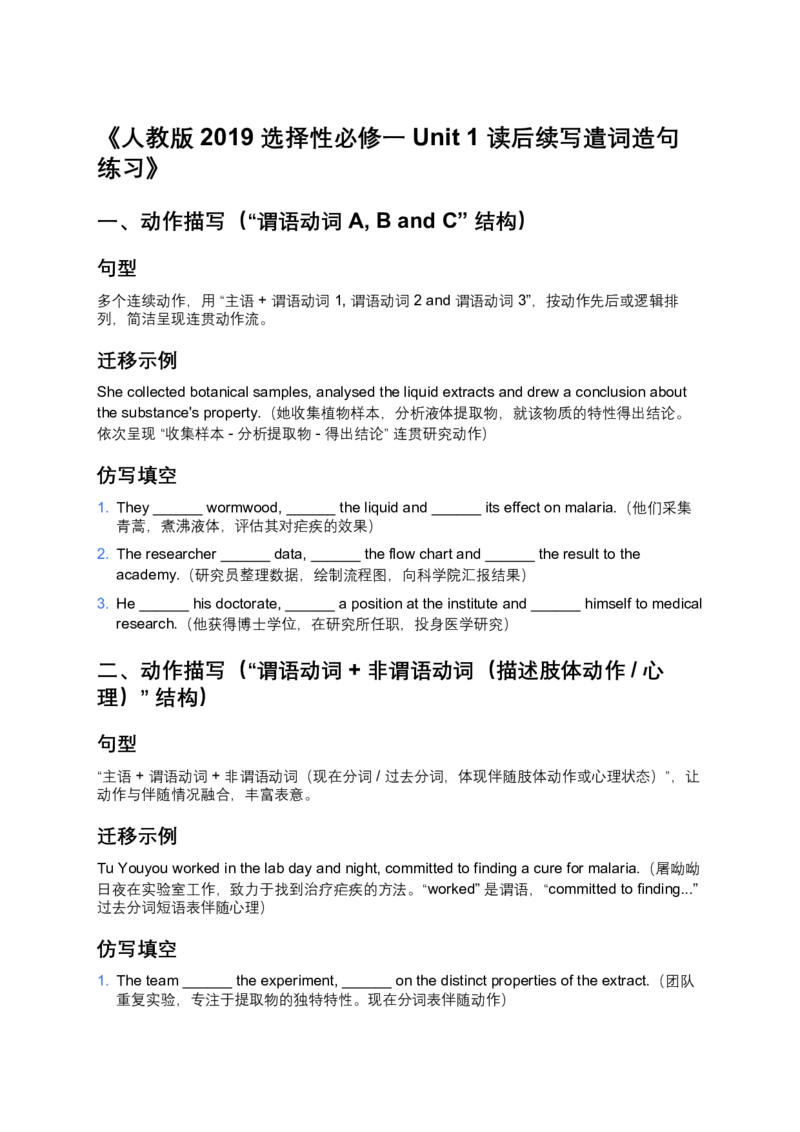
《人教版 2019 选择性必修一 Unit 1 读后续写遣词造句
练习》
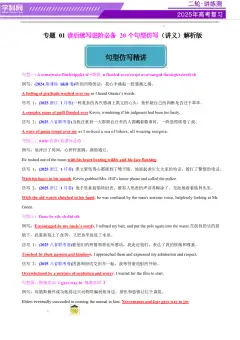
一、动作描写(“谓语动词 A, B and C” 结构)
句型
多个连续动作,用 “主语 + 谓语动词 1, 谓语动词 2 and 谓语动词 3”,按动作先后或逻辑排
列,简洁呈现连贯动作流。
迁移示例
She collected botanical samples, analysed the liquid extracts and drew a conclusion about
the substance's property.(她收集植物样本,分析液体提取物,就该物质的特性得出结论。
依次呈现 “收集样本 - 分析提取物 - 得出结论” 连贯研究动作)
仿写填空
1. They ______ wormwood, ______ the liquid and ______ its effect on malaria.(他们采集
青蒿,煮沸液体,评估其对疟疾的效果)
2. The researcher ______ data, ______ the flow chart and ______ the result to the
academy.(研究员整理数据,绘制流程图,向科学院汇报结果)
3. He ______ his doctorate, ______ a position at the institute and ______ himself to medical
research.(他获得博士学位,在研究所任职,投身医学研究)
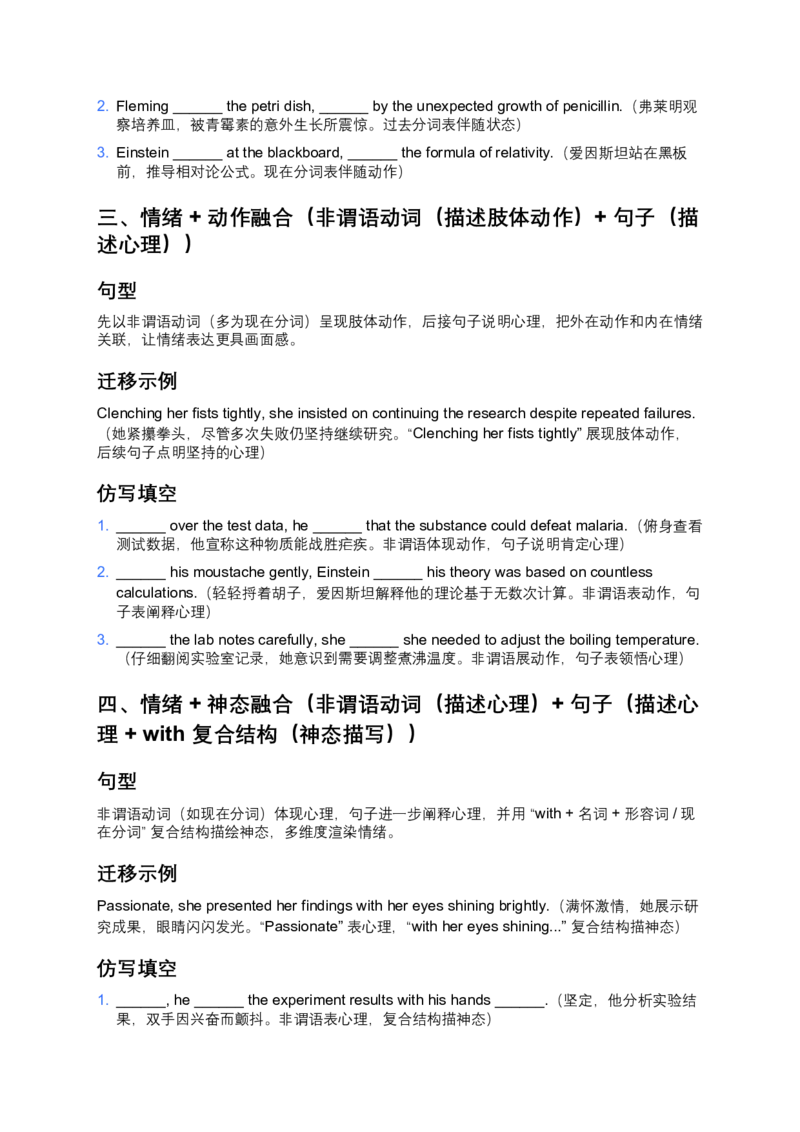
二、动作描写(“谓语动词 + 非谓语动词(描述肢体动作 / 心
理)” 结构)
句型
“主语 + 谓语动词 + 非谓语动词(现在分词 / 过去分词,体现伴随肢体动作或心理状态)”,让
动作与伴随情况融合,丰富表意。
迁移示例
Tu Youyou worked in the lab day and night, committed to finding a cure for malaria.(屠呦呦
日夜在实验室工作,致力于找到治疗疟疾的方法。“worked” 是谓语,“committed to finding...”
过去分词短语表伴随心理)
仿写填空
1. The team ______ the experiment, ______ on the distinct properties of the extract.(团队
重复实验,专注于提取物的独特特性。现在分词表伴随动作)
2. Fleming ______ the petri dish, ______ by the unexpected growth of penicillin.(弗莱明观
察培养皿,被青霉素的意外生长所震惊。过去分词表伴随状态)
3. Einstein ______ at the blackboard, ______ the formula of relativity.(爱因斯坦站在黑板
前,推导相对论公式。现在分词表伴随动作)
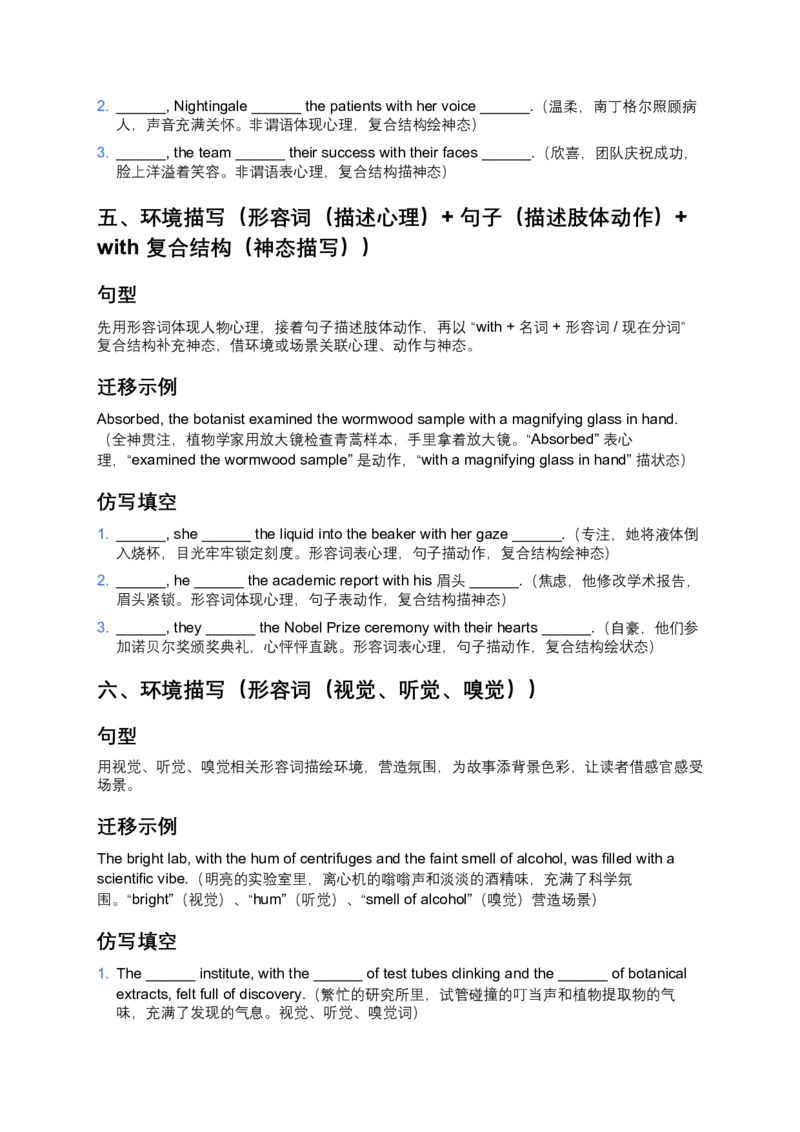
三、情绪 + 动作融合(非谓语动词(描述肢体动作)+ 句子(描
述心理))
句型
先以非谓语动词(多为现在分词)呈现肢体动作,后接句子说明心理,把外在动作和内在情绪
关联,让情绪表达更具画面感。
迁移示例
Clenching her fists tightly, she insisted on continuing the research despite repeated failures.
(她紧攥拳头,尽管多次失败仍坚持继续研究。“Clenching her fists tightly” 展现肢体动作,
后续句子点明坚持的心理)
仿写填空
1. ______ over the test data, he ______ that the substance could defeat malaria.(俯身查看
测试数据,他宣称这种物质能战胜疟疾。非谓语体现动作,句子说明肯定心理)
2. ______ his moustache gently, Einstein ______ his theory was based on countless
calculations.(轻轻捋着胡子,爱因斯坦解释他的理论基于无数次计算。非谓语表动作,句
子表阐释心理)
3. ______ the lab notes carefully, she ______ she needed to adjust the boiling temperature.
(仔细翻阅实验室记录,她意识到需要调整煮沸温度。非谓语展动作,句子表领悟心理)
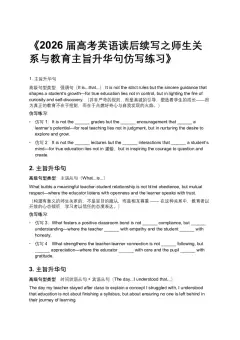
四、情绪 + 神态融合(非谓语动词(描述心理)+ 句子(描述心
理 + with 复合结构(神态描写))
句型
非谓语动词(如现在分词)体现心理,句子进一步阐释心理,并用 “with + 名词 + 形容词 / 现
在分词” 复合结构描绘神态,多维度渲染情绪。
迁移示例
Passionate, she presented her findings with her eyes shining brightly.(满怀激情,她展示研
究成果,眼睛闪闪发光。“Passionate” 表心理,“with her eyes shining...” 复合结构描神态)
仿写填空
1. ______, he ______ the experiment results with his hands ______.(坚定,他分析实验结
果,双手因兴奋而颤抖。非谓语表心理,复合结构描神态)
2. ______, Nightingale ______ the patients with her voice ______.(温柔,南丁格尔照顾病
人,声音充满关怀。非谓语体现心理,复合结构绘神态)
3. ______, the team ______ their success with their faces ______.(欣喜,团队庆祝成功,
脸上洋溢着笑容。非谓语表心理,复合结构描神态)
五、环境描写(形容词(描述心理)+ 句子(描述肢体动作)+
with 复合结构(神态描写))
句型
先用形容词体现人物心理,接着句子描述肢体动作,再以 “with + 名词 + 形容词 / 现在分词”
复合结构补充神态,借环境或场景关联心理、动作与神态。
迁移示例
Absorbed, the botanist examined the wormwood sample with a magnifying glass in hand.
(全神贯注,植物学家用放大镜检查青蒿样本,手里拿着放大镜。“Absorbed” 表心
理,“examined the wormwood sample” 是动作,“with a magnifying glass in hand” 描状态)
仿写填空
1. ______, she ______ the liquid into the beaker with her gaze ______.(专注,她将液体倒
入烧杯,目光牢牢锁定刻度。形容词表心理,句子描动作,复合结构绘神态)
2. ______, he ______ the academic report with his 眉头 ______.(焦虑,他修改学术报告,
眉头紧锁。形容词体现心理,句子表动作,复合结构描神态)
3. ______, they ______ the Nobel Prize ceremony with their hearts ______.(自豪,他们参
加诺贝尔奖颁奖典礼,心怦怦直跳。形容词表心理,句子描动作,复合结构绘状态)
六、环境描写(形容词(视觉、听觉、嗅觉))
句型
用视觉、听觉、嗅觉相关形容词描绘环境,营造氛围,为故事添背景色彩,让读者借感官感受
场景。
迁移示例
The bright lab, with the hum of centrifuges and the faint smell of alcohol, was filled with a
scientific vibe.(明亮的实验室里,离心机的嗡嗡声和淡淡的酒精味,充满了科学氛
围。“bright”(视觉)、“hum”(听觉)、“smell of alcohol”(嗅觉)营造场景)
仿写填空
1. The ______ institute, with the ______ of test tubes clinking and the ______ of botanical
extracts, felt full of discovery.(繁忙的研究所里,试管碰撞的叮当声和植物提取物的气
味,充满了发现的气息。视觉、听觉、嗅觉词)
2. The ______ lecture hall, with the ______ of the professor's voice and the ______ of chalk
on the blackboard, was focused on physics.(安静的演讲厅里,教授的讲课声和粉笔在黑
板上的刮擦声,专注于物理学。感官词)
3. The ______ field hospital, with the ______ of monitors and the ______ of disinfectant,
showed the urgency of saving lives.(混乱的战地医院里,监护仪的滴答声和消毒剂的味
道,体现了救人的紧迫性。感官词)
七、公用高级句式(倒装结构)
句型
把谓语或谓语部分提前,如 “副词 / 介词短语 + 谓语 + 主语”,突出强调,让句子有变化、更
紧凑,增强表达力度。
迁移示例
Only after hundreds of boils did they obtain the effective artemisinin extract.(只有经过数百
次煮沸,他们才获得有效的青蒿素提取物。“Only after hundreds of boils” 提前,引发倒装,
强调过程艰难)
仿写填空
1. ______ did the world acknowledge the significance of her research on malaria.(直到她
获得诺贝尔奖,世界才认可她在疟疾研究上的意义。倒装强调时间)
2. ______ can we understand the extraordinary efforts behind the discovery of penicillin.
(只有通过分析历史记录,我们才能理解青霉素发现背后的非凡努力。倒装强调方式)
3. ______ came the moment when Einstein's theory of relativity was proven correct.(随着
日食观测的成功,爱因斯坦相对论被证实正确的时刻到来了。倒装突出时刻)
八、巧用修辞手法(比喻)
句型
用 “像…… 一样”(like)、“仿佛……”(as if)等,把事物比作另一类事物,让描述生动形象、
具体可感。
迁移示例
Artemisinin is like a sharp sword, cutting through the threat of malaria.(青蒿素像一把利剑,
斩断疟疾的威胁。把青蒿素比作利剑,突出其治疗作用)
仿写填空
1. The scientific method is ______ that guides researchers through the darkness of
ignorance.(科学方法像一盏灯,指引研究者穿过无知的黑暗。比喻体现方法的指引作用)
2. Newton's theory of gravity was ______ that connected the fall of an apple to the
movement of stars.(牛顿的引力理论像一座桥梁,将苹果的下落与恒星的运动联系起来。
比喻体现理论的连接作用)
3. The laboratory notebook was ______ that recorded every step of the extraordinary
discovery.(实验室记录像一本日记,记录了这一非凡发现的每一步。比喻体现记录的完整
性)
九、巧用修辞手法(拟人)
句型
把事物或抽象概念当作人,赋予人的动作、情感、神态等,让描写鲜活有趣,拉近与读者距
离。
迁移示例
Wormwood has silently waited for centuries, finally revealing its anti-malaria property to
human beings.(青蒿默默等待了几个世纪,终于向人类揭示了它的抗疟特
性。“waited”“revealing” 赋予青蒿人的动作)
仿写填空
1. The formula on the blackboard ______, guiding the students to understand the laws of
nature.(黑板上的公式低语着,引导学生理解自然规律。拟人赋予公式 “低语” 动作)
2. Time ______ in the lab, witnessing countless failures and occasional breakthroughs.(时
间在实验室里漫步,见证了无数失败和偶尔的突破。拟人赋予时间 “漫步”“见证” 动作)
3. Penicillin ______ to Fleming, showing itself as a powerful weapon against bacteria.(青霉
素向弗莱明招手,展现自己作为对抗细菌的强大武器。拟人赋予青霉素 “招手” 动作)
十、巧用修辞手法(夸张)
句型
故意夸大或缩小事物特征、程度,突出特点,增强感染力,让读者印象深刻。
迁移示例
His passion for science was so intense that it seemed to burn brighter than the Bunsen
burner in the lab.(他对科学的热情如此强烈,仿佛比实验室里的本生灯还要明亮。夸张突出
热情的程度)
仿写填空
1. The number of experiments she conducted was so large that ______ the entire institute.
(她做的实验数量如此之多,仿佛堆满了整个研究所。夸张突出数量之多)
2. The impact of Einstein's theory was so great that ______ overnight.(爱因斯坦理论的影
响如此之大,仿佛一夜之间改变了世界的思维方式。夸张突出影响之深)
3. Her patience in extracting the substance was so extraordinary that ______ for decades
without rest.(她提取这种物质的耐心如此非凡,仿佛能连续几十年不休息地工作。夸张突
出耐心程度)